Author: immoinvadmin

  • Preventing heat islands in the planning stage

    Preventing heat islands in the planning stage

    Climate change is causing problems for cities, especially in summer. “Heat island” has become a ubiquitous topic. However, those who plan larger neighbourhoods can avoid heat accumulation. The decisive factors here are the setting of the buildings in line with their surroundings, the choice of materials for façades and outdoor areas, green spaces and clever shading. The effects of these factors should actually be taken into account at an early planning stage. For this, however, architects would have to consult computer models that can calculate the impact of the decisive factors for a specific location. The problem with the existing models is that the calculation is time-consuming and costly. For this reason, they are usually not used at an early stage. The Lucerne University of Applied Sciences and Arts (HSLU) has now developed a new interactive neighbourhood climate modelling (QKM), which is limited to phase-specific information and delivers results in seconds. The project was financed by the Infinite Elements Foundation and the HSLU.

    Things have to move fast in the planning phase
    For large-scale construction projects, architectural firms usually apply in an elaborate competition procedure under high time pressure. “They have to consider a multitude of requirements in their design, one of which is the microclimate,” explains simulation expert Prof. Markus Koschenz from the Lucerne University of Applied Sciences and Arts. High costs and two-day waiting times would be out of the question for the architects in this creative work phase. But this is exactly what they would have had to accept up to now if they wanted to include the complex calculations. So what happens if you win a competition project and only then realise that the building placement was chosen in an unfortunate way? After all, the jury has decided in favour of the proposed solution; fundamental adjustments are no longer envisaged in the phase after the jury’s decision – even if the subsequent calculation of the microclimate would suggest this. In short, the dilemma cannot be solved this way. Now, warmer summer temperatures are already causing problems for people today. Warming in the coming years and decades will increase, which can be life-threatening, especially for older people. And buildings that are being planned now will still be standing in fifty years. Ignoring all this in the planning process seems negligent.

    Results in seconds
    “What is needed is an instrument for calculating the microclimate that is cheaper and, above all, can deliver results very quickly,” says Koschenz. His core team with Andrii Zakovorotnyi, Reto Marek and an external Revit specialist developed this instrument at the Lucerne University of Applied Sciences and Arts. He explains: “Existing methods use generally applicable computational fluid dynamics (CFD) instruments. These instruments can be used by specialists to develop machines, investigate flows on aircraft or determine the microclimate in neighbourhoods. They are powerful but also correspondingly complex. Our model concentrates on the aspect of the neighbourhood climate and we work with algorithms that calculate quickly,” says Koschenz, explaining the striking difference in calculation speed. It takes seconds or at most a few minutes to calculate the effects of a change. The tool can be used by the planners themselves from the first step in the planning process. With little effort, for example, one can compare two variants of façade design or the planting of trees in an inner courtyard. And not just for one summer day, but for an entire summer period.

    Checking the model with measurements
    The information on the planned buildings, their position, the materials used or the type and position of green spaces and trees is obtained by the interactive neighbourhood climate modelling from the planning tool Revit, which is already used in architecture and landscape planning offices. From this, the physical model calculates the effect of radiation, shade, heat storage properties of materials, air flow, vegetation and time of day on the neighbourhood climate. Images with colour scales show the results in an intuitively understandable way.

    Koschenz’s team proved that the model works correctly with measurements in the Suurstoffi district in Rotkreuz and also compared the results with those of existing commercial software. Koschenz is extremely satisfied with the results: “We can say that the agreement with both the measurements and the results of other software was high. This means that our tool is much faster with the same accuracy.

  • Pension funds: Out of bounds with real estate

    Pension funds: Out of bounds with real estate

    Everything is relative: for pension fund managers, the quote attributed to Nobel Prize winner Albert Einstein may have a special ring at the moment. Their investments in shares and bonds have lost a lot of value in the past year. Positions in real estate, on the other hand, suffered less. As a result, these have – relatively speaking – often gained significantly in weight in the investment portfolio of the pension funds. This has not only theoretical but also tangible consequences.

    At the end of last year, market observers warned that a quarter of the pension funds in Switzerland would have to sell or devalue real estate investments because their weight exceeded the requirements of the Ordinance on Retirement, Survivors’ and Disability Pension Plans (BVV2). The ordinances prescribe a fixed quota for real estate investments that may not exceed 30 per cent.

    “A few pension funds had bandwidth violations
    Heinz Rothacher, CEO of the well-known St.Gallen pension fund consulting firm Complementa, now tells finews.ch that the quota violations at the end of 2022 turned out to be even more extensive than feared. “More than a third of the pension funds have reported a real estate quota of over 30 percent,” says the market expert (see chart below). And he notes, “There are a few pension funds that had a bandwidth violation due to the increase in ratios.”

    In fact, the OOB2 ordinance allows certain bandwidths in the portfolio shares according to which the pension funds can design their investment strategy. But even this leeway has limits. When the edge of the bands is touched, there are therefore two tactics: Sit it out or correct it.

    Maintain quota for now
    The pension funds have apparently opted for the former as a first step. “Since it is a passive violation of the bands, they tolerated it and decided to maintain the existing quota,” Rothacher reports. The same applies to violations of the BVV2 limit of 30 percent, he adds.

    Complementa has asked a good 150 decision-makers in occupational pension schemes specifically about the problem; the CEO therefore knows pretty well in which direction the industry is heading. As of the end of 2022, the real estate ratio averaged 24.1 percent, 3 percentage points higher than the previous year.

    The wait-and-see approach has not worked badly for the pension funds so far. The real estate quota has been reduced again this year due to the positive performance of the stock markets, Rothacher reports. As a result, “the breach of the bandwidths has been partially remedied.”

    Current surveys by Credit Suisse show that the Swiss pension funds generated an average investment return of 3.86 percent by the end of last June; the major bank UBS comes to an average performance after deduction of fees of 3.51 percent in its measurements. This means that the funds have already exceeded the statutory minimum distribution of 1 per cent per year.

    The crux with illiquidity
    Nevertheless, the problem has not disappeared, and the pension funds must be concerned about keeping within the defined bandwidths in the medium term due to their investment strategy. Another sticking point arises: Due to the illiquidity of the asset class – for example, directly held properties or investment foundations – it is difficult to adjust the ratio in the short term.

    Accordingly, the funds have to tackle where liquidity is most likely to be available: in listed real estate investments. As Rothacher from Complementa reports, there is now movement to be seen there. “37 percent of the funds that participated in the survey are planning to reduce listed real estate funds,” explains the financial professional. As many as 11 per cent of the respondents are also thinking about reducing non-listed vessels.

    Redemption fees increased
    As it turns out, the prices of Swiss real estate funds have already fallen sharply in 2022. The relevant SIX Real Estate Funds Broad Index (SWIIT) lost more than 15 percent of its value last year. This year, the counter stagnated. Meanwhile, a lower demand for additional investments is noticeable among the non-listed investment groups, explains Rothacher.

    Various real estate funds have also received significantly fewer commitments than planned for capital increases. “Not long ago, oversubscriptions were the norm,” he recalls.

    The Complementa CEO does not expect major sales of such vehicles. On the other hand, he knows of individual investment groups that have already increased redemption fees this year – also with the reference to wanting to protect existing investors. This can have a deterrent effect on sellers. “The redemption fees for the various investment vehicles vary greatly and can sometimes account for a large part of an annual performance,” Rothacher knows.

    When do appraisers resort to red pencils?
    But even those who stubbornly hold on to their real estate positions may have to let down their guard. This is the case if there are valuation corrections because the real estate appraisers would be forced to raise the discount rates due to further interest rate steps.

    At least on the Swiss market, the current low level of construction activity, immigration and rising rents make such measures appear premature. However, further interest rate hikes by the Swiss National Bank could still lead the appraisers to apply the red pencil.

    Local pension funds often have a pronounced “home bias” in their real estate investments and would probably be sensitive to a decline in valuations.

  • BIM2SAP: Why a door is not just a door

    BIM2SAP: Why a door is not just a door

    Building Information Modelling (BIM) has established itself over the last few years as an effective method for the planning, execution and management of construction projects. With the understanding of model-based collaboration, the connections and links to other systems are increasingly expanding. This is because experience with BIM has in the meantime shown many property owners that the need for correct, up-to-date and easily accessible data by no means ends with the completion of a building.

    “On the contrary,” says Patrick Pick, Head of Service Unit BIM/LCDM at pom+. “The handling of data only becomes really demanding during operation. That is, when I want to use it for specific applications within the framework of efficient property management.” Here, the flawless transfer of data from the BIM model into the operational and property management systems is of particular relevance, says the trained architect and project manager.

    Optimising building management
    It is not uncommon for BIM to come up against a comprehensive, complex system architecture – such as SAP. The ERP software is used by many companies as a universal tool to link systems, applications and products and thus connect different business sectors and processes. This is particularly exciting for companies that own and manage their own buildings. Even if real estate is often not part of the core business, as is the case with a hospital or airport, for example, it is essential for the security and success of a company, such as pension funds or banks. For this reason, it is no longer just real estate specialists in facility, property and asset management who have been making their claim to data from real estate management for a long time, but also the finance, controlling, sustainability or IT departments.

    SAP has developed a special real estate module – SAP RE-FX – for this purpose. It stands for ‘Flexible Real Estate Management’ and enables a holistic view of the building from different perspectives: “On the one hand, information on the structure of the building, such as office or floor space, is displayed in the architectural view. On the other hand, the usage view contains information on typical business cases in the area of leasing, such as rental agreements, conditions and contractual partners,” explains Stefan Pallier, Consultant Facility & Project Management at Novo. This enables SAP RE-FX to seamlessly integrate the real estate data into the SAP core and to link different SAP modules.

    Reduction to the essentials
    Against this background, the combination of BIM and SAP provides considerable added value. This is because a data-driven planning method meets an application for information management in building operations. BIM thus generates the data, while SAP provides a platform for its use and maintenance. For this, it is crucial that the data can be transferred from project planning to operation with as little loss as possible. “The fragmentation of the processes usually turns out to be the biggest challenge. Project management is not based on object management. Instead, the planning and construction phases are treated as separate units,” says Patrick Pick.

    This makes the integration of BIM and SAP complex. It requires a correspondingly careful, expert transfer, transformation and structuring of the data from the BIM model in the target system. Patrick Pick likes to refer to this as ‘data-to-target’. In this approach, the data from the BIM model is analysed and reduced to the necessary information that is relevant for the SAP system. This process involves identifying the relevant data requirements, mapping this data to the appropriate fields and structures in SAP, and converting and transferring the data to the SAP system.

    Stefan Pallier adds with an example: “In the BIM model, 120 attributes must be defined so that a single door is ordered correctly. In building operation, however, we are only interested in a part of it – for example, whether it is a revolving door, sliding door, fire door or escape route doors. So we need certain information about it in SAP, for example about the locking mechanism, smoke protection or the legal maintenance standard.”

    If the relevant attributes are integrated correctly in SAP, this makes technically and commercially efficient property management possible. Before the actual data mapping, the necessary interfaces must be prepared and the responsibilities for individual data records clearly defined.

  • New Swiss solar cell production in the USA

    New Swiss solar cell production in the USA

    By expanding its business strategy to include solar cells “Made in USA”, Meyer Burger is responding to market requirements resulting from new regulations in the United States: Recently, the US Treasury Department announced guidelines for qualifying “domestic content”. These allow for an additional ten percent bonus on the Investment Tax Credit (ITC) for US solar projects. “Meyer Burger strongly believes that domestically manufactured solar cells bring additional benefits to our customers, both in terms of using premium high performance ‘Made in USA’ solar products and qualifying for additional tax credits,” says Gunter Erfurt, CEO of Meyer Burger. With an initial production volume of two gigawatts of solar cells and modules annually in the US, Meyer Burger has the opportunity to receive tax credits of up to USD 1.4 billion from the start of production in 2024 until the end of 2032.

    As part of the decision to locate the solar cell plant in the USA, the company will receive another substantial financial package in addition to the IRA tax incentives: The city of Colorado Springs and the US state of Colorado are supporting the investment with almost USD 90 million, mainly in the form of tax credits, direct support and discounted electricity and water rates. In addition, upfront payments from module purchasers and a loan from the US Department of Energy (DoE) totalling more than USD 300 million are foreseeable. These are expected to help finance Meyer Burger’s growth in the United States.

    “Our presence in the US will allow us to reach existing and future customers faster. I would like to sincerely thank our partners in the Biden administration and in Colorado as well as our off-take partners DESRI, Ingka and BayWa for their support in expanding our US activities,” says Gunter Erfurt. He adds: “Meyer Burger is currently working on further multi-gigawatt offtake contracts in the US with new customers. We are already exploring opportunities to build further production capacity for solar cells and modules in the US”.

    The accelerated production schedule in the US is made possible by rerouting production machinery originally intended for the previously announced expansion of the solar cell factory at the Thalheim site in Bitterfeld-Wolfen, Germany. This equipment will now be installed at the Colorado Springs site in order to meet the planned completion date of the cell factory in 2024.

    As part of Meyer Burger’s successful application for the EU Innovation Fund, a multi-gigawatt expansion in Thalheim is planned at a later date. A prerequisite for such investments are favourable market conditions and secure, fair competitive conditions for European solar manufacturers in the EU.

    “Meyer Burger is a driving force for the expansion of solar energy in the US as well as in Germany and Europe,” says Erfurt. “We are pleased to lay the foundation for a transatlantic solar energy partnership and to continue to expand our production in Germany and the European Union.” In Germany, the company will therefore participate in the German government’s recently announced expression of interest in a PV industry renaissance.

  • New professions through the circular economy?

    New professions through the circular economy?

    Prof. Dr. Stephen Wittkopf, how do you find a flat that is built according to the principles of the circular economy? That would be very difficult at the moment. In Switzerland, there are only a few residential buildings that have been built according to the principles of the circular economy, in Winterthur for example. In industry and office buildings, people are already a bit further ahead.

    The idea of reuse is very plausible. Why is it only being implemented hesitantly? Because not everything that is built today is suitable for reuse. In many buildings there are so-called composite materials. This means that different materials such as concrete, wood or steel have been glued together. You can’t just separate them. This creates an enormous amount of construction waste. Of all the material that is imported into Switzerland, i.e. clothes, computers, food and other commodities, by far the largest part is destined for the construction sector. That is, for roads, bridges and buildings. All of this is enormously weight-intensive. The construction sector therefore clearly has the greatest potential for saving material and energy through reuse.

    Is the circular economy only about reusing, or also about rebuilding or continuing to build? The concept of the circular economy can indeed be defined so broadly that it includes all reuse. The question of how to preserve and repurpose existing buildings is the first level of the circular economy. The second level is the reuse of building components and the third level is about recycling and reprocessing materials.

    How would new buildings have to be designed so that the components can be reused decades later? The materials must be separable and the components repairable. This means that the purest possible materials are central, which are not glued together but provide stability with plugs and screws. Repairability is important for the longevity of the individual components. It must not be the case that you have to throw away an entire window just because the window handle no longer works. And last but not least, meticulous documentation is important so that it can be traced later which materials are where. At the moment, this is not yet sufficiently recorded.

    Components are continuously being developed; my grandmother had front windows that could be removed, today there is triple glazing. Is it realistic to reuse them in 50 years? Many products are so good today that a noticeable improvement can only be achieved with much greater effort. And you don’t have to reuse components one to one. In the case of windows, there is a good example from the canton of Zurich: older, double-glazed windows were supplemented with a third glazing; as a result, the improved windows could be reused in a new building.

    That sounds as if the reuse of materials completely changes the work for architects. Yes, it requires a radical change. Architects’ work no longer starts on a greenfield site. They have to incorporate existing materials and the availability of products into their concept. But this paradigm shift does not have to become a design or economic obstacle; it can lead to a new language of form.

    So the client must also be on board. Exactly, they play at least as important a role. The client can shape the brief differently, and specify, for example, that only second-hand materials are to be sought and that planning is to be based on this. It will certainly be a complex puzzle – but other industries also work with complex and flexible supply chains. The construction industry is lagging behind.

    What is the situation in terms of profitability? Can the circular economy in construction be profitable? It can, but not without effort and not overnight. It needs new business models, but also financial support, because it is currently a niche market. However, I am firmly convinced that this will change.

    And what might the new business models look like? Maybe one day we will rent recyclable materials – windows, doors, wood or concrete – instead of buying them. Or we design a new building from the outset as a material store for later buildings. This results in a completely new basis for calculation, because the material costs do not have to be amortised in their entirety. The materials could be traded on material exchanges – by the way, this is already done in other countries like Denmark. Maybe even new professions will emerge, such as component hunters.

    That sounds exciting. So it changes the whole concept of new buildings? Definitely. If the future of a building is taken into account, it will be built in such a way that it can be converted with as little effort as possible. Society is changing, and with it the needs for living space. A neighbourhood that was once designed for families may no longer fit the needs of the now older generation decades later. If the family flats can be converted into smaller ones with relatively little effort, money, materials and energy can be saved.

    In which areas of the construction industry would you describe Switzerland as progressive? Switzerland is already quite advanced in the reuse of concrete. Today, natural stone or gravel is replaced by processed construction waste that would otherwise end up in landfill. In addition to reuse, this has the advantage of saving landfill fees. In large new construction projects, building concepts are also becoming more and more flexible. In general, I observe a growing interest in circular economy among building owners. In Switzerland, the canton of Zurich has a pioneering role. And we, as a university, are of course researching the topic and have the task of sensitising a young generation to the issue by giving high priority to used materials in our training and further education courses.

  • “co-operate” – a model for climate-friendly construction

    “co-operate” – a model for climate-friendly construction

    As far as the sparing use of resources and the reduction of CO2 emissions are concerned, the campus that is taking shape on the Empa site in Dübendorf should certainly become a model student – from the top to the bottom, from the roofs to a depth of 100 metres, where the earth probes of a unique experimental seasonal energy storage system end. In summer, these “tubes” will store the waste heat from, for example, the refrigeration machines, ventilation systems and laboratory equipment, and then use it in winter for heating or for the production of hot water. The goal: to reduce the CO2 emissions of the buildings on the entire campus to a minimum and at the same time explore this innovative technology for a sustainable energy future.

    Minimising greenhouse gas emissions: This aspiration also shapes the constructions of the new campus. The three-storey building to the right of the entrance is a unique “wood-concrete car park” whose ceilings are a sophisticated construction of spruce beams and slabs with concrete overlay. According to the construction company Implenia, this hybrid construction method made it possible to reduce the thickness of the concrete layers to about one third. A significant saving was made on the “climate polluter” cement: around 9,300 m2 of concrete ribbed ceilings were replaced with wooden beam ceilings – also a contribution to the current trend of replacing concrete, where possible and sensible, largely with constructions made of wood.

    According to Kevin Olas, Head of Real Estate at Empa, one of the challenging aspects of this project was the cleverly integrated installation of lighting, electrical lines and waste water pipes, so as not to detract from the aesthetics of this sophisticated hybrid construction. In addition, the planning also had to take future aspects into account: With a view to climate change, the multi-storey car park was planned as a modular construction made of demountable prefabricated parts – with a view to a more distant future in which individual mobility may play a lesser role than it does today. Then parts of the building could also be converted into workshops or for other purposes.

    Urine as raw material for fertiliser
    In this future, environmentally friendly recycling will also determine building: Not only steel, concrete or wooden elements can be recycled in a climate-friendly way, but also human “raw materials”. Take urine, for example: in the large laboratory building at the centre of “co-operate”, “NoMix” toilets have been installed, which experts from the Eawag Water Research Institute have developed over the past few years. Without changing the usual use, they separate human urine from the so-called black water from faeces, flushing water and toilet paper.

    Because urine contains valuable nutrients such as nitrogen, phosphorus and potassium, it can be used to produce fertiliser for agriculture. In a process specially developed by Eawag, the raw material is first stabilised in the basement of the NEST building using a biological process, thus losing its strong odour. An activated carbon filter removes all drug residues before the liquid is finally evaporated – to produce a high-quality fertiliser called “Aurin”, which is marketed by the Eawag spin-off Vuna GmbH. 1000 litres of urine produce 100 litres of this fertiliser, which since 2018 has also been approved by the Federal Office for Agriculture for use on edible plants.

    Many mosaic stones for a good carbon footprint

    In addition to the inconspicuous urine collection system, many obvious details document the campus’ claim to be a signpost for environmentally friendly construction. Photovoltaic installations will massively increase the campus’ own electricity production. And on more than 14,000 m2 of floor space, people move on recycled asphalt with a high proportion of 80 percent recycled material in the base layer and 20 percent in the thin surface layer.

    At the same time, the landscape architects have freely dispensed with asphalt in order to design close to nature: Previously sealed areas are “liberated”, such as Ludwig-Tetmajer-Strasse on the Empa site. “This ‘car park asphalt desert’ will become a green and shady zone,” explains Kevin Olas. And behind the large new buildings, biodiversity is also being promoted with diverse plants and trees – thanks to selected heat-resistant species that will also feel at home in future climate conditions.

  • SBV erwartet das Zinserhöhung ein Prozent Umsatz jährlich kostet

    SBV erwartet das Zinserhöhung ein Prozent Umsatz jährlich kostet

    Am 22. Juni 2023 hat die Schweizerische Nationalbank (SNB) den Leitzins auf 1.75 Prozent erhöht. Damit nicht genug, die SNB dürfte den Zins im Laufe des Jahres weiter erhöhen, weil sich die Inflation hartnäckiger hält als bisher angenommen. Die Inflation wird in der nächsten Zeit etwa von den steigenden Wohnungsmietpreisen und höheren Stromkosten getrieben. Sowohl im 2023, aber auch in den nächsten beiden Jahren dürfte die Inflation gemäss der SNB-​eigenen Prognose bei etwas über 2 Prozent liegen, was über dem Zielkorridor der SNB liegt.

    Mittels fünf Schritten sind die Zinsen von -0.75 auf nun 1.75 Prozent gestiegen. Weitere Erhöhungen bis Jahresende sind absehbar. Da sich die Schweizer Konjunktur dieses Jahr abkühlt und die Wirtschaft nur noch schwach wächst, darf die SNB jedoch nicht über das eigentliche Ziel hinausschiessen. Daher sei an dieser Stelle davon ausgegangen, dass der Zins bis zum Jahresende noch zwei Mal um jeweils 0.25 Prozentpunkte angehoben wird. Es wird ausserdem angenommen, dass ab 2024 keine weiteren Schritte folgen, der Zins also mittelfristig bei 2.25 Prozent stabil bleibt.

    Bis zu 1.4% tieferes Umsatzwachstum im Jahr
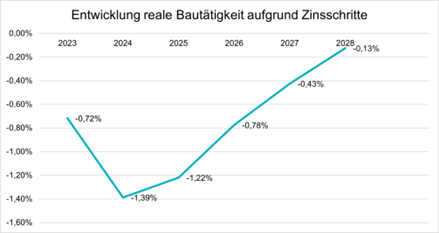
    Ein Rechenmodell des Schweizerischen Baumeisterverbands SBV zeigt, wie stark ein Zinsanstieg die Bautätigkeit negativ beeinflusst. Die Beeinträchtigung dehnt sich langsam und über die Zeit aus. In den ersten beiden Jahren wird das Umsatzwachstum am stärksten beeinträchtigt, aber selbst im fünften Jahr nach den Zinserhöhungen sind noch leichte, negative Auswirkungen spürbar. Die Aussagen beschreiben, wie sich der Umsatz entwickelt im Vergleich zu einer Welt, wenn die Zinsen nicht gestiegen wären.

    In den nächsten fünf Jahren dürfte der Umsatz im Bauhauptgewerbe deswegen kumuliert um 4.65% langsamer wachsen als wenn die Zinsen nicht gestiegen wären. Die grössten realen Umsatzeinbussen sind in den Jahren 2024 (-1.39%) und 2025 (-1.22%) zu erwarten.

    Positive Gegenkräfte könnten Umsatz wachsen lassen
    Die anhaltend starke Zuwanderung, der Nachholbedarf im Tiefbau sowie die Unterstützungsgelder für klimafreundliche Umbauten sind Faktoren, welche den Einbussen durch die Zinsen entgegenstehen und zumindest mittelfristig den Umsatz doch noch positiv wachsen lassen könnten.

    Insgesamt lässt sich also festhalten, dass sich die Leitzinserhöhungen auf den Geschäftsgang der Baufirmen auswirken, auch wenn die Auswirkungen insgesamt begrenzt sind. Das Bauhauptgewerbe bleibt unabhängig vom Zinsniveau eine wichtige Stütze der Schweizer Wirtschaft.

  • Price correction in Swiss real estate is gaining momentum

    Price correction in Swiss real estate is gaining momentum

    Current interest rate situation in Switzerland
    After more than seven years, the Swiss Confederation wants to end the period of low interest rates on September 21st. An increase of half a percentage point to 0.25 is planned. In scenarios that assume further inflation, a 0.75 percent increase to 0.5 percent is planned.

    As early as mid-June, the SNB raised interest rates by half a percentage point to minus 0.25 percent as a first step. The Governing Board weighted the dangers of an uncontrollable fall in prices more than that of a weakening of the export economy. SNB President Thomas Jordan stated: “The price stability goal is absolutely central to us.”

    Real estate prices have plummeted in some cases
    What promises relaxation from an economic point of view is being observed critically by real estate buyers. Because even before the National Bank’s decision, the interest rates for fixed-rate mortgages had risen, in some cases significantly. At the same time, real estate prices fell in certain regions.

    For example, the residential real estate price index of the Federal Statistical Office shows that the value of real estate fell by 0.4 percent in the first quarter of 2022, but partially recovered in the second quarter. There were sometimes significant differences depending on the region and type of property. Owners of smaller single-family homes in smaller towns such as Glarus, Davos or Langenthal were hardest hit. Here the discounts were recently 4.2 percent, in rural regions such as Dissentis and Maggia 1.7 percent and in larger cities such as Winterthur, St. Gallen and Lugano 1.4 percent. Losses in condominiums were even greater. Losses of 3.3 percent were recorded in medium-sized cities and 3.2 percent in rural areas.

    Consequences of the development for real estate buyers and owners
    Due to falling prices, there are already regionally noticeable declines in demand, with places in less good locations being particularly affected. For a long time it was also possible to achieve high prices here with relatively little (marketing) effort. That should change now. The following scenarios are particularly conceivable.

    developments on the buyer side
    As interest rates rise, loans also become more expensive. This increases the monthly burden for all those who use financing to buy real estate. Two problems arise from this.

    First of all, it will no longer be possible for everyone who wants to buy to get financing because they cannot bear the monthly burden. Accordingly, the demand will decrease. While this is not currently a problem due to the excess demand, it could become one if follow-up financing expires in 10 to 15 years and not all buyers can afford further financing at less favorable conditions.

    The second problem is closely related to the first. If follow-up financing can no longer be served and properties have to be sold, more properties come onto the market, which meet falling demand due to higher prices. At the same time, there is a risk for the banks that they will no longer be able to sell mortgaged real estate at the intended price if follow-up financing fails.

    Developments on the owner side
    If demand falls as a result of prospectively rising interest rates, this also becomes a problem for all those who bought the property to maintain the value of their assets. If prices go down, you can get less for them. In that case, the value of the assets protected against currency depreciation is lost elsewhere.

    More houses will come onto the market in the future
    Around half of all homes in Switzerland are owned by pensioners . Many of these houses will come onto the market in the next few years. “Credit Suisse evaluated the data exclusively for Blick. These are impressive: Spread over the next 23 years, a total of over 419,000 homes will become vacant because pensioners move out or die inside. The number of houses that come onto the market in this way will increase every year from now on. If there are still 3,500 houses in 2023, according to CS calculations, there will be over 40,000 homes by 2045.”

    Recommendations for buyers The most important thing for buyers and owners is not to panic. A look at the development of interest rates over the past ten years makes it clear that many financing deals were still concluded at 3.2 to 4.0 percent. Moderate interest rate increases are currently not a problem for these people. They can continue to make their interest and principal payments. Problems are to be expected here at best in the course of an economic slump with sharply rising unemployment figures. But here, too, a stable picture emerges. Between 2011 and 2021, the rate was constant between 4.4 and 5.1%.

    The most important tip is to secure the interest rates, which are still low in a long-term comparison, for as long as possible. Above all, this includes the need to take care of follow-up financing as soon as possible. Here, for example, forward loans can be used. However, interest premiums should be taken into account here in order not to incur additional long-term costs.

    About Betterhomes
    Betterhomes stands for success in real estate brokerage on fair terms and was able to establish itself as the largest independent real estate agent in the home market of Switzerland with the idea of Immobilienfairmittlung® – an innovative combination of the latest technology and local expertise – and is just as successful in Germany as it is in Austria.

    The company guarantees real estate providers the best price-performance ratio of a brokerage service and offers real estate seekers the largest possible and most attractive range of real estate.

    Further information: Betterhomes

  • PropTechs in western Switzerland

    PropTechs in western Switzerland

    Prize de l’innovation

    At the beginning of April, RENT Switzerland 2022 will take place at the Swiss Tech Convention Center of the EPFL in Lausanne. proptechnews.ch will be there and will report later on the event. As part of the Prix de l’innovation, the nine companies selected for the final introduce themselves:

    • Digital solutions: ecco2 building intelligence, sparrow, DOMO
    • Solutions construction: auprès de mon arbre, FenX, AETERNUM enabling circular buildings
    • Solutions énergétiques: enerdrape, ExerGo, STEEN sustainable energy

    ePotek is realigning itself

    Let’s stay in western Switzerland, where Prop/FinTech ePotek is realigning itself. The platform is now called Resolve . As CEO Romain Desquesne told my dear friend Mathias Rinka from domblick.eu, Resolve aims to become the reference partner in Switzerland for optimized financial decisions relating to mortgage financing. The name was changed and new services were developed. The aim is to mutate from startup ePotek to scaleup Resolve.

    Stena joins Swiss Immo Lab

    Stena, one of Sweden’s largest family companies with global activities in shipping, ferries, offshore, real estate and finance, has joined Swiss Immo Lab (SIL) as the fifth founding partner through its Swiss subsidiary. Andy Böhm, Managing Director at Stena (Switzerland), became a member of the Board of Directors of SIL, and Per Hellberg, Investment Director at Stena (Switzerland), became a member of the Investment Committee of SIL. Stena Property owns and operates more than 25,700 residential properties and 4,000 commercial premises in Swedish metropolitan areas.

    “With Stena (Switzerland), Swiss Immo Lab has found a fifth founding partner who ideally complements the expertise of the four others and brings an international perspective,” says Alexander Seel, Managing Director of Swiss Immo Lab. “Having established our track record, we are now working on the next step to bring proptech investing to a broader international investor base,” he adds.

    Coop works with hausheld.ch

    Coop Bau + Hobby works together with hausheld.ch . A craftsman service for Coop’s DIY store customers is to be launched together. Herisauer Vermando AG is behind hausheld.ch. The customer buys the products such as floor coverings, paints, plants or lamps from Coop Bau + Hobby and can then have these professionally installed by the craftsmen who have been provided.

    PropTechs in western Switzerland.

    Selected events

    From 18th to 20th March 2022 the Zurich Real Estate Days will open in the Kongresshaus.

    On March 24, 2022, Alpha IC Schweiz AG invites you to the Office Lab in Zurich-Altstetten on the subject of “The Swiss FM market 2022”.

    Anyone who wants to face a large audience will get their money’s worth at the REAL PropTech Pitches 2022 . These will take place digitally and on site on April 6th and 7th, 2022.

    If Germany is too far away for you, you can make a pilgrimage to Lausanne. RENT Switzerland 2022 will take place there from April 6th to 7th. RENT SWITZERLAND 2022 will take place at EPFL’s SwissTech Convention Center , a symbol of innovation.

    Swissbau has been postponed to May 2022. Between May 4th and 6th, startups will present themselves as part of the “Swissbau Challenge”.

    The Big Handshake will take place on June 21, 2022 in the event hall JED in Schlieren.

    On September 13, 2022, The HALL will host the 8th Real Estate Summit in Dübendorf.

  • Renaissance of Swiss natural stones

    Renaissance of Swiss natural stones

    Switzerland has only a few usable mineral resources that are also effectively used on the home market. This includes salt, which has recently become increasingly scarce due to the sometimes harsh winters. Switzerland is also a moated castle and this resource will become more and more important in the future. Nature also gives us the renewable raw material wood, which is used in a variety of ways in our buildings and is also exported!

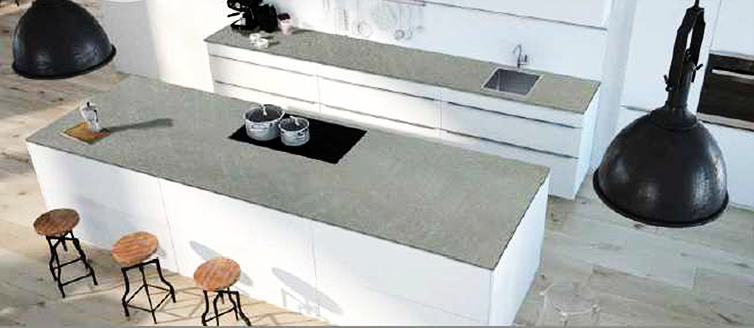
    It is often forgotten that our little Switzerland is “filthy rich” in the truest sense of the word! Our own sandstone quarry on the Rooterberg is located two kilometers from our company as the crow flies, 100 meters above the Veriset. Sandstone has been mined up there for over 200 years. Our company, which was founded in 1944, has also been mining this beautiful gray-blue sandstone since then. This noble plant, which originated 20 million years ago, can also be used as a kitchen cover without any problems. We will market this noble product in the future as Lion Stone with completely new surface treatments .

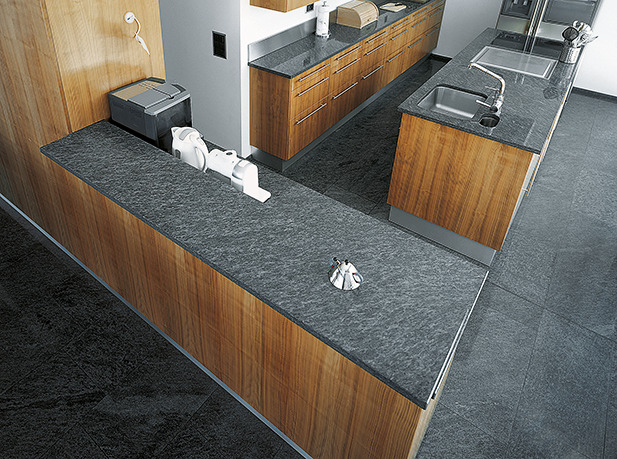
    The lion monument in Lucerne, which was carved out of a former sandstone quarry, is only about four kilometers as the crow flies from our own quarry. It is exactly the same molasse sandstone . Our local material costs a fraction – in contrast to artificial stone or chrome steel! Our noble Ticino gneisses are not only a great eye-catcher, but thanks to the latest impregnation agents they are also suitable for kitchen covers without any problems. Partial darkening really only occurs with very poor care! The very latest impregnation methods, which do not change the color of the beautiful Swiss natural stones, make practical use seem harmless today. In any case, these are far superior to an artificial stone that has only been polished. The noble gray-blue of an onsernone gneiss matches light and gray kitchen furniture simply sensationally and at an affordable price!

    The noble dark gray of the Onsernone is described by experts as the most beautiful gray in the world! Of course, Cresciano and Iragna also shine as light gray alternatives in every kitchen. The green Andeer, Valser or Verde Spluga also look very modern with wooden furniture and are therefore often used. The floor coverings from COOP are a shining example!

    The oldest coverings are already 17 years old and appear almost new despite intensive use. The natural patina makes the floor very attractive. Our Rooterberger sandstone was laid as an example in 1983 in the Jesuit church in Root. 1974 also in the catholic church in Root! Despite their age and intensive use, the floors still look sensational! Somebody should say that sandstone is tricky and that in the public sector.

    We must not forget one thing: Honor local work! In Switzerland, we meet all known safety regulations when mining natural stones and also meet all ecological standards in terms of sustainability. The wages in Switzerland are fair and correct, child or slave labor are foreign words in Switzerland! Thanks to the nearby quarries, the product meets all ecological requirements in terms of gray energy! There is simply nothing better than the use of Swiss natural stones in ecological and sustainable construction! You can also rely on Swiss natural stone, be it indoors or outdoors, as a great floor, wall covering or kitchen cover, Swiss natural stone is always a perfect choice!

    In order to achieve a certain long-term advertising effect, our company Emilio Stecher AG from Root has set up three additional URLs in addition to www.stecher.ch : www.onsernone.com , www.schweizer-natursteine.ch and www.rooterberger.ch . Let yourself be fascinated.

    A visit to us is worthwhile, but even the Internet cannot replace our beautiful exhibition in Root. We would like to invite you to visit us. We hope that you will use a lot of beautiful Swiss natural stones in the future and of course take into account our family-run Lucerne-based company based in Root, which has always advocated the use of Swiss natural stones since it was founded. We can boast that over 50% of our invoiced sales are made with Swiss natural stones!

    Click here for the video from the Rooterberg sandstone quarry: https://www.youtube.com/watch?v=eQpgKNsyli8

  • Digital Day 2021 by SVIT

    Digital Day 2021 by SVIT

    As with the first event in 2020, many interested members of the Swiss Association of the Real Estate Industry (SVIT) and other visitors flocked to the popular event location on “Europaallee Zurich”. Providers, users and interested parties were able to exchange ideas at this specialist conference and seek direct contact with various software developers. The latest software applications for the real estate industry were presented by around 40 exhibitors. The practice-oriented specialist presentations are an additional highlight on the “SVIT Digital Day”. At noon, Mario Facchinetti presented the Global Real Estate Run in which people inside and outside the real estate industry are made aware of the importance of the industry for achieving the climate goals. The running event is a symbol of promoting the necessary changes for our health and energy. Daniel Bruckhoff from ImmoScout24 presented the new and diverse possibilities on the new platform for marketing success. How do you make it from classic property management to networked property management? Peter Schindlmeier CEO of casavie, showed where companies have to start in order to be able to set up their system landscape on a sustainable basis. The managing director Rolf Truninger from QualiCasa AG presented the “Visits” app, which allows the most important properties such as condition, standard and materials to be systematically recorded and evaluated using an intuitive and fast interface when viewing properties.   Access to the symposium and the presentations were free of charge for everyone. We are already looking forward to the upcoming event in 2022, which will again show interesting paths in this dynamic digital transformation.
  • Historical manor with a modern frame

    Historical manor with a modern frame

    Like a park, the spacious grounds of the Glockgut stretches through rural Herblingen. The former farming village is only a few kilometers away from the center of Schaffhausen. In the middle of the green surroundings and at the same time close to urban culture, it has a high recreational and leisure value. A total area of 24,223 m² offered the experienced Steiner AG project developers space right in the middle for the vision of creating a varied living environment for young and old – with a children's playground, flower meadows and open green areas full of tall trees and ornamental shrubs. At the end of March 2018, the project of the working group Theo Hotz Partner AG and Bergamini Partner Architects received the building permit. The main building of the former manor, which is worth protecting, formed the starting point for the development plan. After the Steiner Investment Foundation got involved in the project as an investor, construction began on the family-friendly and near-natural apartments in autumn 2018.

    Open terrain

    The old manor building is now gracefully framed by five modern apartment buildings. It was a particular challenge to design the different buildings and such a large area as uniformly as possible and to realize them from a single source. A special feature of the plot in the north-western area, which initially presented itself as a problem, helped here: a steep slope. The solution was to leave it undeveloped. The actually built-up part today covers an area of 10,330 m 2 , while the preserved green space proves to be an enrichment for the quarter.

    The first construction measure was the conversion of the two-storey manor into a daycare center – in close cooperation with the preservation of monuments. The adjoining shed, in turn, was torn down and replaced by a new multi-purpose building with the same location and similar cubature. On the ground floor, this new building houses a common room that is used by the after-school care center during the day and is available to the residents of the complex in the evenings and on weekends. "The space is intended to give the building an identity as a new center," explains Peter Herzog, team leader for real estate development at Steiner. The ensemble of the two buildings was therefore left free and fits harmoniously into the backdrop of the open slope behind. Arranged in a U-shape around the building, the new housing estate grew step by step.

    The new residential buildings fit in with the simple manor with a straight-line architecture and corresponding colors and, with their loggias, balconies and terraces, bring the interiors together light and airy with the outside area. From the inside, they allow a generous view of the green area and sometimes into the distance. The buildings in the area are loosely distributed and connected by a network of paths. Kindergarten, primary school and various shops can be reached in a few minutes on foot from the quarter. In this way, the entire development is both naturally permeable and urban dense at the same time.

    Sustainable investment

    The five new multi-family houses comprise a total of 27 rental and 71 condominiums. These are 2.5 to 5.5 room apartments with an area of 65 m 2 to 130 m 2 . All apartments have a high standard and are tailored for families as well as for couples or individuals. With the prices and different apartment sizes, the aim is to achieve a mix of one-person and family households. "In terms of price, we are in the middle segment," confirms Peter Herzog. An underground car park with 136 parking spaces also provides space below the site. It is directly accessible for all new buildings.

    The buildings are implemented in accordance with the Minergie standard and are heated with climate-friendly geothermal heat pumps. When possible, sustainable types of concrete with cement from mixed demolition were used for the construction. Recycled aggregates were mixed in here.

    Planning tailored to your needs

    The entire development is based on a design plan that was presented to both the responsible authorities and the local residents during the process. That contributed to the trust in this large project, explains Herzog and adds: "With the Glogguet development we have shown how we can build compacted and how the quality of the place remains." Despite the pandemic, the construction work could be carried out on schedule in compliance with the applicable protective regulations, so that the apartments were ready for occupancy in spring 2021.

    www.steiner.ch
    www.gloggeguet.ch
    info@steiner.ch

  • Ownership obliges – sustainable area development

    Ownership obliges – sustainable area development

    Creating places to live and study, maintain infrastructures, secure values: the public sector, as the largest property owner, has a special responsibility. Social and technological change presents those responsible with new challenges, plus the effects of Corona. How do you deal with it today and tomorrow?

    Under the motto “Ownership obliges”, the Swiss Public Real Estate Forum 2021 offers food for thought and tools. Get an overview: About innovative concepts in planning, useful cooperation in development, the new procurement law and digital realities in the life cycle of a property. Network and exchange ideas.

    We look forward to seeing you on October 28, 2021 in Aarau!

    Albert Schweizer
    Association of state and municipal real estate directors

    Prof. Dr. Boris Szélpal
    Bern University of Applied Sciences, Architecture, Wood and Construction

    Vanity: bfh.ch/spref

  • ImmoScout24 launches platform for new construction projects

    ImmoScout24 launches platform for new construction projects

    A platform with a clear focus on the specific marketing needs of new construction projects has so far been lacking in the Swiss real estate market. ImmoScout24 closes this gap: From June 1, 2021, real estate professionals and seekers will have a dedicated area for new construction projects on ImmoScout24.ch/Neubau. The company is thus offering all of its marketing strengths for advertising new Swiss buildings.

    Targeted addressing of interested parties

    The platform guarantees advertisers maximum visibility and targeted prospecting. Searchers benefit from finding suitable offers more quickly. The menu item “New building” is visible to visitors of immoscout24.ch at first glance and refers to the platform for new buildings. New buildings also stand out in the regular search results list with a label. In this way, complete new construction projects or individual residential units can be found even faster and thus sold and rented out more easily. Martin Waeber, COO of Scout24, knows that there is a particular need for the new platform among advertisers: “ImmoScout24 is a strong, trustworthy brand. When customers use our marketing and rental processes, they benefit directly from our reach, ”says Waeber.

    Stronger lead performance through AI push

    The ImmoScout24.ch/Neubau page strengthens the lead performance of the properties with the latest technology and artificial intelligence. From the start, a data-driven recommendation engine from ImmoScout24's cooperation partner Homsters works in the background. The insertion takes place via the customer's CRM interfaces. To this end, the platform works together with the subsidiary CASASOFT.

    Waeber is certain that the project will be crowned with success: “We are accelerating the marketing process, making it more cost-efficient and ensuring transparency. New building developers and agencies have the opportunity to publish an entire project, including individual project websites. In this way, your brand awareness can be expanded in a targeted manner. "

    New advisory team for new construction projects

    In order to promote the new building platform, ImmoScout24 relies on a strong sales team that was specifically created for the project. «We are very pleased to have Daniel Bruckhoff on board as Head of Sales New Building since April 1, 2021. In this role, Daniel Bruckhoff will be responsible for sales in the area of new buildings, ”said Waeber. As a proven real estate specialist, Bruckhoff has many years of experience in online marketing and most recently worked as a business developer. He leads a sales team of two people. Thanks to the new platform, four jobs have been created so far, and more will follow.

  • Renggli AG wins the Prix SVC Central Switzerland 2020

    Renggli AG wins the Prix SVC Central Switzerland 2020

    First place for Renggli AG from Schötz

    With over 95 years of experience as a timber construction partner and general contractor, Renggli AG offers energy-efficient and sustainable timber construction projects in modern architecture – for multi-storey residential buildings, commercial and public buildings as well as for single-family houses. Jury President Urban Camenzind, Economic Director of Canton Uri, paid tribute to the winner in his laudation: “Renggli AG is known for energy-efficient construction with wood and is one of the MINER-GIE pioneers in Switzerland and beyond. The family company already lived sustainability and put it into practice when this word was often still theory. Renggli AG is characterized by innovation and a pioneering spirit. This means that the company is also doing business successfully and is well equipped for the future. " Renggli AG employs over 230 people at its locations in Sursee, Schötz, Granges-Paccot, Ascona and Winterthur. The family company is run in the fourth generation by Max Renggli, CEO and Chairman of the Board of Directors.

    Elbatech AG and Shiptec AG in second and third place

    Second place goes to Elbatech AG. It installs modern tunnel radio systems for the railway operators throughout Switzerland and thus ensures uninterrupted communication for all travelers. The design and assembly of traction power systems and diamond drilling are other important areas of activity. The company is characterized by innovative in-house developments and total solutions. Elbatech was founded in 2007, is managed by Florian Reichmuth and Stefan Franzen and employs 45 people.

    Bronze went to Shiptec AG, the leading Swiss company in the shipbuilding industry. With its shipyard and an engineering office, the company provides technical services in the areas of ship design and engineering, shipbuilding, ship revisions, conversions and ship maintenance for professional and private shipping. Shiptec AG employs over 70 people and is managed by Ruedi Stadelmann.

    Awards for Allvisual AG, Gübelin and Seiler Käserei AG

    Allvisual AG from Steinhausen, an internationally active, owner-managed consulting company in the areas of digital transformation, product lifecycle management, smart manufacturing / service and 3D visualization, and the world-renowned family company Gübelin from Lucerne, known for its gemstone expertise and luxury, also received awards Watches, as well as the Seiler Käserei AG from Giswil, which has been producing excellent cheese specialties as an independent, owner-managed traditional company since 1928.

    Prix SVC – an opportunity to put SMEs in the limelight

    The sponsor and initiator of the Prix SVC Zentralschweiz is the Swiss Venture Club (SVC), an independent, not-for-profit association for the promotion and support of SMEs in Switzerland. Christoph Baggenstos, SVC Regional Manager Central Switzerland, emphasizes: “We award companies that belong to Switzerland's SME elite. Our focus is on exemplary companies that create jobs and help shape the Swiss economy. With the Prix SVC we offer these companies a platform to show their success to the outside world. Last but not least, the attention that our award winners receive from the Prix SVC should also be an incentive for other companies. "

  • The construction industry will increasingly rely on robots in the future

    The construction industry will increasingly rely on robots in the future

    In the next ten years, 81 percent of construction companies want to introduce robotics and automation or intensify their use. This is the result of a survey by the technology group ABB among 1,900 companies in Europe, China and the USA. According to a press release, only 55 percent of the companies surveyed are currently using robots – compared to 84 percent in the automotive industry and 79 percent in the manufacturing sector.

    The reasons for the intention to automate are to be found in the increasing shortage of skilled workers worldwide. An equally strong argument is the improvement of health protection and safety on the construction site. Environmental protection is also one of the main drivers for changes in the industry.

    "The new awareness of health, safety and sustainability is massively accelerating investment in robotics," said Sami Atiya, head of ABB's Robotics & Factory Automation division . "At the same time, the decreasing supply of skilled workers means that the construction industry increasingly needs robots to keep up with the challenges of urbanization and climate change." Internal analyzes by ABB Robotics on the market potential of robot-assisted automation in the next ten years assume high double-digit growth rates the end. This applies above all to the key areas of construction, including precast construction and 3D printing.

    ABB works with the Swiss Federal Institute of Technology in Zurich , among others, to develop new automation solutions. At the Institute for Technology in Architecture located there , ABB contributed to setting up the world's first laboratory for collaborative, robot-assisted digital manufacturing in architecture. The latest technology for large-scale 3D printing in the construction industry can currently be seen at the Architecture Biennale in Venice. It is part of an installation by the Austrian architecture firm MAEID.

  • PropTech – the evolution of the real estate industry

    PropTech – the evolution of the real estate industry

    Why PropTech? The traditional real estate economy has some drawbacks. It is limited in its supply, has lengthy rental and payment processes, and suffers from a lack of automation and flexibility. PropTech companies try to tackle all of these challenges with innovative approaches.

    PropTech evolution
    The World Economic Forum in Davos divided the PropTech scene into three categories: PropTech 1.0, 2.0 and 3.0.

    PropTech 1.0
    This generation was marked by the growth of online advertising sites. It all started in the 1980s with the invention of personal computers. Various real estate market analysis companies were formed that produced a large amount of real estate data. This wave ended in 2000 when the dot-com bubble burst. At the same time, real estate agencies were shifting their markets to the Internet.

    PropTech 2.0
    Advances in computing made the development of complex transactional environments faster and more accessible. The use of data analysis and virtual reality enabled the real estate market to offer better and more specialized services to clients.

    While the first wave consisted mainly of established companies that went online, the second wave saw startups that are mainly active in the commercial, residential or mortgage sectors.

    PropTech 3.0
    New technologies offer more opportunities to optimize the real estate market. Innovations in the financial and legal sectors allowed the real estate industry to improve the transparency and fluidity of their operations with security mechanisms. Big data, AR and VR, 3D printing and cryptocurrencies will create opportunities to advance the real estate industry into the future.

    You can find an overview of PropTech solutions of the third generation at https://proptechmarket.net/loesungen

  • "SVIT-Switzerland Award Innovation in Real Estate" is determined by public voting

    "SVIT-Switzerland Award Innovation in Real Estate" is determined by public voting

    Among the participants in the “SVIT-Switzerland Award Innovation in Real Estate” voting, we are giving away 3 x 2 entry tickets to participate in the award ceremony on August 30, 2021 (value per ticket CHF 240.—). One vote can be cast per email address. The winners will be determined and notified personally at the end of July 2021. No correspondence will be entered into about the raffle and the judges' decision is final.

    To the website

  • Steiner Office Barometer: Switzerland loves working from home

    Steiner Office Barometer: Switzerland loves working from home

    With the decline in the number of corona cases, the Federal Council could soon lift the home office obligation. Reason to cheer or to be annoyed? As the Steiner study carried out in German and French-speaking Switzerland with over 1,000 employees shows, 9 out of 10 respondents who currently work at home or at least theoretically could do so are in favor of home office. However, many miss the social contacts in the office.

    Bosses discover the advantages of working from home

    It is noticeable that 39% of the respondents had the opportunity to work from home even before they were required to work from home. Currently 48% only work slightly more from home – with a maximum potential of 56%. There is a tendency for more people to work at home in cities and in large companies than in rural areas and in SMEs. In particular, employees with a managerial function (51%) or from company management (61%) currently work from home and obviously appreciate the advantages. Before the pandemic, it was just under 42% and 37%, respectively.

    Since younger people in particular want to work more at home, a home office offer could become an advantage in recruiting in the future. Of those surveyed who could work from home, two thirds (65%) work for employers in the city. Four out of five (81%) work for employers who have their own office space.

    Employees want the best of both worlds

    Home office is a great need. Nevertheless, many respondents do not want to do without a fixed office workplace. Two thirds have one today. A central location of the workplace remains important for the majority of the respondents, even if they do not commute every day. Many employees want the best of both worlds: the freedom of the home office, but still the familiar environment in the office.

    What does this desire mean for the construction of new residential and commercial buildings, in the city as well as in the country? Central, urban workplaces will continue to be in demand, while offices in peripheral locations will probably meet with less demand. Even more creative solutions will be required from planners in the future. On the other hand, thanks to the acceptance of home offices, peripheral places of residence could also become more attractive.

    Steiner is already planning a home office

    When developing real estate projects, Steiner takes social trends into account and responds to the social challenges of the future with innovative building solutions and forms of living. "In residential construction, we are responding to the desire for home office with new ideas," emphasizes Michael Schiltknecht, Head Real Estate at Steiner AG.

    Michael Schiltknecht is convinced that Steiner already offers solutions and tailor-made answers to the requirements of the future in the office and commercial sector: “We have developed the sustainable and multi-dimensional“ Manufakt ”concept, which, in addition to modularly usable rooms, offers an offer of divided and as required required meeting rooms, flex offices and meeting areas ».

  • The Swiss real estate fair for investors becomes independent

    The Swiss real estate fair for investors becomes independent

    As a result of ongoing planning uncertainties and the still applicable restrictive provisions in connection with Covid 19, the organizer has decided to hold the annual industry event independently of the financial fair in Hall 622 in Zurich Oerlikon.

    The Swiss real estate fair for investors has seen steady growth in recent years and is now the largest Swiss fair for professional domestic and foreign real estate players. With the IMMO22 taking place on January 19th and 20th, the organizers are now inviting you to the 10th anniversary.

    Due to a successful IMMO21, which was conceived as an online event due to the pandemic and recorded a new exhibitor record with 93 companies, the hybrid event concept will be continued: The first live broadcast of the IMMO Forum, the accompanying congress of the Swiss real estate fair for investors, met with over 4,000 connections Interest. The decision was made to continue broadcasting the accompanying congress live on the trade fair website in the future and, more recently, to make it accessible to the French-speaking audience by means of synchronized translation.

  • SVIT Switzerland Award “Innovation in Real Estate” will be presented for the first time at the Real Estate Award 2021

    SVIT Switzerland Award “Innovation in Real Estate” will be presented for the first time at the Real Estate Award 2021

    Nominee projects:

    Business case RenoRent

    Feasibility study on the renovation and touristic activation of second homes

    Safe living in old age

    Safe living in old age is an offer from Immobilien Basel-Stadt and Building Insurance Basel-Stadt to their tenants over 65 years of age.

    Basel cost rental model

    Real estate strategy for the financial assets of the canton of Basel-Stadt

    Global Real Estate Run

    Global event for innovation and sustainability in the real estate industry

    Interim project – temporary use and vacancy management

    Projekt Interim offers flexible solutions for temporary spaces throughout Switzerland.

    EDELWEISS – office houseboat

    The mobile real estate showroom

    The members of the German-speaking SVIT member organizations have the opportunity to determine the winner in a public vote. The nominees for the award can be found under the following link https://realestateinnovation.ch/.

  • Interview with Beat Bachmann, Head of the Business Contact Point in the Canton of Zug

    Interview with Beat Bachmann, Head of the Business Contact Point in the Canton of Zug

    Why should a foreign company set up in your canton?
    Beat Bachmann: The Zug economic area offers a total package of outstanding location factors: the pronounced economic friendliness, political and financial stability, attractive taxes for companies and private individuals, internationality and the pool of available specialists, which in turn has a magnetic effect. In addition, there are investments in education, good accessibility, the excellent quality of life and an effective business environment. The canton of Zug is part of the Greater Zurich Area (GZA) and the metropolitan area of Zurich, one of the world's most attractive economic areas.

    What type of company is interested in your canton?
    Companies from broadly diversified industry groups: life science (pharma / biotech / medtech), wholesale, high-tech industry, finance, information and communication technology (including fintech and blockchain) as well as international headquarters.

    What has specifically changed in terms of location quality in your canton over the past five years?
    With the implementation of the tax reform on January 1, 2020, the business location Zug will remain very attractive for companies and private individuals in the long term in international competition. The leading industries have developed positively and have become even stronger, in particular life science with pharmaceuticals and medtech, trade / trading as well as blockchain, tech and IT. Many start-ups have also emerged in these areas. With the commissioning of the IT department at HSLU in Rotkreuz and the imminent start of the higher technical college for IT and electronics at the commercial and industrial training center in Zug, the canton is investing in talented and future skilled workers.

    What developments do you expect in the next five years?
    We hope that the economy – which was prospering before the crisis – will recover well and expect that the industry clusters will continue to develop successfully and that the canton will continue to be one of the most attractive locations.

    How is the corona crisis affecting your canton's economy?
    The Zug economic area is strongly networked internationally, global events have a major impact. The development of the world market has a major influence. We will have clearer information in the third quarter. The Zug government council is planning the coming months with various scenarios; by monitoring selected indicators, it closely follows the recovery of the economy.

    What are you doing about it?
    The canton's representatives are in constant contact with local companies, business associations and organizations. This network has proven its viability in recent months. The proximity to Zug's economy and, as a result, knowledge of the situation, including that of the micro and small firms, helped to shape the canton's support measures, which complement federal measures, in such a way that at least the most basic needs can be met.

  • Andreas Zettel: «Das neue Raumplanungsgesetz erfordert ein aktives Management der Entwicklungsschwerpunkte»

    Andreas Zettel: «Das neue Raumplanungsgesetz erfordert ein aktives Management der Entwicklungsschwerpunkte»

    Herr Zettel, der Kanton Luzern, alle Luzerner Gemeinden sowie Netzwerkpartner aus Wirtschaft und Industrie engagieren sich finanziell und ideell für einen wachsenden Wirtschafts- und Wohnstandort Luzern. Wie beurteilen Sie deren Erfolg?
    Wenn wir auf die letzten Jahre zurückblicken, beobachten wir eine dynamische Entwicklung des Wirtschaftsstandortes Luzern. In den Jahren 2012 bis 2017 ist die Anzahl Unternehmen und Arbeitsplätze im schweizweiten Vergleich überdurchschnittlich gewachsen. Im erwähnten Zeitraum sind kantonsweit über 2 000 Unternehmen und über 15 000 Arbeitsplätze entstanden. Das ist ein nationaler Spitzenwert. Die gemeinsamen Anstrengungen haben sich also gelohnt. Auch letztes Jahr hat der Firmenbestand wiederum um über drei Prozent zugenommen.

    Was macht den Kanton Luzern denn besonders attraktiv?
    Ich würde die attraktive Kombination verschiedener Standortfaktoren in den Vordergrund rücken. Sie macht letztlich die Standortqualität aus. Nebst den stimmigen harten Faktoren wie tiefe Steuern, Verfügbarkeit von Arbeitskräften oder die gute Erreichbarkeit, ist der Kanton Luzern auch landschaftlich reizvoll und kulturell spannend. Jährlich besuchen viele Touristen die Region Luzern. Von den touristi-
    schen Angeboten profitiert direkt auch die lokale Bevölkerung.

    Zurück zu den harten Fakten. Gibt es noch Flächen, welche für Firmenansiedlungen und Unternehmensentwicklungen zur Verfügung stehen?
    In der Tat hat sich der Markt in den letzten Jahren stark verändert. Die Verfügbarkeit von Baulandgrundstücken und entwickelten Arbeitsflächen ist eine zentrale Herausforderung der Zukunft. Das neue Raumplanungsgesetz gibt enge Grenzen vor. So sind Einzonungen nur noch unter bestimmten Bedingungen möglich. Folglich liegt der Fokus zukünftig klar in der Entwicklung nach Innen und auf die bessere Ausnützung von Flächen. Das betrifft in hohem Ausmass auch die Unternehmen, insbesondere das lokale KMU-Gewerbe. Namentlich die Immobilienwirtschaft ist gefordert, neue, attraktive und bezahlbare Angebote zu schaffen für diese Betriebe.

    Wo sehen Sie örtlich die Möglichkeiten für Neuansiedlungen?
    In den neuen Stadtzentren LuzernSüd und LuzernNord sind attraktive neue Flächen am entstehen. Im Zentrum der Stadt Luzern ist die Entwicklung räumlich limitiert, das heisst, hier erfolgt die Entwicklung im Rahmen von Arealentwicklungen, welche die letzten Baulücken füllen und sich in die bestehende Stadt eingliedern müssen. Aus regionaler Optik bedeutet dies, dass sich die Stadt Luzern als funktionaler Raum ausdehnt und neue, attraktive Stadtzentren in den umliegenden Gemeinden entstehen, welche hervorragend erschlossen sind und eine neue urbane Qualität bieten können. Persönlich sorge ich mich etwas um die reinen Arbeitszonen, diese wurden im Zuge der Innenentwicklung häufig einer anderen Nutzung zugeführt, ohne dass Ersatz entstanden ist. Diese Flächen fehlen dann dem Gewerbe.

    Also sind diese Flächen ein knappes Gut?
    Nun, dieser Eindruck kann tatsächlich entstehen. Bei genauerem Hinsehen fällt aber auf, dass es im Kanton Luzern noch eine beträchtliche Anzahl von Grundstücken gibt, welche eingezont, aber noch nicht entwickelt sind. Hier ist die Frage, ob die Grundeigentümer überhaupt entwickeln möchten. Wir stellen eine gewisse Tendenz zur Baulandhortung fest, was klar nicht in unserem Sinne ist. Manchmal fehlt es aber nicht nur am Willen, sondern auch einfach am Wissen, wie man diese Flächen entwickeln könnte. Vor allem die Filetstücke müssen sehr clever und nachhaltig entwickelt werden, damit auch die nächste Generation maximal davon profitieren kann.

    Wie sieht die Entwicklungsstrategie im Kanton Luzern aus?
    Im aktuellen Richtplan wurden zwölf sogenannte kantonale Entwicklungsschwerpunkte (kurz ESP) definiert. Dabei handelt es sich um grossflächige Arbeitsplatzgebiete an gut erschlossenen Standorten. Dabei wird eine eine qualitative Entwicklung angestrebt, wobei insbesondere auch die Abstimmung von Siedlung und Verkehr eine wichtige Rolle spielt. Die ESP sind ein zentrales Element der Luzerner Standortpolitik und ein wichtiges Instrument der gemeinsamen Wirtschaftsförderung von Kanton und Gemeinden.

    Wo befinden sich diese Entwicklungsschwerpunkte?
    Sie orientieren sich aufgrund der wirtschaftlichen Potenziale an den Hauptverkehrsachsen des Kantons Luzern. Hauptsächlich befinden sie sich an gut erschlossenen Lagen, welche verkehrstechnisch gut liegen, mit dem Auto, aber auch mit dem ÖV.

    Wie ist der Stand dieser Entwicklungsschwerpunkte?
    Sehr unterschiedlich. Während etwa in der Stadtregion Luzern die bereits erwähnten Gebiete LuzernSüd und LuzernNord relativ weit fortgeschritten und bereits in der Umsetzung sind, besteht beispielsweise in den beiden Regionalzentren Hochdorf oder Willisau ein erhebliches Nachholpotenzial. Diese Gebiete sind es, welche in den nächsten Jahren vermehrt in den Fokus von Investoren und Entwicklern rücken werden.

    Wo kann man sich über die einzelnen Entwicklungsschwerpunkte informieren?
    Investoren und interessierte Unternehmen können sich bei uns melden, denn wir haben eine gute Übersicht über den Stand dieser Gebiete und kennen sämtliche Ansprechpartner. Zentral für die Entwicklung dieser ESP sind nebst den Standortgemeinden auch die vier regionalen Entwicklungsträger im Kanton Luzern. Das heisst LuzernPlus, Sursee-Mittelland, Region Luzern West und Idee Seetal. Das positive Zusammenspiel von Staat und Wirtschaft ist ein Kernelement unserer gemeinsamen Wirtschaftspolitik. Dieses wollen wir weiter verbessern. ■

  • House of the future with Eternit

    House of the future with Eternit

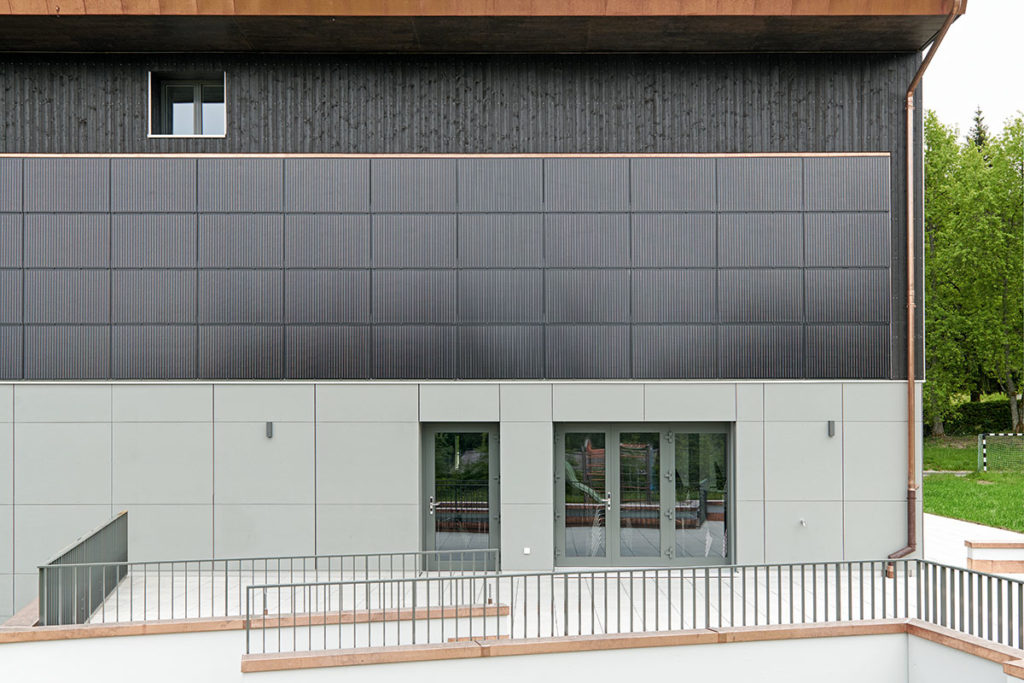
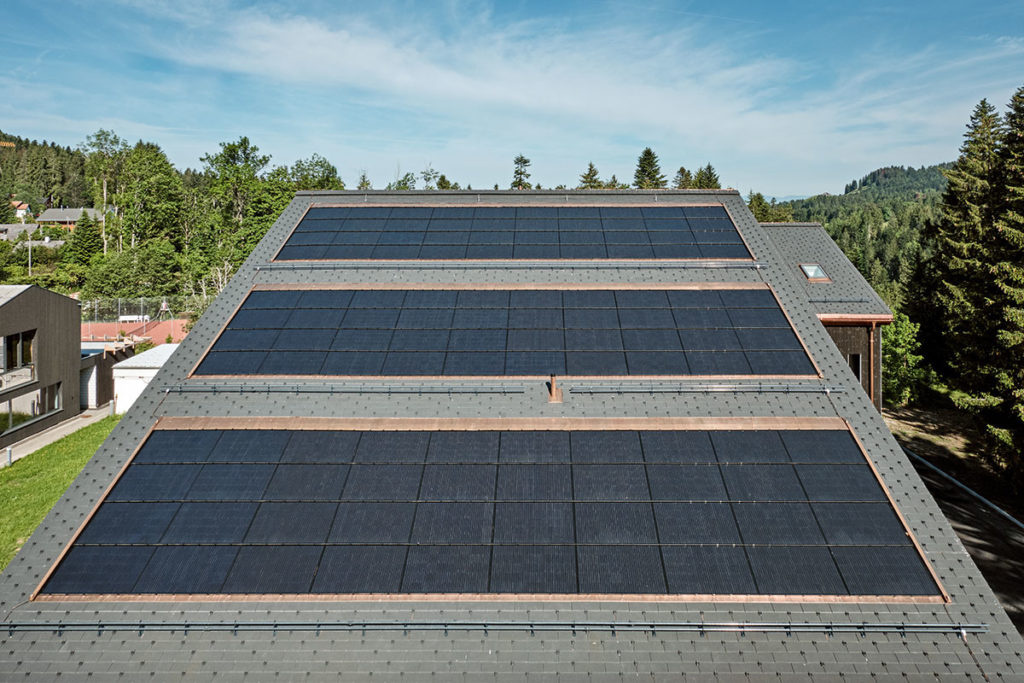
    The Chavacots campus has always been considered the house of the future, as around 900 new building envelope specialists are trained in the training center every year. The building from the 1970s had to be renewed in order to meet today's needs with a modern building infrastructure. The training center was rebuilt in just one year with the help of innovative and ecological Eternit products and solar solutions.

    Eternit (Schweiz) AG, based in Niederurnen and with a 125-year success story, manufactures non-combustible roof and facade products made of fiber cement, which are characterized by high quality, durability and resistance. Roofing slate and facade panels made of fiber cement were used for the building envelope and solar solutions from Eternit were optimally integrated at the same time. The new mineral Eternit floor was used in the interior construction.

    Sunskin roof and Sunskin facade – the Chavacots campus becomes an energy supplier
    Sunksin roof and Sunskin facade from Eternit are ecological system solutions for photovoltaic systems that meet all the requirements of the client, Verein Polybau, for a modern solar system. With their frameless, flat shape, the photovoltaic modules fit perfectly into the roof and facade landscape. They are suitable for almost any roof shape.

    Complementary building envelope
    The solar modules on the roof were complemented by durable and robust roof slate elements made of Eternit fiber cement. A wooden facade was held on because the building regulations of the municipality of Les Paccots do not allow otherwise. However, this did not prevent the training building from being turned into a modern, ecological campus with Eternit products.

    "The black tint of the vertical wooden slats on the storeys and the gray of the Eternit slabs of the base interact with the study building opposite for practical work and work with a logic of location and image," says the architecture office Atelier 78 proudly.

    Eternit floor – the natural, mineral floor
    For the classrooms of the Chavacots campus, a floor was sought that could withstand a lot. A central question was to modernize the traditional building with new materials without losing its authenticity. The natural, mineral texture and the subtle tonality of the Eternit floor turned out to be the right choice. ■

    numbers and facts

    Client
    Polybau Association, Uzwil

    architect
    Atelier 78, Châtel-St. Denis

    Processor
    Facetec SA, Crissier (facade)
    B. Schnider SA, Clarens (roof)
    Helion, Yverdon-les-Bains
    (Sunskin roof and Sunskin facade)
    AGM Entreprise Générale Sàrl,
    Monthey (ground)

    Materials used
    Sunskin facade – 48 modules
    Sunskin roof – 228 modules in connection
    Eternit roofing slate Natura Standard
    40 × 40 / color: 6505
    Facade panels Largo Nobilis 214 (634 m2)
    Eternit floor – trend collection Intense (262 m2)