Category: immoNews

  • 3 needs-based facility management solutions

    3 needs-based facility management solutions

    Soobr on artificial intelligence. The existing performance and building data are read into the software, whereupon the tour planning takes care of the planning of the daily tours based on factors such as room distances, room priority, number and duration of cleaning. The occupancy of the individual rooms can also be integrated into the operational planning via room sensors, so that cleaning can be carried out specifically where it is really necessary. The cleaning staff performing the work are guided through the respective tours by means of an app on mobile devices, whereby you can feed the AI with feedback and documentation. Dynamic route planning increases efficiency, saves time and money in route planning and increases transparency for data evaluation.

    Thingdust also relies on sensor-based data for its Smart Office product. With this simple plug & play solution, companies can measure the definitive utilization of their office space and analyze what will be a great need after returning from the home office. The anonymous data collected by sensors at the workplace is transmitted via an independent LoRa network and is displayed on the dashboard for analysis and statistics. At the same time, the flow of people is directed by means of a real-time display on a monitor placed at the entrance and the distribution of people in the building is optimized. In addition, reservations can be made quickly and easily using QR codes in order to increase the occupancy of meeting rooms, for example.

    The Service on Demand devices, which facility management only call for use when required, also ensure that personnel are deployed as required. Planned tours to filled water dispensers and empty file containers, intact coffee machines or functioning printers are a thing of the past. The service-on-demand devices can be installed in any number of locations and devices in order to report faults, events or services quickly and easily. Instead of these points being constantly checked, the building users report that there is a need for a service at the push of a button.

    You can find more about digital helpers in the real estate and construction industry at: https://proptechmarket.net/

  • Tilbago simplifies handling of credit reports

    Tilbago simplifies handling of credit reports

    The Lucerne start-up Tilbago specializes in digital debt collection solutions. Now, according to a media release, it has launched a new product called Tilbago CredRep. This is a holistic, digital solution for obtaining credit information. According to Oliver Wolf, Chief Operating Officer at Tilbago, it is a "service that customers wanted and that we have implemented with modern technical possibilities".

    Tilbago CredRep is aimed at operators of real estate portals, loan portals or providers of software solutions. Tilbago CredRep can implement these in their existing platforms and make them available to their customers. Customers can then order extracts from the debt enforcement register completely digitally.

    Another advantage of Tilbago CredRep is that the so-called CreditTrust certificate is also integrated into the solution. In contrast to the excerpt from the debt enforcement register, the CreditTrust certificate is not limited to the register of a single office, but rather contains "all information available throughout Switzerland", it says.

    Tilbago developed the new solution together with the PFLab, PostFinance's innovation laboratory. PostFinance is also one of Tilbago's investors. "As an innovation participation of PostFinance, the PFLab supports tilbago in the market development of existing products and services and in the development of new offers," explains Sergio Consonni from the PFLab.

    Thanks to the connection to PostFinance, Tilbago has already won its first customer. Private individuals can now order their digital debt collection register excerpts on the Swiss Post website.

  • Made in Zurich breaks the lance for urban production

    Made in Zurich breaks the lance for urban production

    Made in Zurich wants to unite “urban productivists” of all kinds, explains the initiative founded in 2018 in its self-portrayal . Even when it was founded, the Made in Zurich initiative set out to investigate questions about production in the city, writes the initiative in a recent press release . For this purpose, Made in Zurich created the study “ Locations for urban production and retail – SUPR ”.

    The study examines historical developments and current trends and uses them to develop proposals for urban production. In addition, the analysts sound out the framework conditions for urban production in Zurich. Among other things, they investigate the question of what urban producers need and which urban areas are suitable for urban production.

    The guidelines are intended to provide “instructions for action and food for thought”, writes the Made in Zurich initiative in the communication. The addressees named there are “the public sector, developers and, last but not least, the producers themselves”.

    In the fifth chapter of the study, the authors deal with particularly important aspects of urban production. The entire final chapter of the study is devoted to recommendations for action for the implementation of locations for urban production and retail.

  • Old cotton mill in Turgi becomes an office complex

    Old cotton mill in Turgi becomes an office complex

    The old cotton mill in Turgi is to be converted into a complex with offices and commercial space. That was decided by Limmatkraftwerke AG, which operates its hydropower plant next to the large building. The subsidiary of Regionalwerke AG Baden acquired the building in mid-2020. According to an announcement on LinkedIn, offices, studios and commercial space will be rented on April 1 or by agreement on an area of 7,000 square meters. André Roth AG in Baden is responsible for marketing the space.

    The former cotton mill in Turgi was built as a factory between 1826 and 1879. Between 400 and 600 people worked in the Bebié brothers' cotton spinning mill, according to an article in the “Aargauer Zeitung” about the purchase of the elongated gable roof building in July 2020, which the cantonal heritage authorities call “the largest-scale building of its type in the canton of Aargau” Limmatkraftwerke AG operates the power plant in Turgi, which supplied the 190-year-old cotton spinning mill with electricity.

    Martin Schoop, Chairman of the Board of Directors of Limmatkraftwerke, was quoted at the time about the reasons for the purchase: “We operate one of our power plants right next to the spinning mill building. With the purchase of the spinning mill, we can ensure the operation of this power plant in the long term. ”With the acquisition of the spinning mill, future use can be controlled in such a way that expansion is possible.

  • 4B and Somfy are cooperating on intelligent home control

    4B and Somfy are cooperating on intelligent home control

    4B and Somfy have entered into a strategic partnership in the development of intelligent home controls, the two partner companies inform in a joint communication . With the Somfy TaHOme-Box, house and apartment owners should be able to create the conditions for the digitization of the building during construction or renovation, it says there. Joint products are launched under the Smart Home Ready by Somfy label.

    "Intelligent windows and facades are proof that we have been combining tradition, Swiss quality and innovation for over 100 years and that we are developing from a pure product to a solution provider", says Jean-Marc Devaud, CEO of Lucerne window manufacturer 4B , quoted in the communication. "With the Smart Home Ready cooperation, 4B can offer quality windows in combination with high-quality, radio-controlled privacy and sun protection as a smart, expandable package," explains Hannes Naef, Managing Director of Somfy Switzerland, in the press release.

    An intelligently controllable, motorized sliding door from 4B is to be brought onto the market this summer. The partners explain in the press release that the door can be integrated into intelligent building systems via both io radio and wired controls.

  • Sevensense co-founder praises Switzerland as a location for robotics

    Sevensense co-founder praises Switzerland as a location for robotics

    Roland Siegwart is Professor of Autonomous Systems at the Swiss Federal Institute of Technology in Zurich ( ETH ). He is also co-director of the Wyss Zurich funding program. In 2018 Siegwart co-founded the ETH spin-off Sevensense Robotics. The company, based in Zurich, develops technologies for robots that help them, for example, with independent orientation. Sevensense also works with Deutsche Bahn to develop technologies for the future of train travel.

    In an interview published on the Sevensense blog page, Siegwart praised Switzerland as a location for robotics. All important specialist knowledge for robotics is available in the country. On the one hand, precision mechanics, which have a "long tradition in Switzerland", are particularly important. On the other hand, sensor technology plays an important role in the industry. This is less known worldwide, but Switzerland is already very advanced in this regard.

    Siegwart also praises the ETH Zurich and the ETH Lausanne (EPFL). The two universities would provide the necessary control and intelligence to be able to make good use of the existing specialist knowledge, he emphasizes. They would also spawn a multitude of successful spin-offs – especially in the robotics area. Switzerland has also been able to attract a large pool of foreign talent who further strengthen the robotics scene.

    Switzerland still has some catching up to do when it comes to major investments. Investors in Europe are generally more risk averse compared to those in the USA. However, this also helps European start-ups develop a sustainable, customer-oriented approach. Accordingly, the survival rate of start-ups – for example in Switzerland – is much higher than that of those in the USA. The long-term survival rate of the ETH spin-offs is 80 to 90 percent.

  • Dietikon relies on location advertising with comedian duo Lapsus

    Dietikon relies on location advertising with comedian duo Lapsus

    The city of Dietikon relies on humor in its location advertising. According to a media release, the well-known Dietiker comedian duo Lapsus has therefore received the order to subject their residential area to a critical examination and to record their impressions. It is said that funny, self-deprecating video productions were created.

    The videos can now be viewed on YouTube, Facebook and Instagram. The first is entitled “Dietikon from its most beautiful side”. Dietikon is presented as a noisy and urban city with idyllic green areas as the train passes by. The second video introduces the open-air gallery “DietikON – experience light art”, which will run until the end of February, with humorous puns. Further topics are planned.

    The core of the campaign, which will last in May, is self-irony, according to the media release. The plan is to publish six to seven videos, which will make the qualities and location advantages of the city visible and promote the city's positioning as a center for business, culture, education, local recreation, sport and leisure.

    It is emphasized that the topics have been discussed with the city. The comedians are free to implement it.

  • LafargeHolcim finds partners for CO2 capture

    LafargeHolcim finds partners for CO2 capture

    The building materials group LafargeHolcim and the Texan Schlumberger New Energy want to find a solution for capturing and storing CO2 using the example of two LafargeHolcim cement plants. Using Schlumberger's CO2 sequestration technologies, the two companies plan to develop a concept for large-scale industrial use. The companies will provide information about this in a press release of the same name.

    Both are already active in this field. LafargeHolcim claims that it is currently testing more than 20 capture projects in Europe and North America. The group wants to identify the most promising, highly scalable projects. Schlumberger New Energy is working with leading companies in a number of strategic sectors to demonstrate potential solutions in a variety of projects.

    "Our partnership with Schlumberger, the world's leading technology provider for the global energy industry, will bring new advances in storage," said Magali Anderson, sustainability officer at LafargeHolcim. "These should then be replicated on a large scale at our locations."

  • Zurich and Singapore are exploring big cities

    Zurich and Singapore are exploring big cities

    The Swiss Federal Institute of Technology Zurich ( ETH ) and three Singapore-based universities – the National University of Singapore , the Nanyang Technological University and the Singapore University of Technology and Design – want to jointly research how the global growth of cities can be made more sustainable. To this end, according to a press release on December 1, they launched the Future Cities Lab Global research program. It is an extension of the Future Cities Laboratory of the Singapore-ETH Center , which was successfully completed after ten years.

    This program deals with the major global challenges of increasing urbanization caused by the expansion of existing cities and the emergence of new ones. This against the background that, according to the United Nations, two thirds of the world's population will live in cities by 2050.

    “The ecological and economic advantages of densely populated cities that do not take up much space are being wiped out by the urban sprawl in the hinterland,” explains Professor Stephen Cairns, co-director of the research program and ETH architecture professor in Singapore. "The extent to which we can curb climate change in the next hundred years depends on how well these contrasting city forms are planned."

    Numerous projects are being planned, according to ETH Zurich. Those that have already started dealt with compacted green buildings and quarters, the materials for them and new technologies for the recycling of building materials. In addition, solutions for polluted and flood-prone cities and surrounding regions are sought. Possibilities for sustainable food production in cities and their surrounding areas are also being explored.

  • CO2 reduction is driving the real estate market

    CO2 reduction is driving the real estate market

    In an interview , the new Vice Chairman of the Board of Directors of Herzog Kull Group Holding AG ( HKG ) puts buildings, structural measures and sustainable building management in the focus of the discussion about reducing CO2 emissions. "With increasing penalties for CO2 emissions, owners of real estate portfolios are increasingly coming under pressure," Beat Huber is quoted as saying. Investors, but also tenants, would place higher demands on energy efficiency and ecological energy supply. Electricity from your own roof and ecological heat supply would be standard in many buildings in the future.

    Huber, who is a proven energy specialist, expects that the new CO2 law will certainly accelerate development in Switzerland. Because of the lower energy costs here compared to other countries, cost savings were not a particular issue in the past. That has changed due to the pressure to save CO2. In Switzerland there are currently a lot of efforts, new services and companies around the topic of building technology.

    In Huber's opinion, financial incentives or taxes in the event of excessively high CO2 values will mean that in the future a property with a solar system and ecological heat supply will no longer be a particularly attractive offer. Instead, you will be “punished by investors and tenants if you cannot offer or have implemented this,” Huber is quoted as saying. These expectations will trigger many investments in real estate and areas. “Large property portfolio owners are currently analyzing their properties with regard to reducing CO2 and making funds available.” He sees great potential for corresponding services, such as those already offered by HKG.

  • Andermatt becomes a practical field for the Graubünden University of Applied Sciences

    Andermatt becomes a practical field for the Graubünden University of Applied Sciences

    The location sponsors of Andermatt Swiss Alps and the University of Applied Sciences Graubünden cooperate for the purpose of knowledge transfer. According to an identical press release from both organizations, they signed a corresponding agreement on Monday. The aim of this is to build up relevant knowledge through the university and to scientifically support its implementation in practice. In terms of content, the focus is initially on digital customer experience, guest loyalty, data management, networks and sustainability.

    Joint research and service projects are to be implemented in these subject areas. "The cooperation is proof of the high quality of the innovation promotion at the University of Applied Sciences Graubünden and strengthens the exchange with external partners through practical projects", says the rector of the University of Applied Sciences, Jürg Kessler.

    As part of this cooperation, the Andermatt Swiss Alps Group offers the platform to test the results of scientific work in practice. In this way, the holiday destination is to be substantially further developed. "Thanks to the cooperation with the University of Applied Sciences Graubünden, we can further strengthen our uniqueness in individual topics and test and further develop our modernity", Raphael Krucker, CEO of Andermatt Swiss Alps AG, is quoted as saying.

  • VZ Depotbank builds headquarters in the Tech Cluster Zug

    VZ Depotbank builds headquarters in the Tech Cluster Zug

    VZ Depotbank AG and Urban Assets Zug, a subsidiary of Metall Zug AG , have signed a letter of intent for the construction of the new bank headquarters on the area of the Tech Cluster Zug . The Metall Zug Group will provide information on this in a media release . As it says in it, this signature triggers the start of the overall development of the two high-rise buildings CreaTowers East and CreaTowers West.

    VZ Depotbank is expected to move into the 40 meter high east tower in 2025. In a second construction phase, the up to 60 meter high west tower is to be built for urban uses and living, among other things. A shared underground car park is planned for both. The architecture competition is expected to be completed in 2021.

    According to the Metall Zug Group, the development of the Tech Cluster Zug is “ another big step forward shortly after the project was communicated for SHL Medical AG in November 2020”. At that time , Metall Zug announced that the provider of drug delivery systems would build a combined production and office building on the site.

  • Zurich Airport welcomes new tenants

    Zurich Airport welcomes new tenants

    AMAG , Bruno Wickart , RehaClinic , cermony Swiss and Vebego have signed rental contracts for sales, event, therapy and office space in The Circle , according to a statement from Flughafen Zürich AG . In addition to shops and service providers, The Circle also houses restaurants and a Hyatt Regency Hotel.

    The car dealer AMAG is now also setting up a center for new mobility in The Circle. The furniture store Bruno Wickart will present offers for work and living in a new exhibition area. The RehaClinic will move its RehaCenter from the airport to The Circle in mid-2021. The real estate service provider Vebego is creating a location for its international activities in The Circle. And cermony is opening its Bliss Center for massages and other health-promoting services in spring.

  • Mobiliar's craftsmen platform is online for Zurich and Aarau

    Mobiliar's craftsmen platform is online for Zurich and Aarau

    The Mobiliar subsidiary Buildigo has been bringing together craftsmen and clients in Zurich and Aargau on its digital platform since Monday. According to a media release from the insurance company, the focus is on the quality of the service partners and digital processing from the inquiry to payment. This service can be used by both private individuals and SMEs.

    The start-up Buildigo has been active in French-speaking Switzerland since 2017. Since the summer of 2020, it has been supplementing Mobiliar's services for everything to do with living. Your new trade platform on the Internet is starting in the regions of Zurich and Aarau with a selected range of the most relevant industries. The offer will be gradually expanded in the coming months.

  • Sika purchases in Russia

    Sika purchases in Russia

    Sika is buying up the Russian manufacturer of mortar products Kreps LLC, informs the Zug-based building materials group in a press release . The company, with annual sales of around 15 million francs, specializes in the production of tile adhesives, plasters and floor leveling compounds. The notification does not provide any information about the purchase price.

    The new addition is intended to strengthen Sika's position in the region. "Kreps offers a broad product portfolio and an expanded geographic presence for mortar in the Russian Federation," Ivo Schädler, Regional Manager EMEA at Sika, is quoted in the press release. "Together with the improved access to the sales channel, we get a platform to further expand and strengthen our position in this market." The new acquisition has production sites in Saint Petersburg and Yekaterinburg, both regions in which Sika was previously not represented with its own locations.

    With the takeover, a training center operated by Kreps and “well-equipped” production laboratories will also be owned by Sika, the press release explains. According to her, the transaction has yet to be approved by the local antitrust authorities.

  • Mobimo is defying the pandemic

    Mobimo is defying the pandemic

    Mobimo generated an operating result (EBIT) of CHF 145.8 million in the 2020 financial year, the real estate company informed in astatement . Excluding revaluation effects, the operating result was CHF 111.5 million. In the previous year, the corresponding values were CHF 134.0 million and CHF 82.5 million, respectively.

    The development and sale of properties proved to be growth drivers in the year under review. The year-on-year success here had risen from CHF 3.0 million to CHF 36.8 million. The revaluation gain, however, fell year-on-year from CHF 51.5 million to CHF 34.3 million. Mobimo writes that it was mainly generated operationally in the reporting year.

    The real estate company posted rental income of CHF 105.1 million in the year under review. This only just fell short of the value of CHF 106.7 million in 2019. At the same time, Mobimo supported its own tenants from the catering, hotel and retail sectors with rent relief totaling 6.5 million francs due to the pandemic.

    Mobimo's real estate portfolio increased from CHF 3.3 billion to CHF 3.4 billion in the course of the year under review. The average gross return remains unchanged at 4.5 percent, the company informs in the announcement. As of the end of the year, Mobimo had investment properties under construction in the amount of CHF 90 million and in planning in the amount of CHF 490 million.

  • Data centers conquer Switzerland – second highest density in Europe

    Data centers conquer Switzerland – second highest density in Europe

    In terms of population, Switzerland already has an extremely high density of data centers, after the Netherlands it is even the second highest in Europe. The 93 colocation data centers identified in a current study by CBRE Switzerland have an area of at least 154,000 m2, which corresponds to around 22 football fields.

    Zurich ranks sixth in Europe
    With 68 megawatts (MW), the Zurich region ranks sixth in Europe after London (711 MW), Frankfurt (510 MW), Amsterdam (365 MW), Paris (204 MW) and Dublin (94 MW), which is what the data center Capacities. An increase in output by a further 50 MW by 2022 is already assured, as illustrated by various construction projects in Glattbrugg (Interxion), Winterthur (Vantage Data Centers) or Dielsdorf (Green Datacenter). More data centers are already planned, and this will double capacity in a few years.
    The Swiss market currently consists of a mix of wholesale and retail providers. The major projects initiated in recent years are mostly so-called hyperscaler data centers, which are set up by Swiss or foreign operators and used by major international cloud providers such as Google, Oracle, Microsoft and Amazon.

    Good economic conditions and sovereign data protection requirements
    New customer wins from financial service providers, a growing fintech sector and the ongoing migration of international companies to the cloud have encouraged providers to set up cloud regions in Switzerland. Switzerland has its own data protection requirements, which promote sovereignty, but allow international companies to operate on a European basis without having to meet the requirements of the European Union (e.g. General Data Protection Regulation). Problems with the provision of land and electricity, long planning processes and compliance with sustainability criteria remain the most important challenges.

    Even if the market for data centers in Switzerland is considered a niche, private equity firms and increasingly infrastructure funds are discovering this growth market for themselves. The data center market requires specific know-how that is different from other types of property. While traditional real estate investors are not yet showing much interest in data centers, they should keep a close eye on this market over the long term as it offers rapidly growing potential for alternative real estate investments.

  • UZH gets new center for dentistry

    UZH gets new center for dentistry

    The jury has decided: According to a statement, the new Center for Dentistry (ZZM) at the University of Zurich is to be built according to the plans of the Boltshauser Architects / Drees & Sommer consortium. 46 teams had applied for the architectural competition, 15 had been admitted. Now the winning project “Light Rack” is being further developed under the direction of the UZH together with the building department. A preliminary project that is eligible for approval is to be submitted to the government and cantonal council by 2023.

    The five-storey new building will house the seven clinics and institutes of the ZZM. If everything goes as planned, the new building should be ready for occupancy in 2029. It will be located on what is now the children's hospital in Zurich (Kispi) in Hottingen. The Kispi is expected to move to a new building in Lengg in 2022. François Chapuis, Director of Real Estate and Operations at UZH, is quoted in the press release.

    The new ZZM building is designed as a hybrid structure made of wood and concrete. "The UZH deliberately relies on wooden hybrid buildings in order to improve the CO2 balance," said Chapuis in the press release. The planning provides for a planted inner courtyard and an atrium in the entrance area. The facades and roof are to be equipped with photovoltaic elements and the roof is to be planted with a variety of species. A large part of the energy consumption is to be covered with renewable energies.

  • Swiss and Germans advise on sustainable building

    Swiss and Germans advise on sustainable building

    The Swiss-German exchange on sustainable building 2021 will take place from March 1st to 2nd. The online event aims to promote bilateral discussions on the topic and to provide information on experiences and examples of successful implementation. The aim is also to network possible cooperation partners from Switzerland and Germany.

    The strategy consulting firm Dreberis is organizing this event on behalf of the German Ministry for Economic Affairs and Energy . Your Swiss partners are the Network for Sustainable Building Switzerland and Building Digital Switzerland / buildingSmart Switzerland . The target group includes architecture and engineering offices as well as planners, construction companies and property managers. This online conference is also expressly aimed at users of digital solutions for optimizing business processes in the construction industry, as well as at everyone who advocates sustainable construction.

    Participation is free. Registrations are possible until February 24th. Appointments for individual cooperation discussions with German conference participants on the second day of the event can be arranged in advance. A list of German companies that would like to win cooperation partners in Switzerland can be found on the website of the cooperation days.

  • Valuu triples the volume of brokered mortgages

    Valuu triples the volume of brokered mortgages

    Valuu was able to grow disproportionately in the second year of its existence. According to its own information, the Swiss comparison and conclusion platform for mortgages tripled the brokered mortgage volume in 2020 compared to the year it was founded. As stated in a press release , it currently has 12,000 users. That is twice as many as last year. Valuu puts the number of represented lenders at 29. They represent over 100 well-known Swiss banks, insurance companies and pension funds.

    “And that's just the beginning,” the press release continues: Valuu, a business unit of PostFinance , wants to become “the leading Swiss comparison and transaction platform” in the medium term. In the current year it is expanding its range to include additional services. "More and more people understand the opportunities a transparent comparison and digital mortgage conclusion offer – and how much money they can save with it," Valuu manager Thomas Jakob is quoted in the press release.

  • Switzerland is one of the most innovative countries in the world

    Switzerland is one of the most innovative countries in the world

    Switzerland ranks third worldwide in the current Bloomberg Innovation Index. This means that it has moved up one place compared to the previous year. Only South Korea and Singapore cut ahead of it. This makes Switzerland the most innovative country in Europe and overtakes Germany, which has fallen three places to fourth place compared to the previous year.

    A total of 60 countries are listed in the index. They are assessed on the basis of topics such as research and development, production capability and the concentration of listed high-tech companies. The respective countries can achieve a maximum of 100 points.

    Switzerland received an overall rating of 87.60 points this year. It did particularly well in the area of research and development. It ranks third for research intensity and fourth for concentration on researchers. Switzerland is also one of the top five countries in terms of manufacturing and value creation. She has some catching up to do with patents in particular.

  • New law should enable pilot projects for mobility pricing

    New law should enable pilot projects for mobility pricing

    Mobility pricing with different tariffs for peak and off-peak times could defuse traffic problems, explains the Federal Council in a communication . This was shown by a theoretical impact analysis for the canton of Zug, they said. The Federal Council therefore wants to have the process tested in practice.

    To this end, the Federal Council has drawn up a ten-year law that legally enables pilot projects on mobility pricing and lays the foundations for their financial support. This law will now be sent for consultation, informs the Federal Council in the communication.

    In the template, cantons and municipalities are given the opportunity to carry out pilot projects to influence mobility behavior in private and public transport. If the projects provide for a tax obligation, they must be approved by the canton. In addition, the responsible canton must obtain approval from the Federal Department of Environment, Transport, Energy and Communications . Projects in which participation is voluntary can also be carried out by organizations, it says in the communication.

    As part of a request from the federal government last February, various cities and cantons had already expressed interest in a pilot project, the Federal Council informed in the message. For some of these projects, feasibility studies are now to be drawn up. When the new law comes into force, feasible projects could then be started.

  • s: stebler cooperates with innovative partners

    s: stebler cooperates with innovative partners

    The s: stebler company has already concluded three partnerships this year. This emerges from media releases from the manufacturer of letterbox systems, depot boxes and roof windows from Oensingen.

    Firstly, s: stebler is working with the start-up LivingPackets . The company, founded in 2016 in Nantes, France, has developed an intelligent delivery box that can be digitally locked. Among other things, the box is equipped with a GPS and Internet connection, which means that the delivery can be monitored at any time. In addition, the box is reusable, which reduces the waste generated in online retail. Thanks to the partnership, parcels in the intelligent boxes are delivered directly to multifunctional parcel stations called s: yourbox from s: stebler. The customer will be notified as soon as the delivery arrives.

    Second, s: stebler works with the Zurich start-up Allthings . Allthings has developed a tenant platform, thanks to which all interactions between tenants, property owners and other service providers can be recorded. Together with the letterbox and parcel compartment systems from s: stebler, “total solutions” are now to be created which “significantly increase tenant loyalty and efficiency,” it says.

    Thirdly, s: stebler cooperates with Bird Home Automation , a leading manufacturer of IP door stations. The aim is to integrate IP video door intercom systems from the Berlin company into letterboxes and letterbox systems from s: stebler. Building operators can manage the intelligent door intercom system remotely and integrate it into existing home automation systems.

  • Conflicting goals slow down the expansion of solar energy

    Conflicting goals slow down the expansion of solar energy

    The expansion of domestic solar energy on roofs and facades is currently not progressing fast enough to achieve Switzerland's climate and energy policy goals. Because there is little space in Switzerland for large photovoltaic systems in open spaces, solar energy must also be harvested outside of settlements, write the Swiss Association for Solar Energy, Swissolar , and the Swiss Energy Foundation ( SES ) in a media release of the same name.

    "The greatest potential lies in buildings", David Stickelberger, managing director of Swissolar, is quoted there. "According to sonnendach.ch, 10 percent more electricity per year could be produced on suitable roofs and facades than Switzerland currently consumes." However, in view of the urgent need for action, it is difficult to tap this potential in good time.

    That is why the two organizations, in cooperation with the Zurich University of Applied Sciences ( ZHAW ), shed light on three areas outside of settlements where photovoltaic installations would be possible, but often cannot be implemented due to spatial planning obstacles: on noise barriers, in the agricultural zone and in the alpine area.

    These obstacles have to be removed, warns Felix Nipkow from the SES. That is why his foundation and Swissolar have commissioned the ZHAW to clarify conflicting goals with legal experts with regard to these three installation rooms and to identify solutions. All three reports were published by Dike Verlag . They can be downloaded from SES or ordered in printed form.

  • Procimmo II goes public

    Procimmo II goes public

    The Procimmo SA is its Swiss Commercial Fund II (Procimmo II) in late March on the SIX Swiss Exchange shares listed, the asset manager of collective real estate investments informed in a release . Procimmo II was set up in 2014 for a limited group of investors. Since then, the fund, which mainly holds commercial, industrial and logistics properties, has achieved an average return of 7.4 percent, Procimmo reports.

    In addition, the fund has paid an annual dividend of at least 5 francs per unit over 100 francs, is further explained in the announcement. The fund currently comprises 33 properties in German-speaking Switzerland. The assets invested in Procimmo II amounted to CHF 563.4 million as of September 30th. On the corresponding reporting date in the previous year, it was 470.3 million francs.

    Before going public, Procimmo intends to carry out a further capital increase of around 60 million francs, the company informs in the announcement. The funds brought in are to be used to reduce the debt financing quota and to continue existing construction projects. In addition, Procimmo is examining additional investments in economically active regions outside the city centers.

  • Asking rents rise at the beginning of the year

    Asking rents rise at the beginning of the year

    The monthly rent index compiled by the digital real estate marketplace homegate.ch from TX Group in cooperation with Zürcher Kantonalbank closed at 115.4 points in January. Compared to the previous month, the prices for advertised rents have risen by an average of 0.17 percent, explains homegate.ch in a corresponding message . An increase in rental prices of 0.87 percent has been observed over the past twelve months.

    In a monthly comparison, homegate.ch shows different developments for the individual cantons. The strongest rise in asking rents in January, at 1.59 percent, was observed in the canton of Nidwalden. In the cantons of Appenzell-Innerhoden, Appenzell-Ausserhoden, Uri and Wallis, asking rents rose above average with values between 1.08 and 1.24 percent. Declines were measured in the cantons of Zurich, Neuchâtel and Jura with values between -0.57 percent and -0.10 percent.

    Homegate.ch also makes different developments in the cities. The largest increase was measured here in a monthly comparison of 2.01 percent in Lausanne. The analysts describe the development in Zurich as “noticeable”. Here rental prices fell by 1.00 percent in January compared to the previous month.

    In the quality-adjusted recording of rental price changes for the rental index, the rental prices are corrected for the different quality, location and size of the apartments. This makes it possible to record the actual rental price development, it says in the message.

  • VolkerWessels invests in Parquery

    VolkerWessels invests in Parquery

    Parquery has completed a successful financing round, according to a message on LinkedIn. The spin-off from the Swiss Federal Institute of Technology Zurich ( ETH ) was able to win the Dutch construction and plant engineering company VolkerWessels as an investor.

    Parquery has developed software that analyzes images from street cameras in real time. This enables drivers to find out, for example, whether there are free parking spaces in their vicinity. The platform can also be used, for example, to analyze the flow of traffic in cities. Overall, it helps build smart cities.

    With the fresh money, Parquery wants to strengthen its platform on the one hand in the area of intelligent parking. On the other hand, it is to be further developed for new solutions in the field of intelligent cities.

    Parquery has also been working with Hyrde , a subsidiary of VolkerWessels, for a number of years. Hyrde uses the Parquery solution, for example, for security applications at airports and for intelligent mobility projects in cities.

  • Drilling for the Ennetsee heating network begins

    Drilling for the Ennetsee heating network begins

    According to a press release from WWZ , the construction of the 6.5 kilometer long heat transport pipeline from Perlen to Rotkreuz is in the starting blocks. It is part of the Ennetsee heating network. A challenge of this construction phase is the trenchless crossing under the Reuss and the A14 motorway. To this end, WWZ is starting these days between the sports field of the Root LU sports club and the Rütilöli area in Inwil LU with two pilot drillings for protective plastic pipes. The official start of construction is at the end of March, beginning of April.

    The official start of construction of this heat transport pipeline from the Renergia waste incineration plant in Perlen to Rotkreuz is planned for this spring. The district heating pipes would then also be pulled into the protective pipes under the A14 motorway. After completion of the major project, the region should save around 12,000 tons of CO2 annually.

  • Visits to real estate with man or machine?

    Visits to real estate with man or machine?

    As mentioned in our last article, a variety of virtual viewing solutions offer a welcome alternative to physical on-site appointments, especially in times of pandemic. These range from static 3D tours, video tours and virtually realistic representations, which users can put themselves into with the help of VR glasses (virtual reality), to live broadcasts that are available at all times. We want to take a closer look at the latter in this article.

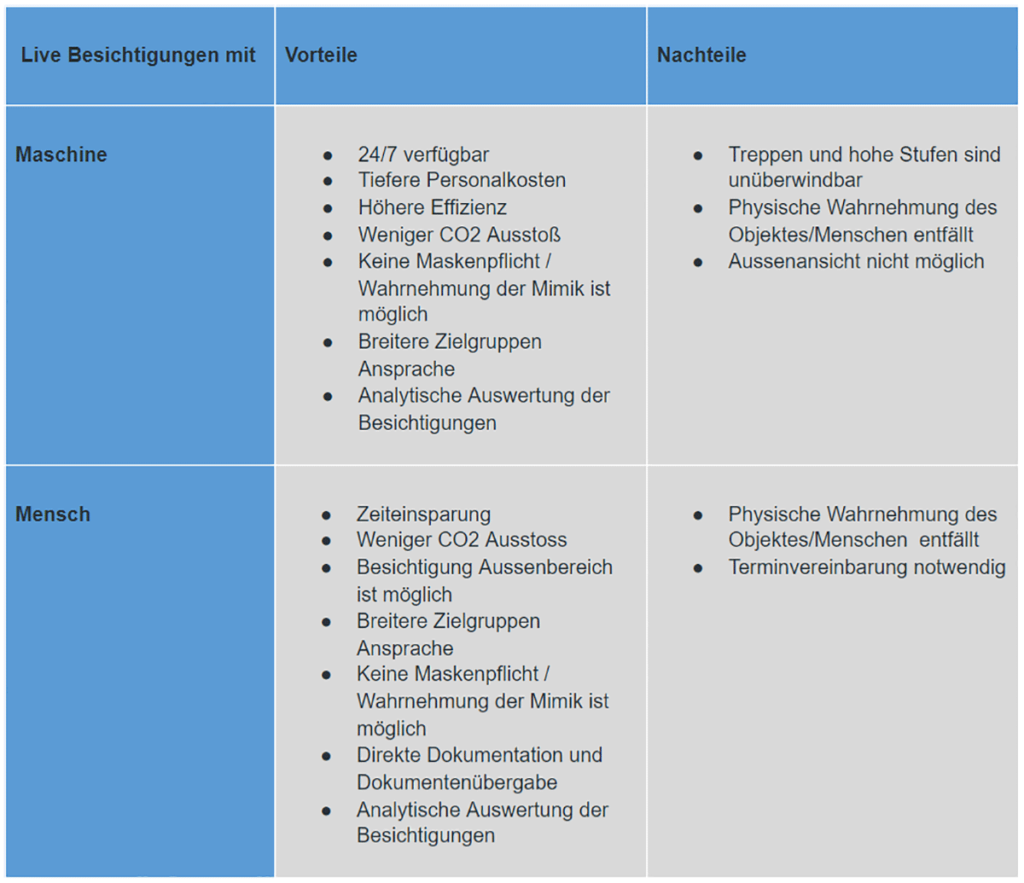
    In the case of live broadcasts , the objects to be viewed are displayed in real time compared to static videos, photos or 360 ° recordings. The greatest advantage of this is that, apart from a viewing appointment, there are no pre- or Post-processing is required. A fully autonomous, 24/7 available variant is the tour with a robot stationed in the property to be visited . This specially developed machine can be conveniently controlled through the object from anywhere in the world, including from home, using a standard Internet browser with the arrow keys on the keyboard. The visit can take place at your own discretion and regardless of the tours and perspectives that have been created. An integrated video conference solution also offers the opportunity to establish a dialogue between the parties during the tour.

    Another variant does not completely do without on-site personnel . While one party (marketer, landlord, owner, facility manager, etc.) is on site and ensures the live transmission via a mobile device (e.g. smartphone, tablet), interested parties can participate in the tour via web browser and with the Interact with the person on site. Due to the high degree of personalization, the automatic documentation of the transmission as well as the possible data exchange, this solution offers far more application possibilities than pure property inspections.

    Even with the current state of the art, digital viewing solutions offer a useful alternative to physical appointments on site. In some points, such as higher efficiency, lower costs and lower environmental impact, the advantages over physical tours even outweigh the advantages. Nevertheless, the solutions presented here do not “yet” succeed in transferring the sensation of a physical encounter with people in digital space. Accordingly, we come to the conclusion that there are valid arguments for tours with man and machine that need to be weighed up according to the situation. In our next article you can read how startups are working on virtual reality to make the aforementioned lack of sensation tangible in the digital world.

    Overview of visualization solutions at: https://proptechmarket.net/visualisierung

    The following table compares the advantages and disadvantages of the two survey approaches described.

    Source: Own illustration, PropTechMarket 2021

  • Adrian Amstutz is to become the top building material recycler

    Adrian Amstutz is to become the top building material recycler

    The board of directors of arv Baustoffrecycling Schweiz proposes Adrian Amstutz as new president to the general assembly. He justifies this in a press release with the experiences of Amstutz as the former owner of an architecture and construction management office, as mayor of Sigriswil BE and as SVP national and state council. Amstutz also chaired the central board of the ASTAG commercial vehicle association for twelve years.

    Amstutz is to succeed Thomas Merz. He resigned as president of the association in autumn after five years. Since then, Vice President Kurt Morgan has been running the President on an interim basis.

    The association was founded in 1990 and is based in Schlieren. He advocates the interests of recyclers of construction waste. The election of the new President is scheduled for the General Assembly on May 19.