Category: Thurgau

  • 80 centimeters slow down 63 million project

    80 centimeters slow down 63 million project

    The secondary school community of Arbon applied for an exemption permit for the planned Lärche school center. Specifically, this concerns the attic storey, which is 4 meters high instead of the 3.2 meters stipulated in the building regulations. The maximum permissible overall height of 16 meters is nevertheless undercut at 15.5 meters. A technical borderline case, not a fundamental problem.

    One man, one objection
    Architect Gustav Maurer has lodged an objection to the application for exemption. He describes the project, which emerged from a competition, as a “proven planning error” and considers it irresponsible in view of the global economic situation. Maurer claims that the required construction volume could be realized for CHF 43 million. This is around 20 million less than the credit of 62.9 million francs approved by the people.

    Timetable is faltering
    The secondary school authorities wanted to submit the building application in November. Due to the objection and the resulting legal uncertainty, this deadline is beginning to waver. If the process is delayed, there is a risk of follow-up costs in the millions due to rising construction prices, longer planning times and postponed building approvals.

    Clear words from the school president
    Secondary school president Robert Schwarzer finds clear words. Maurer has been opposing almost everything that is to be built in Arbon for years. The right to object is undisputed as a fundamental right, but what is being practiced here is an “expression of harassment and arbitrariness”. The objector seemed to be indifferent to the potential multi-million euro follow-up costs.

    Support from the population
    The project has democratic legitimacy. Almost 60 percent of voters were in favor of the 62.9 million loan in September 2025. The ground-breaking ceremony was planned for September 2026, with occupancy scheduled for the 2028/29 school year. Whether this timetable holds will now be decided by the Legal Service. Not at the ballot box.

  • Study shows potential for renewable energy in Frauenfeld

    Study shows potential for renewable energy in Frauenfeld

    The municipal utility company of Frauenfeld, Thurplus, and researchers from the Swiss Federal Laboratories for Materials Science and Technology (Empa) have presented the results of a two-year study entitled “Energy Perspectives 2050”. As detailed in a press release, the study developed scenarios that show which technologies, energy requirements and infrastructures could be used to achieve net-zero emissions in the specified period.

    According to the study, 80 percent of buildings in Frauenfeld are still heated with oil or natural gas. However, decarbonization could be achieved with the technologies already available today, such as district heating, heat pumps, photovoltaics and battery storage. However, to replace the existing fossil heating systems by 2040, 250 buildings a year would have to be equipped with renewable heating technologies. District heating plays a central role here, but solar systems also have great potential. Solar energy, which currently covers 18 percent of Frauenfeld’s electricity requirements, could be increased almost fivefold by 2040, according to the press release.

    The study was carried out in collaboration with Urban Sympheny AG, a spin-off of Empa. The project was supported by the Swiss Federal Office of Energy (SFOE), the Office for Energy of the Canton of Thurgau and the Office for Building Construction and Urban Planning of the City of Frauenfeld.

  • Efficient utilization of agricultural residues

    Efficient utilization of agricultural residues

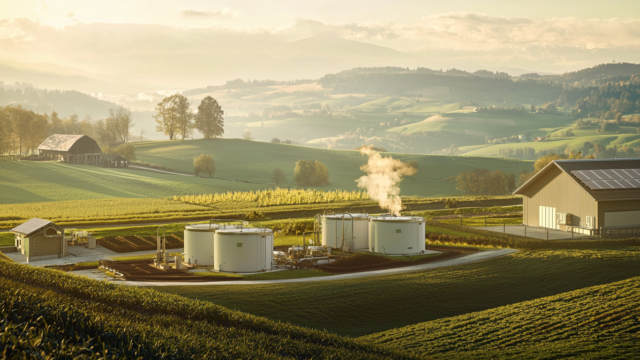
    Renergon International AG wants to set new standards for decentralized energy production. To this end, the Lengwil-based company, which specializes in technologies for generating clean energy, organic fertilizer and compost from organic waste and residual materials, has developed a mini biogas plant with a fuel cell. The RSD XS “was specially developed for farms in Switzerland and offers maximum efficiency on a minimum footprint,” writes Renergon in a press release on the product launch.

    At the heart of the system is a 2-digester system. Here, 2800 to 3500 tons of solid manure can be fermented annually. The biogas produced is utilized in the fuel cell with an efficiency of up to 80 percent. In addition to green electricity, process heat is also generated for operation.

    Each of the two digester boxes is 15 meters long, 5.5 meters wide and 4.5 meters high. They house a gas storage roof as well as a technical and percolate cellar. In total, the plant requires an area of between 750 and 1000 square meters.

  • Merger strengthens electrical expertise in Eastern Switzerland

    Merger strengthens electrical expertise in Eastern Switzerland

    The Arbon-based energy service provider EKT Holding AG has acquired Edelmann Ingenieurbüro AG, based in Thalheim an der Thur. According to a press release, the company will initially operate independently under the umbrella of EKT. All twelve jobs will be retained.

    The engineering firm, which has branches in Winterthur, Schaffhausen and Frauenfeld in addition to its headquarters in Thalheim, specializes in planning, consulting, studies, cost estimates, project planning and construction management for electrical projects. The aim of the merger is to optimally complement the services offered by the building planning company NEGXT AG, Kreuzlingen, which is also part of the EKT Group, according to the press release.

    “This step, this takeover, is a real stroke of luck for us. In the search for a successor solution for our company, EKT was always our partner of choice”, Roman Edelmann, Managing Director of Edelmann Ingenieurbüro AG, is quoted in the press release.

    Thorsten Specker, Managing Director of NEGXT AG, expressed his satisfaction: “As sister companies, we are jointly expanding our market activities to Eastern Switzerland and will do everything in our power to make the best possible use of the synergies this offers us for our customers.

    The merger will increase the number of employees at EKT Holding to 188.

  • Thurgau bank opts for solar energy in Arbon

    Thurgau bank opts for solar energy in Arbon

    Thurgauer Kantonalbank(TKB) has installed a new photovoltaic system on the roof of its branch in Arbon. According to a press release, the new 500 square metre system is the largest that the bank has put into operation. It is expected to supply around 105,000 kilowatt hours of electricity per year. This corresponds to the annual consumption of 21 households.

    The electricity produced on the roof will primarily be used for the operation of the branch. Depending on demand, it will cover between 25 and 40 per cent of the bank branch’s energy requirements, according to the press release. The solar system will also supply three charging stations for electric cars in the neighbouring underground car park of the Novaseta shopping centre. Any surplus electricity generated will also be fed into the public grid.

    With the new system, TKB wants to emphasise its commitment to sustainable and renewable energy and reduce local CO2 emissions.

  • New CEO to take over management of the construction supplier from January 2025

    New CEO to take over management of the construction supplier from January 2025

    From 1 January, the Arbonia Group will once again be led by a CEO who is not also a member of the Board of Directors. As announced by the company, the Board of Directors has appointed Claudius Moor as CEO. Born in Switzerland in 1983, he has worked for Arbonia since 2015 and has been CEO of the Doors Division since 2020. Previously, he was Head of Group Strategy and Corporate Development at the Arbon-based building supplier.

    Alexander von Witzleben will remain Chairman of the Board of Directors “until further notice”. Born in Germany in 1963, he has chaired the Board of Directors since 2015, was also Delegate of the Board of Directors and CEO ad interim until 2022 and has been Executive Chairman of the Board of Directors since then.

    “We are very pleased to welcome Claudius Moor in his new role as CEO of Arbonia”, Alexander von Witzleben is quoted as saying in the press release. “With his extensive knowledge of the industry, his commitment and his great passion for the door business, he has everything it takes to lead Arbonia into a positive future.”

  • Solar power project launched in Frauenfeld

    Solar power project launched in Frauenfeld

    In future,Thurplus will produce solar power on the roof of Signer Elektromotoren in Frauenfeld. According to a press release, the Frauenfeld-based energy supplier commissioned a photovoltaic system with 140 modules on an area of 280 square metres at the end of November. With an output of 62 kilowatt hours, it will generate around 62,000 kilowatt hours of electricity per year.

    Thurplus financed the system, built it with regional craftsmen and will also operate it.
    Signer Elektromotoren is providing the roof and will receive the solar power at a heavily discounted rate. “We have been thinking about realising a photovoltaic system for a long time,” junior boss Dominik Signer is quoted as saying in the press release. “The collaboration with Thurplus was very good and we are pleased to be able to contribute to the promotion of solar energy.”

    Founded in 1967, the family business repairs electric motors and builds customised motors.

    Thurplus is looking for further roof areas for photovoltaics. “Such joint projects contribute to the energy transition and to achieving our urban sustainability goals,” said Fabrizio Hugentobler, city councillor and head of the Thurplus, Leisure and Sport department, in the press release. Frauenfeld aims to install an output of 8,000 kilowatt peak by 2027.

  • Sustainable stadium construction with reusable system components

    Sustainable stadium construction with reusable system components

    Hüttwilen-based event and construction services provider Nüssli has been awarded the contract to build an interim stadium by Spanish second-division football club Real Zaragoza. According to a press release, the sports facility will be able to accommodate 20,000 spectators. Its operation is planned for the next two seasons and should therefore maintain the club’s uninterrupted match operations. The actual home ground, Romareda, will be renovated.

    The stadium will consist of three uncovered spectator areas and a covered stand and will enclose a pitch measuring 120 by 80 meters. The planned construction period is six months, with completion scheduled for Real Zaragoza’s first home game in August 2025. As with other buildings by the specialist company, the construction method involves the use of reusable system components that can be dismantled after use.

    The facilities will also include ticket sales points, a merchandising store, a catering area and booths for radio and television commentators. There will also be an adjoining building with changing rooms, a first-aid room, doping control room, VIP lounges and rest areas.

    “The temporary stadium shows that the highest standards and fan experiences are possible even in transitional times,” said Lluis Herrero, Managing Director of Nüssli Iberia, in the press release. “The project also sets standards for other clubs facing similar challenges.”

  • New app makes measuring and installation planning easier

    New app makes measuring and installation planning easier

    Aadorf-based sun shading manufacturer Griesser has developed a digital platform that can be used to optimize the entire ordering process for customers. According to a press release, potential customers can use the MyGriesser OnSite app with automated processes to significantly reduce the time and effort involved in ordering.

    The app guides the customer step by step through the measuring process. At the same time, a suitable sun shading system can be selected from a digital catalog. Further details about the installation location and installation are added to the app, as are corresponding image or video files. The measurements are transferred to an end device via Bluetooth and the entire data record is synchronized with the MyGriesser platform.

    The app was developed and tested together with users – specialist partners on site. “We wanted to create an efficient, customer-oriented and, in particular, practical digital solution. An important success factor was to involve our specialist partners and our own sales unit, i.e. the stakeholder groups that are particularly close to our customers, right from the start,” Alexander Wimmer, Managing Director of the Griesser business unit, is quoted as saying in the press release. “With our innovative Griesser app, we are revolutionizing everyday life on construction sites and at the same time creating enormous added value for our specialist partners and our direct sales. In addition to massive time savings and fast, expert advice on site, the app creates a better overview and offers an ideal solution for responding even better to individual customer needs.”

  • Thermochemical storage optimises solar energy use

    Thermochemical storage optimises solar energy use

    Lucerne University of Applied Sciences and Arts and its industrial partner Matica have developed a technology that allows surplus solar power to be stored without loss in a thermochemical process in summer and used for heating in winter. A first pilot plant has now gone into operation at the animal carcass collection centre (TKS) in Frauenfeld, Matica announced in a press release. The Wagenhausen-based company specialises in the construction of special containers such as water heaters and heat and cold storage tanks.

    The SeasON demonstration plant in Frauenfeld uses caustic soda as a storage medium. In summer, the caustic solution is concentrated using surplus electricity from the TKS solar system and the separated water is stored in separate tanks at room temperature. In winter, the concentrated lye is diluted again with the separated water. This is vaporised using low-temperature heat from a heat pump. Both this vaporisation energy and the heat generated from the exothermic reaction when the lye is diluted can be used for heating. The storage efficiency of the system is put at up to 95 per cent in the press release.

    “SeasON solves several challenges of the energy transition at the same time and promotes sustainable, efficient energy management,” Benjamin Fumey from Lucerne University of Applied Sciences and Arts is quoted as saying in the press release. “In the development of SeasON, we have mutually conditioned each other and at the same time created a win-win situation between research and practice,” says Matica CEO Marc Lüthi. A second demonstration system is currently being installed in the new Swiss Post delivery centre in Kaltenbach TG.

  • Negative emissions for a climate-neutral future

    Negative emissions for a climate-neutral future

    Energie 360° is opening up the market for permanent CO2 removal to interested companies and private individuals. According to a press release, the Zurich-based energy supplier is now enabling them to buy certificates for negative emissions online.

    The physical removal of CO2 takes place in the pyrolysis plant of Energie 360° subsidiary Bioenergie Frauenfeld. There, CO2 is extracted from waste wood with the help of renewable energies and bound as pure carbon. This is mixed with an earth substrate, for example, and can thus be permanently removed from the atmosphere. Bioenergie Frauenfeld produces around 3500 tons of biochar per year. This corresponds to over 10,000 tons of stored CO2.

    One of the first customers for the certificates is Zürcher Kantonalbank(ZKB). “Our goal is to achieve net zero in our operations by 2030,” ZKB CEO Urs Baumann is quoted as saying in the press release. “In order to permanently remove some of our unavoidable CO2 emissions from the atmosphere, we are purchasing negative emissions certificates from Energie 360°’s Frauenfeld bioenergy plant.”

    Energie 360° also invested in two German start-ups in September in order to develop products for the Swiss market with them. Ucaneo Biotech in Berlin has developed an electrochemical process for the direct removal of CO2 from the air. Planeteers in Hamburg removes stored CO2 from seawater and can thus produce mineralized water and improve the acid-binding capacity of the sea.

  • Environmentally friendly innovation in the construction industry

    Environmentally friendly innovation in the construction industry

    Griesser is switching to even more sustainable aluminum. Previously, the internationally active developer of sun protection systems for buildings from Aadorf used aluminum that consisted of 64 percent primary raw material and 36 percent recycled aluminum, Griesser explains in a press release. Griesser now uses aluminum that consists of only 35 percent primary raw material. The remaining 65 percent is obtained from scrap or consumer scrap generated during the aluminum production process.

    “Our climate vision envisages complete decarbonization by 2050,” Griesser CEO Urs Neuhauser is quoted as saying in the press release. “In the material area of aluminum, we have the greatest leverage to significantly reduce our CO2 footprint.” The aluminum previously used by Griesser had a footprint of around 4.7 kilograms of CO2 emissions per kilogram of aluminum produced. Switching to the even more sustainable aluminum will reduce this figure by 30 percent to 3.3 kilograms of CO2 per kilogram of aluminum. The press release cites a European average of 6.7 kilograms and a global average of 16.7 kilograms as comparative values.

    Griesser is working with two European suppliers to reduce its footprint. They offer certified low-carbon aluminum. In addition to the use of recycled aluminum, the aluminum is produced in Europe using energy from renewable sources and modern technologies, explains Griesser. Compared to conventional production, the production process therefore has “up to five times” lower CO2 emissions.

  • Thurgau agrivoltaics and energy storage projects receive funding

    Thurgau agrivoltaics and energy storage projects receive funding

    Four projects will receive support from the EKT Energy Foundation. According to a press release, 20 applications were submitted to the foundation board for consideration in the second round of awards. All of the projects are working towards a secure, sustainable energy supply and the realisation of climate targets. They were convincing due to their high practical orientation and their connection to the canton of Thurgau. They are also “good examples of how both the Thurgau economy and Thurgau agriculture can benefit from the EKT”, according to Foundation Board President Fabian Etter.

    One of the research projects is in the field of agrivoltaics. Ways of dual utilisation of agricultural land are being investigated, both for the production of crops and solar power. A test plant with semi-transparent photovoltaic modules from the Arenenberg Agricultural Competence Centre is intended to provide insights into the suitability of varieties, weather protection, irrigation and light management.

    Two other projects relating to energy storage are also being funded, as these are central to the restructuring of the energy supply. One is being carried out at the animal carcass collection centre in the city of Frauenfeld, which is involved in the pilot project. The prototype of a sorption heat pump is being investigated. This will allow the waste heat generated during cooling to be stored thermochemically together with the electrical energy from the photovoltaic system during the summer months. The second energy storage project is a preliminary study investigating the opportunities and framework conditions for using modular sand batteries as heat storage systems.

    The EKT Energy Foundation sees further innovative approaches for the energy transition in the Thurgau Energy Utilisation from Underground 2023 project. The funding will be awarded in combination with a loan and is intended to support the basic research and planning work required to apply for funding from the canton and the federal government. The aim of the research is to gain insights into the utilisation of geothermal energy sources.

  • Bank aims for net zero by 2030 in its own operations

    Bank aims for net zero by 2030 in its own operations

    ZKB wants to reduce its operational emissions to net zero by 2030. Since 2010, the Cantonal Bank has already reduced its greenhouse gas emissions by around 70 per cent, explains Marit Kruthoff from ZKB’s Performance Mandate department in an interview on the Cantonal Bank’s blog. The overall goal is to continuously reduceCO2-equivalentemissions(CO2e) and increase operational ecological performance. ZKB aims to limit its operational emissions to a maximum of 1,800 tonnes ofCO2eper year by 2030.

    ZKB aims to eliminate these unavoidable residual emissions through its removal portfolio. This involves removing CO2 from the atmosphere and storing it permanently in plants, soil, oceans or cement, for example. ZKB is relying “on the combination of the three providers neustark, climeworks and Bioenergie Frauenfeld”, explains Kruthoff.

    Climeworks, a Zurich-based spin-off of the Swiss Federal Institute of Technology in Zurich, operates plants that remove CO2 directly from the atmosphere and permanently store the CO2 captured from the air. Bioenergie Frauenfeld, based in the capital of Thurgau, uses pyrolysis to produce biochar and gas from wood. The resulting waste heat is utilised as district heating. Neustark from Bern has developed a technology for storing CO2 in demolition concrete. All three companies achieve negative emissions with their technologies. The resulting waste heat is utilised as district heating. Neustark from Bern has developed a technology for storing CO2 in demolition concrete. All three companies achieve negative emissions with their technologies.

  • Further development of the district heating pipeline between Constance and Kreuzlingen

    Further development of the district heating pipeline between Constance and Kreuzlingen

    In summer 2022, Energie Kreuzlingen, KVA Thurgau and Stadtwerke Kon stanz announced their plans to build a cross-border district heating pipeline. The project is now entering the next phase, Stadtwerke Konstanz announced in a press release. The three partners have agreed to define the key points of the project and to draw up a preliminary project. The realisation decision will then be made on this basis.

    The planned district heating pipeline will run from the future waste incineration plant in Weinfelden to Kreuzlingen and on to Constance. In a memorandum of understanding, the partners have defined the roles and distribution of tasks in the planning process. KVA Thurgau will then take over the financing and realisation of the work required for the project planning. Energie Kreuzlingen and Stadtwerke Konstanz will contribute the technical and planning fundamentals.

    KVA Thurgau is to update the feasibility study already carried out on the basis of the specified technical and operational parameters and initiate the planning of the route. At the same time, the partners want to hold talks with potential partners for financing the project. In a second stage, the basis for obtaining a realisation credit is to be developed. According to current planning, the replacement waste incineration plant could supply its first heat by the end of 2031. The district heating pipeline should also be in place by this time if possible.

  • Four eastern Swiss cantons strengthen cooperation for a networked future

    Four eastern Swiss cantons strengthen cooperation for a networked future

    On July 4, 2024, the governments of the cantons of St.Gallen, Appenzell Ausserrhoden, Appenzell Innerrhoden and Thurgau signed a declaration on closer strategic cooperation. This step marks the start of an intensive cooperation process aimed at strengthening and networking Eastern Switzerland. The joint declaration underlines the commitment of the four cantons to work together to find and implement solutions to common challenges.

    Joint commitment to the Lake Constance region
    The four cantons had previously announced that they would work together to establish the international Lake Constance region at a national level as part of the Swiss Spatial Concept. This project was positively received by the economy and the public and highlighted the potential of closer cooperation to strengthen Eastern Switzerland as a whole.

    Strategic fields of action and annual discussions
    The declaration raises cooperation to a strategic level. The governments of the four cantons will discuss fields of action for cooperation on an annual basis and evaluate the potential for cooperation. Employees of the administrations are invited to submit proposals and participate in the selection of areas for action.

    Possible strategic fields of action include spatial development, transport, education and culture, innovation and digitalization, natural hazard prevention, crisis management and security. The cantons hope that strategic cooperation will lead to more efficient and effective solutions in these areas.

    Flexible cooperation models
    Cooperation can take different forms depending on the needs and situation. Solutions can either be implemented jointly by all four cantons or by two or three cantons. Other cantons, particularly from Eastern Switzerland, can also participate in projects. Each canton decides individually whether a joint solution makes sense for it and offers added value.

    Institutionalization of cooperation
    A central concern of the governments is to start the process of strategic cooperation and then institutionalize it. By taking this step, the four cantons are sending out a strong signal for closer cooperation and a networked future for Eastern Switzerland.

    The signing of the declaration on closer cooperation marks an important milestone on the way to a stronger and more efficient Eastern Switzerland. Together, the cantons want to overcome challenges and develop the region sustainably.

  • Authorisation granted for sustainable office building complex

    Authorisation granted for sustainable office building complex

    Green Spin receives authorisation to build a sustainable office building complex. According to a press release, companies specialising in sustainability will move in here in three years’ time. The future units will have modular rental areas of between 35 and 1,400 square metres with a total area of 31,000 square metres. In addition to commercial, office and production premises, catering businesses and individual retail outlets will also move into the future quarter. Green Spin was initiated and developed by Felix Partner Architektur Design from Zurich.

    The architecture firm promises functional architecture with a photovoltaic façade and wind turbines for green electricity as well as a heating system that works with geothermal energy. The location is close to the city centre and has good connections to public transport and the city’s cycle network. A ramp up to six metres wide, which rises gently around the inner courtyard and is accessible by bike, is a particular highlight. This provides access to the rental space on all levels so that you can cycle directly to the office or shop.

    The building is certified in accordance with the international sustainability standard for buildings, BREEAM, and fulfils the ESG standards for sustainability reporting as well as the standards for Scope 1 and Scope 2 emissions of the Greenhouse Gas Protocol.

  • New commercial property with innovative energy technology

    New commercial property with innovative energy technology

    Immatica AG was granted planning permission for a commercial building on the site of Matica AG in Kaltenbach, to which it belongs, at the beginning of 2024. Matica AG specialises in the manufacture of energy-efficient storage tanks and the construction of special containers. Post AG will be the tenant of the 1,500 square metre new building from the beginning of 2025, as the previous site in Stein am Rhein SH has become too small, according to a press release.

    The flat roof will be equipped with a 1000 square metre photovoltaic (PV) system. A new type of storage technology will also be able to supply the building with solar energy in winter. With a sorption heat pump (SWP), the potential of solar energy can be stored for any length of time using a chemical process. The reversal process produces heat that can be used for heating in winter. The SWP solves several challenges of the energy transition: From the system operator’s point of view, it increases the PV system’s degree of self-utilisation and thus better cushions energy price fluctuations, according to the press release. It also helps to reduce seasonal fluctuations in the electricity grid. This relieves pressure on the grid and reduces the need for grid expansion. The use of the PV system with an annual output of around 215 kilowatt peak could save 33 tonnes of CO2 per year.

    Post AG wants to deliver all its letters in a climate-neutral way by 2030. The electricity generated by the PV system will be used to power all electrical systems in the building as well as the electric charging infrastructure for the electric vehicles. The SWP in Kaltenbach is the second pilot plant to be realised by Matica AG in collaboration with Lucerne University of Applied Sciences and Arts and Helbling Technik AG. In summer 2024, the first system will go into operation at the carcass collection centre in Frauenfeld.

  • Bernapark and Winterthur present themselves to location promoters

    Bernapark and Winterthur present themselves to location promoters

    The Swiss Association for Site Management(SVSM) is holding its traditional Dialogue Site Management conference on 12 March. According to a press release, this time the network for experts from location and business development and the property industry will focus on urban and site development.

    Bettina Furrer will provide insights into Winterthur’s integral site development. The head of the city’s Urban Development Office is responsible for economic and site development, housing policy and Winterthur’s Smart City programme. The former industrial city has developed into a location at the interface of industry, services, health and culture. With Smart Machines, Smart Energy and Smart Health, three clusters for the intelligent further development of the economy have been established on the basis of the location’s existing strengths.

    Caroline Forte presents the development of the site of the former cardboard factory in the Bernese suburb of Stettlen into the Bernapark area. The neighbourhood combines living and working, education and leisure, culture and innovation in historic buildings and new constructions. As a member of the management and board of directors of Bernapark AG, Caroline Forte is responsible for communication and project management.

    The symposium will take place in the Gleisarena Zurich, starts at 4 pm and is open to the public. It will be preceded by the SVSM Annual General Meeting. A decision will also be taken on the renaming of the organisation to Network Location Switzerland. The new name is intended to reflect the intended expansion of the association’s activities to the whole of Switzerland.

  • Halter pushes ahead with project in Bischofszell

    Halter pushes ahead with project in Bischofszell

    Halter AG of Schlierem has pushed ahead with the Schützengütli site project in two steps, according to a media release. After the urban planning, a study contract was awarded for the architectural planning. Of the six participating teams, Daniel Cavelti Architektur AG from St.Gallen came out on top. The study, called Zauberwald, will now be further developed.

    In addition to representatives of the municipality and landowner Halter, the jury also included several experts. They agreed that the winning design fits perfectly into the surrounding neighbourhood. In addition to 54 condominiums, which will be realised in several buildings, the design envisages a spacious inner courtyard that will be lushly planted in accordance with its name, Zauberwald. If construction begins in 2026, the flats could be completed in 2028.

    Until a few years ago, the site was used for production by the Laumann und Co malt factory and fruit pressing plant. The plans by Daniel Cavelti Architektur call for a chimney to be retained as a reminder of the previous use of the Schützengütli site. Halter AG acquired the site in 2022. ce/jh

  • ZHAW weiht Laborgebäude für Lebensmittelforschung ein

    ZHAW weiht Laborgebäude für Lebensmittelforschung ein

    Die ZHAW zieht ihre Lebensmittelforschung an einem Ort zusammen. Dafür hat die Hochschule mit Hauptsitz in Winterthur ein neues Laborgebäude auf dem Campus Reidbach in Wädenswil eingerichtet, informieren Bau- und Bildungsdirektion des Kantons Zürich in einer gemeinsamen Mitteilung. Das von der Tuwag Immobilien AG errichtete Gebäude wurde am 23. August von Baudirektor Martin Neukom, Bildungsdirektorin Silvia Steiner sowie ZHAW-Rektor Jean-Marc Piveteau und Heiner Treichler, CEO der Tuwag Immobilien AG, eingeweiht.

    In das neue Gebäude wird vor allem das Institut für Lebensmittel- und Getränkeinnovationen der ZHAW einziehen. Seine Mitarbeitenden und Studierenden können künftig unter einem Dach die gesamte Wertschöpfungskette von Lebensmitteln erforschen. Dabei soll in Wädenswil „nicht nur geforscht und gelehrt, sondern auch produziert, analysiert, degustiert und verpackt“ werden, heisst es in der Mitteilung.

    Namensgeberin des Laborgebäudes ist die 1842 geborene und 1906 gestorbene Wädenswiler Geschäftsfrau im Biergewerbe Elisabeth Weber-Hauser. Der Kanton Zürich hat die Räumlichkeiten von der Tuwag Immobilien AG für 20 Jahre gemietet. In Mieterausbau und Ausstattung hat der Kanton zudem rund 48 Millionen Franken investiert.

  • Wood-fired power plant in Frauenfeld has opened

    Wood-fired power plant in Frauenfeld has opened

    Bioenergie Frauenfeld AG has officially opened one of the largest wood-fired power plants in Europe in Frauenfeld. The company was founded by Energie 360° and Schweizer Zucker AG to implement this project. The plant’s four gas engines generate electricity for around 8,000 households and heat for the sugar factory and the Thurplus heating network from wood waste that would otherwise go unused. Its technology comes from the Tyrolean company Syncraft .

    “The wood-fired power plant is a perfect example of how renewable energy is produced and used in a decentralized manner,” said Romeo Deplazes from Energie 360° in a press release from the Agricultural Information Service . “It’s the kind of project that is needed for the energy transition.”

    In addition, Bioenergie Frauenfeld also uses the renewable raw material to produce biochar. Part of the CO2 stored in the wood is not released and is permanently removed from the atmosphere in the form of biochar. It is used, for example, in agriculture to improve the soil, as a feed additive or as activated carbon in water treatment.

    The ground-breaking ceremony for the construction of the wood-fired power plant took place in February 2021. “What we have achieved in Frauenfeld in one year is unbelievable,” says project manager Stefan Ellenbroek. “Thanks to the excellent cooperation of all partners, we were able to keep to the very ambitious schedule and realize the light tower project.”

  • Walo completes work at Kesswil train station

    Walo completes work at Kesswil train station

    Walo Bertschinger completed the renovation of a track section at Kesswil station in the short time available. According to a statement on Facebook and on the company’s dedicatedwebsite for this project, it has rehabilitated 595 meters of track for SBB in just seven days.

    In order to meet the time challenge, the work steps had to be precisely interlinked. The close coordination between the various performance centers for transport and logistics, civil engineering, track construction and road construction was carried out by Raphael Reber, construction manager for track civil engineering, according to Walo.

    In order not to endanger the increased volume of traffic with the replacement buses, a concept was worked out with the municipality and the SBB. A temporary bridge was used to calm the volume of traffic in the town of 1,000 inhabitants and to bring around 1,000 trucks to the construction site by a shorter route. In addition, a 600 meter long construction slope was built along the construction site.

    First the rails were removed and then the old ballast was excavated. This was washed and processed. Due to the washed material and the resulting shorter transport routes, Walo was able to guarantee savings of around 65 tons of CO2. A new drainage system was installed for the substructure renovation.

    After the provisional approval of the SBB for the use of the washed ballast, the laying of the tracks could begin. Around 1,000 new sleepers were used for the 595 meter stretch. A report of the construction work with comments from the construction management can be seen on YouTube.

  • Baumer is building in Frauenfeld for 20 million francs

    Baumer is building in Frauenfeld for 20 million francs

    Baumer will add a development center to its Frauenfeld site. The company is investing 20 million francs in its new Innovation Center. It will offer space for around 120 employees on 5,000 square meters. According to a press release , the teams should move in in late summer 2023.

    Baumer is investing in its innovative strength for the second time in just a few years, following the opening of the new high-tech center in Stockach in southern Germany in 2018. The central location between the Swiss Federal Institute of Technology in Zurich , the University of Excellence in Konstanz and the OST – Ostschweizer Fachhochschule is “optimal”. “The new building enables us to expand the development capacities at the headquarters in order to expand our position as a driver of innovation,” says Dr. Oliver Vietze quoted, CEO of the company from the St.GallenBodenseeArea.

    When it comes to sustainability and energy efficiency, the Innovation Center is set to become a showcase project. A complete solar building envelope is planned for power generation. Geothermal probes and a heat pump are to temper the building. Baumer will obtain further CO2-neutral electricity from Swiss hydropower.

  • Heart Neuro Center Lake Constance is inaugurated

    Heart Neuro Center Lake Constance is inaugurated

    On February 7th, the key handover ceremony for the new Heart Neuro Center Lake Constance on the Münsterlingen hospital campus took place. A department for neurological early rehabilitation from the Rehabilitation Clinic Zihlschlacht will also start work there in March.

    The move of the patients from Kreuzlingen TG had taken place two weeks earlier without any problems, according to a media release . The Heart Neuro Center in Münsterlingen has been in regular operation since January 24th. Since then, 50 interventions have already been carried out.

    Government Councilor Urs Martin and Mayor René Walther delivered greetings. As a sign of their “lived partnership”, the flags of the two sponsors and the canton of Thurgau were hoisted.

    The CEO and owner of the real estate service provider HRS Real Estate in Frauenfeld, Martin Kull, handed over the symbolic key to the two operators. HRS “entered the demanding construction project” at the end of 2021, “after the new clinic building threatened to fail due to massive construction delays”. According to the information provided, Professor Dierk Maass, Chairman of the Board of Directors of the client, confirmed to the HRS team that they had “achieved a great deal in an enormous race to catch up” during the final sprint.