Category: Solothurn

  • New impetus for the Schwarzbubenland region

    New impetus for the Schwarzbubenland region

    The Forum Schwarzbubenland has appointed a new location promotion officer for the districts of Dorneck and Thierstein. According to the association, it has entrusted National Councillor Christian Imark with the mandate. The aim is to better meet the needs of a dynamic economic situation.

    On the one hand, the location promoter should help to attract new companies in order to strengthen the economic base. On the other hand, he is to support local companies in overcoming current challenges and achieving growth. Finally, Imark is to intensify cooperation between business, education and politics.

    “As an experienced personality from politics and business, Christian Imark brings with him the ideal tools to make our region better known, position it successfully and provide new impetus,” Dieter Künzli, President of Forum Schwarzbubenland, is quoted as saying in the press release.

    Christian Imark (born 1982) has been a member of the National Council for the Swiss People’s Party (SVP) since 2015. He is also the owner of Airboxx GmbH, a company based in Fehren SO that specializes in the rental of marquees. The location promotion mandate comprises a 30 percent workload.

    Imark replaces Karoline Sutter, who took over location promotion in 2022. At that time, the mandate still consisted of the location promotion of Schwarzbubenland and the neighboring Baselbieter Laufental. Sutter took over the mandate together with Rita Stoffel-Meury.

  • New building strengthens Solothurn cantonal police force

    New building strengthens Solothurn cantonal police force

    The tasks of the police have become more diverse. Technology and society are changing rapidly. Legal requirements are becoming increasingly complex. KAPO Solothurn needs new structures to be able to react to this. Well-trained employees and ongoing training are more important than ever. Sufficient equipment is also a basic requirement for efficient work today.

    Lack of space, outdated infrastructure
    The existing infrastructure no longer meets current requirements. Many services work in cramped and unsuitable rented premises. There is a lack of special rooms for training and modern investigations. Forensics and the education and training service are particularly affected. Employees therefore have to move to external premises. This complicates processes and costs time.

    The new building as a solution
    A central unit for the police is being built at the Oensingen site. More than 150 employees from eleven different services will work under one roof in future. This will create better communication and shorter distances. Cooperation with the nearby heavy traffic control center will also be simplified. The new building offers enough space for current and future teams. Modern working and training conditions ensure greater efficiency and motivation.

    The focus is on training and quality
    A new on-site training center simplifies the training of police officers. Forensic technology will have modern laboratories and examination rooms. This increases the quality of work and improves conditions for everyone.

    More efficiency, lower costs

    The new structures will simplify processes and reduce costs. The internal synergies and proximity to the SVKZ lead to shorter deployment times. This makes the jobs for the police more attractive and increases their effectiveness.

    Facts, figures and outlook
    The building is planned to cost around 85 million francs. The floor space amounts to a good 10,400 m². The building offers rooms for all important police services. It has special training areas, laboratories and 204 parking spaces. Completion and occupation are scheduled for 2031. Luna Productions from Deitingen delivered the winning project in the competition. The costs are constantly being reviewed and optimized.

    The new building will position the Solothurn cantonal police for the future. Better working conditions, more efficient processes and modern technology will ensure that police work can continue to develop flexibly.

  • Discussion about security of supply and dependence on nuclear power

    Discussion about security of supply and dependence on nuclear power

    The Gösgen nuclear power plant(KKG) is modernizing its feed water system. It has therefore been off the grid since the end of June. The resumption of electricity production has now been delayed by a further six months, according to a statement.

    KKG blames this on the increasing safety requirements. The system needs to be strengthened at certain points. It also needs more time to provide evidence to the authorities. The KKG can only be restarted once the Swiss Federal Nuclear Safety Inspectorate(ENSI) has given its approval. The KKG is therefore expected to be able to return to the grid at the end of February 2026, according to the press release.

    The operators expect a loss of production during these eight months amounting to almost 6 terawatt hours and a loss of revenue of 500 million Swiss francs, Alpiq writes in a press release.

    Alpiq is the largest single shareholder with 40 percent and expects a loss of earnings of CHF 200 million. Axpo is the second-largest shareholder with 25 percent, followed by the city of Zurich with 15 percent, Axpo subsidiary CKW with 12.5 percent and Energie Wasser Bern(ewb) with 7.5 percent. On top of this, the shareholders must now procure the missing electricity on the free market in order to meet their supply obligations.

    KKG covers a good tenth of Switzerland’s electricity consumption. Critics of nuclear power such as the Swiss Energy Foundation SES point out the risks of centralized power generation. “Dependence on individual nuclear power plants represents a cluster risk for the secure supply of electricity,” Managing Director Nils Epprecht is quoted as saying in an SES press release. “We would do well to shift our electricity production to many decentralized, renewable plants as quickly as possible.”

  • Monument protection and technology in harmony

    Monument protection and technology in harmony

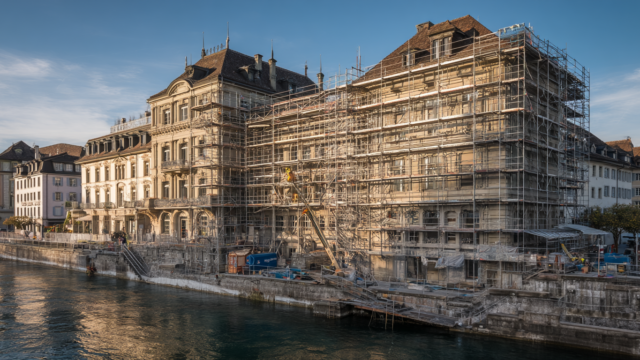
    According to a press release, the Schlieren-based construction company STRABAG AG and its building construction department are taking on “central tasks in the comprehensive renovation of the Landhaus Solothurn”. In addition to measures to modernize the building’s technical infrastructure, including plumbing, ventilation, lighting and stage technology, the focus is on modernizing the heating system.

    This will be converted to resource-saving energy generation by means of a heat pump. Water from the River Aare will be used as a heat source to supply both the Landhaus and adjacent public buildings such as the youth hostel, Kollegium school and municipal theater.

    The location between the old town and the River Aare requires logistical attention. Material deliveries and waste disposal had to take place in the morning so that the riverside promenade could be used as a promenade from midday.

    It was also necessary to take into account the stringent requirements of monument protection. The listed country house is like a “winding architectural work of art with six levels, each with its own renovation requirements”. The approach required “sensitivity” in order to preserve the historical character and the fabric of the building. In particular, the original Solothurn limestone staircases are to be preserved in their uniqueness, it is said. Special protective devices have been created for this purpose.

    Solothurn voters approved the renovation in October 2023. Construction work has been underway since January 2025. Construction is scheduled to end in October 2026. In January, construction site operations will be suspended in consideration of the Solothurn Film Festival 2026.

  • Automated production for sustainable energy use

    Automated production for sustainable energy use

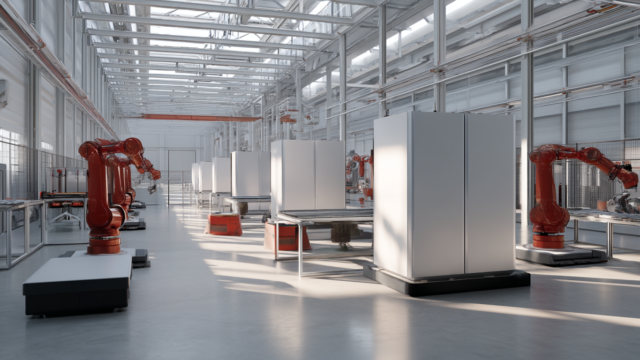
    Libattion AG, based in Opfikon, has opened a new plant in Biberist for processing used batteries from electric cars. Here, the batteries are used to produce modular stationary energy storage units. According to the company, this is Europe’s largest plant of its kind. The production facility was set up on the site also used by battery recycling company Librec.

    The new facility has a high degree of automation. “Our new production hall enables us to respond flexibly to market requirements and make an important contribution to conserving resources in Europe,” said Stefan Bahamonde, CEO and co-founder of Libattion, in the press release. “By automating our production, we can not only operate efficiently, but also economically and adapt our capacities precisely to demand.”

    In 2022, Libattion produced stationary storage systems with a total capacity of 7 megawatt hours; last year, the company already achieved a total capacity of 27 megawatt hours. The company aims to increase its total capacity to 500 megawatt hours by 2026. Libattion’s storage systems have a modular design and can have capacities ranging from 97 kilowatt hours to 60 megawatt hours. Safety is the top priority, explains Bahamonde: “Thanks to automated production and strict quality controls, we can guarantee the highest safety standards for every storage system”.

  • Expansion of the photovoltaic system in Schönenwerd

    Expansion of the photovoltaic system in Schönenwerd

    Fashion Fish is investing in the expansion of solar energy, taking the next step towards greater sustainability. As the Schönenwerd-based outlet for designer items informs in a press release, the expansion of the photovoltaic (PV) system on the roofs of the six-storey former Bally production building includes a further 335 solar modules with an output of 140 kilowatt peak. In total, the area equipped with PV modules has increased by 664 square meters.

    According to the press release, the company has been taking steps towards more sustainable energy use for years. According to Managing Director Robert Meier, heating energy is generated via district heating. Electricity requirements have been covered by PV systems since 2020.

    The installation of the first system on the shed roofs has already achieved high peak outputs. An expansion to the east and west at the beginning of 2024 led to a balance in output throughout the day. By the end of August, energy production had amounted to more than 47 megawatt hours of electricity.

    The aim of the investment is to ensure that the majority of stores cover their energy requirements with solar power. This is also to the benefit of customers, for example through cooling ventilation in the summer months. “Thanks to the measures we have taken, we have been able to drastically reduce Fashion Fish’s CO2 emissions in recent years and offset the energy consumption of our air conditioning and ventilation systems with our own solar power,” Robert Meier is quoted as saying. The decision to expand the plant coincides with the company’s 20th anniversary year.

  • Strabag builds roads in the Weitblick district of Solothurn

    Strabag builds roads in the Weitblick district of Solothurn

    The Schlieren-based construction company Strabag is carrying out work in the future Weitblick district of Solothurn to create a network of roads and paths as well as all utility lines. According to a press release, the new Weitblick district in Solothurn will be completed by 2036. The district will provide living space for around 1,700 people and accommodate the same number of jobs. There will be a new park and recreational space. Thanks to Weitblick, the city of Solothurn will be able to create new living space and space for new life in a central location, in the existing district structures and at the gates of the old town, the press release continues.

    According to the press release, Strabag has been involved in the project since the start of construction. In April 2023, Strabag teams began road construction work in the northern part of the site. Last September, Strabag laid the surface for the first road in Weitblick. After a construction break, the final work is now in full swing and the job will be completed in this part of Weitblick in the next few weeks. Construction work in the southern part of the Weitblick site is currently in full swing, according to Strabag.

    The subsoil in this area is also difficult to build on due to the high groundwater level. Sheet piling, bored piles and a lowering of the groundwater level were therefore necessary. All special civil engineering work was carried out by Strabag. The trenches for the utility lines are currently being excavated and the access roads for the Weitblick site are being constructed.

  • Building cooperatives should act more confidently

    Building cooperatives should act more confidently

    Association President Daniel Burri welcomed around 100 delegates and guests to the 13th ordinary delegates’ meeting of Wohnen Schweiz on 20 June at the Landhaus Solothurn, the association of building cooperatives reported in a press release. Everyone agreed that cooperative housing construction is more necessary than ever due to the housing shortage, according to the press release. Those responsible should therefore be “more self-confident”.

    In a video message, Federal Councillor Guy Parmelin acknowledged the important role played by non-profit property developers in the creation of affordable housing. Parmelin cited densification, streamlining procedures and the provision of more affordable housing as the key to solving the housing problem. Association President Burri called for “these statements to be followed by concrete action and for the instruments of indirect housing promotion, in particular the Fonds de Roulement, as well as the work of the associations to be strengthened”. In particular, Wohnen Schweiz wants to defend itself against planned cuts to the federal government’s performance agreements with the umbrella organisations.

    The wohnen malters cooperative was honoured with the Swiss Housing Foundation’s recognition award at the delegates’ meeting. The company, which is based in Malters LU, received the award, worth CHF 10,000, for the refurbishment of the Oberfeld property in Malters.

  • HIAG wins cleantech company Grensol as tenant

    HIAG wins cleantech company Grensol as tenant

    The property company HIAG has been able to secure another cleantech company as a tenant for its Papieri site in Biberist. According to a press release, Grensol AG recycles valuable low-emission resources such as hydrogen, carbon black, metals and glass from end-of-life vehicles. By recycling in the circular economy, the company also avoids waste incineration and landfill, which emit pollutants. On 19 June, Grensol was awarded the W.A. de Vigier Award, one of the most coveted sponsorship prizes in Switzerland, for its commitment. Grensol will build its first pilot plant in Switzerland on an area of 860 square metres on the Papieri site.

    “We are delighted that Grensol AG is the second clean-tech company to decide to build its innovative plant on our Papieri site,” said Raphael Schibli, the responsible asset manager at HIAG, in the press release. “This shows that the Papieri site offers ideal conditions for companies from various industries to develop.”

    The start-up Librec AG had already established itself on the site. The company specialises in the recycling of electric batteries.

  • Future Perfect launches project for circular construction

    Future Perfect launches project for circular construction

    The Future Perfect association, together with the Plavenir professional association, the Constructa Association of Teachers of Drawing Professions and the educational materials publisher LernMedien-Architektur GmbH, is realising a project to integrate circular construction into basic vocational training in spatial and construction planning. The Future Perfect Circular Building project aims to teach skills for the reuse and recycling of materials and components, Future Perfect explains in a press release. A test run is planned for the spring semester 2025. The courses will be available to schools on a regular basis from autumn semester 2025.

    The project is aimed at both students and teachers of spatial and construction planning. Teachers will be offered full-day training courses in which they will be introduced to circular construction and the use of Future Perfect’s digital teaching materials will be explained. Digital courses for basic education, advanced seminars, project work and project competitions will be made available to learners. The project is financially supported by the Minerva Foundation and the Federal Office for the Environment.

  • Opening of a new vocational training centre

    Opening of a new vocational training centre

    Polybau ‘s new training centre in Grenchen will be the third vocational training centre after the two main sites in Uzwil and Les Paccots. Polybau was founded in 1949 as a technical college of the Swiss Association of Master Roofers. Today, it is regarded as the leading training centre for building envelope specialists in Switzerland. The expansion is intended to strengthen Solothurn’s educational landscape and cooperation with local businesses and industry.

    “With its central location and good connections to the public transport network, Grenchen is easily accessible for students from the entire region,” said André Schreyer, Managing Director of the Polybau training centre, in a press release. “The new vocational school location also offers the necessary infrastructure to meet the high demands of modern and future-oriented vocational training.”

    Every year, around 750 Swiss Federal Certificate of Competence (EFZ) and Swiss Federal Vocational Certificate (EBA) apprentices are trained in the fields of roof, wall, sealing, sun protection and blind technology as well as scaffolding. From August, some of the new solar professions and existing German-speaking roofing classes, which are currently based in Les Paccots, will be taught at the new site in Grenchen. Polybau’s strategy is to train young people in Switzerland and promote their professional development. The school management responsible for the school concept will remain at the Uzwil site. According to the press release, the centralised administration guarantees efficiency and quality in training.

  • Energy crisis 2022 leaves its mark on the financial year

    Energy crisis 2022 leaves its mark on the financial year

    Region Energie Solothurn also felt the consequences of the 2022 energy crisis in 2023. According to a press release, the regional supplier posted a loss of CHF 760,374. It blames this on record-high purchase prices, which have a delayed effect until 2024. It has not passed these on to customers in full.

    Gas sales to business and small customers fell by 4.6 per cent to 334 gigawatt hours in 2022. Sales to large customers even fell by 19.4 per cent to 394 gigawatt hours. Regio Energie Solothurn refers to the measures taken by the federal government, under which the industry was required to switch from gas to oil.

    Electricity sales increased by 11.1 per cent to 130 gigawatt hours. The company points out that it has also been supplying the municipalities of Lommiswil SO and Nennigkofen SO since January 2023. On the other hand, the grid levy has fallen because more solar power is being produced for the company’s own consumption instead of being fed into the grid.

    Regio Energie has also completed the biogas pipeline between Utzenstorf BE and Gerlafingen SO. This means that the planned biogas plants in Utzenstorf can be realised.

  • New branch manager in Solothurn

    New branch manager in Solothurn

    The PRIVERA branch in Solothurn will be managed by Matthias Räber from August 1st, 2022. Mr. Räber is a real estate manager with a Swiss Federal Diploma. Specialist certificate and has been supporting PRIVERA since October 2021 as a senior manager. He previously worked as head of property management at a well-known real estate company in the Olten/Gäu/Solothurn region and has many years of experience in the real estate industry.

    Matthias Räber is taking over from Roger Kiefer. Mr. Kiefer is leaving PRIVERA at the end of July 2022 to take on a new professional challenge. Until Matthias Räber took up his post, the time was optimally used for the handover. «Being able to fill the branch management in Solothurn internally is an asset for PRIVERA. Matthias Räber will continue to run the branch with great commitment,» says Andrea Jürg Wegmüller, COO of PRIVERA.

  • UBS pension fund joins Halter project

    UBS pension fund joins Halter project

    As the new landowner of the Attisholz core area, the UBS pension fund is participating in the Attisholz development project in Riedholz. According to a media release by Halter AG , this core area covers an area of 73,000 square meters. The remaining area of 420,000 square meters will remain in the possession of Halter. The Schlierem-based real estate company will transform the area step by step over the coming years and will implement various construction projects in the process. “By the time it is completed, this part of the site will offer space for around 740 apartments with 1,250 residents. At the same time, several hundred new jobs will be created,” says the project’s goals.

    A cooperation agreement between the canton of Solothurn, the municipality of Riedholz and Halter AG was originally concluded for the project. This has now been expanded to include the UBS pension fund. “The entry of the UBS pension fund immediately after the usage plan came into force is a strong commitment to the Attisholz area and thus also to the Solothurn region as an attractive place to live, work and live,” says Andreas Campi, Managing Director of Halter Developments.

    The municipality and canton are also pleased about the entry of the UBS pension fund. Sandra Morstein, Mayor of Riedholz, sees the “trustworthy and constant cooperation” of all partners strengthened. “For the Canton of Solothurn, the sustainable and future-oriented development of the Attisholz area is a central concern,” says Government Councilor Birgit Wyss. “The investment by the UBS pension fund is an important signal for the canton of Solothurn as an investment location.”

  • Plans for the Attisholz area are issued

    Plans for the Attisholz area are issued

    A competition for landscape architects was carried out for the design of the Attisholz area in Riedholz. According to a media release from Halter AG , those that are to be pursued have been selected from the six projects submitted. The Schlieremer construction group is the landowner of the area. The projects will now be presented to the public. The exhibition opened on Thursday, May 19, at 5 p.m. in the evaporation plant building. The exhibition will remain open until June 2nd.

    The government council of the canton of Solothurn approved the usage plan for the Attisholz area in Riedholz in December. The project page from Halter states that cellulose was industrially produced on the site for 130 years. Since the end of 2016, Halter AG has been working with the local municipality of Riedholz and the canton of Solothurn to find a new use for the area.

    Six teams led by landscape architecture offices took part in the competition that has now been held. In the program, the creation of a sustainable and changeable basis for the development of a living space for all users was formulated as a core task. The aim was to design the mostly public open spaces on the eastern part of the site in detail.

    The assessment committee consisted of experts in landscape architecture and urban planning, representatives of the municipality of Riedholz, the office for spatial planning of the canton of Solothurn and the landowner Halter AG. The committee unanimously recommended the study by DnD Landschaftsplanung ZT Wien and Freimüller-Söllinger Stadtbau ZT Wien for further processing.

  • Halter AG can realize the Attisholz-Areal project

    Halter AG can realize the Attisholz-Areal project

    The government council of the canton of Solothurn has approved the land use planning for the Attisholz area in Riedholz. The decision ensures the further development of the area in the next 25 years, according to a media release from the Schlierem-based construction company Halter AG . On the Halter project page , it says about the project that cellulose has been industrially produced on the site for 130 years. Since the end of 2016, Halter AG has been working with the municipality of Riedholz and the canton of Solothurn to redesign the area.

    The usage planning that has now been approved was drawn up from 2018 to 2019 in a planning group of the municipality, the canton and Halter AG. After the preliminary examination, the participation procedure and the condition of the land use planning from 2020 to 2021, the municipality of Riedholz transferred the dossier to the canton of Solothurn in June 2021, according to the holder's notification. The decision of the government council now creates the planning law basis for a new zoning plan, as well as a zoning and development plan, in order to develop a living space for living, working and leisure out of the area.

    It is important that "the population stands behind the project and that the effects on the community in social, economic and ecological terms are acceptable," said Sandra Morstein, Mayor of Riedholz. "That is why great importance was attached to informing and participating in the population as well as trusting and constructive cooperation with the canton and Halter AG in the planning and development of common objectives."

    The results of a study by landscape architects on open space will be available in February. The planning of the infrastructure for public transport and community buildings such as schools and day-care centers is in preparation.

  • Steiner AG is redeveloping the industrial area in Breitenbach

    Steiner AG is redeveloping the industrial area in Breitenbach

    The Steiner Investment Foundation wants to convert the Isola area not far from the center of Breitenbach into a residential and commercial area. The owner of the eleven hectare site has commissioned the construction service provider Steiner AG with this, according to a media release . The residents of Breitenbach are to be included in the development process from next year.

    The project developer also wants to open up the Isola area, which is located directly on the Lüssel, to the public. “This can look forward to new, attractive meeting and green areas, which will be created in place of the existing company roads and storage areas”, Stefan Gabriel, team leader for real estate development at Steiner AG, is quoted in the media release.

    The new quarter is not intended to compete with the village center, but rather to complement it. An intensive exchange is currently taking place with the Breitenbach municipal administration about the respective ideas and expectations. As a basis for a common understanding of the spatial development of the area, an urban development and open space planning test planning process will also be carried out, according to the media release. Renowned architectural offices and landscape architects would be invited to come up with suggestions.

    Construction on the first stage is expected to start in 2029. During the planning phase, however, the company wants to enable interim uses and, if necessary, bring forward individual conversion projects in existing buildings.

    The Steiner Invest Foundation, a Zurich-based asset management company for Swiss pension funds and an investment foundation of Steiner AG, acquired the 114,280 square meter area with its largely empty industrial and warehouse buildings in spring 2021.

  • Renewal of the Läbespark retirement home

    Renewal of the Läbespark retirement home

    The four existing main buildings and other auxiliary buildings in the Läbespark retirement home in Biberist are getting on in years: they were built between 1969 and 1995. In order to improve the quality of life for around 100 residents, the cooperative had a refurbishment project drawn up. Phalt Architekten AG, Wam Planer und Ingenieure AG and Neuland ArchitekturLandschaft GmbH were commissioned for this. A committee consisting of representatives of the Biberist community, the responsible cooperative and various experts accompanied the process.

    The alignment project forms the basis for the design plan process and the further project elaboration. The oldest house at Blümlisalpstrasse 12 will be replaced by a new building. The height of this is based on the existing building. Compact small apartments based on the Bonacasa building standard are planned. The 1.5 to 3.5 room apartments will have a wet room with a laundry tower and a loggia facing the park-like inner courtyard. A reduit complements the larger apartments. «The existing restaurant / café Pintli will move into the new building. To do this, we are revitalizing the premises of the former Pintli with commercial and service uses, ”says Ronny Fluri from Bonainvest AG, which takes on the building owner function for the cooperative. A common room is also planned, which should also promote social contact among the residents. The new building will have a parking garage.

    So the previous parking lot can give way to a piazza. “We are thus creating another meeting zone and upgrading the area. Our green park with a small pond will have a herb garden, more seating and various exercise elements that are intended to provide incentives for the residents, ”explains Fluri. The surrounding quarter will be better networked by footpaths. But there is still one problem to be solved: “The building that is being replaced has heating for two more houses. We would like to work with geothermal probes in the future. However, various investigations are still ongoing, ”says Fluri. When this has happened, the other buildings can at least be refurbished in terms of energy. There is still some time until construction begins: work is scheduled to start in 2023. The new building should be ready for occupancy at the end of 2024.

  • Listed outdoor pool, newly renovated

    Listed outdoor pool, newly renovated

    In three consecutive winters, the Solothurn outdoor pool is transformed into a construction site. In the first winter, 2019/20, the sports pool at Badi Solothurn was renovated. In the second and third winter, it is the turn of the outdoor swimming pool to be built.

    The two stages of renovation of the buildings were preceded by a municipal council decision, a municipal assembly decision and a referendum. In the latter case, the people approved the restructuring loan of 7.8 million francs in February 2020 with 86.7 percent yes-votes.

    The renovation is intended to remedy safety deficiencies, the swimming pool is to be made more accessible, processes are to be optimized and visitor flows are to be unbundled, and there should be more showers and toilets. Overall, the outdoor pool should offer guests more comfort after the renovation. Since it is a listed building, the visible changes must be subtle.

    With the start of the 2021 bathing season in mid-May, the first phase of renovation in the Solothurn outdoor pool was completed. In this first phase of renovation, underground technical work was the main task. The building structure was repaired and safety deficiencies were corrected. In addition, the northern parts of the extension from 1964, where the entrance area and cloakrooms are located, were renewed in this phase. The construction of new showers and a new cloakroom area also started, which will continue in the second stage.

    The second stage of the building construction will begin this year after the end of the bathing season in September 2021. Then the southern part of the extension building with a restaurant, kiosk, cloakrooms, showers and toilets will be renewed. A new lift will enable people with walking difficulties to access the restaurant.

    Some preparation and follow-up work may overlap with the end or the start of the bathing season. The outdoor swimming pool should always be possible. The renovated Solothurn outdoor pool is due to go into operation in mid-May 2022.

  • From the metal factory to the mixed neighborhood

    From the metal factory to the mixed neighborhood

    The Wydeneck was a closed area for over 100 years and was used exclusively by the "Schweizerische Metallwerke AG Dornach" for metal processing. Swissmetal still produces today and uses around half of the area. Small craft businesses and manufacturing SMEs also work.

    In 2015, Hiag acquired the area in Dornach and began planning its future use. In close cooperation with the canton and municipality, the owner developed a coherent basis for the transformation of Wydeneck. The leading office for the test planning process was the Zurich urban planning office Feddersen & Klostermann in collaboration with Brühlmann Loetscher. 90 interested residents brought their wishes and suggestions into the planning process during a two-day participation process. On this basis, the master plan was drawn up and approved by the municipal council in 2018. In this context, the new name was also announced: Wydeneck – Metalli im Wandel.

    The area-specific sub-zone plan revision and the development of a sustainable mobility concept are currently on the agenda. Central topics are the development of the quarter with a bus line, its own S-Bahn stop and the integration of the feeder to the A18 motorway. Building land is to be re-zoned along the Birs and the river basin is to be revitalized.

    The opening of the aeral will initially take place through transitional uses. This creates space for business, leisure and culture. The offers are intended to attract customers and visitors. With the start of the first construction phase, these uses will be successively replaced or relocated. Several hundred apartments as well as commercial and service-oriented offers will be built in the next 20 to 25 years. Some of the existing historical buildings will be renovated and will remain as a contemporary witness of industrial history.

    The Wydeneck is to become a lively, mixed and urban district. Around 1,800 residents and a wide range of commercial and service offerings with up to 400 jobs are planned. The publicly accessible riverside park and the preservation of the historical substance also ensure the special flair.

  • Papieri Biberist – The quarter of tomorrow is created today

    Papieri Biberist – The quarter of tomorrow is created today

    In mid-2012, Hiag acquired the premises of the former paper mill in Biberist. The area with around 277,000 m² of industrial space was used for paper production for a good 150 years. Accordingly, it is very well anchored as an industrial location in the region and is considered a development area of cantonal importance. The area is strategically located along the A1 and A5, between the metropolitan areas of Zurich, Basel and Bassin lémanique. Within the Solothurn industrial cluster, the Papieri area benefits from the networking with numerous companies and research institutions as well as a unique, high-performance infrastructure on the area. In addition to the largely commercial-industrial use, places are to be created on the area where work, culture and leisure uses as well as living can be found.

    The Papieri area is ideally located and should become a destination in the suburban country.

    Revitalization of the area
    In cooperation with the municipality and the canton, work is being carried out on the transition to a binding sub-zone plan: "The sub-zone plan is currently being revised, which will encompass the entire area perimeter," says the responsible site developer Michele Muccioli to Immo! Nvest. “We expect 12 to 18 months before the zoning plan becomes legally binding. After three complete lines of paper machines have been sold in the past few years, the remaining lines are currently being sold. In addition, the settlement and provision of usable space will continue to be promoted. " Around 20 companies are currently located on the site, and around 120 people have their workplaces on the paper. Companies from a wide variety of areas are located here. The next step is the partial opening of the area in the area of the Biberist Ost train station. The aim is to activate and revitalize the area. According to Muccioli, this is now possible because the sales and dismantling of the large machines have now been completed.

  • Spinning mill, girls' home and soon residential area

    Spinning mill, girls' home and soon residential area

    The Emmenhof is located in the center of Derendingen and looks back on a varied history: It began 150 years ago with the establishment of a cotton spinning mill. In 1897 a girls' home was also built. In 1932 there was another change of ownership: when Scolari AG moved in, the Emmenhof served as a pasta production facility until 1973. From then on, various SMEs settled on the 50,000 m² area. Even today there are around 100 companies that have their offices or warehouse here. The area, which has so far only been built on in the southern part, is characterized by its own hydropower plant, the striking factory and the former manufacturer's villa.

    Emmenhof Immobilien AG has planned a fundamental transformation of the area: by 2030, a new quarter with residential offers, leisure facilities, various office and commercial space as well as a catering concept is to be built here. In addition to the preservation of some detached historical buildings, several new buildings are planned. A total of 270 apartments are planned, the construction of which is based on the history of the area.
    Access to the new quarter is marked on the south side by the “Wollturm” with ten floors, an underground car park entrance and a visitor parking lot in front of it. This entrance is followed by the “cotton yard”, which is framed by two buildings and closed off by the historic factory building. The “Garnwerk”, “Turbinenhaus” and “Därberei” buildings are being built in the north of the site. Generous green areas and direct access to the Emmen Canal and the Schluchtbach give the quarter a natural character.

    The development of the area is planned in six stages. The first stage has already been completed and includes the “Spindelgut” project in the southwest. The new building, designed by the architects Liechti Graf Zumsteg, consists of three wings with 14 apartments.

    Emmenhof Energie AG is the area's electricity producer. This enables tenants and owners to obtain sustainable energy: from photovoltaic systems that are installed on the roofs of the new buildings and from hydropower. Hot water and heating get into the houses by means of district heating.

  • Riverside benefits from pop-up pickling

    Riverside benefits from pop-up pickling

    The Riverside in Zuchwil combines the best of both worlds: urban amenities and rural tranquility. The owner is the Swiss Prime Investment Foundation, which not only attaches great importance to careful treatment of the environment, not only in this sensitive development. "For us, a holistic, sustainable development of this former Sulzer industrial area also includes regular exchange with the surrounding area and the community in order to be able to respond to the current needs of society in the further development of the existing master plan," says Tobias Hossfeld, Head Development at of Swiss Prime Site Solutions AG, the asset management team of the investment foundation. Markus Hauri, a genuine Solothurn native and his team from mha GmbH, is responsible for the structural developments. At the same time, Andreas Brunner and his team from Wincasa MUSM are working on the best possible management and marketing of the new quarter, which offers space for a wide variety of uses such as living, leisure and business. Seen in this way, around 20 people are permanently busy with the riverside area.

    Lots of momentum
    Last year the RiverYard garden pub was created in an industrial look, which not only received a lot of popularity from the region, but also works wonderfully as a marketing tool. Many guests were already interested in renting an apartment, even though the shell was not even finished. "We did not expect such a rapid momentum of its own", says Leo Smeets, Head Letting at Swiss Prime Site Solutions AG. He believes this development will continue in the future. The restaurateur would also like to stay on the site for the long term and is already working on new ideas with the development team. In the area of living, too, development is being advanced with care and continuity. Various projects are being worked out in line with ongoing demand and will be implemented in the coming years.

    Proximity to the quarter
    Riverside management is currently looking forward to inquiries from other interested parties, for example from the retail and service sectors or the catering industry. Seen in this way, the development from a former industrial area to a lively, diverse quarter is working very well. According to Hauri, more and more people are recognizing the qualities of the area and are able to establish a closeness. The effects of the pandemic have also resulted in only a few changes in rental inquiries.

  • Solothurn receives a new waste incineration plant

    Solothurn receives a new waste incineration plant

    Kebag in Zuchwil disposes of 221,000 tons of waste annually and supplies the region with district heating and electricity. It is the third largest waste recycling company in Switzerland. 85 percent of the waste comes from the 1,178 municipalities in the cantons of Bern and Solothurn. However, the plant will be 50 years old in 2025 – and will thus reach its age limit. In order to ensure environmentally friendly disposal in the future, a new system is essential. Because with increasing age, failures increase, which lead to expensive business interruptions and disposal bottlenecks, as the company writes on its website.

    The company in Emmenspitz is already the largest electricity producer in the region. Throughout Switzerland, the largest proportion of electrical energy is obtained from the rubbish. The planned plant, called Kebag Enova, will in future be able to generate up to 15 percent more energy from the same amount of waste thanks to the latest technology. A special fabric filter and multi-stage flue gas cleaning lead to an almost complete reduction in pollutants. The investment costs amount to between CHF 450 and 500 million. But the new building cannot be implemented without any compromises: 11,000 square meters of forest had to be cleared. As compensation, Kebag is providing the same amount of replacement afforestation at other locations in the canton of Solothurn.
    The company TBF + Partner AG from Zurich was commissioned with the planning mandate. Penzel Valier AG won the architecture competition in 2017. The Kebag Enova will have two instead of four incineration lines. Larger furnace lines are planned for this, which ensure greater energy efficiency. The building envelope is fitted with solar panels, making it currently the largest photovoltaic facade system in Switzerland. The chimney is attached to the side of the building and rises 80 meters in height. There is a viewing room at the top of this concrete shaft.

    One or the other challenge had to be overcome beforehand: A significant change had to be made in 2018 to the cooling. The kebag has always used river water cooling. Cooling is essential so that electricity can be generated and the steam required for this can be used. Due to the revised Water Protection Ordinance, which came into force in mid-2018, the decision was made to use air instead of river water cooling for the new building. In addition, a test showed that the subsoil was not stable enough for the Kebag Enova. Thanks to a pile and slab foundation, this problem could also be solved.

    The planning application was finally submitted in 2019. The groundbreaking took place on May 7, 2020. Commissioning is planned for the beginning of 2025.

  • Create new living space

    Create new living space

    The Attisholz-Nord area is very large and has massive industrial buildings from bygone times. Cellulose was produced industrially on the Attisholz site for 130 years. Over the next 20 years, the area is to become a lively place for living, working, business, education, research, living, experiencing and enjoying. «There will be offers for all population groups with the most varied of needs in
    find all phases of life », says Andreas Campi from the real estate developer Halter AG. “The area has huge development potential for the realization of a new living space in an intact landscape with diverse typologies, renovated factory buildings and new buildings. In addition, the city of Solothurn with its high density of cultural offerings is located a short distance away. "

    The former factory halls can be used as an event location.

    Start of construction in autumn 2023
    The public edition of the land use planning has just been completed. As the next planning step, study orders are carried out, which form the basis for the subsequent design plan and the building permit process. In fact, the pandemic had no impact on the planning: “Since we made the relevant information available digitally and online, the planning could take place as originally scheduled. Video presentations made comprehensive information possible. This was also possible thanks to the good cooperation with the municipality of Riedholz. " The planned start of construction for the first stage is now in autumn 2023.

  • From the biscuit bakery to the center district

    From the biscuit bakery to the center district

    In 2022, the Trimbach community will say goodbye to its longstanding figurehead: the Wernli biscuit factory. Since the beginning of the 20th century, they have been making their biscuits, which are known throughout Switzerland, on the Breiti site.

    Following the takeover of Wernli AG by Hug AG in 2008, the production site will soon be relocated to the new owner's headquarters in Malters, Lucerne. This frees up the space in the best location in the center of Trimbach for a new use.

    The new owner of the area, Aare Liegenschaften AG, is developing a new residential area in close cooperation with the municipality. In order to determine the most coherent concept, a study contract was awarded. The Rykart Architekten AG project emerged as the winner from the proposals submitted. The architects won over the jury with an overall urban planning concept that provides for a residential complex with around 150 apartments. The few, compact buildings fit harmoniously into the existing structure of the district.

    Four 4- to 6-storey buildings are planned for the front, flatter part of the site. Three higher buildings with up to 9 storeys will be erected in the rear part along the edge of the forest. Thanks to the different heights, the various buildings fit smoothly into their surroundings. Condominiums are planned in the three rear buildings and rental apartments in the four front buildings. An underground car park and bicycle parking spaces are also planned.
    The “Wernli-Haus” on Baslerstrasse has been preserved as a witness of the industrial past and forms the entrance to the development. A place with trees, which is also available to the surrounding quarters, serves as a meeting place. The future residents are to have their own square in the center of the settlement in the upper area. To the side of this there are two tree groves, a playground and a lawn. The exposed Gämpfibach flows through the entire site.

    Public-oriented commercial uses are planned on the ground floors along the streets. Thanks to its location right in the center, the new quarter already offers optimal connections to public and private transport. The area itself remains car-free and is characterized by a well-developed network of paths.

    The winning project is currently being further developed and revised. At the same time, the development and layout plan is drawn up. The planning work should be completed in mid-2022.

  • The canton master builder as a bridge builder

    The canton master builder as a bridge builder

    You have been a cantonal master builder since August 1, 2019 and thus head of the building construction department. What were your motivations for taking on this post?
    Before that, I had already been the deputy of the former cantonal master builder for several years. This gave me a good insight into the area of responsibility. I like the interaction between the various players from politics, the private sector and the public sector. I like to take on the role of the “interpreter” between the parties and try to find solutions based on consensus. The plans and projects to be worked on are exciting and often unusual. We mainly take care of structures with special or specific uses.

    What does a typical working day look like for you?
    One quality that all of our employees must have is the ability to multitask (laughs). I deal with personnel issues, budget planning and try to think with my team as forward-looking as possible: What requirements will buildings have to meet in the future? I also deal with innovative technologies such as new digital planning landscapes, increasing automation in the construction industry or the use of robotics and 3D printers.

    You worked in the private sector until 2004. How do you experience changing sides?
    The change was big, especially at the beginning. The canton has around 2,650 employees, 630 of whom are in the building and justice departments. An enormous amount of know-how is concentrated here. I first had to realize that I could fall back on these skills. The complexity of the buildings – for example a museum, a prison or a hospital – are extremely demanding in every project phase. The work as a cantonal master builder is thematically diverse in any case. In contrast to before, I am present in every phase of the planning and construction process.

    Government councilor Roland Fürst addressed the planned new administrative building. What's the schedule?
    By the end of 2022, we would like to create a basis for decision-making for the government council and show possibilities where suitable land or buildings are available in the canton of Solothurn in order to implement the project. The corona pandemic will certainly have an impact on space requirements and working methods. We are currently in the process of analyzing them. Our findings will be incorporated into a possible implementation of the project.

    What does the real estate portfolio you have to manage look like?
    It is made up of financial, administrative and foundation assets. The administrative assets, with the buildings required for operation, have the largest share. But we also have interesting uses and buildings in terms of financial assets: For example, a hotel and various restaurants and plots that are available for the settlement of interesting companies or for any personal use. We have 320 canton-owned buildings, 60 of which are in the city of Solothurn. The purpose of our real estate strategy is to ensure a sustainable real estate portfolio that is suitable for use in order to fulfill the cantonal tasks.

    What are the largest items in the portfolio in terms of value?
    The building insurance value is CHF 1.628 billion. Until the planned transfer to Solothurner Spitäler AG, half a billion will be allocated to the hospital and educational buildings. The other properties such as administration buildings or penal systems make up the remaining almost CHF 600 million. In any case, I have never before dealt with such a heterogeneous portfolio: It ranges from underground historical military facilities to ruins, castles, churches, agricultural land and ultra-modern laboratory and hospital buildings.

    "We check the use of BIM on a case-by-case basis"

    What values does the building department represent in the projects to be worked on?
    The government council has formulated a strategy which, on the one hand, provides for property before rent. We had and still have many rental properties today. Now one would like to rely more on property again. That is why we are currently also working on a possible new central administration building. In addition, the overall concept comes before individual measures. Furthermore, spatial planning, urban planning and architectural aspects are very important to us. Just like ecological and energetic issues. Ultimately, we build people for ourselves.

    What challenges do you see yourself confronted with in the future?
    Covid-19 has changed a lot. This could have an impact on society and the construction industry. Increased home office and desk and room sharing may free up usable space in very attractive locations. These could be used differently and influence the housing shortage in numerous small and large cities in Switzerland. Climate changes in cities are also current issues. The possible use of recycling materials is exciting. Likewise, conversions, new ways of working and changing demands of employers and employees should continue to occupy me. An additional point is the emerging change in the conclusion of service and work contracts, especially in the conclusion of building rights contracts.

    What energy strategy is the building construction department pursuing?
    The installation of photovoltaic systems is a matter of course for us. We have analyzed the entire portfolio for the suitability of such systems and have already implemented various. With us, Minergie or Minergie-Eco is standard. This gained a foothold in Switzerland in 1998. We recently compared the energy consumption of our buildings before and after 1998: The buildings before the introduction require around three times as much heating energy. On the other hand, after 1998 we recorded electricity consumption in the buildings that was approximately twice as high. The share of electricity-dependent installations in general and operating facilities in particular has increased sharply in new buildings.

    What does the digitization strategy look like for new construction projects?
    In current construction projects – such as the planned new construction of the central prison – we intend to use Building Information Modeling (BIM) during the entire planning phase. For now, we will examine the benefits of BIM on a case-by-case basis.

    Could you imagine working with virtual reality in the future?
    Virtual reality brings great advantages – especially for people who cannot imagine models or visualizations so vividly. I am very confident that we will use such solutions in the years to come.

    What future plans do you have for the civil engineering department?
    We would like to continue to analyze, plan and implement high-quality buildings with foresight and care. With a good team behind us, this will also be possible in the future.

  • "We will launch the electronic submission of building applications this year"

    "We will launch the electronic submission of building applications this year"

    You are head of the building and justice department. What is the attraction of this office?
    I've been on the road for community welfare for over 40 years. Of these, I was the mayor of the community of Gunzgen for 14 years, then a cantonal councilor for 8 years and since then a member of the government council for as long. I am attracted by the active participation and shaping of political, social and cultural issues as well as searching for and finding solutions. I not only want to manage the canton, but also to advance it. What I generally like about my department is the range of topics and the diversity of the employees in terms of expertise and character.

    Where do you see the specific challenges that the office brings with it?
    Spatial planning and mobility are and will remain important issues. But there are also changes in the climate, digitization and society that must be taken into account.

    How far is your department specifically on the subject of digitization?
    In the department, as well as in administration in general, we are still relatively new. I am surprised that the public sector has not made any significant progress in 2021. We have been trying to advance digitization in the department for a long time – accompanying workshops are intended to support this. I see digitization as a key issue that absolutely has to be implemented quickly. However, there are still obstacles, starting with data protection aspects and ending with a lack of financial or personal resources.

    The canton of Aargau, for example, has introduced the digital submission of building applications with eBau. Is that also an issue in the canton of Solothurn?
    It's not just an issue. The project is already well advanced: We are already working internally with a pilot project. This works fine; we will soon be ready to offer this service throughout the canton. The aim is for all interested municipalities to be able to submit building applications digitally this year. We are also currently working on the introduction of document management software (DMS). A pilot project that provides for a digital archive is currently running in the building construction department.

    It feels like the canton of Solothurn is in a real building boom. Is this perception deceptive?
    No, it really is. The largest projects with an investment volume of 450 million francs include the new Kebag Enova facility, 340 million francs are being built for the new citizens' hospital, and 86 million francs have been budgeted for the overall renovation of the Olten Cantonal School. But big things are also happening on the Attisholz North and South areas. An important project is Biogen's biopharmaceutical production facility in Luterbach: the first stage was 1.6 billion Swiss francs. Hopefully more stages will follow. But we also have around 2000 residential units in and around the city of Solothurn that are either planned or already under construction.

    What about your own projects?
    We are currently looking into building a new education campus as well as a new administration building where different locations could be concentrated. Optimizing the sports infrastructure in the city of Solothurn is also an issue.

    From a cantonal point of view, are there still sufficient building land reserves to implement all of these projects?
    We are currently busy with spatial planning development. Here we find that the building land reserves should be sufficient for the next 15 years. But this also means that no new land will be zoned during this period. In return, none have to be zoned out. We also have many industrial wastelands or otherwise fallow land that we can convert.

    "The building department stands for solutions – not for managing problems"

    What makes the canton of Solothurn so attractive for new construction projects?
    On the one hand, we are very central and also offer a lot of quality of living and tranquility. The people of Solothurn particularly appreciate the Jura landscape and the diverse cultural offerings. Solothurn is also known as the most beautiful Swiss baroque city. We are also well connected to public transport and private motorized transport. And our land prices are still affordable. From an economic point of view, we have many innovative companies and niche players who are attracting attention worldwide, such as Ypsomed (insulin pump system) or Jura Elekt-roapparate (premium coffee machines).

    Which construction projects have you helped shape during your tenure so far?
    As a government councilor, of course, I don't work on projects myself – but I pave the political path and thus enable the start. I was most actively involved in the development of the Attisholz Süd area: As a former director of the Solothurn Chamber of Commerce, I was already involved in the test planning. One highlight is the transformation of the former Schöngrün prison into a residential complex. But I also have fond memories of the renovation of the Altes Zeughaus Museum and the indoor swimming pool at the Olten Cantonal School, where, by the way, I went to school myself. I also accompanied the project for the renovation and conversion of the Rosengarten property intensively – with this project we had to go to the federal court.

    The Capuchin monastery in Solothurn, the Fridau psychiatric clinic and the Allerheiligenberg high altitude clinic are considered problem children. What exactly are the problems with these objects?
    These three projects are simply not a sure-fire success. They are located in zones that do not allow every use. The Allerheiligenberg, for example, is located in the agricultural zone. There are additional usage restrictions here: the surrounding hospitals must not be allowed to compete. In addition, there is the financial outlay, which is immense for such large projects. The Capuchin monastery, for example, is a listed building. The Fridau Clinic is located together with the Allerheiligenberg in the Jura protection zone. The difficulties mentioned require a lot of patience from investors and owners.

    An inventory of spatial planning is currently taking place at the cantonal level. What is the detailed plan?
    The whole of Switzerland is challenged when it comes to spatial planning. The revision of the Spatial Planning Act from 2014 requires all cantons to revise the structure plans. We have already done this. Now all municipalities have to revise their local planning. We count 107 municipalities in the canton of Solothurn – it takes time before all thoughts on further development within the framework of the cantonal requirements have been made. The inward development of the settlement poses major challenges for the community. The Solothurn municipalities will have completed this process within the next five years.

    What about urban sprawl in the canton of Solothurn?
    In the past, people certainly paid too little attention to this – but that should apply to all of Switzerland. The municipalities supported the new spatial planning law by a majority in the run-up to the vote. What a law really means can often only be seen when it is implemented. This is also the case here – the accusation arises that the canton or the federal government would prevent a municipality from developing. In the canton of Solothurn, however, we are on the right track. The need for internal densification is now firmly anchored in the minds of those responsible for the community. The majority deal very well with the new challenges and framework conditions.

    The municipalities enjoy a great deal of autonomy in the canton of Solothurn. Do you perceive these as an advantage or disadvantage in the performance of your office?
    I know both sides. As a mayor, it's an advantage – as a councilor it's a disadvantage (laughs). No, seriously: The autonomy is one thing, the other is the high number of communities: We have 107. But we maintain a good exchange with the community association, so we always find solutions.
    They are stepping down in the summer for health reasons. Do you already have plans for the time after that?
    I will definitely continue to be active. I have already accepted various board memberships and have other open inquiries. But first I'll take care of my old sports injuries and then I'll see how things go from here.

    What do you wish for the future of the building department?
    The building department stands for adherence to deadlines, adherence to budgets, speedy work and high quality. It should stay that way even after my retreat. Of course, I don't just want to hand over the projects to the new hands, I also want my heart and soul to continue to flow into it. Our credo is: The building construction department stands for solutions and not for managing problems.

  • Complete renovation of the Olten Cantonal School

    Complete renovation of the Olten Cantonal School

    Work at the canton school in Olten has been going on for five years. Around 1000 pupils are taught at the school, which was completed in 1973 by the architects Marc Funk and Hans-Ulrich Fuhrimann. Construction work is ongoing in parallel. The architectural office Batimo AG Architekten SIA from Olten, which specializes in renovation strategies and has already renovated numerous school buildings, was commissioned.

    "In order not to impair school operations too much, we have postponed the most noisy work to the school holidays according to specifications and in consultation with the school management," explains Dario Pagliari – he is responsible for construction management on the part of Batimo AG. The overall renovation includes a complete renovation of the building services and the facade, slight floor plan adjustments, the elimination of technical defects and an adjustment to the current standard in terms of fire protection, earthquake safety and energy efficiency.

    Great attention is then also paid to improved energy efficiency: the modified building envelope, an optimized, natural ventilation concept as well as a geothermal heat pump system and the installation of a solar system reduce the energy consumption of the buildings by around 67 percent. The annual CO2 emissions are reduced by 732 tons, which translates into annual energy cost savings of around 200,000 francs.

    The work was divided into different stages: "Right at the beginning we replaced the windows and carried out the insulation work both inside and on the flat roofs," explains Pagliari. The work on the indoor swimming pool, the cafeteria, the auditorium as well as the workrooms and gyms have already been completed. The premises are currently being adapted to the changing needs of school operations, as the site manager explains. A floor can be renovated in a three-month stage. The pupils of the corresponding classes are meanwhile being taught in the specially built temporary school facility with eight classrooms. There are a total of two school wings with ten and five floors each.

    The last stage will include work on the surrounding area as well as the renovation of the sports fields and underground car park. Once all the work has been completed, the Olten Cantonal School should be fit for another 40 years of operation at its special location in the elevated forest area not far from the train station.

  • Solothurn economic barometer

    Solothurn economic barometer

    The evaluation of the first-time survey among the members of the Solothurn Chamber of Commerce and the Cantonal Solothurn Trade Association on the Solothurn Economic Barometer shows that the economy is returning to the growth zone. There are big differences in the industries. The sectors affected by the lockdowns are suffering, but since the beginning of the year large parts of industry and economic services have returned to a steep growth path.