Category: Nidwalden

  • 270 reasons for Stans

    270 reasons for Stans

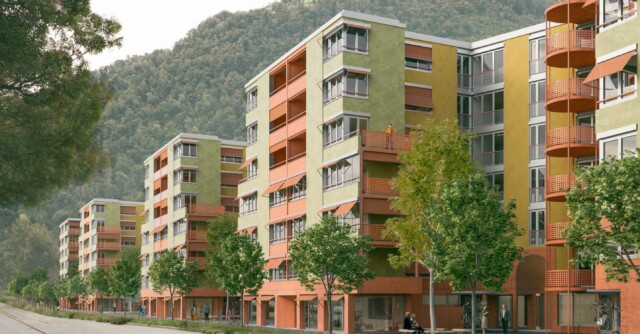
    The non-profit housing association Logis Suisse AG is planning a new housing estate in the west of Stans. Around 270 affordable apartments, around 1,000 m² of commercial space and two communal areas will be built by 2032 on a 12,700 m² site that the company acquired back in 2015. The study contract, in which seven general planning teams took part in 2025, was won by Studio Sintzel from Zurich and Uniola AG.

    Two buildings, eight courtyards
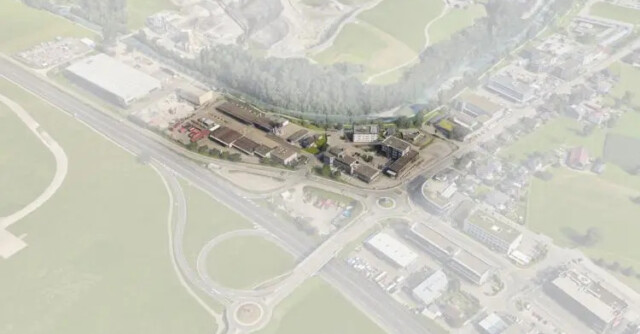
    The project, known internally as “Eight courtyards for Stans”, is based on two seven-storey buildings. Despite their volume, they appear from the outside as loosely placed point buildings. Head elements refer to existing buildings and structure the street fronts with front garden zones. Open courtyards with passageways structure the outdoor space and allow views of the surrounding mountains. A high-quality counterbalance to the adjacent highway. An existing old building in the center of the development will be retained and will serve as a social meeting point in the future.

    Mixed quarter with short distances
    The site is located opposite the Länderpark shopping center, on a multi-lane road and in the immediate vicinity of the freeway. Bicycle paths and footpaths should nevertheless link the new district well with Stans and Stansstad. With 0.8 parking spaces per apartment, Logis Suisse is below the usual standard, a clear commitment to sustainable mobility. The apartment mix ranges from compact 1.5-room apartments for singles and older people to spacious 5.5-room apartments for families and shared flats. On the first floor, studio apartments, care facilities and commercial space enliven the district.

    Built to conserve resources
    The client’s aim was to create a model project in terms of ecology, social space and economic efficiency. The load-bearing structure is designed to be material-efficient, the floor plans are compact and a photovoltaic system on the roofs covers a large part of the electricity requirements on site. A single-storey underground car park minimizes excavation work. Construction is scheduled to start in 2030 and be completed in 2032.

  • Nidwalden pools its blue light forces

    Nidwalden pools its blue light forces

    The 33,000 square meter site on Kreuzstrasse is now completely built over. Many of the buildings are in need of considerable renovation, including the cantonal police and prison buildings. In addition, there are operational deficiencies such as a lack of escape routes or inadequate separation between public and staff entrances.

    On the basis of a broad-based investigation, the cantonal government has decided to completely reorganize the site and build new replacement buildings. The aim is to create a modern security competence center that improves functional processes, increases security and is more economical in the long term than selective renovations.

    Bundled blue-light organizations
    The site is currently home to the police, prison, road safety center, road inspectorate, justice department and public prosecutor’s office. Due to the central location, the possibility of relocating additional emergency services, in particular the fire department and ambulance service, to Kreuzstrasse is being examined. The aim is to create a location with short distances, coordinated processes and clear responsibilities.

    Test planning has shown that this bundling on the existing site is realistic. It confirms that the spatial requirements of the current uses and additional organizations can be implemented on the site without obstructing the site’s development potential.

    Prison with a view to future needs
    The future direction of the cantonal prison was also analyzed in depth as part of the test planning. The demand for prison places in Switzerland is high, particularly for inmates in need of care in the penal system. Against this background, Nidwalden is examining how the new prison facilities should be dimensioned and functionally aligned in order to meet demand in the long term.

    Design plan and indicative project
    The District Council has approved a planning credit of CHF 1.63 million for the design plan and indicative project. The planning will be continued with a clearly defined group of users – the cantonal police, rescue service, fire department, justice department, public prosecutor’s office, prison, road inspectorate, road safety center and selected administrative units.

    The design plan is intended to create the legally binding framework for the next planning steps. It specifies which uses are permitted where, how development, open spaces and urban planning are to be designed and which stages are possible.

    Adjustments to the process and open sub-projects
    Several planning teams were initially involved in the study commission for the design plan and indicative project. In the course of 2025, however, it became apparent that the development with a moderate expansion of the existing traffic circle would not be sufficient in view of new traffic forecasts. At the same time, a new option for the road safety center came into play. Obwalden is planning a new building in Sarnen and synergies of a shared location with test halls and test tracks are being examined.

    In order to be able to react more flexibly to these changes, it was decided to terminate the study contract in its previous form and to continue working on the indicative project with just one planning team. In October 2025, the District Council also requested more planning certainty, particularly for the two sub-projects “Road Safety Center” and “Prison”, before the design plan and indicative project are definitively completed.

    Next steps and timetable
    The design plan will cover the three local municipalities of Stans, Buochs and Oberdorf. The corresponding municipal assemblies or ballots for decision-making are currently scheduled for 2027.

    The first loan applications for architectural competitions for individual buildings of the security competence center are expected from 2028 at the earliest. Until then, it will be a matter of clarifying the unresolved issues relating to development, the prison layout and the traffic safety center.

  • Historical manor with a modern frame

    Historical manor with a modern frame

    Like a park, the spacious grounds of the Glockgut stretches through rural Herblingen. The former farming village is only a few kilometers away from the center of Schaffhausen. In the middle of the green surroundings and at the same time close to urban culture, it has a high recreational and leisure value. A total area of 24,223 m² offered the experienced Steiner AG project developers space right in the middle for the vision of creating a varied living environment for young and old – with a children's playground, flower meadows and open green areas full of tall trees and ornamental shrubs. At the end of March 2018, the project of the working group Theo Hotz Partner AG and Bergamini Partner Architects received the building permit. The main building of the former manor, which is worth protecting, formed the starting point for the development plan. After the Steiner Investment Foundation got involved in the project as an investor, construction began on the family-friendly and near-natural apartments in autumn 2018.

    Open terrain

    The old manor building is now gracefully framed by five modern apartment buildings. It was a particular challenge to design the different buildings and such a large area as uniformly as possible and to realize them from a single source. A special feature of the plot in the north-western area, which initially presented itself as a problem, helped here: a steep slope. The solution was to leave it undeveloped. The actually built-up part today covers an area of 10,330 m 2 , while the preserved green space proves to be an enrichment for the quarter.

    The first construction measure was the conversion of the two-storey manor into a daycare center – in close cooperation with the preservation of monuments. The adjoining shed, in turn, was torn down and replaced by a new multi-purpose building with the same location and similar cubature. On the ground floor, this new building houses a common room that is used by the after-school care center during the day and is available to the residents of the complex in the evenings and on weekends. "The space is intended to give the building an identity as a new center," explains Peter Herzog, team leader for real estate development at Steiner. The ensemble of the two buildings was therefore left free and fits harmoniously into the backdrop of the open slope behind. Arranged in a U-shape around the building, the new housing estate grew step by step.

    The new residential buildings fit in with the simple manor with a straight-line architecture and corresponding colors and, with their loggias, balconies and terraces, bring the interiors together light and airy with the outside area. From the inside, they allow a generous view of the green area and sometimes into the distance. The buildings in the area are loosely distributed and connected by a network of paths. Kindergarten, primary school and various shops can be reached in a few minutes on foot from the quarter. In this way, the entire development is both naturally permeable and urban dense at the same time.

    Sustainable investment

    The five new multi-family houses comprise a total of 27 rental and 71 condominiums. These are 2.5 to 5.5 room apartments with an area of 65 m 2 to 130 m 2 . All apartments have a high standard and are tailored for families as well as for couples or individuals. With the prices and different apartment sizes, the aim is to achieve a mix of one-person and family households. "In terms of price, we are in the middle segment," confirms Peter Herzog. An underground car park with 136 parking spaces also provides space below the site. It is directly accessible for all new buildings.

    The buildings are implemented in accordance with the Minergie standard and are heated with climate-friendly geothermal heat pumps. When possible, sustainable types of concrete with cement from mixed demolition were used for the construction. Recycled aggregates were mixed in here.

    Planning tailored to your needs

    The entire development is based on a design plan that was presented to both the responsible authorities and the local residents during the process. That contributed to the trust in this large project, explains Herzog and adds: "With the Glogguet development we have shown how we can build compacted and how the quality of the place remains." Despite the pandemic, the construction work could be carried out on schedule in compliance with the applicable protective regulations, so that the apartments were ready for occupancy in spring 2021.

    www.steiner.ch
    www.gloggeguet.ch
    info@steiner.ch