Category: Luzern

  • Lucerne knocks Zug off its throne

    Lucerne knocks Zug off its throne

    Lucerne is lowering its effective corporate tax rate from 11.91 to 11.66 per cent in 2026, overtaking Zug, which is now at 11.71 per cent. According to PwC, this makes Lucerne the canton with the lowest corporate tax rate in Switzerland for the first time.

    The difference is small, but the message is all the greater. In tax competition, it is not only the absolute amount that counts, but also the symbolic effect. Whoever is at the top sends a clear signal to mobile companies and investors.

    Switzerland keeps moving
    Eight cantons are lowering their corporate taxes slightly, while four are increasing them minimally. Overall, the 2026 tax comparison shows a country that remains active in international competition and does not simply manage its attractiveness.

    It is striking that the OECD minimum tax introduced in 2024 has hardly changed the cantonal tax rates so far. PwC speaks of a rather wait-and-see attitude towards the new global framework conditions. This is precisely why competition within Switzerland continues to gain in importance.

    Zurich and Bern are coming under pressure
    At the other end of the scale are Bern and Zurich. According to PwC, Berne has an effective rate of 20.54 per cent, while Zurich is still at 19.47 per cent despite a slight reduction. Both cantons therefore continue to be among the most expensive locations for companies in Switzerland in terms of taxes.

    This is tricky from a location perspective. After all, high economic quality, good accessibility and strong labour markets are not always enough if the fiscal difference is almost twice as high as in Lucerne. The tax factor remains a tough lever in the competition for new relocations and expansions.

    More than just a tax ranking
    According to PwC, Central Switzerland maintains its role as a particularly attractive business location. In an international comparison, Lucerne and Zug rank at the lower end of the tax burden; in the EU, only Hungary taxes companies more heavily than Lucerne.

    This makes it clear what is really at stake. It’s not just about a difference in figures between two cantons, but about the strategic positioning of entire economic areas. Lucerne has taken a small step towards the top. This is precisely what can make the difference in the competition between locations.

  • New foundation to bring SMEs forward

    New foundation to bring SMEs forward

    Lucerne performs solidly in national competitiveness rankings. In terms of innovative strength, however, the canton ranks at the bottom. Those who fail to address this shortfall risk losing out in the competition between locations in the long term. This finding is the starting point for the planned Lucerne Innovation Foundation and for the special credit that the cantonal government is now applying for.

    The foundation as the linchpin
    The new foundation is not intended to create a parallel structure, but rather to coordinate existing partner organizations and better network their offerings. The focus is on companies in the early stages of development. In other words, where the need is greatest and resources are scarcest. In addition to coordination, the foundation can also co-finance specific implementation projects such as feasibility studies. The foundation board should consist of at least five members, and a four-year performance agreement ensures planning security.

    24 million with a clear earmarking
    One million of the requested 24 million francs will flow into the foundation’s capital. The remaining CHF 23 million is earmarked for the foundation’s services in the years 2026 to 2029. Lucerne is thus positioning itself as a canton that does not wait for federal funding, but acts itself. In addition to national programs such as those of Innosuisse, which support SME innovation throughout Switzerland.

    Part of a larger reorganization
    The foundation is embedded in the canton’s broader location promotion package. In January 2026, the cantonal council approved a package of measures worth around CHF 300 million per year. This was in response to the OECD minimum taxation, which reduces previous tax advantages. The Lucerne innovation contribution alone comprises CHF 110 to 160 million per year for companies that invest in research and development. The Lucerne Innovation Foundation is therefore not an individual measure, but part of a coordinated offensive.

    Referendum in September
    The Cantonal Council has already approved the overarching Location Promotion Act. However, the voters have the final say. The vote is scheduled for September 2026, with entry into force in October 2026. However, the foundation can already be established on the basis of the current legal foundations. The go-ahead does not have to wait for the referendum.

  • Horw is growing upwards, 14 storeys at the railway station

    Horw is growing upwards, 14 storeys at the railway station

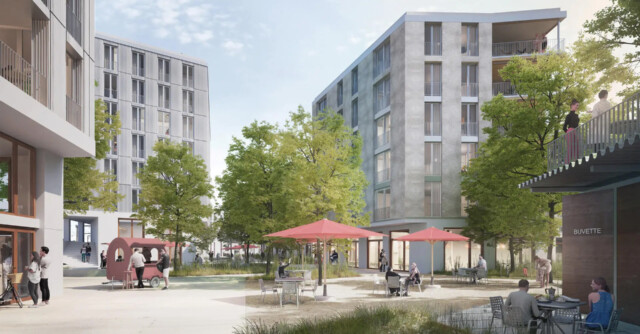
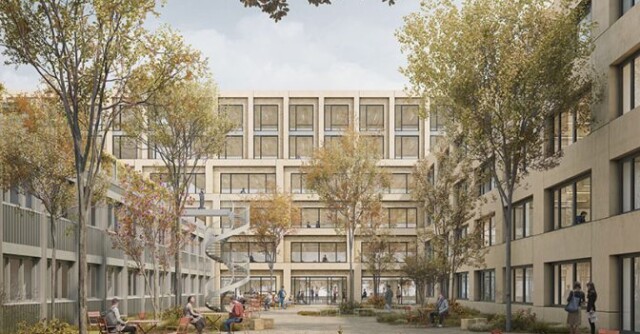
    Three striking new buildings with inner courtyards are being built between the railway station and Ebenaustrasse. The municipality is planning an eight-storey building at the roundabout, a 14-storey high-rise to the south of it as a vertical accent and an eight-storey longitudinal building facing Ebenaustrasse. The new bus station will be located in between, closer to the railway line than today and much more convenient for all those who change buses every day.

    “Janus” favours greenery and glass
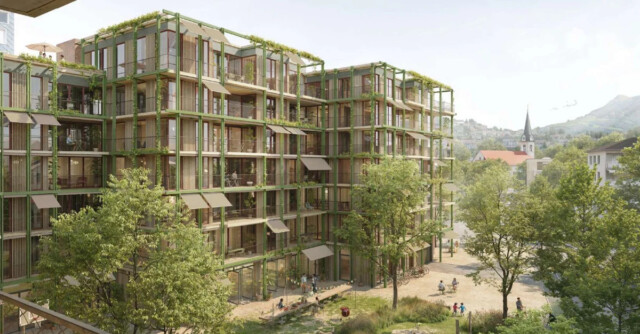
    Further east, along Ebenaustrasse and Ringstrasse, the municipality has held an architectural competition. The winning project is called “Janus” and envisages five largely glazed, six- to seven-storey apartment blocks, surrounded by trees and connected by a shared forecourt. The buildings appear bright and open, the ensemble creates urban quality without anonymity.

    Commercial yes, but how much?
    At least 20 per cent of the space in the new buildings is to be used for commercial purposes. This is envisaged by the municipality, and not just on the ground floor, but up to the third or fourth floor. The property owners take a critical view of this. They point to a lack of demand and draw on their experience with the previous “Horw centre” open space concept. The municipal council is willing to talk, but reserves the right to add further storeys if necessary.

    Part of a big picture
    The railway station project is embedded in the overall “Horw Mitte” project, which covers around 12 hectares and plans 1,000 new flats and 800 new jobs in the long term. A large part has already been realised to the west of the tracks, while the eastern part is now catching up. Over two decades, the municipality is thus developing a former peripheral area into a compact, well-developed centre.

    Residents’ Council has the floor
    The bus station was already approved by the Residents’ Council on 27 March 2026, with construction not due to start until 2028 at the earliest. The vote is still pending for the Part East development plan. This requires the approval of the cantonal government of Lucerne and a referendum-free conclusion. It is also still unclear who will bear the planning costs. So there is still a lot to be clarified before the construction cranes move in.

  • Ein Quartier ohne Einsprache

    Ein Quartier ohne Einsprache

    Der Luzerner Regierungsrat genehmigte den Bebauungsplan Schützenmatt im Januar 2026. Der Emmer Einwohnerrat hatte ihn bereits am 1. Juli 2025 in zweiter Lesung einstimmig verabschiedet. Nach Ablauf der Beschwerdefrist liegt nun Rechtskraft vor, kein einziger Rekurs wurde eingereicht. Das ist bei einem Projekt dieser Grössenordnung keine Selbstverständlichkeit, sondern ein Zeichen breiter Akzeptanz.

    250 Wohnungen, 4000 Quadratmeter Leben
    Auf dem Areal entstehen rund 250 Wohnungen in verschiedenen Grössen sowie Gewerbe-, Gastronomie- und Dienstleistungsflächen von insgesamt rund 4000 Quadratmetern. Der Wohnungsmix reicht von kleineren Einheiten über Familienwohnungen bis zu Alterswohnungen . Bewusst konzipiert für alle Lebensphasen und verschiedene Einkommensstufen. Ein Teil der Wohnungen muss als preisgünstiger Wohnraum realisiert werden.

    Weniger Auto, mehr Velo
    Das Mobilitätskonzept setzt klare Prioritäten sodass Fuss, Velo und öffentlicher Verkehr Vorrang haben. Geplant sind über 970 Veloabstellplätze, darunter eine gedeckte, öffentlich zugängliche Velostation mit mindestens 300 Plätzen direkt an der Bahnhofunterführung. Für Autos stehen maximal 120 Parkplätze in der Tiefgarage bereit. Die Velohauptroute entlang der Gleise wird kreuzungsfrei geführt. Somit entfallen Konflikte mit dem Fussgängerverkehr.

    Die Stadt als Schwamm
    Das städtebauliche Konzept stammt von Fischer Architekten, deren Wettbewerbsbeitrag mit dem ersten Preis ausgezeichnet wurde. Im Zentrum steht das Schwammstadtprinzip. Sickerfähige Beläge, Bäume auf natürlichem Boden und begrünte Dachflächen speichern Regenwasser und geben es kontrolliert wieder ab. Mindestens 60 Prozent der Dachflächen werden intensiv begrünt. Das verbessert das Mikroklima und macht das Quartier klimaresilient.

    Ab 2027 wird gebaut
    Mit der Rechtskraft liegt die Umsetzung nun bei den Grundeigentümerschaften. Die Realisierung ist in vier Etappen geplant, ein Bezug der ersten Wohnungen ist ab rund 2030 realistisch. Christine Bopp, Leiterin Planung der Gemeinde Emmen, spricht von einem abgeschlossenen langen Planungsprozess, der nun Planungssicherheit für alle Beteiligten schafft. Emmenbrücke bekommt sein neues Herz und baut es mit Bedacht.

  • “Insieme” education centers in Sursee

    “Insieme” education centers in Sursee

    The project competition was announced as an open, single-stage and anonymous procedure for general planning teams, with eight teams submitting proposals on time. The jury assessed them according to functionality, cost-effectiveness, sustainability, urban planning and architecture and awarded the contract to the “Insieme” project by Bob Gysin Partner from Zurich. The centerpiece is a new seven-storey building along the railroad line, which makes a clear contribution to urban densification and orients the campus more towards the station.

    Bright learning landscape
    In future, the new main entrances will be oriented more towards the railroad station, thus relieving the existing access through the adjacent residential area. All gymnasiums will be accessible via the newly defined entrance area, which will simplify routing and orientation. The arrangement of classrooms, group rooms, atriums and meeting zones creates a bright, flexible learning landscape that supports different forms of teaching and informal encounters in equal measure.

    Building sustainably, upgrading open spaces
    In terms of construction, “Insieme” relies on a combination of existing buildings and timber construction. With the exception of the basement, the existing building in Wing B is being dismantled and extended with a timber ribbed ceiling to create a six-storey building. The design of the open space responds to the climate heating by shading the existing staircase and enhancing it with additional planting and seating. The edge of the forest will have new recreational areas and loose tree planting, which will significantly increase the quality of the outdoor space.

    Next steps until commissioning
    In the first quarter of 2026, the jury’s comments will be reviewed and the competition project optimized if necessary. The extended facility is currently scheduled to open in 2035. Around CHF 97.4 million has been set aside in the cantonal financial planning for the expansion and partial renovation of the BBZG W in Sursee. An investment in future-proof vocational training and a strong educational location in the region.

  • Urban change on the Wellis site

    Urban change on the Wellis site

    One of the region’s most exciting transformation areas is located between the railroad station and the old town. Halls, warehouses and work yards are being transformed into an urban quarter with its own character. The area thus plays a key role as the gateway to Willisau.

    The area is roughly the same size as the historic old town. The previously closed production site is being transformed into an open piece of town. Paths, squares and open spaces will connect the station, the old town and the district. The previous barrier will become an urban interface.

    Mixture instead of monofunction
    The development clearly focuses on a mixture of uses. Several hundred apartments of different sizes and typologies are planned, supplemented by areas for commerce, services and local amenities. Living, working, shopping and leisure are moving closer together.

    It creates frequency throughout the day, increases the utilization of the infrastructure and reduces dependency on a single type of use. At the same time, it opens up scope for new forms of work, small-scale service providers and local suppliers.

    Identity from the industrial past
    The Wellisareal remains recognizable as a place. Parts of the existing building fabric will be preserved and used for new purposes. The industrial character not only provides history, but also identity. It clearly distinguishes the district from green meadow developments on the outskirts of the town.

    New buildings complement the existing buildings without covering them up. A high point marks the area in the silhouette of Willisau. The decisive factor here is not the height alone, but the effect in the urban space. This creates an image that remains anchored in the perception of residents, visitors and investors.

    Open space as a location factor
    The project consistently combines density with open space. Generous green spaces, trees, squares and paths structure the quarter and ensure a quality of stay. Instead of the inner courtyard as a residual area, the open space is at the center of the concept.

    For future users, this is more than just a matter of comfort. Shaded recreational areas, well thought-out outdoor spaces and differentiated microclimates are becoming hard location factors. They influence rentability, image and long-term value development. A robust open space concept also supports the adaptability of the neighborhood over its life cycle.

    Rebalancing mobility
    The location directly next to the train station and close to the old town allows for a low-traffic approach. Priority is given to pedestrians and cyclists, with public transport services within walking distance. The project deliberately reduces the number of parking spaces and focuses on alternative forms of mobility.

    For local authorities and investors, this means less land consumption for cars, more space for value creation and quality of life. At the same time, there is increasing pressure to think of mobility as an integrated offer. From sharing solutions to logistics and neighborhood services.

  • New CKW headquarters strengthens Emmen

    New CKW headquarters strengthens Emmen

    With the “EnergiePark Emmen” project, CKW intends to further develop its existing site on the Reussinsel. The centerpiece is a new plant building for the Grids and Building Technology divisions, including a grid base for the construction, operation and maintenance of the electricity grid in the greater Lucerne area. The employees previously based in Reussbühl will thus have modern workplaces in Emmen, and processes will be bundled in terms of space and organization.

    Commitment to Emmen and more jobs
    The Reussinsel is CKW’s historic place of origin, where the first power plant went into operation in 1894. With the planned relocation of its headquarters, CKW is building on these roots and making a long-term commitment to the Emmen site. The number of employees on the Reussinsel will increase from around 600 today to around 1,000, which will generate additional tax revenue and strengthen the economic development of the municipality.

    Careful planning and inward densification
    The guideline project was developed in a planning process lasting several years with the municipality of Emmen and a study contract with five planning teams. The “Compakt” project by Penzel Valier AG with Maurus Schifferli Landschaftsarchitekten was selected for its urban planning quality and sensitive integration into the landscape. The project consistently focuses on inward densification. The valuable natural space on the Reussinsel remains untouched and additional buildings are only planned as a long-term reserve.

    Traffic, development and next steps
    An important part of the project is the development and traffic management. Mobility measures are planned together with Emmen and Ebikon, including a new bus stop in the Rathausen area, adjustments to the road infrastructure and mobility management with trip caps and balanced traffic distribution. Based on the indicative project, the municipality of Emmen is now drawing up the development plan with the active involvement of the local population. According to the current timetable, concrete construction projects could be approved and implemented from 2030.

  • Lucerne invests 300 million in its location

    Lucerne invests 300 million in its location

    The starting point for the proposal is the concern that the previous locational advantage of low corporate profit taxes will be lost as a result of the OECD minimum taxation. International corporations will have to pay more tax in future, which means there is a risk that top taxpayers and jobs will move away. The adopted package is intended to cushion these effects and keep Lucerne attractive as a business location through other levers.

    The Cantonal Council has amended the law on economic development and regional policy for this purpose. An annual volume of measures of around CHF 300 million has now been anchored in favor of location promotion. The canton is thus creating a predictable framework for the targeted financing of strategic projects and structural improvements.

    Innovation, taxes, land, administration
    The measures in favor of the economy are concentrated on several axes. At the center is the promotion of innovation. This means supporting companies, projects and structures that increase value creation and future viability. This is complemented by an improvement in the tax burden in other areas in order to partially compensate for the loss of the profit tax advantage.

    Another focus is on the development and availability of commercial and residential space. Lucerne wants to ensure that sufficient suitable space is available for businesses, services and housing. Equally important is a “customer-oriented” administration. Processes should become faster, more transparent and more business-oriented so that investments do not fail due to bureaucratic hurdles. For the population, additional measures are aimed at easing the tax burden, improving work-life balance, culture and digitalization.

    New rules for micro-shops and shop-fronts
    The bill also includes changes to the retail sector. Self-service stores without sales staff with a maximum area of 30 square meters will be allowed to open daily from 5 a.m. to 10 p.m. in future. A restriction to farm stores was narrowly rejected. The regulation thus applies more broadly and facilitates new, automated store concepts.

    In addition, stores with fast charging stations will in some cases be treated in the same way as petrol station stores. Anyone who operates at least four charging stations with 150 kilowatts each and a simultaneous total charging capacity of at least 300 kilowatts can benefit from extended opening hours. In this way, the canton is supporting the expansion of e-mobility and linking charging infrastructure with local service offerings.

    Political controversy is inevitable
    The bill is politically controversial. The SVP and SP have announced a referendum. Both because of the fundamental direction of the package and because of the extended store opening hours and the location policy in favor of large companies. This means that the thrust of Lucerne’s location strategy is likely to be the subject of public debate.

    In practice, this means that companies, investors and municipalities will receive a clear signal that the canton is prepared to invest substantial funds in location development. However, whether and in what form the package of measures will definitely come into force will also depend on the political debate and a possible referendum.

  • Lucerne Economic Development Wermelinger takes over

    Lucerne Economic Development Wermelinger takes over

    The Board of Trustees of Lucerne Economic Development has elected 54-year-old Patrik Wermelinger from Lucerne as its new Director. He comes from the canton of Lucerne, lives with his wife in Meierskappel and has known the regional economy at close quarters for many years. He has a degree in business administration and an Executive MBA in General Management, which he completed at Lucerne University of Applied Sciences and Arts.

    Wermelinger is currently Chief Investment Promotion Officer and a member of the Executive Board at Switzerland Global Enterprise. In this role, he supports international companies in setting up operations in Switzerland and operates at the interface between location marketing, investment decisions and global competition for projects. This profile predestines him to position Lucerne visibly in the competition between business locations. With a clear understanding of the requirements of international investors.

    Familiar head with a return bonus
    Patrik Wermelinger is no stranger to Lucerne. From 2006 to 2016, he was head of location promotion and marketing at the Lucerne Economic Development Agency. During this time, he built up a broad network of companies, municipalities, institutions and partners in Switzerland and abroad. He knows the strengths, but also the challenges of the economic region from practical experience. From industry to tourism and knowledge-intensive services.

    This return with additional international experience is a strategic advantage for the organization. Wermelinger brings in-depth relocation and promotion experience from Switzerland as a whole, combined with a clear view of Lucerne as an independent brand in the competition between locations. This creates good conditions for maintaining existing relationships and attracting new companies. Especially in an environment in which location decisions are more competitive.

    Orderly transition at the top
    Patrik Wermelinger will take over as Director on June 1, 2026. The current Director, Ivan Buck, will retain operational responsibility until the end of February 2026. He will then set up his own company in the field of relationship management. For the transition phase between March and the end of May 2026, Deputy Director Andreas Zettel will take over management on an interim basis and ensure a smooth transition.

    Lucerne Economic Development thus relies on continuity in ongoing operations and a clear handover. The combination of temporal overlap, internal interim solution and succession communicated at an early stage strengthens planning security for partners, municipalities and companies that work with the organization.

    Trust in expertise and personality
    The Board of Trustees is convinced that it has made the right choice in Patrik Wermelinger. President Erwin Steiger emphasizes both the high level of expertise and the international experience of the designated Director. At the same time, he emphasizes his trustworthy and winning manner. A combination that is central to the work at the interface between politics, administration and business.

    With this personnel decision, Lucerne Economic Development is positioning itself for the coming years with regional roots, an international network and a director at the helm who already knows Lucerne as a location.

  • The Sursee hospital site – new prospects from 2034

    The Sursee hospital site – new prospects from 2034

    The new construction of the LUKS Sursee and the Seeblick care center on Schwyzermatt in Schenkon will free up an area of around 47,000 square meters on Spitalstrasse in Sursee. About seven football pitches, centrally located, well developed and with views as far as the Alps. Where hospital buildings still stand today, a new urban building block can be created from 2034 that will shape Sursee in the long term. The canton of Lucerne is the main owner of the site, while adjacent areas also belong to the canton and partly to the city and will be included in the planning.

    The almost 50-year-old LUKS Sursee no longer meets the requirements of a modern hospital operation. The government council’s decision to build a new hospital and care center in Schenkon by 2033 will shift the healthcare infrastructure and open up a rare urban development potential in Sursee.

    Living, living, meeting
    The canton of Lucerne and the city of Sursee are pursuing a common goal: a mixed-use, lively district that combines living, services and quality of life. A test plan from 2026 will examine which uses and development structures are possible and sensible on the site. The results will form the basis for rezoning, architectural competitions and the first construction phases, which are to start after the hospital and nursing home have moved away, with the aim of avoiding vacancies as far as possible.

    It is already clear that the area is particularly suitable for residential use, for families, couples, singles and senior citizens. In addition, services, shopping facilities and restaurants are conceivable to fill the district with life. The aim is to create a socially mixed environment with a mix of upmarket and affordable housing that strengthens Sursee as a place to live and at the same time creates new opportunities for different phases of life.

    Sursee is growing
    Sursee is growing dynamically and, with a vacancy rate of 0.26 percent, has an extremely tight housing market. The new offer on the hospital site should help to alleviate the pressure and create additional residential quality in a central location. Its proximity to the old town, the existing transport links and the view of the lake make the site a key location for future urban development.

    It is an opportunity to create a new, identity-forming district. The site can provide impetus for the economic development of the region, create new jobs in the service sector and further raise Sursee’s profile as a regional center.

    District development as a joint task
    The planning of the hospital site is deliberately designed as an open process. Workshops with the local population and various interest groups are planned from spring 2026. Needs, ideas and expectations are to be incorporated at an early stage so that a district is created that is not only convincing from a planning perspective, but is also supported by the population.

    The municipal assembly will decide on the necessary changes to the sub-zone plan. This makes it clear that the future of the hospital site will not be designed in secret, but in a transparent process that combines specialist planning and local perspectives.

    A new urban building block with a history and a future
    In the long term, a diverse residential and living space with green areas, play areas and recreational spaces could be created where a hospital still operates today. Outdoor meeting places, short distances and good connections to the existing urban structure should make the area an integral part of Sursee.

    The canton of Lucerne wants to make targeted use of the potential of the privileged location with its lake view and historical use. From 2034, there will be an opportunity to create a district that respects the history of the site and at the same time provides answers to the housing and living needs of the coming decades. A new chapter for the hospital site and for Sursee.

  • Engineers’ Day 2026

    Engineers’ Day 2026

    Against the backdrop of climate change, digitalization and sustainable mobility, engineers are taking on a key role. They develop solutions for renewable energy systems, resilient infrastructures, smart mobility concepts, digital technologies, data-based applications and resource-conserving production.

    focus on the next generation
    Engineers’ Day aims to get young people interested in technology at an early age, from primary school children to university students. Companies and institutions offer guided tours, workshops, demo stations and dialog formats that bring professions to life and enable direct encounters with experts.

    the background to this is a persistent shortage of skilled workers, particularly in engineering and STEM professions, where women continue to be severely underrepresented. Companies, organizations and educational institutions are therefore invited to register their own events and activities for 4 March 2026 and thus actively contribute to the promotion of young talent.

    national Conference of Engineers
    The National Conference of Engineers will be held on the same day for the first time. Around 40 experts from business, science, politics and associations will come together at Lucerne University of Applied Sciences and Arts in Horw to discuss specific measures to strengthen the next generation of engineers.

    the aim of the conference is to join forces across industries and disciplines and find new ways to attract more young people in their diversity to engineering, STEM and tech professions. The conference thus complements the decentralized activities of Engineers’ Day with a strategic platform for exchange and joint initiatives.

    from Muttenz to Lucerne
    The handover from the previous venue of Muttenz to Lucerne in October 2025 marks a further step in the format’s development. With the first National Conference of Engineers at HSLU, Engineers’ Day 2026 will not only be an event for young talent, but also a meeting place for decision-makers in the engineering and education landscape.

  • From the depot to a climate-resilient urban district

    From the depot to a climate-resilient urban district

    The starting point for the development is the withdrawal of the CKW depot in the context of the large-scale transformation around Seetalplatz. Based on a two-stage study commissioned by CKW and the city of Lucerne, the “Habitat – Quartier im Hain” project was selected in 2022. The careful handling of existing buildings was decisive. In particular, the Shedhalle and the consistent integration of open spaces and rainwater management.

    The ideas of the winning project were then applied to the entire perimeter of the development plan and enshrined in planning law. The result is a coordinated overall figure that combines private properties and the former factory yard area into an urban development whole.

    Urban development, mixed use and sponge city
    For reasons of noise and urban space, the north-eastern part of the area is characterized by larger, mixed-use buildings in closed construction. Living, working, services and first floor uses are concentrated here along streets and squares. The western part focuses on open residential buildings, connected green spaces and paths that link the adjacent neighborhoods.

    The central element is a topographical depression in the west, a former floodplain. It serves as a retention area for rainwater and forms the basis of the “urban grove”, which characterizes the district with trees, infiltration areas and a cooling microclimate. Rainwater management, climate-adapted open space design and the sponge city principle thus become key components of the district’s identity.

    Social mix and diversity
    When completed, around 700 to 800 additional apartments are planned for Reussbühl West, at least 20 percent of which will be non-profit. They will be supplemented by multi-purpose rooms and around 15,000 to 18,000 square meters of work space for businesses and services. Short-term rentals will be limited to the areas already available today and are only permitted in construction site C9. This is a deliberate signal in favor of long-term residential and neighborhood structures.

    The existing shed hall will be opened up for public-oriented uses and will function as an address for culture, leisure or small-scale businesses. Together with the first floor uses of the new buildings, a mixed-use, all-day lively environment will be created that closely interlinks living, working and public facilities.

    Legal planning basis and timeline
    The “Reussbühl West” development plan sets out the main elements of the urban design and the distribution of uses in a way that is binding on the landowner and allows for staggered implementation. It is open to the public from November 24 to December 23, 2025. Objections and negotiations will be incorporated into further processing before the plan is submitted to the City Council.

    Together with the “Reussbühl Ost” development plan, which is already legally binding, this will create a legal planning framework for an upgraded, mixed-use district with a total of around 1,000 additional apartments and 15 to 20 percent commercial space. The densification will take place gradually. The first non-profit apartments and new commercial space are already under construction in Reussbühl Ost, marking the transition from an industrial area to the urban city building block of the next generation.

  • Location search for the ETH Swiss GeoLab

    Location search for the ETH Swiss GeoLab

    The ETH Swiss GeoLab is to become an international center for earth observation and data analysis over the next ten years. This will create a place in Lucerne where data from space, the air and the ground will flow together. With the help of artificial intelligence and high-performance computers, forecasts and analyses of natural hazards, climate and agricultural developments will be made possible. ETH Professor Thomas Zurbuchen and ETH Professor Verena Griess will lead the project strategically, while Felix Seidel Caprez will take over the operational management of the center.

    Site selection with clear criteria
    The requirements profile for the site was defined by ETH Zurich and made public. It attaches great importance to optimal conditions for research, cooperation and innovation. A location with modern infrastructure, proximity to universities, companies and authorities is sought. Proposals submitted will be evaluated in the first quarter of 2026.

    Networking and concrete perspectives
    Networking with Lucerne’s education and research landscape is already underway before the location decision is made. Workshops between ETH, regional companies and administrative partners are intended to identify synergies and initiate joint projects.
    “This investment in knowledge and technology is a great opportunity for the canton,” says Cantonal Councillor Fabian Peter, who sees the project as a milestone for Lucerne as a location for innovation.

    Research region with a signal effect
    By 2030, the Swiss GeoLab is expected to employ around 100 people and involve start-ups and industrial partners. The center will not only redefine earth observation, but also strengthen Lucerne’s position as a strong research location in the international innovation network.

  • Lucerne presents structure plan to the public

    Lucerne presents structure plan to the public

    According to forecasts, the population of Lucerne will increase by around 120,000 people by the middle of the century and reach the 560,000 mark. In order to manage this growth in an orderly manner, the spatial development strategy sets out clear objectives in the structure plan. Priority should be given to compact, efficient settlement structures based on public transport.

    The plan ensures the economical use of land and coordinates the canton’s development plans with those of the federal government and the municipalities. It is intended to create the basis for spatially harmonizing living, working and mobility.

    Focus on inner development and affordable living space
    The central element of the revision is the creation of living space without endangering valuable cultivated land. The structure plan focuses on inward densification, for example through minimum densities and higher building densities in locations with good transport links, and allows selective extensions to building zones where they make sense for affordable housing construction.

    The so-called center areas create planning instruments for the targeted development of central locations with high densities. In future, municipalities will be able to make their housing supply binding. In addition, measures are needed in other policy areas, such as land policy or support programs for non-profit housing construction.

    Work zones and economic development
    The structure plan strengthens the local scope for action for economic areas. Municipalities are given the opportunity to expand their own work zones in order to promote new settlements with a regional connection and to link living and working more closely.

    The canton assumes a coordinating role with the program for development priorities. In addition, the structure plan creates the basis for an active land policy in order to develop areas in the canton’s interest. Such as strategic employment areas or infrastructure projects.

    Integration of overarching sustainability goals
    The structure plan revision links spatially relevant topics with overarching strategies. Aspects relating to climate protection, energy production and mobility development from cantonal projects such as “Future Mobility Canton of Lucerne” or the Climate and Energy Planning Report are anchored spatially. In this way, planning integrates ecological, economic and social developments.

    Procedure and political responsibility
    Since the revision of the Planning and Building Act in 2018, the Cantonal Council has been more closely involved in structure planning. It defines the strategic objectives in the spatial development strategy, while the cantonal government is responsible for operational coordination and the concrete spatial definition in the structure plan maps.

    The current revision is based on feedback from the 2023 consultation and the preliminary federal review in 2024. After the public consultation, all submissions will be evaluated before the revised version is forwarded to the Cantonal Council, probably in summer 2026, and then submitted to the Federal Council for approval.

  • New paving blocks reduce CO2 emissions in construction

    New paving blocks reduce CO2 emissions in construction

    CREABETON, a building materials company based in the canton of Lucerne and a subsidiary of Müller-Steinag Baustoff AG, has developed a new series of cement-free paving blocks in collaboration with the start-up Oxara. According to a press release, the new concrete blocks produce 30 percent less CO2 emissions than conventional paving blocks.

    The new product is available in three variants. In addition to the standard paving block version, water-permeable or grass paving blocks can also be laid. Instead of conventional cement, the material uses the Oulesse binder developed by Oxara, a spin-off of the Swiss Federal Institute of Technology in Zurich(ETH).

    “With these products, we are responding to the growing demand for climate-friendly construction solutions,” said Hendrix Müller, CEO of the Müller-Steinag Group, in the press release. “Our collaboration with Oxara enables us to offer our customers more sustainable alternatives – today, not in a few years’ time.” Martin Bodmer, Head of Operations at Oxara, is convinced that the collaboration with CREABETON can scale up his company’s sustainable developments.

  • Think circularly, build together

    Think circularly, build together

    The Circular Time Lab at Lucerne University of Applied Sciences and Arts brings together theory and practice, design and craftsmanship, teaching and urban development. It is an interdisciplinary project of the Competence Centre Typology & Planning in Architecture and the architecture degree programme at HSLU. Together with students from timber construction companies in the region, the students develop structures that are not only architecturally appealing but also fully reusable.

    The focus is on learning and designing together. The students gain an insight into manual processes and technical possibilities, while the trainees participate in design processes. The result is a deep understanding of resource-conserving construction that closes cycles and preserves material value.

    Experience architecture – in the centre of Lucerne
    Since June 2025, the results of this collaboration can be experienced at two central locations in the canton of Lucerne, on the Inseli near the railway station and at the Viscosi site in Emmenbrücke. There, airy wooden structures with colourful fabrics invite you to linger, observe and pause. They offer protection from the sun and rain and at the same time inspire reflection.

    The structures are more than just aesthetic interventions in the urban space. They are built statements in favour of a building culture that takes responsibility. Their open design invites people to engage in dialogue and makes sustainability visible and tangible. The “Lucerne Summer” thus becomes a field of experimentation for an architecture that aims for impact rather than permanence.

    Circularity instead of deconstruction
    Reuse is at the centre of the Circular Time Lab. The wooden pavilions are not designed as one-off buildings, but as temporary structures with a future. Existing timber components were used for the initial construction. All connections are detachable and all dimensions are retained. The pavilion will be dismantled in autumn 2025 and a new pavilion with a new function will be built from the same elements in 2026.

    This iterative approach not only conserves resources, but also trains planning thinking. After all, circular construction requires creativity and precision. How does an old beam fit into a new design? How do you create beauty without waste? These questions accompany the participants of the Circular Time Lab throughout the entire process and strengthen their skills for the sustainable construction of tomorrow.

    Part of an international network
    The Lucerne project is embedded in the European research programme BAUHALPS, Building Circular in the Alps. in this programme, 13 partner institutions from six countries are jointly developing new strategies for circular construction in the Alpine region. The Circular Time Lab serves as a living real-world laboratory. A place for experimentation, exchange and applied research.

    The cooperation not only opens up new perspectives for students and trainees, but also international networks. In this way, a local timber construction project becomes a building block for transnational change, an impulse that radiates far beyond Lucerne.

    The future begins on a small scale
    The timber structures of the Lucerne Summer may seem small at first glance. But they harbour big ideas: collaboration, circular economy, education and responsibility. The Circular Time Lab shows how sustainable construction can be anchored in education and made visible in public spaces. Because if you want to reuse materials, you first have to rethink ideas.

  • How Lucerne is actively designing new workspaces

    How Lucerne is actively designing new workspaces

    At the beginning of April 2025, representatives from Lucerne municipalities and regional development agencies met for the third “Location and economic development in the municipalities” forum. The event was organised by Lucerne Economic Development and the Association of Lucerne Municipalities. The forum at Lucerne University of Applied Sciences and Arts focussed on the question of how municipalities can strategically secure and develop areas for economic activities.

    Cantonal framework and digital tools
    After the opening by Ivan Buck, Director of Lucerne Economic Development, and VLG President Sibylle Boos-Braun, the Business Development team presented practice-orientated tools. These included a guide and the digital tool from start.swiss, which enables automated welcome processes for new companies in the municipality. A step towards efficient administration and location management.

    Cantonal planning as a driving force
    André Duss from the canton of Lucerne presented the planned measures for the development of workplace areas in the draft cantonal structure plan. The focus was on areas for the expansion of local companies and attractive locations for new settlements. Coordination between the canton and municipalities is to play a central role in this.

    Regional practical examples provide impetus
    Specific projects were used to illustrate how municipalities are already taking action today. LuzernPlus demonstrated successful area management with LuzernNord, flanked by developments in LuzernSüd, LuzernOst and Rothenburg-Station. The Sursee Plus pilot project, presented by Matthias Senn, also showed how densified construction in work zones can also work for land-intensive companies. Florian Furrer from Schüpfheim gave an insight into the municipal process of zoning new employment areas, an example of forward-looking planning at municipal level.

    Municipalities are actively shaping the future with
    The forum made it clear that location and business promotion starts locally. Innovative approaches, digital tools and targeted cooperation between the canton, municipalities and regions are creating new spaces for entrepreneurial development. Lucerne shows how the future is being realised.

  • Quality label strengthens ceramics industry with 121 Platinium certifications

    Quality label strengthens ceramics industry with 121 Platinium certifications

    A total of 121 tiling, trading and mixing companies from the ceramics industry have received Platinium certification this year, CERUNIQ announced in a press release. The quality label is awarded by the association of leading installation companies and specialist retailers in the ceramics industry to companies for the high quality and professionalism of their work. “Platinium embodies consistency, quality and stability,” CERUNIQ Central President Konrad Imbach is quoted in the press release from his speech on the occasion of the awarding of the label.

    Of the certified companies, five received the label for the first time, while the others were recertified. The canton of Lucerne is represented by nine of the recertified companies. Specifically, Bacchetta Baukeramik GmbH from Horw, Bühlmann Keramik AG from Hochdorf, DÄHLER KERAMIK GmbH from Weggis, Häfliger Plattenbeläge AG from Rain, JÖRI PLATTEN AG from Egolzwil, MUHEIM KERAMIK AG from Weggis, P. Bachmann AG from Urswil/Hochdorf, Ziswiler GmbH, Keramik, Naturstein, Ofenbau from Eschenbach and Zwimpfer – Platten AG from Sursee were awarded the label.

    This year’s certification took place “under stricter requirements”, writes CERUNIQ. Particular emphasis was placed on the training and further training of apprentices and employees, the quality of advice, precision in the execution of the work and the professional and customer-oriented handling of complaints. The next Platinium certification is scheduled for 2027.

  • Award for health-oriented corporate culture

    Award for health-oriented corporate culture

    Real estate service provider Welcome Immobilien AG has become the first real estate consultancy to be awarded the “Friendly Work Space” certificate for successful occupational health management, according to a press release. The label was introduced in 2009 by Health Promotion Switzerland with partners from science and practice to support companies in systematically implementing and promoting occupational health management.

    The Emmenbrücke-based real estate service provider was recognized for a wide range of measures that ensure a sustainable working environment, employee well-being and a good corporate culture. These include systematic human resource management, flexible working time models, offers for well-being, further training opportunities and flat hierarchies.

    “We are convinced that an attractive working environment is crucial to our company’s success,” CEO Marc Furrer is quoted as saying. Motivated and satisfied employees can ensure better customer service and strengthen the company in the long term. “We are already seeing the benefits of these measures and are benefiting, for example, from a comparatively low fluctuation rate.”

    Welcome Immobilien AG has 80 employees and is represented not only in Emmenbrücke but also in Zug, Sursee and Lucerne.

  • Investing in depth saves costs and improves carbon footprint

    Investing in depth saves costs and improves carbon footprint

    Pistor’ s initial assessment of the first winter with its new geothermal storage system is positive: “It works so smoothly that we haven’t had to burn a drop of heating oil so far,” Michael Waser, Pistor’s Head of Infrastructure, is quoted as saying in a company press release.

    This saves Pistor over 100,000 liters of heating oil per year at its headquarters in Rothenburg and prevents the release of 330 tons of CO2. This amount is released by more than 200 direct flights from Zurich to Tokyo, for example. Waser expects “that the underground storage facility will save us money in the medium term”.

    Pistor has invested CHF 1 million in the construction work. This involved drilling 75 boreholes to a depth of 250 meters. The result is one of the largest geothermal storage facilities in Central Switzerland, according to the trading and service company for the bakery and confectionery industry as well as for restaurants and care facilities.

    According to Waser, the Pistor cooperative is responding to the wishes of its customers, who are increasingly demanding supply chains that are as socially and environmentally friendly as possible: “We meet them.” The twelve electric trucks in the fleet and renovations with sustainable materials also contribute to this.

    In addition, Pistor transports its more than 27,000 products by train from one distribution center to another. Thanks to this rail transport, an additional 785 tons of CO2 are saved each year.

  • Compact heat storage system wins innovation award for energy solutions

    Compact heat storage system wins innovation award for energy solutions

    The international jury of the SET Award 2025 has chosen Cowa Thermal Solutions as the winner in the Clean Energy & Storage category. The SET Award promotes innovative ideas and solutions for a sustainable energy future and thus accelerates the energy transition.

    The competition is announced and organized worldwide by the German Energy Agency in cooperation with the World Energy Council. It is supported by the German Ministry of Economic Affairs and Climate Protection. The award recognizes innovations that drive forward the global energy transition. The award ceremony took place as part of the SET Tech Festival 2025 in Berlin.

    As the organizers point out in a press release, Cowa is developing “compact heat storage systems with phase change materials that are five times smaller than water-based systems. With the aim of serving the growing European heat pump market, Cowa is improving the integration of renewable energy and urban energy efficiency.”

    In a press release issued by his company, which was founded in 2019 and is based in Technopark Lucerne, Cowa CEO Simon Maranda describes this award as “a great recognition of our work and commitment to innovative energy storage solutions. Our compact thermal energy storage systems are an ideal solution for integrating renewable heating systems, especially heat pumps, in urban buildings with limited space. We are proud to continue to drive this technology forward and play an active role in shaping the energy transition.”

    Once again this year, pioneering start-ups were honored in five categories: Clean Energy and Storage, Mobility & Transportation, Industry, Buildings & Construction and Access to Quality Energy & SDG-7. The winners of all five categories also presented their solutions at the Berlin Energy Transition Dialogue afterwards.

  • Lucerne responds to tax pressure with a billion-euro package

    Lucerne responds to tax pressure with a billion-euro package

    International tax competition is being readjusted by the OECD minimum taxation and is hitting Lucerne hard. The previous advantage of low corporate taxes for internationally active groups will no longer apply. This could result in companies moving away, a drop in investment and a massive loss of tax revenue. Over a billion francs are at stake for the federal government, canton and municipalities – a scenario that Lucerne is not prepared to accept without taking action.

    Strengthening the business location, ensuring quality of life
    The cantonal government is responding with a far-reaching location promotion programme, which comprises around CHF 300 million per year. Around two thirds of this is to flow directly into measures to promote innovation, digitalisation, economic areas and a business-friendly administration. This will also create new opportunities for property developers and investors. In particular in the planning and realisation of forward-looking commercial and infrastructure projects.

    The remaining third is dedicated to quality of life. The measures range from tax relief and family friendliness to the promotion of culture and digital participation, key location factors when it comes to retaining talent and attracting new workers.

    Participatory and forward-looking
    The programme was developed in close consultation with the business community, municipalities and social partners. The public consultation will run until 9 June 2025 via the “e-participation” tool. The final decision lies with the people. The package will be put to the vote in September 2026 and is scheduled to come into force on 1 October 2026.

    Lucerne is sending a strong signal with this proposal. Location promotion is no longer an optional extra, but a strategic duty – and it requires clear, long-term investment.

  • Canton of Lucerne plans investments in living and business location

    Canton of Lucerne plans investments in living and business location

    The canton of Lucerne is planning an investment offensive to promote the location. Due to international tax developments such as the OECD minimum taxation, the canton is “losing its competitive advantage of low corporate profit taxes for large international companies”, explained the cantonal state chancellery in a press release. Specifically, there are fears that affected companies will relocate or limit their investments in the canton. The cantonal government wants to counteract this with targeted investments in the canton as a place to live and do business.

    A proposal submitted for consultation by the cantonal government on 10 March envisages investing CHF 300 million a year in a broad package of measures from 2026. “The canton of Lucerne is doing well, so we have the opportunity to invest in our living and economic environment and remain attractive in the long term,” said Fabian Peter, Head of the Cantonal Department of Building, Environment and Economic Affairs, in the press release. “That is the aim of this bill.”

    Two thirds of the funds will be used to strengthen the business location. The focus here is on promoting innovation and improving the framework conditions for digitalisation, the availability of business premises and customer-oriented administration. Of the remaining CHF 100 million in favour of the people of Lucerne, the lion’s share of CHF 70 million is earmarked for a reduction in the tax rate for natural persons.

  • Lucerne relies on energy from the lake

    Lucerne relies on energy from the lake

    The city of Lucerne and the local supplier energie wasser luzern(ewl) want to work together to create opportunities to cover part of the city’s heating requirements with energy from Lake Lucerne. According to a press release, the aim of switching to lake energy is to reduce greenhouse gas emissions from gas, oil, petrol, diesel and paraffin to zero by 2040.

    In order to achieve this goal, the partners have considered possible locations for mostly underground energy centres. From a selection of 100 possible sites, five have emerged from the preliminary process: Three sites are on the left bank of the lake, one each on the right bank and in the Würzenbach supply area.

    Following extensive analysis, these sites were found to be the most suitable. In addition to the energy yield, ownership and criteria such as nature conservation and social impact were also taken into account. Urban planning and feasibility studies should be available by mid-2025. Alternative locations will be announced if there are too many conflicts of interest.

    “It was therefore crucial to involve municipal and cantonal authorities as well as various nature conservation and planning associations in the search for suitable locations,” said Martin Arnold, member of the Executive Board and Head of Realisation at ewl, in the press release. “In this way, we were able to take the various interests into account and harmonise them.”

  • Project planning credit for Lucerne theatre rejected

    Project planning credit for Lucerne theatre rejected

    With 15,033 votes against compared to 10,914 votes in favour, the project planning loan for the planned Lucerne Theatre was clearly rejected on 9 February 2025. The turnout was 49.67 per cent. The result spells the end for the “überall” project by Ilg Santer Architekten, which was intended as a new stage for music, spoken word and dance theatre.

    City Council expresses disappointment
    The City Council notes the vote with great regret. The planned further development of the Lucerne Theatre cannot be realised with this decision. City President Beat Züsli emphasises: “We have always said that there is no Plan B. What happens next is completely open. This result is a great disappointment for Lucerne’s culture.”

    The location and construction volume of the planned theatre in particular were repeatedly criticised in the public debate. Nevertheless, it is still too early to draw any definitive conclusions. The city council intends to carefully evaluate the results of the vote together with the partner organisations involved.

    Consequences for cultural policy
    The rejection of the loan presents the city of Lucerne with new challenges. The previous plans have been halted and it remains unclear how the future of Lucerne’s theatre can be shaped. Nevertheless, the city council emphasises the importance of dealing constructively with the vote: “It is now our joint task as a city community to find a new solution for theatre culture in Lucerne.”

    Despite the defeat, the city council would like to thank everyone who was involved in the project. The existing partnerships will continue to be cultivated and the impact of the result of the vote on cultural policy will be carefully examined.

  • District heating network in the lower Wiggertal is getting closer

    District heating network in the lower Wiggertal is getting closer

    The energy companies Primeo Energie from Münchenstein and StWZ Energie AG are in the planning stages for the district heating network Fernwärme Unteres Wiggertal (FUWI). According to a press release, their solution envisages the integration of existing networks.

    “The project is an important contribution to the decarbonisation of the heat supply. StWZ and Primeo are convinced that the district heating network in the lower Wiggertal can be realised most effectively if we join forces in a joint company,” Michael Schneider, Managing Director of Primeo Wärme AG, is quoted as saying. The first step will be to expand the district heating network in Oftringen and Zofingen and to integrate the existing district heating networks of both municipalities. Wood combustion in the StWZ energy centres and waste heat from the waste incineration plant (KVA) of Erzo (Entsorgung Region Zofingen) are to be used as climate-neutral heat energy substitutes.

    In addition to StWZ Energie AG Zofingen, EW Oftringen AG and EW Rothrist AG were initially involved in the project. Contrary to the plans, the two regional energy suppliers have withdrawn their commitment to join the company for the time being for various reasons. However, according to the press release, both companies are behind the project for CO2-neutral district heating. Participation at a later date has not been ruled out.

    The question of a future increase in heat consumption from summer 2027 is also still open. The Oftringen electorate will be asked to vote on the construction of a new waste incineration plant and the additional land required for this in November 2025.

  • New indoor golf facility with high-tech training in Hildisrieden

    New indoor golf facility with high-tech training in Hildisrieden

    Golf Sempach has expanded its golfing facilities to include an indoor area. According to a press release, from 17 January 2025 golfers will be able to train indoors in first-class conditions in Hildisrieden. Modern technologies allow for maximum training efficiency. For example, precise target lines for putting can be created on the indoor field by means of projection. The practice facility for pitching and chipping provides effective training for all types of shots.

    During swing analysis, radar systems provide detailed club and ball data with more than 40 parameters. Data acquisition is supplemented by a moving floor that can simulate variable ground inclinations. In addition, three high-speed cameras record movement and ball contact from every angle for later video analyses.

    In a fitness area, golfers can tackle targeted endurance, stability and strength training on the latest generation of Technogym equipment, thus creating “the perfect basis for a biodynamically optimised and precisely controlled golf swing”.

    As Golf Sempach reports, the Performance Centre sets new standards throughout Europe. “The high-end technology used meets Professional Tour standards and gives ambitious players in Switzerland access to world-class training facilities,” Daniel Weber, Managing Director and owner of Golf Sempach, is quoted as saying.

  • Lucerne promotes circular construction projects

    Lucerne promotes circular construction projects

    The canton of Lucerne is joining forces with the Lucerne University of Applied Sciences and Arts to promote circular construction. The two partners have launched the Eco-Design in Building Construction tender, the cantonal state chancellery announced in a press release. Circular building projects are to be subsidised with a total of 200,000 Swiss francs in the coming year. Particularly innovative projects will also receive a material passport and consultancy services.

    Building owners from the private and public sectors as well as planners can apply for funding digitally from 13 January until 16 May. It does not matter whether the projects have already been realised or are still in the planning or implementation phase. However, the prerequisite for funding is that it is a construction project in the canton of Lucerne.

    We are looking for projects that follow the eco-design approach. According to this approach, buildings are designed to be durable and circular. In order to receive funding, the project should also have the character of a lighthouse, according to the press release. The canton and university want to use this to raise the profile of opportunities for sustainable construction and the circular economy and provide planners with the relevant knowledge.

  • Pilatus Arena: progress in construction and new ownership structure

    Pilatus Arena: progress in construction and new ownership structure

    The Schlieren-based Halter Group is to become the majority shareholder of Pilatus Arena Sports & Events AG (PASE) in Kriens, according to a press release. Halter will become the majority shareholder with a 70 per cent stake. caranto AG from Lucerne, which specialises in real estate management and stadium catering, holds 30 percent. The Pilatus Arena is being built in the Mattenhof neighbourhood of Kriens and will provide space for sporting and other events. The arena has space for a maximum of 4,500 spectators and is scheduled to open in the fourth quarter of 2025. The interior work is currently underway.

    The project was launched by Toni Bucher and Nick Christen in 2011 and has been under the lead management of Halter AG since 2018, according to the press release. Pilatus Arena Sports & Events AG (PASE) was founded in November and will be responsible for operating the arena.

    The arena will be the new home of handball club HC Kriens-Lucerne. According to Halter’s press release, the focus will also be on international matches, national finals, world and European championships, concerts, corporate events, congresses and school and university sports. As general tenant of the arena, the operating company PASE is responsible for the organisation and marketing of these events.

    “The fact that the Halter Group is now also significantly responsible for the operation of the Pilatus Arena is an ideal constellation. The cooperation between the partners is well-established and the competences complement each other perfectly,” says Toni Bucher, Chairman of the Board of Directors of the client Pilatus Arena AG.

  • Lucerne’s Wesemlin neighbourhood is leading the way, mastering the energy transition together!

    Lucerne’s Wesemlin neighbourhood is leading the way, mastering the energy transition together!

    Despite existing technologies and support measures, switching to climate-neutral forms of heating is still a challenge in Switzerland. In particular, high investment costs and uncertainty about the best technology are holding many owners back. This is where the Wesemlin neighbourhood in Lucerne comes in: In a collaborative project with the HSLU, the aim is to develop community-based, customised heating solutions that go beyond individual actions and involve the entire district in the energy transition.

    The QUBE project – a model for change
    The QUBE research project by HSLU and Innosuisse is based on the assumption that community heating solutions achieve more than isolated measures. The transdisciplinary team developed a method to accompany such change processes that takes equal account of technical and social factors. The pilot project found a perfect test environment in the Wesemlin neighbourhood: residents, authorities and teams of experts worked together to establish climate-neutral energy sources. “Only by involving all stakeholders can we find viable and customised solutions for the local energy transition,” emphasises Prof. Alexa Bodammer from HSLU.

    Community expertise as a driving force
    Initially unfamiliar, the open dialogue in the Wesemlin district brought decisive progress. Residents were able to contribute their own ideas, experiences and concerns, while the research team took on the role of technical moderator and incorporated technical analyses. Business partners and authorities supported the planning, offered data and helped to clarify funding opportunities. “Cooperative projects create possible solutions that would never be achieved through individual solutions,” explains Stefan Mennel from the Institute of Building Technology and Energy IGE.

    Energy transition as a joint task
    The QUBE project impressively demonstrates that technical innovations alone cannot bring about the energy transition. Sustainable change can only be achieved if local residents are involved in shaping it and the solutions are socially accepted. Through workshops, information events and network meetings, technical and social expertise was pooled in order to develop an implementable and accepted energy strategy for the Wesemlin neighbourhood. “This collaborative approach acts as a multiplier for change,” says Bodammer.

    Knowledge building and networking as a lever for success
    The collaboration with experts and authorities led to a great increase in knowledge at an individual level. Today, neighbourhood residents are well equipped for discussions with technical providers and energy suppliers. For Daniel Bolliger, resident and researcher at HSLU’s iHomeLab, the project demonstrates the value of collective engagement: “QUBE has opened up access to relevant stakeholders and energy providers – an opportunity that individuals would otherwise not have had.”

    A model for the future
    The concepts for the neighbourhood energy transition developed as part of QUBE can be used in a variety of ways. The methodology for supporting and moderating cooperative processes provides a blueprint for similar projects in other neighbourhoods and cities. According to Stefan Mennel, interdisciplinary collaboration is the key: “Only through cross-disciplinary, cooperative collaboration can we ensure that everyone involved is properly understood.” This applies both within the project team and in dialogue with the residents of the neighbourhood. The QUBE project has shown that a sustainable, community-led energy transition is possible – a model for the future.