Category: Construction

  • Video technology improves occupational safety on construction sites

    Video technology improves occupational safety on construction sites

    Zurich North America and Zurich Resilience Solutions (ZRS), the risk manager of insurer Zurich, will require the use of Arrowsight technology on all Zurich-insured construction completion projects in New York City. Arrowsight, based in Katonah, New York, focuses on video-based behavior modification and coaching analytics to improve jobsite safety and reduce workplace accidents.

    The background to the collaboration announced in a press release is a three-year pilot program in which Arrowsight video analysis and coaching was applied to eight major construction projects and one complex civil engineering project. Compared to twelve construction projects on which the safety technologies were not used, the Arrowsight work resulted in 50 percent fewer workplace accident reports.

    “Increasing worker safety while reducing risk and potential fraud with our cost-effective video equipment is a milestone for the industry. The reduction in the frequency and cost of claims is a direct result of compliance with workplace safety regulations – from 70 percent before the introduction of Arrowsight to 97 to 100 percent after using our technology,” Adam Aronson, founder and CEO of Arrowsight, is quoted in the press release. “We have been working with Zurich and Arrowsight on a major project in New York City since 2024 and are very pleased with how few claims we have had so far,” says Deborah Broom, VP Risk Management at Tutor Perini Corp, a participating construction company.

    Arrowsight will operate throughout the US as the exclusive provider of camera-based construction site technology for Zurich North America. Zurich Resilience Solutions will be the exclusive risk management service provider for Arrowsight.

  • Modern logistics construction focuses on efficiency and sustainability

    Modern logistics construction focuses on efficiency and sustainability

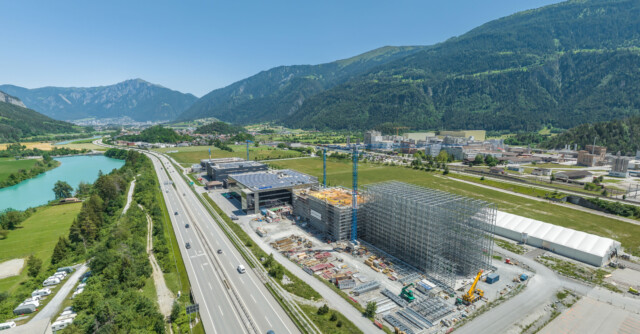
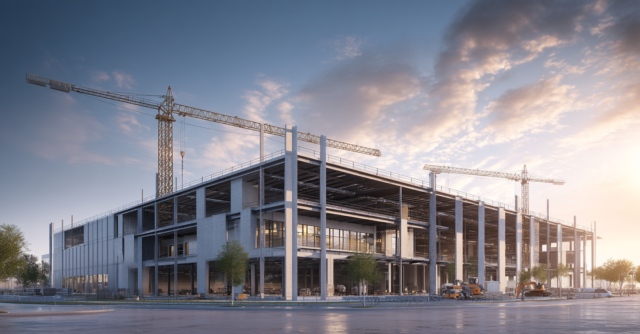
    Transstahl AG, which belongs to Pestalozzi, is to be able to transport long and bulky goods even more efficiently and flexibly throughout Switzerland in future. The Pestalozzi Group is therefore building a new logistics center in Pieterlen, for which the ground-breaking ceremony has now been held, according to a press release. In addition to representatives from Pestalozzi and Transstahl, Beat Rüfli, Mayor of Pieterlen, and Simon Enderli, Head of Location Promotion for the Canton of Bern, as well as other guests also took part in the ceremony.

    The logistics center will be 100 meters long, 30 meters wide and 12 meters high. An energy-efficient heating system is planned, as well as a photovoltaic system and charging stations for electric trucks and cars. A large proportion of the materials used come from the Pestalozzi Group, which specializes in steel technology and building services.

    “With this ground-breaking ceremony, we are investing in the development of our group of companies and making a clear commitment to Switzerland as a business location and to working in partnership with municipalities and regions,” Matthias Pestalozzi is quoted as saying in the press release. He is the owner and Delegate of the Board of Directors of the Pestalozzi Group.

  • Innovation impetus for the construction and property industry

    Innovation impetus for the construction and property industry

    Professor Adrian Wildenauer is to become the new head of the Centre for Smart Building & Real Estate at the Zurich University of Applied Sciences(HWZ). The centre will become part of the newly created Department of Banking & Finance, Controlling and Real Estate, according to a press release. The department will begin its work in January 2026 and will be headed by Nadine Rusch-Schenker.

    By taking on the new role, Adrian Wildenauer wants to play an active role in shaping the further development of the construction and real estate industry. He is currently a professor of digital construction at Bern University of Applied Sciences(BFH). Previously, he worked at SBB AG as Head of BIM Standardisation & Industry Activities and in other management positions in the real estate sector. His research focuses on the areas of Building-as-a-Service and digital construction.

    “With Adrian Wildenauer, we are gaining an internationally networked expert who combines theory and practice in a unique way. His work on smart building, digital twins and data-based services strengthens the innovative power of the HWZ in the field of real estate management,” said Brian Rüeger, Rector of the HWZ, in the press release.

  • Expansion of the company site for future growth

    Expansion of the company site for future growth

    HKG, a company specialising in building technology and energy consulting based in Aarau, is moving to new premises in Baden. From 1 March 2026, it will be operating from its site at Täfernstrasse 14a in the Dättwil district of Baden. HKG is currently still looking for additional employees for the new location, as detailed in a press release. The new offices are described as a “state-of-the-art workplace with light, space and a feel-good atmosphere” as well as a “workplace of the future” with a roof terrace, focus zones and modern infrastructure.

    Founded in 1978, Herzog Kull Group Holding operates in various fields of electrical engineering. These include electrical engineering, building automation, building IT and security, as well as consulting, energy, digitalisation and overall planning. While Herzog Kull Group Holding is headquartered in Rotkreuz, companies belonging to the group such as HKG Engineering and HKG Consulting are based in Aarau.

  • Bellinzona transformiert

    Bellinzona transformiert

    The historic SBB workshops, the centrepiece of Ticino’s industrial history, are making way for a district that serves as a model for sustainable urban development, an innovative mix of uses and high-quality living spaces. The political, economic and urban development significance of the project extends far beyond the borders of Bellinzona.

    Historical continuity
    The SBB offices have shaped the city centre for more than a century, providing thousands of jobs and an independent industrial identity. The relocation and replacement construction of the SBB industrial facilities in Arbedo-Castione by 2028 will create a rare development opportunity in the centre of Bellinzona. Over 100,000 square metres will be freed up for a comprehensive urban redevelopment, with a balance between tradition, innovation and strategic urban development.

    Participatory guiding process
    The redesign of the site is based entirely on participatory processes. The development process began with an international urban planning competition. Five European planning teams competed against each other, with the “Porta del Ticino – Urban Living Lab” project ultimately coming out on top thanks to its bold use of green space, multifunctionality and attractive density. Public consultations and a broad-based residents’ dialogue ensured broad acceptance and political backing. A representative survey showed that 65 per cent of the population supported the winning concept. Younger generations in particular have high expectations of innovation and quality of life.

    Urban structure, mix and development phases
    The masterplan concept envisages a clear linear tripartite structure for the site. Two peripheral zones combine flats, cooperatives, administrative and research uses, universities, commercial and hotel facilities. In the centre, the spacious Almenda will be a public green and meeting space that will serve as a social, cultural and ecological focus. The implementation period for the realisation of the district extends over several years in order to gradually create lively, resilient living, working and research landscapes. This guarantees flexible management of market dynamics and avoids vacancies or excessive property yield orientation.

    The striking “cathedral”, a listed building dating from 1919, will remain as a cultural magnet and will be transformed into a meeting and event venue. A worthy perspective for a landmark of industrial labour culture.

    A real laboratory of urban change
    The development plan commits to the highest sustainability standards, with the aim of achieving the Swiss Sustainable Building Standard (SNBS). Fossil fuels are excluded, and comprehensive photovoltaics and greenery, rainwater utilisation in the spirit of the “sponge city”, energy-efficient district heating and active promotion of electromobility are integral components. An energy plan supports the objective of covering a large part of the neighbourhood’s electricity requirements locally. Wide green spaces, biodiversity, urban gardening, resource-saving construction methods and low-emission mobility round off the ecological profile.

    Special attention is paid to intergenerational housing models, educational and research facilities, start-up promotion and the new innovation park, which will give Bellinzona a model character and regional appeal

    Model character and regional appeal
    The project combines socio-cultural values, sustainable infrastructure, entrepreneurial innovation and ambitious living and quality of life to create a new urban “engine” for the region. With its combination of participatory governance, versatile utilisation options and resilient open spaces, Bellinzona is setting exemplary standards for Swiss and European urban development in the coming decades.

  • Tenero Swimming Centre

    Tenero Swimming Centre

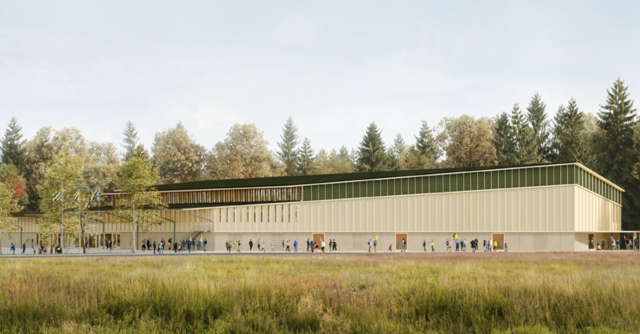
    The days of the old swimming facilities at the CST youth and competitive sports centre are over. The needs of young and elite aquatics athletes are constantly increasing. With the CHF 91.8 million investment approved by the Federal Assembly in 2021, Switzerland is setting an example for top-level promotion and sustainable development. The new replacement building will raise the CST to a new level as a central centre of excellence for swimming, artistic swimming, water polo, water jumping and ski freestyle.

    Modern concept
    Simply renovating the outdated facilities proved to be uneconomical and not future-proof. The planning therefore favours a complete new build in two construction phases. Firstly, a multifunctional indoor swimming pool will be built, which will define new training standards with an Olympic pool including a lifting floor, whirlpools, ice bath and comprehensive diagnostics area. This will be followed by the renovation of the outdoor facilities, including a modern training pool and landing area for freestyle skiing. Completion is scheduled for 2029, until then operations for athletes will be secured.

    Focus on sustainable and versatile infrastructure
    The Federal Office for Buildings and Logistics attaches great importance to sustainability in construction. The swimming centre is being built in accordance with SNBS and MINERGIE-ECO guidelines, optimised for life cycle costs and energy efficiency. The architecture by Studio Burkhardt and Stücheli Pestalozzi Schiratzki is characterised by its transparency, spaciousness and integration into the park landscape. Art and material aesthetics are also part of the new building, as a sensitive art-in-building concept creates identity for the location.

    A milestone for Swiss sport and the region
    With the laying of the foundation stone and prominent guests such as Olympic medallist Noè Ponti, the project promises not only international training standards, but also innovative event and training opportunities in water sports. The CST remains a pioneer in the promotion of young talent and will become a hub for cross-generational sports development in Switzerland.

  • Modernisation of the drinking water supply in Kopfholz

    Modernisation of the drinking water supply in Kopfholz

    The Schlieren-based construction company STRABAG has begun dismantling and rebuilding the Kopfholz reservoir on behalf of the municipalities of Horgen, Thalwil, Rüschlikon and Kilchberg. According to a statement from STRABAG, the modernisation project is intended to secure the local drinking water supply until 2050. In order to ensure a continuous supply of water, three construction phases are planned for the planned replacement construction. The first construction phase is to be completed by February 2026, with the project scheduled for completion in March 2027.

    According to the press release, the municipalities have been operating a joint water supply since 1905. The connection will be continued with the project, which the municipalities believe sends a “strong signal for a sustainable, safe and future-oriented water supply”. Rüschlikon’s storage capacity is expected to increase from 1000 to 1600 cubic metres, and Kilchberg’s from 1500 to 2800 cubic metres.

    The press release emphasises the particular challenge faced by the construction teams from the four clients in building the reservoir during ongoing operations. “The reservoir supplies more than 6,000 households with drinking water and the supply must be guaranteed at all times,” Beat Spörndli, Construction Manager, Civil Engineering and Road Construction North-East, is quoted as saying. He also emphasised the “high demands on coordination and hygiene on the construction site”. In addition to compliance with SIA standards (Swiss Society of Engineers and Architects), the use of a special drinking water concrete is a prerequisite. As the construction is subject to the Foodstuffs Act, germ-free water storage must be ensured. The close cooperation between the municipalities enables coordinated planning, minimises interference with the forest area and triggers synergies in tenders and construction processes.

  • Electrical installations in the historic railway station combined with modern technology

    Electrical installations in the historic railway station combined with modern technology

    Ernst Selmoni AG is responsible for the entire electrical system in the new Migros shop in the historic Badischer Bahnhof railway station. The rooms in the former theatre of the Förnbacher Compagnie in the southern part of the station building are, like the entire building, a listed building. Badischer Bahnhof, one of six railway stations in Basel and today the second largest, was opened in its current form in 1913.

    The contract included the complete electrical installation, from the power supply and modern lighting to the technical systems that enable smooth operation. “The work in the listed building was particularly exciting,” said Selmoni in a company press release. The historical substance demanded creative solutions, careful planning and close coordination with the authorities to ensure that tradition and modern technology were in harmony”.

    Christophe Hassler, Business Unit Manager at Selmoni Installation AG, describes this project as “an exciting challenge: realising modern electrical installations in a listed building without compromising its historical substance. With great care and innovative solutions, my team proved that technology and history can harmonise perfectly.”

    Selmoni was founded in 1934. The approximately 600 employees serve global corporations as well as private individuals. The company focuses on innovative solutions and digitalisation in construction. New technologies such as prefabrication, drilling robots, building information modelling and Hololens are already part of Selmoni’s everyday work to make construction projects faster, safer and more sustainable.

    Selmoni is one of five finalists for the Prix SVC Nordschweiz. This prize from the SME network Swiss Venture Club(SVC) will be awarded on 13 November in front of around 1,000 guests at the Congress Center Basel.

  • Circular construction as the new standard in the canton of Zurich

    Circular construction as the new standard in the canton of Zurich

    The Canton of Zurich ‘s Real Estate Office and Building Construction Office is systematically integrating the principles of circular construction into its processes with the help of the Circular Hub as a platform for the circular economy. This initiative goes back to the circular economy strategy published in 2024. According to a Circular Hub press release, the Community of Practice format entitled “KreislaufLAB – Planning and Building for Zurich’s Future” was established for this purpose. The aim is to sustainably anchor the necessary knowledge in the existing roles of cantonal property management. According to the project description, Circular Hub has taken on the conception, moderation and impact measurement of the format in close collaboration with cantonal managers. Internal anchoring is also supported by a communication strategy.

    Expertise and practical examples should make it easier to plan and implement circular construction. Specifically, topics such as deconstruction, material selection and life cycle thinking play a central role. “This creates a lively network in which knowledge is shared and anchored in concrete application aids. This is how impact can become visible,” is how Circular Hub describes its approach.

    Specifically, there will be five interactive workshops combining expert input, panel discussions and practical group work. As a result, practical tools and application aids will be developed. Internally, the process will be flanked by bulletins and a closing event, among other things. Ultimately, an impact assessment will provide information on how competences have been developed and the principles of the cycle have been anchored.

  • New competence centre strengthens logistics and flooring solutions in Oberhasli

    New competence centre strengthens logistics and flooring solutions in Oberhasli

    SHARKGROUP AG, a specialist in flooring solutions from Oberhasli, is moving into its new centre of excellence in Oberhasli together with Dietiker Planzer Transport AG. As Planzer reports in a LinkedIn post, the two companies will now be pooling their expertise under one roof. While Planzer will take over SHARKGROUP’s logistics on the 4000 square metres of warehouse space, SHARKGROUP will be able to use the new location to drive its growth and further expand its range of services.

    The competence centre covers an area of 10,000 square metres and has a 3,000 square metre solar installation on its roof. It also enables companies to travel short distances and reduce CO2 emissions during transport, which is a step towards sustainable logistics.

    As SHARKGROUP explains in a press release, the new site will enable the company to further strengthen its presence in the Zurich region and improve the availability of its product range. In addition, the expanded capacity and exhibition space will create more room for personalised support and services. “We are proud of the growth of our group and of being able to offer our customers even greater proximity and service in future,” says Managing Director Moritz Mühlebach, CEO of SHARKGROUP. “This project is an expression of our entrepreneurial vision and our ambition to play an active role in shaping the industry.”

  • Opening ceremony: Innovations in the finishing trade – Globus Basel flagship project

    Opening ceremony: Innovations in the finishing trade – Globus Basel flagship project

    Switzerland is being transformed in order to achieve the goals of energy, climate, circular economy and densification. The finishing and building envelope industry and its professions are crucial to this and are making the building stock fit. With a turnover of 36 billion, it is the strongest sector in the construction industry. Bauenschweiz’s core group for the finishing trade and building envelope would like to focus on this at the opening. This is exemplified by the completely renovated Globus Basel property, which will open at the end of 2025. In addition to a look at the project, guests will discuss the importance of the finishing trade, the further development of skilled workers and the needs of entrepreneurs and young professionals in the market.

    Program (as of 23.10.2025)

    10.15 a.m.Introduction with short clip on GAG at Globus Basel
    10.17 a.m.Welcome by moderator Sonja Hasler
    10.20 a.m.Discussion with Bauenschweiz President Hans Wicki, Member of the Council of States, and Home Group President Peter Meier
    10.30 a.m.Message of welcome from Cantonal Councillor Esther Keller, Head of the Building and Transport Department of the Canton of Basel-Stadt
    10.40 a.m.Moderated discussion with project managers “Globus Basel – from urban planning challenges to lighthouse project”
    Andrin Sennhauser, Confirm
    Jean-Luc von Aarburg, Miller & Maranta
    10.55 a.m.Panel discussion with Beat Hanselmann, President of Gebäudehüllenplaner, National Councillor Sandra Sollberger, entrepreneur and SMGV board member and sister duo Ladina and Alisa Oppliger, Gold and Silver Swisskills 2025 in façade construction
    11:30 a.m.Apéro riche

    Further information can be found here:
    LINK

  • Easier to build?

    Easier to build?

    The motion by Councillor of States Benedikt Würth (center/SG) demands that the federal government should in future only be responsible for objects of national importance. While the protection of sites will be transferred entirely to the cantons. This would remove the national inventory of sites worthy of protection as a common basis for assessment. The result would be different cantonal regulations, lengthy conversions and more legal disputes.

    The National Council’s Committee for Science, Education and Culture considers the path taken by the Federal Council to be more expedient. The measures agreed at the ISOS Round Table strengthen efficiency and clarity without abandoning proven standards.

    Reform instead of rupture
    Specific simplifications have already been agreed. Such as a more precise application of ISOS to federal tasks, clearer discretionary powers for cantons and municipalities and simplifications for projects with photovoltaics. These steps shorten procedures without sacrificing quality and are supported by the cantons, cities and municipalities.

    The central problem is not the ISOS itself, but the lack of coordination and the fact that interests are weighed up too late. If this is done at an early stage, conflicts can be avoided and projects accelerated.

    Proven examples from practice
    Successful models already exist. In Geneva, the “Patrimoine-Paysage-Territoire” platform significantly reduces the number of objections through joint project development. Neuchâtel shows how densification can be reconciled with ISOS through clear zoning and high-quality planning. These approaches strengthen transparency, acceptance and building culture.

    Accelerate with substance
    Instead of creating legal uncertainty, the ongoing ISOS development should be implemented consistently. Quality and planning security are the key to faster, sustainable construction, not federal patchwork. Only those who combine the two will achieve the goal of building simply without endangering our established building culture.

  • Strong wood presence at the ‘Swiss Arc Award’ 2025

    Strong wood presence at the ‘Swiss Arc Award’ 2025

    On October 30, the jury honored the best buildings of the year from over 400 submissions. The award, presented at Trafo Baden in front of over 500 guests from architecture and the construction industry, underlines the creative diversity and technical maturity of Swiss planning culture. The Lifetime Achievement Award was presented to Kaschka Knapkiewicz and Axel Fickert, whose work has had a decisive influence on local architecture for decades.

    Sustainability and functionality
    The Hortus office building in Allschwil by Herzog & de Meuron won in the “Work, Production & Infrastructure” category thanks to its systematic climate protection and material intelligence. The new University Children’s Hospital Zurich, the winning project in the “Education & Health” category, was also designed by Herzog & de Meuron. Its horizontal structure creates bright, open pathways and a new typology of hospital building that combines functionality with humanity.

    Wood as a design leitmotif
    The Guggach residential and commercial development in Zurich by Donet Schäfer Reimer Architekten won in the “Residential” category. Climate-optimized concrete and timber construction elements demonstrate how sustainable building materials can interact constructively and aesthetically. Andreas Fuhrimann and Gabrielle Hächler were awarded the first prize for interior design for their sensitive conversion of a terraced house in Gockhausen. Wood permeates surfaces, furniture and construction as a connecting element and emotional carrier of spatial quality.

    Audience award for multi-purpose building in Lavaux
    The multi-purpose building in Forel by Samir Alaoui Architectes won the audience award. The stacking of industrial and residential use creates an architectural unit with a high degree of spatial intelligence. Here too, the timber construction underlines the fact that sustainable construction and architectural expressiveness are not mutually exclusive.

    The Swiss Arc Award 2025 confirms that wood is not just a building material, but an expression of a new culture of responsibility in the Swiss construction industry.

  • Swiss Logistics celebrates the opening of Campus Zofingen

    Swiss Logistics celebrates the opening of Campus Zofingen

    The Swiss Association for Vocational Training in Logistics announces the grand opening of its Swiss Logistics Campus in Zofingen. The new training centre was officially inaugurated on 25 October with an open day. “It was a day full of exciting experiences, inspiring encounters and warm conversations,” writes Swiss Logistics in a press release on the opening.

    The association wants its new campus to be a “place of learning, development and encounters”. The training centre combines basic and advanced training as well as higher vocational training under one roof. Swiss Logistics is focussing on modern forms of learning and flexible spaces when providing training. The association’s programme is geared towards the future requirements of the industry.

  • New logistics centre secures pharmaceutical supply in Switzerland

    New logistics centre secures pharmaceutical supply in Switzerland

    Spirig HealthCare AG has opened a new logistics centre in Wangen an der Aare, the Egerkingen-based pharmaceutical company specialising in generics announced in a press release. The 2600 square metre facility houses over 2000 picking stations as well as refrigerated and special warehouses. The amount of the investment, which has already created eight new jobs, is not disclosed in the press release.

    Spirig HealthCare intends to use the new logistics centre to increase its own storage capacities and make distribution more flexible. If necessary, medicines can be delivered to any location in Switzerland within a few hours using the company’s own fleet, the company writes.

    “Providing a reliable basic supply of important medicines in Switzerland is our core mission,” said Hans-Peter Borger, General Manager of Spirig HealthCare, in the press release. “With targeted investments in our own storage capacities, we are ensuring that we can fulfil this requirement. The new logistics centre stands for flexibility, speed and sustainable distribution – and is our clear commitment to security of supply.”

  • St. Gallen modern urban development with double railway station

    St. Gallen modern urban development with double railway station

    The development model was developed jointly by urban planning, landowners and the neighbourhood association in a broad, cooperative process. Four workshops between June 2024 and May 2025 ensured broad participation and made it possible to identify specific opportunities for the nine sub-areas.

    Potential and spatial focus
    The structure plan identifies nine sub-areas, from Straubenzellstrasse to Debrunner Ost, which are to be developed individually and with a mix of uses. The area offers additional floor space potential of around 80,000 m², which can be used specifically for housing and workplaces. Better links between the neighbourhoods, more green and open spaces and new public squares are planned.

    Railway station as a driver of urban development
    The future relocation of Bruggen railway station to the east and its merger with Haggen railway station are one of the reasons for the project. They eliminate existing barriers and make large-scale accessibility possible. The planned passerelle creates new path connections and improves the integration of neighbouring districts such as Lerchenfeld. The railway station project influences the ongoing local planning revision and serves as a lever for sustainable, urban densification.

    Future prospects and planning security
    The development model provides the city and landowners with binding guidance for upcoming implementation projects in individual areas for the first time. The next steps concern the project planning for the railway station, including the Passerelle, and the transfer of the findings to the overall revision of local planning.

    Thanks to forward-looking planning and an integrative project structure, the Bruggen-Haggen area is on the verge of becoming an urban, mixed-use district with a high quality of life, better accessibility and targeted growth in area.

  • New residential neighbourhood brings dynamism to Spreitenbach

    New residential neighbourhood brings dynamism to Spreitenbach

    The Tivoli Garten neighbourhood is revitalising the municipality of Spreitenbach, according to a press release. People have been able to move in there since mid-July and by mid-September more than 500 residents had already taken advantage of this, according to the municipality, citing figures from the residents’ services.

    The largest group are the 226 people (45 per cent) who have moved to Tivoli Garten from the canton of Zurich. This is followed by 121 people (24 per cent) from the canton of Aargau, 89 people (18 per cent) who have moved within Spreitenbach, 49 people (10 per cent) from other cantons and 22 people (4 per cent) who have moved to Tivoli Garten from abroad.

    Tivoli Garten offers a total of 445 rental flats (1.5 to 5.5 rooms) and small commercial spaces on an area of 15,000 square metres. A communal garden with a playground serves as a meeting place for the residents.

  • Further training for modern fire protection expertise

    Further training for modern fire protection expertise

    The Technopark Zurich-based AFC Academy, which claims to be a leader in training and further education in the areas of fire protection, safety and building technology, has developed the BSV 2026 retraining concept, which prepares specialists for the new BSV 2026 fire protection regulations, according to a press release.

    In Module A of the training programme, the academy provides an overview of the key innovations of BSV 2026 at fire protection specialist level and practises drawing up plans and concepts in accordance with the regulations. Module B, on the other hand, teaches the practical application of the new requirements and documentation methods at fire protection expert level.

    According to the AFC Academy, the new fire protection regulations BSV 2026 mark a fundamental change in Swiss fire protection and significantly increase the requirements. Risk-based verifications are replacing standard solutions and make in-depth knowledge of structural, technical and organisational contexts essential. As fire protection is becoming an integral part of architecture, utilisation, operation and technology, it is necessary to work together on all these levels – interdisciplinary thinking is therefore becoming crucial, according to the Academy. In future, clear communication will also be required: specific requirements for documentation, quality assurance and enforcement must be clearly communicated to clients, authorities and project partners.

    The AFC Academy has been offering training programmes for fire protection, sustainable construction, safety and building technology since 2016.

  • Compact energy storage for sustainable building technology

    Compact energy storage for sustainable building technology

    Cowa Thermal Solutions AG, based in the Technopark Lucerne in Root, has entered into a wholesale partnership with the distribution company Meier Tobler from Schwerzenbach ZH. According to a press release, Cowa intends to use this partnership to significantly expand its market segment in Switzerland. Meier Tobler, a provider of building technology products in the areas of heating, ventilation, air conditioning and sanitation, will distribute Cowa heat storage units for use in single-family homes, apartment blocks and for integration into heat pump and photovoltaic systems. This will make access easier for tradesmen in particular.

    “With Meier Tobler, we have gained Switzerland’s strongest sales partner, who also shares our vision of compact and sustainable heat storage,” said André Waller, CRO of Cowa Thermal Solutions AG, in the press release. “This partnership is a milestone for us. It makes access to future-oriented heat storage easier than ever before, directly where installers order anyway.”

    Cowa plans to launch a new latent heat storage system on the market by the end of 2025. The product for domestic hot water will have a phase change material (PCM) melting point of 48 degrees Celsius and therefore have a high energy efficiency. According to Cowa, the melting point of this “technological world first” would be 10 degrees lower than that of previous systems. Thanks to the low melting point, almost all standard heat pumps can be used for the storage tank.

  • Strategic partnership strengthens building technology and energy planning

    Strategic partnership strengthens building technology and energy planning

    AEW Energie AG is acquiring a stake in Herzog Kull Group Holding AG(HKG). The energy supplier from Aarau will acquire a 35 per cent stake in the Zug-based building technology and electrical engineering group, AEW announced in a press release. The two companies intend to develop new business areas together. Examples cited in the press release include general planning for site concepts and standardised overall solutions for residential construction.

    The two companies have agreed not to disclose the purchase price for the shares. AEW and HKG have already worked together in the past. AEW acquired a 50 per cent stake in the HKG subsidiary GA-Werkstatt.ch AG(GAW) at the end of 2023. GAW is to be merged with HKG subsidiary Energy-Group.ch AG this year to form Energy Group AG.

    “The megatrends of decarbonisation, decentralisation and digitalisation will continue to shape the energy system in the future, and every building will be an active element in this,” AEW CEO Marc Ritter is quoted as saying in the press release. His company intends to expand its own expertise in planning, engineering and building management, while continuing to forgo activities in execution. As part of the acquisition of HKG, Ritter and AEW Chairman of the Board of Directors Raffael Schubiger will join the Board of Directors of Herzog Kull Group Holding AG.

  • Expansion of the range for modern building envelopes

    Expansion of the range for modern building envelopes

    The Pestalozzi Group has launched Pestalozzi Alutechnik AG. As Pestalozzi reports in a LinkedIn post, the subsidiary will offer “a wide range of high-quality aluminium products and innovative system solutions” as the exclusive Swiss distribution partner of Aluprof, a manufacturer of aluminium systems belonging to Grupa Kęty SA from Kenty (Kęty) in Poland and operating in Europe. While the company is available immediately for industrial profiles and consultations, aluminium systems are to be delivered from 9 March 2026.

    Pestalozzi Alutechnik AG is your contact for windows and doors, façades and fire protection. The company offers innovative products as well as intelligent and modular system solutions for residential and commercial construction. After detailed consultation with experts, solutions are developed individually and customised to the customer’s needs. Pestalozzi offers support from planning and system selection through to delivery.

  • Expansion in the area of wall solutions

    Expansion in the area of wall solutions

    Holcim AG acquires Xella International GmbH. The Duisburg-based group, which operates throughout Europe, specialises in building materials, insulating materials and services for the building envelope. With this acquisition, Holcim intends to expand its own portfolio with Xella’s complementary offering, the Zug-based building materials group explained in a press release.

    “This strategic acquisition is a milestone in our vision to be the leading partner for sustainable construction and accelerates the expansion of our high value-added Building Solutions business in line with our NextGen Growth 2030 strategy,” Holcim CEO Miljan Gutovic is quoted as saying. “By complementing our offering in the highly attractive market for wall solutions with a volume of more than 12 billion euros, Xella will open up cross-selling and system sales opportunities for us.” The transaction value is estimated at 1.85 billion euros in the press release. The acquisition is expected to be completed in the second half of 2026.

  • Between regulation and innovation

    Between regulation and innovation

    What is the biggest challenge facing the Swiss construction industry?
    The construction industry is facing numerous challenges: A shortage of skilled workers, increasing regulation, climate neutrality and digital transformation. The SBC is therefore actively investing in young talent, digitalization and the circular economy. However, the biggest challenge, which has far-reaching consequences for society, is the implementation of the Spatial Planning Act, i.e. structural densification. There is no alternative if we want to protect our living space and manage population growth at the same time. The cantons and municipalities have largely failed in this respect. We are progressing far too slowly.

    In your opinion, what are the main reasons for the shortage of skilled workers in the construction industry and how can the sector be made more attractive to young people?
    Many experienced specialists will soon be retiring, while there is a shortage of future generations. In addition, working in construction is seen as demanding and is associated with prejudices. Yet the construction industry offers very attractive working conditions: Around 5,000 francs starting wage and the highest tradesmen’s wages in Europe, early retirement from 60 and very good career opportunities. To make these strengths visible, we invest in career marketing(bauberufe.ch) and are constantly developing our training and further education program. This is having an impact: the number of apprentices rose by 10 percent in 2024.

    What strategies and initiatives does the Master Builders Association want to use to strengthen and expand the construction industry’s contribution to Switzerland’s climate targets?
    The construction industry is central to a sustainable Switzerland and has already halved its per capita footprint in the last 30 years! The SBC supports its members in exploiting sustainability opportunities and transferring knowledge from research into practice. The focus is on the circular economy with a life cycle approach. Concrete is the world’s recycling champion and can make a significant contribution to climate neutrality with CO₂ storage. To ensure that recyclable building materials and construction methods are used, building owners must tender accordingly. The SBC Sustainability Toolbox helps to integrate ecological, economic and social criteria into tenders. Energy-efficient renovations and replacement buildings remain important in the building stock, where appropriate.

    How digital is the construction industry and what are the future trends in the construction industry in the digital age?
    The construction industry is more digital than is often assumed, but there is still a lot of potential. Many companies now use digital tools for organization and construction site documentation. Building Information Modeling (BIM) is a key lever: model-based information can already be used in specific use cases on the construction site. In addition, more and more clients are demanding model-based tenders. Due to the lack of binding standards, SBV is developing component-based calculation bases. We also support companies with the digital AI assistant Construix.ch, which answers legal and normative questions in a matter of seconds. This is the new chat GPT of the Swiss construction industry, soon to be indispensable for every construction specialist.

    What opportunities do you see for the construction industry through the increased use of 3D printing technologies?
    3D printing is no longer a new technology. We are following it closely, particularly with regard to sustainability, efficiency and construction time. However, it is currently not widely applicable due to a lack of technical, regulatory and economic requirements. Some SBC members are testing pilot projects, but many are still questioning the practical benefits. The SBC positions itself as a mediator between hype and reality and sees 3D printing as one of many means of increasing productivity. As an association, we consciously focus on topics that are having a broad impact today, such as BIM or the use of AI. Where the leverage is greatest.

    In your view, what political reforms are urgently needed to accelerate the planning and approval processes?
    For us, this is the top priority on the road to successful densification! We need three key reforms to achieve this: Firstly, faster procedures. Solar systems or heat pumps, for example, should be subject to the notification procedure and digital processes should be implemented consistently. Secondly, objections must be restricted. Too many objectionable cases are currently blocking construction. Only those with vested interests worthy of protection should be permitted and abuse should be prevented with cost requirements. Thirdly, there needs to be a better balance between residential construction and monument protection: inner densification, replacement new builds and a reduction in protection inventories are crucial to ensure that residential construction is not blocked. We are driving these reforms forward, hand in hand with our cantonal sections, at all three federal levels.

    How does the sector assess the international political situation and what specific effects are you feeling?
    The global uncertainties are above all an opportunity for the Swiss real estate industry. As a safe haven, Switzerland attracts wealthy foreigners to the country, who demand real estate and infrastructure. Of course, we also have risks in supply chains, rising material and energy costs and more regulation, but the industry can deal with these and is therefore resistant to crises.

    What motivates you personally to work so hard for the further development of the Swiss construction industry?
    I live the Swiss militia system with conviction. Our civil society needs pragmatic practitioners at the levers and not ideologues with mere theoretical knowledge. The construction industry plays a central role in our social future, and that motivates me. It creates living space, infrastructure and secure jobs for many families.

  • Future neighbourhood with residential and commercial space in Döttingen

    Future neighbourhood with residential and commercial space in Döttingen

    The results of the study contract for the Gewerbestrasse site development in Döttingen will be exhibited in Döttingen on 18 and 19 October. The winning entry was submitted by fsp Architekten from Spreitenbach, together with LAND Suisse from Lugano and ASTOC Architects and Planners from Cologne. In the DOT project, a new neighbourhood is being created on the Birchmeier Hess Immobilien site. An area of 75,000 square metres will be home to 550 flats, while 15,000 square metres are earmarked for commercial use, as detailed in a press release.

    “With the transformation of the site, industry will become a neighbourhood. Halls become home, traces become identity. The industrial heritage is being transformed – sustainable, future-proof, mixed,” says Ivo Lenherr from fsp Architekten about the DOT project. The jury’s unanimous vote in favour of the winning project was based, among other things, on the “sophisticated urban planning strategy in dealing with the specifications of the landowner, the current building stock and the approved structure plan”. The project represents “a considerate approach to the neighbourhood and public needs and promises a harmonious and rich living and working environment for future users.”

  • Investments boost marketing success

    Investments boost marketing success

    With targeted investments in marketing, cybersecurity and AI innovations, the company is continuously developing its platforms, offering real estate professionals future-proof products and services for a digital competitive edge in the market.

    Marketing power for maximum reach
    Visibility is a decisive factor in real estate marketing. This is why SMG Real Estate invests in marketing activities with its platform brands, which include ImmoScout24 and Homegate, in order to continuously improve reach, efficiency and target group approach. The aim is to lead the most relevant interested parties directly to the advertisements, to strengthen the market opportunities of business customers and to position the two brands as the top real estate platforms in Switzerland in the long term.

    Dedicated marketing experts at SMG Real Estate develop integrated strategies that combine inspiring and attention-grabbing content with target group-specific social media campaigns. Interactive user engagement approaches are used to make property seekers aware of the platform brands in the long term. This ensures that the real estate professionals’ properties are present at exactly the right time on the channels with the widest reach.

    Technological reliability is a key issue
    To ensure all of this, performance is a key issue – after all, hundreds of thousands of Swiss people visit the SMG Real Estate platforms every day and use the daily updated listings for their property search. A team of over 100 tech specialists ensures that the required systems function efficiently, reliably and with the latest technology.

    Security also plays an important role. State-of-the-art protection mechanisms and two-factor authentication (MFA) ensure that customer data is reliably protected. Investments in the stability of the platforms and strict security requirements create the basis for real estate professionals to focus on their marketing ambitions.

    Gaining efficiency with artificial intelligence
    Real estate professionals are also supported by innovative, AI-based functions that take real estate marketing to a new level. They make it possible to display advertisements in a more targeted manner, identify the best times to approach advertisers and use data analysis to increase the relevance and attractiveness of listings. Artificial intelligence is thus increasingly becoming a valuable tool that makes the day-to-day work of marketers and managers measurably easier – from AI-supported ad creation, which saves up to 14 minutes per ad, to the intelligent management of ad performance. In summary, SMG Real Estate’s extensive investments in technology, marketing and security have a clear objective: they offer business customers the best possible return on investment and therefore a competitive advantage in the highly competitive real estate market. Because only those who can sustainably position themselves in the market and stand out will have the best possible marketing opportunities.

    Find out more

  • Precision work at the Luterbach hydropower plant honoured

    Precision work at the Luterbach hydropower plant honoured

    Senn AG from Oftringen, which specialises in steel and metal construction as well as crane and other transport, took second place for Crane Work of the Year 2025 under 120 tonnes at the BSK Annual General Meeting on 12 October. The company was nominated in several categories with challenging projects.

    According to a press release, the basis for the award is the overhaul of the Luterbach SO hydropower plant, which Senn carried out together with ADEV. As part of the project, a 20-tonne generator with a height of 3.5 metres and a 3.4-metre turbine wheel had to be removed from the hydroelectric power plant, transported, overhauled and finally reinstalled. Lifting the generator and turbine wheel through a roof opening in the power station required millimetre precision work from the crane operators. A specially designed steel frame and a customised heavy-duty transport solution then ensured the smooth removal to the overhaul plant.

    The Luterbach project is an example of the company’s own combination of engineering skills, precision and experience in heavy haulage, which enables successful project execution, explains Senn AG.

    Senn AG operates in the fields of steel and metal construction, sheet metal and stainless steel centres, emergency power systems, cranes and transport. With more than 200 employees, the company claims to be one of the most important employers in the Zofingen district.

  • Strategic expansion on the European door market

    Strategic expansion on the European door market

    Arbonia AG is strengthening its market position in Europe. The Arbon-based company, which specialises in interior doors made of wood, glass and metal, has taken over the Portuguese door manufacturer Cicomol with effect from 15 October, Arbonia announced in a press release. On 9 October, Arbonia also completed the takeover of the German specialists for special metal frames from Rüthener Zargenbau GmbH & CoKG. Last year, the two companies generated a combined turnover of around 20 million euros.

    Arbonia expects the takeover of Cicomol SA, the market leader in Portugal, to strengthen its presence in the specialised trade in Portugal and to generate sales synergies in Spain, Portugal and France. The acquisition of Rüthener Zargenbau, in turn, is intended to close a gap in Arbonia’s portfolio. To date, the international company has largely purchased its metal frames externally. According to Arbonia, both acquisitions will also strengthen margins and increase value.

    The transactions include the takeover of around 130 employees from Cicomol and almost 40 employees from Rüthener Zargenbau. The management of the two companies will also remain unchanged.

  • Clay celebrates its comeback

    Clay celebrates its comeback

    Clay has been tried and tested for thousands of years, consists of local clay, silt and sand, can be used without energy-intensive firing processes and is available in almost unlimited quantities. In contrast to concrete, the production of which causes considerable CO₂ emissions by burning limestone, loam scores points with its minimal energy consumption during extraction and processing. According to estimates from various sources, the production of concrete generates an average of 800-900 kg of CO₂ per tonne, whereas clay often only produces a tenth of this and usually none at all, provided it is dried naturally

    The clay pavilion in Horw
    As part of the “Think Earth” programme, ETH Zurich, HSLU and industrial companies are working together to bring clay and wood into innovative applications as a material base. One milestone is the clay pavilion in Horw, where clay and wood elements are combined in hybrid form with recycled Oulesse, a mixed demolition material developed by Oxara. The prototypes are created in close collaboration with the construction industry and students. The aim is to create modular, prefabricated clay building components with reliable strength, versatile and deconstructable, for multi-storey residential construction and flexible architecture

    Advantages, challenges and recycling potential
    Earth is not only energy-saving, but can also store CO₂, especially when organic additives are added – it can even have a climate-positive effect. Earth building materials can be easily separated and reused when buildings are dismantled. The recycling process is not costly and enables a genuine circular economy.

    Clay is already available in abundance regionally as excavated clay or as a by-product (“filter cake”) from gravel and excavation washing. So far, widespread use has failed mainly due to a lack of standardisation and market maturity. The “Think Earth” project partners are now working intensively on this

    Clay construction hybrid solutions are still more cost-intensive than conventional concrete construction, but advances in industrial production, material mixing and quality assurance are increasingly bringing them within reach for the masses

    From niche to standard?
    Researchers at HSLU and ETH Zurich are working on the standardisation of the new hybrid earth building elements, so that market entry in the next ten years is realistic. The industry is showing great interest. Especially because “waste” from excavations is becoming a key raw material. With clay, wood and intelligent hybrid technologies, a building principle is available that conserves natural resources, offers climate benefits and still enables architectural diversity. Clay is experiencing an innovation and image revival. “Think Earth” and the earth pavilion show how research and the construction industry are working together to deliver solutions for the building revolution. A small ecological footprint, circular potential and healthy living are more than just a trend – they mark the path to urban building culture in the 21st century.

  • Impetus for sustainable site development

    Impetus for sustainable site development

    Switzerland is one step ahead with the harmonisation of labels. Minergie-Areal focuses on energy efficiency, comfort and climate-friendly mobility and, with its streamlined certification process, is ideal for smaller, manageable sites. It sets clear specifications, for example for building quality and monitoring. SNBS-Areal is convincing for large, complex sites of 10,000 m² or more and covers social, economic and ecological aspects in equal measure. With 30 tested criteria and a broad sustainability assessment, it also serves as a basis for ESG reporting and special utilisation planning

    The example of Kraftwerk1 in Zurich
    Kraftwerk1 demonstrates the value of self-organisation, diversity and solidarity in urban areas. Democracy, low-car living, social rental models and flexible spaces ensure sustainability in practice. The cooperative structure combines individual appropriation with neighbourhood cohesion and strong environmental responsibility

    Life cycle, costs and sufficiency as levers
    Costs are reduced in the long term where product life cycles are extended, recycling is promoted and resources are optimally utilised. Beat Salzmann explains how life cycle management and the circular economy influence financial planning. Sustainable buildings are investments in the future. Sufficiency, as Boris Szélpal explains, means targeted reduction and conscious use of materials and energy. It expands the understanding of sustainability to include the aspect of voluntary renunciation, the development of resilient living spaces and social structures

    Sustainable site development is a coordinated process. Standards create clarity, cooperatives live values and sufficiency opens the way to resilient neighbourhoods with a high quality of life and low environmental impact. The future lies in the balance between comfort and indulgence and in the openness to consistently develop new models

  • Energy self-sufficiency for buildings and 6G

    Energy self-sufficiency for buildings and 6G

    Traditional sensor solutions are cumbersome. They contain environmentally harmful substances such as lead or rare earths, require costly maintenance and often cause hazardous waste due to batteries. The new sensors are based on lead-free aluminium nitride and use special metamaterials produced using 3D printing. These focus metamaterials bundle vibration energy, such as vibrations from rail or road traffic, exactly where it is needed on the sensor (“rainbow trapping”). This maximises the efficiency with which vibration energy is converted into electricity for the sensor

    The result is a prototype just 300 micrometres long, i.e. smaller than a five-wheeler, which obtains its energy directly from the environment, works completely without a battery and transmits data wirelessly in real time.

    From bridges to 6G stations
    The potential applications are diverse. In structural monitoring, the sensors enable continuous, maintenance-free monitoring of bridges, tunnels and high-rise buildings, especially in places that were previously difficult to reach. They provide continuous data on material fatigue, vibrations or any damage and offer the possibility of equipping critical infrastructures with early warning systems. For example, to detect earthquake movements or damage to the terrain.

    Another field is opening up with 6G technology. High-frequency, energy-autonomous microsensors will enable a very dense sensor network, which is essential for the next generation of digital communication. The new technology will become a key element for real smart cities.

    Sustainability, ethics and regulatory added value
    The elimination of lead and rare earths not only protects the environment. The innovation is also beneficial from a regulatory perspective, as no special disposal is required and global supply chains become more independent. The use of freely available materials also increases the economic feasibility and scalability of such solutions.

    Interdisciplinary partnership and funding landscape
    The technology is the result of a major collective research effort. From mathematical modelling at Imperial College, materials research in Zurich and Milan, through to industrial implementation by the project partners Multiwave and STMicroelectronics. The project was funded by the EU’s Horizon 2020 programme and the EIC Pathfinder, which specifically bridge the gap between basic research and concrete applications, bringing sustainable, microscale sensor technology to where it is most urgently needed – on buildings, in remote areas and in the network technology of the future. The combination of energy self-sufficiency, robust material selection and integrated digitalisation is exemplary for a construction and infrastructure sector that combines ecological transformation and technical innovation. The project thus provides a construction kit for an Internet of Things that works with the environment instead of against it. Pioneering and immediately applicable in practice