Category: Facility Management

  • BIM and digital twins the digital partners of buildings

    BIM and digital twins the digital partners of buildings

    BIM, Building Information Modelling, replaces static 2D plans with a shared, digital building model in which architecture, technology and costs interact in real time. All components are recorded as BIM objects with dimensions, services, prices, warranty and maintenance information, from the brickwork to the door, from the sensor to the pump.

    Instead of sending plans back and forth, everyone involved works in the same 3D model, recognises collisions early on and experiences the building virtually before the first excavator rolls in. This reduces the risk of errors, makes deadlines easier to plan and lays the foundation for clear budgets instead of later addenda.

    From the BIM model to the building twin
    The digital twin is created from the BIM model during operation. The building twin, which takes over up to 95 per cent of the planning information and links it with live data from the building. It forms the “single source of truth” for areas, technology and sensors and visualises performance, occupancy and comfort levels in real time.

    Cloud-based building twin platforms enable buildings to be monitored virtually, scenarios to be simulated and new applications to be scaled quickly, from energy monitoring to user-centred service suites with AI analytics. This transforms the rigid plan into a learning system that evolves with the requirements of operators, tenants and cities.

    Added value in operation instead of just on the construction site
    Around 80 per cent of a building’s life cycle costs are incurred during operation. This is precisely where BIM, in combination with digital twins, has the greatest leverage. Facility managers access maintenance cycles, operating instructions, manufacturer and warranty data in the 3D model, plan conversions precisely and reduce downtimes and journeys.

    Structured product and live data allow predictive maintenance, bundled procurement or automated reactions such as closing blinds in the event of severe weather warnings. At the same time, the transparent database supports ESG goals, decarbonisation and the circular economy, from energy and water tracking to the valuable reuse of materials in dismantling.

    Digital ecosystems as a model for the future
    Digital twins connect buildings, campuses and neighbourhoods to form intelligent ecosystems in which energy, use and mobility are coordinated. They provide insights into comfort, health, utilisation and emissions and help to manage net-zero strategies, new working environments and mixed-use urban building blocks based on data.

    For owners and operators, BIM and digital twins are thus becoming market differentiators. Those who understand their own portfolio digitally can better prioritise investments, manage risks and prove the return on investment of refurbishments, conversions and services. In an industry caught between decarbonisation pressure and user expectations, they are becoming the key to transforming properties from static objects into adaptive, future-proof infrastructures.

  • Hybrid is the new normal

    Hybrid is the new normal

    77% of Swiss companies now rely on hybrid working models. That is more than twice as many as before the pandemic. In Germany, 79% of companies offer hybrid working, while the proportion of employees working from home remains stable at between 23% and 24%. At the same time, the analysis of job advertisements, a reliable seismograph for medium-term corporate decisions, shows that hybrid working has been consistently communicated as a working model in around 20% of German and 15% of Swiss job advertisements since 2023.

    Recalibration, not capitulation
    Yes, the average time spent working from home has fallen slightly. In Switzerland from 1.36 to 1.15 days per week, in Germany from 1.0 to 0.85 days. Anyone who sees this as the end of flexibilization is misreading the data. Only 4 to 5 percent of German companies are considering doing away with the home office completely. 74 percent plan to retain hybrid models, while 11 percent even want to increase flexibility. Adjusting entrepreneurial thinking, not turning back.

    Rethinking the office
    The real question is not how many days someone spends in the office. It is why someone should come to the office. 75 percent of employees see the office as a better place for social interaction, 58 percent for networking and career development, 49 percent for creative interaction. The office is changing from an obligatory place to a meeting point for things that don’t work remotely. CBRE speaks of the “office as an attractor”, a place that must offer tangible added value in order to justify the journey. Globally, office occupancy has now recovered to 53%, the highest level since March 2020.

    What companies need to do now
    The data is clear, as are the areas for action. 72% of the companies surveyed have set themselves the goal of improving office space utilization. 66 percent want to sustainably improve the office experience. In other words, spaces that enable collaboration instead of hindering it. Concepts that make team days meaningful and a corporate culture that makes presence attractive rather than enforcing it. Anyone who views the office as a mere cost problem is missing the real strategic question. What value does it create for people and the organization?

    Flexibility as a competitive factor
    Hybrid working has long been more than just an HR issue. It is a factor in the battle for skilled workers. Companies that credibly embrace flexibility have a measurable advantage in recruiting. The ISG study on the future of the Swiss workplace shows that employee experience has become a key lever, from collaboration and onboarding to the availability of space. Hybrid working is the new normal and those who strategically shape it now will position themselves as employers of the future.

  • Clean waste disposal systems as a success factor in property management

    Clean waste disposal systems as a success factor in property management

    Functioning waste disposal systems are a central component of modern properties. Underfloor and waste containers must not only be emptied, but also professionally cleaned on a regular basis to ensure hygiene, operational safety and value retention. The requirements for odour management, cleanliness and documented service processes are growing, especially in densely used residential and mixed-use areas.

    For property managers and owners, this means that container cleaning must increasingly be seen as an integral part of site management. Today, modern processes with closed water cycles and standardised procedures enable efficient and sustainable implementation.

    Practical example from Ascona

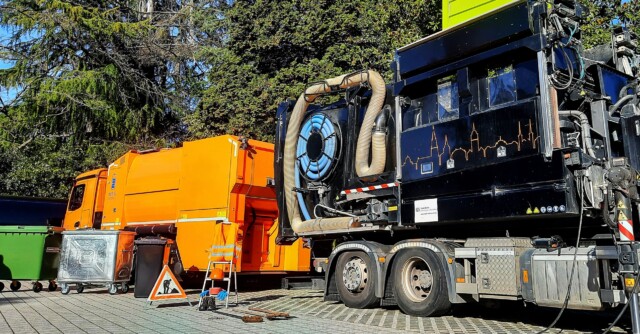
    A recent CleanTech Day in Ascona showed how professional container cleaning works in practice. Representatives from local authorities and facility management took the opportunity to watch live cleanings and exchange ideas directly with experts. The positive response confirms the growing importance of structured container maintenance in property operations.