Tag: 3D-Druck

  • Building a house from plastic waste

    Building a house from plastic waste

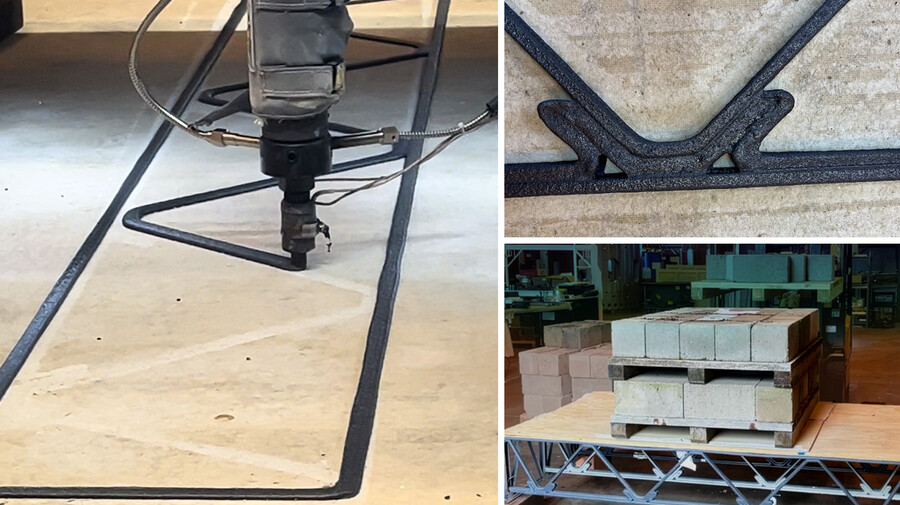
    Today’s PET bottle could be part of a floor beam tomorrow, as a load-bearing element. A research team at the Massachusetts Institute of Technology is investigating how recycled plastic can be shaped into load-bearing components using large-format 3D printing. The focus is on a beam system that has been specially developed and tested for use in residential construction.

    Plastic trusses instead of wood
    The new beams look familiar at first glance, as they are based on the geometry of classic wooden trusses. A frame with diagonal struts absorbs and distributes forces, a construction method that has been tried and tested for decades. What is new is the material and production. A composite of recycled PET and glass fibres is used for printing, which provides rigidity and stabilizes the pressure behaviour. Each beam measures around 2.4 m long, around 30 cm high and a good 2.5 cm wide, weighing only around 6 kg and therefore significantly less than a comparable wooden beam. The production time is short, less than 13 minutes per component is sufficient for printing.

    Load test under practical conditions
    In order to test its suitability for everyday use, the team assembled four beams in parallel and screwed them together with a wood-based panel to form a floor frame measuring approximately 1.2 by 2.4 m, a common grid dimension in the USA. The surface was then gradually loaded with sandbags and concrete weights, while the deflection was continuously measured. Up to a load of around 140 kg, the deformation remained well below the limits permitted by US building regulations. Only when the total load exceeded 1,800 kg did the construction fail, the beams buckled and broke. This indicates that the rigidity is generally sufficient to meet the relevant requirements in residential construction.

    Lightweight, modular, quick to assemble
    In addition to the load-bearing capacity, the low weight is a key advantage of the system. The plastic beams can be transported using a pickup truck, which simplifies logistics and handling on the construction site. Assembly follows the principle of classic timber frames. The elements are screwed together on site and joined to form a load-bearing skeleton. In the long term, the concept is aimed at modular house frames in which the floor, walls and roof consist of standardized, printed components. This approach is particularly interesting for regions where wood is scarce or expensive.

    Plastic waste as a raw material for a billion houses
    The project was triggered by the enormous global demand for housing. AJ Perez from the MIT School of Engineering points out that around one billion new houses will be needed by 2050. A demand that can hardly be met with wood alone without clearing gigantic areas of forest. Instead, existing waste streams should be used. Disposable plastics such as bottles or food packaging will be given a second life as a construction product. The aim is to create components that are lighter, more durable and more sustainable than conventional alternatives.

    Costs, standards, long-term behavior
    Despite the promising results, the technology is still in its infancy. The actual costs on an industrial scale, the adaptation of standards and approval processes and the long-term behavior of the components under weathering, UV radiation and changing loads are still unclear. Nevertheless, the project opens up exciting prospects for planning, development and the construction industry. 3D-printed supporting structures made from recycled plastic could change the material mix in building construction. Provided that cost-effectiveness and durability can be convincingly demonstrated.
  • Think circular, reprint wood

    Think circular, reprint wood

    Stricter regulations on the energetic use of waste wood mean that large quantities of wood waste can no longer simply be incinerated, but can still be recycled. The “Experimental and Digital Design and Construction” department at the University of Kassel is working with Buro Happold to develop a 3D printing process that converts waste wood particles into load-bearing wall components. The project is being funded as part of the “Zukunft Bau” program of the Federal Institute for Research on Building, Urban Affairs and Spatial Development.

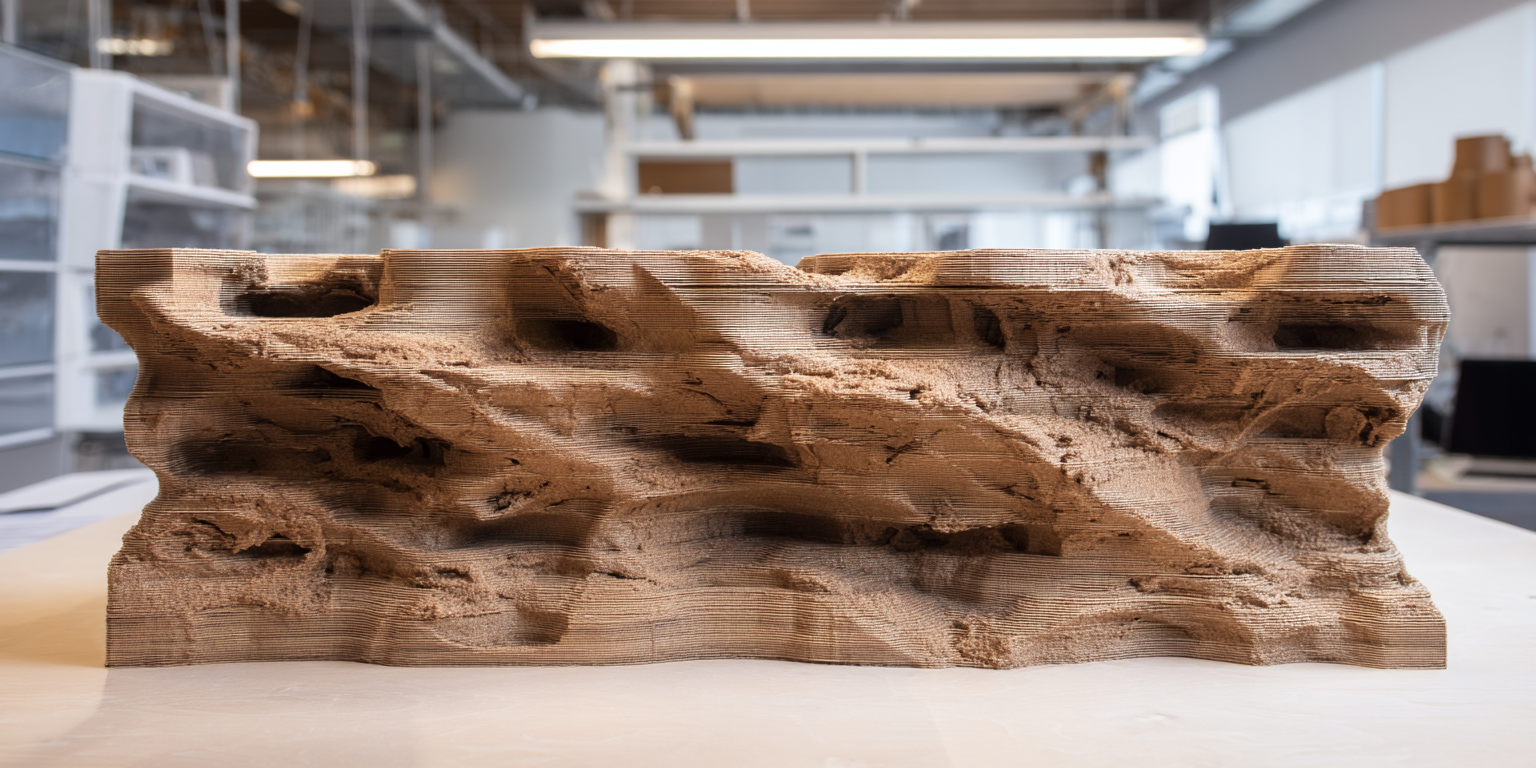
    the focus is on a bio-based printing material made from shredded waste wood particles, which mainly originate from secondary material flows from the wood industry – i.e. from post-consumer wood. Industrial partners process the material and mix it with biogenic binders to create a paste-like mass that can be extruded with robotic support.

    lightweight components from the 3D printer
    The result is clearly different from the familiar 3D concrete printing process. The mass of wood particles and binder is applied in layers on a scale of 1:1 and forms lightweight but stable components. Flat wall structures are possible, as are freely curved geometries that can be precisely adapted in terms of construction and architecture.

    the current Rafa 2.0 project phase will run for 18 months and builds on the previous Rafa project, in which the researchers fundamentally investigated the suitability of waste wood particles for additive manufacturing. Material formulations are now being refined, the extrusion process optimized and the components tested under laboratory conditions, with the aim of achieving an end-to-end digital manufacturing process through to the full-scale prototype.

    load-bearing, fire-resistant and circular
    For the concept to work in practice, the printed elements must do more than just show shape. Load-bearing capacity, rigidity and fire protection properties that meet the requirements of interior construction are required. The project partners see an initial field of application in modular wall systems that can be easily assembled, dismantled and reused elsewhere.

    this principle fits in with circular building approaches, in which building components are not disposed of at the end of their life cycle, but are transferred to new uses. The components can be dismantled by type because no components containing harmful substances are used. This is a prerequisite for closed material cycles in timber construction.

    digital planning as a key technology
    Digital planning plays a central role. Buro Happold is responsible for computational design and structural planning and uses simulations to predict the structural behavior of the components. Geometries are optimized so that material is only used where it is structurally necessary – resource efficiency becomes a design task.

    “We turn waste into an opportunity, reclaimed wood is turned into high-performance components through digital design and additive manufacturing,” says Shibo Ren from Buro Happold, describing the approach. Away from linear consumption and towards a circular, data-based construction practice that closely interlinks robotics, engineering and design.

    practical prospects
    In the short term, the process aims to use less material and reduce emissions compared to concrete-based 3D printing technologies. In the long term, it could open up new markets for bio-based additive construction methods. Especially where low weight, deconstructability and architectural freedom are required.

    whether and how quickly the approach becomes commercially viable depends on scaling, standards and acceptance in construction practice. Technically, however, the project already shows that circular construction does not begin with recycling, but with design. Where materials, processes and life cycles are rethought.

  • Blue-green algae material stores CO2 on building facades

    Blue-green algae material stores CO2 on building facades

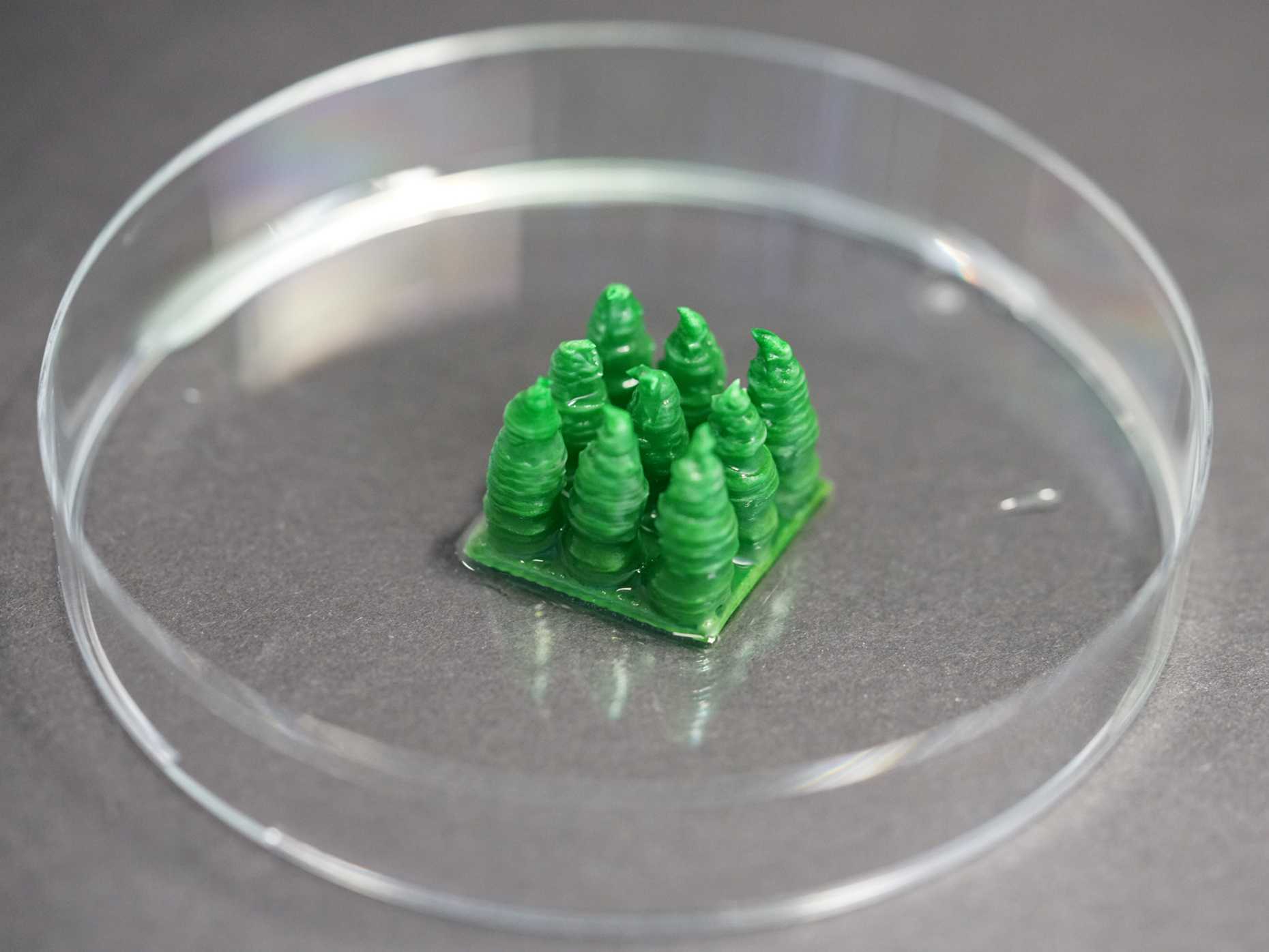
    Researchers at the Swiss Federal Institute of Technology in Zurich(ETH) are creating an organic material that removes carbon dioxide from the atmosphere. According to a press release, this 3D-printable building material should help to reduce the carbon footprint of buildings and infrastructure in the future. Photosynthetic blue-green algae, known as cyanobacteria, grow inside the material, forming biomass and solid carbonaceous minerals and thus binding carbon dioxide twice.

    An interdisciplinary research team led by Mark Tibbitt, Professor of Macromolecular Engineering at ETH Zurich, was able to stably incorporate the photosynthetic bacteria into a printable gel. This new material can be moulded at will using 3D printing and, in addition to CO2, only requires sunlight and artificial seawater with readily available nutrients to grow, according to the press release.

    “As a building material, it could help to store CO2 directly in buildings in the future,” Tibbitt is quoted as saying in the press release. The new material absorbs much more CO2 than it binds through its growth. “This is because the material can store carbon not only in biomass, but also in the form of minerals – a special property of blue-green algae,” says Tibbitt.

    The researchers’ aim is to use the material as a coating for façades in the future in order to bind carbon dioxide throughout the entire life cycle of a building. The team gained initial experience at the Venice Biennale and the Triennale in Milan. This marked the first successful realisation of the project from a laboratory scale to an architectural format. The results were recently published in the specialist journal “Nature Communications”.

  • Sustainable wall elements dehumidify interiors

    Sustainable wall elements dehumidify interiors

    A team of researchers at the Swiss Federal Institute of Technology in Zurich(ETH) has developed construction elements that can be used to dehumidify rooms. According to a press release, the elements are able to bind moisture and thus temporarily store it. The wall elements consist of a hygroscopic moisture-binding material. This is able to absorb a higher level of humidity in an interior space if required and then release it back into the environment by ventilating the room. “Our solution is recommended for heavily frequented rooms for which the installed ventilation systems are inadequate,” said the supervisor of the research project, Guillaume Habert, Professor of Sustainable Building at ETH Zurich, in the press release.

    The construction elements are made from reusable materials, using waste from marble quarries. These are finely ground and processed with a binding material, a so-called geopolymer, to form a solid building material. The geopolymer consists of an aqueous potassium silicate solution and metakaolin, which is traditionally used in the production of porcelain. It is produced using 3D printing technology. In this technique, the marble powder is applied in layers and bonded using geopolymer. “This process allows components to be produced efficiently in a wide range of shapes,” says Benjamin Dillenburger, Professor of Digital Construction Technologies at ETH. So far, the team has been able to produce prototypes of a wall and ceiling element measuring 20 by 20 centimetres and 4 centimetres thick. Following this proof of concept, the researchers see opportunities to scale up the technology to an industrial scale.

  • Mushroom batteries the energy source

    Mushroom batteries the energy source

    The components of the mushroom battery are manufactured using 3D printing. The mushroom cells are incorporated directly into the printing ink. This special ink, developed on a cellulose basis, supports the growth of the mushrooms and is also electrically conductive. The manufacturing process places high demands. The ink must be biodegradable, easy to extrude and rich in nutrients without damaging the sensitive fungal cells.

    Possible applications and potential
    Although the mushroom battery only generates small amounts of electricity, it is sufficient to operate sensors in agriculture or environmental research for several days. The battery can be activated at the place of use by simply adding water and nutrients. After use, the materials decompose on their own due to the fungi.

    Challenges and future plans
    Working with living materials requires interdisciplinary knowledge from microbiology, materials science and electrical engineering. The researchers are planning to improve the performance and service life of the mushroom battery and to research other types of mushrooms as electricity suppliers. The aim is to develop an even more efficient, sustainable energy source.

    Green biotechnology with wood and mushrooms
    Wood, a renewable raw material, is also used by Empa for innovative applications. In addition to the mushroom battery, environmental sensors and green electronics made from cellulose fibres are being developed here. These projects promote the sustainable use of wood and fungi in materials science and contribute to the energy transition.

  • Research into resource-efficient construction driven forward at NEST

    Research into resource-efficient construction driven forward at NEST

    The STEP2 module in the NEST research and innovation building at Empa celebrated its inauguration on August 29, Empa announced in a press release. New technologies for resource-saving construction are being tested in the new module. The approaches installed in STEP2 were developed by Empa in collaboration with research and industry partners. BASF and the architecture firm ROK were the main partners.

    STEP2 features, among other things, a noise-insulating ribbed filigree concrete ceiling and a 3D-printed concrete staircase. The façade with integrated shading and controlled natural ventilation is designed as a test platform. A window element with a 3D-printed structure will be the first to be tested here. All innovations serve to reduce material and energy consumption in construction and promote the circular economy.

    “At the same time, it is very important to us that we develop solutions that are marketable and actually have a future in the construction industry,” said Enrico Marchesi, Innovation Manager at NEST, in the press release. Main partner BASF wants to use STEP2 to “incorporate BASF’s broad chemical know-how into concrete, new and sustainable solutions for the construction sector in collaboration with the other partners”, explains Olivier Enger, Senior Innovation Manager at BASF. “In practice, a construction project of this kind requires close cooperation between all parties involved, from conception to implementation,” says architect Silvan Oesterle from ROK.

  • Largest 3D-printed housing estate being built in Texas

    Largest 3D-printed housing estate being built in Texas

    In the Wolf Ranch community in Georgetown, Texas, 100 single-storey houses are being built using the Vulcan printer from ICON. This 3D printer builds the houses layer by layer from a special concrete mix that is robust and weather-resistant. The construction process saves time and labour while creating walls that can withstand extreme weather conditions.

    Resilience and modern challenges
    The solid concrete walls of the houses not only offer excellent protection against extreme weather conditions, but also provide excellent insulation. This construction proves particularly useful in hot summer months, as the interiors remain cool and the air conditioning systems are relieved. However, the thick walls also pose challenges: the signal strength of wireless networks is impaired, which is why many residents rely on meshed routers.

    Building revolution
    The Wolf Ranch homes, known as the “Genesis Collection”, are available for between 450,000 and 600,000 dollars, and a quarter of the units have already been sold. The project demonstrates the potential of 3D printing to change the construction industry for good. ICON already built its first 3D-printed house in Austin in 2018 and is even planning to use the technology on the moon as part of NASA’s Artemis programme in the future.

    3D printing on the upswing worldwide
    3D printing in the construction industry is also picking up speed in Germany. the first 3D-printed detached house was opened in Beckum in 2021, and further projects, such as the publicly subsidised apartment block in Lünen, are in the pipeline. These developments show that 3D printing is becoming increasingly important worldwide and will potentially shape the future of construction.

  • Eschbal uses 3D printers from Sintratec

    Eschbal uses 3D printers from Sintratec

    Eschbal AG has focussed on the 3D printing technology developed by Sintratec for the production of connecting elements. As detailed in a press release, the window manufacturer based in the canton of Zurich has put a Sintratec S2 3D printer into operation for this purpose. Eschbal uses the modular SLS system to produce prototype parts, production aids and small series from robust PA12 nylon. The advantage of selective laser sintering (SLS) lies in the high precision of the components with tolerances as low as 0.1 millimetres. With the Sintratec S2, 100 components can be produced in 24 hours.

    “In terms of design, 3D printing gives us much more creativity – we can now develop things that we hadn’t even thought of before,” says Michael Ebnöther, Head of Technology at Eschbal, in the press release. As the demand for 3D printed parts continues to grow, the company has decided to purchase its own printer. “As we are a company that produces exclusively in and for Switzerland, it was essential for us to find a Swiss 3D printer.”

  • Urma AG builds second company site in Mägenwil

    Urma AG builds second company site in Mägenwil

    Urma AG has submitted a planning application for a second company site. Like the Rupperswil headquarters, it is located in the canton of Aargau. According to a press release from the company, which specialises in machine tools and additive manufacturing (3D printing), a new Experience Centre is to be built in Mägenwil by summer 2025. The second Swiss headquarters has been developed for 30 employees, who will be relocated from Rupperswil to Mägenwil or newly created, the press release continues. The family business has been operating globally for over 60 years with around 130 employees.

    The new Experience Centre, with offices and a spacious exhibition area for CNC machines, 3D printers, post-processing machines and all other machining products, is to be built on the 3,600 square metre site in the “Büntli” industrial and commercial zone in Mägenwil by summer 2025. In the exhibition area, customers will have the opportunity to view a variety of machines and gain a comprehensive insight into additive manufacturing along the entire production chain, according to the company press release.

    “The canton of Aargau lies in the heart of Switzerland’s strongest economic region and is located on the main transport axes between the economic centres of Basel, Bern and Zurich. In addition to the good accessibility, it is important to us that the two company headquarters are close to each other – Mägenwil is therefore perfectly suited for URMA,” Urs W. Berner, Chairman of the Board of Directors and CEO of Urma AG, is quoted as saying.

    The aim is to create the largest competence centre for industrial 3D printing in Switzerland. The new building will give customers a “unique insight into industrial innovations”, Berner continued.

  • 14Trees is building schools in Africa with 3D printing

    14Trees is building schools in Africa with 3D printing

    14Trees is using 3D printing on a large scale to build affordable residential and school buildings in Africa. Starting in Malawi, such buildings should be realized in record time in this way. The walls of the first school in Salima were printed in just 18 hours, according to a media release . In addition, the CO2 footprint is reduced by up to 70 percent through “optimized use of materials”.

    14Trees is a joint venture between the building materials group LafargeHolcim and the London-based impact investor CDC Group . "I am thrilled with the work our joint venture 14 Trees is doing," said Miljan Gutovic, Head of the Middle East and Africa region and member of the LafargeHolcim Executive Committee, quoted in the press release. "Starting in Malawi, we will use the technology throughout the region and already have projects in the pipeline for Kenya and Zimbabwe."

    Tenbite Ermias, Managing Director Africa of CDC, is convinced that “the broad application of the groundbreaking cutting-edge technology” of 14Trees enables “enormous development effects”. "This is a wonderful example of our investments in companies that contribute to the UN Sustainable Development Goals."

    As the message goes on to say, UNICEF estimates that Malawi is short of 36,000 classrooms. With conventional technology, this would take 70 years. According to 14Trees, this gap could be closed in ten years with 3D printing. In addition, the local projects would create qualified jobs.

  • Matériaux Sabag prints concrete elements

    Matériaux Sabag prints concrete elements

    Matériaux Sabag is expanding its offer with a 3D printing solution for concrete elements. The company, based in Delémont, has been using a robot since the end of September that enables 3D printing using the concrete spraying process. The concrete elements can thus be tailor-made in the prefabrication. The solution allows the use of raw materials from local production, writes the company in a press release . In addition, CO2 emissions can be reduced by 30 percent. “In this way we will be able to accept urgent orders and react flexibly to customer requests so that we can meet the requirements of the construction sites,” Cédric Theubet, Operations Manager at Matériaux Sabag, is quoted in the press release.

    The Jura specialist for building materials is the first company in Switzerland to use this Mobbot solution. The start-up from Freiburg i.Ue. develops robot platforms for 3D concrete printing. His 3D printing of concrete parts means that cladding can be dispensed with and less manual work is required. Mobbot was founded in 2018 by Agnès Petit and today has eleven employees.