Tag: Abstimmung

  • Project planning credit for Lucerne theatre rejected

    Project planning credit for Lucerne theatre rejected

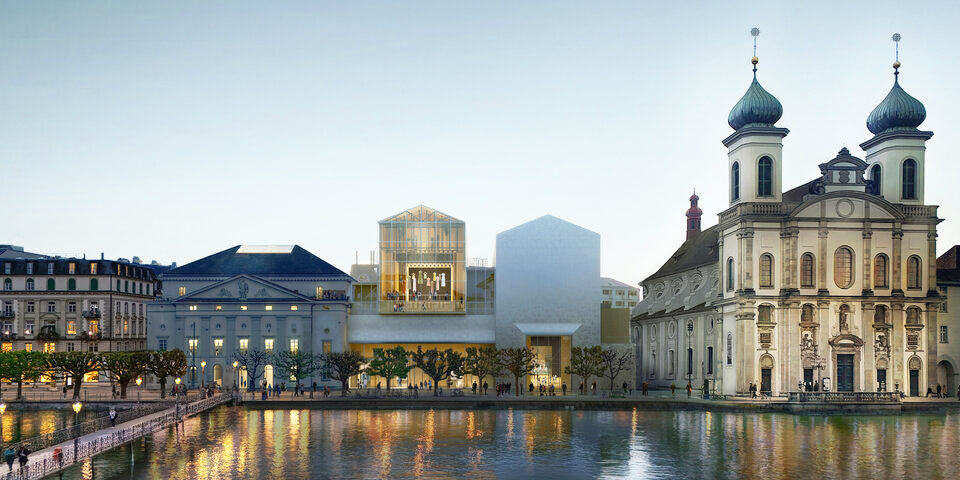
    With 15,033 votes against compared to 10,914 votes in favour, the project planning loan for the planned Lucerne Theatre was clearly rejected on 9 February 2025. The turnout was 49.67 per cent. The result spells the end for the “überall” project by Ilg Santer Architekten, which was intended as a new stage for music, spoken word and dance theatre.

    City Council expresses disappointment
    The City Council notes the vote with great regret. The planned further development of the Lucerne Theatre cannot be realised with this decision. City President Beat Züsli emphasises: “We have always said that there is no Plan B. What happens next is completely open. This result is a great disappointment for Lucerne’s culture.”

    The location and construction volume of the planned theatre in particular were repeatedly criticised in the public debate. Nevertheless, it is still too early to draw any definitive conclusions. The city council intends to carefully evaluate the results of the vote together with the partner organisations involved.

    Consequences for cultural policy
    The rejection of the loan presents the city of Lucerne with new challenges. The previous plans have been halted and it remains unclear how the future of Lucerne’s theatre can be shaped. Nevertheless, the city council emphasises the importance of dealing constructively with the vote: “It is now our joint task as a city community to find a new solution for theatre culture in Lucerne.”

    Despite the defeat, the city council would like to thank everyone who was involved in the project. The existing partnerships will continue to be cultivated and the impact of the result of the vote on cultural policy will be carefully examined.

  • Population supports sustainable electricity production

    Population supports sustainable electricity production

    On 18 August, the voters of Spiringen clearly approved the Sidenplangg solar installation with 68.8 percent. The voter turnout was 55.3 per cent. With their approval, the voters have seized a great opportunity and shown that they are in favour of sustainable electricity production, writes the municipal council in a press release.

    EWA-energieUri is also delighted with the yes vote. He is “grateful that the people of Spiringen are so clearly in favour of our project”, Werner Jauch, CEO of the Uri-based energy producer, is quoted as saying in a separate press release. As the landowner, the Uri Corporation must now approve the project. The planning application can then be submitted.

    The plant is to be built in the Schächental valley on 12 hectares at an altitude of 1,800 to 2,000 metres above sea level in an area that is already used for avalanche barriers. With a capacity of 8 megawatts, around 12.5 gigawatt hours are to be generated annually, up to 45 per cent of which in winter. The investment amounts to around CHF 39 million. The first part of the plant is due to be connected to the grid at the end of 2025.

    In addition to EWA-energieUri and the municipality, aventron AG, a joint venture of Swiss regional utilities based in Münchenstein BL, is also involved in the project.

  • Schaffhausen rejects new Axpo contract

    Schaffhausen rejects new Axpo contract

    On August 18, a majority of 53.4 percent of Schaffhausen voters rejected the replacement of the old founding agreement of Nordostschweizer Kraftwerke (NOK) with a new Axpo shareholders’ agreement. The proposal failed in 16 of the 26 municipalities, including the city of Schaffhausen, Neuhausen, Beringen and Stein am Rhein.

    The voters thus went against their government and the cantonal council, which approved the new agreement by 52 votes to one, according to the voting magazine in January. They argued that the old NOK contract from 1914 was no longer appropriate for an internationally active group with around 7,000 employees.

    Opponents warned of a possible privatization of the energy producer. A majority of five contracting parties could decide on the sale of the company, provided they also held a majority of the voting rights. The canton of Schaffhausen currently holds 7.9 percent.

    The approval of all shareholders is required for the new shareholders’ agreement to be accepted. The other shareholders have already approved the agreement. The canton of Zurich and its cantonal utility EKZ are the largest shareholders with 18.3 and 18.4 percent respectively, followed by Aargau and its cantonal utility AEW with 14 percent each. St.Gallen and the two cantons of Appenzell hold a 12.5 percent stake via St.Gallisch-Appenzellische Kraftwerke(SAK), Thurgau holds 12.3 percent via EKT, Glarus 1.7 percent and Zug 0.9 percent.

  • Landsgemeinde decides on Braunwald’s development

    Landsgemeinde decides on Braunwald’s development

    The future development of Braunwald will be determined by the Landsgemeinde 2025. Following intensive political and public discussions, a revision of the law on public transport will allow citizens to decide on the development option. The cantonal government favours the modernisation of the funicular railway as the most economical solution with low procedural risk and shorter construction time.

    The favoured solution
    After a long evaluation phase, the cantonal government opted for a new funicular railway, which is considered the most cost-effective and practicable option. It involves investment costs of CHF 24 million and operating costs of CHF 3 million per year. Compared to a gondola lift, which would be almost twice as expensive to build and would take up to ten years to complete, the funicular railway offers clear advantages. An automated funicular railway would also enable use independent of the timetable.

    Legal amendments to involve the Landsgemeinde
    The cantonal government has decided to include the development of Braunwald in a new article of the Public Transport Act, which will enable a discussion and vote at the Landsgemeinde 2025. This will give the population the final say on this important infrastructural decision. Should the Landsgemeinde vote in favour of an alternative gondola lift, the cantonal government would initiate the corresponding planning adjustments.

    Investments and future prospects
    The planned investments of CHF 24 million for the construction of the funicular railway and CHF 3 million for its operation will create sustainable and future-oriented access for Braunwald. The cantonal government expects that the decision of the Landsgemeinde will be an important step towards economic and environmentally friendly mobility, which will strengthen the region in the long term and promote tourism.

  • Another stage victory for Quatre Bornes wind farm

    Another stage victory for Quatre Bornes wind farm

    The initiators of the Quatre Bornes bicantonal wind farm have achieved another stage victory. According to a statement, the Federal Supreme Court has rejected the appeal by opponents to repeat the vote on the wind farm in Sonvilier.

    The municipality of Sonvilier can now vote again on the neighbourhood plan on 22 September. This is equivalent to a building permit for the wind farm. The voters of Sonvilier rejected the wind farm on 27 September 2020 with a narrow majority of 289 no votes to 285 yes votes. A municipal initiative launched in December 2021 called for the vote to be repeated.

    In August 2023, the Neuchâtel cantonal court rejected an objection to the planned wind turbines in the Neuchâtel part of the wind farm in the municipality of Val de Ruz.

    The Quatre Bornes wind farm is being planned by the two municipalities as well as 23 farmers and others. Groupe E is investing in the project through its subsidiary greenwatt. The first wind measurements were taken in 2006. The wind farm is to generate 63 million kilowatt hours per year with three wind turbines in Val de Ruz and six in Sonvilier.

  • Zurich cantonal parliament approves runway extension

    Zurich cantonal parliament approves runway extension

    Flughafen Zürich AG wants to extend Runway 28 by 400 metres to the west and Runway 32 by 280 metres to the north. With this project, the airport wants to implement the conclusions of the 2012 safety review of Zurich Airport(SÜFZ) by the Federal Office of Civil Aviation. The extension of the runways is intended to increase the stability of air traffic in all weather conditions and for all types of aircraft.

    According to a press release, the Zurich Cantonal Council approved the extension on 28 August with a narrow majority of 87 to 83 votes, with two abstentions. The SVP, FDP, Mitte and EVP voted in favour of the proposal, while the other parties rejected it.

    Zurich Airport is pleased with the decision, as it writes in a statement. The longer runways would increase braking distances and reduce crossing points on the ground and in the air. More stable operations would reduce the number of delays as well as those affected by aircraft noise. “There are no alternative measures in flight operations that would bring the same improvements in terms of safety and reduction of delays,” the statement says. The number of flight movements, on the other hand, would remain the same.

    The Zurich Chamber of Commerce(ZHK) also welcomes the decision of the cantonal council. “Zurich Airport is of great economic importance for the greater Zurich area and for the entire country,” it writes in a statement. “To ensure Zurich’s international connectivity with the world in the long term, the airport must be able to adapt to changing circumstances.” ZHK Director Regine Sauter had already campaigned in advance for approval by the cantonal parliament. “The runway extensions bring multiple benefits: Residents benefit from more peace and quiet at night, and Zurich as a business location can count on a punctual airport and reliable connections to the world in the long term,” she is now quoted as saying in the ZHK release.

    The cantonal council’s decision is subject to an optional referendum, so the electorate is likely to have the final say. Only then can the airport submit an application for planning permission to the federal government.

  • Zurich defines new rules for high-rise buildings

    Zurich defines new rules for high-rise buildings

    The Office for Urban Development of the City of Zurich is updating the high-rise guidelines from 2001, according to a press release . They regulate provisions for districts in which high-rise buildings are built up to 40 meters, 60 meters and 80 meters in height. The examination is carried out taking into account other planning instruments such as the municipal structure plan for settlement, landscape, public facilities and buildings accepted by the population.

    The media release mentions the addition of a 60-meter area as an innovation. An extension is planned for the existing 40-meter area. A design plan must still be available for high-rise buildings over 80 meters.

    In addition, applicable rules relating to urban development, programmatic, typological and design requirements must be observed, which are also part of the revision of the high-rise guidelines. "The taller a skyscraper is built, the more it has to do," they say. Mandatory requirements that a high-rise must meet should be partially anchored in the building code. The city of Zurich is also planning an adjustment to the planning and approval process.

    When building high-rise buildings over 60 meters high, for example, the district must be informed at public events. Competitive procedures are also mandatory.

  • The hotel construction site in Geroldswil has been secured

    The hotel construction site in Geroldswil has been secured

    With more than 60 percent, the Geroldswilers approved an additional loan of 650,000 francs, which increases the project planning loan, which was too tight in 2017, to around 2.6 million francs. This means that work on the project can continue. A center development with a lower level garage, a major distributor in the basement and apartments on the upper floors are to be created. According to a media release by the municipality of Geroldswil , 872 voters voted for the approval of the additional funds. In contrast, there were 559 no votes with a participation of 50.45 percent.

    The leases for the Hotel Geroldswil and the pizzeria on Dorfplatz are limited in time and will expire on December 31, 2021, the municipality announced when the project was presented . Based on an economic and feasibility study, the two floors with the hotel rooms are to be converted into apartments. As a supplement, a new building with family apartments is to be built as a so-called point building in the north-western part of the property. The current community hall is to be demolished and a new, modern and well-equipped community hall will be implemented as a connecting wing between the current Hotel Geroldswil and the apartment building. There should be space for one or two restaurants on the village square, it said.

    The independent mayor Michael Deplazes is quoted in an article in the “Limmattaler Zeitung”: “The voters recognize the necessity of the project and understand why we are investing in age-appropriate apartments and in new buildings.” According to Deplazes, the planners and architects can now do their work again record: "We put a project freeze until the additional loan was approved because we cannot spend money that we don't even have."

    The next ballot will take place on June 13, 2021. Then the people should decide on the building loan. "We expect an estimated 26 million francs," said Deplazes.

  • Groundbreaking ceremony for the new Stierenmatt school pavilion

    Groundbreaking ceremony for the new Stierenmatt school pavilion

    The new construction of the Stierenmatt pavilion on the Hunziker area in the Limmatfeld area is scheduled to begin on October 1st. A temporary school building for the Stierenmatt school unit will be created. According to the city of Dietikon , this should offer space for nine primary classes. The creation of classrooms in the Limmatfeld district has been planned for some time. "Due to outstanding cantonal plans, the construction of the planned school building on the Stierenmatt area belonging to the city is delayed and will probably be completed in 2028 at the earliest," said a message from the city of Dietikon on the occasion of the vote on the loan financing of the project to justify a temporary solution .

    In the vote in June, according to the city, 2,056 voters were in favor and 735 were against the loan. This approved the submission for a loan of CHF 15.2 million.

    Construction work for the temporary school is expected to be completed in August 2021. The entire population is invited to the groundbreaking ceremony on Thursday, October 1st at 5.30 p.m. Registration is not necessary. Due to the current pandemic, however, there are no tables, benches and no toilet facilities available. Every visitor is legally obliged to register on an attendance list for contact tracing, the invitation draws attention to.