The area in Winterthur Töss is a focal point in the 2040 development concept of the city of Winterthur. Thanks to the nearby railway and bus stations and a motorway connection, the area has excellent transport links. In view of the very good location quality in a changing area, the site has attractive long-term development potential.
In a first step, Allreal will define the framework conditions for future development in dialogue with the city of Winterthur and the other responsible authorities. Over time, the current industrial site is to be further developed into a modern working and living space of supra-regional appeal, which also makes reference to the pioneering days of the textile industry.
Rieter will remain closely linked to the site with its new campus, also built by Allreal, with its headquarters and research area. In addition, well-known companies from the technology and research sectors are to settle here. In this way, Allreal is helping to secure jobs in the long term and create new living space in the city of Winterthur. Allreal will take over the existing tenancy agreements and refurbish and successively re-let unrented space over the next few years.
Roger Herzog has significantly shaped Allreal in recent years, initially as CFO and since 2015 as CEO. Under his leadership, the business model with the two business areas of real estate and general contracting was consistently further developed and the real estate portfolio expanded in line with strategy.
Until his departure in spring 2023, Roger Herzog will continue to perform his duties as CEO and ensure an orderly handover to his successor.
The Board of Directors of Allreal Holding AG regrets Roger Herzog’s decision, thanks him in advance for his committed and valuable work and wishes him continued success for the future. The search for his successor has been initiated.
At the end of June 2022, Allreal signed two purchase contracts with a private seller for a three-parcel property with a total of 4,916 square meters in Sünikon-Steinmaur in the Zurich Unterland. Depending on contractual agreements, the transfer of ownership is expected to take place in September 2022.
The property is located on Hohlgasse/Regensberger- and Neubrunnenstrasse in the center of Sünikon and is characterized by an elevated and sunny location with a panoramic view.
Allreal plans to realize residential property; whether in the form of multi-family houses/condominiums or single-family houses is currently still open. A feasibility study is in preparation and will serve as the basis for further specification of the plans. The approximate investment volume is around CHF 35 million.
Good things take time – there is no better way to describe the development of the Oberhauserriet in Opfikon. As early as 1952, the city separated the 67.4 hectare Oberhauserriet as an industrial zone. A district plan procedure was initiated five years later, but this was only approved in 1979. The first district plan provided for 30,000 jobs. But the project dragged on due to numerous appeals and requests for revision. In 1986, the city council of Opfikon stopped the enforcement request. Because: The planned jobs would also have meant 30,000 parking spaces. Traffic problems and environmental pollution threatened.
Interest in the planned industrial area increased sharply with the construction of the north ring road in the 1980s. In 1987, Planpartner AG was commissioned to review the planning. The planning office proposed a renewed revision of the building and zoning regulations with a significantly reduced use. New only 9700 jobs were planned. In addition, living space for 3000 people was considered for the first time, as well as a park that should cover around a third of the country in the direction of Glatt. Access to public transport rounded off the project in terms of environmental compatibility.
These adjustments found favor with the electorate in 1990. The city council of Opfikon, the city of Zurich and the interest group of landowners that had been created in the meantime also approved of the new overall plan. The then 25 landowners were closely involved in the planning by the city council. It is probably thanks to this circumstance that they were willing to make a significant financial contribution: in terms of green space or the planned “monorail” – a kind of elevated railway that should have opened up the new district.
It was spring 1996 before the first draft for the new district plan was available. Due to numerous requests, this was revised twice before the city council was finally able to set the district plan in 1999. The Government Council of the Canton of Zurich passed it on October 11, 2000, paving the way for implementation – after almost 50 years of planning.
First area marketing organization in Swiss real estate history They had agreed on living space for 6,600 people and 7,300 jobs. A 12.4-hectare green area with an artificial lake was planned for the park. A project competition was announced in 2001 for the design of the park, which the Kiefer landscape architecture office in Berlin won. Central was the elongated rectangular lake, which later received the name “Glattpark-See”.
In 2000, the city of Opfikon, the city of Zurich and the company Allreal tendered a contract for the development of a comprehensive platform for the development area. Halter Immobilien + Treuhand with the then managing director Bernhard “Beny” Ruhstaller was awarded the contract. Ruhstaller’s communication strategy envisaged making a brand out of the Oberhauserriet in order to simplify the search for investors and key tenants as well as communication with the population and image cultivation. Ruhstaller proposed area marketing empowered by all landowners.
The mission was clear: from the mass of planned individual projects, a vision of a completely new district should find its way into people’s minds. Ruhstaller already brought experience from the Limmatwest, Zurich-West and Zurich-North development areas. «It was precisely these experiences and insights that helped me with the Oberhauserriet development area. The Glattpark was of course one size bigger. On the other hand, it was almost easier to create a new identity here, since there was no inhabited area,” Ruhstaller sums up. He also remembers the founding of the new area marketing well: “The first difficulty was convincing the then many private landowners to pay money into a marketing pot, although a possible start of construction could not even be estimated.”
The real estate professional was successful together with the city of Opfikon: In December 2001, 63.64 percent of all property owners recognized the added value of joint marketing. On May 13, 2002, for the first time in Swiss real estate history, 14 of the 21 landowners founded an area marketing organization. This merger quickly bore fruit: Thanks to marketing and communication measures such as a showroom, website, trade fair appearances and intensive networking, the organization quickly became the central information and contact point for the new district, which the city of Opfikon had given the name “Glattpark” in 2001. With the increasing success of the marketing efforts, more landowners could be brought on board: in 2017, the area marketing organization had a maximum of 35 members.
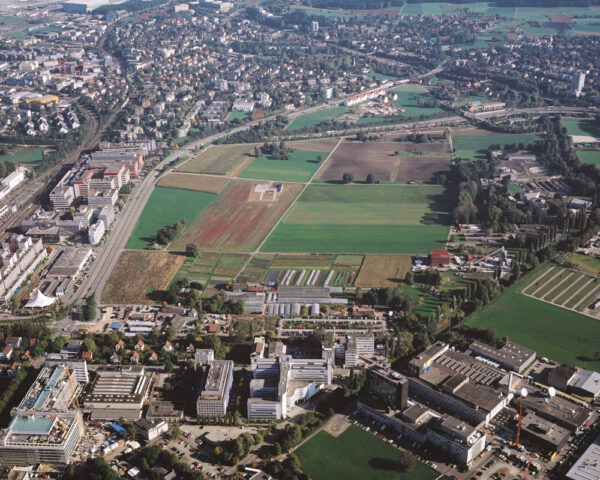
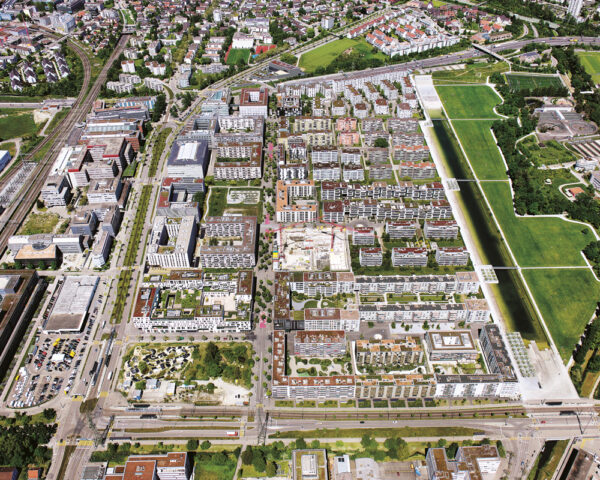
↑ The aerial photo – taken from a helicopter at the time – shows the Oberhauserriet in 2001. The city of Opfikon commissioned the company Comet Photoshopping GmbH, which specializes in aerial photos, to document the construction progress. And this is how the Glattpark looks from the air 20 years later. ↓
Thanks to the Glattpark, Opfikon is now one of the 50 largest cities in Switzerland Again and again, there were discrepancies between area marketing and the city of Opfikon: “The planning authorities involved in the Oberhauserriet district plan were not used to the fact that market and marketing issues suddenly played a role,” explains Ruhstaller and adds: “The private organization of the In the beginning, landowners might also have been perceived as a danger.” Today, cooperation between the city authorities and area marketing has normalized and can be described as mutually beneficial.
The transition from the development to the operational phase in 2016 brought with it changed tasks for area marketing. A simplification of the landowner’s contributions and the renaming to IGG Glattpark were decided. Today, the organization takes care of overarching issues. “It’s about processes that go beyond the parcel boundary of an individual property owner – such as the boulevard, parking or media work,” says Ruhstaller, who has been working as managing director of the area marketing organization for around 20 years and meanwhile from his Daughter Janina is supported. The IGG Glattpark is intended to protect and further develop the identity of the still young district. “In cooperation with the city of Opfikon, we are currently conducting a needs survey among the more than 70 businesses in the Glattpark,” Ruhstaller gives an example.
The former vision of Glattpark has become reality: the first residents moved in as early as 2006. The Monorail, which was originally planned, became the Glattalbahn, the last stage of which was inaugurated in 2010. In 2019, the majority of the second construction phase was completed. By the end of 2019, 3100 jobs were created and 5781 residents were counted. And that’s not the end of the development of the young part of the city: the hard-fought school building should be ready for occupancy in 2023/24. The often neglected 3rd stage of the Glattpark could also be in motion in the near future: “The city of Zurich, as the largest property owner, is facing an early solution together with the city of Opfikon and other private property owners,” says Ruhstaller.
The development of the Oberhauserriet – which was often referred to in the media as “the most expensive meadow in Europe” – into the Glattpark district has definitely been a success: in the past 16 years, Opfikon has grown from 13,000 to 21,000 inhabitants thanks to the Glattpark. This means that Opfikon is now one of the 50 largest cities in Switzerland.
In the 2021 financial year, Allreal achieved a company result that was significantly higher than in the previous year, the real estate company with its own general contractor informed in a press release . Specifically, Allreal reported a profit of CHF 182.6 million, compared to CHF 167.2 million in 2020. Excluding the revaluation effect on the real estate portfolio, a profit of CHF 133.3 million was realized.
In the real estate division, Allreal achieved “an excellent result” in the year under review, the press release goes on to explain. The company from Opfikon emphasizes the expansion of its portfolio in western Switzerland as a growth driver. He increased the market value of the investment properties to CHF 5.11 billion. In addition, rental income increased year-on-year by CHF 4 million to CHF 204.4 million.
In general contracting, a profit of 53.4 million francs was realized in 2021, compared to 46.6 million francs in the previous year. Here the company benefited “from high sales success”, writes Allreal. The completed project volume, on the other hand, developed “less dynamically than expected”, as in 2020. The division’s result, at CHF 13.8 million, was nevertheless CHF 6 million higher than in the previous year.
Allreal writes that the backlog of around CHF 694 million secured at the end of the year will ensure capacity utilization for around two years. For the current fiscal year, the company is assuming rising real estate income and further growth in the operating result.
According to a press release , Allreal has started construction work on Rieter ‘s new campus in Winterthur. The real estate company from Opfikon is responsible for the project as general contractor. She works with the BDE Architects from Winterthur, among others.
Rieter is investing around 80 million francs in its new campus. This is to include a customer and technology center and an administration building on an area of 30,000 square meters. The textile machine manufacturer will be able to employ around 700 people there from 2024.
Rieter relies on renewable energies for the new campus. The heat is to be generated with geothermal probes, for example. In addition, a 1300 square meter photovoltaic system will be installed. According to Allreal, the project is “very complex, especially with regard to the building services”. In product and technology development, different climate zones are required that can be set differently.
Anne-Marie Loeillet (CH, *1961) graduated from the Languedoc-Roussillon University of Applied Sciences and holds a master's degree in urban planning from the University of Stuttgart. She has worked successfully for various large companies and the public sector in Germany, France and Switzerland over the past 20 years.
Since 2011, as CEO of PCM Opérateur Urbain SA, she has been the driving force behind the development and realization of the Le Quartier de l'Etang residential and business district in Geneva, with an investment volume of around CHF 1.4 billion. Anne-Marie Loeillet takes over the role from Olivier Plan, who sold various real estate companies belonging to Immosynergies Holding Sàrl to Allreal on October 15, 2021. In addition to a first-class portfolio of investment properties with a value of around CHF 500 million and additional development properties with a potential investment volume of more than CHF 700 million, the company also acquired the general contractor Roof SA.
Allreal acquired the Escher-Wyss-Areal in 2002 and has been MAN ever since Energy Solutions Schweiz AG (“MAN”) the main customer on the 38,362 square meter plot of land in Zurich-West with a usable area of around 87,000 square meters.
The long-term partnership between MAN and Allreal is being continued, in which the lease, which expired on December 31, 2023, was prematurely extended by five years to at least December 31, 2028 under the same conditions as before. This involves around 32,000 square meters of commercial and storage space and around 11,500 square meters of office space.
This means that the Escher-Wyss-Areal will continue to be the largest private industrial site in the future. location in the city of Zurich. According to the 2021 semi-annual report, MAN is one of Allreal’s five largest tenants, accounting for 6% of total rental income from commercial properties.
According to a media release, the real estate company Allreal is acquiring individual companies from Immosynergies Holding Sàrl , based in Cointrin GE. According to a press release, almost all of the properties taken over are in prime locations in the canton of Geneva. There is also a portfolio of development projects in the cantons of Geneva and Vaud. Allreal is thus significantly expanding its involvement in western Switzerland.
According to the announcement, the package taken over by founder and owner Olivier Plan from Immosynergies Holding Sàrl includes investment properties of around CHF 500 million and additional development properties of around CHF 210 million, which have a potential investment volume of more than CHF 700 million. Allreal also buys the general contractor belonging to the group of companies. All 45 employees will be taken over. The net purchase price of the entire transaction is given as around CHF 400 million.
Half of the net purchase price is to be paid in cash and half in Allreal shares. As a result, Olivier Plan, who is 100 percent owner of Immosynergies Holding Sàrl, will be one of Allreal's largest shareholders after the transaction is complete.
The Board of Directors of Allreal Holding AG intends to carry out a capital increase from the authorized capital while excluding subscription rights for the previous shareholders. It is planned to issue up to 650,000 new Allreal shares, which corresponds to an increase in the existing share capital of 4.1 percent.
As a result of the transaction, the total market value of the Allreal investment properties will rise to around CHF 5.1 billion.
Allreal achieved rental income of CHF 200.4 million last year, according to a statement . The company was thus able to maintain the level from the previous year despite the Corona crisis. In 2019, it had received 203.1 million francs from rents.
In the spring, Allreal stated that it was able to agree on rent waivers in connection with the lockdown with all affected tenants. In total, the company has granted rent leases amounting to 1.5 million francs.
The cumulative vacancy rate has meanwhile fallen by 0.8 percentage points to 1.4 percent despite the crisis. According to the information, it is at the lowest level that Allreal has ever reached.
The company result including the revaluation effect is 167.2 million francs after 243.2 million francs in the previous year. Excluding the revaluation effect, the company result is 124.7 million francs after 142 million francs in the previous year. Allreal explains the decline primarily with one-off effects from the sale of development properties.
According to the announcement, Allreal is satisfied with its annual result and expects overall “stable business development” in the long term. The Board of Directors is therefore proposing to the General Meeting of Shareholders a stable distribution at the previous year's level of 6.75 francs per share.
Allreal is based in Glattpark in Opfikon. The company is listed on the SIX Swiss Exchange.
Wir verwenden Cookies zur Unterstützung und Verbesserung unserer Dienste. Mit der Nutzung dieser Website erklären Sie sich mit der Verwendung von Cookies einverstanden. Weitere Informationen finden Sie in unserer Datenschutzerklärung.