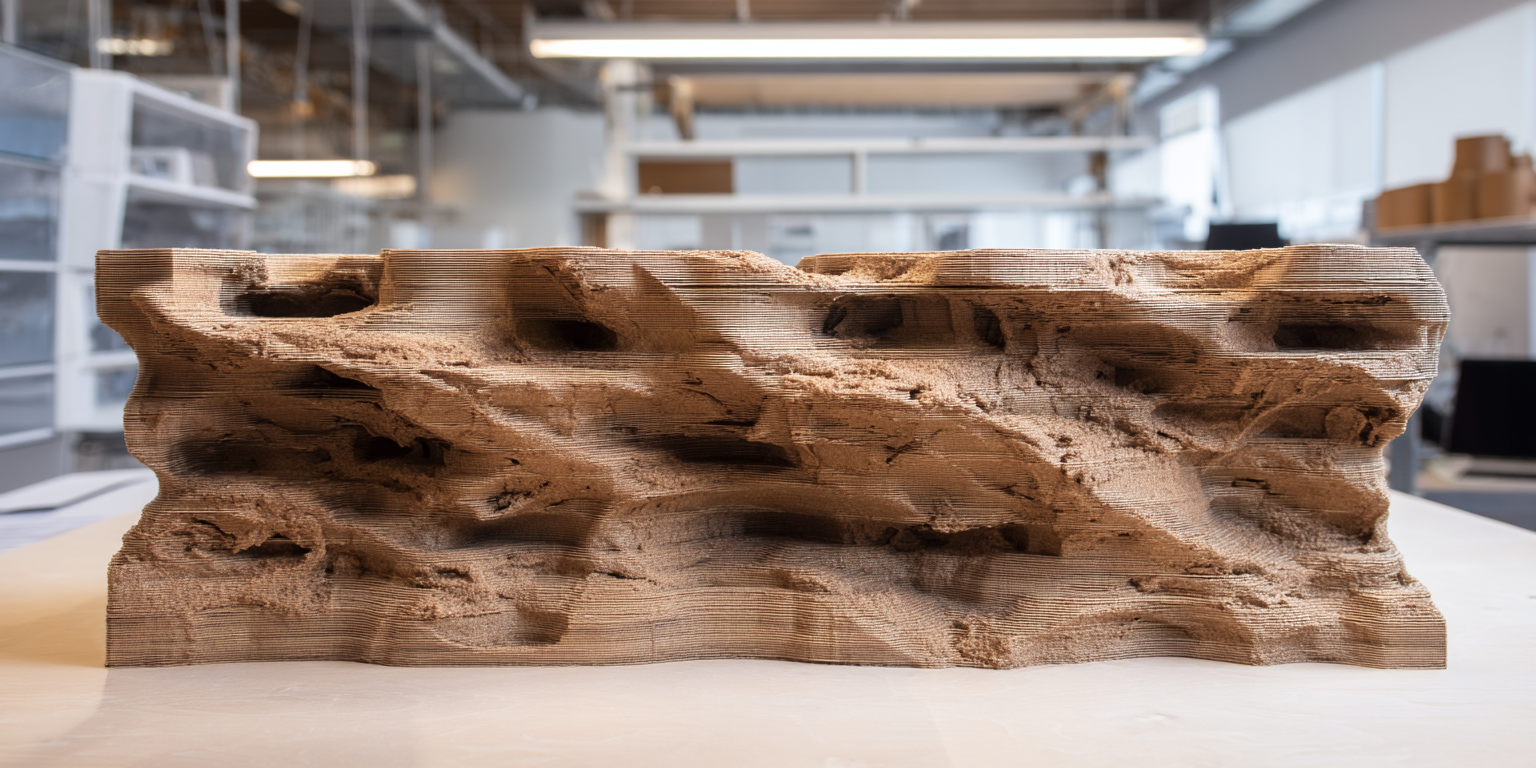
Stricter regulations on the energetic use of waste wood mean that large quantities of wood waste can no longer simply be incinerated, but can still be recycled. The “Experimental and Digital Design and Construction” department at the University of Kassel is working with Buro Happold to develop a 3D printing process that converts waste wood particles into load-bearing wall components. The project is being funded as part of the “Zukunft Bau” program of the Federal Institute for Research on Building, Urban Affairs and Spatial Development.
the focus is on a bio-based printing material made from shredded waste wood particles, which mainly originate from secondary material flows from the wood industry – i.e. from post-consumer wood. Industrial partners process the material and mix it with biogenic binders to create a paste-like mass that can be extruded with robotic support.
lightweight components from the 3D printer
The result is clearly different from the familiar 3D concrete printing process. The mass of wood particles and binder is applied in layers on a scale of 1:1 and forms lightweight but stable components. Flat wall structures are possible, as are freely curved geometries that can be precisely adapted in terms of construction and architecture.
the current Rafa 2.0 project phase will run for 18 months and builds on the previous Rafa project, in which the researchers fundamentally investigated the suitability of waste wood particles for additive manufacturing. Material formulations are now being refined, the extrusion process optimized and the components tested under laboratory conditions, with the aim of achieving an end-to-end digital manufacturing process through to the full-scale prototype.
load-bearing, fire-resistant and circular
For the concept to work in practice, the printed elements must do more than just show shape. Load-bearing capacity, rigidity and fire protection properties that meet the requirements of interior construction are required. The project partners see an initial field of application in modular wall systems that can be easily assembled, dismantled and reused elsewhere.
this principle fits in with circular building approaches, in which building components are not disposed of at the end of their life cycle, but are transferred to new uses. The components can be dismantled by type because no components containing harmful substances are used. This is a prerequisite for closed material cycles in timber construction.
digital planning as a key technology
Digital planning plays a central role. Buro Happold is responsible for computational design and structural planning and uses simulations to predict the structural behavior of the components. Geometries are optimized so that material is only used where it is structurally necessary – resource efficiency becomes a design task.
“We turn waste into an opportunity, reclaimed wood is turned into high-performance components through digital design and additive manufacturing,” says Shibo Ren from Buro Happold, describing the approach. Away from linear consumption and towards a circular, data-based construction practice that closely interlinks robotics, engineering and design.
practical prospects
In the short term, the process aims to use less material and reduce emissions compared to concrete-based 3D printing technologies. In the long term, it could open up new markets for bio-based additive construction methods. Especially where low weight, deconstructability and architectural freedom are required.
whether and how quickly the approach becomes commercially viable depends on scaling, standards and acceptance in construction practice. Technically, however, the project already shows that circular construction does not begin with recycling, but with design. Where materials, processes and life cycles are rethought.
