At the recent open day of the wastewater treatment plant (WWTP) in Appenzell I.Rh., the latest project – an ingenious solar folding roof – attracted around 200 interested visitors. This innovative system demonstrates the combination of energy efficiency and environmental protection by covering 80% of the ARA’s energy requirements and minimising the formation of algae in the clarifiers.
In his speech, Ruedi Ulmann, the client of the project, emphasised the importance of the project for the regional energy and climate strategy and highlighted the support of the Grand Council. The solar folding roof, whose design both optimises technical operation and reduces the environmental impact, was blessed by the parish priest Lukas Hidber.
The solar folding roof impresses with its lightweight construction, which allows unrestricted access to the system and protects it from the weather thanks to intelligent control software. The resulting longer service life of the modules and the reduction in algae growth lead to a reduction in operating costs. The innovative use of solar and biogas technologies at the Appenzell I.Rh. wastewater treatment plant is a pioneering example of the effective utilisation of renewable energies at municipal facilities.
Zizers-based dhp Technology is building its largest folding solar roof to date for the main sewage treatment plant in Stuttgart-Mühlhausen. By spring 2026, 5280 modules are to be installed on an area of 17,000 square metres. According to a statement, the system with an output of 2745 kilowatts peak is the largest folding solar roof installed by dhp.
With the Bündner technology, the sewage treatment plant in Baden-Württemberg’s state capital can generate up to 11 per cent of its annual consumption itself. In the medium term, a value of 18 percent is targeted.
According to the plans of the Stuttgart municipal wastewater treatment plant(SES), solar modules will be installed not only in the aeration basin in the north of the 25-hectare plant, but also in the area to the south, which is of a similar size. According to SES, the investment will save more than 900 tonnes of carbon dioxide.
A new soil washing plant has been built at Niederstettenstrasse 28 in Niederstetten near Wil SG. With the fully automated plant, RCO now also processes contaminated construction waste and returns it to the building materials cycle as high-quality materials. RCO expects about 200,000 tonnes of processed building material per year that can be reused in this way. This means that more than 500 single-family homes could be built each year from sustainable building materials.
Washing instead of landfilling The wet-mechanical processing plant replaces the dry-mechanical plant that has been in operation for about two decades. “With the soil washing plant, we can now accept and process materials that previously had to be landfilled. This includes, for example, contaminated excavated materials,” says Samuel Graf, a member of the RCO board of directors. “This not only saves valuable landfill space, but also conserves natural gravel resources.” The materials are then widely used in civil engineering, for example as sand or gravel for concrete production.
Taking building materials recycling to the next level The state-of-the-art process technology sorts, classifies and doses the various material components. “In addition, pollutants and foreign substances can be removed efficiently, which ensures a significantly improved quality of the products,” explains Stefan Eberhard, Delegate of the Board of Directors. “The building materials produced in this way are of high quality and conform to standards – this is also demonstrated by our company building.” This consists to a very large extent of recycled building material and serves RCO as a showroom to visually demonstrate the many advantages of sustainable building materials to customers and the public.
About the R CO The RCO was founded in 2018 by the two companies Holcim Kies und Beton AG and Zürcher Kies und Transport AG. With their joint know-how, Holcim and Zürcher are driving innovations in building materials recycling, closing material cycles even more consistently and serving the eastern Swiss market with high-quality building materials.
The construction work for the extension of Basel SBB station is on track. On 14 December 2022, the federal government granted SBB the construction permit for the two projects. Construction work started on 2 January 2023. The CHF 210 million project package includes, on the one hand, the Basel SBB performance enhancement project with the additional 460-metre-long platform track 19/20 and capacity-increasing measures on the approach tracks towards Basel St. Johann and Münchenstein. On the other hand, the package includes a provisional 147-metre-long and approximately 10-metre-wide passerelle in the area between the existing passerelle and the Margarethen Bridge.
One of the prerequisites for future service extensions At a media conference in Basel, Wolfgang Stolle, SBB overall project manager, and Thomas Staffelbach, SBB overall coordinator Basel, provided information on the status of the work and the other extension projects in the region. Marco Galli, coordinator of the Basel rail hub at the canton of Basel Stadt, emphasised the importance of the project package for the canton. Because from the end of 2025, northwestern Switzerland is to receive significantly more trains. This was decided by the federal government, parliament and cantons. From then on, the S-Bahn trains between Basel and Liestal are to run every quarter of an hour and the long-distance trains on the Basel-Delémont-Biel/Bienne line every half an hour. Increased performance and a temporary passerelle will create the necessary capacity at Basel SBB station for more train stops and more passengers, especially during rush hour.
Drilling machine creates piles for 570-metre-long retaining wall The construction team is currently working on the future retaining wall along Meret Oppenheim-Strasse. The approximately 570-metre-long, four to seven-metre-high structure will close off the track field from the Gundeldinger district. The track field must be widened towards the south in order to create enough space for the extended platform and track system. Since the end of January, a drilling machine has been drilling the piles for the retaining wall. The machine will be in use between the Margarethen Bridge and the Peter Merian Bridge until probably June 2023. 119 of the total of 308 bored piles had been constructed by the end of March. The bored piles go to different depths in the ground; the longest are up to 14 metres long.
Demolition of the houses near the tracks between Passerelle and Hochstrasse In order to be able to build the retaining wall, the construction crews have been demolishing the nearby houses between Postpasserelle and Hauptpasserelle since January 2023. From April, the buildings on the track side of the upper Hochstrasse will follow. SBB had to close the southern access to the Postpasserelle for the same reason on 13 February 2023. The construction team will demolish the relevant section of the Postpasserelle from mid-May 2023. After that, the access will be rebuilt about 4.3 metres further south. In this way, it will extend over the wider track field in the future. The new access will go back into operation at the end of 2023.
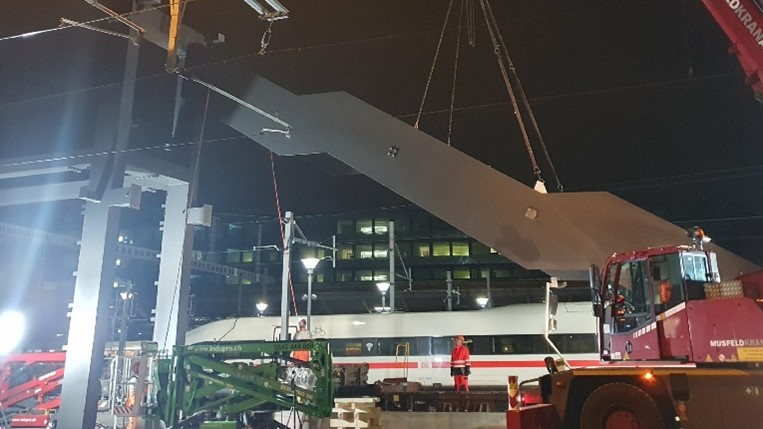
The first yoke for the new passerelle is in place The first work for the temporary passerelle is also underway. From mid-January to the beginning of April 2023, the construction team built the foundations and supports for the new passerelle at the western end of the platform 11/12. In the meantime, the yoke and the stairway to the passerelle have been built. At the beginning of April, the builders will then move to the western end of the platform 9/10 and do the same there. At the end of June, they will move to platform 7/8. During the work, the length of the platform in question will be restricted.
Extensive night work in the track area Since January, the construction teams have been working at night on the catenary, the tracks and the cable systems. These adjustments are necessary for the foundations of the passerelle and the new platforms. The construction teams are also erecting protective scaffolding. These are to ensure that no construction debris gets onto the operational track systems during the demolition work. For safety reasons, the construction teams can only carry out all this work with the track closed and the overhead line switched off. They must therefore be carried out at night, when there is less traffic. SBB is constantly examining how night-time noise can be reduced depending on the construction phase. However, it is aware that the work will still require a great deal of patience and understanding from residents.
Restrictions for bicycles and motorised traffic There have been and will be restrictions for bicycles and motorised traffic. For example, the number of bicycle parking spaces on the Gundeldinger side has been reduced from 700 to 530. SBB is therefore currently reviewing again with the canton how and where additional parking spaces are possible. The aim is to be able to put these additional spaces into operation in the spring. In the meantime, SBB is asking cyclists to use all the temporary parking spaces, including those at the Meret Oppenheim high-rise. In many cases, there are still spaces available there, especially on the upper floor of the double-storey parking facilities. in 2025, SBB will dismantle the temporary bicycle stands and re-install them on the redesigned south side of the station, along the tracks. The total number of bicycle stands will be increased to around 1100. For safety reasons, road traffic restrictions have been necessary on Meret-Oppenheim-Strasse since the beginning of January and on the upper Hochstrasse from 3 April to 30 June. SBB submits the restrictions to the cantonal police in advance in accordance with the applicable cantonal processes and guidelines and coordinates them with them.
The municipality of Grengiols and five energy companies are planning to set up one of the largest solar plants in Switzerland: 910,000 solar modules with a total output of around 440 megawatts peak are to be installed on the southern slope of the Saflis Valley in the Valais, inform Industriellen Werke Basel(IWB) in a statement. In addition to IWB, the two Valais energy companies Energie Brig-Aletsch-Goms(EnBAG) and Forces Motrices Valaisannes(FMV), as well as the Zurich Cantonal Electricity Works(EKZ) and the French-speaking Swiss energy company Groupe E are involved in the project. A feasibility study completed at the beginning of the year has already confirmed the potential of Grengiols-Solar.
The plant is planned in an area that receives around 1500 hours of sunshine per year, which is considerably more than the Unterland. According to IWB, 42 per cent of the 600 gigawatt hours of electricity that are possible per year will be generated in winter. In combination with the Chumensee storage power plant planned by Gommerkraftwerke(GKW), 1200 gigawatt hours of electricity could be generated annually “in a plannable manner and available at any time through storage”.
The project partners are planning several years for the realisation of the plant. By the end of 2023, they want to have prepared the environmental impact report and the construction project. The investment costs are also to be calculated in connection with the latter.
By the end of 2025, the partners want to connect Grengiols-Solar to the grid with the capacity required by law. Initially, the electricity will be supplied via a temporary overhead line to a 65-kilovolt line in the Rhone Valley.
Ticino Solare was installed on the roof of a technical college building near Lugano. On May 13, 1982, the south-facing facility supplied power to the grid. The installed power: 10 kWp. That was unusual at the time. Later the panels were transferred to another building.
The condition, quality, color and performance of the solar cells were regularly checked and measured. An investigation after 35 years of operation came to the conclusion that the cells are showing signs of wear – keywords are corrosion, burned areas (hot spots), cracks in the cells or defective connection cables. But: The majority of the modules still worked well and still delivered at least 80 percent of the power overall. Manufacturers of solar panels usually guarantee a service life of 25 to 30 years.
Energeiaplus asked Mauro Caccivio what makes TISO-10 special. Caccivio heads the photovoltaics laboratory at the Ticino University of Applied Sciences SUPSI. "It's absolutely amazing. Looking at the black and white photos from back then and considering the technological advances that have been made since then, you can understand how visionary the project was and how courageous the team behind it was. TISO was important for the subsequent massive spread of solar energy: right from the start of its industrial phase, photovoltaic technology was able to return the energy required for the production of solar modules to the power grid many times over. This is crucial to minimize the impact on the environment and nature, and this is even more true today given the tremendous evolution we are witnessing,
According to a press release , the electricity works of the city of Zurich ( ewz ) have sold 7,544 square meters of solar space. This means that the demand for solar energy has doubled compared to the previous year. The increased popularity of sustainably produced electricity is attributed to the commitment to the net zero goal, the solar offensive launched by the city and the consequences of the Ukraine war.
ewz announces that with the second high-alpine solar system currently under construction in Graubünden with an area of 1795 square meters, it will again rely on the willingness of the public to participate in local solar systems and thus accelerate the energy transition.
The large-scale photovoltaic system in the high mountains is to be built in the course of the summer on the dam wall of Lago di Lei. According to the company, it has a potential of 1,000 photovoltaic modules that could generate 380 megawatt hours of electricity per year. The dam wall belongs to the power plants Hinterrhein AG, in which ewz has a stake.
ewz customers in the city of Zurich and in the Mittelbünden supply area now have the opportunity to participate on the ewz website for as little as half a square meter for CHF 280. In return, ewz announces that it will credit 90 kilowatt hours of sustainably produced electricity from renewable energy to the bill every year for 20 years.
Die Avobis Invest AG übernimmt die Kreditfabrik AG rückwirkend auf den 1. Januar 2022 mitsamt dem Kundenstamm und den Kreditspezialisten und untermauert damit die Führungsposition im Bereich des Hypotheken-Servicings. Mit den übernommenen Kundenbeziehungen verwaltet Avobis nun ein Kreditvolumen von über zwölf Milliarden Franken und baut damit seine Nummer 1-Stellung im Markt noch weiter aus. Zudem verfügt die Avobis Invest AG über eine Bewilligung der FINMA als Vermögensverwalterin für kollektive Kapitalanlagen und bietet mittlerweile das breiteste Dienstleistungsangebot für alle Kundensegmente im Markt an. «Das Hypotheken-Servicing ist für Avobis seit 25 Jahren einer der strategischen Grundpfeiler. Wir freuen uns sehr, dies mit der Integration der Kreditfabrik zu unterstreichen. Avobis ist nun der grösste Anbieter auf dem Schweizer Markt, der sowohl Pensionskassen, Anlagestiftungen, Versicherungen sowie auch alle Arten von Banken als Hypothekar-Servicing-Kunden mit der für sie passenden Lösung betreuen kann», sagt Andreas Granella, Geschäftsführer der Avobis Invest AG. Auch Stefan Hermann, bisheriger Verwaltungsratspräsident der Kreditfabrik AG, ist überzeugt: «Unsere Kunden profitieren nun vom geballten Know-how und der Kompetenz beider Unternehmen – eine Win-Win-Situation für alle Beteiligten.»
Neue Investitionsmöglichkeiten für institutionelle Anleger Die Avobis Invest AG plant zudem, den Bereich der Investmentprodukte weiter zu verstärken, um die Position als One-Stop-Shop für alle Dienstleistungen entlang der gesamten Immobilien-Wertschöpfungskette zu stärken. Dafür soll die bereits seit 20 Jahren bestehende Palette an Anlagemöglichkeiten für institutionelle Investoren um weitere Investmentprodukte erweitert werden. Die Entwicklung erfolgt in den nächsten 12 Monaten und ermöglicht Investoren spannende Anlagemöglichkeiten auf der Aktiv- sowie auch auf der Passivseite der Bilanz.
A city quarter on top of an art museum? This is not a typo, but a reality: In Regensdorf, the investment foundations Turidomus, Adimora and Pensimo have planned a new type of living and working concept. Zwhatt is the name – and it stands for social, cultural, ecological and architectural diversity. The cemented art museum of the Fondation Riklin is located in the foundation of the city quarter, which is being built on 3.6 hectares directly at the Regensdorf-Watt train station.
On behalf of the aforementioned investment foundations, Pensimo Management AG is realizing around 600 rental apartments and commercial space around central Zwhattplatz in two construction phases. The first construction phase envisages around 400 apartments, 12,000 square meters of commercial space and 330 underground parking spaces. The rental of the first apartments is scheduled to begin in autumn 2021.
A total of seven buildings are planned, two of which are high-rise buildings. The Riklin Foundation was set up in January by the St. Gallen conceptual artists Frank and Patrik Riklin. In Zwhatt, art is becoming the DNA of a new city quarter – it is supposed to lay a new foundation for social cohesion.
Pilot project for climate-adapted area development Residents from Regensdorf, Adlikon and Watt gave the two artists everyday items such as suitcases, lamps and rocking horses. These were then reassembled with other suitcases, lamps and rocking horses, or rather “latticed”. The works of art created in this way were sunk into the foundation of the museum. Later they will be brought back to life using augmented reality.
The new city quarter should meet the need for mobility, flexibility and freedom as well as the desire for community and home. Different lifestyles, family models and types of consumption are expressly encouraged. Zwhatt stands for the encounter with diversity. And this motto does not stop at the architecture either: the interpretation limits of the design plan were explored using a so-called Charrette process. 100 architects, urban planners and experts took part in the preselection in 2018. In the end, five teams were selected to help shape the project. The architects of the first construction phase were also evaluated using unusual methods such as the sufficiency pitch.
Zwhatt is a pilot project for the federal government’s climate-adapted area development. The district draws its energy from the groundwater and the electricity from its own photovoltaic systems. In the case of high-rise buildings, panels are also integrated into the facades. The mobility concept provides for a small number of parking spaces and thus low-car living. The desired mobility is made possible by sharing offers for electric cars and e-bikes. Co-working spaces, shops and restaurants directly on the site support this concept. The first occupancy is planned for 2023.
Building materials from the Basel region should in future be processed and recycled in the local building material cycle. Baustoff Recycling Nordwestschweiz AG, a joint venture between Holcim Kies und Beton AG and Antag Recycling AG , founded in August 2020, wants to build a processing plant in the Birsfelden state mine. The former gravel pit is easily accessible by rail, road and the Rhine and is located next to the tunnel portal for the planned Rhine tunnel on the Basel eastern bypass.
The plant in Birsfelden should also be able to process excavated material with the highest chemical pollution level. The processed gravel is then to be further processed in the neighboring concrete plant of Holcim Kies und Beton AG. A total of two thirds of the material should flow back into the building material cycle.
The canton of Basel-Stadt surrenders part of its state mine under construction law for the plant, he writes in a message .
In St.Gallen, several solar technicians have collected the remaining modules from photovoltaic systems that have already been implemented. Now they are jointly producing solar power on the roof of the building called Lattich at the St.Gallen freight yard. The unusual project, about which the city of St.Gallen reported in a media release , provides solar energy for ten four-person households.
This photovoltaic system is a joint project of the St.Galler Stadtwerke (sgsw) and five solar energy companies that have the Swisssolar quality label Solarprofi: Helion , Etavis Grossenbacher AG , Grob AG Gebäudehüllen, Huber + Monsch AG and solarmotion GmbH . They all delivered the solar modules that were no longer needed. They planned and created the system together with SGSW.
In return for their contribution to the project, the partners involved receive solar power units on the Lattich roof and thus benefit from a credit on their electricity bills. Solar power units from the St.Gallen Solar Community are still available to the public on the roof of the Lerchenfeld ice rink.
Wir verwenden Cookies zur Unterstützung und Verbesserung unserer Dienste. Mit der Nutzung dieser Website erklären Sie sich mit der Verwendung von Cookies einverstanden. Weitere Informationen finden Sie in unserer Datenschutzerklärung.