Tag: Arbeitsgebiet

  • Rethinking linen

    Rethinking linen

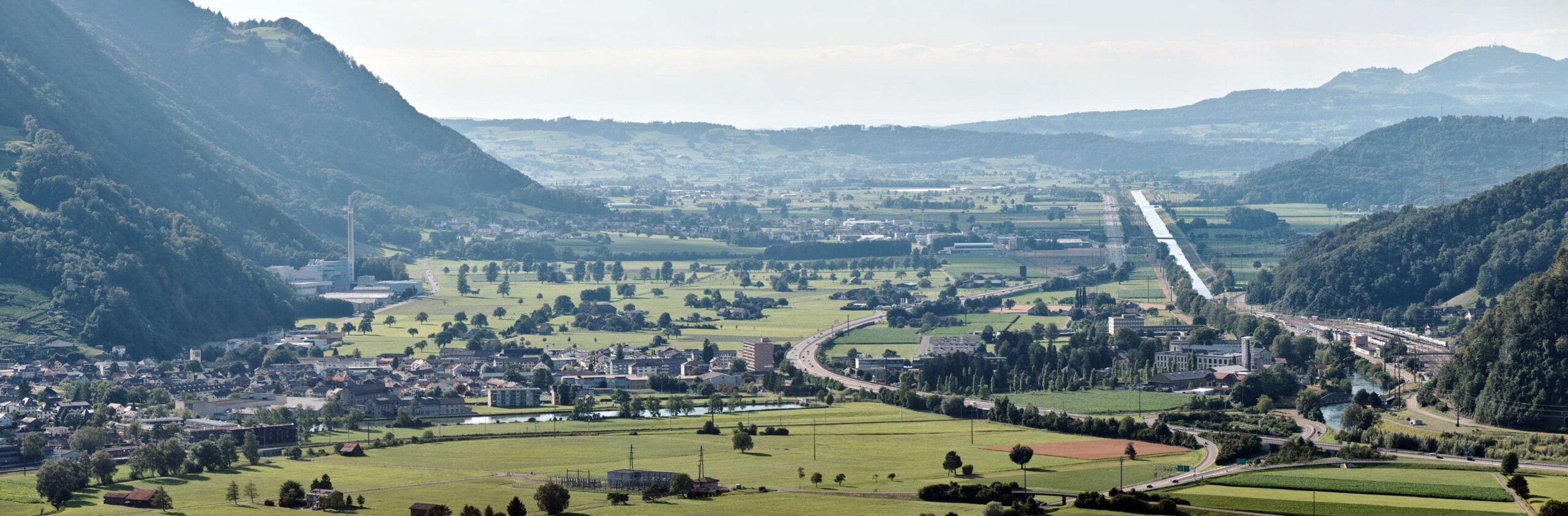
    The Biäsche work area combines location qualities that are rare in this form. The motorway junction, a goods station and natural recreational areas are right on the doorstep. Between municipal boundaries, transport axes and the natural environment lies an area that is to be economically considered, intelligently planned and sustainably utilised. The plots are in public, private and cantonal ownership. A constellation that requires integrative development.

    From area to function
    There is currently a lack of maturity in terms of planning and building law. Without development and development planning, the potential remains unutilised. For this reason, a test planning procedure examined various utilisation scenarios and development strategies. The aim was to create a clearly positioned, marketable economic area that is ready for low-emission, high value-added businesses. Staging this development is key. The site can only be developed sustainably in the long term with flexible, compatible concepts.

    One location, many interests
    The municipality of Glarus Nord holds 3.8 hectares of undeveloped employment zone land in the Unterflechsen sub-area. The canton of Glarus owns a further 2.7 ha in the neighbouring Mittelflechsen area. There are specific interests for this area. A salmon farm and a new penal centre are under discussion. The area is supplemented by private land and existing uses. This diversity makes spatial coordination a key planning task.

    Infrastructure as a driver of development
    Biäsche is ideally positioned in terms of transport links. The area is served by national transport routes operated by SBB and FEDRO. However, future-proof development requires that motorised traffic, public transport, pedestrian and bicycle traffic as well as supply and disposal infrastructures are coordinated and planned with foresight. This is the only way to create a location that is economically attractive and ecologically responsible.

    Indicative project as the key to progress
    After the test planning for the Biäsche site development was completed in June 2023, the concepts of Ernst Niklaus Fausch Partner AG and Studio Vulkan Landschaftsarchitektur AG will be further developed into an indicative project by August 2025 as part of a synthesis phase. As a synthesis, the indicative project summarises the parameters of the site development that the signatories consider to be correct and shows the main features of how the site should develop in the short, medium and long term. This serves as the basis for the subsequent development plan and perimeter procedure.

  • Zug Economic Area – Facts and Figures Zug

    Zug Economic Area – Facts and Figures Zug

    Located within the Greater Zurich Area (GZA), Zug is one of the world’s leading economic regions. The location boasts an excellent infrastructure, great potential for young talent and political and economic stability.

    Both the municipalities and the canton of Zug are constantly evolving and adapting to the requirements. With innovative projects, such as a bypass to relieve congestion in the centre of Cham, lake water that will regulate the temperature in the houses in residential areas in the future and exciting projects, such as the Association for Decarbonisation or the Climate Charter Zug, the canton is shaping a modern image with ambition.

    Numerous areas of historical significance are being renovated and converted to create attractive mixed-use developments comprising residential, work and commercial space.

    As a result, Zug remains a canton worth living in, which is also reflected in a high level of life satisfaction.

    Zug is not only appreciated by its 133,000 residents, numerous independent ratings and studies also confirm Zug’s outstanding position. For example, Zug has been ranked first among the Swiss cantons in the Credit Suisse and UBS rankings for 24 years. The basic principles of business friendliness, service orientation and a culture of innovation make the canton of Zug an ideal partner for companies, educational institutions and research institutes.

    Testimonials

    Andreas Klopp
    General Manager Roche Diagnostics International AG

    “Rotkreuz is located in the Zurich-Zug life sciences cluster and offers ideal conditions for driving innovation thanks to its excellent infrastructure and high quality of life. For over 50 years, Roche in Rotkreuz has been contributing to the health of patients worldwide with diagnostic solutions.”

    Dr Katja Buller
    Vice President, Head of Corporate Affairs International, Biogen

    “Local and international specialists,
    “Local and international specialists, a multi-layered infrastructure and professional cooperation with the authorities have made the canton of Zug the ideal location for our international headquarters for more than 20 years”

    Katharina Gasser
    President of the Zug Chamber of Commerce

    “Our members appreciate the business-friendly conditions in the dynamic and innovative Canton of Zug. The authorities are service-orientated, make decisions quickly and work efficiently; the unique “spirit of Zug” is palpable.”

    Hanspeter Rhyner
    Chairman of the Executive Board, Zuger Kantonalbank

    “Zuger Kantonalbank combines tradition and modernity. This is precisely the DNA of the attractive location of the Canton of Zug. Digital AND personal –
    this is how we meet the needs of our customers in line with this DNA. And we can fulfil all needs and accompany you through life.”

  • Attractive residential and commercial mix with industrial charm

    Attractive residential and commercial mix with industrial charm

    Cotton yarns were produced on the Bühler site for over 160 years. At the end of 2016, the spinning mill was shut down in order to give the site a new purpose: an attractive residential and commercial area. In the process, the four industrial buildings (spinning mill, bale warehouse, factory and power plant) will be converted into flats as well as flexibly usable commercial spaces and a bistro.

    The “factory” and the “bale warehouse” are intended for individual commercial uses. Built in the 1980s, the factory halls are ideal for production, workshops, laboratories and training rooms. Generous windows and gates on the southwest façade provide natural light and direct access to the halls. Offices and studios are housed in the former service wing. An underground car park with around 100 parking spaces has been created in the basement. The bale warehouse can be used as an unheated workshop or storage area.

    A diverse mix of flats will be built in the “Spinnerei” by 2026: 89 loft-like flats are planned, which will be built according to Minergie standards. Seven flats in terraced house style extend over three floors. They have a garden, a balcony and a direct view of the Töss. The mezzanine floor of the spinning mill building, which dates back to 1860, is partly intended for commercial use and is accessed via a platform. The “power plant” continues to generate renewable energy from hydropower. The adjoining former energy centre will be converted into a bistro.

    The owners attach great importance to preserving the historical heritage and industrial charm of the site. The site scores with its good location: Winterthur city centre is just a few minutes away – the airport and the city of Zurich can be reached in half an hour by car or train. The “Sennhof-Kyburg” S-Bahn connection is only 400 metres away. And yet the future residential and commercial quarter is located directly on the banks of the Töss and offers an unobstructed view of the Kyburg.