Tag: Arbeitsplätze

  • 2000 jobs are on the line in Wettingen

    2000 jobs are on the line in Wettingen

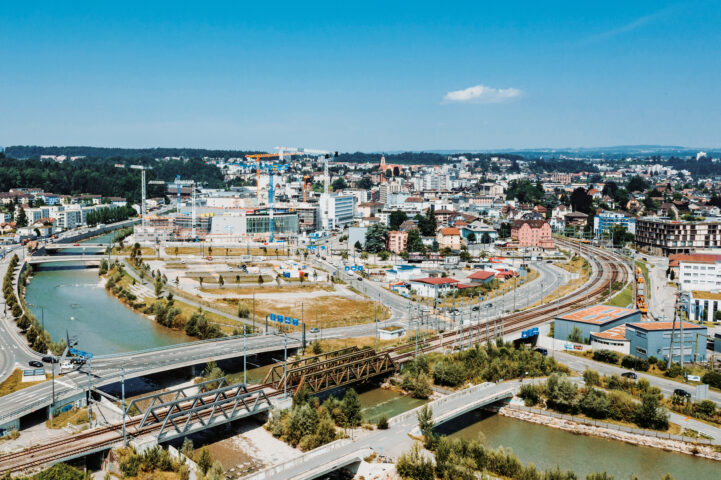
    Wettingen has moved to the centre of an economic policy decision. The Aargau cantonal council wants to amend the structure plan in the Tägerhardächer area and thus create the planning conditions for a possible Hitachi Energy campus.

    This is a big step. Because it is not just about a single building project. It is about the question of whether Aargau can retain and at the same time expand its industrial substance. In the best-case scenario, around 1000 existing jobs will remain in the canton and up to 2000 new jobs could be created.

    Why Tägerhardächer
    The location is no coincidence. Hitachi Energy is looking at several options for expanding its capacities and relocating current jobs. The Tägerhardächer area is one of the favoured options.

    From a location promotion perspective, there are many arguments in favour of Wettingen. The site is located in the Zurich, Limmattal and Baden area, has good transport links and enables a coherent, expandable campus solution. It is also close to an existing cluster of companies from the energy sector. This increases the appeal of the location far beyond the municipal boundaries.

    The price of progress
    Wherever development becomes possible, conflicts arise. 10.7 hectares of settlement area would have to be designated for the project. The area is currently located in an agricultural area and is partially overlaid by a settlement separation belt.

    This is precisely where the criticism arises. In the consultation process, the loss of cultivated land, the reduction of crop rotation areas, encroachment on the settlement separation belt and traffic issues were criticised in particular. Nevertheless, the cantonal government maintains that the project is appropriate and spatially harmonised from a cantonal perspective. At the same time, attempts should be made to upgrade agricultural land elsewhere so that the loss remains limited.

    The region is thinking further ahead than the
    factory buildingThe
    decisive factor now is whether growth and quality of life can go hand in hand. After all, a campus of this size not only has an impact on the labour market. It changes traffic flows, settlement areas and expectations of the infrastructure.

    That is why accessibility should not only work for cars. Public transport as well as pedestrian and cycle connections should be designed in such a way that the impact on neighbouring communities remains as low as possible. This is more than just background music. It is a prerequisite for economic dynamism to be accepted regionally.

    Nothing has been decided yet
    The political will is visible. Wettingen and Baden Regio also support the amendment to the structure plan. However, the company has yet to make a final decision on the location. If it decides against Wettingen, the corresponding resolutions will become null and void.

    This is the real message of this dossier. The future does not just fall from the sky. It must be planned, politically supported and regionally balanced. Wettingen now has the chance to prove just that.
  • Investments strengthen production capacities in the medical technology sector

    Investments strengthen production capacities in the medical technology sector

    The Burgdorf-based medtech company Ypsomed has invested 25 million Swiss francs in the remodelling and construction of a new machine tool park in Solothurn. In order to meet the growing global demand for injection systems and offer customers the highest quality, Ypsomed intends to significantly expand its position and capacity in the production of injection moulds, according to a press release. At the Solothurn site, the company intends to concentrate on the design and manufacture of plastic injection moulds for pens and autoinjectors.

    The commissioning of the mould construction facility marks the start of the implementation of a 200 million Swiss franc investment package to develop the site. Two new high-volume assembly systems with associated injection moulding systems for autoinjectors are to be opened in the coming months. The company has also announced plans to build a fully automated high-bay warehouse at the Solothurn site by the end of 2027. At the same time, a conference centre (Ypsomed Forum) is to be built there with space for around 300 guests. “The investment in the new toolmaking facility in Solothurn is a clear commitment to the development of our sites in Switzerland,” said Simon Michel, CEO of Ypsomed.

    The company also wants to continue to grow internationally in order to consolidate its position in the medical technology market and meet the increasing demand for injection systems for self-medication. in 2025, Ypsomed opened its first own plant in Changzhou, China, and started the expansion of its production site in Schwerin, Germany. A new site is currently under construction in Holly Springs in the US state of North Carolina.

    The investment also serves to double the number of staff in this area. The current number of 35 employees plus trainees is set to grow to 100 employees and apprentices.

  • Investment in modern workplaces and training

    Investment in modern workplaces and training

    The Ferrum Group has inaugurated its new ferruBase extension at its Schafisheim site, according to a press release. With the new building, the mechanical engineering company has realised a vertical production structure that creates space for 240 new office workstations, fully equipped production rooms and a future-oriented training workshop on around 14,000 square metres of floor space. More than 1,000 guests attended the opening and were able to gain an insight into the new building during expert tours.

    According to the press release, the new building seamlessly combines modern production processes with ergonomic office design and a training workshop. During the guided tours, employees, family members and guests were able to gain an initial insight into the architecture, construction method and new machinery. Catering was also provided at the opening ceremony and a varied entertainment programme was offered.

    For Ferrum, the new building is an investment in the future viability of the company and is intended to secure jobs in Aargau in the long term. At the same time, it also demonstrates how tradition and modern technology can be successfully combined.

  • Investment strengthens business location with 60 new jobs

    Investment strengthens business location with 60 new jobs

    Emmen-based SME Technik AG has broken ground on the construction of a new company building. With the construction of the new production facilities, the CNC manufacturing specialist aims to strengthen its location in the canton of Lucerne, according to a press release. With an investment of 7 million Swiss francs, a three-storey work and production building is being constructed. It will also create 60 new jobs.

    The building, with 1,200 square metres of production space and 1,100 square metres of office space, is primarily intended to optimise the CNC production of small parts or series for the aviation and railway industries. In a first step, two new CNC machines will be installed. The move is scheduled for spring 2026.

    The building, planned and realised by Cerutti Partner Architekten AG from Rothenburg, is designed for sustainability and energy efficiency. A solar system on the roof and air-to-water heat pumps were installed to ensure resource-conserving operation.

    “With the new building, SME Technik is creating modern workplaces that are attractive for both existing and future employees,” said Jan Kottucz, investor, owner and Chairman of the Board of Directors of SME Technik AG, in the press release. “At the same time, we can manufacture CNC parts for our customers with the highest precision and to Swiss quality standards in the modern production halls with new systems.” Ramona Gut-Rogger, Mayor of Emmen, sees the new investment by SME Technik as a “strong signal for the future of our business location.”

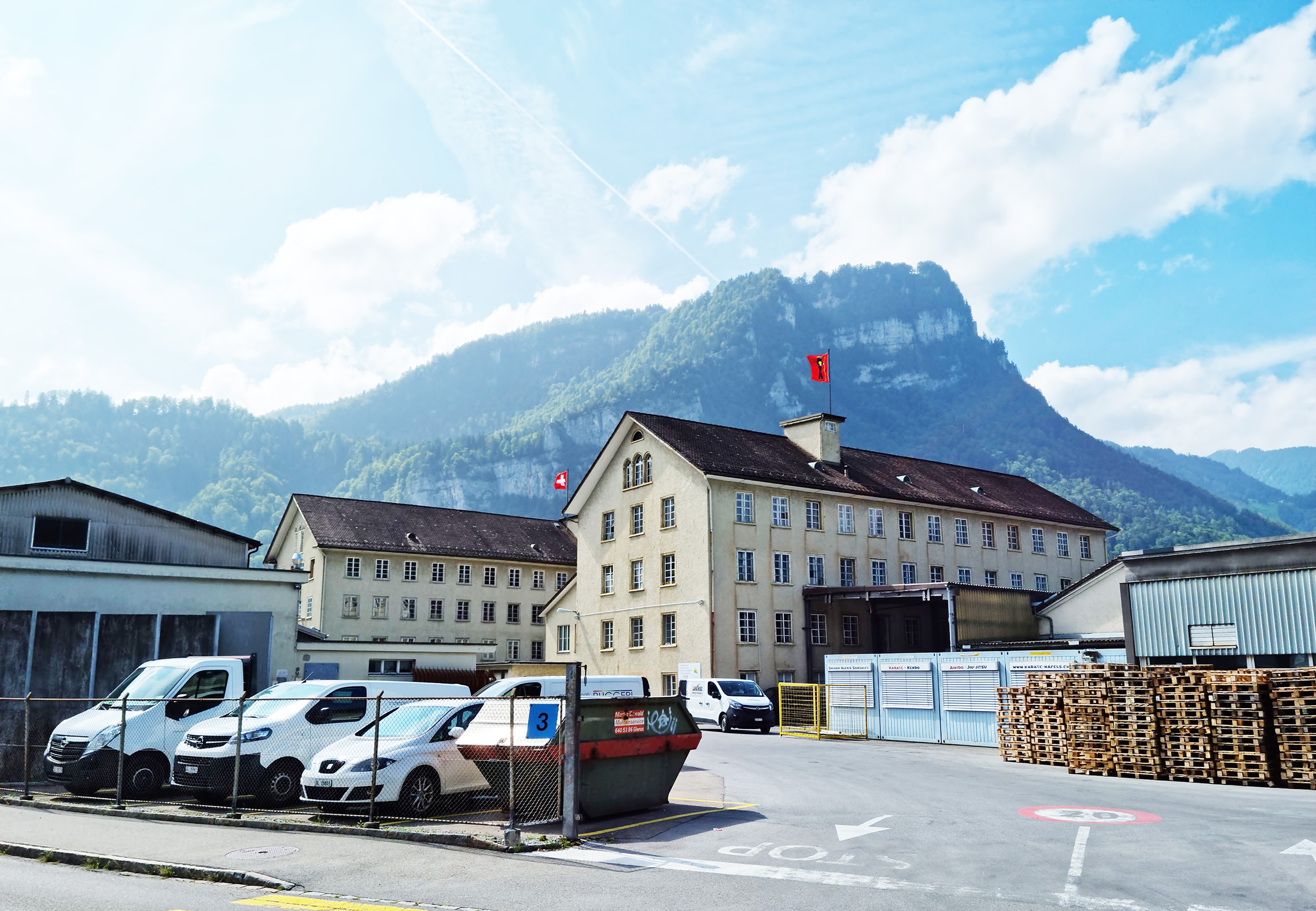
  • The Landolt site in transition

    The Landolt site in transition

    What significance does the development of the Landolt site have for Glarus as a business location? What specific impetus do you expect for the local economy and the creation of new jobs?
    The site is already well utilised with many different SMEs. When the Landolt company moves out in the medium term, the old stock will be freed up. The Shedhalle, which we have already renovated and equipped the roof with a large PV system, is particularly interesting. We are in the process of attracting new tenants and offer a very attractive location with optimal logistics connections. Attractive new jobs are being created here.

    Temporary uses such as the planned mobility hub are a central element of the concept. What opportunities do you see in these temporary uses to revitalise the site during the development phase?
    This is one of the most important parts of the transformation. We would like to keep all of the existing tenants if possible. We maintain direct contact with them so that they can continue to develop within the site. The buildings with interim uses are let cheaply but not for long, whether as storage, car parks or hubs, but without major investment on our part. There is also room for creativity here.

    How are the canton of Glarus and the location promotion organisation involved in the project? Is there strategic coordination with cantonal development goals?
    We are in regular dialogue with the location promotion agency and are confident that the good location and the size of the space on offer will also attract larger SMEs to the canton of Glarus. Several companies are already interested in setting up here.

    Participatory planning is emphasised. How were local residents and businesses able to get involved and what findings from this process will be incorporated into the next steps?
    With well-supported representation from the authorities and a specialist committee from the worlds of business and urban planning, as well as an international team of planners, the urban design, the relationships with the neighbours and the use and building distribution of the site were reworked. Many of the old spinning mill buildings are to be preserved and given a new lease of life.

    The current purely commercial area will be supplemented with various commercial offerings, and a small proportion of housing will also be possible. The very attractive location between the Chli Linthli and Mühlibach streams also invites walkers and residents to experience this beautiful and idyllic place.

    The planners are currently working with the design commission and the heritage conservation organisation to draw up the basic project. By the summer of 2025, it will be possible to show the future shape of the site, the expanded commercial offer and the variety of flats. We are very pleased with the excellent cooperation and are convinced that the careful handling of the existing buildings and the new buildings will create great added value for the users of the site, as well as for local residents.

    The development will take place in four stages. How will you ensure that the site remains lively, usable and attractive in the intermediate phases and does not become a long-term construction site?
    As already mentioned, part of the existing industrial buildings will be used for new purposes. The very old existing buildings, which will be vacant in the medium term after the Landolt company moves out, are to be rented out again quickly after conversion or modernisation. The various talent zones were defined for this purpose, and these form the stages. The development will be successively finalised with the completion of the respective zones.

    The innovation campus at Chli Linthli is intended to develop independently and in line with demand. Which target groups would you like to address here and which sectors could settle here?
    This site is already fully occupied with a wide range of businesses. The needs of the future will be accommodated here. The idea is to create a diverse range of businesses that require good networking within this area and function like a campus. However, we are also open to other ideas. Only time will tell what these are.

    How do you create long-term identity and loyalty on the site? What role do social, cultural or ecological offerings play for future users?
    The site already has a rich history. You can see this everywhere here. With a new use and the right approach, the culture will be preserved but also redefined. With our goal of sustainability, this process will also conserve resources. The use of natural building materials and simple architecture will create affordable working and living space that is healthy and worth living in. With its watercourses, green spaces, newly created neighbourhood squares, etc., the site offers a lot of spatial quality, but also a very attractive place to work, live and stay.

  • Innovation campus in the heart of the Engadin

    Innovation campus in the heart of the Engadin

    The Engadin is known for its cultural diversity and breathtaking nature. At the same time, the region is increasingly focussing on innovation and sustainable development. The InnHub La Punt is a place where research, entrepreneurship and education come together.

    The centre offers a wide range of uses over an area of 7,700 square metres. These include workshop and classrooms, coworking workspaces, an auditorium with 250 seats, a sports training infrastructure, a spa, a restaurant with bar and lounge, a sports shop, a tourist information centre, 44 hotel rooms and 8 tourist flats. The multifunctional premises create a dynamic environment for innovation and interdisciplinary dialogue.

    Construction begins in spring 2025
    Following a comprehensive planning phase in which the concept was further refined, construction of the InnHub La Punt will begin in spring 2025. The municipality issued the building permit in autumn 2023. The existing buildings will be demolished first, followed by the excavation and construction of the underground car park by summer 2026. The shell will be completed by mid-2027 before the interior work begins. The opening is scheduled for the end of 2028.

    In parallel with the municipality of La Punt Chamues-ch’s future projects, including the road bypass and the renaturation of the Chamuerabach stream, the InnHub will create a new centre that will revitalise the town and provide new impetus.

    Sustainability as a central building block
    A key component of the project is its sustainable approach. The building is being constructed from local wood, granite and lime mortar and is an example of the circular economy and ecologically responsible construction. “The InnHub is a matter close to my heart, as I have lived in the Engadin for years. It is an example of sustainability and innovative construction methods,” emphasised architect Norman Foster in a video message.

    The operation of the campus is also designed to be sustainable. The initiators, including Caspar Copetti, are not focussing on short-term profits, but on long-term positive effects for the region. The InnHub is intended to create new jobs, promote year-round tourism and establish an innovation ecosystem in the Engadin.

    New impetus for the economy and the community
    The InnHub La Punt will not only attract companies, start-ups and skilled workers, but also facilitate strong networking with the local population. The municipality of La Punt Chamues-ch sees the project as an important step for the further development of the region. “The campus will create a cultural and social meeting point in our village. The projects that are being created here will inspire future generations to come to La Punt,” says mayor Peter Tomaschett.

    In addition to the long-term effects for the region, the InnHub offers an InnHub PopUp even before its completion, which can be used as a co-working and event venue for locals, holiday guests and professionals until it opens.

    A milestone for the Engadin
    The InnHub La Punt combines innovation, sustainability and community in a unique way. With a clear focus on responsible development, it will radiate far beyond the Engadin and serve as a model for sustainable innovation centres in the Alpine region. The combination of state-of-the-art architecture, innovative working environments and regional roots makes the InnHub a forward-looking project that will provide new impetus for the Grisons as a business location.

  • Location promotion brings over 700 new jobs in the first year

    Location promotion brings over 700 new jobs in the first year

    The establishment of a total of 231 international companies in 2024 supported by the location promoters strengthens Switzerland as a location for innovation, according to the Conference of Cantonal Economic Directorates and Switzerland Global Enterprise, the national Swiss export and location promotion organization, in their press release. The committee particularly emphasizes that around two thirds of these companies are active in the five key technologies of healthcare, digital, automation, food and finance. They were defined by the federal government, cantons and regions in their joint strategy for the years 2024 to 2027 as particularly worthy of support.

    According to the press release, this strategy has brought the promotional activities of all stakeholders even closer together. Switzerland benefits from the fact that the various competencies of the promotion partners complement and reinforce each other.

    In the first year of operation, these 231 newly established companies in Switzerland created 716 new jobs. According to the information provided, they plan to create a total of 2135 jobs over the next three years.

    Around half of these companies come from the USA, Germany, France and the UK. As Cantonal Councillor Walter Schönholzer, Director of Economic Affairs of the Canton of Thurgau and Co-President of the steering body for national location promotion, emphasizes, the companies located here “also contribute to cross-cantonal value creation and to strengthening the local SME landscape with their innovative know-how and broad network”.

  • Roche opens new centre for pharmaceutical research

    Roche opens new centre for pharmaceutical research

    A significant milestone has been reached at Roche’s headquarters in Basel. The inauguration of the new Pharma Research and Early Development Centre (pRED). The centre, which offers 1,800 state-of-the-art workstations for laboratory and office work, brings together experts from various fields of research. The aim is to increase the efficiency of research and development through close collaboration. Federal Councillor Guy Parmelin also attended the opening ceremony, which emphasises the national importance of this project.

    With the new pRED Centre, Roche is pursuing a clear vision of pooling expertise from areas such as chemistry, biology and data science in order to drive forward pioneering innovations. Thomas Schinecker, CEO of the Roche Group, emphasised the central role of the centre in the company’s global innovation network. “This centre will not only improve the efficiency of our research, but also help us to achieve the greatest possible benefit for patients worldwide.”

    Investing billions in the future
    The investment in the pRED Centre is part of Roche’s long-term commitment to the Basel site. Since 2009, the company has invested 4.6 billion Swiss francs in the expansion of the site. With the new four buildings – including two high-rise laboratory buildings, an office complex and a congress centre – Roche is sending another strong signal for the future.

    And this is just the beginning: a further 1.2 billion Swiss francs are being invested in modernising and expanding the site, which will strengthen Basel’s role as a global centre for pharmaceutical research and development in the long term.

    With the opening of the new pRED Centre, Roche is not only investing in its own innovative strength, but also in strengthening Basel as a business location. This billion-euro investment is a clear signal that the pharmaceutical company intends to further expand its leading role in global research and development – a significant step both for the industry and for the region.

  • Rolex invests one billion francs in new giant factory in Bulle

    Rolex invests one billion francs in new giant factory in Bulle

    The world-famous luxury watch manufacturer Rolex is planning a massive expansion in western Switzerland. A gigantic production facility is to be built in Bulle, in the canton of Fribourg, by 2029. Covering an area of 104,000 square metres – the equivalent of almost 15 football pitches – Rolex plans to produce luxury watches from 2029 to meet the growing demand for its products. The new factory is expected to create 2,000 jobs and thus make a significant contribution to the regional economy.

    Land sale approved
    The General Council of Bulle has approved the sale of the construction site to the Rolex Group by a large majority. Rolex is investing a total of one billion francs in the project and paid 31.4 million francs for the 100,000 square metre site. The planning application has now been submitted and the first visualisations of the planned buildings have been published.

    Innovative construction concept and sustainability
    The new plant will consist of four production buildings connected by a central building. In addition to the administration, this central area will also house catering facilities as well as meeting and rest areas. A striking head-end building at the southern end of the site will house the main entrance.

    Rolex attaches particular importance to environmental friendliness and sustainable design. The factory is to achieve the highest standard of the British Breeam label – a first for an industrial building in Switzerland. The buildings will be arranged so that they are integrated into a park that serves as protection from emissions from the nearby motorway.

    Fifth Rolex production site
    With the new site in Bulle, Rolex is expanding its already highly integrated production chain. The luxury watch manufacturer already operates production sites in Geneva, Chêne-Bourg, Plan-les-Ouates and Biel. Most of the watch components, from movements and cases to dials and bracelets, are produced in-house at these sites.

    Temporary solution in Romont
    In order to expand production capacity before 2029, Rolex will temporarily set up a factory in Romont. Around 250 to 300 employees are to be employed there from the beginning of 2025, most of whom will be newly recruited and trained. These employees will move there once the factory in Bulle is completed.

    With the new factory in Bulle, Rolex is strengthening its position as one of the world’s leading luxury watch manufacturers and investing in the future of the Swiss production site.

  • New offices and meeting rooms completed in Bern

    New offices and meeting rooms completed in Bern

    The remodelling and renovation of the offices and meeting rooms at the Halter construction company’s Bern site have been completed. They were realised by Integral design-build AG, part of the Halter Group in Schlieren, within six months. The keys were handed over last week, according to Integral’s LinkedIn page. “By using recyclable materials such as wood, glass and metal, we have created a space that not only minimises our ecological footprint, but also reflects our values of sustainability and aesthetics,” it continues.

    The Halter site in Bern is growing and with it the “need for a larger and more inspiring working environment”, according to a Halter press release. Since the beginning of March this year, an additional 600 square metres of the former Denner site have been rented at the location in the House of Religions realised by Halter. The conversion phase, including dismantling, began in November 2023 and was successfully completed in July 2024. The expansion has increased capacity from 40 to 58 workstations. There are now also additional touchdown workstations and meeting rooms with modern equipment. The move has been successfully completed and the premises have already been filled with life.

    A particular highlight of the remodelling is the impressive staircase, which connects the two floors and creates an open and dynamic working atmosphere, according to the Halter press release.

    The Halter Group comprises a total of ten companies. The head office is in Schlieren, with further locations in Münchenstein BL, Bern, Kriens LU, Lausanne, St. Gallen and Geneva.

  • New cooperation between SVIT Zurich and “immobilienjobs.ch”

    New cooperation between SVIT Zurich and “immobilienjobs.ch”

    As part of the collaboration, “immobilienjobs.ch” creates exciting career opportunities for jobseekers by providing access to job offers in the property industry. This includes not only traditional jobs, but also innovative positions that arise as a result of changing industry requirements. The platform thus ensures that jobseekers and companies find each other in a modern, efficient and targeted way.

    SVIT Zurich members benefit from this co-operation. The job portal enables them to find qualified specialists more efficiently. In this way, staff shortages can be optimally and quickly eliminated, which in turn promotes the productivity and innovative strength of companies. It should be emphasised that “immobilienjobs.ch” is also an ideal platform for well-trained career changers who want to start their career with sound training and personal job coaching from SVIT Zurich. This allows them to present their skills and knowledge in the best possible way and facilitate their entry into the industry.

    A special offer for all SVIT Zurich members – “immobilienjobs.ch” offers them two job advertisements for the price of one. This exclusive offer ensures that the association’s members achieve maximum visibility and reach for their job offers, while at the same time reducing recruitment costs.

    Overall, this partnership offers clear advantages: it creates new career opportunities, promotes the recruitment of qualified specialists and efficiently integrates career changers into the property sector. The cooperation between SVIT Zurich and “immobilienjobs.ch” therefore represents a significant step towards more efficient and innovative personnel development in the property sector.

  • Professionalisation of the management of residential and commercial properties

    Professionalisation of the management of residential and commercial properties

    Wincasa wants to break new ground in property management. The property service provider, which is part of Implenia, is splitting its corresponding services into the residential and commercial divisions, Wincasa announced in a press release. Employees will be trained in newly created functions and job profiles.

    The new Target Operating Model (TOM) is intended to professionalise the two areas and enable even more needs-oriented and use-oriented management of different properties. “The aim of the TOM project is to implement an operating model that covers today’s management requirements,” says Philipp Schoch, Head of Property Management at Wincasa, in the press release.

    As part of the project, Wincasa will set up 18 physical locations throughout Switzerland by the end of 2025 for the management of residential tenants and eight locations for the management of commercial tenants. The so-called walk-in locations in the residential sector can be used, for example, to clarify questions about the tenancy agreement or to report damage. In the commercial sector, on the other hand, “it’s about more complex properties, long-term tenancy agreements and vacancies that are more significant,” explains Schoch. Here, Wincasa wants to deploy qualified specialists “who provide highly professional support to commercial tenants in all phases of the management process”. Real-time monitoring of important key figures such as vacancy rates at the locations should show property owners the measurable success of the new management model.

  • A visionary spatial planning concept for the future of the Zurich metropolitan area in 2050

    A visionary spatial planning concept for the future of the Zurich metropolitan area in 2050

    With almost 40% of the Swiss population and the majority of jobs, the Zurich metropolitan area is home to a significant proportion of national life and economic activity. The updated spatial planning concept Metro-ROK 2050, an update of the first Metro-ROK from 2015, defines ambitious planning objectives for this important economic and living space. It aims to promote sustainable development that fulfils both the needs of the population and the protection of the environment.

    The concept divides the area into four action areas: urban landscapes with urban centres, transitional landscapes with regional centres, cultural landscapes and natural landscapes. This categorisation makes it possible to develop targeted measures that guarantee a high quality of life and at the same time make the area ecologically sustainable.

    A core concern of the Metro-ROK 2050 is the protection of green spaces and the promotion of high-quality inner-city development. No expansion of the settlement area is planned until 2040 in order to stop urban sprawl and make better use of existing areas. The building culture should be based on the circular economy principle, take grey energy into account and protect biodiversity.

    The concept also places a strong focus on the sustainable use of resources and the promotion of energy efficiency. Innovative technologies and ecological construction projects should help to improve the carbon footprint and make the metropolitan area more resilient to climate change. Renewable energies and the reduction of soil sealing are just as much a focus as the promotion of public transport and sustainable mobility solutions. The aim is to significantly increase the proportion of environmentally friendly means of transport by 2050.

    The Zurich Metropolitan Area 2050 spatial planning concept represents a decisive step towards sustainable and future-proof development. With the positive acceptance of the recommendations for action by the Metropolitan Council on 3 November, a further milestone has been reached. The concept reflects the commitment of the participating cantons to work together to ensure a liveable and ecologically sustainable Zurich metropolitan area.

  • Economic development Freiburg successful despite challenges

    Economic development Freiburg successful despite challenges

    The Economic Development Agency of the Canton of Fribourg, or WIF for short, supports companies wishing to expand their activities in the canton or relocate here. It is also responsible for implementing the New Regional Policy (NRP) in the canton. Last year, the WIF supported a total of 40 company projects and 23 NRP projects. Of the business projects, 24 were expansions and 16 were new establishments. The majority of the 16 new establishments (10 projects) came from Switzerland. One example of a Swiss new establishment is the Algaltek GmbH project, which has settled on the AgriCo-Campus in St-Aubin. Algaltek is a biotech spin-off of the EPFL and specialises in the production of algae.

    Strengthening 1000 jobs in Fribourg companies
    In addition to expansions and new settlements, projects are also helping to strengthen existing jobs in the long term. Last year, around 1000 jobs were secured in the canton thanks to WIF measures. One example of this is SMG Swiss Marketplace Group AG in Flamatt. The WIF supported SMG in its search for a new location in order to retain the 160 jobs in the canton of Fribourg. The choice fell on the bluefactory site in the centre of Fribourg, an attractive location that is easily accessible for employees from all over Switzerland and especially from western Switzerland. The move is planned for the second half of 2024. “The work of the Economic Development Agency is geared towards the long term,” said State Councillor Olivier Curty, Director of Economic Affairs and Vocational Training. “Every year, its work has a profound impact on our economy, both quantitatively and qualitatively, which pleases me.” WIF Director Jerry Krattiger also emphasised that the WIF is increasingly supporting research and development projects. “The importance of R&D projects in Fribourg companies is increasing. in 2023, we supported 13 such projects, 6 of which were co-financed by Innosuisse at federal level.”

  • ABB modernises Untersiggenthal site

    ABB modernises Untersiggenthal site

    The technology company ABB has opened a new multifunctional building in Untersiggenthal. According to a press release, there are 500 workstations for employees in the areas of research and development, sales and service, project management and engineering. The Emotion building took two years to construct. At a cost of around 45 million Swiss francs, this is ABB’s largest investment in Switzerland for over ten years. It was built using over 2,200 cubic metres of Zirkulit, a recycled concrete that also stores CO2.

    “With this investment, we are strengthening ABB’s presence in Switzerland and investing in high-growth technologies of the future. The new multifunctional building is an important step towards positioning ourselves as an employer of choice and attracting the best talent and experienced workers in an age of skills shortages,” said Nora Teuwsen, CEO of ABB Switzerland.

    “The ABB site in Untersiggenthal is an impressive success story of constructive interaction between politics, business, education and research,” said Stephan Attiger, Head of the Department of Construction, Transport and Environment of the Canton of Aargau. The location demonstrates that the high-tech canton of Aargau “offers the best ground for innovation and technological progress, and how regional origins can lead to global success”.

    In Untersiggenthal, ABB develops and manufactures efficient and sustainable technology solutions for drive technology in the areas of industrial processes, infrastructure and railways, as well as for applications in the field of renewable energy generation, for customers worldwide.

  • KONE makes new location a laboratory for New Work

    KONE makes new location a laboratory for New Work

    KONE, the Finnish specialist for building mobility, has inaugurated a new branch for around 70 employees in Sion, according to a media release. It was officially opened in the presence of the Finnish ambassador to Switzerland, Valtteri Hirvonen. KONE has been present in Western Switzerland since 2001 and employs 140 people there.

    With the opening of its newest location, KONE is simultaneously introducing a new working model. Among other things, this includes a new computer-controlled allocation of workstations every day. Anyone who wants to fill a workstation submits a request via an app and is then assigned a place. This is done randomly and differently from the previous day.

    The company hopes that this will lead to stronger communication between employees, which should promote cooperation and creativity. In addition, the office building in Sion is reportedly KONE’s first in the world to be fully designed in the new brand identity. A dynamic and flexible space has been created that can be changed according to needs. This concept was developed with a team of local employees in a participatory process, it said.

    “We are proud to be able to introduce a form of collaboration at the Sion site that meets the requirements of digitalisation and globalisation and promotes inclusion and innovation in our Western Switzerland team,” Christian Wukovits, Managing Director KONE Switzerland and Austria, is quoted as saying in the statement, “I would like to express my sincere thanks to the project group and everyone else who was involved in this process. They have done an excellent job that will be groundbreaking for our company”.

  • Veriset renews kitchen exhibition

    Veriset renews kitchen exhibition

    Veriset AG has invested in its kitchen exhibition at its headquarters in Root. After six months of construction, the showroom has been completely refurbished. The infrastructure had reached its limits since the last major renovation in 2010, according to a press release. In addition to modernisation, the aim was also to present the exhibition kitchens in a fresher way. Now the exhibition appears airier and larger.

    At the same time, many new functions will be introduced. For Veriset, these include a new type of appliance wall, where new built-in appliances can be quickly and easily exchanged, or a kitchenette with a utility room that is “cleverly hidden behind a cupboard door, as is customary today”.

    The two partners Cozza Plättli and Textilwerke are also represented with their products. For the employees, Veriset has reportedly created attractive workplaces with new, modern offices.

    The three kitchen professionals have two consulting stations with numerous material samples and a large computer screen for visualisation and planning. According to Veriset, both the simple rental flat kitchen and the luxurious black island kitchen have been considered for the exhibition kitchens. A virtual tour and pictures are intended to provide a first impression.

  • Master Builders’ Association counters shortage of skilled workers

    Master Builders’ Association counters shortage of skilled workers

    The Swiss Association of Master Builders(SBA) expects a growing shortage of skilled workers in the construction industry. It has therefore commissioned a “Study on the Long-Term Development of the Economy and Skilled Workers in the Main Construction Industry” from the Competence Centre for Demographics, the association informs in a press release. According to the study, which was presented at the end of June at the Construction Industry Day in Lugano, the shortage of skilled workers, measured in terms of construction volume, could reach about 16 percent by 2040. This would cause annual turnover losses of up to CHF 800 million and thus endanger jobs in the construction industry.

    In Lugano, however, SBC Central President Gian-Luca Lardi also pointed out possible solutions. “If we increase turnover per capita by 0.5 per cent annually, we can make up for 50 per cent of the shortage of skilled workers,” Lardi is quoted as saying in the press release from his address at the industry’s traditional networking event. According to the association, this increase in productivity should mainly be achieved through digitalisation and innovation. At the same time, Lardi suggested “training more apprentices, keeping skilled workers in the profession longer and ultimately recruiting more lateral entrants”. In this way, the other half of the gap could be closed, according to the Central President.

  • Regio Energie Solothurn awards two prizes in 2023

    Regio Energie Solothurn awards two prizes in 2023

    Regio Energie Solothurn did not just award a prize for energy efficiency, climate protection and sustainability at its annual energy forum, as is usually the case. This year, according to a statement, two organisations were awarded instead: the Restessbar Sol othurn association and the Discherheim Solothurn foundation.

    The Restessbar association saves food. Since 2017, its members have been collecting fruit, vegetables, pastries and drinks from partner companies on a voluntary basis, which would otherwise end up in the waste. They are then sorted and distributed to around 300 people on twelve tours per week. In this way, around 26 tonnes of food that can still be consumed are saved from disposal every year. In addition, the association conducts educational work against food waste and supports pupils in the preparation of a cookbook.

    At the Discherheim, “care is taken to ensure that everything you do has as long an effect as possible”, says Regio Energie Solothurn. At the three locations of the foundation, which offers housing and jobs to people with disabilities, this also applies to energy efficiency and resource conservation, both in the conversion of the heating source and the fleet of six vehicles to electric drives. The electricity for this comes from the building’s own photovoltaic system. In addition, the biotope, hedges, natural meadow, insect hotels and birdhouses contribute to biodiversity.

  • Schlieren reports record number of companies moving to the city

    Schlieren reports record number of companies moving to the city

    The City of Schlieren ‘s location promotion department reports the highest number of company arrivals in a single year for 2022. According to a statement, there were exactly 1300 companies in Schlieren as of 1 January 2023. That is around 100 more than a year earlier. According to the head of location promotion, Albert Schweizer, the new companies mainly come from the location promotion’s cluster efforts such as biotechnology, start-ups and med- and healthtech. “One of my most important tasks as location promoter is to network the new companies and also the companies that have been in Schlieren for years,” location promoter Schweizer is quoted as saying.

    In his view, the business and trade associations and the Standortförderung Limmatstadt AG have contributed to the success of the new settlements. With the IFJ – Institut für Jungunternehmen (Institute for Young Enterprises ), based in Schlieren, the city can count on a large and important partner. The city also works intensively with the Canton of Zurich’s business promotion agency.

    Schweizer recalls that in 1998, when Schlieren’s location promotion was introduced, there were only 655 companies in Schlieren. Today there are exactly 1300, the largest annual increase since 1999, and the number of jobs has risen from 12,000 to around 19,000.

    Schweizer assumes that the number of jobs will continue to increase strongly, which will also benefit the retail trade. This is because more research institutes are coming to Schlieren. The Swiss Federal Institute of Technology Zurich is strengthening its medical research and building a new location in Schlieren. A new laboratory building for medical research is being built in the immediate vicinity of the Schlieren-Zurich Bio-Technopark. And the Roche pharmaceutical group is setting up an Institute for Human Biology(IHB) in Basel with a satellite laboratory in Schlieren.

  • Hammerwald Sursee: Neuer Gewerbe- und Bürokomplex

    Hammerwald Sursee: Neuer Gewerbe- und Bürokomplex

    An der Allmendstrasse in Sursee erfolgt in wenigen Monaten der Spatenstich für das Gewerbeprojekt Hammerwald. Geplant sind zwei Gebäudekomplexe sowie ein dreigeschossiges Parkdeck mit 450 Autoabstell- sowie Veloparkplätzen. Der Neubau soll Platz für rund 600 Arbeitsplätze bieten. Die Flächen im Gebäude A1 werden vermietet, während diejenigen im Gebäude A2 zum Verkauf stehen. Die insgesamt 27’000 Quadratmeter umfassenden Flächen werden für eine flexible Nutzung konzipiert. Bis 2025/26 soll der Komplex fertiggestellt sein.

    Das Gebäude A1 erhält sieben Geschosse, deren Mietflächen sowohl vertikal als auch horizontal erschlossen werden können. Die Flächen im sechsgeschossigen Gebäude A2 werden im Stockwerkeigentum veräussert. Die Stadt Sursee ist in den letzten Jahren stark gewachsen – dadurch fehlt vielen lokalen Gewerblern der Platz, um sich weiterentwickeln zu können. Dieser Umstand war Paul Fuchs, Inhaber der Hoch- und Tiefbau AG, bewusst, weshalb er gemeinsam mit Alex und Jörg Lütolf von der Sustra AG sowie Urs Meyer und Christoph Geiser von der Cerutti Partner Architekten AG die Hammerwald AG gründete. Das Ziel: Ein umfassendes Gewerbegebäude für Sursee zu erschaffen. Die Inhaber sind sich einig: «Der Hammerwald soll für das lokale Gewerbe ein flexibles Flächenangebot zu attraktiven Konditionen bieten», so Paul Fuchs.

    Unter der architektonischen Leitung von Urs Meyer, Cerutti Partner AG, wird das Gebäude A1 mit Gewerbe-, Ausstellungs- und Büroflächen bestückt. Das Gebäude A2 erhält höhere Räume und wird für grössere Nutzlasten mit einem integrierten Autolift für Lieferwagen gebaut. Die im A2 entstehenden Einheiten sind speziell auf Handwerksbetriebe ausgelegt. Das Parkdeck ist für Lastwagen befahrbar und ermöglicht die ebenerdige Anlieferung in der Ebene 1. Dank Treppenhauskernen und Steigzonen sind flexible Unterteilungen der Flächen sowie vertikale Verbindungen über mehrere Ebenen möglich. Neben den Handwerksbetrieben soll der Hammerwald die unterschiedlichsten Unternehmen und Branchen ansprechen.

    Der Gebäudekomplex punktet mit seiner Nähe zum Autobahnzubringer sowie zum Bahnhof Sursee. Das Naherholungsgebiet Surseerwald liegt direkt angrenzend. Das nachhaltige Energiekonzept sieht die Energieerzeugung mittels Grundwassernutzung über Energiepfähle vor.

  • Pistor expands its headquarters

    Pistor expands its headquarters

    Pistor AG has been headquartered in Hasenmoosstrasse – near Rothenburg Station – for over 40 years. The company offers over 25,000 products as well as innovative services: “As a wholesaler and service provider, we have been supplying not only bakeries and confectioners for some time, but also catering and healthcare businesses such as hospitals and retirement homes. We want to supply the latter increasingly with medical consumables,” explains Pistor CEO Patrick Lobsiger. He emphasises that the company is basically on a growth course, which is why more space is needed.

    The planned 32,000 square metres of space will mainly be used for warehousing, goods handling and distribution. In addition, there will be parking spaces for cars, lorries and bicycles, as well as new office space. These are to be realised on the meadow between the headquarters and the ACE Café. Since the site is located in the agricultural zone, rezoning is a prerequisite. This fulfils the requirements of the Lucerne Plus partial guideline plan for settlement management 2030. The Rothenburg electorate approved this project on 12 March 2023. The cantonal government of Lucerne still has to formally confirm the voters’ decision in an approval procedure. Lobsiger is pleased about the trust of the people of Rothenburg: “With the expanded infrastructure and our highly automated logistics solutions, we want to offer our cooperative members and customers the most efficient and reliable supply chain on the market,” says Lobsiger.

    The new building is to be constructed in three stages starting in 2026 using a CO2-reducing construction method. Around two years are planned for each stage. None of the buildings will exceed 30 metres in height. An ecological upgrading of the new buildings by greening the surroundings is planned. The flat roofs will also be greened and equipped with seepage-capable surfacing and photovoltaic systems. The double-digit million euro amount budgeted for the expansion of the headquarters is also to include the acquisition of additional E-LKWS. By the end of 2023 alone, Pistor AG wants to expand its fleet from the current three to a new eleven e-trucks.

    The company, which currently employs around 616 people, is considered an important employer in Rothenburg. The expansion could create more jobs for central Switzerland.

  • Lucerne North on the way to becoming a Smart City

    Lucerne North on the way to becoming a Smart City

    Lucerne North is a development focus of the Canton of Lucerne. In the coming years, 1,500 new flats, 4,000 additional jobs, 850 study places, two recreation zones and various cultural facilities are to be built here step by step.

    In order to become a modern, ecological and lively centre on the river, Lucerne North is to develop as a Smart City. A Smart City uses technologies, innovations and data to improve people’s quality of life, make the location more attractive for businesses, use the infrastructure more efficiently and conserve resources.

    So far, Central Switzerland has lacked concrete examples of the smart city approach in an area development. Lucerne North is to become a first practical example with a pioneering character – with the simultaneous developments of the city of Lucerne towards a Smart City as well as possible cooperations on the way to a Smart Region Lucerne. The municipality of Emmen, the city of Lucerne, the canton, the transport association, the business development agency, companies, site developers and the population are involved in this networked approach.

    The partners involved are convinced that the Lucerne North area is particularly suitable as a smart city, as there are an above-average number of innovative companies, investors and organisations on site and cooperation already works well.

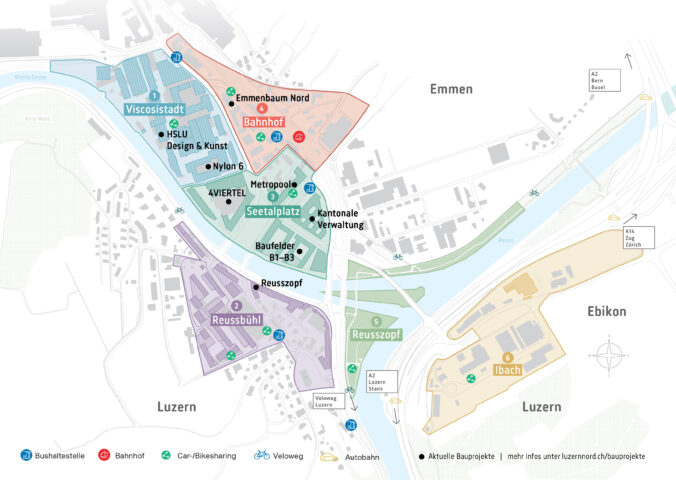
    Lucerne North is divided into six sub-areas. The adjacent areas of Seetalstrasse and Littauerboden are also part of the development focus.

    Smartness has many dimensions
    The Smart City approach is characterised by six dimensions: “Mobility”, “Living”, “Economy”, “Environment”, “Governance” and “People”. In the Smart City dimensions “Living” and “People”, the participatory pilot project “Quartiereffekt” was a milestone in Lucerne North. It enables the population to finance and implement their own ideas for neighbourhood design. But exciting projects were also developed on a smaller scale, such as a smart box from which the population can spontaneously borrow balls, badminton rackets and other games free of charge via an app.

    The “Offcut” materials market in the Reussbühl area pursues the goal of a circular economy by recycling residual and used materials, in line with the “Environment” dimension.
    The “4VIERTEL” development on Seetalplatz provides new approaches in the “Mobility” dimension and provides its residents with a mobility station with sharing vehicles such as e-cars, e-scooters, e-cargobikes and e-bikes. In addition, all car-free households receive annual vouchers for public transport, a bicycle service or the in-house sharing service.

    In the “Economy” dimension, a new research cooperation for sustainable textiles was established in 2022 with the Viscosistadt Lab. It aims to realign the textile competences at the location in Lucerne North.

    Viscosistadt is gradually developing into the creative part of Lucerne North.

    Transformation in full swing
    The transformation of Lucerne North is in full swing. While some projects are under construction, important planning decisions have been made for others.

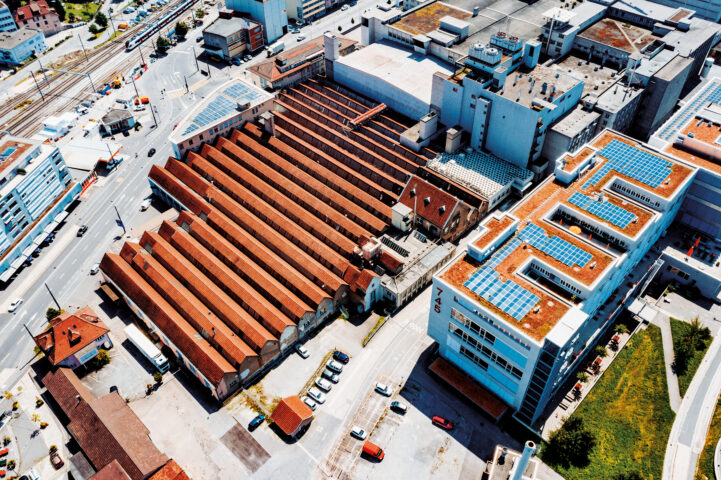
    In Viscosistadt, a historic industrial building of the former Nylon-6 factory is currently being converted. This will create about 20,000 square metres of new space for office and commercial use. Right next door, the construction site for the “4VIERTEL” development is in the final phase. The first residents of Lucerne North will move in here from summer 2023.

    Near Emmenbrücke station, 42 new flats will be built in “Gerliswil Central” by 2024. The Emmenbaum Nord building and the newly designed Schützenmatt district will give the area directly around Emmenbrücke station a fresh face.

    An urban location with high density is being created around the new Seetalplatz.

    The Rüüssegg housing cooperative’s development on Seetalplatz is about to receive the building permit for around 380 flats. Directly opposite the Kleine Emme in Reussbühl, 80 cooperative flats will also be built from 2024. The “Metropool” project of the Luzerner Kantonalbank and the cantonal administration on Seetalplatz are about to start construction.

    The Reussbühl West area has a somewhat longer time horizon. The CKW site, which is used for commercial and industrial purposes, is to become an attractive and lively urban district in the coming years.

    Even if no new flats have been occupied yet, Lucerne North is already alive today. Various temporary uses such as the cultural meeting place “NF49” (until November 2022) or the “Garage Emma” with studios for creative people, numerous events such as “Design Schenken” or the Swiss championship of bicycle couriers, cinemas and leisure facilities such as the “Adventure Room” brought around 105,000 visitors to Lucerne North last year. In addition, there are thousands of guests at the summer bar “Nordpol” on the Reuss.

  • Schlössli Schönegg becomes an innovation campus

    Schlössli Schönegg becomes an innovation campus

    The historic Schlössli Schönegg and its chalet on the Wilhelmshöhe in Lucerne have belonged to Stefan Muff, the main shareholder of the Axon Active Group, since 1998. Together with his brother Bruno, Muff renovated the building, which at the time was in great need of renovation, in close consultation with the monument preservation authorities. It then served as the headquarters of Endoxon AG, which developed technologies for digital maps and was sold to Google in 2006. Since 2008, the “Schlössli” has been the headquarters of the Axon Active Group, which is strategically positioned in the field of digital transformation. Axon deals with complex big data solutions for globally operating companies as well as digital ecosystems for diverse industries. Today, the group has over 750 employees at 18 locations around the globe. Currently, 50 people work at the headquarters – and the number is growing rapidly.

    Muff had great visions for the Schönegg castle from the very beginning. He already planned for extensions when he bought the building. Today, the building can no longer meet the future requirements as a centre for providing digital services and for the planned research activities and the newly developed “DeepWorking” operating concept. For this reason, the newly initiated project envisages a supplementary new building as the “Axon Campus”, which is to serve as an innovation laboratory. This is intended to promote the interdisciplinary cooperation of various interest groups and ideas. The campus brings together stakeholders from education, politics, public authorities and business and lets them participate in forward-looking forms of society and business. At the same time, innovations can be experienced and tested in digital ecosystems. The environment is also intended to offer ideal conditions for start-ups, which is why the project has also been reported as the “Silicon Valley of Central Switzerland”.

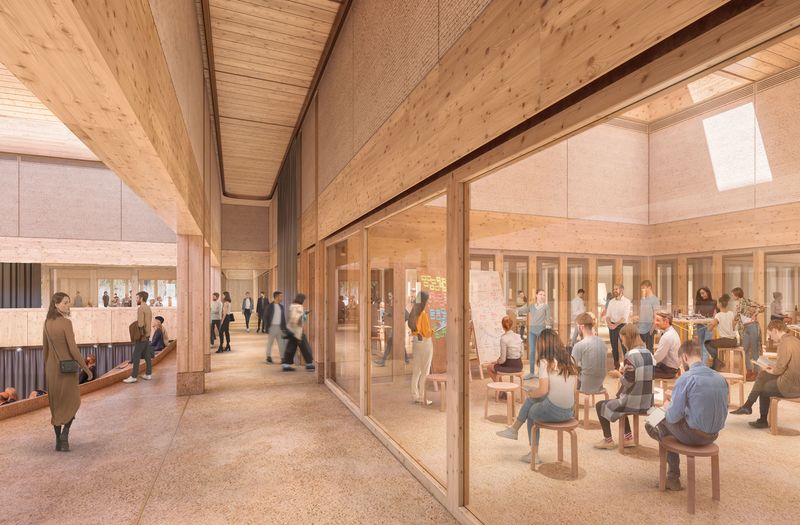
    Sketch of the planned extension.

    To meet the demands of a modern campus, the future space must be open, flexible and multifunctional. A gross floor area of 1500 square metres is planned with about 150 workplaces. The project also includes a high-quality canteen with a production kitchen and a fully digital and multifunctional auditorium for 120 people with an adjoining bar area. The new building will be adapted to the special local conditions and the resulting hazard situation due to possible landslides and rock falls. Comprehensive slope protection is guaranteed by the new building. The changing mobility requirements are also taken into account: by means of rented parking spaces on the Gibraltarstrasse level and the installation of e-mobility compliant parking and bicycle spaces in the new building, which is estimated at 15 million Swiss francs. The approval process is still underway. Occupation is expected in 2025 at the earliest.

    Thanks to the project by the renowned architectural firm of Daniele Marques from Lucerne, the Wilhelmshöhe place of power will increasingly become a house of encounter and digital transformation. Muff envisions the place developing into a holistic innovation location. A possible opening of the rooms at weekends for educational institutions or other curated events is conceivable.

  • Women's power for the energy transition

    Women's power for the energy transition

    Im Energiesektor ist der Frauenanteil seit jeher gering, in Führungspositionen erst recht. Die Bedingungen sind für Frauen schwieriger als für Männer. Das beginnt schon bei der Ausbildung, denn Frauen trauen sich immer noch zu selten, mathematisch-naturwissenschaftliche oder technische Berufe zu ergreifen. Dabei bringen sie nicht weniger mathematisches oder technisches Verständnis mit, sind aber gleichzeitig stark am Gemeinwohl und an Innovationen interessiert.  

    Klimabewegung in weiblicher Hand 
    Eine gute Nachricht vorweg: Der Frauenanteil im Bereich der erneuerbaren Energien wächst stärker als im konventionellen Energiesektor. Ein möglicher Grund könnte das steigende Bewusstsein für den Klimawandel sein, denn schlussendlich ist weltweit die Klimabewegung weitgehend weiblich. Zudem geben Frauen als Grund für ihre Berufswahl häufig an, mit ihrer Tätigkeit etwas Sinnvolles tun zu wollen. Frauenpower ist also erwünscht: Denn es ist längst erwiesen, dass Unternehmen von einer vielfältigeren Belegschaft und einem gemischten Führungsteam nachhaltig profitieren.

    Doch wie sieht es eigentlich beim Energielösungsunternehmen Helion aus, dass in einer typischerweise Männer dominierten Branche tätig ist. Oder ist dem überhaupt so? Und wo genau sind die Frauen im Unternehmen zu finden? Wir haben nachgefragt: Derzeit machen Frauen nur 12 Prozent der Belegschaft aus und sind vor allem in den Bereichen Marketing, Öffentlichkeitsarbeit und Personalwesen anzutreffen. Aber nicht nur! Weitere Infos auf www.helion.ch News.

  • Dynamic growth uninterrupted

    Dynamic growth uninterrupted

    Ende 2021 zählten die 14 Städte und Gemeinden 189’000 Einwohnerinnen und Einwohner, das sind 8454 oder 4,7 Prozent mehr als Ende 2018. Dabei handelt es sich um das Kerngebiet der Flughafenregion. Die entsprechenden 14 Städte und Gemeinden sind Teil der FRZ Flughafenregion Zürich, Wirtschaftsnetzwerk & Standortentwicklung. Auch die Zahl der Beschäftigten hat sich erhöht: Sie wuchs seit 2018 um 5258 oder 3,6 Prozent, verglichen mit der letzten Erhebung Ende 2020. In der gleichen Zeitspanne stieg die Zahl der Wohneinheiten um 3,2 Prozent auf 88’541. Das bedeutet, dass die Flughafenregion auch als Wohnstandort attraktiv ist. In den vergangenen zehn Jahren ist die Zahl der Einwohnerinnen und Einwohner stärker gestiegen als die Zahl der Arbeitsplätze.

    Derzeit werden in der näheren Flughafenregion Zürich viele Bauprojekte von überregionaler Bedeutung realisiert, andere sind in Planung. In Dübendorf wurde Mitte 2019 das höchste Hochhaus für Mietwohnungen in der Schweiz bezogen (JaBee Tower). In den Jahren 2020 und 2021 entstand beim Flughafen Zürich eine moderne Destination mit über 6000 Arbeitsplätzen (The Circle). Zu den Mietern gehören unter anderem: Abraxas, Dufry, Edelweiss, Flughafen Zürich, Horváth, Hyatt, Inventx, Isolutions, Jelmoli, Kieser Training, Microsoft, MSD, Neuroth, Novo Nordisk, NTT Data, Omega, Raiffeisen Schweiz, Oracle, Raiffeisen, Sablier, SAP, Singapore Airlines, Totemo, Universitätsspital Zürich und Vebego.

    Der Bau von Rechenzentren beschleunigt sich. Zwischen 2019 und 2022 werden in der Flughafenregion Zürich Rechenzentren im Wert von über einer Milliarde Franken gebaut. Zu den Investoren gehören Green Datacenter AG, Interxion, NTT Data und Equinix. Ihre grössten Kunden sind Google, Microsoft und Amazon Web Services. Der Grossraum Zürich gehört mittlerweile europaweit zu den wichtigsten Datacenter-Hubs nach London, Frankfurt, Paris, Amsterdam, Dublin und Berlin. Die Forschung und Entwicklung soll mit dem geplanten Innovationsparks Zürich am Standort Dübendorf – Teil des Schweizerischen Innovationspark – vorangetrieben werden. Die Themenschwerpunkte für den Innovationspark Zürich sind wie folgt definiert: Life Science und Lebensqualität, Engineering und Umwelt, Digitale Technologien und Kommunikation. Der Park soll die Zusammenführung des Wissens der Zürcher Hoch- und Fachhochschulen mit der Praxis- und Markterfahrung führender Unternehmen fördern.

    USP
    Die Flughafenregion Zürich gehört zu den schnellstwachsenden Regionen der Schweiz. Die hervorragende verkehrstechnische Lage ist ein wichtiger Wettbewerbsvorteil. Hier haben viele internationale Konzerne ihren Sitz. Die Hochschulen und ihre Forschungseinrichtungen sind in unmittelbarer Nähe. Das gilt ebenso für Naherholungsgebiete und Shopping Centers. Seit einigen Jahren entwickelt sich erfolgreich ein ICT-Cluster – von Datacenter-Anbietern bis Kreativwirtschaft.

    Testimonials

    Remo Weibel
    Global Sana

    Der Richtsatz für 10-jährige Festhypotheken ist seit Anfang Jahr stark gestiegen. Grund dafür ist die Zinserhöhung der US-Notenbank. Wir gehen davon aus, dass die SARON-Hypothek nach wie vor attraktiv bleibt, da noch einige Zinsschritte der SNB nötig sind, bis die Zinssätze für SARON-Hypotheken steigen.

    Gregor Meili
    Kenny’s Auto-Center AG

    Die Flughafenregion zeichnet sich durch eine hohe Dynamik aus. Das ist der Verkehrsknotenpunkt der Schweiz und in der Mobilität spielt Kenny’s Auto-Center eine wichtige Rolle. Deshalb investieren wir hier und an weiteren Standorten. Wir bauen aus, um für die Herausforderungen der Zukunft vorbereitet zu sein.

    Patrick Angioy
    Seitzmeir Immobilien AG

    «Die Flughafenregion erweist sich als leistungsfähiger Wirtschaftsstandort mit maximaler Verkehrsinfrastruktur und bietet Unternehmen jeglicher Grösse hervorragende Voraussetzungen für ein erfolgreiches Business – regional, national wie auch international. Dank eines attraktiven Steuerfusses, einer unkomplizierten Ansiedlungspraxis und innovativen Neubauprojekten wie z. B. dem WestGate (www.westgate-zurich.ch), gehört Kloten meines Erachtens bei jedem erfolgsorientierten Unternehmen auf die Watchlist bei der Suche nach einem neuen Standort.»

  • Switzerland attracts more foreign companies

    Switzerland attracts more foreign companies

    The location promotion of the Confederation, regions and cantons can look back on another positive year, explains the Conference of Cantonal Economics Directors ( VDK ) in a statement . Once a year, it compiles statistics on the number of new foreign companies settling in Switzerland. According to the latest VDK survey, a total of 282 foreign companies settled in Switzerland in 2021. This exceeded the previous year's figure by 62 settlements.

    The jobs created by the settled companies in the first year of operation increased year-on-year by 20 percent to 1396 jobs. With 3566 jobs forecast for the third year of operation, the high level of 2020 could be maintained, writes the VDK.

    Most of the companies that came to Switzerland in the year under review are active in the life sciences and ICT sectors. In terms of origin, around half of the new settlements come from the USA, Germany and France.

    The focus on future technologies set in the current strategy 2020-2023 of the national location promotion has proven itself so far, the VDK explains further in the communication. She also emphasizes the "successful cooperation" between the official Swiss organization for export promotion and location promotion, Switzerland Global Enterprise , and its representations abroad, which are run as Swiss Business Hubs, with the regions and cantons. According to the VDK, this cooperation is organized in such a way "that the Swiss location can be optimally marketed abroad as 'Team Switzerland'".

  • Up to 10,000 new jobs in Sisslerfeld

    Up to 10,000 new jobs in Sisslerfeld

    The Sisslerfeld in Fricktal should develop into a place of the future. It is the largest contiguous and zoned industrial area in the canton of Aargau. With the further development of the Sisslerfeld, more companies should settle in the area and 5,000 to 10,000 additional highly qualified jobs should be created.

    The four municipalities involved – Eiken, Münchwilen, Sisseln and Stein – the Fricktal Regio planning association and the canton of Aargau therefore decided at the end of 2018 to tackle the development of the 200-hectare work zone together and in a coordinated manner. Qualitative growth is in the foreground.
    As early as 2019, people who live or work in Sisslerfeld, as well as companies and property owners, were asked about their needs. This resulted in guiding principles for further development.

    From January to September 2020, four teams of specialist planners looked for solutions to implement the guiding principles. In this so-called test planning, the teams dealt with the question of how jobs in Sisslerfeld can grow while traffic can remain bearable and the beauty of the landscape with its local recreational value can be preserved. Experts from the fields of business, society, urban planning, mobility, open space and energy worked together on an interdisciplinary basis. They examined and compared different approaches and discussed their advantages and disadvantages.

    Their solution approaches were intensively and critically discussed by a 16-strong assessment committee in three workshops. In order to give the younger generation enough weight, very young specialists were also represented on this body. The judging panel was chaired by Rainer Klostermann, an architect and urban planner from Zurich. In the test planning, it was important for him to "consider all the ideas and findings on how the Sisslerfeld can be designed as a future place of work, but also as a place to live and play". "On the other hand," Klostermann continues, "it is important to take local needs into account, indeed to protect them." The test planning not only explored how the Sisslerfeld could be developed. "It was just as important to discuss and reconcile different perspectives."

    Following the test planning, the various concerns were brought together to form a coordinated overall picture. The judging panel approved this synthesis in early July 2021. It consists of eight directions and shows how Sisslerfeld could develop sustainably and what course can be set for this today.

    In a next step, these directions will be discussed with the municipalities, the population and the landowners. The results of this dialogue are to be transferred in 2022 to plans that are binding on the authorities and then on the landowners.

  • Lucerne location defies the pandemic

    Lucerne location defies the pandemic

    The canton of Lucerne was also able to attract new companies in the 2020 pandemic. According to a report by the Lucerne Economic Development Agency, a total of 19 companies have settled in the canton. Eight settlements came from abroad. The five immigrants from Great Britain stand out in particular. The other three foreign companies came from Germany, Poland and Slovakia. Overall, they want to create 329 jobs in the canton in the next three to five years, it is said.

    Even founders were not intimidated by the pandemic. If the whole of Switzerland is taken into account, the number of start-ups even rose to a record level in 2020. In the canton of Lucerne, too, the number of start-ups increased by 11.1 percent compared to the previous year, as the report shows. The Lucerne Economic Development Agency supports you in the initial phase, for example with start-up courses.

    Ivan Buck, Director of the Lucerne Economic Development Agency, speaks of an overall “challenging, but nevertheless successful” year. He is also pleased with the results of a satisfaction survey. This was carried out at over 200 companies as well as cantons and municipalities. Compared to the last survey three years ago, satisfaction could be increased at all levels. "A new record of 175 network partners rounds off this wonderful result," said Buck.

  • The Zurich economic area remains attractive for new settlements in the corona crisis

    The Zurich economic area remains attractive for new settlements in the corona crisis

    Together with partners, the location marketing organization Greater Zurich Area AG (GZA) was able to relocate 86 companies despite the corona crisis, which corresponds to a decrease of 21 percent compared to the previous year. According to the GZA, the new settlements have already created 510 new jobs in the region, and 1599 new jobs are to follow in the next five years. GZA published these figures at a digital media conference. On this occasion, GZA managing director Sonja Wollkopf Walt commented: “In view of the global crisis, the result is very solid.” This is due to a well-filled project pipeline at the beginning of the crisis, but also to long-term networks abroad and the sustainable work of GZA and the partner of the location funding. According to Walt Wollkopf, the crisis has digitalized the work of the GZA even more: Existing instruments have been expanded and others newly developed.

    Almost half of the companies located here come from the information and communication technology (ICT) and life sciences sectors, with biotech accounting for the lion's share. Machine industry and financial services take third and fourth place. According to GZA, the origin of the companies by world region reflects the course of the pandemic in 2020. The US remains the leader with 20 companies, but the number of projects here has almost halved. With 14 settlements, Germany remains almost at the previous year's level and there are even two more projects from China than in 2019.

    The successful ICT settlement Speed U Up stands for the digitization boost caused by the pandemic and the strengths of GZA in the digital sector. The digital agency from Austria with a focus on alpine tourism founded a joint venture in Chur GR with the Swiss media company Somedia in October 2020. A technology hub with 75 new jobs is to be created. Somedia CEO Thomas Kundert said: "For us, the joint venture is a further step towards the growth market of digital services." This is playing an increasingly important role in the media company's strategy.

    Sven Thoenes, member of the Board of Directors of Speed U Up Suisse AG , emphasized: "In the Zurich economic area we find excellent talents to further develop our technologies in the areas of speech recognition, artificial intelligence and augmented reality." U-Up customers like Zermatt Tourismus benefit.