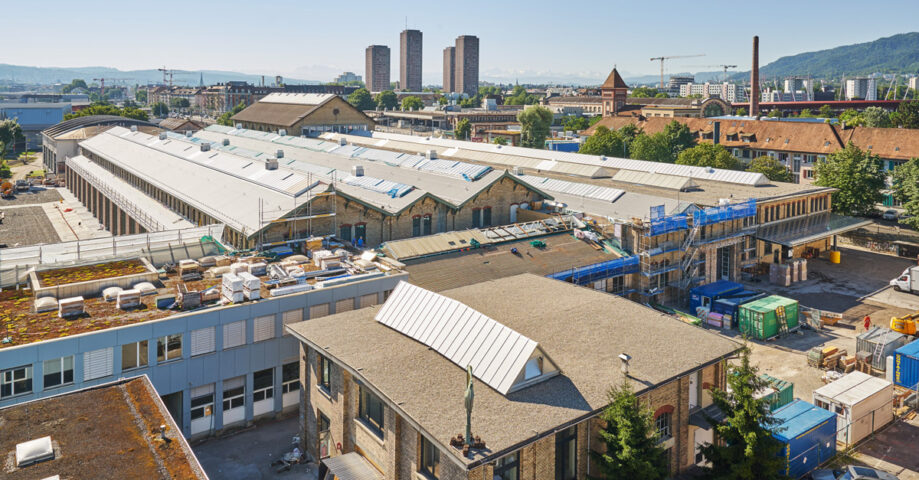
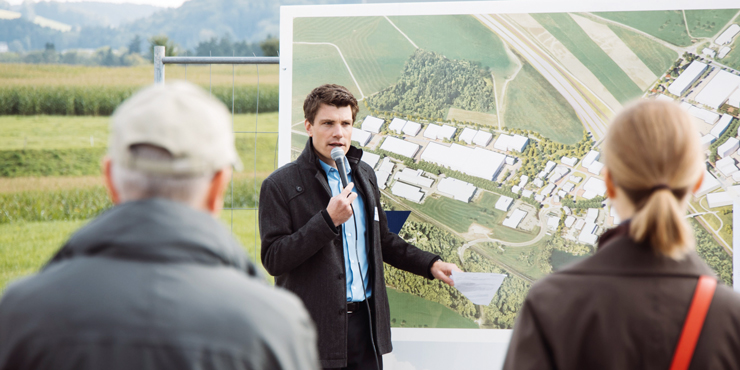
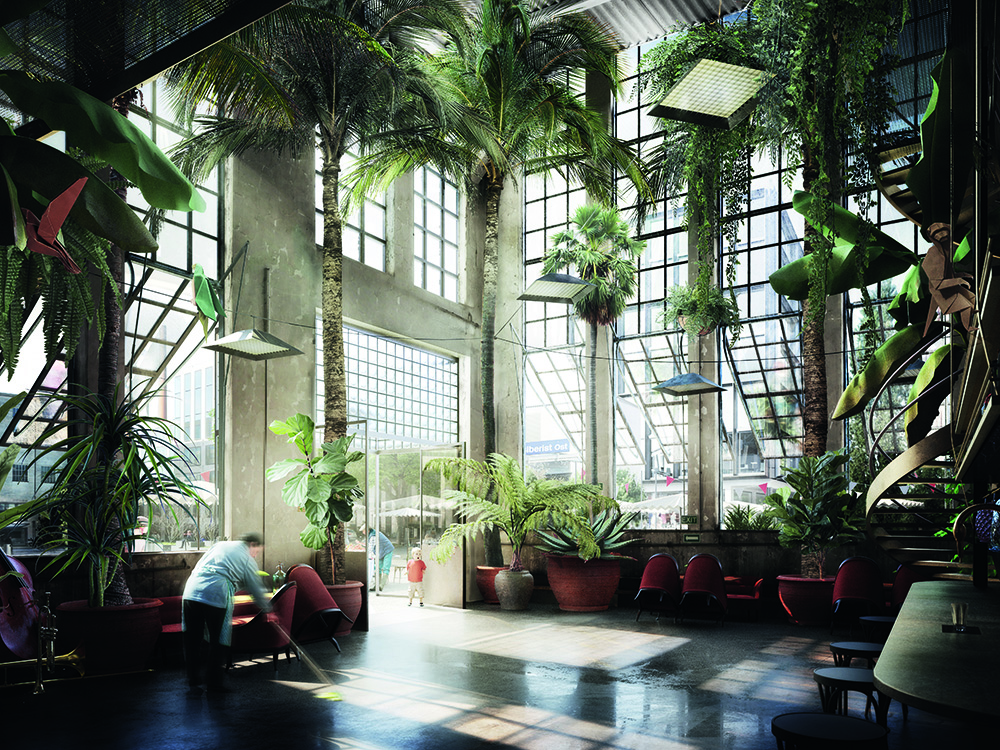
The Zurich Innovation Park is taking shape, as the operator announced in a recent press release. The first phase of the development, which includes the construction of seven new buildings on the apron of the site, will be launched this year. These projects were carefully selected from a total of 28 proposals submitted as part of a global architectural competition.
The selected projects come from renowned architectural firms such as E2A, Roger Boltshauser, Mulder Zonderland, TEN from Zurich as well as Muoto from Paris and 3XN from Copenhagen. The planned use of the total floor area is divided into around 24 per cent office space, 8 per cent laboratory space and 12 per cent production space, including areas for the production of prototypes. The focus is on flexibility, with a further 36 per cent for a variety of uses and areas for utilities, services and research-related living. Catering, leisure and shopping facilities are also planned.
The Innovation Park Zurich is pursuing an ambitious sustainability concept that is intended to lead the way for urban developments. Planned measures include the establishment of an energy grid and the installation of large solar panels on roofs and façades to ensure a reduced ecological footprint. By creating flexible and modular building typologies, the Zurich Innovation Park is aiming for long-term usability and sustainability while incorporating the latest technologies.
The barracks area in Aarau is facing a major transformation. From 2031, a new urban neighbourhood is to be created and military use will be shifted to a reduced area. To support this process, the canton of Aargau has decided to extend the lease agreement with armasuisse, which expires in 2030. This decision provides all parties involved with the necessary planning security until the army’s relocation is completed in 2035. It is planned to conclude a new contract for civilian use from 2036 and to develop a concept for military use at the same time in order to safeguard the interests of all parties.
The barracks site, which currently belongs mainly to the Canton of Aargau and the federal government, is to be made more accessible to the public in future. The urban development project allows for civilian use from 2031, and the agreement to restrict military use to the northern part of the site means that the civilian development of the site can take place gradually without jeopardising the overall urban development vision.
The planning security created by the extension of the lease agreement enables all partners involved to plan the necessary steps to realise the construction projects from 2031. This chronological sequence should ensure that the landowners can realise the construction projects efficiently from 2031 and that the army can move into its new facilities by the end of 2035.
The city of Winterthur is tackling one of the four individual projects in the development of the Obertor site. The buildings at Obertor 11, 13 and 17, which were previously used by the city police, are to be extensively renovated and converted into new office, commercial and residential space. The properties will remain in municipal ownership and will be subject to the cost rent, the city administrationannounced in a press release. The costs for the structural remodelling are estimated at CHF 16.2 million in total.
The two four-storey buildings at Obertor 11 and 13, which were built before 1850, will be returned to their original use. Commercial space will be created on the ground floor and a total of seven flats will be realised on the upper floors. In addition to an energy-efficient refurbishment and the renewal of all building services installations, a new staircase and lift core is planned in the buildings. In addition, “the façades will be adapted to the new use where necessary”, writes the city administration.
The property at Obertor 17 is a rococo villa dating back to 1764, which has served as a police station since its renovation in 1947. Now the original room layout is to be restored and the building shell repaired. Inside, “new office space will be created, which will allow the historic interior to be emphasised again”. The Haus zum Adler is also to undergo an energy-efficient refurbishment and the renewal of the building services installations. Fire protection and earthquake safety are also to be improved.
The Papierwerd site is to become a public place that is well connected to the adjacent urban space and invites people to stay, meet and exchange ideas. With this in mind, the city council has agreed to a careful transformation, in which the open space offer in particular is to be increased. The direction of development is based on the results of the “Forum Papierwerd” dialogue process and takes into account important framework conditions, such as the need to protect the temporary Globus building and water protection. How far the redevelopment of the Papierwerd site will go and what it will involve in detail is still open.
Strategy process for the Papierwerd site The Papierwerd site strategy process was used to develop the basis for a broad-based decision on the future of the site. The core of this process is the “Forum Papierwerd” dialogue procedure carried out in 2022, in which experts from various disciplines, representatives from politics, associations and other organisations as well as the population participated. The process revealed that both structural and use-related changes are necessary for the desired opening and changeability of the area. The results are recorded in eleven central statements that contain important aspects for the future of the village.
Immediate measures The transformation of the Papierwerd site will begin as soon as possible. Where changes in the sense of the results of the dialogue process are feasible on a low-threshold basis, (temporary) immediate measures will be implemented from 2024. For example, an upgrading of the open space south of the Globus temporary building or a more open, transparent design of the ground floor façade in the entrance area of the station bridge are planned.
Next steps
In an in-depth phase up to the beginning of 2025, various construction-related questions will be clarified and the handling of the Globus provisionals’ worthiness of protection as well as water protection will be further discussed. In the subsequent project phase, which is estimated to last until 2026, a competition will be held. This will be followed by project planning and the approval procedure. All work on the Papierwerd site should continue to be carried out transparently and in dialogue with the various parties involved.
Die Genossenschaft Urbane Dörfer mit Sitz in Bern lädt am Samstag, 26. August, ab 17 Uhr zur Eröffnungsfeier des Projekts Melchenbühl nach Muri-Gümligen ein. Dort, direkt bei der Tramhaltestelle Melchenbühl in Gümligen, eröffnet die Genossenschaft einen vielfältigen Begegnungsort. Es ist das zweite Pilotprojekt von Urbane Dörfer neben dem Urbanen Dorf Webergut in Zollikofen BE. Laut einem zu diesem Anlass herausgegebenen Flyer mit Einladung wird am 26. August zunächst ein Kreativort mit Kaffee und Bar, Coworking und Atelier eröffnet. Langfristig sollen 60 Wohneinheiten entstehen.
Am 1. März 2023 hat Urbane Dörfer das Areal übernommen. Die ungenutzte Wiesenfläche, ein zweistöckiges Werkstatt- und Bürogebäude mit Innenhof und ein Zeithorizont von zwei bis drei Jahren schaffen Raum für Ideen aus der Bevölkerung, das Testen von zukünftigen Nutzungen des Urbanen Dorfes und für einen Begegnungsort, heisst es auf der Internetseite zum Projekt.
Am neuen Kreativort wird es Benela’s Kaffee und Bar im Erdgeschoss geben. Im Obergeschoss sollen Atelier und Coworking Space einen schöpferischen Nährboden für Kreativschaffende und Selbstständige schaffen. Die Kreativwerkstatt diene als Workshop-Raum für kreative Projekte.
Zur Zukunft des Pilotprojekts heisst es, langfristig entstehe auf dem Areal ein vielfältiger Wohn-, Arbeits- und Kreativort und eine Basis für gelebte Nachbarschaft. Geplant sind 60 Wohneinheiten, gemeinschaftlich genutzte Flächen und öffentliche Gewerbeflächen. Das partizipative Wohnprojekt sei „eine Keimzelle für ein nachhaltiges urbanes Leben“.
Dann folgt noch der Hinweis, dass der Anlass bei jedem Wetter stattfinde und eine Anmeldung nicht erforderlich sei.
At the beginning of The Valley is one of Switzerland’s best-known “start-ups”: in 1872 Julius Maggi founded the company J. Maggi & Cie on what was then a sparsely developed site in Kemptthal and gradually expanded the site in the years that followed. in 1886 he developed Maggi seasoning – which became world famous.
A lot has happened since then. in 1947, Maggi merged with Nestlé. in 2002, Givaudan took over Nestlé’s flavour business and the associated properties in Kemptthal. in 2003, most of the Maggi production was relocated to Germany. in 2017, Givaudan sold two-thirds of the site to the real estate developer Mettler2Invest.
Since the beginning of 2018, Metler2Invest and the Motorworld Group have been developing the site with the joint company MA Kemptthal Besitz AG, based on a master plan by the architectural firm Ernst Niklaus Fausch Partner.
Since 2019, the area has a new name: The Valley. Today, it comprises office, commercial and production space. Currently 1100 people work here in over 130 companies. The area has a modern village character. Among other things, there is a post office, a bakery, numerous restaurants, bars, shops, health practices, art studios, a car-sharing company for business vehicles and a fitness centre.
Food still plays an important role on the site today – a high-quality food cluster is to develop in the Valley. Many of the resident companies produce or develop food: for example, the well-known manufacturer of plant-based meat substitutes Planted, a contract cheese dairy, a chocolate manufacturer, a bouillon producer and a coffee brewery. Givaudan with its highly specialised research centre and Nestlé with its retail shop are also still present in the area. By 2025, the first new building will house laboratory space for food development and, with The Cultured Hub (Migros, Bühler, Givaudan), a highly specialised research centre for the production of meat from animal cells.
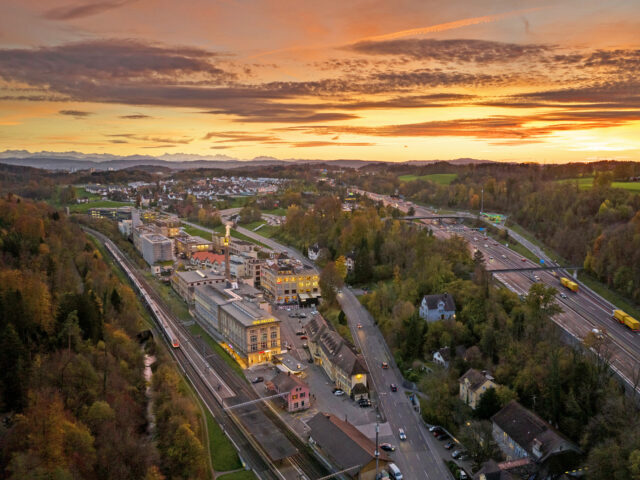
The Valley is located directly at Kemptthal railway station.
A second thematic focus of The Valley is on motor vehicles. The Motorworld Manufaktur Region Zürich in the heart of the area is a meeting place for people with a passion for classic and high-quality mobility. Various event rooms among vintage cars, supercars and electric racers are the hub for mobility topics and offer space for numerous events.
With events, those responsible also want to enliven the area, which is easily accessible with its own railway station and the nearby motorway connection, but does not directly border on a city, for hours and days at a time. To this end, they have founded their own event company. The area offers 10 to 10,000 square metres of event space for seminars, congresses, readings, meetings, banquets, concerts, markets and festivals. As a supporting programme, for example, guided tours, various team-building activities or rides in racing simulators are possible.
Since 2018, the historic, listed industrial buildings have been extensively renovated and supplemented with additional new buildings that architecturally blend in with the historic building stock. Currently, one of the existing halls is being expanded as an event hall, and the first new building will go into realisation this spring.
A multi-storey car park on an adjacent plot is currently in the approval phase. A pedestrian bridge will later connect it with Valley Square – the central square of the area. A hotel is also planned in one of the existing buildings. A corresponding adjustment of the structure plan is currently underway at the cantonal level for the non-zoned use.
Another new building could be realised from 2026 or 2027. Another four new buildings are possible; these are to be realised depending on demand.
Integrated and intelligent Integrated energy solutions combine different energy sources and technologies to achieve high energy efficiency and flexibility. Intelligent energy management systems are used to optimise energy consumption and reduce CO2 emissions. They help to reduce operating costs and increase property value. IWB offers companies in the construction and real estate sector carefree packages for a high return on investment. Customers can choose between centralised, decentralised or combined solutions depending on their location and portfolio strategy. To achieve an optimal sustainable energy supply and use, the early involvement of the energy partner is crucial.
Sustainable and economical Implementing renewable energies and intelligent energy management systems not only saves costs and increases the value of properties, but also achieves environmental sustainability. A good ESG score is becoming increasingly important and can also influence financing options. Property owners can reduce CO2 emissions and optimise the energy consumption of buildings by using photovoltaic systems and climate-friendly heating solutions such as heat pumps or district heating from renewable sources. Intelligent energy management systems monitor energy consumption in real time and regulate it by automatically controlling heating, ventilation and cutting off energy peaks.
Sensible and profitable Investing in good energy solutions and intelligent energy management is sensible and profitable for a sustainable real estate portfolio. With IWB as a partner in the field of energy and sustainability, companies in the real estate sector can benefit from customised, efficient and smart solutions. The focus is on developing individual solutions tailored to the specific needs and goals of the customers. Together, they can invest in a sustainable future that offers not only ecological but also economic benefits.
AEW Energie AG has installed and commissioned a 13,000 square metre solar plant with 5000 modules in Rheinfelden. It is located on the roof of the Isemeyer site and is one of the largest in the energy provider’s portfolio.
According to a press release, it generates about 1.9 gigawatt hours of solar power annually. About a third of this is taken directly on site by the leased companies. The rest is fed into the AEW grid.
The plant is operated on a contracting model: it belongs to AEW, which pays for the installation and maintenance costs. In return for providing the space, Soluma AG as the owner will receive a contractually agreed fixed price from AEW for the electricity drawn from the roof for the next 30 years. There are no additional costs for the tenants either. Before the installation of the 5,000 solar panels, the roof of the industrial halls was additionally insulated at AEW’s expense, thus improving the energy efficiency of the building envelope.
Last but not least, the environment also benefits, says AEW. “Because the amount of this installation alone could supply 420 four-person households with electricity for an entire year.”
At the end of August 2021, the management of the Hochdorf Group, known in the region as “Südi”, informed that it wanted to sell its 86,000 square metre site in Hochdorf. Shortly afterwards, the Hochdorf municipal council decided to participate in the bidding process.
The acquisition of the site by the municipality for over 60 million Swiss francs required, among other things, the approval of the Hochdorf electorate. With 87.6 percent of the votes in favour, the project met with great support.
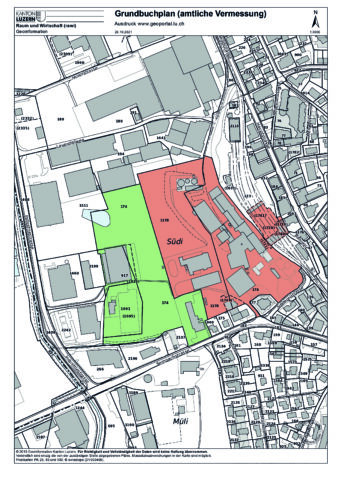
Since the beginning of 2022, the municipality of Hochdorf has owned the land, which previously belonged to the Hochdorf Group and its pension fund. The Hochdorf Group has leased the site back until the end of 2025, with the option to extend it by one year. The municipality would like to use this time to plan the development of the site.
Since the beginning of 2022, the municipality of Hochdorf has been the owner of the land, which previously belonged to the Hochdorf Group (red) and its pension fund (green). .
The people of Hochdorf are to play a decisive role in this. The project began with a three-stage participation process. In a first step, qualitative focus discussions were held with interested parties until mid-September 2022. In a second step, the input from these discussions was discussed at a public participation event at the end of September 2022. In a third step, at the end of October 2022, the population was given the opportunity to evaluate and weight the inputs from the first two steps in an online survey and to further sharpen the emerging idea.
Thanks to the many responses, those responsible gained a clear picture of the ideas of the people of Hochdorf. A large majority wants a central meeting place with inviting squares and paths. A broad housing mix and attractive office and commercial space are important to them. Ecological measures should also be a central factor in further planning.
The findings and the vision derived from them were summarised in a report and presented to the population at the end of February 2023. They form the basis for the test planning due in summer 2023, where topics such as urban development, traffic planning or building density will be examined for the first time.
The municipality would like to complete the utilisation planning, including the revision of the zoning plan, for part of the site by the end of the leaseback contract at the end of 2025 or 2026.
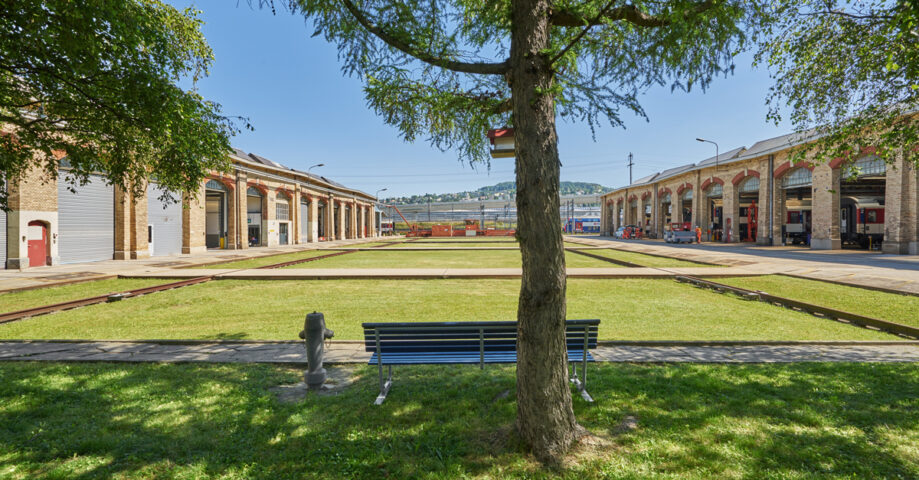
SBB is transforming the 42,000-square-metre Werkstadt site in Zurich into a vibrant urban space, to be completed by 2035. This will preserve the fabric of its historic buildings, which will one day be joined by both new buildings and extensions to create an exciting cluster. The transformation of the former SBB workshops will be exceptionally sustainable, featuring climate-conscious building measures, circular economy elements and an innovative energy concept.
Developing existing buildings In close coordination with the monument preservation authorities, the existing buildings will be gradually renovated and joined by new buildings and extensions in the coming years. At the heart of the site, the former carriage workshop ‘Building Q’ will allow for a diverse usage mix under one roof from 2023. The development will offer an exciting interplay between the fabric of historic buildings, structural densification and public use of outdoor space.
Environmentally friendly construction ‘SBB wants to be climate-neutral by 2030, and climate-compatible construction is an important factor in achieving this objective,’ said Gabriele Bühler, Project Manager at SBB. Various climate-conscious building measures have been incorporated into the planning of the site. That includes configuring the new buildings to promote the circulation of cool air currents. Where possible, the roof water will be allowed to seep into an above-ground system for further cooling. Surfaces will remain unsealed where possible. The transformation follows a systemic approach that considers the building along its entire life cycle. The aim is to keep CO2 emissions as low as possible. To ensure circularity, all construction components are recorded on the Madaster platform. There is also a particular focus on reusing components.
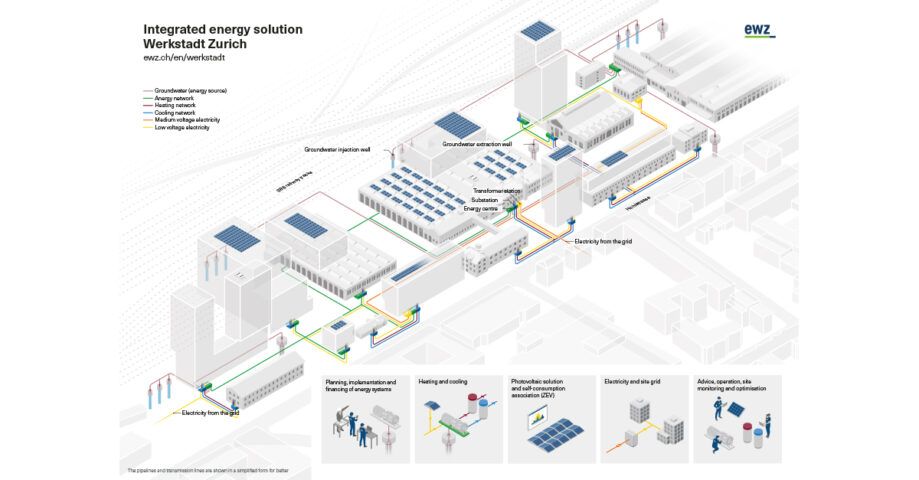
Energy concept: 100% renewable ewz was able to win SBB’s public tender with an energy solution based on 100 per cent renewable energies. Groundwater, which is collected in four wells on the site, serves as a source of heating and cooling. From these wells, the water flows to the energy centres in the larger buildings, which house heat pumps and cooling machines that bring the water to the required temperature. An anergy network connects all the buildings and ensures that excess energy is exchanged between the building groups. For example, excess heat or cold in one building can be used in another. This system also has the advantage of not requiring groundwater boreholes in every building: the smaller buildings are connected to the energy centres via a local heating network. Heating and cooling is generated without any CO₂ emissions, as the rest of the electricity also comes from renewable sources. The use of a monovalent energy system will ultimately lead to a CO2 reduction of over 2,100 tonnes per year.
High self-consumption of solar power ewz also plans, finances, creates and operates the transformer systems and medium-voltage lines to supply the site with electrical energy. ‘Some of the electricity that the people in the Werkstadt use on the site is produced there using photovoltaics,’ explains Markus Fischer, Head of Sales at ewz Energy Solutions. To this end, SBB and ewz want to make the best possible use of the roof areas for solar power production. Both the roof of Building Q, at the centre of the site, and the roofs of other buildings with a suitable structure and orientation for generating solar power are to be kitted out with photovoltaic systems. SBB requires its tenants on the site to form a self-consumption association (ZEV). ‘When completed, the ZEV will consist of around 300 parties that will use locally produced electricity on the site. This allows us to achieve a high self-consumption rate, which, in turn, makes a significant contribution to the cost-effectiveness of the photovoltaic systems,’ says Markus Fischer. He expects self-consumption on the Werkstadt site to be almost 100 per cent when completed.
The benefits of contracting For the owner, this form of collaboration has various benefits, including keeping financial risks and management costs very low. If a system fails, ewz makes sure it gets back into operation as quickly as possible. To ensure that the system can be operated efficiently, ewz will start undertaking energy-related operational optimisations shortly after commissioning. As part of an ongoing process, the systems will be optimised and adapted to the actual needs relating to their use. By extension, this ensures that they consume as little energy as possible, generate minimal costs and offer maximum convenience for users.
Werkstadt Zürich is a successful example of a forward-looking approach to repurposing a historic industrial site. With the targeted renovation and expansion of existing buildings and a ground-breaking energy concept, the developers – together with the planners and ewz – are creating added value for future users and the environment alike. Find out more about the Werkstadt site’s innovative energy concept here.
In February 2022, Halter AG acquired the Schützengütli site in Bischofszell with two areas of around 6500 and 1000 square metres. The property, which had served the Schiffli embroidery factory from 1907 and later the glass rectifier construction, passed into the ownership of the Laumann & Co. malt factory and fruit pressing plant in 1946. Essences and syrups were produced here until a few years ago. On 10 February 2023, the revised building and zoning plan of the city of Bischofszell came into force, allowing residential use with a design plan obligation on the site.
For a lively and attractive Bischofszell “With this site development in an intact neighbourhood, we will create attractive living space in a very well-developed location right next to the railway station,” says Rolf Zäch, project manager at Halter Entwicklungen, with conviction. “The development of the site makes a valuable contribution to an attractive Bischofszell.” Thomas Weingart, mayor of Bischofszell, is also pleased about the upcoming development: “The centre of our town continues to develop positively. The town council is pleased about that. We are particularly honoured that Halter AG, a well-known company, will be active in Bischofszell and can contribute its great experience in urban development.”
Harmonious integration into the neighbourhood and the city Around 50 owner-occupied flats are planned, for which the existing buildings will be removed except for individual elements. In a two-stage study contract, the aim is to achieve a high-quality site development that offers future residents a high quality of living and blends harmoniously into the surrounding neighbourhood. Taking economic criteria into account, an urban planning concept for the site will be developed, which will be followed by the architectural design in a second step. The study commissioning process already initiated by Halter Entwicklungen will start this spring.
Das Ziegler-Areal soll gemäss heutiger Planung zu einem vielfältigen Quartier mit Schwerpunkt Wohnen entwickelt werden. Seit der Spitalbetrieb auf dem Areal im Jahr 2015 eingestellt wurde, sorgt die Stadt Bern als Grundeigentümerin mit verschiedenen Zwischennutzverträgen für Leben und Vielfalt auf dem Gelände. Insgesamt steht heute eine Nutzfläche von rund 23’000 Quadratmeter zur Verfügung.
So betreibt die Firma ORS Service AG im Auftrag des Staatssekretariats für Migration (SEM) das einstige Bettenhochhaus als Empfangs- und Verfahrenszentrum. Der Kanton Bern zeichnet als Mieter der Räumlichkeiten des Renferhauses verantwortlich und stellt diese der Medizinischen Fakultät der Universität Bern zur Verfügung. Büroräumlichkeiten und eine Wohnung sind im Haus Bellevue untergebracht. Zur Wohnnutzung dient auch das Personalhaus 2 sowie das Wohnhaus Kirchbühl.
Der Verein Boulissima betreibt im Personalhaus Ost/West eine IndoorBoule-Anlage, während der Verein Ziegler-Freiwillige im Personalrestaurant ein Begegnungszentrum für Quartierbewohnende und Asylsuchende geschaffen hat. Ansonsten wird das Gebäude vom Hostel77, der Geschäftsstelle des Vereins «Helvetiarockt», als Studentenwohnheim und von der Quartierküche Ziegler genutzt. Hierbei handelt es sich um die erste Quartierküche der Stadt Bern, die seit dem Beginn des Schuljahres 2019/20 insgesamt 19 Tagesschulen und Kitas mit Mahlzeiten versorgt.
Das Leitbild für die Entwicklung des Ziegler-Areals wurde in Partizipation mit den verschiedenen Anspruchsgruppen erarbeitet. Auf Grundlage dieses Leitbilds wird eine Areal- und Nutzungsstrategie entwickelt. Diese soll den zuständigen politischen Gremien Anfang 2023 zur Beschlussfassung vorgelegt werden. Die Volksabstimmung zur Planungsvorlage dürfte frühestens 2028 stattfinden.
Das Areal grenzt direkt an die Gemeinde Köniz an. In unmittelbarer Umgebung liegen der Naherholungsraum Gurten und dessen Talstation. Das Gelände ist durch die Buslinien 19, 22 und 29 bereits heute gut erschlossen. Ein mögliches zukünftiges Wohnareal soll sich sorgfältig in sein Umfeld einfügen und dank vielfältigen Nutzungen – die sich mitunter aus den der-zeitigen Zwischennutzungen ergeben können – zu einem belebten Ort werden.
Lonza AG is expanding its operational headquarters in Basel, which has been located on the Lindenhof site since 1962, the cantonal administration of Basel-Stadt informs in a press release . Two more high-rise buildings are to be built in the vicinity of the existing Lonza high-rise building, which is under a preservation order. In addition to commercial and service areas that are required by Lonza, apartments "for different needs" are also planned, according to the statement.
The extension buildings are intended to “develop the area into a green, mixed-use and publicly accessible district component of the St. Alban district,” writes the canton administration. The edge of the park is to be preserved and planted with more trees. Grounds previously sealed by parking lots and tennis courts will be "upgraded and greened in terms of biodiversity and climate compatibility".
The plan requirement for the necessary change to a development plan from 1991 that was never implemented can be viewed at the cantonal building and transport department until September 30th. On September 6, Lonza also wants to provide information about the project itself from 6 p.m. in the Hotel Victoria.
The assessment committee for the study contract for the redesign of the CKW site in Reussbühl, which is now used for commercial and industrial purposes, unanimously decided in favor of the “Habitat – Quartier im Hain” project. It was developed by the Zurich architects Salewski Nater Kretz in collaboration with the Office of Living Things and the Dudler office for space and traffic planning.
According to a CKW press release , the 27,000 square meter area is to be “transformed into an attractive, lively and distinctive city quarter”. The energy service provider will give up its location there “in a few years”. In the call for tenders, requirements were made with regard to heat generation and rainwater management. In addition, at least half of the CKW shed hall, a former silk mill, was to be retained. Residential buildings will primarily be built on the remaining area.
The winning project “convinces in the reinterpretation and further development of the historical landscape”, which was once characterized by floodplains and water-using industry. The design based on the so-called sponge city principle “cleverly” incorporates these historical references. This project will be further developed in the coming months and will then form the basis for the Reussbühl West development plan. The designs of all planning teams are on display at CKW in Rathausen from June 21st to July 4th.
The handling of the Ecobau requirements, which sometimes formed the basis for the Minergie ECO label, has apparently not yet been finally clarified. As is well known, they have largely been included in the SNBS (Swiss Sustainable Building Standard), as they include topics that will become even more important in the future, namely the circular economy, gray energy, etc. – sustainable buildings are not just buildings that have been optimized in terms of operational energy .
And yet, this consolidation creates clarity in the market and is also a clear commitment to the SNBS, as a key benchmark in the Swiss construction and real estate market and an important instrument for implementing the Energy Strategy 2050.
The label for 2000-watt areas will disappear at the end of 2023. According to a statement from the Federal Office of Energy (SFOE), the suppliers of labels for sustainable buildings in Switzerland have agreed on this. The label was previously offered by the SFOE Swiss Energy program.
In return, the Minergie association will in future also offer a Minergie area label for areas that comply with climate protection. The Swiss Sustainable Building Network , as the sponsor of the Swiss Sustainable Building Standard (SNBS), will create the SNBS-Areal label for the sustainability of sites in all their dimensions.
At the building label level, there will also be the cantonal building energy certificate (GEAK), the various Minergie categories and the SNBS.
The bearers of the various labels want to achieve a greater impact by pooling resources. “Sustainable real estate makes a major contribution to climate protection. The trend is positive, but the potential is far from being exhausted,” Marc Mächler, District President of the Canton of St.Gallen and President of the Minergie Association, is quoted as saying in the statement. “The labels complement each other, are better coordinated with each other and builders and planners can find out more easily which label meets their needs.”
V-Zug employs around 2000 people at the Zug location. A few years ago, the former subsidiary of Metall Zug – Metall Zug is still the largest shareholder – was faced with an all the more serious decision: Where should production be in the future? The choices were a land reserve in Risch-Rotkreuz or moving abroad. In the end, the decision was made in favor of the previous location in Zug; a strong commitment with a vision: on the 80,000 m2 site, the production of V-Zug and other Metall Zug subsidiaries will be concentrated on around a third of the total area. In the coming years, a tech cluster is to be built on the free space. When completed, the area will offer around 3,000 jobs and living space for 300 people. The goal is an actual ecosystem of innovative technologies and services. The future users should come from areas such as cleantech, simulation technology or sensor technology or be related to the core competencies of Metall Zug – i.e. building technology, kitchen, food and cleaning.
Climate neutrality as a goal Now the idea of such a cluster is neither new nor groundbreaking. On the other hand, the goal that Metall Zug has set itself for the realization is innovative: the area should be largely energy self-sufficient. Therefore, together with the local energy supplier, a separate energy system, the so-called Multi Energy Hub, is being implemented. The various areas of the energy sector and industry are linked – a holistic approach in which the areas interact and are connected to one another. Thanks to this sector coupling, the Tech Cluster Zug is not only supplied with energy, but also generates some of it itself. The area will have its own power grid for medium and low voltage. Several water networks with different temperatures enable the generation of cold and heat from the groundwater. The waste heat from industrial production is used to heat the apartments on the one hand and the seasonal groundwater and earth storage tanks on the other. In addition, comprehensive photovoltaics ensure a further step towards CO2 neutrality. Incidentally, the Tech Cluster Zug will be car-free: An intelligent mobility and parking system – the Mobility Hub Zug Nord – is intended to create sustainable solutions for urban areas.
The people of Visper associate numerous memories with the Litterna Hall, built in 1978, as the hall was the home ground of EHC Visp from 1979 to 2019. Before the hall was demolished, the farewell was duly celebrated with a party in autumn 2019 – and at the same time the new ice sports and event hall, the Lonza Arena, was inaugurated. There has been a legally binding district plan for the Litterna site since 2018, which provides for several mixed-use residential and commercial buildings. Accordingly, the client Swiss Prime Investment Foundation planned to start construction work on the four buildings in total after the demolition of the hall in autumn 2020. However, a resident's objection to the planning application delayed the approval process. Nevertheless, the building application was approved by the Visper municipal council in December 2020, and the objection was rejected: the municipality argued that the buildings and facilities would correspond to the purpose and the district plan. The objector took his complaint further and reached the State Council in spring 2021. The Valais government also rejected the appeal against the municipality's decision, whereupon the objector went to the cantonal court as the next instance. However, before the Valais judiciary could make a further decision, the objectors and the client reached an agreement.
The construction work on the approximately 15,700 m2 area, which is an important building block due to its location along the railway line and the proximity to the public transport hubs nothing stands in the way of the overarching settlement development of Visp. The four buildings will contain 138 rental apartments, commercial premises on the ground floors, a day-care center and a retail store. The first apartments should not be ready for occupancy until autumn 2023 at the earliest. The client Swiss Prime Investment Foundation is investing around 70 million Swiss francs in the Visper location. Total contractor is Eiffage Suisse, the construction work is being carried out by the Volken Group.
HRS Real Estate is taking over the overall management of the further project development, the search and selection of investors as well as the realization and marketing of the Basel project Rosentalturm at the Basel exhibition center. According to a press release , MCH Messe Basel and HRS Real Estate have signed a corresponding agreement.
A project competition is now being held in cooperation with the construction and transport department of the canton of Basel-Stadt and with the support of the Zurich planning specialists Planpartner . According to the information, seven architectural firms were invited: Buchner Bründler Architects, Herzog & de Meuron and Morger Partner Architects from Basel. Burkard Meyer Architekten from Baden AG as well as the two Zurich offices Michael Meier and Marius Hug Architekten and Armon Semadeni Architekten are competing for the best design.
The assessment committee made up of national experts is chaired by Thomas Hasler from Staufer + Hasler Architekten from Frauenfeld. The results are expected in autumn 2022. Construction is scheduled to start in summer 2023.
The Rosentalturm building is to be erected on the site of the existing trade fair car park. The parking lot will be underground. Of the total of 48,000 square meters planned, 40,000 are intended for housing and 8,000 for commercial use.
The government council of the canton of Solothurn has approved the land use planning for the Attisholz area in Riedholz. The decision ensures the further development of the area in the next 25 years, according to a media release from the Schlierem-based construction company Halter AG . On the Halter project page , it says about the project that cellulose has been industrially produced on the site for 130 years. Since the end of 2016, Halter AG has been working with the municipality of Riedholz and the canton of Solothurn to redesign the area.
The usage planning that has now been approved was drawn up from 2018 to 2019 in a planning group of the municipality, the canton and Halter AG. After the preliminary examination, the participation procedure and the condition of the land use planning from 2020 to 2021, the municipality of Riedholz transferred the dossier to the canton of Solothurn in June 2021, according to the holder's notification. The decision of the government council now creates the planning law basis for a new zoning plan, as well as a zoning and development plan, in order to develop a living space for living, working and leisure out of the area.
It is important that "the population stands behind the project and that the effects on the community in social, economic and ecological terms are acceptable," said Sandra Morstein, Mayor of Riedholz. "That is why great importance was attached to informing and participating in the population as well as trusting and constructive cooperation with the canton and Halter AG in the planning and development of common objectives."
The results of a study by landscape architects on open space will be available in February. The planning of the infrastructure for public transport and community buildings such as schools and day-care centers is in preparation.
Around 70 people were present on three Wil Mobil buses and explored various posts on the Wil West site in the style of a “scout exercise”. There were representatives from all the departments involved in the cantons of St. Gallen and Thurgau as well as the 23 member communities of the Wil region. And off we go: The northern network extension was discussed at the Ebnetsaal in Bronschhofen, aspects such as infrastructure and ecology on the terrace of the car world of Rotz and the details of the cantonal usage zone in Gloten.
The tour of the site met with a consistently positive response: many participants had real aha moments when it came to the “dimension of the project” or “how detailed ecological compensation measures have already been defined”. The area tour with various stations should also be a central instrument in the future to make Wil West more tangible. Corresponding implementations are being planned for both the media and the population.
The District President of St. Gallen, Marc Mächler, also insisted that Wil West be brought to life and that the project be brought to the next phase: "We must soon get away from the paper and the plans and show people specifically what is happening here." The CFO also submitted details of the special loan for the development of the site, which the Cantonal Council is expected to discuss in its first reading in November. In addition to Mächler, site manager Susanne Hartmann was also present from the government of the canton of St. Gallen. The Canton of Thurgau was also represented by the head of construction, Carmen Haag. The latter explained the network decision on the new connecting road and the footpaths and cycle paths, over which the Great Council of Thurgau has to decide. The Wil West motorway junction is at the center of the infrastructure construction. The Astra is planning this as an exciting high-spinning bridge and will then build it later.
The modernized “Wil West” logo with the claim “The future lies with us” also premiered at the location conference. The claim stands for the self-confidence that the future lies here in the region and that future generations will find attractive jobs locally and no longer have to migrate in large droves to other cities. In addition to the logo debut, a new, fresh website is also being planned.
Three young personalities from regional politics took part in the “Voices of the Future” podium: Meret Grob, City MP Green prowil; Salome Zeintl, President Jungfreisinnige Wil and the surrounding area and Serge Müller, Vice President SP Münchwilen district. They combined many positive aspects with the project, such as cross-cantonal cooperation or the economic strengthening of the entire region. However, they also expressed the need to involve the young and the population in general even more and to think more about the future, instead of just looking at today's forms of construction and transport.
For thirty years there was a jumbo hardware store on the 8,600 square meter area in Arbon. It was demolished at the end of 2018. There are now two new buildings here: The Breeze residential complex offers a total of 63 apartments in two houses.
Breeze is located directly on Lake Constance, between the city's waterfront promenade, designed as a chestnut avenue, and Bahnhofstrasse, on a plot of land with a connection to the lake. The park-like surroundings, the proximity to the train station, the historic old town and the shopping facilities of Arbon are also intended to make the centrally located development an attractive place to live.
In modern apartments, classic, high-quality materials should convey style and comfort. The apartments with 2.5, 3.5, 4.5 and 5.5 rooms have large windows, spacious floor plans and bright rooms. Your terraces are large and partly all around. With its generously designed outdoor spaces, Breeze should blend in harmoniously with the surroundings and location directly on the water.
The architecture competition for Breeze took place in 2017. The jury decided in favor of the project by the Caruso St John Architects.
The two angular houses with receding outer corners each have five main floors and an attic floor. They are mirrored to each other and rotated 180 degrees. There is a shared underground parking garage under the two structures.
Towards the lake, the houses border a semi-private open space with seating and trees. The houses are accessed on Bahnhofstrasse. The re-entrant corner areas are transformed into clearly delimited, greened front zones by pavilions. From here, footpaths also lead to the open space on the lake side and on to Kastanienallee.
Breeze complies with the Minergie guidelines and uses environmentally friendly district heating. As a further contribution to sustainability, the flat roofs of the building are greened. The roof structure is chosen in such a way that the rainwater is largely retained.
Construction work started in early 2019. The development has been in place since December 2020. All 63 apartments have already been sold and will be ready for occupancy at the end of 2021.
In mid-2012, Hiag acquired the premises of the former paper mill in Biberist. The area with around 277,000 m² of industrial space was used for paper production for a good 150 years. Accordingly, it is very well anchored as an industrial location in the region and is considered a development area of cantonal importance. The area is strategically located along the A1 and A5, between the metropolitan areas of Zurich, Basel and Bassin lémanique. Within the Solothurn industrial cluster, the Papieri area benefits from the networking with numerous companies and research institutions as well as a unique, high-performance infrastructure on the area. In addition to the largely commercial-industrial use, places are to be created on the area where work, culture and leisure uses as well as living can be found.
The Papieri area is ideally located and should become a destination in the suburban country.
Revitalization of the area In cooperation with the municipality and the canton, work is being carried out on the transition to a binding sub-zone plan: "The sub-zone plan is currently being revised, which will encompass the entire area perimeter," says the responsible site developer Michele Muccioli to Immo! Nvest. “We expect 12 to 18 months before the zoning plan becomes legally binding. After three complete lines of paper machines have been sold in the past few years, the remaining lines are currently being sold. In addition, the settlement and provision of usable space will continue to be promoted. " Around 20 companies are currently located on the site, and around 120 people have their workplaces on the paper. Companies from a wide variety of areas are located here. The next step is the partial opening of the area in the area of the Biberist Ost train station. The aim is to activate and revitalize the area. According to Muccioli, this is now possible because the sales and dismantling of the large machines have now been completed.
The Aarau Aeschbachquartier with 167 rental apartments, 92 condominiums, the Aeschbachhalle and the Oehlerpark as well as 4600 square meters of commercial space is being expanded. A large part of the Rockwell area, which belongs to the western part of Torfeld Süd, will be linked to the existing quarter. This is made possible because Rockwell Automation GmbH is largely giving up operations there. Only research and development will remain at the site.
The owner of the area, Mobimo Management AG, invited five architecture firms to participate in a study. The specifications were defined as follows: The project is to be carried out in wood and meet the SNBS Gold standard. The client also wanted a clear contrast to the existing and planned properties in Torfeld Süd. Baumberger & Stegmeier Architects from Zurich emerged victorious from the process. In collaboration with Hoffmann Müller Landschaftsarchitekten and Pirmin Jung Holzbauingenieur, your project provides for an extension of the historic Hall 5. This is supplemented by a courtyard-like new building in the desired timber construction and a spacious square. This creates 110 barrier-free rental apartments of various sizes. In addition, alternative forms of living such as cluster apartments and five commercial units are planned. The timber construction is also consistently implemented inside the property. Several green areas and trees are distributed over the site and take up the vision of the Aeschbach district – that of an «Urban Village».
The first groundbreaking should take place in mid-2023. Completion is scheduled for mid-2025.
NeoVac now uses the NeoVac my Charge app to bill the consumption-based costs for e-charging stations in apartment buildings and areas. According to a media release , the specialist for building and environmental technology based in Oberriet is reacting to the increasing demand for e-charging stations in buildings.
The app was developed by eCarUp AG from Zug. The young company offers a comprehensive software solution for setting up charging infrastructure. Its backend enables billing, monitoring, load management and maintenance of e-charging stations.
With its Switzerland-wide service network, NeoVac prepares the consumption-based energy and water bills for over 400,000 apartments every year. The Rheintaler company has set itself the goal of offering a solution for every billing-relevant measuring point in a building. "The number of new registrations of electric vehicles is increasing significantly and tenants are asking for more and more charging options," says Pascal Welti, Head of Energy Consulting at NeoVac. That's why his company has now launched an app for it.
It enables drivers of electric cars to activate charging stations and pay for the electricity they use. In addition, the charging data is transferred directly to the NeoVac myEnergy app. There, users receive an overview of their personal consumption and a directly accessible energy cost bill.
NeoVac also offers complete solutions for e-mobility infrastructure projects with a nationwide sales and service network. In addition, charging stations could "also be controlled depending on the PV system, battery storage or heat pump". This increases self-consumption and the profitability of photovoltaic systems.
The area to be built is only a few minutes' walk from Zug's old town and has excellent development potential, writes the building construction department of the canton of Zug in a message. There is a legally valid development plan for the area. This includes various construction areas with public uses, gastronomy and hotel uses, apartments and old-age living. In a two-stage competition process, a suitable team of investors, operators and planners is to be evaluated in order to find a competitive building lease offer and the best development concept for the area.
Submit a binding offer In the current phase 1b “shortlist”, the teams selected from phase 1a “prequalification” would be given the opportunity to deepen their proposals and submit a binding offer for building permits. After the legally binding construction contract and the development agreement between the canton and the investor of the winning concept have been concluded, the latter will take responsibility for the implementation of stage 2 «architectural competition / study contract». In doing so, the project is to be evaluated, which is able to implement the framework conditions of the development plan as well as the selected development concept from the 1st stage, writes the building department. ■
Contact
Construction Department of the Canton of Zug Building Department Telephone +41 (0) 41 728 54 00 Info.hba@zg.ch www.zg.ch/hochbauamt
Wir verwenden Cookies zur Unterstützung und Verbesserung unserer Dienste. Mit der Nutzung dieser Website erklären Sie sich mit der Verwendung von Cookies einverstanden. Weitere Informationen finden Sie in unserer Datenschutzerklärung.