The Federal Council is preparing the next expansion of rail, road and agglomeration transport. It has instructed the Federal Department of the Environment, Transport, Energy and Communications(DETEC) to prepare a consultation draft for a first expansion phase in 2027 by the end of June 2026, the Federal Council announced in a press release. DETEC will base its work on an ETHreport commissioned by the Federal Council. In this report, the university sets out which projects should be realised as a matter of urgency over the next 20 years from a technical perspective.
By the end of January 2026, DETEC is also to draw up a proposal based on the report as to which transport infrastructure projects should be implemented by 2045. Additional revenue must be generated in the railway sector. The existing financial framework will be maintained for road expansion and the agglomeration transport programme.
“The prioritisation by ETH Zurich and the subsequent political decision by the Federal Council should ensure an orderly, financially viable and holistically coordinated development of transport infrastructure by 2045,” the press release states. The Federal Council is sticking to a staggered expansion programme when determining the expansion stages. The consultation proposal for the first expansion phase in 2027 is intended to bundle all planned measures for rail, road and urban transport. At the same time as its presentation, the Federal Council intends to provide an outlook for the further expansion stages in 2031 and 2035.
As part of its local-for-local strategy, Sika is expanding its presence in China, Brazil and Morocco. In China, the globally active speciality chemicals company for construction and industry has expanded its existing site in the Suzhou metropolitan region, Sika announced in a press release. The site produces polyurethane bonding and sealing solutions for the automotive, construction and industrial sectors.
In Brazil, Sika has expanded its site near Belo Horizonte. In this strategically important industrial region of the country, Sika manufactures admixtures for ready-mix concrete, cement and mining. The company has built a new plant for mortar and admixtures near Agadir. From here, Sika intends to supply the south of Morocco and neighbouring markets.
“These site investments reflect our customers’ trust in us and our long-term commitment to our markets,” said Sika CEO Thomas Hasler in the press release. “By expanding our local production capacities, we are not only improving flexibility, but also creating a resilient, sustainable foundation for our continued growth alongside our long-standing customers and partners.” Sika expects the construction industry in the three countries to grow by more than 4 per cent annually until 2028.
AEW Energie AG is opening up its heating network in Kaiseraugst to new customers. According to a press release, it will begin construction work on two branch lines of the “Ast Dorf” project on 4 November.
These two branch lines are located at Lindenweg 11 and 13 and between Dorfstrasse, at property no. 36 and Heidemurweg. According to a press release, the work is expected to be completed by Christmas.
Work on the main district heating line and the other sections along Dorfstrasse and Lindenweg will begin in January 2025. After deducting the municipality’s contribution to the costs, AEW is investing a total of around 3.2 million in the expansion of the Kaiseraugst district heating network.
The Kaiseraugst heating network has been in operation since October 2021. It is one of the largest in the canton of Aargau. in 2023, additional customers were connected in the industrial area, in the south-east and with the branch to the Rinau retirement home. The large-scale project, which took over four years to build, currently supplies over 1,500 households and numerous industrial and commercial customers with heat from at least 80 per cent renewable energy.
Mobimo has laid the foundation stone for the Hofhaus and Hallenhaus buildings in Aarau’s Aeschbach neighbourhood with representatives from the authorities and its project partners, according to a press release. As part of the overall Torfeld Süd development area, the next stage in the expansion of the neighbourhood, which was revitalised in 2019, is thus being realised.
Based on plans by Baumberger Stegmeier Architekten from Zurich, 126 rental flats with 1.5 to 5.5 rooms will be built there. The courtyard house is being realised as a timber construction with a garden courtyard in a future-oriented, ecological design. According to Mobimo, the hall building stands out positively in terms of sustainability and grey energy because as much of the existing façade of the former Hall 5 has been retained as possible. It will serve as the ground floor for the extension of the historic building.
Completion is planned for autumn 2026, with occupancy scheduled for the second quarter of 2026. Marketing will begin in the third quarter of 2025. The Aeschbachquartier will then have a total of around 260 rental and owner-occupied flats. It will also offer around 4600 square metres of commercial space for 1400 people working there.
In a strategic initiative to decarbonise the energy supply, the city of Zurich is identifying key districts in which the conventional heat supply is to be replaced by sustainable alternatives. Despite the challenge that locally available, renewable energy sources such as heat pumps are not sufficient to meet demand, a comprehensive study has identified possible solutions.
Concept for densely built-up urban areas The Hard, Wiedikon and Sihlfeld-Werd neighbourhoods in particular are the focus of energy planning. These areas, which cover around seven per cent of the city’s settlement area, require an innovative approach due to their dense perimeter block development. The supply concept developed envisages the construction of thermal networks, which will account for around a quarter of the city’s new installations by 2040.
New combined heat and power plants required To cover the calculated heat demand of 282 GWh/year, high-performance heating plants are required, comparable to the capacity of the existing Hagenholz waste incineration plant. Additional boilers are used to cover the peak load, which is particularly necessary on extremely cold days.
Modular expansion and innovative heat sources The concept includes the use of diversified energy sources such as wastewater heat, river water, wood biomass and waste heat from computer centres, which is generated outside the supply area and fed into the neighbourhoods via a new main network. Implementation will be carried out in modular steps, with independent distribution centres being built in a timely manner to ensure that end consumers are connected quickly.
The planning and implementation of this forward-looking project is now required in order to connect the first properties to the grid early in the 2030s. The replacement of the current 1,500 fossil-fuelled heating systems in these areas will make a decisive contribution to achieving Zurich’s climate targets.
In a densely built-up district such as District 2, the emergency services currently only reach the scene within the critical ten-minute mark in around 60% of cases. The planned expansion and redesign of the southern fire and ambulance station addresses this problem with a comprehensive approach aimed at shortening response times and increasing the efficiency of the services. At the same time, the project aims to enhance the urban development of the area, which is in line with the redesign of the urban space through the demolition of Weststrasse and the new construction of the “Hohe Haus West”.
The winning project from the architectural competition, “FUCHS”, creates a seamless integration into the existing structure of the fire station. The extension blends in harmoniously with the existing building in terms of both height and alignment and harmoniously completes the perimeter of the block. Particularly noteworthy are the courtyard-side extensions with shed roofs and photovoltaics as well as a setback from the first floor, which give the new building a striking independence. These architectural features make it possible to master the balancing act between preserving the historical heritage and fulfilling state-of-the-art operational requirements.
The “FUCHS” project not only impresses with its aesthetic and functional integration into the existing building fabric, but also sets new ecological standards. Thanks to the environmentally friendly energy supply, which is based 100 per cent on renewable energies, and the generously dimensioned photovoltaic system on the shed roofs, a contribution is being made to climate protection. In addition, the design optimises the operational processes of Schutz & Rettung Zürich and creates a coherent unit of high spatial quality.
The project impressively illustrates how the challenges of modern emergency care can be mastered in a historical context through creative and innovative solutions. The careful balancing of the needs of the emergency services and the requirements of heritage conservation has resulted in a project that breaks new ground both functionally and aesthetically. The result is a sustainable infrastructure that meets the requirements of modern emergency services and at the same time makes a valuable contribution to the urban quality of the location.
Switzerland is about to take a decisive step in its energy policy. The government and parliament have set the course for the increased use of solar, wind and hydropower with the so-called “Mantelerlass”. A decisive step in this direction is the “Electricity Act”, which will be put to a popular vote on 9 June 2024. A representative survey conducted by a market research institute reveals that an overwhelming majority of 78% of the population wants to accelerate the expansion of renewable energies.
Patrick Drack, Managing Director of STIEBEL ELTRON Switzerland, emphasises the importance of this law for the country’s energy future: “The Electricity Act is a fundamental building block for reducing greenhouse gas emissions to net zero by 2050 and aims to make our energy supply more sustainable and secure.” Political efforts are focussing in particular on avoiding energy shortages in winter.
The survey results also make it clear that the Swiss population is calling for a balanced consideration of nature and landscape conservation alongside electricity production. While 42% are against prioritising electricity production over environmental protection, 58% are in favour of such prioritisation, provided it is carefully weighed up.
Parallel to the energy transition, an increase in electricity demand is expected, particularly for heating and cooling buildings. Heat pump technology offers an efficient solution here, as it primarily utilises environmental energy. Although a high proportion of new buildings already rely on heat pumps, the heating supply for over half of all residential buildings is still based on fossil fuels. Environmentally friendly alternatives are supported by extensive subsidy programmes to facilitate the financial transition.
The results of the “Energy Trend Monitor 2024” continue to show a strong 84% of the population in favour of financial support for households in need to convert to environmentally friendly heating systems. Similarly, 79% are in favour of targeted measures to reduce electricity prices for climate-friendly heating systems, such as the heat pump tariff.
On 26 September, the National Council cleared the way for an agreement with the Council of States on the federal law on a secure electricity supply with renewable energies. The so-called Energy Decree sets binding target values for the expansion of renewable energies and extends previously limited support instruments. Special emphasis is placed on securing the electricity supply after the phase-out of nuclear power and, in particular, on the electricity supply in winter.
Lastly, Kurt Egger (GP/TG) had cleared the way for agreement. According to the minutes of the National Council, he withdrew a motion by the minority that would have prescribed the construction of photovoltaic systems on new car parks from a size of 500 square metres from 2030. Egger also regretted that the new law only stipulates a solar obligation for new buildings from a floor area of 300 square metres.
Previously, the Council of States had accommodated the large chamber. For example, less residual water in hydroelectric power plants may only be permitted if there is an imminent shortage of electricity. The small chamber also approved the introduction of a market for energy efficiency measures proposed by the National Council.
Federal Councillor Albert Rösti thanked both chambers for their ability to compromise. He said he hoped that Parliament had thus achieved a “medium level of satisfaction” on all sides. He said that the law would lead to Switzerland generating 3 to 5 terawatt hours more winter electricity in the next five to ten years. “Then we will be back on the safe side,” Rösti said. But this would require new hydropower projects, namely Grimsel, Trift and Gorner, as well as alpine solar plants.
The new federal law is to come into force on 1 January 2025. But the political debate continues. Kurt Egger pointed out that the Greens would launch their solar initiative for compulsory solar energy on roofs and facades of new buildings.
Renato Piffaretti will take office on 1 October as one of two future CEOs at Zurich-based CSL Immobilien. According to a media release, his focus will be on product development and product marketing. He was most recently Head of Real Estate Switzerland at Swiss Life Asset Management AG.
The company, led by Chairman of the Board Markus Schawalder, has decided on a co-CEO structure to succeed Yonas Mulugeta, who will leave at the end of September. Piffaretti’s competencies will complement those of Thomas Walter. The latter will take up his post as Co-CEO on 1 March 2024 at the latest and will then be responsible for the areas of business and digitalisation.
“The appointment of Renato Piffaretti and Thomas Walter is the right step to strengthen and expand CSL’s services,” Schawalder is quoted as saying in the statement. “They will successfully shape the future of CSL Immobilien based on the cornerstones of innovation, quality and responsibility.”
The local citizens’ municipality of Spreitenbach has awarded the contract for the installation of the second boiler for the Neumatt woodchip heating system. According to a media release, the work has started successfully. In the future, additional district heating pipes will be laid for the connection of private properties, which will lead to road breakages and may cause partial traffic obstructions, the statement said. The additional credit of 3 million Swiss francs for the realisation of the second furnace line was approved by the local citizens’ assembly on 22 November 2022.
The first stage of the Neumatt heating network was realised by Amstutz Holzenergie AG as overall planner and construction manager. The new heating centre in Spreitenbach is centrally located on the communal utility yard next to the Shoppi Tivoli shopping centre. The elongated post-and-beam building offers space for two woodchip boilers with an output of 550 and 1600 kilowatts, according to a statement by the company from Emmen LU. The large technical room contains two buffer storage tanks with a total volume of 57 cubic metres, which cover short-term peak loads and enable continuous operation of the combustion plant.
The long-distance network was 380 metres long in the first expansion stage. The woodchip heating system has been supplying heat since the beginning of October 2022 and heats the buildings in the vicinity that are already connected, such as the Werkhof itself as well as the Im Brühl retirement home and the new Spreitenbach community centre.
According to Amstutz Holzenergie, 1800 cubic metres of wood chips from the local forest are needed annually for the heating system. After the complete final expansion, the annual demand will rise to 5400 cubic metres of woodchips. This quantity is also to be covered by wood from the local forests.
As an IT and digitalisation partner for Swiss banks and insurance companies, Inventx addresses the steadily growing customer demand for security expertise with a comprehensive solution portfolio. The company advises customers in the areas of information security, cyber crime, cyber risks, secure enterprise architectures and zone concepts as well as future-oriented risk management. Thanks to its independent Cyber Resilience Centre with highly trained analysts, it keeps its finger on the pulse of current cyber-crime trends around the clock.
Reto Zeidler joins Inventx from process and digitalisation consultant Pragmatica, where as Head of Information and Cyber Security he was responsible for the company’s consulting expertise in these areas and led security projects as Principal Consultant. Before that, Reto Zeidler was Chief Managed Services Officer and a member of the executive board at the IT security service provider ISPIN. Other stations in his career included Associate Partner / Executive Advisor for IBM Security and Head of Cloud Security Services at Swisscom.
As an active member of the cyber security community, he is involved in the Information Security Society Switzerland (ISSS) and the Cloud Security Alliance. He is also a lecturer and expert in information security at the Lucerne University of Applied Sciences and Arts.
At Inventx, Reto Zeidler is responsible for the entire cyber security cluster, ensures sustainable and high-quality service provision and strategically aligns it with customer needs. He continuously develops the area and expands it in terms of personnel and technology.
Fabio Cortesi, CTO and Member of the Executive Board of Inventx AG, welcomes the new Head of Cyber Security: “We are pleased to have gained an experienced and highly competent security expert. Reto combines technical and leadership expertise at the highest level, always with a clear view of current and future customer needs.”
Reto Zeidler on his new role: “I am very much looking forward to taking the Cyber Security Cluster even further forward for our customers together with my team. We can build on an excellent foundation. Now we want to take the next development step.”
On behalf of the federal government, SBB is planning a new double track through the Brüttener tunnel, the expansion of the Dietlikon, Bassersdorf, Wallisellen and Winterthur Töss stations as well as other construction measures on the railway infrastructure between Zurich and Winterthur. The planned infrastructure upgrades of the major Zurich-Winterthur MehrSpur project will eliminate the current bottleneck in the railway network. Thanks to the second double track through the Brüttener Tunnel, two long-distance lines will run every quarter of an hour between Zurich and Winterthur in future. On Zurich’s S-Bahn network, the quarter-hourly service will become the basic service.
The project will be open to the public in the municipalities concerned from 30 May to 28 June 2023. The documents can be viewed during the official opening hours of the municipal administrations. During the public display, SBB project managers will be on site at certain times to answer questions from residents in the project perimeter. Information and registration for the event on the SBB website “MehrSpur Zürich-Winterthur”.
Expansion enables 30 percent more capacity The expansion of the Zurich-Winterthur railway line includes the following projects:
Around nine-kilometre-long Brüttener tunnel between Dietlikon / Bassersdorf and Winterthur
Expansion of the four stations Dietlikon, Bassersdorf, Wallisellen, Winterthur Töss
Construction of two bridges and two short tunnels. These structures will connect the new tracks to the existing railway network and unbundle traffic: Trains can cross each other without obstructing oncoming traffic.
The project also includes the planning and realisation of projects by the Canton of Zurich (bicycle connections), cities and municipalities, as well as investments by the federal government for the maintenance of the railway infrastructure.
With the large-scale project MehrSpur Zurich-Winterthur, the railway capacity between Zurich and Winterthur will be expanded by 30 percent: Every day, 900 trains will be able to transport around 156,000 passengers. This will make travelling faster, easier and more comfortable.
Around ten years construction time If the project proceeds without appeal proceedings, from today’s perspective, construction can start in the mid-2020s and the service can go into operation in the mid-2030s. SBB will be able to draw up a definitive construction programme as soon as it has received the legally binding construction permit from the federal government and the construction work has been awarded.
Largest project in the federal government’s 2035 expansion plan The costs for the planned extensions between Zurich and Winterthur amount to around 2.9 billion Swiss francs. This makes MehrSpur Zurich-Winterthur the largest project in the federal government’s 2035 expansion stage. Financing is provided by the federal government’s railway infrastructure fund, which is fed by contributions from the federal government and the cantons, among others.
Bottlenecks occur time and again at the Bern railway junction, which have an impact on all long-distance traffic in Switzerland. With the Federal Expansion Plan 2025 (AS25), such bottlenecks will be eliminated and rail operations in Switzerland will be further optimised: There will be more stable and more connections between Bern and Zurich, a half-hourly service to Lucerne and Neuchâtel, and more trains on the Bern-Thun line. In future, there will be an S-Bahn train every quarter of an hour between Bern and Münsingen, and there will also be more connections between Bern and Burgdorf.
Various projects planned Five sub-projects are planned for the overall AS25 project “Performance improvement Bern West”: – the Holligen disentanglement with the 1.7 km long new Holligentunnel – the Aebimatt stabling facility – the west end of Bern railway station – the Europaplatz Nord stop – the Steigerhubel passerelle for pedestrian and bicycle traffic
The new Europaplatz Nord stop also includes a new pedestrian subway for the city of Bern. A separate planning approval procedure will be submitted later to the Federal Office of Transport (FOT) for the west end of Bern station.
Construction work will take twelve years Construction is scheduled to start in spring 2025. The new station with the project name Europaplatz Nord will go into operation in 2028 and will thus replace the existing Stöckacker stop located a few hundred metres to the west. Passengers are expected to travel through the Holligentunnel for the first time in 2034. As things stand today, it will take until 2036 for the entire project to be completed.
In February 2023, SBB submitted the dossier for the planning approval procedure to the Federal Office of Transport. The public consultation will take place in Bern from 15 May 2023 to 13 June 2023.
As things stand today, the estimated costs for the “Bern West service enhancement” amount to around CHF 750 million (+/- 10%). The project will be financed through the federal government’s extension step 2025 (AS25).
Information room opens its doors An information room will be open during the planning period so that residents and interested parties can obtain comprehensive information about the project. It is located in the BLS building at Stöckackerstrasse 25 in 3018 Bern.
Further information on the project can be found at sbb.ch/bernwest
The capital increase enables investors to invest in the residential fund with one of the highest distribution yields of all Swiss residential funds. The fund management considers this an extremely attractive window of opportunity to enter the undervalued Swiss residential market.
Investments are made in the most attractive regions The HSL Fund invests in easily accessible regional economic centres with a rapidly growing population and good public transport connections. According to the latest study “Transaction Market Switzerland, Outlook 2023” by JLL, 46 per cent of the investors surveyed expect the best risk/return ratio in the residential sector to be in precisely these locations. The aim is to invest for the most part at attractive yields that improve the portfolio ratios. Priority acquisition criteria are properties with low rent ratios, ideally around 30 percent, and gross yields of over 4 percent. Helvetica’s large network ensures access to the best purchase opportunities.
Market rents will rise sharply Record population growth, inflation and the strong demand for housing will inevitably lead to rising rents. Accordingly, the Helvetica Swiss Living Fund is ideally positioned for an increase in market rents thanks to its low rent levels. Thanks to the natural tenant fluctuation of around 15 percent per year, the existing rents can be successively adjusted to market rents and inflation. With a rent quantile of currently 39 percent, the level of rents is in the lowest price segment and thus ensures a very high payout capacity in the long term. Swiss residential real estate is thus very crisis-resistant and offers stable cash flow and long-term value appreciation.
One of the highest-distributing residential funds Helvetica has repeatedly demonstrated that it can generate sustainable growth even in a difficult market environment. The Helvetica Swiss Living Fund grew by 63 percent in the 2022 financial year and, with a real estate portfolio of over CHF 818 million and 1,850 first-class flats, is one of the largest unlisted residential funds in Switzerland. For the 2022 business year, a distribution of CHF 3.45 per unit could be made, which represents an increase of 1.5 percent compared to the previous year.
Outlook For the 2023 financial year, the fund management aims to increase the distribution by a further 5 centimes compared to the previous year and is targeting CHF 3.50 per fund unit.
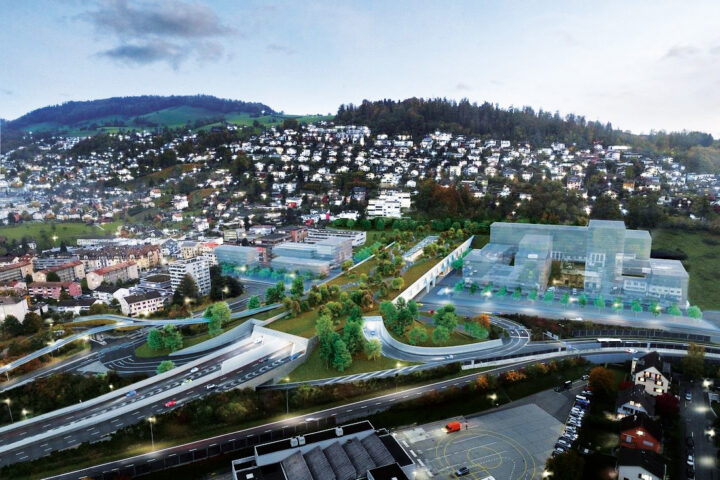
In the past ten years, traffic to and from Lucerne has increased by around 20 percent. Further growth is forecast – but the A2 and A14 are already reaching their capacity limits. At the Rotsee junction outside Lucerne, the traffic flows of the A2 north-south axis and the A14 from Zurich-Zug meet. On the city thoroughfare, regional and local destination and source traffic are added. In order to ease the situation, the federal government wants to significantly improve the traffic situation on both motorways with the Lucerne bypass. Without the bypass, alternative traffic on the subordinate road network would increase, and as a result, public transport would also be impeded.
The core element of the bypass consists of two two-lane tunnels with a length of 3760 metres in the northbound direction and 3850 metres in the southbound direction, which pass under the city of Lucerne and the Reuss river. In the north, the connection points are in the Ibach area and in the south in the Grosshof area (Lucerne-Kriens). The planned tunnel bypass is primarily intended to accommodate transit traffic.
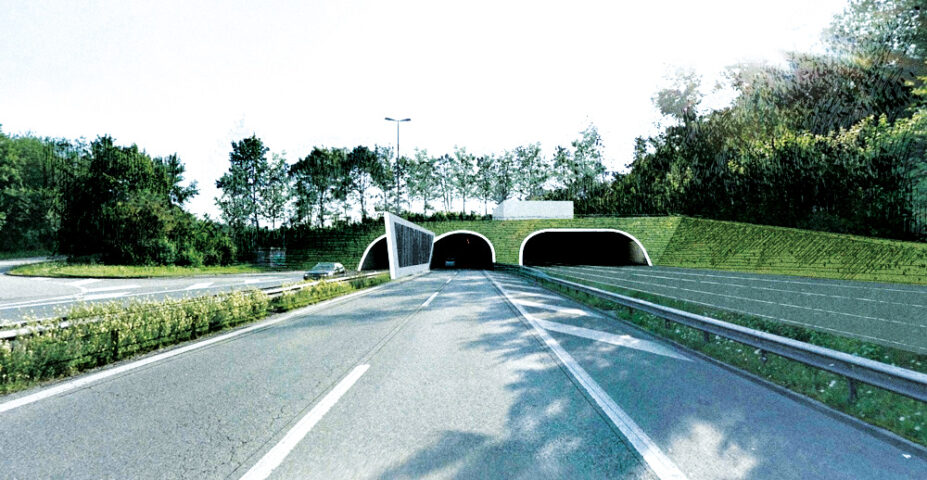
In addition, it is planned to expand the A14 in the north from four lanes today to six lanes in the future from the Rotsee junction to the Buchrain junction. To achieve this, the Rathausen tunnel will be extended with a third tube. The structures will be adapted at the Rotsee junction. At the Rotsee junction, the A2/A14 Basel lane will be widened to two lanes in the direction of Zug in order to eliminate the existing bottleneck.
Between the Rotsee junction and the Lucerne-Kriens junction, the A2 will become an urban motorway serving exclusively the destinations, sources and domestic traffic of the Lucerne conurbation. Emmen Süd, Luzern-Zentrum and Luzern-Kriens are connected to it. If necessary, for example in the event of an incident or during maintenance and repair work, the urban motorway serves as an alternative route to the bypass and vice versa.
The Grosshof bridges as the new gateway to the city of Kriens.
In the south, the Spier tunnel between the Lucerne-Horw and Hergiswil junctions is to be re-marked with three lanes in each direction. The third lane will extend the entry and exit lanes. The new Grosshof bridges will provide the town of Kriens with a new gateway: a park with paths from Sonnenberg to Kriens, Horw and Lucerne is planned on the roof. Below the bridge, a diverse mix of uses is to be created, including cafés, shops and commercial space.
The Lucerne bypass envisages the construction of three new road wastewater treatment plants (SABA) in Rathausen, at the Rotsee junction and at Grosshof-Kriens. Thanks to these, the wastewater from the motorway will be cleaned in an ecological way before it flows into the surrounding water bodies.
The Bypass relief project is intended to improve the flow of traffic on the motorways and ensure the functionality of the north-south axis. It will also create alternative routes in case of accidents or maintenance work. Central Switzerland and the Lucerne agglomeration will benefit from better accessibility, and the urban motorway will be relieved of through traffic. Last but not least, safety for all road users will be increased.
The Rathausen tunnel will be extended with a third tube.
The total costs amount to CHF 1.8 billion and are financed by the federal government. If everything goes according to plan, the bypass should be open to traffic in about 2035 after about 12 years of construction – subject to the still pending planning permission.
The construction work for the extension of Basel SBB station is on track. On 14 December 2022, the federal government granted SBB the construction permit for the two projects. Construction work started on 2 January 2023. The CHF 210 million project package includes, on the one hand, the Basel SBB performance enhancement project with the additional 460-metre-long platform track 19/20 and capacity-increasing measures on the approach tracks towards Basel St. Johann and Münchenstein. On the other hand, the package includes a provisional 147-metre-long and approximately 10-metre-wide passerelle in the area between the existing passerelle and the Margarethen Bridge.
One of the prerequisites for future service extensions At a media conference in Basel, Wolfgang Stolle, SBB overall project manager, and Thomas Staffelbach, SBB overall coordinator Basel, provided information on the status of the work and the other extension projects in the region. Marco Galli, coordinator of the Basel rail hub at the canton of Basel Stadt, emphasised the importance of the project package for the canton. Because from the end of 2025, northwestern Switzerland is to receive significantly more trains. This was decided by the federal government, parliament and cantons. From then on, the S-Bahn trains between Basel and Liestal are to run every quarter of an hour and the long-distance trains on the Basel-Delémont-Biel/Bienne line every half an hour. Increased performance and a temporary passerelle will create the necessary capacity at Basel SBB station for more train stops and more passengers, especially during rush hour.
Drilling machine creates piles for 570-metre-long retaining wall The construction team is currently working on the future retaining wall along Meret Oppenheim-Strasse. The approximately 570-metre-long, four to seven-metre-high structure will close off the track field from the Gundeldinger district. The track field must be widened towards the south in order to create enough space for the extended platform and track system. Since the end of January, a drilling machine has been drilling the piles for the retaining wall. The machine will be in use between the Margarethen Bridge and the Peter Merian Bridge until probably June 2023. 119 of the total of 308 bored piles had been constructed by the end of March. The bored piles go to different depths in the ground; the longest are up to 14 metres long.
Demolition of the houses near the tracks between Passerelle and Hochstrasse In order to be able to build the retaining wall, the construction crews have been demolishing the nearby houses between Postpasserelle and Hauptpasserelle since January 2023. From April, the buildings on the track side of the upper Hochstrasse will follow. SBB had to close the southern access to the Postpasserelle for the same reason on 13 February 2023. The construction team will demolish the relevant section of the Postpasserelle from mid-May 2023. After that, the access will be rebuilt about 4.3 metres further south. In this way, it will extend over the wider track field in the future. The new access will go back into operation at the end of 2023.
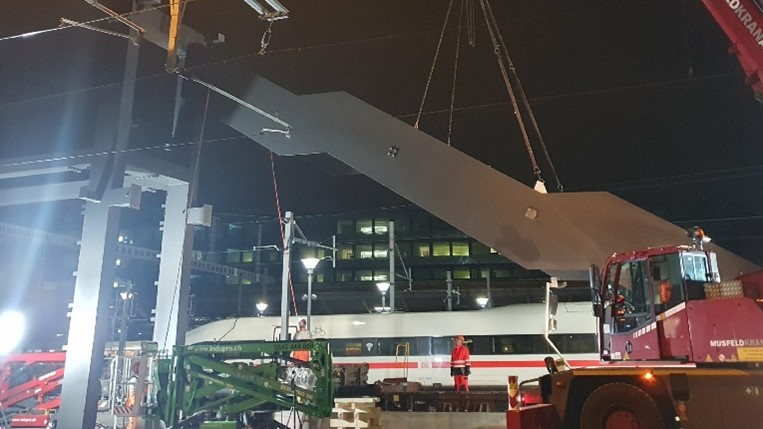
The first yoke for the new passerelle is in place The first work for the temporary passerelle is also underway. From mid-January to the beginning of April 2023, the construction team built the foundations and supports for the new passerelle at the western end of the platform 11/12. In the meantime, the yoke and the stairway to the passerelle have been built. At the beginning of April, the builders will then move to the western end of the platform 9/10 and do the same there. At the end of June, they will move to platform 7/8. During the work, the length of the platform in question will be restricted.
Extensive night work in the track area Since January, the construction teams have been working at night on the catenary, the tracks and the cable systems. These adjustments are necessary for the foundations of the passerelle and the new platforms. The construction teams are also erecting protective scaffolding. These are to ensure that no construction debris gets onto the operational track systems during the demolition work. For safety reasons, the construction teams can only carry out all this work with the track closed and the overhead line switched off. They must therefore be carried out at night, when there is less traffic. SBB is constantly examining how night-time noise can be reduced depending on the construction phase. However, it is aware that the work will still require a great deal of patience and understanding from residents.
Restrictions for bicycles and motorised traffic There have been and will be restrictions for bicycles and motorised traffic. For example, the number of bicycle parking spaces on the Gundeldinger side has been reduced from 700 to 530. SBB is therefore currently reviewing again with the canton how and where additional parking spaces are possible. The aim is to be able to put these additional spaces into operation in the spring. In the meantime, SBB is asking cyclists to use all the temporary parking spaces, including those at the Meret Oppenheim high-rise. In many cases, there are still spaces available there, especially on the upper floor of the double-storey parking facilities. in 2025, SBB will dismantle the temporary bicycle stands and re-install them on the redesigned south side of the station, along the tracks. The total number of bicycle stands will be increased to around 1100. For safety reasons, road traffic restrictions have been necessary on Meret-Oppenheim-Strasse since the beginning of January and on the upper Hochstrasse from 3 April to 30 June. SBB submits the restrictions to the cantonal police in advance in accordance with the applicable cantonal processes and guidelines and coordinates them with them.
Lucerne station is the sixth-largest railway station in Switzerland: around 100,000 passengers board and disembark here every day. The problem: the double-track access has reached its capacity limit and is prone to disruptions. The forecast growth in public transport mobility in the canton of Lucerne is around 40 percent by 2030. Rail mobility has already increased by 50 to 100 percent in the last ten years – especially on the canton’s main development axes.
The Federal Office of Transport, the Swiss Federal Railways (SBB), the cantons of Lucerne, Nidwalden and Obwalden, the city of Lucerne, the regional development agency LuzernPlus, the Lucerne Transport Association and the Zentralbahn (Central Railway) therefore want to expand rail services with the Lucerne through station (DBL) and implement various infrastructure projects. The planned through station is considered a generation project in Central Switzerland.
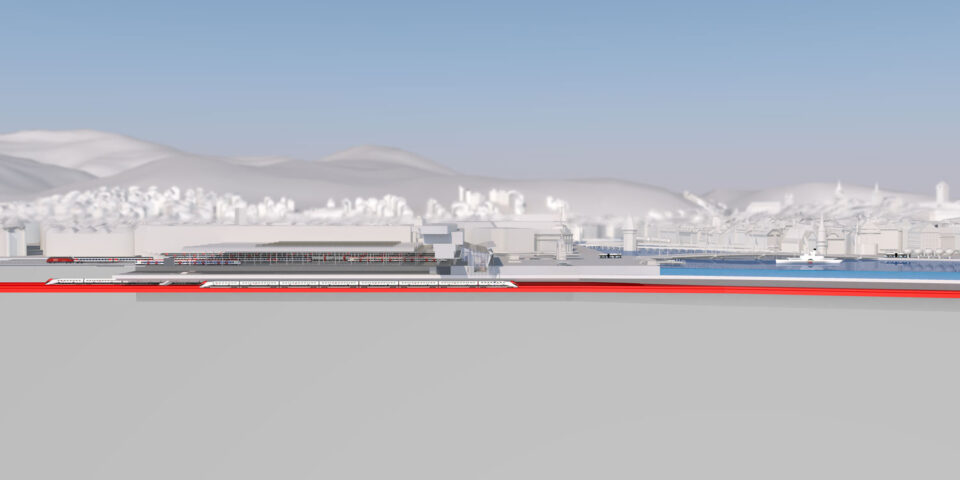
The visualisation shows the side view of the through station.
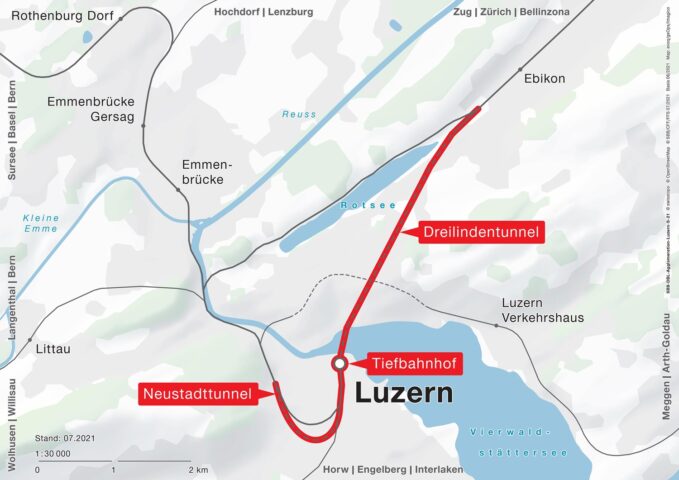
An underground through line with four lowered tracks is planned under the existing terminus station. This will be supplemented by a 3.5-kilometre-long underground double-track access and exit from Ebikon (three-lane tunnel) and a likewise underground double-track access and exit to the Heimbach area (Neustadt tunnel). The existing above-ground parking facilities at Lucerne station will be partly relocated, as they will then no longer be directly connected to the underground through station.
The DBL creates the conditions for faster connections in the region’s S-Bahn system as well as a faster north-south connection via Lucerne. This not only sets the course for more mobility, but also for achieving the climate goals in terms of sustainable mobility development. After all, the greatest potential for switching to public transport lies in the agglomerations and in connections between regional centres.
The planned route.
But the DBL will also optimise economic and urban development opportunities: The population will become more mobile, and in the centre of the city of Lucerne new space for urban development will be created thanks to the release of above-ground track infrastructure. The popular tourist cantons of Obwalden and Nidwalden will also benefit from better access.
The Zurich-Zug-Lucerne-Sursee-Olten axis in particular will benefit from the improved services. The Lucerne-Zug-Zurich line is the busiest railway line in the Lucerne region. With the addition of six long-distance trains from Lucerne to Zurich, the DBL will increase the timetable, enable a basic 30-minute interval for long-distance services and a quarter-hourly interval for regional services.
The DBL offers the possibility of managing the travel time between Lucerne and Milan envisaged in the NRLA concept and brings Ticino closer to German-speaking Switzerland: 20 minutes of travel time can be saved thanks to the DBL. The north-south connection via Lucerne will thus be faster than the one via Zurich, which passes through the busy Zurich main station.
The federal parliament approved the 2035 expansion step for the railway infrastructure in 2019. SBB is currently working on the preliminary project, which is expected to be completed in the first months of 2023. This will be followed by the examination of the results of a study on the implementation sequence, which should take about another six months. in 2027, the federal parliament will decide whether the DBL can be realised after 2030. If everything goes smoothly, the through station could be opened in 2040 at the earliest after a construction period of about ten years.
The costs will be available when the preliminary project is completed. The project will be financed through the Railway Infrastructure Fund (BIF). The client for the DBL project is the Federal Office of Transport (FOT). SBB is responsible for planning and implementation. The railway infrastructure will be expanded step by step – the expansion steps are determined every four years by the National Council and the Council of States.
Chur’s energy supplier Energie Wasser Chur(IBC) can massively expand its district heating network. The electorate approved a corresponding municipal proposal by 60.85 per cent. It states that the city will contribute 80 million Swiss francs to the total costs for the expansion of the heating network over a period of twelve years. These costs amount to 314 million francs.
According to its message to the polls on 12 March, the municipal council supported the proposal with 17 votes in favour and 4 against. Now Chur is supporting the generation project of the IBC, which is an independent institution under public law in the sole ownership of the city, with 60 million francs to increase the endowment capital and in the form of a loan. The city is holding a further CHF 20 million in reserve for any guarantee that may be required.
In the view of the municipal council, the investment is necessary to ensure the conversion to a renewable heat supply within the city. “At the same time, the loss of the previous added value from the sale of gas can be absorbed and the revenues increased elsewhere,” the message continues. “The money that flows out today for the purchase of oil and gas will remain in the region in the future.”
According to the information, IBC wants to borrow a total of 160 million Swiss francs from financial institutions. In addition, a contribution of 56 million francs from the federal government and the canton is expected. The company intends to invest 38 million francs of its own funds.
The city of Zug, the Kunsteisbahn Zug AG (KEB) and the EV Zug have agreed to implement the expansion of the Bossard Arena in a tenant model. “The city council recognises the necessity of further developing the Bossard Arena,” Urs Raschle, head of the finance department, is quoted as saying in a corresponding statement by the Zug city administration. “With the present Memorandum of Understanding, we have now created the necessary conditions together with the EVZ and KEB.”
The memorandum of understanding stipulates that the Bossard Arena will remain the property of the city of Zug even after the expansion. KEB will become a tenant of the city and will operate the Bossard Arena on its behalf. KEB’s subtenant EVZ, as the main user of the arena, will realise and finance its expansion. A feasibility study estimates the necessary investments at around 36 million Swiss francs.
The Keep Building project provides for the expansion of the arena capacity from 7,200 to 9,000 seats and the extension of the catering facilities. Among other things, the northern roof of the stadium is to be steepened and led over an extension module that will be built underneath. It is assumed that planning permission will be granted in 2024, with construction work to be completed in 2027.
This year, the Zug Ice Sports Club is one of the finalists for the Prix SVC Central Switzerland, which will be awarded on 2 May. With this, the entrepreneurial network Swiss Venture Club honours companies for their innovative products and services, for their corporate culture and for their sustainable track record.
Particularly important decisions of the Commission meeting of 20-23.2.2023
A regulation for solar plants in the national interest: This will make it possible to build Alpine solar power plants even after the expiry of the urgent federal decree (“Solar Express”).
The obligation of operators of larger storage hydropower plants to participate in the energy reserve: Photovoltaics (PV) in combination with hydropower enables a secure power supply in winter, provided the reservoirs are not emptied prematurely for economic reasons.
The possibility of loans in case the resources of the grid surcharge fund are not sufficient for the intended promotion of renewable energy production: This can avoid a “stop-and-go”.
Data from smart metering systems are to be made available to end consumers in real time: This promotes the optimal coordination of electricity production (e.g. from PV systems) and consumption at the local level, which can reduce investments in electricity grids.
Storage facilities without end consumption are to be exempted from the grid fee for an unlimited period. And storage facilities with end consumption should also be able to benefit from a refund of the grid fee for the energy fed back into the grid from these storage facilities: This promotes the grid-serving use of stationary storage facilities as well as the bidirectional charging of electric vehicles.
The framework conditions for local electricity communities (LEG) have been significantly improved compared to the resolution of the Council of States: this is also a significant contribution to the intelligent use of the grids.
In rural areas, high costs for grid reinforcements often lead to PV projects being suspended. A cost pass-through is intended to provide relief here.
The parliamentary initiative by Swissolar President Jürg Grossen’s initiative to harmonise the taxation of the sale of solar electricity was unanimously approved. This is an essential contribution to clearing up the “patchwork” of framework conditions for solar plants.
According to a press release , St.Gallisch-Appenzellische Kraftwerke AG ( SAK ) and Heizplan AG from Gams are founding a joint venture for the training of skilled workers. The background is the increasing order situation for photovoltaic systems, for which additional specialist staff is required.
As a result of the high demand for solar roof systems for single and multi-family houses as well as for commercial properties, customers have to wait longer for the craftsman. SAK and Heizplan want to tackle the growing need for additional skilled workers under a joint company roof. The first positions are to be advertised in the course of the week.
According to the head of the energy solutions and production divisions at SAK, Adriano Tramèr, who was quoted in the media release, the expansion of photovoltaics can be accelerated together. "By founding the company, we are pooling our strengths and supporting the energy transition in Eastern Switzerland – and thus the energy policy efforts of the Eastern Swiss cantons."
12 years ago, CKW subsidiary Steiner Energie built the last hydroelectric power station in the canton of Lucerne in Malters. Even then, CKW was intensively involved in the planning of the Waldemme power plant. A lot of water flowed down the Waldemme before the excavators could finally drive up and drive their shovels into the ground.
Within a year, some of this water will be used to produce clean, renewable electricity. At today's ground-breaking ceremony in Flühli, government councilor Fabian Peter, head of the building, environment and economic department, expressed his delight: "With the new construction of this power plant, CKW is making another important contribution to achieving the energy and climate policy goals in the canton of Lucerne. »
Expansion of renewable energies is urgently needed In his speech to more than 70 invited guests, CKW CEO Martin Schwab was primarily pleased that the power plant is finally being built. Because it was a long and rocky road. Schwab positively emphasized the great commitment in Entlebuch. "The region is a pioneer in using its own local energies." At the same time, Schwab warned: “We urgently need to expand the production of renewable energy in Switzerland. The corona pandemic and the war in Ukraine clearly show how dangerous strong dependencies on foreign countries can be, »said Schwab. Today things are progressing much too slowly in Switzerland. “This is primarily due to the long approval process. The Waldemme power plant is the best example of this: it took more than 17 years from the first plans to the groundbreaking.»
"We want to move forward and make a significant contribution to the energy transition in Switzerland – in hydropower, wind power, solar energy and other renewable technologies. But the resistance is often great. This is paradoxical, as we all want the energy transition and need more renewable energies for it."
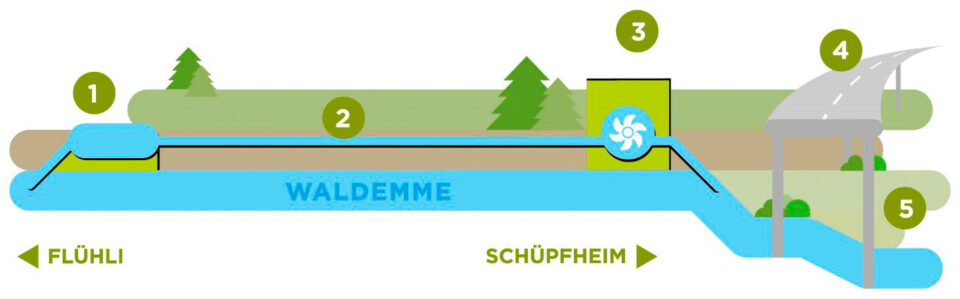
Electricity for 1500 households The roughly one-year construction phase begins with the ground-breaking ceremony. The water intake is at the hamlet of Matzenbach in Flühli. From this location, part of the water from the Waldemme is routed via a 2.1-kilometer-long underground pressure line to the power plant headquarters, where ecological electricity is produced. The power plant control center is located directly in front of the Lammschlucht at the Chrutacher Bridge. Immediately afterwards, the water is fed back into the natural course of the Waldemme and flows through the Lamm Gorge. The power plant has an output of 1.4 megawatts and produces an average of 6.5 GWh of electricity. This means that clean electricity can be generated from mid-2023, which will cover the annual needs of around 1,500 average four-person households. CKW is investing CHF 12.4 million in the power plant.
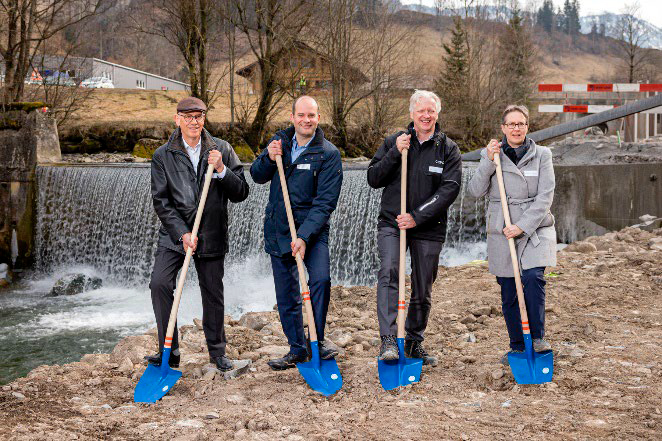
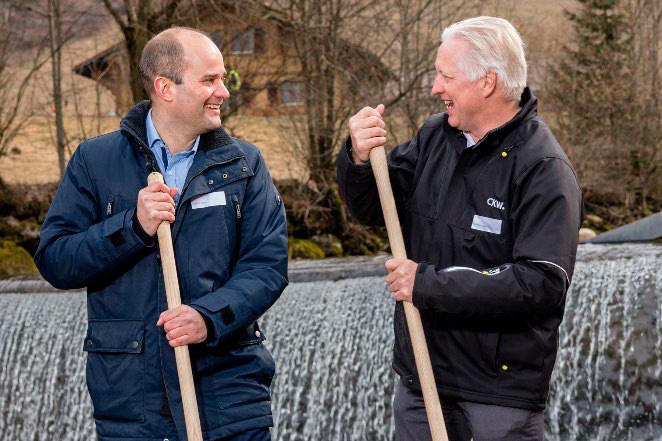
In the hamlet of Matzenbach, the water intake (1) takes part of the water from the Waldemme. In the approximately two-kilometer-long underground pressure line (2), the water is routed to the power plant center (3) at the Chrutacher Bridge (4), where it drives a turbine and generates electricity. Directly at the headquarters, the water is fed back into the natural course of the Waldemme and flows through the Lamm Gorge (5), which is untouched by the project. Breaking ground at the Waldemme: (from left) Hans Lipp, Flühli municipal mayor, Fabian Peter, member of the cantonal government and head of the building, environmental and economic departments of the canton of Lucerne, Martin Schwab, CEO of CKW and Hella Schnider-Kretzmähr, Flühli municipal president. Happy about the start of construction: Fabian Peter, member of the government and head of the building, environment and economic department of the canton of Lucerne, and Martin Schwab, CEO of CKW.
About CKW: The CKW Group is a leading Swiss provider of integrated energy and building technology solutions. For more than 125 years, the company has been supplying electricity to over 200,000 end customers in the cantons of Lucerne, Schwyz and Uri. In addition, there are innovative products and services throughout Switzerland in the fields of connectivity & IT infrastructure, electrical engineering, energy technology, IT & communication and security. The CKW Group employs over 2,100 people. With around 350 apprentices in 14 professions, it is the largest private-sector training company in Central Switzerland. In the 2020/21 financial year, CKW generated sales of CHF 916 million. With 81 percent of the shares, Axpo Holding AG is the majority shareholder of CKW. Further information at www.ckw.ch
Around 5 percent of annual electricity consumption in Switzerland is currently covered by domestically produced solar electricity, explains Swissolar in a press release . In the standard electricity products of the energy suppliers, however, the proportion of solar electricity is only 1.85 percent on average. The Association of the Swiss Solar Energy Industry is working together with the power comparison service myNewEnergy to increase the solar proportion of standard products to this 5 percent in a first step.
“This value should be increased annually by at least the amount of additional construction in question,” Swissolar managing director David Stickelberger is quoted in the announcement. “Around 1 percent would correspond to the necessary expansion of photovoltaic systems.”
The majority of households do not choose a special electricity product and therefore receive the standard offer from the respective energy supplier, explains Swissolar in the press release. If the proportion of solar power in the standard product is increased to the proportion of power consumption, the comparatively expensive power is divided among a large number of consumers, argues Swissolar. This keeps the product price low and opens up new sales markets for providers of solar power who have been “sitting on their clean electricity” up to now.
“It is important that these certificates come exclusively from Swiss solar systems, because only such certificates make an effective contribution to a safe and clean power supply in our country,” explains Stickelberger. “To replace the nuclear power plant alone, we need 20 terawatt hours of solar power.”
"The greatest potential lies in buildings", David Stickelberger, managing director of Swissolar, is quoted there. "According to sonnendach.ch, 10 percent more electricity per year could be produced on suitable roofs and facades than Switzerland currently consumes." However, in view of the urgent need for action, it is difficult to tap this potential in good time.
That is why the two organizations, in cooperation with the Zurich University of Applied Sciences ( ZHAW ), shed light on three areas outside of settlements where photovoltaic installations would be possible, but often cannot be implemented due to spatial planning obstacles: on noise barriers, in the agricultural zone and in the alpine area.
These obstacles have to be removed, warns Felix Nipkow from the SES. That is why his foundation and Swissolar have commissioned the ZHAW to clarify conflicting goals with legal experts with regard to these three installation rooms and to identify solutions. All three reports were published by Dike Verlag . They can be downloaded from SES or ordered in printed form.
Wir verwenden Cookies zur Unterstützung und Verbesserung unserer Dienste. Mit der Nutzung dieser Website erklären Sie sich mit der Verwendung von Cookies einverstanden. Weitere Informationen finden Sie in unserer Datenschutzerklärung.