Tag: Automatisierung

  • Digital twins are shaping the industry of tomorrow

    Digital twins are shaping the industry of tomorrow

    At the NVIDIA GTC in Washington, Siemens and NVIDIA presented a new type of AI-based system architecture that links the Siemens Xcelerator portfolio with the NVIDIA Omniverse platform. This “industrial tech stack” enables digital twins that visualize, simulate and optimize factories in real time. This creates a foundation for the industrial metaverse. A networked ecosystem that seamlessly brings together design, operation and energy supply.

    The new solution dramatically accelerates planning and engineering processes. Factory layouts can be simulated and adapted in just a few hours instead of weeks. AI-driven workflows make data-based decisions and increase precision, efficiency and sustainability.

    Chip-to-grid end-to-end industrial value creation
    At the heart of the approach is the “chip-to-grid” value chain, which integrates semiconductor design, factory operation, energy supply and building technology. It ensures that power, cooling and computing power function as a unified system, whether for new buildings or existing modernizations. With the help of AI-based simulation, operators can optimize production facilities in months rather than years.

    This integrated approach corresponds with the blueprint for “AI Factories” with gigawatt capacity. Together, the two companies are setting new standards for efficiency, scalability and energy intelligence in AI data centers and production facilities.

    Industrial AI as a driver of innovation
    With this cooperation, the two companies are underlining the global upheaval in manufacturing. Digital twins, AI automation and real-time simulation are becoming the basis for new industrial intelligence.

    By merging planning, engineering, energy and building management into one platform, companies have a tool that streamlines complex processes, conserves resources and accelerates innovation. A clear step towards self-optimizing industrial environments.


  • Swiss industry under stress test

    Swiss industry under stress test

    There are many reasons for this development. External shocks such as the strong franc, US tariffs and declining demand in China have been hitting Swiss industry with full force since spring 2025. In the machinery and technology base, incoming orders and production capacities are slumping noticeably. According to Swissmem, the order volume of the MEM industries fell by over 13 per cent in the second quarter, and industry turnover has fallen for nine consecutive quarters. Swiss companies’ dependence on exports makes them particularly vulnerable, as competitors in the EU pay significantly lower customs duties

    Job cuts among the big players and the consequences
    Sika is cutting 1,500 jobs worldwide, mainly in the construction sector and production sites in China. The restructuring is a reaction to double-digit sales losses and a weakening construction market. At the same time, Sika is focusing on investments in digitalisation and automation

    Kühne Nagel also announced up to 1,500 job losses following a slump in profits and pressure on margins. The market is heavily burdened by overcapacity and US tariffs. Efficiency improvements and automation are leading to the loss of many logistics jobs

    SFS Group cuts 110 jobs with the closure of the Flawil plant. The dramatic slump in the automotive industry, the switch to electromobility and competitive pressure from Asia lead to the relocation of production and the reduction of skilled assembly jobs

    Schindler rationalised 1,200 jobs in the third quarter because the global new installations business for lifts, particularly in China, collapsed. This resulted in rationalisations in the back office and production

    Other industry giants such as Rieter (mechanical engineering) and Helvetia (insurance) are also reporting hundreds of impending job losses, often citing declining orders and relocation abroad

    Blue-collar jobs and the risk of a location crisis
    Classic blue-collar jobs – i.e. jobs in production, assembly, logistics or maintenance – are particularly affected. Technology-driven rationalisation, the switch to electromobility in the automotive sector and efficiency programmes in logistics and back office are causing processes to be relocated abroad or automated. According to surveys, more than one in three CFOs in Switzerland currently expects further job cuts in their own company

    The consequences extend far beyond individual companies. Regionally, there is a threat of the desertification of industrial locations, social decline scenarios and risks to social stability. Labour market researchers also warn that even the strong pharmaceutical industry may not be spared further waves of rationalisation.

    Society and politics in dialogue
    Public discussions and economic forums are struggling to find answers. Location promotion, targeted further training and qualifications, accompanying socio-political measures and innovation promotion are the key issues. This is because the downsizing is an expression of a twofold structural change. It is the result of a fluctuating global economy, but also of the rapid progress of digitalisation and AI, and will not be solved by pure market logic.

  • Apply now for the Digital Journey Challenge 2025

    Apply now for the Digital Journey Challenge 2025

    The digital transformation is unstoppable and offers enormous opportunities for small and medium-sized enterprises in particular. The Digital Journey Challenge 2025, launched by the Centre Suisse d’Électronique et de Microtechnique (CSEM), is aimed at companies and start-ups that want to take their innovative strength to a new level with digital technology.

    The focus is on promoting pioneering projects in areas such as artificial intelligence, the Internet of Things (IoT), automation and other key technologies. Applicants receive professional guidance, technological expertise and up to CHF 100,000 in financial support.

    Three strong arguments in favour of your participation
    Technology Boost
    Access to CSEM expertise in eight key technologies

    Financial support
    Up to CHF 100,000 for development time, consulting and technology transfer

    Strengthen market position
    Greater visibility, more media presence, access to expert networks

    Simple application process, big impact
    Participation is straightforward. Interested parties download the factsheet, describe their idea and submit the form. All information and conditions are available on the CSEM website. The application deadline is 15 September 2025.

    Success story
    The 2024 winning project shows just how effective the challenge can be. Varioprint AG impressed with its AI-supported 3D inspection solution for printed circuit boards. Their project “AI in Every Pixel” addresses a global growth market and accelerates quality control in the electronics industry in the long term.

    Apply now and play an active role in shaping your digital transformation.

  • PropTech start-up develops AI solution for property

    PropTech start-up develops AI solution for property

    The start-up Nestermind, which specialises in AI-supported automation solutions in the real estate sector, has successfully completed a substantially oversubscribed pre-seed financing round, according to a press release.

    The fresh capital will be used to further develop the technology and boost the company’s national and international market presence. The Agentic AI software developed by Nestermind enables easier management of property listings, better customer communication and faster sales processes.

    “We are proud to have such experienced and strategically valuable partners at our side who share our vision of taking property marketing to a new level,” said co-founder and CEO Lucas Pelloni.

    The platform opens up new ways for players in the property industry to network in a data-driven ecosystem. “We are thus creating enormous efficiency potential and paving the way for a new way of working in the property industry,” co-founder and CTO Severin Wullschleger is quoted as saying.

    According to the company, the software is particularly tailored to the needs of smaller SMEs in the property sector. By automating tasks such as lead generation and CRM management, they can increase efficiency and save time without having to invest in complex systems.

    According to the press release, the financing was concluded with the participation of a round of investors comprising “well-known personalities from the property sector, renowned family offices and leading property companies”. The amount was not disclosed.

  • Automated production for sustainable energy use

    Automated production for sustainable energy use

    Libattion AG, based in Opfikon, has opened a new plant in Biberist for processing used batteries from electric cars. Here, the batteries are used to produce modular stationary energy storage units. According to the company, this is Europe’s largest plant of its kind. The production facility was set up on the site also used by battery recycling company Librec.

    The new facility has a high degree of automation. “Our new production hall enables us to respond flexibly to market requirements and make an important contribution to conserving resources in Europe,” said Stefan Bahamonde, CEO and co-founder of Libattion, in the press release. “By automating our production, we can not only operate efficiently, but also economically and adapt our capacities precisely to demand.”

    In 2022, Libattion produced stationary storage systems with a total capacity of 7 megawatt hours; last year, the company already achieved a total capacity of 27 megawatt hours. The company aims to increase its total capacity to 500 megawatt hours by 2026. Libattion’s storage systems have a modular design and can have capacities ranging from 97 kilowatt hours to 60 megawatt hours. Safety is the top priority, explains Bahamonde: “Thanks to automated production and strict quality controls, we can guarantee the highest safety standards for every storage system”.

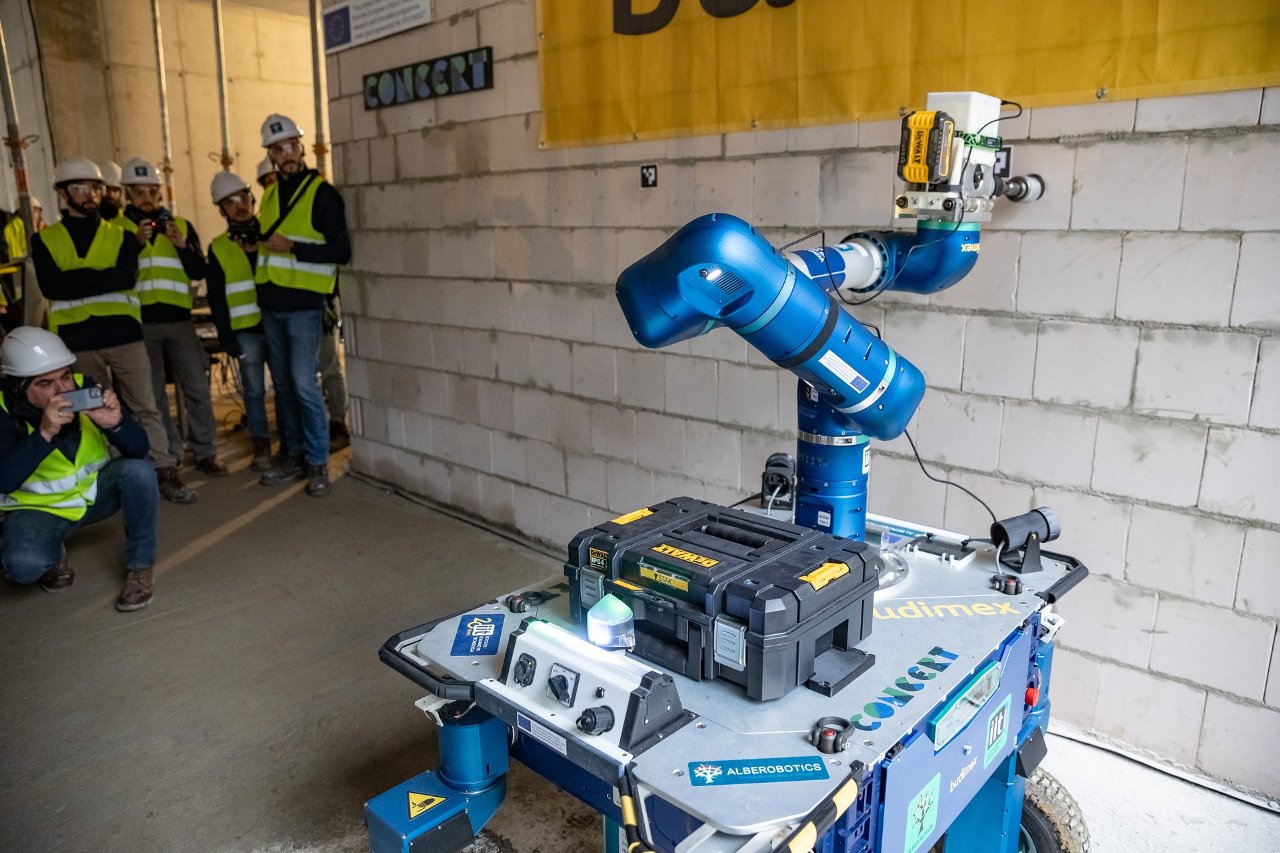
  • Robot platform ensures safety and efficiency on construction sites

    Robot platform ensures safety and efficiency on construction sites

    Work such as drilling, sanding, spraying insulation or lifting heavy materials harbours high risks. According to recent figures, in 2024 there were 30 fatalities on construction sites in Europe alone within four months.

    With the support of the EU-funded CONCERT project, IIT has developed an innovative, modular robot platform. “Our aim was to create a flexible and adaptable solution that optimises construction processes, reduces the workload on people and improves safety,” explains Nikolaos Tsagarakis, project coordinator at IIT.

    Robot as a support – not a replacement
    Although the CONCERT robot can work autonomously, it was primarily designed as an assistance system for construction workers. While the machine takes over repetitive or dangerous tasks, skilled workers can concentrate on more complex activities. This not only increases work safety, but also efficiency on construction sites.

    “Instead of using a separate robot for each task, we have developed a fully reconfigurable solution that can be customised directly on the construction site,” continues Tsagarakis.

    Seamless integration into the digital construction site
    The robot was successfully tested under real construction site conditions. It not only demonstrated its performance, but also its flexibility by being able to adapt to the spontaneous requirements of the construction team.

    One major advantage is the link to digital building information models (BIM). This allows the robot to be controlled directly via a tablet without workers having to operate heavy power tools.

    A breakthrough for construction robotics
    CONCERT has ushered in a new era in digital construction site automation with the first reconfigurable multi-purpose construction robot platform.

    The solution not only has the potential for broad industrial application, but also exceeds the usual technology maturity level in research projects. “The flexibility of the platform makes it usable for many other construction tasks,” says Tsagarakis. Future developments will expand the areas of application even further.

  • Efficient letting thanks to AI

    Efficient letting thanks to AI

    The Swiss real estate sector accounts for around 20 percent of GDP, but digitalisation is lagging behind. SMG Real Estate is setting new standards with an innovation offensive. Platforms such as ImmoScout24, Homegate and Flatfox now offer fully digital solutions that create listings faster, simplify viewings and optimise the entire rental process.

    A central component is the Flatfox Messenger, which is integrated into the aforementioned platforms. This WhatsApp-like communication solution bundles all exchanges between prospective tenants and landlords. Viewing appointments, applications and acceptances can be managed seamlessly – without the usual flood of emails.

    AI-supported adverts for maximum efficiency
    SMG Real Estate also relies on automation when creating adverts. Agents and property managers can generate a complete listing with just a few clicks. By entering the property address, all relevant data such as size and features are automatically added and an AI-supported text is created.

    This innovation saves an average of 14 minutes per advert. Extrapolated to the large number of daily adverts, this results in considerable time and cost savings. This leaves more time for the core business – direct contact with interested parties.

    Future-proof solutions for the sector
    The company wants to make the Swiss property sector fit for the digital future. The new technologies not only offer convenience and efficiency, but also contribute to the professionalisation and competitiveness of the sector.

    With this initiative, SMG Real Estate is proving that digital innovations are changing the property market for the long term and creating real added value for everyone involved.

  • Advanced logistics solution: opening of the new centre in Möhlin

    Advanced logistics solution: opening of the new centre in Möhlin

    Rhenus Logistics AG will open its new Swiss logistics centre in Möhlin in January after a construction period of one and a half years. According to a press release, this will comprise a total of 30,000 storage spaces on a total area of 2,000 square metres.

    The logistics centre will be operated by around 80 employees working with 30 P40 robots from Chinese manufacturer Geek and seven RoboShuttles. This collaboration should enable time savings of 70 per cent. The building will also have special storage rooms for temperature-controlled goods and the storage of hazardous materials, for example.

    Power will be supplied by a photovoltaic system on the roof. This is expected to generate 1 million kilowatt hours per year.

    “Our new logistics centre in Möhlin is an impressive example of what modern logistics looks like: more automation and increased efficiency while simultaneously promoting jobs, sustainability goals and quality standards,” said Andreas Stöckli, CEO of Rhenus Alpina and a member of the Rhenus Group’s Management Board, in the press release.

    The Rhenus Group, which has its headquarters in Holzwickede in North Rhine-Westphalia and its Swiss headquarters in Basel, has a presence at 1,320 sites in more than 70 countries and generates an annual turnover of EUR 7.5 billion.

  • Achieving success even more efficiently with digital tools

    Achieving success even more efficiently with digital tools

    In the current market situation, efficiency in marketing and management processes is more important than ever for property professionals. A quick letting or sale means lower costs. With optimised digital operating and communication processes, estate agents and property managers also gain valuable time to focus on the essentials: looking after tenants and owners. The new digital solutions from SMG Real Estate offer the ideal support to save time and money in the property business while improving the quality of customer communication.

    Automation and artificial intelligence (AI) are two important new details that SMG Real Estate is using to support its business customers in making the marketing process more efficient. New tools based on these technologies significantly simplify and speed up the listing process. All you need to do is enter the address and some specific data about the property and the advert is created automatically. The software accesses IAZI’s extensive database.

    In a matter of seconds, concise and appealing property texts are also created that optimally present the specific advantages of the property. The new AI solution is conveniently integrated into the Business Manager user interface and is available as an option.

    Strengthen customer loyalty through fast and professional communication

    Communication with potential prospective tenants is now much easier thanks to the Flatfox tools, which are also integrated into the Business Manager. The Flatfox Messenger enables efficient management of the entire rental process. From scheduling viewings to online application management and the automatic generation of rejections – everything can now be done with just a few clicks. This simplification creates space for the essential tasks, such as intensive support for owners and tenants. A particularly useful feature is the digital reference check, which allows quick access to all relevant information on prospective tenants and thus increases the chances of swift rental agreements.

    In addition, improved lead qualification ensures that all contact enquiries contain all the necessary information to qualify customers, including relevant financial aspects. Property professionals thus receive all decision-relevant information at a glance, which increases the chances of success in the letting process and facilitates faster deals.

    Last but not least, it provides access to a comprehensive digital ecosystem that includes numerous other partner services. Customers can now access all SMG Real Estate services via a single login. This means that they can access the entire SMG Real Estate ecosystem with just one login, including daily updates in the Business Manager and third-party services – all available in a centralised and user-friendly way.

    There has already been a lot of positive feedback from existing and new customers who have tested SMG Real Estate’s digital tools in a practical check. The numerous pieces of feedback flow directly into processes that are used to further develop the solutions and services on offer and work on additional innovations. The aim is to enable property professionals in Switzerland to digitally let and manage their properties with maximum efficiency and professionalism.

  • Automated portfolio valuation tool revolutionises property analysis

    Automated portfolio valuation tool revolutionises property analysis

    The new version of the SSREI portfolio valuation tool is characterised by significant automation that simplifies and speeds up the valuation process. Thanks to the partnership with SFGM, building and location data can be retrieved directly via the EGID number, which minimises manual input. This provides owners with important information on monument protection, contaminated sites, noise pollution, radon risks, energy supply and public transport connections.

    Automated indicator evaluation based on master data
    The optimised evaluation tool enables the automated evaluation of 23 of the 36 sustainability indicators. The combination of publicly available information and building-specific data enables a precise assessment of the potential. Information such as year of construction and renovation date can be used to derive the building envelope and noise protection values – supported by the relevant SIA standards.

    Further optimisations and interface connection
    Newly developed tools help to determine usage density and utilisation based on statistical data and provide a sound basis for decision-making. The tool also offers interfaces to external asset and portfolio management systems, which facilitates integration into existing processes and makes data analysis and evaluation even more efficient.

    The portfolio valuation tool provides property owners with a valuable basis for the sustainable development of their portfolios and makes an important contribution to value retention and regulatory protection. It supports investors in future-proofing their property portfolios and meeting the requirements of sustainable transformation.

  • Researchers call for a paradigm shift in building and energy planning

    Researchers call for a paradigm shift in building and energy planning

    Matthias Sulzer from the Swiss Federal Laboratories for Materials Science and Technology(Empa) and his colleague Michael Wetter from the Lawrence Berkeley National Laboratory in California are advocating a paradigm shift in the planning of building and energy systems. “Due to the complexity and required flexibility of future energy systems and the urgency of change, today’s planning processes are not suitable,” explains Sulzer, who heads Empa’s Urban Energy Systems department and is also a researcher at the Lawrence Berkeley National Laboratory, in an Empa press release. “There is little to no interaction between the disciplines in order to design buildings or energy infrastructures as a holistic system.”

    Sulzer and Wetter are in favour of transferring the so-called platform-based design developed for the automation of chip production to the planning of building and energy systems. The methodology is based on various levels of abstraction on which mutually influencing systems are holistically analysed and optimised. Generally valid models are created at each level, which specify how a system is to be defined and built. The individual models can then be individually combined in practice. Such a paradigm shift could “revolutionise our planning, construction and operating processes and promote the digitalisation and automation that are essential for achieving our ambitious decarbonisation goals,” says Sulzer.

  • Baden-Württemberg interested in autonomous bus in Schaffhausen

    Baden-Württemberg interested in autonomous bus in Schaffhausen

    The first bus line in Switzerland to be served by a self-driving bus with dual-mode technology has now also aroused curiosity in Baden-Württemberg, according to a media release from the Swiss Transit Lab. Winfried Hermann, the transport minister of the south-west German state, visited the Swiss Transit Lab’s STL Line 13 in Schaffhausen with a high-ranking delegation.

    According to its media release, the delegation discussed “with great interest” the benefits, previous experiences and opportunities of the new technology and saw for themselves the driving comfort of the minibus. The line was opened on 28 April and runs in an initial pilot phase from Monday to Saturday between 10 a.m. and 2 p.m. three times an hour between the North Station and the Stahlgiesserei.

    Hermann sees the development of autonomous buses as an important component for cost-efficient and demand-oriented public transport in rural areas in the long term. “As part of on-demand services, these can ensure that people always remain well connected and are flexibly transported to their destination, even outside of rush hours,” he is quoted as saying in the statement. “In Schaffhausen, the Swiss Transit Lab is already demonstrating the impressive potential of the technology.” The state of Baden-Württemberg is involved in several pilot projects that are advancing research on autonomous buses, he said.

  • Tilbago offers the cheapest debt collection statement

    Tilbago offers the cheapest debt collection statement

    Tilbago AG is lowering the price for digitally signed debt collection statements to 22.90 Swiss francs. This means that this “fully digital bridge” between private individuals and debt collection offices is the most cost-effective at the Lucerne-based company, according to a media release.

    A digital debt collection statement replaces the previously common paper form for a credit report, as it is required, for example, before concluding rental, credit or leasing contracts. It can be ordered online, is usually delivered by e-mail within a few hours and can be used as often as desired. The digital statement proves ex officio and forgery-proof that a person does not have any outstanding debts that are or have been enforced by means of debt collection.

    The online debt collection solution tilbago is a PostFinance innovation. Tilbago guides companies fully automatically through the debt collection process. This is intended to automate and optimise workflows and make it easier to comply with legal requirements and deadlines. The solution is hosted by PostFinance. According to the company, this means that the data remains in Switzerland and is protected in the PostFinance data centre.

  • Far superior to drones

    Far superior to drones

    New construction projects can be digitally modeled using drone recordings. With the help of software, the planned object is, so to speak, “inserted” into the property and surroundings images received by the drone. This Building Information Modeling (BIM) creates realistic visualizations of a new building project in two or three-dimensional views. Object-strategic statements can thus be made reliably, quickly and cheaply.

    Drones are also used for construction-related work themselves. One of the most recent applications is the computer-controlled use of drones for painting facades. The flying robotic helpers can be controlled very precisely and can fly very close to a wall. So it is possible to paint facades without work preparation and erection of scaffolding. In addition to saving time, this is also a step forward in terms of safety on the construction site.

    Another area of application is that for inspections and damage tests of buildings and structures – for example the use of drones for roof inspections. Due to the high altitudes and good stabilization in flight, drones can also be used in historic buildings, such as churches. But drones can also be used comfortably and safely to check building cracks, glass damage or hard-to-reach areas. Thanks to the high resolution of the images, even the finest damage can be detected and these images can be saved for later documentation purposes.

    You can find impulses around innovations in the real estate and construction industry here: https://hubs.li/H0RQl480