Tag: Bahnhof

  • Voters stop Locarno railroad station project

    Voters stop Locarno railroad station project

    The proposal to redesign the Locarno-Muralto train station was narrowly rejected with a voter turnout of 31%. 33,723 no votes were cast against 33,621 yes votes. The project was thus stopped by a wafer-thin margin of 102 votes. A result that shows how controversial urban planning interventions can be, even for regionally important infrastructure projects.

    Planned investments for greater clarity and mobility
    The project would have involved a comprehensive upgrade of the transport hub with a total volume of CHF 16 million. The canton of Ticino would have borne around CHF 7 million of this. The plan was to focus more strongly on pedestrian and bicycle traffic and to organize the bus bays more efficiently. The aim was to improve multimodal connections to the station and make public transport clearer and more accessible.

    Opposition from the business community
    The project faced particular opposition from businesses and restaurants around Viale Cattori. They feared that the increased bus frequency – more than 250 buses per day – would impair the quality of life on the lakeside promenade. The loss of direct access routes for motorized private transport to stores and restaurants was also seen as a significant disadvantage. Opponents argued that this could jeopardize the economic attractiveness of the zone.

    Infrastructure project with conflicting local objectives
    The rejection of the station redesign in Locarno is a good example of the tensions between the mobility turnaround, urban development and local economic interests. Despite clear advantages in terms of traffic and design, the project was not able to prevail. This was mainly due to the feared disadvantages for the existing business location. For future infrastructure projects with an impact on urban development, this will serve as a reminder to involve affected interest groups in the dialog early and comprehensively.
  • Zurich Stadelhofen is open to the public

    Zurich Stadelhofen is open to the public

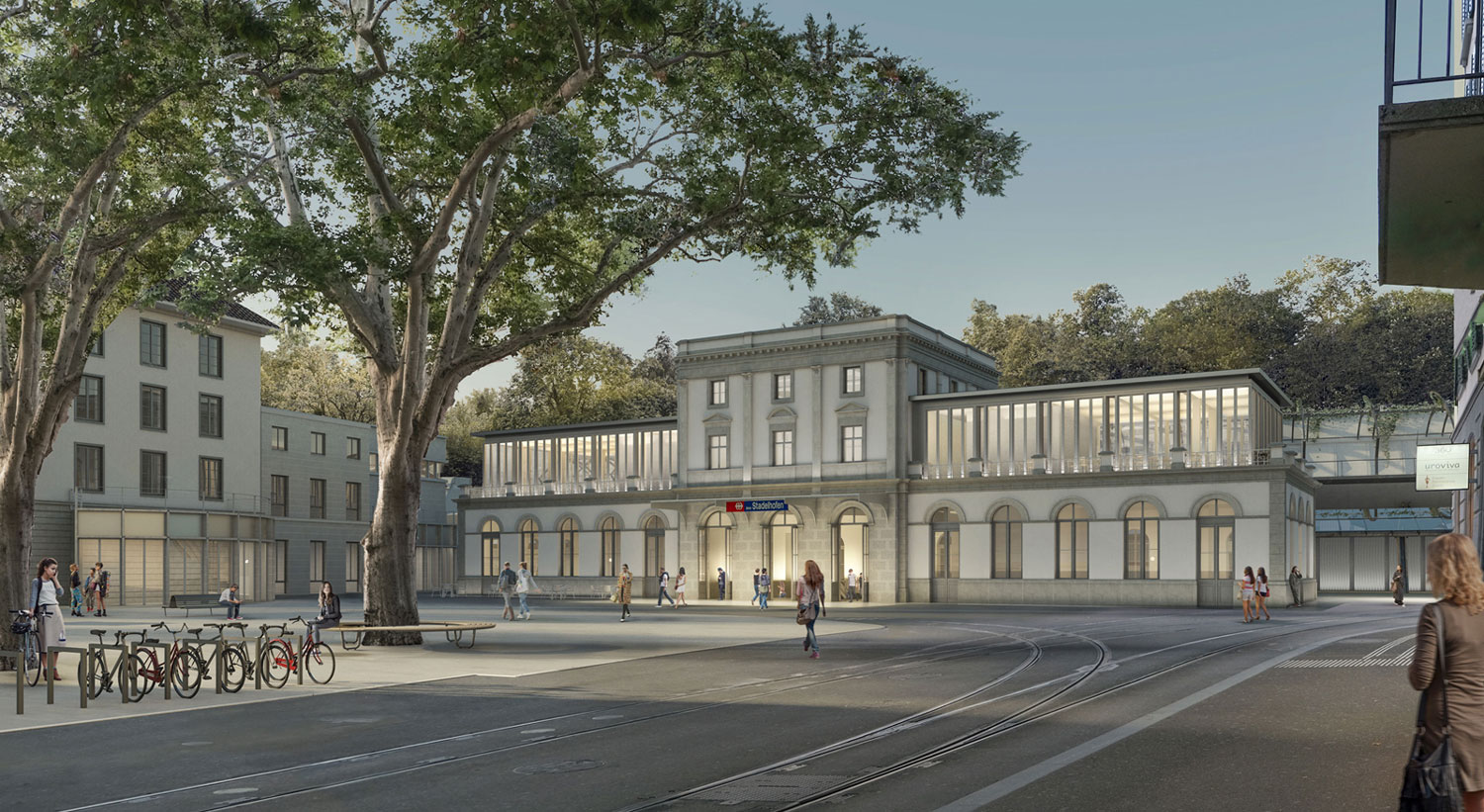
    With 80,000 travellers a day, Zurich Stadelhofen is a central transport hub in the city. However, the three existing tracks are overloaded and limit the growth of the S-Bahn. The construction of a fourth track and an additional tunnel in the direction of Tiefenbrunnen will massively increase capacity. An expansion that will have an impact far beyond the city limits.

    More capacity, better connections
    The expansion should enable up to 50 per cent more train movements. It paves the way for a comprehensive quarter-hourly service throughout the entire Zurich S-Bahn network. An improvement that will benefit not only the city of Zurich but also the 6 neighbouring cantons. The project involves several sections, including a new main access, improved passages and additional platform access in the Kreuzbühl-/Mühlebachstrasse area.

    Ten years of construction and an investment of CHF 1.1 billion
    The project will take around ten years to complete. If everything runs smoothly and there are no objections, construction should start in the second half of the 2020s, with commissioning scheduled for the 2030s. The estimated costs amount to around 1.1 billion Swiss francs. A significant but necessary step for a sustainable mobility infrastructure.

    Transparency and participation – project open to the public at
    The project will be open to the public in Zurich and Dübendorf from 14 May to 12 June 2025. The complete plans can be viewed in Zurich and those for the Zürichberg tunnel in Dübendorf. SBB specialists will be on hand to answer questions. A planned major expansion with room for dialogue.

  • The through station at LUGA 2024

    The through station at LUGA 2024

    The Lucerne through station is the focus of this year’s Luga, the Central Switzerland Spring Fair, which takes place from 26 April to 5 May 2024. The project of the century will be brought to life in three dimensions over an area of around 800 square metres. Visitors will have the unique opportunity to learn about the project in an interactive and playful way and experience its enormous benefits for the entire region.

    Government President Fabian Peter emphasises the importance of the special exhibition: “By presenting the Lucerne through station at Luga, we are giving the people of Central Switzerland the opportunity to experience the project up close and understand the added value it will bring to our region.”

    The special exhibition will not only take place in Hall 1, but can also be experienced on the exhibition forecourt. There, the focus will be on public transport, with various activities under the motto “experience, try out and join in”. Lucerne’s through station is more than just a railway station; it is a crucial building block for a denser public transport network throughout Central Switzerland.

    Over 100,000 people board, alight or change trains at Lucerne station every day. However, the capacity limit has been reached and additional connections are no longer possible. The Lucerne through station paves the way for the further development of sustainable mobility and enables a forward-looking design of the public transport network.

    The special exhibition on the Lucerne through station is a joint initiative of the Canton of Lucerne and the Lucerne Transport Association (VVL), supported by the City of Lucerne, the Central Switzerland Public Transport Conference and other partners.

  • Switzerland Innovation Park East offers jobs for travellers

    Switzerland Innovation Park East offers jobs for travellers

    In a pilot project, SBB and the Switzerland Innovation Park Ost are providing commuters with specially equipped workstations at St.Gallen station, according to a media release. Eight tables were built for this purpose by Agosti Meier AG from Waldkirch SG and equipped with electrical systems and wireless internet. Since 14 August, they have offered travellers the opportunity to creatively bridge waiting times.

    They meet “a great customer need” for work at the station as well, Michael Disch of SBB’s real estate management is quoted as saying. “With this initiative, we are turning St.Gallen station into a productive workplace.” In addition to the existing co-working spaces on the Innovation Park Ost campus in the west of the city, the spaces set up in the St.Gallen station concourse now also represent an opportunity for exchange and networking.

    The project is initially planned for three months. It is intended to provide food for thought for other similar projects. “Because with work and new ideas, it’s like travelling – if you never start, you can’t get anywhere,” Peter Frischknecht, Head of Campus at Switzerland Innovation Park East, is quoted as saying.

  • Basel: Visionary building planning on the Dreispitz North site

    Basel: Visionary building planning on the Dreispitz North site

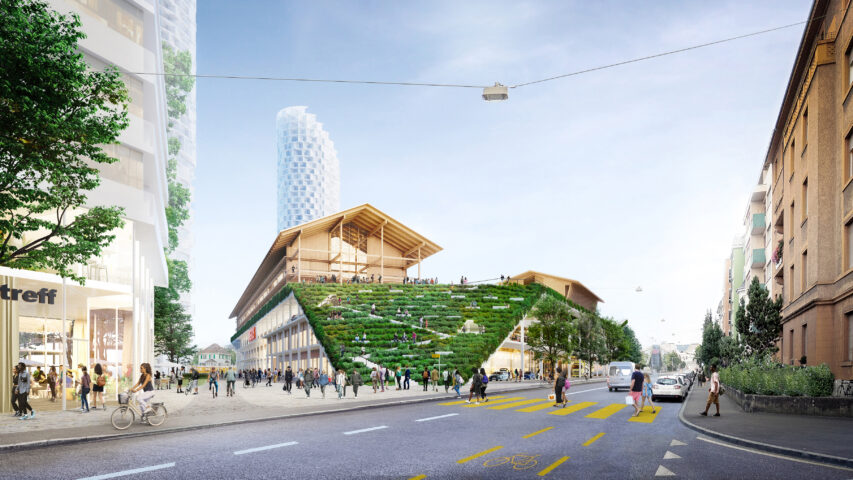
    The planning of Basel’s new Dreispitz Nord district in the “Gundeli” neighbourhood was penned by Basel architects Herzog & de Meuron. It fills the area with new life, the parking area disappears. On an area of about eight football pitches, space is created for a diverse further development of the neighbourhood.

    The direct access from Gundeldingen to Dreispitz Nord is an eye-catcher: via a wide, green ramp, a footpath leads to the roof of the new MParc shopping centre, where there is a unique view over the roofs of Basel.

    The new secondary school for about 600 pupils is also located on the roof of the shopping centre. There are sports fields, a triple gymnasium, green and open spaces and a youth club.

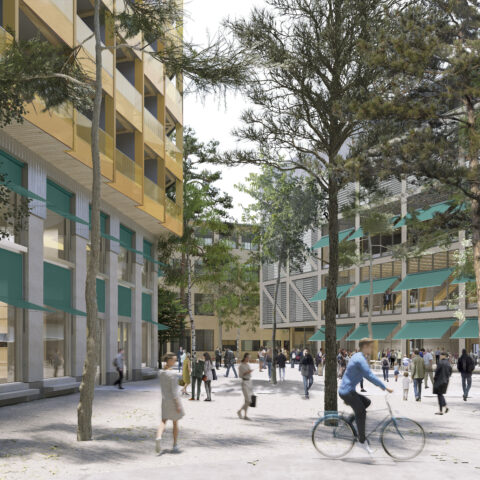
    The new public parks, the size of two football pitches, offer space for play and recreation with their large, shady trees. Pedestrians and cyclists have priority here, and the public space is to be car-free.

    800 flats are being built in Dreispitz Nord. In the far north, seven townhouses are planned with affordable or non-profit housing. In addition to attractive flats, the three round high-rises will also offer space for offices and other uses such as a library or a fitness centre.

    A secondary school for 600 pupils will be built on the roof of the MParc shopping centre.

    The area is already well served by public transport and is only three tram stops away from the SBB railway station. The new footpaths and cycle paths, car-sharing facilities and around 4000 bicycle parking spaces are intended to promote low-car living. Those who still need a car will have a parking space in separate parking facilities and will not have to search for parking spaces in the adjacent neighbourhood streets. A maximum of 662 parking spaces are planned for the new living and working areas. Access to the parking facilities on the northern edge will help keep the new district and the Gundeldingen neighbourhood car-free.

    The district development wants to lead the way as a model example of sustainable spatial development: Instead of sealed car parks, new green and open spaces will be created. Due to the high level of use, the use of land is economical. Existing jobs are preserved and new ones are to be created. A balanced range of housing for all incomes allows for a mix of residents. As part of the construction work, the existing MParc building will be integrated into the new complex. The spacing in the development on the northern edge and the spaces between the high-rise buildings allow air to circulate and ensure good ventilation. The green and open spaces provide cooling through shade and evaporation, and water can seep back into the ground, thus improving the urban climate.
    In September 2020, those responsible for the project presented the Dreispitz North guideline project to the general public. This serves as the basis for the development plan, the environmental impact assessment and the urban development contract. In order to include the neighbourhood interests in the best possible way, the planning partners have maintained a dialogue with neighbourhood organisations since the start of the project.

    In the first quarter of 2023, the public plan submission of the development plan and the environmental impact report should be ready. The parliamentary decision is expected in 2024. As soon as the decision is legally binding, construction project planning for the first stage can begin. Concrete construction measures can be expected from 2027.

  • Maaglive makes Zurich West even more attractive

    Maaglive makes Zurich West even more attractive

    Up to now, the Maag site has been characterised mainly by office use. The large-scale Maaglive project will give Zurich West a versatile and green centre with various uses by 2027. An ensemble of three buildings is planned: a residential tower with a roof garden and loggias, a four-storey cultural centre and the existing Building K, which will be renovated and converted.

    Building K will be protected as a historic monument – after all extensions have been removed. In the future, it will offer operational synergies with the neighbouring Kulturpavillon with a foyer, restaurant and bar as well as a market hall and book café. Wooden constructions provide for an attractive interior of the culture pavilion.
    The residential tower is characterised by flexible usage possibilities, with the residential area predominating. Office space and rooms for events complete the offer. A co-working space with café and wine bar will be incorporated into the two-storey base.

    The visualisation shows the town square near the tower.

    At the highest point of the tower – next to the green roof garden – residents will have access to a library and a communal kitchen. Public-oriented uses are planned for the ground floors. An area of around 6000 m2 is planned for the flats, 3000 m2 for the cultural and event area, and a further 3000 m2 for studios, co-working and gastronomy.

    The centre of the area is formed by the neighbourhood square, which is planted with up to 80 high-stemmed native trees and extends over 4000 m2 . The canopy of foliage thus created is intended to provide the square with the quality of stay that has been lacking up to now. Open spaces and additional green areas with seating as well as various play and rest areas will also provide more life on the site during the day. At the same time, this will optimise the microclimate and reduce the heat that accumulates in summer. The latter is a particular problem in the city centre. Maaglive also counters this with pavement structures that offer a certain degree of retention as well as heat reduction. The entire construction project focuses on circular building and the use of resource-efficient building materials.

    The historic Lichtstrasse and the Maschinenstrasse will be opened up to the public. In addition, new pedestrian and bicycle paths will be created. The project is the brainchild of the Berlin architectural firm Sauerbruch Hutton. Hager Landschaftsarchitekten is responsible for the landscape architecture. The owner of the site, Swiss Prime Site, has already submitted the building application. Realisation will begin in the 3rd quarter of 2024 at the earliest. If everything goes according to plan, Maaglive should be ready for occupation in the 3rd quarter of 2027.

    The cultural pavilion is intended to become a lively meeting place for art, the creative industries and the population.
  • Centurion Tower: Tight as an officer

    Centurion Tower: Tight as an officer

    With its clear volume, the new high-rise integrates itself as a matter of course into the urban structure of the new “Vision Mitte” quarter. It takes up the lines of the surrounding buildings and forms, so to speak, the last piece of the puzzle in the large cluster of buildings of the university of applied sciences and office and industrial buildings on this site. The building was not named after the number of flats, of course, but after the famous Roman excavation site in Windisch (Vindonissa).

    The right type of wall for every use
    The 16 condominiums are located on the top four floors of the tower, the 116 rental flats on the 3rd to 10th floors. On the lowest three floors, the Centurion Towerhotel with 66 flats and rooms meets the needs of many regional businesses as well as the neighbouring technical college. These different uses are reflected not least in the materialisation and design within the building. The tower was raised as a skeleton structure and completely finished with non-load-bearing gypsum drywall systems.

    The (almost) all-rounder
    Hydrophobised Rigips® Habito board plays a central role in the kitchens and wet rooms of the condominiums. It is probably one of the most versatile gypsum boards available and is suitable for residential, office and commercial construction, but also for hotels, hospitals and schools. During development, the focus was on an optimal room climate and easy processing. The revolutionary product was uncompromisingly optimised for these properties and equipped with the best performance data and a wide range of applications. The board is very robust, fire-resistant, sound-insulating, ecologically sustainable and efficient to work with.

    A lot of planning and conversion freedom
    As soon as a brick wall is replaced with the Rigips® Habito system, the advantages multiply. There is no need to measure and install load-reinforcing wall inserts, because force loads such as furniture, pictures or TV screens can be screwed on directly without dowels. For the same reason, there is no need to determine the wall inserts at an early stage, which increases planning freedom. Habito is therefore as stable as a Roman legionnaire or as a conventional solid wall. With all these strengths in terms of building physics and con-
    struction, thanks to planning with gypsum drywall systems, there remains sufficient flexibility for later conversions if the utilisation requirements of individual rooms or even floors should change.

    Gypsum drywall construction has also long been able to keep up at this level.

    ABOUT RIGIPS
    Rigips is a pioneer of dry construction in Europe and part of the Saint-Gobain Group, one of the most traditional and innovative industrial groups in the world. In Switzerland, Rigips AG is the leading producer and supplier of gypsum drywall systems and a reliable supporter in the planning and execution of sophisticated interior design solutions. Plasterboard systems from Rigips AG are developed to successfully and sustainably realise the goals of customers and partners.

    www.rigips.ch


  • Shoppi Tivoli takes over the Limmat Valley Railway station

    Shoppi Tivoli takes over the Limmat Valley Railway station

    With a ceremonial "key handover" the "Shoppi Tivoli" stop of the Limmattalbahn (LTB) was handed over to the Shoppi Tivoli shopping center by the operator Aargau Verkehr (AVA) on Monday. According to the Shoppi Tivoli media release, the management of Aargau Verkehr AG and Shoppi Tivoli Management AG and other guests, including the mayor of Spreitbach, Markus Mötteli, attended.

    For Severin Rangosch, CEO Aargau Verkehr, the realization of the Limmattalbahn is a commitment to the region. One believes in their potential, Rangosch is quoted as saying.

    Patrick Stäuble, center manager and CEO of Shoppi Tivoli, is quoted as saying that the management is "proud to be able to present the Shoppi Tivoli train station today". This is extremely important for the shopping center, but also for the adjacent facilities, including the environmental arena and the entire Tivoli Garden district with its housing, a medical center, shopping facilities and a kindergarten.

    The Shoppi Tivoli is preparing for the station by expanding its service to the special needs of travelers. There are already five new fast food restaurants at the entrance to the LTB train station. And they are still accessible after the official closing time. According to CEO Stäuble, this will also include a restaurant that is open seven days a week.

    “The stop will be directly under the CenterMall. So you get off the train, take the escalator and you're already in the Shoppi Tivoli. This connection will be a major milestone for us, because development is taking place along the Limmattalbahn," Stäuble was quoted as saying in an interview with the regional location promoter Limmatstadt AG.

  • Swiss train stations perform moderately

    Swiss train stations perform moderately

    Of 50 train stations in Europe that were examined, the train stations in Bern and Zurich performed moderately to poorly in terms of passenger-friendliness. According to a press release, Bern train station landed in 40th place in the European Railway Index 2021, while Zurich train station was in 21st place.

    The consumer protection group Consumer Choice Center , based in Washington, has examined in its index, among other things, the shopping experience, the accessibility, the WLAN network, the number of national and international destinations as well as the choice of travel providers.

    The main train station in Bern, for example, has toilets for wheelchair users, but with six shops and eight restaurants only a very limited range of options for eating and shopping. The Zurich main station offers more than 53 shops and 39 restaurants, but does not provide barrier-free toilets for wheelchair users.

    Leipzig Central Station performed best in front of Vienna Central Station and St. Pancras in London. According to a media release, the train station in the German state of Saxony offers most domestic destinations, many shops and restaurants, and several railway companies.

  • Dietikons Bahnhofsplatz is being redesigned with the SBB

    Dietikons Bahnhofsplatz is being redesigned with the SBB

    The planned competition program for the redesign of the Dietikon station area can now be started. The Dietiker city council has approved a loan of 56,000 francs for the preparation of the "Bushof / Bahnhofplatz competition program" and the necessary clarifications, according to a message from the city chancellery. The contract for procedural support had been awarded to the Zurich consulting firm Eckhaus AG. In addition to upgrading the public space with quality of stay and a wheelchair accessible hub for public transport, an attractive location for living and working is to be created on the SBB site, according to the city of Dietikon about the project .

    The city of Dietikon and the SBB jointly awarded an urban planning study contract for the Dietikon station area in 2019. The "in-depth study of the Dietikon station area" was exhibited in plans and models in November and December 2020 on the window front of the Dietikon town hall. The results report was also available on the Internet.

    According to the plans of the city of Dietikon, the bus station is to be redesigned around two islands. This creates a largely traffic-calmed space in front of the train station, which is to be landscaped and planted with trees to create a lingering zone. According to the announcement, the SBB wants to develop a lively district from its parcels west of the track field. The station building is to be extended. Two construction sites for an office building and a complex with 200 apartments are planned on the parking lot.

  • Domat / Ems station area is being converted

    Domat / Ems station area is being converted

    The Rhaetian Railway (RhB ) wrote in a press release that the Domat / Ems station area is getting "a new face". According to her, the Graubünden railway company will renew the Domat / Ems station and make it accessible for the disabled. "We are building a modern train station that is adapted to the needs of our customers and to those of the community," RhB director Renato Fasciati is quoted in the announcement.

    Specifically, the RhB wants to extend both platforms at the station and partially cover them. In addition, a pedestrian underpass is to be built and equipped with handicapped-accessible ramps and stairs. The municipality of Domat / Ems contributes two passenger lifts. In addition, the RhB plans to equip sidewalks and streets with a continuous separation at the three secured level crossings.

    At the same time, the municipality of Domat / Ems is tackling extensive changes in the station area. The heart of the building plans is a new commercial and residential building directly on the platform. The four-storey building will have space for public use on the ground floor and living and office space on the other three floors, according to the announcement. In addition, a new space is planned on the south side of the station. The number of bicycle parking spaces available at the station will be increased to around 300. All construction work planned by the municipality and the railway company should be completed in summer 2023.

    "Good transport links are central to the community of Domat / Ems – for the numerous commuters, but also as an important commercial and industrial location," said Mayor Erich Kohler (CVP) in the message. "The overall project creates a modern, functional train station area that optimally meets high requirements for user-friendliness and audience-oriented uses."

  • Construction plans in Zurich North Next step for densification in Neu-Oerlikon

    Construction plans in Zurich North Next step for densification in Neu-Oerlikon

    Zurich's plans for Neu-Oerlikon: This is how the space around the train station should be designed. Red are buildings with a height of 80 meters, orange are those with a height of 54 and yellow are those with a height of 45 meters. Image: Master plan 07/10/2018

    More apartments, more jobs, more shops, more culture. North of the Oerlikon train station, “an attractive, urban-planning center is to be created”, says structural engineering supervisor André Odermatt (SP). To this end, the city council approved a partial revision of the Neu-Oerlikon special building regulations from 1998.

    The new regulations are a "huge opportunity" for Oerlikon, says Odermatt. "We are improving the plans from the 1990s and bringing them to a close."

    The partial revision allows a clear consolidation. Two skyscrapers with heights of 80 and 54 meters are planned on Max-Frisch-Platz. A total of 400 to 500 new apartments are to be built between Binzmühlestrasse and Oerlikon train station. In around half of them, non-profit housing construction is possible, according to the Urban Development Office.

    ABB cedes city property

    The city developed the plans together with the three major landowners, the canton of Zurich and the companies ABB Immobilien AG and AXA Leben. The city can claim some of the profit generated by the rezoning.

    The city receives money from the canton and AXA Leben – how much is not yet public. She would like to use the amount to improve the infrastructures in the neighborhood. ABB Immobilien will provide the city with the property on which Hall 550 is located. "In this way we can secure the existence of Hall 550," says Odermatt. This makes an important contribution to the cultural offerings in Oerlikon. The city is also taking over the property south of it. There she is planning charitable apartments.

    The special building regulations guarantee that with Hall 550 and the former ABB brick building 87T, two buildings from the industrial past will remain. In addition, they should create a greener quarter. Max-Frisch-Platz and a pedestrian zone are being enlarged. Shops and restaurants on the ground floors should keep the streets busy.

    Next, the local council will discuss the new building regulations. They will come into force in mid-2022 at the earliest. Then the owners can start planning their properties.

  • Almost all of the new apartments in Würenlos have been sold

    Almost all of the new apartments in Würenlos have been sold

    In the middle of the center of Würenlos, the new Steinhof settlement with eight apartment buildings is being built directly on the Landstrasse. They offer 85 apartments and the community is expected to have around 200 residents. The first tenants or buyers should be able to move in in August 2022. Most of the two and a half to five room apartments have already been sold, according to an article in the “ Badener Tagblatt ”. However, there should also be buyers of an entire house among the investors, so that rental offers can also be expected in the future. “We expected a run on the apartments. But we would never have thought that things would go so well, ”said architect Martin Thalmann , whose company is located in Wettingen AG.

    The settlement is close to the town center and the train station and also close to a forest, so that leisure time in close proximity to nature is possible. The client is Immopuls AG. The modern buildings also have underground parking garages.

    The settlement is named after the traditional Steinhof inn . It was closed for a long time and only reopened as a hotel and restaurant in August after modernization. “Gasthof Steinhof, founded in 1850, has always been a veteran of hospitality and conviviality in Würenlos. In the middle of the 20th century it developed into a popular excursion destination in the region, not least thanks to a huge lawn for sunbathing and the associated zoo, ”says a self-portrait on the hotel’s website. This is now run by the Lisa and Juan Rodriguez family.