Tag: Bahninfrastruktur

  • From the construction group to the top of the railway

    From the construction group to the top of the railway

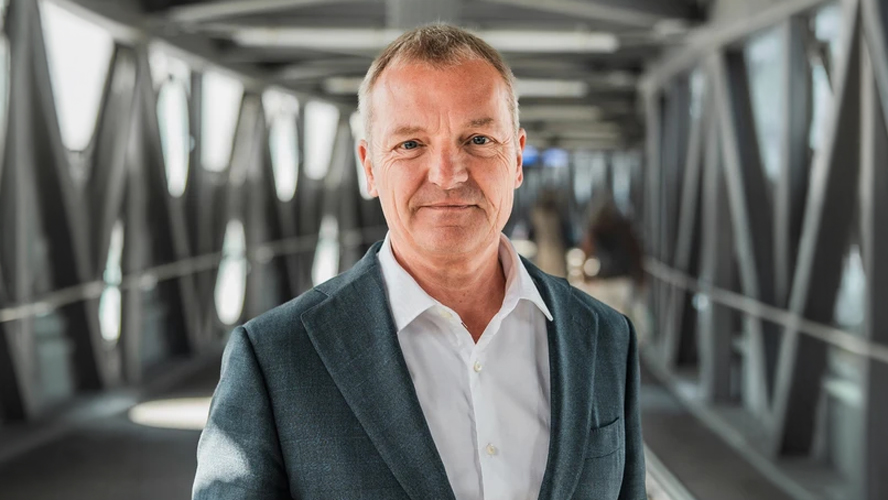
    After twelve years on the Board of Directors, ten of them as Chairwoman, Monika Ribar leaves behind an institution that has changed. The term limit ended her commitment, not her will. Together with her, Vice-Chairman Pierre-Alain Urech, Georg Kasperkovitz and Clara Millard Dereudre are leaving the Board.

    A lateral entrant with a system
    André Wyss was born in 1967, completed an apprenticeship as a chemical technician, studied economics part-time and furthered his education at Harvard Business School. Before joining Implenia as CEO in 2018, he was responsible for around 40,000 employees at Novartis. He brings 40 years of management experience in the construction, property and pharmaceutical industries to his new role. He has already been a member of the SBB Board of Directors since August 2024, so the handover went smoothly.

    Construction meets rail
    What seems like an unusual career move at first glance makes sense on closer inspection. SBB is not only a railway operator, it is also one of the largest property owners in Switzerland. Wyss has first-hand knowledge of complex infrastructure projects, sustainable construction and the political framework conditions in Switzerland. This is precisely why the Federal Council saw him as the right candidate.

    Stable course, new impetus
    Wyss has clearly communicated what he wants: to further develop SBB as the modern and sustainable backbone of Switzerland, focussing on stability and innovation. For its part, SBB is pursuing the goal of being climate-neutral by 2030. This is precisely where Wyss and the new composition of the Board of Directors come in.

    Four new members strengthen the Board
    Four new members were elected to the Board of Directors at the same time as Wyss: Anna Barbara Remund, Dino Cauzza, Dominique Pierre Locher and Maria-Antonella Bino. They are intended to complement the Board professionally and bring new impetus without changing course. The Board of Directors was constituted directly after the Annual General Meeting in Berne.

  • Railroad modernization in the sensitive Alpine region

    Railroad modernization in the sensitive Alpine region

    STRABAG AG is carrying out the outstanding renovation work on the Zentralbahn line between Meiringen and Brienzwiler in the Bernese Oberland. The narrow-gauge line runs on a single track along the Hasliaare, which is part of the Aare flood plain. Out of consideration for several nature conservation areas, “maximum precision for logistics and coordination” is required for the new construction, according to a press release. Preparatory work began in March 2025 and the ten-week intensive phase has been underway since October 2025.

    Heavy rainfall events had repeatedly occurred in the area, causing the railroad embankment and superstructure to flood, resulting in damage to the railroad infrastructure and adjacent cultivated land. STRABAG already carried out track construction work there in 2022 and 2023 (lots 1 and 3). The modernization project will now be completed with a total reconstruction of the challenging middle section of lot 2 over a length of 2600 meters and in the middle of the Sytenwald nature reserve. This involves raising the railroad embankment. To allow surface and slope water to drain away, a continuous planned drainage system will be installed along the route. The area along the Hasliaare will receive a new flood protection wall.

    According to the press release, the “tight space conditions and local lack of redundant construction slopes in certain sections between the Hasliaare, the railroad line and several nature conservation areas” are a special construction feature, which requires special precautions for ecology and landscape protection. On the one hand, STRABAG is building 30 new foundations for the catenary masts on the side facing away from the river, and on the other, 37 crossings are to ensure the ecological continuity of the terrain. This means protection for wildlife and small animals when crossing the section.

    A particularly challenging component is the new construction of the Hüsenbach bridge made of ultra-high-strength and durable fiber-reinforced concrete (UHPC). During bridge construction, special consideration was given to the trout population present there at spawning time.

  • New railway line in Sweden takes shape

    New railway line in Sweden takes shape

    Construction services provider Implenia has been awarded the contract for the first construction phase of the new East Link railway line by the Swedish Transport Infrastructure Agency (Trafikverket). According to a press release, the project is worth CHF 130 million. Implenia will build the 8-kilometre section of the Bibana Nyköping line by 2031.

    This is a section that connects the centres of Skavsta and Nyköping with the main route of East Link. East Link connects several coastal towns in eastern Sweden with Stockholm. Implenia’s contract includes bridges, railway tracks, refurbishment of existing buildings and other work.

    According to Erwin Scherer, Head Division Civil Engineering, Implenia is helping to “take the mobility infrastructure in eastern Sweden to a new level”.

  • Milestone at Basel railway station

    Milestone at Basel railway station

    Basel SBB railway station is facing a problem. It is reaching the limits of its capacity. The increasing number of trains and travellers, especially at peak times, requires urgent measures to avoid bottlenecks.

    From December 2025, it is planned that the S-Bahn trains between Basel and Liestal will run every quarter of an hour. This ambitious goal requires considerable investment in the railway facilities between Basel and Liestal, which the federal government is financing to the tune of around CHF 1 billion. SBB is responsible for realising these projects on behalf of the federal government, while the federal government and the cantons are jointly ordering and financing the additional S-Bahn connections.

    Most of the investments are included in the 2025 expansion phase, which is part of the “Financing and expansion of the railway infrastructure” (FABI) bill that was approved by the Swiss electorate in February 2014. These expansions not only enable the quarter-hourly S-Bahn service between Basel and Liestal, but also lay the foundation for further improvements in passenger and freight transport.

    Two main measures are required to create the capacity for the planned quarter-hourly service and the extended timetable.

    Additional stops for trains: The planned quarter-hourly frequency will increase the number of trains at Basel SBB station. Additional stopping points and platform edges are therefore required to ensure smooth operations. This is the main objective of the “Basel SBB performance enhancement” project.

    Additional crossing options for travellers: The increasing number of trains leads to more travellers and thus to higher utilisation of the Passerelle at Basel SBB station. In order to cope with this increase, the creation of additional crossing facilities is urgently required. The “Provisional Passerelle” project aims to realise this increase in capacity quickly until further crossings, such as the Margarethen platform access, can be built.

    The temporary pedestrian crossing is a temporary solution until long-term measures can be implemented. The planning and construction of further crossings are planned for the 2035 expansion phase and will also be financed by the federal government.