Tag: Bahnverkehr

  • Basel SBB West sets new standards

    Basel SBB West sets new standards

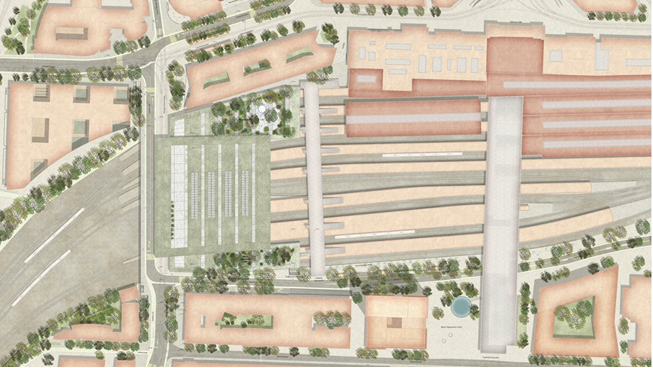
    Das gemeinsame Projekt von SBB, Bund und Kanton Basel-Stadt zielt auf einen Ausbau des Bahnhofs Basel SBB mit höherer Kapazität und verbesserten Verbindungen in Richtung Westen. Kernstücke sind zwei Grossprojekte, die neue Margarethenbrücke und der Perronzugang Margarethen. Ein interdisziplinäres Gremium hat Ende Mai 2025 das überzeugendste Konzept im Rahmen eines Studienauftrags gekürt.

    Das Siegerprojekt des Zürcher Teams Penzel Valier bringt eine innovative architektonische Lösung. Ein leichtes, ausgedehntes Dach überspannt künftig Tramhaltestelle und Perrons. Es schafft nicht nur eine neue Bahnhofshalle mit hoher Aufenthaltsqualität, sondern bietet auch Platz für Begrünung und Photovoltaik.

    Verbindung von Funktion und Gestaltung
    Die neue Brücke und der Perronzugang fügen sich harmonisch in das städtische Umfeld ein. Dank schlanker Tragwerke können die Anschlüsse zu den umliegenden Quartieren tief gehalten werden. Die Halle SNCF, ein denkmalgeschütztes Element, bleibt erhalten und wird sorgfältig in das neue Gefüge integriert.

    Ein differenziertes Wärmemanagement und die geplante Flexibilität bei späteren Erweiterungen zeigen, das Projekt denkt in Etappen und bietet langfristige Perspektiven für die Mobilität der Region.

    Umsetzung in Etappen, mit Fokus auf Qualität
    Die neue Infrastruktur wird frühestens ab 2034 realisiert. Grund dafür ist die komplexe Ausgangslage. Neben dem laufenden Bahn- und Stadtverkehr sind auch denkmalpflegerische Auflagen und ein möglicher zukünftiger Tiefbahnhof zu berücksichtigen.

    Beide Teilprojekte, die Brücke und der Zugang, können unabhängig gebaut werden, doch Bund, Kanton und SBB streben eine gemeinsame Umsetzung an. Die voraussichtlichen Kosten liegen je Projekt im dreistelligen Millionenbereich. Während der Zugang Margarethen bereits finanziert ist, steht die Finanzierung der Brücke noch aus.

    Neue Mobilitätsdrehscheibe mit Symbolkraft
    Mit Basel SBB West entsteht nicht nur zusätzliche Bahninfrastruktur, das Projekt schafft neue Räume für Stadtentwicklung, nachhaltige Mobilität und Aufenthaltsqualität. Es ist ein Musterbeispiel für die Integration von Verkehr, Architektur und Städtebau in einem historischen Kontext. Die öffentliche Ausstellung des Siegerprojekts findet vom 19. bis 28. Juni 2025 statt, ein öffentlicher Infoanlass folgt am 25. Juni.

  • Tunnel instead of bottleneck: SBB upgrades line between Zurich and Winterthur

    Tunnel instead of bottleneck: SBB upgrades line between Zurich and Winterthur

    Today, all rail traffic between Zurich and Winterthur uses the only double-track connection via Effretikon. This section of the line is therefore a veritable bottleneck. To eliminate the bottleneck, SBB is upgrading the line on behalf of the federal government. A new double-track line through the Brüttener Tunnel as well as the expansion of four stations and existing lines should bring relief.

    The core of the Zurich-Winterthur multi-track project is the Brüttener Tunnel. It will be about 9 kilometres long and have two tunnel tubes with one track each. Trains will travel at 160 kilometres per hour. The journey time in the tunnel is around 3 minutes.

    The northern portal of the Brüttener Tunnel is at Tössmühle before Winterthur. The tunnel tubes divide and end in two tunnel portals in the south: at Bassersdorf and at Dietlikon. This route is the fastest and most efficient connection between Zurich and Winterthur, as it connects both Zurich Airport (via Bassersdorf) and Zurich HB (via Dietlikon) directly to Winterthur. Because most of the new double track runs underground, no major interventions in the landscape will be visible after construction.

    The project will increase the rail capacity between Zurich and Winterthur by 30 per cent to around 900 trains and 156,000 passengers per day. Two long-distance lines will run between Zurich and Winterthur every quarter of an hour in future.

    The project will be made public at the end of May 2023. If the project progresses without any appeal proceedings, construction work is currently expected to start in the mid-2020s and the service could be put into operation in the mid-2030s.

    With the “2035 expansion stage”, the federal government is investing around CHF 12.89 billion in numerous projects to expand the railway infrastructure throughout Switzerland. The “Zurich-Winterthur multi-track” project is the largest of these projects, with estimated costs of around CHF 2.9 billion.

  • Plans for Bern’s West railway expansion project are on the table

    Plans for Bern’s West railway expansion project are on the table

    Bottlenecks occur time and again at the Bern railway junction, which have an impact on all long-distance traffic in Switzerland. With the Federal Expansion Plan 2025 (AS25), such bottlenecks will be eliminated and rail operations in Switzerland will be further optimised: There will be more stable and more connections between Bern and Zurich, a half-hourly service to Lucerne and Neuchâtel, and more trains on the Bern-Thun line. In future, there will be an S-Bahn train every quarter of an hour between Bern and Münsingen, and there will also be more connections between Bern and Burgdorf.

    Various projects planned
    Five sub-projects are planned for the overall AS25 project “Performance improvement Bern West”:
    – the Holligen disentanglement with the 1.7 km long new Holligentunnel
    – the Aebimatt stabling facility
    – the west end of Bern railway station
    – the Europaplatz Nord stop
    – the Steigerhubel passerelle for pedestrian and bicycle traffic

    The new Europaplatz Nord stop also includes a new pedestrian subway for the city of Bern. A separate planning approval procedure will be submitted later to the Federal Office of Transport (FOT) for the west end of Bern station.

    Construction work will take twelve years
    Construction is scheduled to start in spring 2025. The new station with the project name Europaplatz Nord will go into operation in 2028 and will thus replace the existing Stöckacker stop located a few hundred metres to the west. Passengers are expected to travel through the Holligentunnel for the first time in 2034. As things stand today, it will take until 2036 for the entire project to be completed.

    In February 2023, SBB submitted the dossier for the planning approval procedure to the Federal Office of Transport. The public consultation will take place in Bern from 15 May 2023 to 13 June 2023.

    As things stand today, the estimated costs for the “Bern West service enhancement” amount to around CHF 750 million (+/- 10%). The project will be financed through the federal government’s extension step 2025 (AS25).

    Information room opens its doors
    An information room will be open during the planning period so that residents and interested parties can obtain comprehensive information about the project. It is located in the BLS building at Stöckackerstrasse 25 in 3018 Bern.

    Further information on the project can be found at sbb.ch/bernwest

  • Plans for “Unbundling Gümligen South” are on the table

    Plans for “Unbundling Gümligen South” are on the table

    In order to be able to implement the service improvements ordered in the Federal Expansion Plan 2025 (AS25), a new railway tunnel is to be built near Gümligen. Together with other projects from the AS25, the “Unbundling Gümligen South” will make it easier for trains to cross. In the long term, this will make it possible to run a quarter-hourly service on the Berne-Muensingen S-Bahn, coupled with a half-hourly service on the Berne-Langnau S-Bahn, as well as additional capacities for long-distance traffic and freight traffic in the Aare Valley. The “unbundling of Gümligen South” provides passengers with more stability in the timetable and, together with other projects, more connections.

    450 metres of tunnel for easier crossing of trains
    Specifically, SBB is planning a new, 450-metre-long railway tunnel underneath the existing railway line between Muri and Rüfenacht/Allmendingen, in the Hüenli forest. In order to be able to operate the new tunnel, SBB must also replace the existing Gümligen signal box and relocate the transmission line in the affected area.

    Around 5 years construction time
    As things stand today, construction is scheduled to begin in May 2024. The new transmission line is scheduled to go into operation one year later and the new signal box another year later. Passengers are expected to travel through the new tunnel for the first time in mid-2028; according to current planning, it will take until the end of 2029 to complete the entire project.

    In December 2022, SBB submitted the dossier for the planning approval procedure to the Federal Office of Transport. The planning documents will be open to the public from 1 May 2023 to 30 May 2023 at the municipal administrations of Muri bei Bern, Allmendingen, Worb, Ostermundigen, Vechigen, Stettlen and Krauchthal.

    The estimated costs for the “Unbundling Gümligen South” are around CHF 200 million (+/- 10%). The project is being financed through the federal government’s 2025 expansion stage.

    Further information on the project can be found at sbb.ch/guemligen.