Tag: Baubewilligung

  • Whoever blocks, pays

    Whoever blocks, pays

    The majority of building permit procedures in Switzerland take place within reasonable time limits. However, there are exceptions and these have a serious impact. Objections and appeals can block projects for years or prevent them altogether. Today, even people who are not directly affected by a project can lodge an objection, for example because they don’t like the color of the neighbor’s planned façade. This is one of the structural weaknesses that the Federal Council is now addressing.

    Housing construction becomes a national objective
    The strongest lever in the reform package lies in the Spatial Planning Act. Housing construction as part of inward settlement development is to be enshrined there as a national interest. This sounds technical, but has a concrete effect. When weighing up interests, housing construction would be given more weight than the protection of the townscape or listed buildings. Projects that currently fail due to local protection interests would have a better chance of being realized.

    Objections with consequences
    Anyone who raises objections improperly, i.e. with the sole aim of delaying a project, should in future bear the procedural costs. The Federal Council is considering a legal obligation for the cantons to impose such costs on objectors. At the same time, the right of private individuals to appeal to the Federal Supreme Court is to be restricted. However, the Federal Council rejects flat-rate fees for rejected appeals. Access to legal protection should not depend on your wallet.

    The limits of the federal government
    Despite the political will, the federal government’s scope for intervention is limited. Building permit procedures are the responsibility of the cantons. The federal government cannot impose binding deadlines for cantonal procedures or the obligation to introduce digital approval processes. It recommends that the cantons introduce such measures on their own responsibility, as they have a demonstrably accelerating effect in the long term. The Swiss Construction Industry Association supports this approach and is calling for leaner processes while maintaining a high level of planning quality.

    Consultation
    The reform report fulfills five postulates from the National Council and Council of States and is part of the federal government’s housing shortage action plan. DETEC has now been instructed to draw up a consultation draft by the end of 2026. It is likely to be years before concrete legislative changes come into force.

  • Zurich tests AI in the building permit process

    Zurich tests AI in the building permit process

    From April 2027, the canton of Zurich will require all municipalities to use the eBaugesucheZH platform. This lays the foundation for digitization, but only the foundation. The content of the applications will continue to be processed in different systems, depending on the municipality or canton. This historically evolved system landscape leads to media disruptions, manual coordination rounds and data inconsistencies.

    What the FHNW study shows
    The Building Directorate commissioned the FHNW Institute of Digital Construction to conduct a potential study along the entire process chain. 15 fields of action were identified, from initial digital information to building acceptance. The greatest short-term potential lies at the very beginning. Chatbots for the initial consultation, structured submission support and automated preliminary checks could immediately improve the quality of submitted applications and significantly reduce queries. Many improvements can already be achieved with rule-based systems, without generative AI.

    Prototype with the city of Kloten
    The Innovation Sandbox for AI of the Office of Economic Affairs tested an AI-based preliminary check for the notification procedure together with practice and technology partners, including the city of Kloten. For simple projects such as solar installations or heat pumps, a rule-based system automatically clarifies the admissibility and choice of procedure, and an AI then checks the completeness and quality of the entries. 3336 tests were evaluated. The results are encouraging, even if the reliable interpretation of complex plan representations remains an open challenge.

    Humans remain responsible
    Both studies agree that complete automation is currently not realistic. Where decision-making logic is clearly defined, rule-based systems are preferable to generative AI. The authority to make decisions remains with humans. Legal issues relating to data protection, liability, transparency and copyrighted blueprints as AI training material must be examined in depth before any implementation.

    The results are now being incorporated into the further development of eBaugesucheZH. Individual applications are to be tested in pilot municipalities. Zurich is thus demonstrating how the careful, step-by-step use of AI can work in a complex administrative domain.

  • When cantons go from being a drag to a location factor

    When cantons go from being a drag to a location factor

    In several cantons, digital building permits are no longer a vision of the future, but part of everyday life. Building applications are submitted via central platforms, distributed digitally and reviewed in standardized processes. This relieves the burden on administrations, planners and building owners and makes procedures more transparent for all parties involved.

    Pioneers rely on clear cantonal solutions and cooperation. Shared platforms reduce costs, pool expertise and prevent isolated solutions. At the same time, digitalization is only effective if it is not thought of as an IT project, but as a change to the entire process, from submission to decision.

    Who already approves digitally
    Several cantons use canton-wide platforms to submit and process building applications electronically. Bern with “eBau”, Zurich with “eBaugesucheZH”, Graubünden with ebau.gr.ch or Valais with “eConstruction” show what a digitally managed procedure looks like, in some cases obligatory or with transitional periods. Other cantons such as Solothurn or Aargau rely on the common open source solution Inosca and are introducing their systems in stages.

    However, the degree of digitization differs significantly. In some cantons, digital submission is mandatory; in others, analog and digital channels run in parallel or there are only pilot municipalities. There is no complete, up-to-date overview across Switzerland, and not every platform already maps the process fully digitally end-to-end.

    Politics between speed and legal protection
    Politically, the building permit process is caught in the crossfire. On the one hand, there is the housing shortage, energy and climate targets, and on the other, federalism, appeal rights and complex technical specifications. Business associations are calling for shorter deadlines and more binding regulations, while municipalities and cantons are insisting on their own responsibilities and limited resources.

    Digitalization reveals these tensions. It makes it clear how many places a dossier affects, where there are snags and how different practices are between the cantons. However, it does not replace political decisions. Whether objections are restricted, procedures harmonized or deadlines shortened remains a question of power, not software.

    Costs, benefits and risks
    For administrations, the switch to digital procedures is a tour de force. New specialist applications, interfaces, training and change management cost time and money. Smaller municipalities in particular are reliant on cantonal platforms and joint solutions to carry the burden.

    On the other hand, there are tangible effects. Fewer interruptions to a process, fewer multiple entries, faster workflows. Even more important are the indirect effects. Every shortened approval week reduces project and financing costs, increases the ability to plan and makes a location more attractive. At the same time, the handling of data remains sensitive. Transparency, data protection and acceptance must be carefully balanced.

    From e-dossier to intelligent inspection
    The digitalization of building permits is only just beginning. In the short term, the aim is to introduce cantonal platforms across the board, eliminate media disruptions and manage building applications digitally throughout. At the same time, expectations are growing. Planners want digital interfaces, investors want reliable deadlines and municipalities want more control options.

    In the medium term, the focus will shift to automated plausibility and rule checks, the integration of planning and construction data and AI-supported assistance. They can speed up procedures, enforce standardization and direct resources to those cases where political or technical decisions really need to be made. Whether building permits in Switzerland go from being a drag to a strategic locational advantage will depend on how consistently politicians and administrators manage this change and whether they are prepared to shake up rules, roles and routines.

  • Green light for cargo sous terrain

    Green light for cargo sous terrain

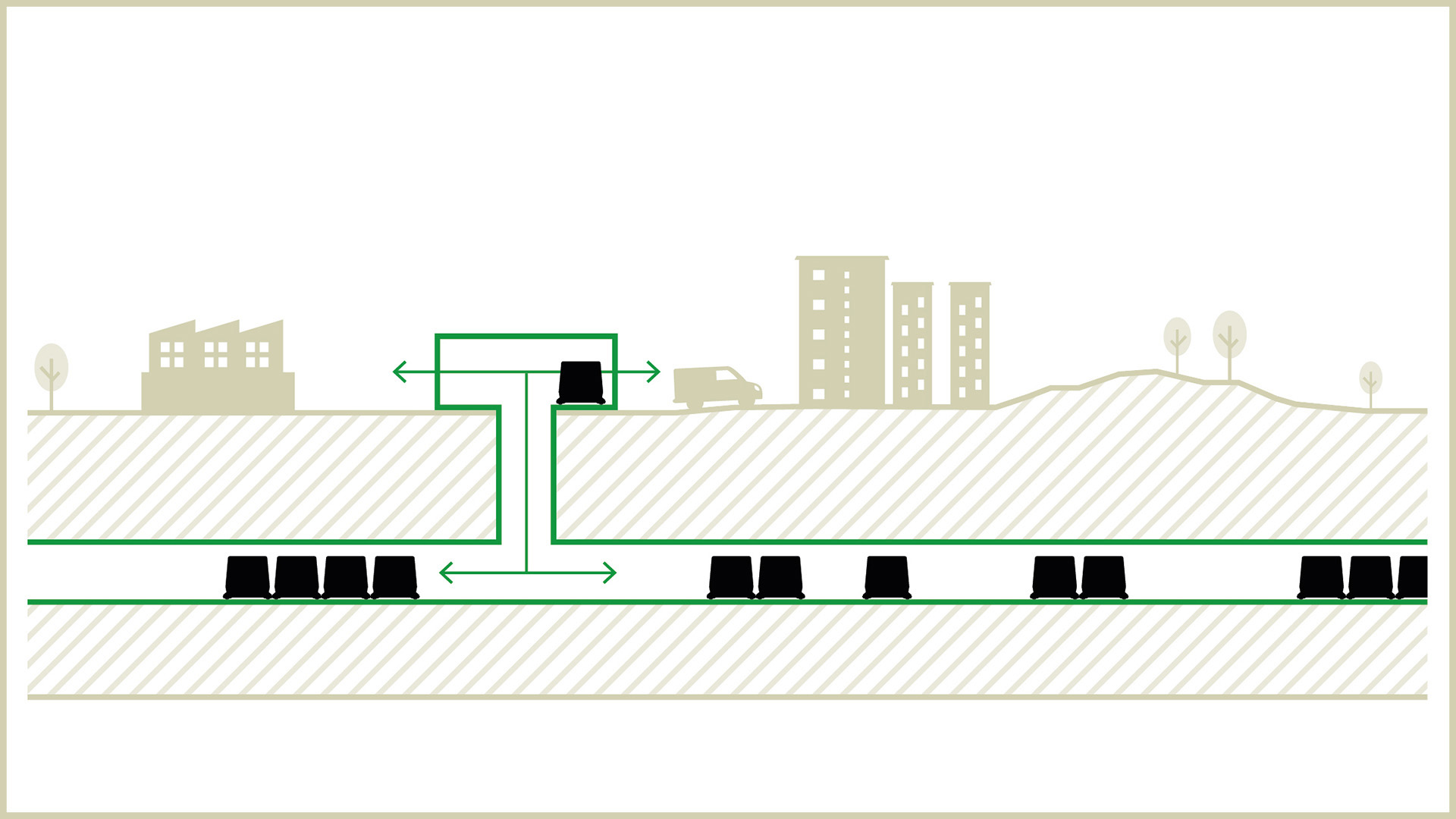
    With the Federal Council’s sectoral plan decision, the innovative Cargo sous terrain freight transport system is officially anchored in spatial planning for the first time. The privately initiated project will transport goods through an underground tunnel system from the Swiss Plateau to the cities. This will be done around the clock, with low emissions and independently of road traffic.

    The basis for this is the Federal Act on the Underground Transport of Goods (UGüTG), which came into force in 2022. It enables companies like CST to plan and implement such systems under clear legal conditions.

    First stage between Härkingen and Zurich defined
    The federal government has now defined the spatial planning corridor for the first section from Härkingen to Zurich in the newly inserted part of the sectoral transport plan. The planned locations for the logistics hubs are also spatially localised in the plan. The plan thus creates planning and legal certainty for all levels involved, from the federal government to the cantons and municipalities.

    Critical points will be incorporated into further development
    The cantons and municipalities affected were able to express their opinions during a consultation in the first half of 2024. Issues discussed included the impact on groundwater, the volume of traffic at the hubs and the handling of excavated material from tunnelling. The feedback will be integrated into the further development of the sectoral plan. According to the federal government, there are no contradictions with existing structure plans.

    Important step on the way to the construction permit
    The entry in the sectoral plan fulfils a key requirement for the subsequent construction permit. Further authorisation and approval procedures are still to come, but the current decision significantly strengthens the feasibility of the overall project.

    Paving the way for a new logistics era
    With the sectoral plan decision, the Federal Council is sending a clear signal in favour of sustainable and innovative infrastructure development. Cargo sous terrain could revolutionise freight transport in Switzerland in the long term – underground, quiet and space-saving. The spatial planning framework is in place, now the next stage of implementation begins.

  • Bergdietikon grants building permit for retirement and care centre

    Bergdietikon grants building permit for retirement and care centre

    The Bergdietikon municipal council has given the green light for the construction of a retirement and care centre in the Hintermatt area, according to a statement from the Oase Group. Retirement flats and care places are to be built there. The building permit is expected to come into legal force at the end of May, according to the municipality’s press release.

    Planning for the Hintermatt retirement and care centre in the Kindhausen district of Bergdietik has been ongoing for around twelve years, according to the press release. It began with a municipal assembly and the sale of the land in Hintermatt to Oase Holding AG in Baar ZG. Oase submitted the planning application in November 2023.

    The Oase Group, based in Dübendorf ZH, currently operates a wide range of residential concepts in the areas of retirement living, assisted living, care for people in need of care and long-term and palliative care at eight locations throughout Switzerland, according to the company. A further seven projects, including Bergdietikon, are in the planning stage.

    According to the guideline project on which the design plan is based, Oase will build a centre with around 64 retirement flats and 45 care places. Seven parties objected to the planning application. After the public consultation was completed in summer 2024, several objection negotiations took place between the developer and the objectors. The negotiations were concluded before Easter and the municipal council issued the building permit at its meeting on 22 April, according to a statement from the municipality.

    According to the plans of the municipality and the Oase Group, the new retirement and care home is set to open in the fourth quarter of 2027.

  • How nonsensical regulations are slowing down residential construction

    How nonsensical regulations are slowing down residential construction

    In Swiss cities, rental flats are scarce and expensive, and there are many reasons for this. One decisive factor is the increasingly long waiting time between planning application and building permit. The number of waiting days has increased by around 12 per cent on average across Switzerland in the last ten years. Whereas a decade ago, building applications still took an average of 118 days to be approved, today the figure is already 133 days.

    The cantons of Geneva, Fribourg and Basel-Stadt are particularly affected, where it takes up to 188 days to review a planning application. The waiting time in the canton of Zurich is also considerable at 152 days. These delays are a symptom of more far-reaching problems in the Swiss construction industry.

    Nonsensical regulations act as a brake
    Architects and experts see nonsensical building regulations as a key obstacle to the rapid construction of new rental flats in urban centres. Peter Sturzenegger, owner of the architectural firm Isler Architekten AG in Winterthur, cites the multiple length allowance (MLZ) as an example. This regulation stipulates that the boundary distance must be increased for buildings over 14 metres in length, which has made many construction projects impossible. In Winterthur, it is planned to abolish this regulation by the end of 2025, but in other cities such as Zurich, the future of this rule remains uncertain.

    Outdated laws and their consequences
    Another example of outdated building regulations is the orientation of living spaces in the canton of Zurich. The Planning and Building Act requires that the majority of living spaces must not face north-east or north-west in order to maximise daylight and prevent mould growth. However, Pascal Müller from Müller Sigrist Architekten AG argues that this regulation is no longer appropriate in the context of today’s urban conditions, such as noise pollution and climate change.

    In addition to the legal hurdles, Müller also criticises the role of the courts. The large number of court rulings and judgements creates uncertainty for building owners, as they constantly change the regulations and significantly restrict the scope for planners.

    Monument protection and energy-efficient refurbishment
    Aargau architect Daniel Huber emphasises the restrictive requirements for monument protection and the complex requirements for energy-efficient refurbishment as further obstacles. For him, the inconsistent implementation of building regulations, which depends heavily on the interpretation of the responsible authorities, is particularly problematic.

    The mass of regulations as a central problem
    The Swiss Federation of Master Builders sees the growing number and complexity of building regulations as the biggest challenge. Jacqueline Theiler, Head of Communications at the association, explains that the increasing density of regulations and the associated appeal procedures considerably lengthen the building permit process. The over-interpretation of existing noise regulations by the Federal Supreme Court is particularly problematic.

    The association is now pinning its hopes on swift changes to the law by parliament in order to get the faltering housing construction back on track and realise the urgently needed flats in Switzerland.

  • Easier building in noisy areas

    Easier building in noisy areas

    As part of the revision of the Environmental Protection Act, the UREK-N would like to simplify building in noise-polluted areas. In principle, at least half of the noise-sensitive rooms in new homes should have a window that complies with the noise limits. Relaxations are possible if controlled ventilation systems are installed or a quiet, private outdoor space is available. These regulations are intended to create a balance between densification and noise protection.

    Positions of the National Council and the Council of States
    The Council of States proposes that the limit values no longer have to be complied with at any open window in flats with controlled ventilation. However, the UREK-N considers the National Council’s version to be more balanced, as it offers a pragmatic solution to the housing shortage. The committee emphasises that building permits will only be granted if the buildings meet stricter noise protection requirements and measures to limit noise emissions are still prescribed.

    No reduction in noise protection regulations in aircraft noise areas
    The UREK-N dispenses with specific aircraft noise limits and agrees with the Council of States. This means that no further legal amendments should be necessary to allow construction near airports. The Commission does not envisage any additional restrictions for municipalities with regard to lowering the speed limit.

    Remediation of contaminated sites and VOC steering levy
    In the area of remediation of contaminated sites, the UREK-N maintains that owners must pay for the costs of investigating and remediating private playgrounds and gardens. The committee also requests that alternatives to the VOC incentive tax be examined and calls for an in-depth analysis by the Federal Council.

    Geoinformation Act and energy research
    The UREK-N has decided to refer the draft amendment to the Geoinformation Act back to the Federal Council for a thorough review. In the area of energy research, the aim is to harmonise the credit period of the SWEETER programme with the four-year period of validity of the ERI Dispatch.

    Approval of the electricity reserve
    The Commission supports the amendment to the Electricity Supply Act without a dissenting vote and emphasises the importance of a secure electricity supply even in extreme situations. It will examine the concept of the electricity reserve in depth and analyse various options in order to guarantee security of supply while minimising the environmental impact and costs.

    The UREK-N also recommends that the Federal Council provide stronger incentives for the formation of local electricity communities and relieve them of grid utilisation fees. The meeting took place under the chairmanship of National Councillor Christian Imark and partly in the presence of Federal Councillor Albert Rösti.

  • Canton can build Graubünden University of Applied Sciences Centre

    Canton can build Graubünden University of Applied Sciences Centre

    Construction of the new Chur University of Applied Sciences Centre can begin in spring 2025. According to a recent press release, the cantonal building construction office received the building permit from the city of Chur at the beginning of June.

    The fact that the city was able to give the green light just three months after submitting the planning application was due to its quality, according to the responsible city councillor Sandra Maissen: “The canton’s largest construction project was well and comprehensively prepared. Thanks to the excellent cooperation between the canton and the city of Chur, the planning application was processed very quickly.”

    According to cantonal master builder Andreas Kohne, the realisation can now be tackled according to schedule. This schedule envisages the ground-breaking ceremony and thus the official start of construction in late autumn 2024. The actual start of construction should then be in spring. If everything goes according to plan, the new Graubünden University of Applied Sciences Centre should open in 2028. Initial demolition work on the Pulvermühle site in Chur and the rerouting of the Mühlbach stream began a few weeks ago.

  • Building licence granted: Ground-breaking ceremony draws closer

    Building licence granted: Ground-breaking ceremony draws closer

    Under the title “Full speed ahead thanks to building permit”, the latest issue of the “Impulse” magazine published by the Aargau Chamber of Industry and Commerce(AIHK) reports on the progress of planning for the new Haus der Wirtschaft in Aarau. On 25 March, the city of Aarau issued the building permit, according to the magazine. The path to the new Haus der Wirtschaft is therefore clear and the ground-breaking ceremony is approaching. The new Haus der Wirtschaft is expected to be completed in spring 2026.

    As the building permit has been granted earlier than expected, the parties involved have been able to press ahead with the planning work and bring forward the implementation planning, the report continues. Tenders are currently being invited for the various works. The award negotiations for the most important contracts are due to take place at the beginning of July.

    According to the plans, the demolition of the existing building will then begin in mid-August. This will be followed by excavation and drilling for the planned seven geothermal probes. The shell construction work will start at the beginning of October 2024. The new Haus der Wirtschaft should be ready for occupation in spring 2026.

    During the construction work, the employees of the AIHK and the AIHK compensation fund will move to other premises in July. It is still unclear where. Talks about possible rental properties in Aarau are ongoing, according to the AIHK.

    According to an earlier report in “Impulse”, the new Haus der Wirtschaft will enable more professional courses and events to be organised. The new building also stands for the ongoing digitalisation and modernisation that has been taking place at the association for several years.

  • New start on the site of the “Müllerbräu-Areal”

    New start on the site of the “Müllerbräu-Areal”

    Today’s ground-breaking ceremony marks the start of the redevelopment of the “Müllerbräu-Areal” in the heart of Baden. By 2027, a modern district will be created there under the motto “brew – live – enjoy”. In addition to retail and office space, 136 flats will also be built. The traditional brewery H. Müller AG will continue to brew beer at this historic site, where Baden’s brewing activities began in 1897.

    When the building permit is granted in October 2023, the ground-breaking ceremony today will mark the visible start of the transformation of the 8,000 square metre site. The new district next to Baden railway station will enhance the entire neighbourhood and have a positive impact on urban development.

    The art of brewing remains an important part of Baden’s identity. The site design plan still envisages the popular Müllerbräu beer garden. From 2027, the classic Müllerbräu beers as well as specialities from the “Müller Bräu Handcrafted” line, which are already produced by master brewer Simon Neuhold, can be enjoyed there.

    The fourth generation of the family business is investing a considerable sum in the double-digit millions in the new building project. It is possible that part of the development will be handed over to a partner. The construction phase will take around three years, during which the neighbours will be kept regularly informed of progress. The rental flats are expected to be advertised for rent from summer/autumn 2026 and ready for occupancy from summer 2027.

  • Dismantling for the Lymhof is complete

    Dismantling for the Lymhof is complete

    According to an article in the Lymhof newsletter, the demolition of the Vitis Sport Centre with tennis hall in the Rietpark district of Schlieren has been completed. The construction of the Lymhof can now begin after planning permission and preliminary work have been granted. The vertical farm planned by start-up Yasai in the hall building will not be realised. Yasai recently withdrew from the project because it is realigning itself as a company. The landowner Geistlich Immobilia is now planning to divide the hall into six sections. The rooms, which are up to 9 metres high, could provide space for creative uses such as an artists’ collective, a mixed studio community, cultural uses or neighbourhood offers.

    In February 2024, Schlieren City Council granted planning permission for the Lymhof. The appeal period has now also expired, meaning that the realisation of the new neighbourhood near Schlieren station can begin, according to the press release. The next step is to finalise all official and cantonal requirements. Construction approval for the excavation is expected in summer 2024. The actual construction of the buildings will begin around autumn 2024 and will take around three years.

    The Lymhof should then be ready for occupancy in 2027. In addition to a colourful mix of flats for a colourful mix of residents with different generations and lifestyles, ground floor uses along Wiesenstrasse and a restaurant with catering facilities and hotel rooms will also be built there. Although the 350 or so rental flats will not be ready for occupation until 2027, interested tenants can already register their interest online.

  • Digitisation of building permit procedures in the canton of Zurich

    Digitisation of building permit procedures in the canton of Zurich

    As part of its efforts to modernise and digitalise administrative processes, the canton of Zurich has taken a decisive step to simplify and speed up the building permit procedure. From 1 April 2024, the procedure for submitting building applications will be completely digitalised with the introduction of the platform. This development marks a step forward in the administration and processing of building projects by reducing paper consumption and increasing efficiency.

    Since its launch in February 2020, the platform has already made a significant contribution to simplifying the building permit process. It enables a smooth exchange of information between applicants, authorities and other parties involved and supports the entire process from submission to approval of a building project. Until now, however, the process was not completely paperless, as legal provisions prevented the exclusive use of digital means.

    The latest amendments to the Planning and Building Act, the Building Procedure Ordinance (BVV) and the Special Building Ordinance I, which were passed by the Government Council, remove these hurdles. The new legal basis paves the way for a fully digitalised building permit procedure. Building Director Martin Neukom emphasises the importance of this development and stresses that the implementation of this digital project will create a customer-oriented and resource-saving service that meets today’s requirements and simplifies the processing of building applications for all parties involved.

    To ensure full implementation, all cities and municipalities in the canton of Zurich must switch to the new, exclusively electronic process within three years. This changeover promises to make the building permit process more efficient and environmentally friendly, which represents a significant innovation for property management professionals.

  • New housing construction lags behind population growth

    New housing construction lags behind population growth

    Across Switzerland, around a quarter less new residential space is being built than a few years ago. In view of the rising population, there is a threat of an undersupply of urgently needed new residential construction, according to a media release from Zürcher Kantonalbank(ZKB) on the new study of its real estate research.

    The study cites a declining number of building applications as reasons for the slowdown in construction activity. On average, it takes 140 days from planning application to approval in the country, which corresponds to an increase of 67 percent compared to 2010. Those who want to build wait the longest in densely populated regions. The time span for the canton of Zurich, for example, is given as almost 200 days, which corresponds to an increase of 136 percent compared to the year of comparison and a waiting time of almost one year. The negative front-runner is the canton of Geneva, where 500 days pass before a housing project is approved.

    Furthermore, high construction requirements make it difficult to create new housing quickly. Appeals also contribute to the slowdown in the new construction sector. The real estate research is based on a study of actually realised new housing projects, according to which every tenth approved housing project was not realised in 2010 and the rental housing market is lacking 4000 flats per year.

    In the latest issue of Immobilien aktuell, the Zürcher Kantonalbank provides data-based facts and analyses on the topic of housing shortage. In a further article, new housing construction is compared to a hurdle race.

  • FC Aarau's new home

    FC Aarau's new home

    How do you combine a football stadium with an attractive residential area? – "It's not always easy, but it offers great opportunities," says Ariel Arthur Dunkel, project manager for real estate development at HRS Real Estate AG. «The focus here is on the question of use and the possibilities of appropriating the diverse open spaces. The district thrives on the tension between everyday life and a festive atmosphere.» The planning is already very advanced, but it has not yet been possible to submit a building application: “We are waiting for the partial change in the usage plan of the city of Aarau, against which a complaint has been lodged, to take legal effect. Then comes the approval process for the design plan that we developed for the area together with the city of Aarau. Then comes the building permit process. Until then, the planning rests.”

    There aren't many vacant areas that are so well developed. The eastern part of Torfeld Süd is, so to speak, a missing part of the city that is now being supplemented. To the south and west, Torfeld Süd borders on lively quarters. The networking of the non-motorized traffic development and the open and green spaces is an important topic in the planning. «The project is very visible. And that's why we want it to be seen as an example of good development – in terms of architecture, the revitalization of the building base, the attractive open spaces, the high standards of sustainability and the mix of uses that people with everything important in a small radius provided."

    Ariel Dunkel would like to start building tomorrow: “However, it is understandable that numerous interests have to be coordinated with a project of this size and scope. This will need time. The difficult thing here is that the population, who always clearly supported the stadium project in the votes, now have to be so patient because of the appeals process. There is also intensive dialogue with politicians, who rightly have high expectations of the project. Personally, I am convinced that the project will create significant added value not only for the area itself, but also for the surrounding area.» The construction project was also affected by the corona pandemic. Many households would like more space so that they can work comfortably from home in the long term: “We also have studios and small apartments that can be rented. In principle, we are working from a very solid starting position due to the good development and the comprehensive supply of quarters and can easily react to changes," concludes Dunkel.

    In a project of this size, numerous interests have to be coordinated.
  • Steiner AG can realize the residential building project Haus Weiler

    Steiner AG can realize the residential building project Haus Weiler

    The building permit for the new building project Haus Weiler in Winterthur's Neuhegi district is legally binding. As Steiner AG , which was commissioned with the planning, informed in a press release , the first apartments should be ready for occupancy in spring 2025. Residents will find peace and quiet and close to nature, but at the same time can reach the city in around 15 minutes by bike or bus, according to the message.

    The new residential development will close another gap in the KIM area. A modern building with 80 modern apartments with two and a half to five and a half rooms is to be built on 3328 square meters. The extraordinary room heights are a special feature. "While the apartments on the ground floor are equipped with private garden seating, the residential units on the top floors will impress with their large, private terraces," the company reports. The plans also provide for “a cozy inner courtyard”, which offers space for “cozy get-togethers, lingering, relaxing and playing”.

    The KIM quarter, launched in 2018 in the Oberwinterthur district , sees itself as “a lively and multi-layered quarter with commercial and residential buildings of various sizes”. The new district combines the advantages of urban structures with high recreational value at the same time. Green areas, playgrounds and car-free zones as well as attractive shopping opportunities in the area are named as strengths.

  • "Gupfengarten" in Niederweningen receives building permit

    "Gupfengarten" in Niederweningen receives building permit

    The building permit for the Gupfengarten residential development in Niederweningen is now legally binding. According to a media release, construction on a well-developed area south of the 3,000-inhabitant village should begin in late summer. The project is being implemented by the Zurich project developer Steiner AG on behalf of Evostate Immobilien AG.

    The Gupfengarten project comprises 36 single-family houses and three multi-family houses with 21 condominiums. It should be completed by the 3rd quarter of 2023. Graf Biscioni Architekten AG is responsible for the architecture.

    Othmar Ulrich, Head of Real Estate Development in the Eastern Region at Steiner AG, points out in the press release that the marketing of the apartments began last year. "With the legally binding building permit, another important milestone has now been reached," said Ulrich. The 36 row single-family houses with 4.5 and 5.5 rooms have their own private garden and are child-friendly. The 21 condominium apartments with 2.5 to 4.5 rooms have a covered outdoor area. The traffic-free settlement has an underground car park with direct access to the residential units.

    The Gupfengarten project focuses on sustainability with heat generation using a heat pump and photovoltaic system. The building envelope is made of wood for optimal thermal insulation values. The Gupfengarten development is within walking distance of the train station. From there it is 35 minutes by train to the center of Zurich.

  • St.Gallen gets a new hotel

    St.Gallen gets a new hotel

    HRS Real Estate AG will start work on the renovation of the Villa Wiesental and a new hotel building on April 26, according to a media release . The building permit was recently received by HRS and the City of St.Gallen Pension Fund. Since the symbolic groundbreaking ceremony will not take place due to the corona situation, the initiators are planning a ceremonial laying of the foundation stone for June.

    The combination of Villa Wiesental renovation and new hotel building is an "excellent urban development solution", according to HRS Real Estate. Both the historical building and the urban development in the Bahnhof Nord district are taken into account. After the renovation, the Pension Fund Stadt St.Gallen would like to offer representative office space in the Villa Wiesental.

    After the planned construction period of two years, the new hotel will be operated by Hotel Wiesental St.Gallen AG. It will have around 100 rooms. Both the hotel's parking area and the publicly accessible ground floor should contribute to the revitalization and upgrading of the quarter.