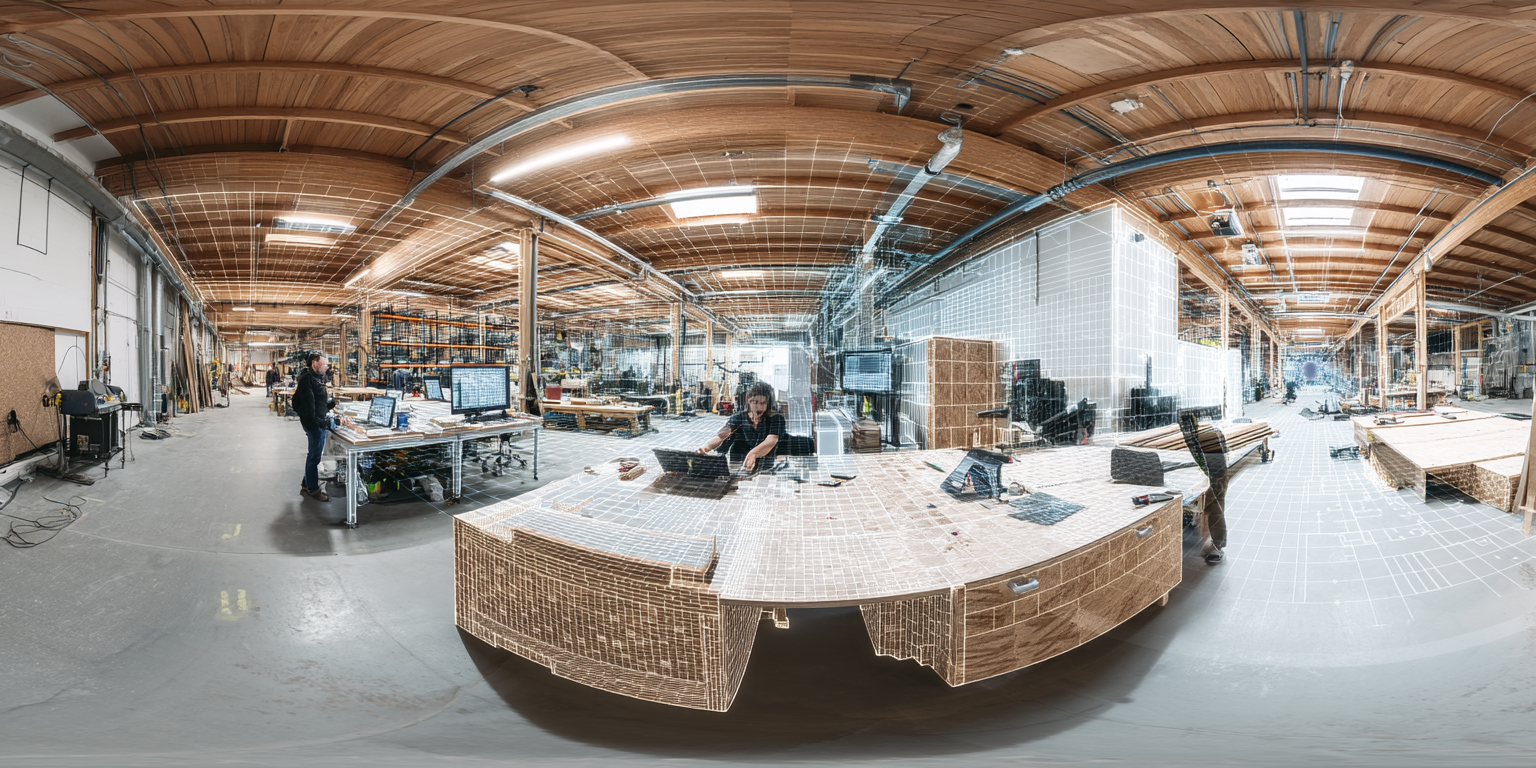
Researchers at the Swiss Federal Institute of Technology in Zurich(ETH) are working on the reuse of old building materials, according to a press release. In a project-based interdisciplinary course developed by Prof Dr Catherine De Wolf, prospective engineering students from fields such as architecture and computer science are looking for ways to recycle materials in the construction industry in order to save resources and use materials for longer.
They apply their knowledge during construction site visits, workshops or in the workshop. The ETH researchers spend around 70 per cent of their time in the field. “They learn how to carefully remove materials from existing buildings, document them digitally, integrate them into new designs and finally realise them,” they say. The experience of dismantling a building and reusing this demolition material, which would otherwise end up in landfill, for new construction processes demonstrates “how sustainable construction methods can be implemented in practice”. In the Digital Creativity for Circular Construction course, teams work on realisable projects for external clients and users. Laser scanning, artificial intelligence and augmented reality are used to record the building fabric.
The students’ work has been exhibited at the Kunsthalle Zürich, the Art Genève art fair and the Architecture Biennale in Venice and has been used by external clients and users.
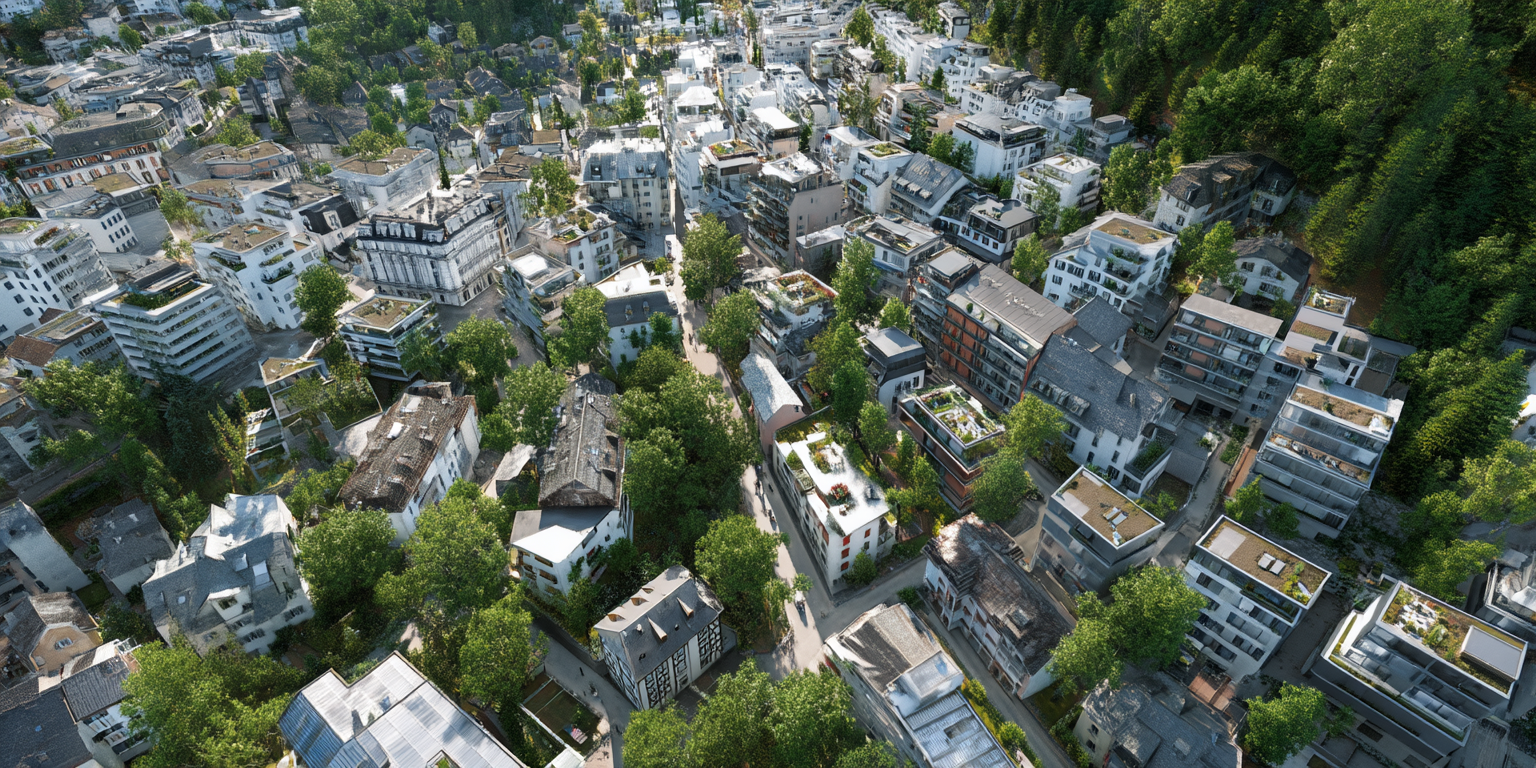
Switzerland is heading for hotter summers, more hot days and more frequent extreme weather events. Cities and densely populated areas in particular heat up more than their surrounding areas and cool down more slowly at night – the well-known heat island effect. It is directly related to the way buildings are constructed; dense sealing, dark surfaces and solid structures store heat and only release it again with a delay.
Because buildings and infrastructures stand for decades, the materials used today shape the microclimate of tomorrow. This makes the choice of materials a strategic decision. It influences not only energy requirements and comfort in the building, but also health and quality of stay in public spaces.
What the new edition does This is where the second, expanded edition of the materials catalog comes in. The reference work from the Federal Office for Housing shows how different building materials influence the outside temperature and what contribution they make to a heat-resilient urban climate.
The catalog compares common outdoor materials such as floor coverings, facades and now also roofs and greenery in dry and wet conditions. In addition to the effect on the ambient temperature, it takes into account additional properties such as reflection of solar radiation, durability and, in the case of coverings, infiltration capacity. This creates an overall picture that combines thermal, functional and water management aspects.
Updated method, comparable results The new edition is based on simulations carried out by the University of Applied Sciences Northwestern Switzerland on behalf of the Swiss Federal Office of Energy and the BWO. The materials already included in the first edition were also recalculated using improved simulation software.
As a result, all results are based on a uniform methodological standard and can be directly compared with each other. For planners, this means that they can compare variants qualitatively and quantitatively and better justify their decisions to clients and authorities.
Tool for planning and implementation The material catalog is designed as a practice-oriented reference work for new buildings and renovations in densely built-up areas. It supports specialist planners and property developers in integrating the effect of material selection on heat development into their processes at an early stage, from the project idea to detailed planning.
In combination with other instruments for climate-adapted urban development, the catalog becomes a building block for heat-resilient districts. It helps to brighten surfaces in a targeted manner, utilize evaporation capacity, improve infiltration and thus gradually make the urban climate more robust in the face of climate change.
Researchers at the Swiss Federal Laboratories for Materials Science and Technology(Empa) want to remove large quantities of excess carbon dioxide from the atmosphere with the Mining the Atmosphere working group. According to a press release, 5 to 10 billion tonnes of carbon could be used annually as concrete aggregate. This would be enough to permanently store the excess CO2 within 100 years after the energy transition and thus bring the atmosphere back to a climate-friendly level. This is estimated to be 400 billion tonnes of carbon or the equivalent of around 1500 billion tonnes of CO2.
However, surplus renewable energy is needed to realise this. This is the only way to convert the carbon dioxide into methane or methanol and then process it into polymers, hydrogen or solid carbon. “These calculations are based on the assumption that sufficient renewable energy will be available after 2050,” Pietro Lura, Head of Empa’s Concrete and Asphalt Department, is quoted as saying in the press release.
However, the amount of building materials required worldwide far exceeds the surplus carbon in the atmosphere. “Even if sufficient renewable energy is available, the key question remains as to how these huge amounts of carbon can be stored in the long term,” Lura continues. The researchers see one approach here in the production of silicon carbide, which can be used as a filler in building materials and the production of asphalt. This should bind the carbon in the long term and have excellent mechanical properties. However, Lura describes the production process as extremely energy-intensive. Production still requires considerable material and processing research in order to make it economically viable.
Reducing greenhouse gas emissions alone is not enough to slow down climate change. It is just as important to actively remove CO₂ that has already been emitted from the atmosphere. Empa researchers have calculated that up to ten billion tonnes of carbon could be sequestered annually through targeted CO₂ storage in concrete. In the long term, this process could help to reduce the CO₂ level in the atmosphere to the target value of 350 ppm.
The concept is based on the conversion of CO₂ into solid carbon compounds that are used as concrete aggregates. In addition to concrete, other building materials such as asphalt or plastics could also contribute to storage. The challenge lies in incorporating large quantities of carbon efficiently and quickly into these materials without impairing their properties.
Silicon carbide as a key technology One promising approach is the production of silicon carbide as a concrete aggregate. This compound can bind carbon almost permanently and at the same time improves the mechanical properties of the concrete. However, the production of silicon carbide is very energy-intensive, which is why the full utilisation of this technology is only realistic after the energy transition.
Without the use of silicon carbide, it would take more than 200 years to remove the excess CO₂ from the atmosphere. However, a combination of porous carbon and silicon carbide could significantly accelerate this process.
New paths for a CO₂-binding economy The “Mining the Atmosphere” research initiative aims not only to reduce CO₂, but also to utilise it as a valuable raw material. In addition to storage in building materials, carbon can also be used for the production of polymers, carbon fibres or graphene.
However, technological advances as well as economic and regulatory incentives are required for successful implementation. The researchers emphasise that a combination of CO₂ reduction and active removal is necessary to mitigate climate change in the long term.
Using concrete as a carbon sink could make a decisive contribution to stabilising the climate. A sustainable solution for the future of the construction industry.
The construction industry is one of the largest CO2 emitters in the world. However, projects such as “Beyond Zero” and the “Mining the Atmosphere” initiative could turn the tide. The aim is not only to reduce the harmful greenhouse gas, but to actively bind it in building materials. These materials, which are being tested in the new NEST unit, could revolutionise concrete and insulation materials and have the potential to make the construction industry climate-neutral or even CO2-negative.
Technology undergoing practical testing Nathalie Casas from Empa explains that “negative emissions technologies” (NET) are the key to achieving climate targets: “We need to remove excess CO2 from the atmosphere in order to achieve the 1.5-degree target. NETs, which already work in the laboratory and are now being used in the construction industry, will help us achieve this.” Casas emphasises the urgency of taking action as emissions continue to rise.
Sustainability in the construction industry Corinne Reimann from Implenia sees NET as a great opportunity for the construction industry: “The new materials will finally enable us to make decisive progress in the area of sustainability. The industry has enormous leverage here, but also challenges. Price and acceptance will be crucial.” Reimann emphasises that the functionality and cost-effectiveness of new materials must be ensured in order to enable their widespread use.
The contribution of architects and planners Christoph Kellenberger, co-founder of OOS, sees the early involvement of architects and planners as a decisive factor: “With our knowledge, we can help develop the right building materials from the outset and integrate them into construction practice. We also need to publicise the potential of CO2-storing materials in the industry and show what effects can be achieved with them.” For Kellenberger, the key to success lies in transparent knowledge transfer and practical solutions.
Political framework conditions and social responsibility In addition to technological innovation, the construction industry also requires political and economic framework conditions. According to Casas and Kellenberger, clear cost transparency is necessary in order to promote the widespread use of NET. CO2 emissions must be priced fairly and subsidies could help to offset the initial higher costs of the new materials. “The transformation will only succeed if everyone pulls together – politics, business and society,” says Casas.
The “Beyond Zero” project shows that it is possible to turn buildings into carbon sinks. However, this requires not only technological solutions, but also the will of politics, business and society to break new ground. The construction industry has the opportunity to develop from one of the largest CO2 emitters into a pioneer of the climate transition – and the potential to do so already exists today.
The Future Perfect association, together with the Plavenir professional association, the Constructa Association of Teachers of Drawing Professions and the educational materials publisher LernMedien-Architektur GmbH, is realising a project to integrate circular construction into basic vocational training in spatial and construction planning. The Future Perfect Circular Building project aims to teach skills for the reuse and recycling of materials and components, Future Perfect explains in a press release. A test run is planned for the spring semester 2025. The courses will be available to schools on a regular basis from autumn semester 2025.
The project is aimed at both students and teachers of spatial and construction planning. Teachers will be offered full-day training courses in which they will be introduced to circular construction and the use of Future Perfect’s digital teaching materials will be explained. Digital courses for basic education, advanced seminars, project work and project competitions will be made available to learners. The project is financially supported by the Minerva Foundation and the Federal Office for the Environment.
The debate about energy consumption and environmental costs in the construction and disposal of buildings is intensifying. Against this backdrop, companies are being forced to scrutinise their approaches and explore sustainable alternatives. In order to understand the various approaches and reactions of players in the construction and property industry to these growing challenges, the Green Building Association is launching a comprehensive survey. The aim is to create a sound basis for discussion and promote the exchange of knowledge and strategies within the industry.
The online survey, which takes around 7 minutes to complete, aims to gain insights into the willingness of companies to adapt to the new requirements associated with reducing grey energy. With the results, Green Building hopes to shed light on the diverse strategies that companies are adopting to minimise the environmental footprint of their construction projects while remaining competitive in the market.
Taking part in the survey not only offers companies the opportunity to share their perspectives and measures, but also to learn from the insights and best practices of others. The Green Building Association therefore cordially invites all industry participants to take part in the survey and to forward the survey to other interested colleagues. The results will be a valuable resource for the industry to jointly pave the way to a more sustainable future.
Carbon fibre reinforced plastic lamellae (CFRP lamellae) are among the building materials that have not yet been reintroduced into the material cycle, Empa explains in a press release. Its researchers from the Mechanical Systems Engineering department want to remedy this situation. A corresponding research project has already found a sponsor in a foundation not named in the press release.
The process of reinforcing bridges, car parks, building walls and ceilings made of concrete or masonry using CFRP lamellas has already been developed at Empa by its former Dübendorf director Urs Meier, according to the press release. “By significantly extending the service life of buildings and infrastructure structures, CFRP lamellae make an important contribution to increasing sustainability in the construction sector,” Giovanni Terrasi, Head of Empa’s Mechanical Systems Engineering research department, is quoted as saying. “However, we now also need to find a way to continue using the CFRP louvres beyond the service life of these buildings.”
The first step is to develop a mechanical process that allows the lamellae to be detached from the concrete without causing damage. The researchers then want to process the demolished CFRP into reinforcements for prefabricated components. The first object the group has in mind is reinforcements for railway sleepers made from recycled concrete. This means that the “supposed waste material could play a new role in Swiss infrastructure”, writes Empa.
Paolo Tombesi, the director of the Laboratory of Construction and Architecture(FAR) at the Swiss Federal Institute of Technology Lausanne(EPFL), and visiting scientist Milinda Pathiraja have completed a groundbreaking construction project at its old high school in Kandy in central Sri Lanka: The construction of two toilet facilities is designed to demonstrate industrial development potential through architectural design. Their prototype is based on 20 years of joint research.
With strategic planning, the design of such infrastructures “can be used as an opportunity to showcase and disseminate innovations and introduce practice-based triggers for a much-needed revitalisation of local building culture”, Pathiraja is quoted as saying in an EPFL report. It was also about “cultivating new, economically sustainable and ecologically oriented building ‘traditions’ for countries facing urbanisation pressures, limited raw materials and financial constraints”.
For example, non-sustainable building materials that require functioning supply chains, such as glass and aluminium, or are not available in the country, such as clinker, were avoided. The two researchers also wanted to illustrate how building policy and sustainability lead to value creation at different points, for example in the case of vaulted roofs made of ferrocement.
For all this, the industry needs concrete examples and prototypes “that show both the technical value and the economic feasibility of such ideas”, says Tombesi. These toilets simultaneously lower the total cost to $400 per square metre, including sanitation. “And given the nationwide need for this type of programme, the lessons we’ve learned will likely be picked up by others.”
In the canton of Zurich, around 1 million tonnes of waste end up in a landfill each year. Most of this comes from construction activities – even though a large proportion of all construction waste is already used as recycled building material, for example in road and earth construction or for the production of recycled concrete. Landfill capacities in the canton of Zurich are scarce, and the construction of new landfills is becoming increasingly costly and difficult. The Department of Construction therefore wants to adapt the specifications for the treatment and recycling of construction waste with the aim of ensuring that in future even more waste is returned to the material cycle and does not end up in a landfill. This will also conserve natural resources.
Recycling up to 100,000 tonnes of additional waste per year
By far the largest part of the waste produced during the construction of buildings, roads and infrastructure is excavated material, i.e. soil and rock. If this is contaminated by pollutants, it must first be treated in a soil washing plant or a thermal plant before it can be recycled as construction material. Up to now, the Department of Construction has stipulated that at least 50 per cent of excavated and excavated material with low and low levels of pollution must be treated during excavation work. This quota is now to be increased to 75 per cent. This would mean that between 80,000 and 100,000 tonnes of polluted construction waste could be treated each year and returned to the material cycle as recycled construction materials.
Dismantling material only in exceptional cases directly to landfill
The demolition or conversion of existing buildings also generates around 2.5 million tonnes of construction waste per year in the Canton of Zurich. Of this, about 90,000 tonnes are deposited directly in a landfill. In future, only those demolition materials that are explicitly listed will be allowed to go directly from the construction site to a landfill. This list includes materials for which no recycling process exists to date, such as ceramics, porcelain or expanded clay. All other deconstruction materials must first be taken to a sorting or processing plant. This new regulation is intended to ensure that demolition materials are reprocessed into new building materials wherever possible.
The specifications for the recycling of construction waste are laid down in a guideline (“Treatment rule for contaminated construction waste, bullet trap material and demolition materials”), which must be applied to construction projects in the canton of Zurich. The Construction Directorate has submitted the adaptation of this guideline to the stakeholders concerned for comment by the end of September.
The federal government has presented a reference work for new buildings and buildings to be renovated that shows the effect of building materials on the heat in urban and densely populated areas. It was created by the University of Applied Sciences Northwestern Switzerland on behalf of the Federal Office for Housing ( BWO ).
According to a media release by the BWO, the catalog compares materials for outdoor use such as floor coverings and facades and explains their effect on the outside temperature. It also takes into account other properties of the materials, such as how they reflect sunlight or how much water floor coverings allow to seep away.
The BWO calls on planners, developers and house owners to consult this material catalog when choosing suitable materials. In addition, the Office invites the scientific community to further develop and research the topic. Because according to the latest climate scenarios, the average temperatures in Switzerland will be 2.5 to 4.5 degrees higher by 2060 than in the period from 1981 to 2010. This means that the buildings that are being built or renovated today will be the microclimate of tomorrow shape.
A major strength of building with wood is the great planning security. High quality and adherence to schedules are motivating more and more builders to implement extensive projects with wood. In 2021, however, price turbulence and long delivery times did not go unnoticed by the material wood.
Market is returning to normal In the meantime, the warehouses at various retailers are full again. Suppliers can once again serve the Swiss market on schedule. "In Switzerland, the costs for the most common products such as glued laminated timber, construction timber C24 or multi-layer panels have stabilized at a slightly higher level than in the previous year," notes Hansjörg Steiner.
inflation in construction «The changed material prices have only a minor impact on the total costs in construction. In the case of conversions, which require less material compared to new buildings, the price increase is not significant,” says Hansjörg Steiner. Building has basically become a little more expensive – caused by the price increase of almost all building materials.
Regional use According to Florian Landolt from Wald Schweiz, the Swiss forestry industry is benefiting from the slightly higher prices, and is now able to cover its costs. The availability of Swiss wood products remains a major challenge. The Swiss timber construction companies are dependent on neighboring countries for 70% of the material. Targeted support for construction projects that use locally harvested wood would create efficient incentives to promote the entire Swiss wood chain and reduce dependency on other countries.
Building with the renewable raw material wood Wood is the material of choice for energy-efficient and climate-friendly projects. Wood stores CO2 in the biomass – one ton of CO2 per cubic meter of wood used. Building with wood makes a significant contribution to achieving climate goals. In order to make the Swiss real estate park more climate-friendly, promoting timber construction is obvious, both for new buildings and conversions.
For thirty years there was a jumbo hardware store on the 8,600 square meter area in Arbon. It was demolished at the end of 2018. There are now two new buildings here: The Breeze residential complex offers a total of 63 apartments in two houses.
Breeze is located directly on Lake Constance, between the city's waterfront promenade, designed as a chestnut avenue, and Bahnhofstrasse, on a plot of land with a connection to the lake. The park-like surroundings, the proximity to the train station, the historic old town and the shopping facilities of Arbon are also intended to make the centrally located development an attractive place to live.
In modern apartments, classic, high-quality materials should convey style and comfort. The apartments with 2.5, 3.5, 4.5 and 5.5 rooms have large windows, spacious floor plans and bright rooms. Your terraces are large and partly all around. With its generously designed outdoor spaces, Breeze should blend in harmoniously with the surroundings and location directly on the water.
The architecture competition for Breeze took place in 2017. The jury decided in favor of the project by the Caruso St John Architects.
The two angular houses with receding outer corners each have five main floors and an attic floor. They are mirrored to each other and rotated 180 degrees. There is a shared underground parking garage under the two structures.
Towards the lake, the houses border a semi-private open space with seating and trees. The houses are accessed on Bahnhofstrasse. The re-entrant corner areas are transformed into clearly delimited, greened front zones by pavilions. From here, footpaths also lead to the open space on the lake side and on to Kastanienallee.
Breeze complies with the Minergie guidelines and uses environmentally friendly district heating. As a further contribution to sustainability, the flat roofs of the building are greened. The roof structure is chosen in such a way that the rainwater is largely retained.
Construction work started in early 2019. The development has been in place since December 2020. All 63 apartments have already been sold and will be ready for occupancy at the end of 2021.
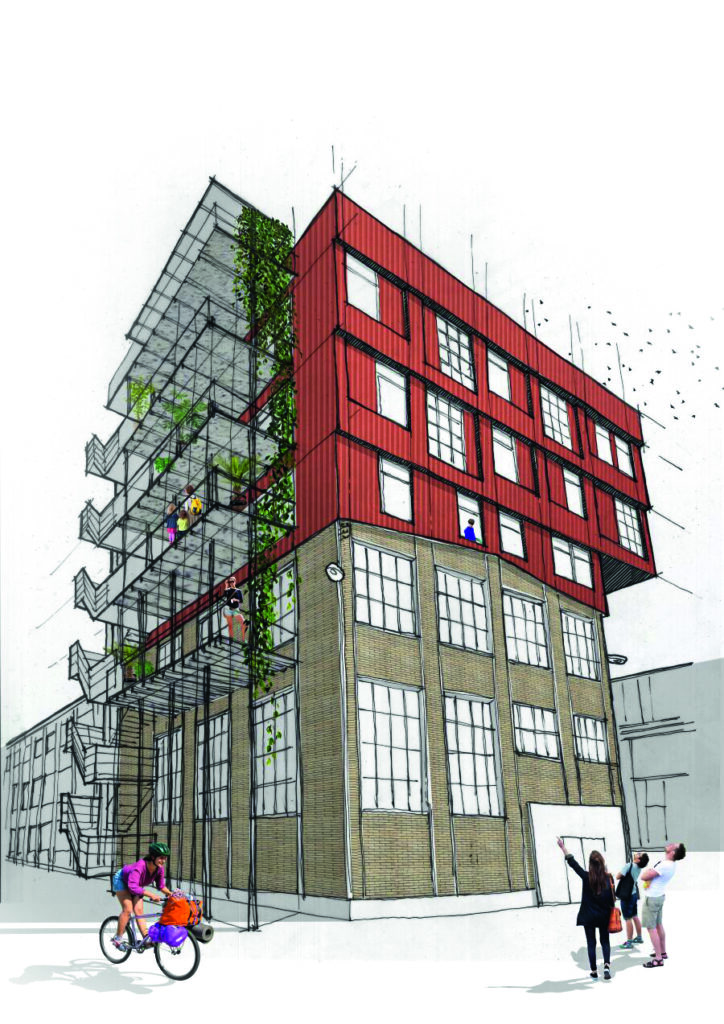
A project that could hardly be more sustainable: the extension of hall 118 on the storage area in Winterthur ZH was increased by five floors. And wherever possible with reusable building materials. The presence of such materials from demolitions in the region was decisive for the current appearance. The building is not yet completely finished: “The construction should be completed in early 2021,” says Benjamin Poignon, architect and civil engineer at “baubüro in situ”.
The Abendrot Foundation, based in Basel, bought the Lagerplatz area from Sulzer Immobilien AG in 2010. The direction of focus was quickly clear to the pension fund, which is committed to sustainability: the already existing mixed use should be further developed in cooperation with the tenants. Several new studios of up to 60 square meters for start-ups and small businesses are planned for each of the upper floors.
Although the buildings and their footprints were to be retained, they were to be further developed in terms of energy and in accordance with legal standards. The “construction office in situ” is responsible for the project. The project managers Marc Angst and Pascal Hentschel sum up the concept: «Repairing what can still be used. Remove what disturbs or is no longer suitable – and add what is new. "
Finding building materials is half the time The supporting framework consists of an used steel structure. Prefabricated facade elements made of wood, which are filled with straw insulation, are attached to this. Such simple ecological building materials as straw, excavated earth and wood accumulate in large quantities and can be processed and used with a minimal use of gray energy. They also ensure a pleasant room climate.
The slightly overhanging south facade in bright brick red-orange comes from the sheet metal facade of the former Ziegler print shop in Winterthur Grüze. The windows in the new recycling building are inconsistent, but overall they are consistent. In order for the insulation to meet today's standards, the glazing was doubled in nine windows, the others had sufficient insulation. The staircase on the east facade is over 30 years old and previously adorned the facade of the Orion office building in Zurich-West. 80 windows and facade panels made of granite, which are recycled for the balcony floors, also come from this building, which was erected in 1989. The respective components are not reprocessed – this differentiates the project from so-called downcycling, in which building materials are initially reworked in a energy-intensive manner.
The architects have already learned a lot from this unique pilot project: “It is the first time that we have reused a supporting structure. But we also noticed that there are components that are cheaper to buy than to reuse. For example, we have tried to reuse limestone sandstone. But the cleaning and preparation work was so high that we decided to buy a new one here, ”explains architect Poignon. The project also created a new job: component hunter. The “baubüro In situ” hired interns specifically for this purpose, who looked for suitable demolition objects and any reusable materials that might arise. But the architects, too, are always on the move with open eyes. Usable materials are dismantled and picked up by the architectural office with roots in Basel. The architects spend half of the time evaluating and procuring possible components. "In situ" did not have any problems finding the right material: of the approximately 7.5 million tons of construction waste that is generated in Switzerland every year, only 0.1 percent is directly reused, according to the Federal Office for the Environment (FOEN) has. «In situ» assumes that ten times more can be reused.
Book publication planned If you think about the costs at this point: 4.8 million Swiss francs have been budgeted for the project so far. One of the stated goals was to build in such a way that it does not cost more than a completely new building. “It is difficult to make direct comparisons,” says Benjamin Poignon.
In general, “in situ” always relies on the reuse of materials during construction – even if rarely on this large scale. With its uniqueness, K118 has definitely attracted interested parties: A research and teaching project at the ZHAW University of Applied Sciences in Winterthur and a case study in environmental systems science at ETH Zurich accompanied the planning. Among other things, the environmentally relevant (waste, resources, lifespan, etc.) and legal as well as those relating to the construction process are examined. A joint publication is planned in cooperation with the Federal Office for the Environment: The book is intended to comprehensively shed light on the reuse of components in building construction and to make the knowledge and experience gained publicly available. ■
This is what building K118 should look like after construction work is complete.
Wir verwenden Cookies zur Unterstützung und Verbesserung unserer Dienste. Mit der Nutzung dieser Website erklären Sie sich mit der Verwendung von Cookies einverstanden. Weitere Informationen finden Sie in unserer Datenschutzerklärung.