Tag: Bauprojekt

  • New railway line in Sweden takes shape

    New railway line in Sweden takes shape

    Construction services provider Implenia has been awarded the contract for the first construction phase of the new East Link railway line by the Swedish Transport Infrastructure Agency (Trafikverket). According to a press release, the project is worth CHF 130 million. Implenia will build the 8-kilometre section of the Bibana Nyköping line by 2031.

    This is a section that connects the centres of Skavsta and Nyköping with the main route of East Link. East Link connects several coastal towns in eastern Sweden with Stockholm. Implenia’s contract includes bridges, railway tracks, refurbishment of existing buildings and other work.

    According to Erwin Scherer, Head Division Civil Engineering, Implenia is helping to “take the mobility infrastructure in eastern Sweden to a new level”.

  • Project planning credit for Lucerne theatre rejected

    Project planning credit for Lucerne theatre rejected

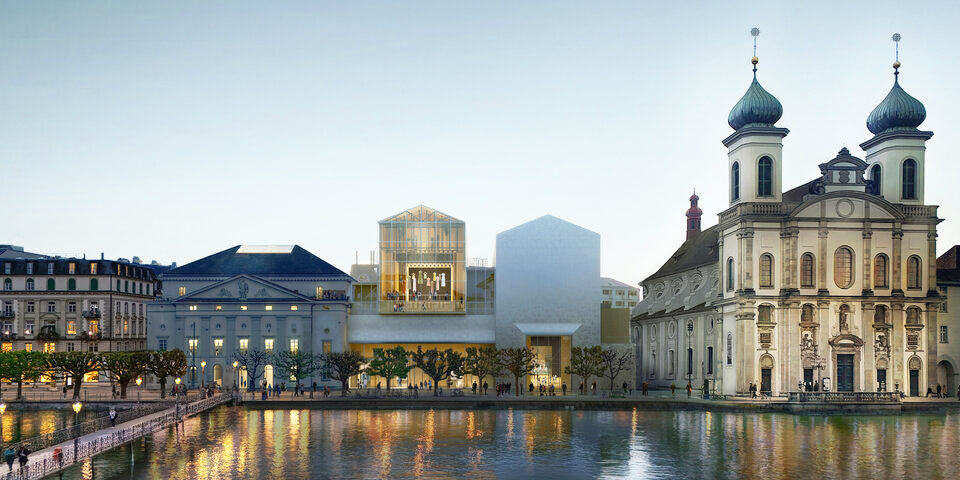
    With 15,033 votes against compared to 10,914 votes in favour, the project planning loan for the planned Lucerne Theatre was clearly rejected on 9 February 2025. The turnout was 49.67 per cent. The result spells the end for the “überall” project by Ilg Santer Architekten, which was intended as a new stage for music, spoken word and dance theatre.

    City Council expresses disappointment
    The City Council notes the vote with great regret. The planned further development of the Lucerne Theatre cannot be realised with this decision. City President Beat Züsli emphasises: “We have always said that there is no Plan B. What happens next is completely open. This result is a great disappointment for Lucerne’s culture.”

    The location and construction volume of the planned theatre in particular were repeatedly criticised in the public debate. Nevertheless, it is still too early to draw any definitive conclusions. The city council intends to carefully evaluate the results of the vote together with the partner organisations involved.

    Consequences for cultural policy
    The rejection of the loan presents the city of Lucerne with new challenges. The previous plans have been halted and it remains unclear how the future of Lucerne’s theatre can be shaped. Nevertheless, the city council emphasises the importance of dealing constructively with the vote: “It is now our joint task as a city community to find a new solution for theatre culture in Lucerne.”

    Despite the defeat, the city council would like to thank everyone who was involved in the project. The existing partnerships will continue to be cultivated and the impact of the result of the vote on cultural policy will be carefully examined.

  • Basel invests in sustainable heating infrastructure

    Basel invests in sustainable heating infrastructure

    IWB and the Department of Construction and Transport of the Canton of Basel-Stadt are starting the construction of a new district heating pipeline in the Bachletten neighbourhood. Construction work is due to begin on 3 February, the two partners announced in a joint press release. The work is divided into five stages, running from Paulusgasse via Arnold-Böcklin-Strasse and Therwilerstrasse to Rütimeyerplatz.

    As part of the installation of the new heating pipeline, the canton also wants to renew the electricity and water pipes in the affected streets. There are also plans to “partially green and unseal the road surface”, according to the press release. To this end, trees are to be planted in small hollows and car parks are to be laid out with grass paving stones so that water can seep into the ground. However, the redesign of the surface is currently still dependent on the outcome of pending objections.

    IWB will also be laying district heating pipes and renewing the service lines in other streets in the Bachletten neighbourhood by 2031. Work is expected to begin in the fourth quarter of this year in the Kluserstrasse, Marschalkenstrasse and Bernerring perimeters.

  • Ground-breaking ceremony for new production hall in Birr

    Ground-breaking ceremony for new production hall in Birr

    BRUGG Lifting, part of the BRUGG Group from Brugg AG, is starting the second expansion phase of its Industrial Park 2025 at the Birr site in January. The symbolic foundation stone for the new production hall 6 has now been laid with a ground-breaking ceremony in front of guests from local politics, business and the media. “With this project, we are sending out a strong signal of our innovative strength and our commitment to the region,” said CEO Markus Grüter in a press release.

    Production hall 6 will be equipped with two automated small parts racks and will also serve as a logistics centre. Three loading ramps will also be integrated. The investment totals 9.5 million Swiss francs. The construction work is expected to be completed in February 2026.

    In a first step, the new belt sheathing system – the production machine for the flat belts of the BRUbelt lift system – was built in the existing production hall. The costs for this totalled 3.5 million Swiss francs. At the same time, a new sliding rack was built to support production, providing storage space for over 1600 pallets for finished products, raw materials and semi-finished products. The lightweight hall was put into operation together with the mobile racking system on 6 December 2024.

    “The new production hall enables optimal integration of the new belt casing system and creates an efficient flow of goods with a modern logistics concept,” says Grüter. “The maintenance area will also be modernised to better integrate our apprentices.”

  • New school infrastructure in Zofingen takes shape

    New school infrastructure in Zofingen takes shape

    The building construction for the new secondary school centre in Zofingen has been underway since June 2024. As the construction company responsible, STRABAG, has now announced, the basement and the first floor with classrooms are already in place. In the excavation pit next to the gymnasium, the specialised civil engineering team has completed the groundwork by installing the bored piles and constructing the retaining walls.

    At the same time, employees from Verkehrswegebau Obergösgen are laying the service lines. The structural engineering work should be completed by the end of June 2025. The finishing work will then begin, according to the information provided. The building will be put into operation at the start of the 2027/2028 school year.

    STRABAG describes the ten concrete beams for the gymnasium ceiling, which were lifted into place in mid-November, as a “spectacular highlight”. Each of them was 29 metres long and weighed 60 tonnes. Other prefabricated elements were also installed. They were reportedly planned immediately after the contract was awarded in order to be ready for use on time.

    Now that the beams for the new triple gymnasium have been moved into place, the structural engineering staff, led by site manager Daniela Huonder and foreman Vincenzo Tafaro, are currently busy shuttering, reinforcing and masonry work on the other floors.

  • Farewell party planned for the Raben-Bad in Baden

    Farewell party planned for the Raben-Bad in Baden

    Bagni Popolari heralds the end of the interim use of the Bad zum Raben. On 25 January, the thermal baths on Kurplatz in Baden will celebrate the end of the “Acts of Attention” exhibition, the association announced in a press release. At the same time, a temporary outdoor pool with natural thermal water on the Limmat promenade will invite visitors to take a dip.

    Bagni Popolari has been revitalising the previously closed Raben-Bad since 2017 with exhibitions, performances, music, readings, lectures and animated films, attracting thousands of visitors, according to the press release. However, the thermal baths now need to be thoroughly renovated in order to continue operating. Among other things, it needs solid pool technology, ventilation, new electrical installations and wheelchair-accessible toilets.

    The Raben cooperative, which emerged from Bagni Popolari, is responsible for the renovation. It was founded in 2022 to acquire the bathing floor in the former Badegasthof zum Raben. The Raben cooperative estimates that the necessary renovations will cost around CHF 4.5 million.

    1.5 million of this is to be raised through the sale of new cooperative shares and donations. The Raben-Genossenschaft intends to raise the remaining 3 million Swiss francs through donations from the public sector, foundations and sponsors as well as loans. “If everything goes well, Bagni Popolari will be able to celebrate the first vernissage in the renovated Bad zum Raben in 2027,” hopes the association.

  • Expansion of district heating in Münchenbuchsee

    Expansion of district heating in Münchenbuchsee

    The Schlieren-based construction company STRABAG is creating a modern energy supply for the municipality of Münchenbuchsee with district heating pipes. According to a press release, STRABAG is laying around three kilometres of new district heating pipes to expand the district heating network in the municipality in Bern-Mittelland. Work began on 9 September and the first of around 15 stages has already been completed, according to STRABAG. Two further stages will follow by the end of the year, according to the company press release.

    Regarding the progress of the work, the company says that as residents still need access to their homes and garages, the road cannot be completely closed for the construction work. To install the district heating pipes, just under a quarter of the road will be opened up and the pipes laid. After each construction phase, the trenches will be temporarily backfilled with earth and a temporary surface will be laid. Over the next few months, the earth will settle. Therefore, once all 15 stages have been completed, the temporary surface will be milled off again and a new asphalt layer will be applied.

    According to STRABAG, the construction work is expected to be completed by December 2025 by the STRABAG Traffic Route Construction (VWB) team in Bern. “We are well on schedule so far and should complete the project on time,” says Lena Wagner, construction manager at VWB Bern.

  • Customised processes support bridge renovation in Chur

    Customised processes support bridge renovation in Chur

    The AS Chur Süd consortium, consisting of METTLER PRADER AG and Cellere Bau AG, has commissioned STRABAG to replace the bridge edge beams as part of the renovation of the Sommerau subway in Chur. The timber construction department of the Schlieren-based construction company was tasked with developing a customised method for the formwork, explained STRABAG in a press release. “With our experience, we found the right solution,” Dominic Graf, timber construction foreman at STRABAG AG, is quoted as saying.

    Specifically, the work was made more difficult by the limited space available, which, among other things, did not allow for a conventional substructure for the formwork. The STRABAG timber construction team solved this problem by reinforcing the formwork panels with flat steel. Fire hoses were inserted into the gaps. The hoses, filled with compressed air, hold the panels in a stable position during concreting.

    According to the press release, the first bridge edges have now been completed to the complete satisfaction of the master builders on site. According to STRABAG, the other construction phases are currently being realised according to plan with the help of this technically demanding but ideally suited solution.

  • Museum Langmatt in Baden to be completely renovated by 2026

    Museum Langmatt in Baden to be completely renovated by 2026

    ERNE is involved in the complete renovation of the Langmatt Museum in Baden. Specifically, the construction company from Laufenburg is to take on part of the renovation of the villa. “The work includes the demolition of entire rooms inside the building and the subsequent reconstruction of floor slabs, walls and ceilings, the renewal of the sewerage system and the partial demolition of the exterior façade, including façade renovation,” explains ERNE in a post on LinkedIn. ERNE also moved benches and steel supports for the construction of a new glass pavilion.

    The overall refurbishment of the villa and the surrounding public park will take place this year and next. Meanwhile, the museum’s private collection of French Impressionism in Europe will be sent on a European tour. The Langmatt Museum is due to reopen in spring 2026.

  • Vision for sustainable technology centre takes shape

    Vision for sustainable technology centre takes shape

    FlexBase intends to realise its new technology centre in line with the plans already presented. According to a press release, the technology company has secured the ERNE Group, also based in Laufenburg, as general contractor. Construction is scheduled to begin in 2025. An updated planning application has been submitted to the relevant authorities.

    The technology centre is to be built on the former Swissgrid site. The centrepiece will be a new building opposite the existing building. In addition to many research facilities, a data centre with capacities for the use of artificial intelligence is to be built there. FlexBase also plans to build a 20,000 square metre battery storage facility with a capacity of more than 500 megawatts on the site. According to the press release, the non-flammable and non-explosive storage facility is the “world’s largest and most modern battery storage facility of its kind”. The construction of the new technology centre will create several hundred jobs for skilled workers and apprenticeships.

    According to the press release, Marcel Aumer, CEO of the FlexBase Group, does not anticipate a delay in construction despite the relaunch of the project. He justifies this view with the close collaboration with ERNE: “In this project, I have not only experienced ERNE’s expertise right from the start, but also the full attention of the top management.” The CEO of ERNE, Giuseppe Santagada, is also optimistic: “My personal commitment goes far beyond the realisation of this project; it also includes the promotion of new technological skills and increasing the attractiveness of Laufenburg as a location for the vision of a prosperous region”.

  • Geistlich invites you to the ground-breaking ceremony at Lymhof

    Geistlich invites you to the ground-breaking ceremony at Lymhof

    Geistlich Immobilia AG invites you to the ground-breaking ceremony for the Lymhof construction project in Schlieren on September 20. The event begins at 4 p.m. with information stations and festivities on the construction site. The official ground-breaking ceremony will take place at 5 p.m. and then there will be a get-together at the Buvette from 6.30 p.m. to 8 p.m.

    The Lymhof will become part of the Schlieren quarter Am Rietpark. According to the project description, the Lymhof will not only create an attractive residential offering for residents of different generations and lifestyles. It will also become a meeting place for the district, with a bistro and hotel, a multifunctional hall, two green courtyards and spaces for small stores and local amenities.

    Excavation work is now starting after the demolition of the Vitis Sport Center with tennis hall has been completed. In February 2024, Schlieren City Council issued the building permit for Lymhof. Although the 350 or so rental apartments will not be ready for occupation until 2027, tenants can already register their interest now.

  • Parliament restricts the right of associations to lodge complaints about residential construction projects

    Parliament restricts the right of associations to lodge complaints about residential construction projects

    On 11 September, the Council of States made a far-reaching decision: in future, associations will no longer be allowed to lodge complaints against smaller residential construction projects in building areas. This new regulation affects residential construction projects with a floor area of up to 400 square metres. With a clear majority of 30 votes to 14, parliament voted in favour of this measure, which has triggered a wave of relief, but also criticism, in the construction industry.

    The new regulation, which is described as a “moderate restriction” of the right of appeal by associations, aims to reduce delays in the realisation of construction projects. This development is particularly important for property developers in times of increasing housing shortages. “The current right of appeal often acts as a brake on the creation of new living space,” explained Fabio Regazzi (centre/TI). “With this adjustment, we are reducing the power imbalance between small builders and national associations.”

    Fewer objections to single-family homes
    The new law means that smaller construction projects, such as single-family homes, can be realised more quickly and without costly objections in future. This applies in particular to projects within designated building zones. For many building owners, this means a reduction in bureaucratic hurdles and greater planning security.

    Beat Rieder (centre/VS), President of the Committee for the Environment and Spatial Planning, emphasised the urgency of this amendment: “It is unacceptable that even the smallest construction projects are blocked for years by appeals.” The majority in parliament sees the amendment as an urgently needed measure to accelerate residential construction in Switzerland and meet the growing demand for living space.

    Critics warn of undesirable developments
    However, not all parliamentarians were satisfied with the decision. Simon Stocker (SP/SH) warned that the new law hits the wrong targets. “In many cases, it is not the associations but neighbours who file objections to small construction projects,” said Stocker. The regulation therefore does not always affect the right players.

    Environmental organisations also expressed their concerns. Heidi Z’graggen (centre/UR) pointed out that the previous regulations of the Nature and Cultural Heritage Protection Act (NCHA) had an important preventative effect. She warned that the new regulations could create undesirable loopholes that would impair the quality of construction.

    The central point of contention
    Another point of discussion was the upper limit of the floor area. While the majority supported the limit of 400 square metres proposed by the National Council, a minority called for this to be lowered to 250 square metres. According to Simon Stocker, this area corresponds more to that of an average detached house. However, the motion failed to gain majority support.

    The Federal Council was also in favour of the 400 square metre rule. Environment Minister Albert Rösti explained that this size would also allow for a detached house with a granny flat and would therefore meet the needs of building owners.

    Restriction to important sites and water areas
    Another controversial point in the bill concerned the exceptional cases in which association complaints are still possible. The Council of States decided that these are only permitted for construction projects in areas of national importance. The National Council had originally defined “important sites” as the benchmark. However, the stricter regulation of the Council of States was adopted by a majority, as was the cancellation of the possibility of appeals by associations in water areas, which led to further opposition.

    Céline Vara (Greens/NE) sharply criticised the decision and warned of the ecological risks: “Building near bodies of water can have fatal consequences. Experts strongly advise against it, and yet this protection is being dangerously weakened by the new regulation.”

    Harmonisation with the Environmental Protection Act
    The amendment to the right of appeal for associations also takes place in the context of harmonisation with the Environmental Protection Act (EPA). While the Environmental Protection Act already recognises restrictions for complaints regarding major projects, the Nature and Cultural Heritage Protection Act was previously unrestricted in this respect. The new regulation aims to eliminate this discrepancy and standardise the handling of complaints.

    A controversial but decisive step
    The restriction of the right to lodge complaints with associations for smaller residential construction projects is a significant step that will have a lasting impact on both developers and the property sector. While some speak of an urgently needed reduction in bureaucratic hurdles, critics warn of possible undesirable developments and ecological risks. The bill will now be discussed again in the National Council – and the outcome of the final vote remains exciting.

  • Large-scale project for performing arts and student accommodation in Vernier

    Large-scale project for performing arts and student accommodation in Vernier

    The Fondation pour le Développement des Arts et de la Cultur from Vernier has commissioned HRS with the construction of two buildings in Vernier. The corresponding total contractor agreement has already been signed, the real estate service provider based in Frauenfeld announced in a press release. The financial scope of the large-scale project dedicated to the performing arts has not been disclosed.

    The first building will serve as a cultural centre. It will have an event hall with 492 seats and 920 standing places, explains HRS. The second building will house 220 flats for students. The two buildings will be connected by a pedestrian bridge.

    The complex will be complemented by a hotel, a co-working area, a brasserie and a catering service. They are intended to “enrich the site’s offering and make it a dynamic place to live”, writes HRS. A timetable for the realisation of the project is not communicated in the press release.

  • Wipkingen church becomes an educational space

    Wipkingen church becomes an educational space

    The Wipkingen church is a remarkable example of adaptive space utilisation. No longer used for church services since 2019, it is now intended to meet the space requirements of the neighbouring Waidhalde school complex. A concept developed by Vécsey Schmidt Architekten BSA SIA in collaboration with Anderegg Partner AG won the architectural competition and promises a cautious yet future-oriented transformation. A newly installed ceiling allows for the creation of a multi-purpose room, a library and catering facilities at ground floor level, while the upper floor offers flexible usage options under the historic church vault.

    André Odermatt, Head of Building Construction, emphasises the importance of this initiative: “The intelligent conversion of existing buildings is essential in order to meet current challenges in urban areas.” The project not only provides solutions to the urgent need for school space, but also strengthens cooperation between the city and the church.
    Thanks to this conversion, the necessary rooms for six to eight additional classes will be created by the 2031/32 school year. Filippo Leutenegger, Head of School, sees this as an example of the effective utilisation of creative solutions.

    The cooperation with the Reformed parish of Zurich has already borne fruit and plans to open up further church buildings for charitable purposes. The project in Wipkingen is just the beginning of a series of initiatives that prioritise community benefit.

    The estimated construction costs amount to CHF 7.5 million, with completion planned for 2026, in time for the start of school in 2026/27. This project marks an important step in Zurich’s evolutionary urban development by showing how historical substance can be meaningfully brought into the future.

  • The Rolf-Liebermann-Weg on the outskirts of Zurich

    The Rolf-Liebermann-Weg on the outskirts of Zurich

    Das Projekt «Rolf-Liebermann-Weg» entwickelt von Mettler Entwickler AG mit der Bauherrschaft Asga Pensionskasse, profitiert von seiner einmaligen Lage am Stadtrand von Zürich, zwischen dem Schulhaus Staudenbühl und den idyllischen Grünflächen des Hürst-Gebiets. Die Hanglage eröffnet spektakuläre Ausblicke auf den Zürichberg und die Alpen, während die gute Anbindung an das Verkehrsnetz und die Nähe zu Einkaufs- und Dienstleistungszentren urbanen Komfort bieten.

    Die geplante Wohnsiedlung zeichnet sich durch ihre L-förmige Anordnung aus, die grosszügige Freiräume für Gemeinschaftsaktivitäten und individuelle Entfaltung lässt. Der vielfältige Wohnungsmix reicht von kompakten 1½-Zimmer-Wohnungen bis zu geräumigen 5½-Zimmer-Wohnungen, um ein breites Spektrum an Bewohnerinnen und Bewohnern anzusprechen – von Singles über Senioren bis hin zu Familien.

    Architektonisch setzt das Projekt auf einen innovativen Hybridbau. Eine Kombination aus tragendem Mauerwerk im Inneren und einer ästhetisch ansprechenden, hinterlüfteten Holzfassade. Betonelemente in den Untergeschossen und den Erschliessungskernen sowie die Wohnungstrennwände garantieren Stabilität und Privatsphäre. Die begrünten Dächer fördern die Biodiversität und das Mikroklima der Siedlung und werden durch die Integration von Photovoltaikanlagen ergänzt, die nachhaltige Energiegewinnung unterstützen.

    Mit der geplanten Fertigstellung Ende 2027 setzt der «Rolf-Liebermann-Weg» neue Massstäbe für modernes, nachhaltiges Wohnen in Zürich, indem er die Balance zwischen Natur und städtischem Leben meisterhaft gestaltet.

  • The “ALTO” construction project

    The “ALTO” construction project

    The “ALTO” project, initiated by the
    property company HIAG, fits seamlessly into the urban transformation of Zurich Altstetten, a district that is changing from an industrial to a lively residential and working area. The plan is for an 80-metre-high residential building that is characterised by its integration into existing structures and its sustainable construction.

    The ground floor of the new building will be used for commercial purposes and open to the public, while the first floor will serve as a social centre for residents with communal spaces, a roof garden and studios. In addition, modern flats will be built on the 25 floors above, reflecting the new urban lifestyle in Altstetten.

    In addition to the residential use, the neighbourhood will be further enhanced by the project. The Shedhalle, formerly part of the Fiat garage, will be converted into a food market with an attractive range of fresh produce and will take on the function of a local supplier. There are also plans to construct an urban loggia, which will serve as a public meeting place that incorporates the community concept and emphasises the urban quality of the area.

    Sustainability plays a central role in the development of the “ALTO” construction project. The use of resource-conserving materials and the design of permeable open spaces emphasise the commitment to environmentally friendly urban development. As the first residential tower block in the canton of Zurich, the façade will be fitted with photovoltaic panels throughout, allowing tenants to benefit from the electricity they generate themselves. An innovative mobility concept, which provides for a significant reduction in parking spaces, rounds off the future-oriented overall concept.

    With completion scheduled for spring 2026, the “ALTO” construction project will not only offer new living space in Zurich Altstetten, but will also serve as a showcase project for sustainable urban development and social coexistence.

  • Competition for construction project in Riedholz is complete

    Competition for construction project in Riedholz is complete

    Halter AG is developing the Attisholz site in the municipality of Riedholz. According to a press release issued by the property developer from Schlieren, the planning law basis for developing the site into a vibrant and sustainable living space over the next 25 years has been created with the land-use plan, which came into force in January 2022. A competition was organised for the warehouse building. This competition has now been concluded.

    The task was to add new storeys to the existing building to create attractive condominiums. In the past, the warehouse was used to store materials for cellulose production on the Attisholz site. During the development of the site, it has been used intensively in recent years as a venue for a variety of events, the report continues.

    According to the landowner Halter, five teams, known as work groups, were invited to develop a proposal for the extensions in collaboration with architectural firms. The process was overseen by an assessment panel consisting of experts in the fields of architecture and urban planning, representatives of the municipality of Riedholz and the Office for Spatial Planning of the Canton of Solothurn, as well as Halter AG.

    The committee unanimously decided to recommend the design and construction of the building envelope by Blumer Lehmann Holzbau in Gossau SG, together with Stücheli Architekten in Zurich, and the supporting structure by Anliker AG in Emmenbrücke LU for further processing.

    The projects for the Attisholz site can be viewed from Thursday 21 March in a public exhibition on the site in the so-called Eindampfanlage.

  • Development plan for the ZVB site was clearly approved

    Development plan for the ZVB site was clearly approved

    The ZVB acts as a mobility service provider in the service of the population. In order to be able to fulfil its mission in the future, an urgently needed new infrastructure is required, which is set out in the Areal An der Aa development plan. Today’s referendum Sunday marks a historic moment for ZVB: with 81.3% in favour, the electorate has clearly voted in favour of the future of ZVB and positioned itself behind the company.

    Cyrill Weber, Managing Director of ZVB, is delighted with the clear result and emphasised in his speech: “We have always worked to take all the concerns of our project into account and achieve the best possible result for everyone. Today’s vote shows me that our efforts are recognised and appreciated by the public.”

    Thanks to the positive decision, the construction project can move forward. With the new main base, ZVB will be able to promote the growth of mobility and drive forward the electrification of the fleet. ZVB employees, who currently work in outdated infrastructures, will have modern workplaces where they can give their best.

    By adopting the development plan, additional uses will be made possible on the company premises and the area will become more permeable and greener. The ZVB is very grateful for the great support it has received over the past weeks and months.

  • New school toilets to transform Sri Lanka’s construction industry

    New school toilets to transform Sri Lanka’s construction industry

    Paolo Tombesi, the director of the Laboratory of Construction and Architecture(FAR) at the Swiss Federal Institute of Technology Lausanne(EPFL), and visiting scientist Milinda Pathiraja have completed a groundbreaking construction project at its old high school in Kandy in central Sri Lanka: The construction of two toilet facilities is designed to demonstrate industrial development potential through architectural design. Their prototype is based on 20 years of joint research.

    With strategic planning, the design of such infrastructures “can be used as an opportunity to showcase and disseminate innovations and introduce practice-based triggers for a much-needed revitalisation of local building culture”, Pathiraja is quoted as saying in an EPFL report. It was also about “cultivating new, economically sustainable and ecologically oriented building ‘traditions’ for countries facing urbanisation pressures, limited raw materials and financial constraints”.

    For example, non-sustainable building materials that require functioning supply chains, such as glass and aluminium, or are not available in the country, such as clinker, were avoided. The two researchers also wanted to illustrate how building policy and sustainability lead to value creation at different points, for example in the case of vaulted roofs made of ferrocement.

    For all this, the industry needs concrete examples and prototypes “that show both the technical value and the economic feasibility of such ideas”, says Tombesi. These toilets simultaneously lower the total cost to $400 per square metre, including sanitation. “And given the nationwide need for this type of programme, the lessons we’ve learned will likely be picked up by others.”

  • ewz plans large-scale, high-alpine solar plants in Graubünden

    ewz plans large-scale, high-alpine solar plants in Graubünden

    ewz can plan further large-scale solar plants in the canton of Graubünden. With an annual production of around 93 gigawatt hours (GWh), it should be possible to supply up to 58,000 households with renewable energy in the future. In this way, ewz is making an important contribution to increasing security of supply and achieving the net-zero targets.

    These projects are also important for achieving the goals of the federal government’s Energy Strategy 2050. Thanks to the “Federal Act on Urgent Measures for the Short-Term Provision of a Secure Electricity Supply in Winter” (amendment to the Energy Act), the prerequisites for the rapid expansion of such PV ground-mounted systems with high winter production were first created.

    Municipality of Surses, Savognin site
    The city council has approved new one-off expenditure of CHF 1.7 million for a preliminary and construction project for a high-alpine photovoltaic (PV) plant in Val Nandro above Savognin. Ewz can now plan a large-scale PV plant on several areas adjacent to the Savognin ski area. The results of the preliminary and construction project will then serve as the basis for the investment decision on the part of ewz, which will probably be the responsibility of the town council.

    PV modules are also planned for areas west of Piz Curvér. Approval of the project planning costs for these areas is the responsibility of the head of the Department of Industrial Operations.

    In total, depending on the implementation variant, up to 80 GWh of solar electricity could be produced annually for around 50,000 households on the above-mentioned areas in the municipality of Surses. The construction projects will be submitted to the municipality of Surses and the landowners for approval. The municipality, the landowners and Savognin Bergbahnen support the projects.

    Municipality of Rheinwald, Splügen-Tambo site
    Independently of the plans in the municipality of Surses,ewz is continuing to push ahead with the expansion of high-alpine solar plants. On the Tanatzhöhi in the Splügen-Tambo winter sports area in the municipality of Rheinwald, ewz is also starting a preliminary and construction project for a high-alpine PV plant. Depending on the implementation variant, it could produce up to 13 GWh of solar power annually for around 8,000 households. Approval of the project costs is the responsibility of the head of the Department of Industrial Operations.

    Councillor Baumer: “Expand own productionin Switzerland”
    The large-scale solar plants in the municipalities of Surses and Rheinwald are planned in areas that are already developed in terms of infrastructure. The areas concerned are not located in any national or local protected areas. A dual use with alpine farming and electricity generation is envisaged.

    Michael Baumer, councillor and head of the Department of Industrial Operations, explains: “In order to increase energy security and at the same time achieve the net zero targets, the expansion of sustainable electricity production is central.” Alongside hydro and wind power, solar energy is an important pillar of sustainable electricity generation, he says. Councillor Baumer: “In terms of PV expansion, we are concentrating on properties on city territory, Switzerland-wide sites as well as high alpine sites. The projects in the municipalities of Surses and Rheinwald are important building blocks for expanding renewable energy production domestically and further increasing the security of supply in winter.”

    Pioneering high-alpine plants are already running at full speed
    ewz already has two large-scale high-alpine solar plants in operation. They produce solar electricity at the Albigna dam in Bergell and at the dam on Lago di Lei. Both plants meet expectations, especially in terms of high electricity production in winter. Around 50% of the electricity is produced in the winter half-year. In addition, it is confirmed that 25% more energy can be produced on an annual average at a high alpine location than in the Central Plateau.

  • New JED building in Schlieren to be built with Zirkulit

    New JED building in Schlieren to be built with Zirkulit

    As early as October 2020, Swiss Prime Site opted for zirkulit® concrete for the new JED building in Schlieren. With the installation of 8300 cubic metres of concrete, a total of over 10,000 tonnes of primary resources were saved and 83 tonnes of CO2 were bound in the material. The use confirms the transformation to a circular economy and sets an example for future generations. With this concept, Swiss Prime Site aims to create flexible and sustainable space for diverse tenants.

    Acting together
    Circularity is an important element in ecology. Construction plays a decisive role here. Circular economy requires all actors who opt for circular construction.

    The latest generation of concrete
    Thanks to a special recipe, alternative concrete surpasses all previously known types of concrete in terms of sustainability. For the first time, circular concrete combines resource conservation with a minimal CO2 footprint and can be used throughout the entire house. The environmental properties are transparent and externally monitored. In order to achieve the transformation to a circular economy, building owners such as Swiss Prime Site need to opt for the alternative concrete.

  • Raegipark topping-out ceremony: work progressing according to plan

    Raegipark topping-out ceremony: work progressing according to plan

    After several years of planning and preparation and after obtaining the building permit, the demolition work of the existing “Revox building” could be carried out from May 2021. The shell construction with excavation started in August 2021. In the meantime, the finishing work is already well advanced. Reason enough to thank the approximately 150 assembled craftsmen and women as well as those involved in the project for their tireless efforts with a topping-out ceremony. For Christoph Keller of HRS Real, a “stage success on the way to the future” was achieved. He pointed out the impressive dimensions of the construction project: around 2,500 tonnes of steel and around 20,000m3 of concrete were used. “That corresponds to around 2 million watering cans,” he added with a wink in his speech. “Rägipark is also something we can be proud of in terms of aesthetic quality and sustainability.”

    Great demand thanks to successful marketing
    On the way to the goal, there were numerous obstacles to overcome, such as the Corona pandemic, the Ukraine war, delivery delays for building materials and construction materials, as well as general inflation, which made construction difficult, as the overall project manager of Allianz

    Suisse Immobilien AG, Kurt Hadorn, emphasised: “The fact that the client’s specifications regarding quality, deadlines and construction costs were largely met is not a matter of course,” the construction professional praised those involved in the project and the trades. “The result

    demand for the rental flats and commercial space is high

    great. I am pleased that Rägipark will soon be filled with life.” The work will be completed and handed over to the building owners in two stages at the end of November 2023 and the end of December 2023. The marketing of the flats is already well advanced

    advanced. Of a total of 204 flats, 200 have already been let. Marketing of the commercial and office space is also proceeding successfully, with leases already signed for around 70%. For Allianz Suisse, the project realised together with HRS as general contractor is one of the largest construction projects in the company’s history, with a total investment volume of around CHF 120 million.

  • New business card for Sursee

    New business card for Sursee

    Möbel Ulrich AG and Truvag AG, which have been based in Sursee for around 60 years, are jointly planning an office, commercial and residential building on the Ulrich site between Ringstrasse and Pilatusstrasse, which will complement and revitalise the existing furniture store. The project, called ALEA, is intended to become the new calling card for the location: The plan is to build 70 affordable rental flats with between 2.5 and 4.5 rooms using timber construction. In addition, there will be 2400 square metres of commercial and 1600 square metres of retail and restaurant space. The project scores not least with its central location directly at the railway station.

    The approximately 49-metre-high CO2-neutral timber construction was developed by the planning consortium Leuenberger Architekten AG from Sursee and Deon AG from Lucerne. The flats will have visible wooden beams and partly also wooden walls. The environmentally friendly material is breathable, insulating, very stable and load-bearing. In ancient Greek, ALEA means “warmth and protection” – these features should be visible and tangible for the future residents and employees. For fire protection reasons, only the façade design had to do without domestic and sustainable wood.

    But ALEA also does justice to its Latin meaning with its cube shape. The lower part of the building comprises three storeys – this is integrated into the slope. The silhouette is thus visible at a height of around 41 metres. While the upper part of the building is intended for residential use, the base area is available for offices, shops, commerce and gastronomy. A walkway creates a safe and fast pedestrian connection between the Kotten quarter and the railway station. All squares and connections in the new building are open to the public.

    The carefully thought-out traffic concept is intended to keep motorised individual traffic to a minimum: to this end, sharing services for cars, bicycles and e-scooters are planned. Accordingly, the parking garage will be equipped with a minimum number of parking spaces. The rental price structure is also intended to offer incentives for a life without a car. Generous parking spaces for bicycles have been designed to encourage non-motorised traffic.

    ALEA combines living and working.

    So that the tenants do not live anonymously, togetherness and mixing are to be promoted: A public square with a restaurant on the same level as the railway station creates meeting opportunities with various seating options around the building. The residents also have access to a green roof terrace for common use. Furthermore, several green terraces are planned.

    It is important to the initiators, who have strong regional roots, that “Surse residents build for Surse residents”:

    Not only were the partners chosen to carry out the construction work based on regional roots, but preference was also given to people who live or work in Sursee when renting out the apartments. In addition, Truvag AG, with around 80 employees, will relocate its headquarters to the new building. With the building planned by Möbel Ulrich AG and Truvag AG, the two traditional companies want to create added value for Sursee and enrich the area. The construction costs are expected to be in the double-digit millions.

  • The LIMMIviva construction project ends with savings

    The LIMMIviva construction project ends with savings

    The Limmattal Hospital Association completes the LIMMIviva new construction project for the acute hospital. The construction was realized between 2014 and September 2018. This was followed by relocation and commissioning. The project can now be considered completed. According to the media release, less was spent on the costs than estimated. The approved commitment credit of 275.7 million francs, including two supplementary credits, was undershot by around 0.8 million francs.

    In a construction project lasting several years, adjustments to the original project are quite common, according to the hospital association. This also applied to the new building project for the Limmattal hospital. The high dynamics of the healthcare system meant that the project was continuously adapted to changing requirements in over 100 supplements. Such supplements usually lead to significant additional costs. During the construction of the Limmattal hospital, together with the Bern-based construction company Losinger Marazzi AG , which was commissioned as general contractor, additional costs that caused additional costs were compensated for by optimizations in other areas.

    With the hospital financing introduced in 2012 and an amendment to the municipal law, the Limmattal Hospital Association was able to finance the investments of around 270 million francs itself, without the help of the municipalities and thus without burdening the taxpayer. 220 million francs of outside capital was raised through the issue of two bonds.

  • Daiwa House Modular Europe names four trends that will be essential for the real estate industry in 2022

    Daiwa House Modular Europe names four trends that will be essential for the real estate industry in 2022

    Global scarcity of resources
    The prices of many building materials are currently skyrocketing. This will not change this year either – insulating materials, steel, everything will become more expensive and scarce. Construction prices are rising accordingly and threaten to make many projects unprofitable. In addition, the emerging countries in particular are currently asking for a lot of material and are buying the market empty. So the situation will continue to worsen. In the long term, only improved project planning with a greater focus on reusability can help, because circular economy and resource protection already begin in the planning phase. If entire buildings, parts of buildings and building materials can be recycled or found a subsequent use, this not only reduces the material requirement, but also contributes to greater sustainability at the same time. It is important to think big about Cradle to Cradle in the future.

    Sustainability not only through energy savings in the usage phase
    The German construction industry in particular has an urgent need to catch up when it comes to sustainability. In the Netherlands there is already a CO 2 cap per square meter of new construction. With the new government with green participation, it is quite conceivable that such a cap will also become the new guideline in Germany. In addition, disposal costs will remain a major issue and will increase proportionately. Due to the still immature framework conditions for recycling processes and the low landfill capacities, waste is becoming a further driver of construction costs. This shows how important it will be in the future to use building materials and building parts for a long time and to reuse them later – as is already possible in modular construction by refurbishing reused modules. The circular economy should therefore be the focus of the project early on in the planning.

    Digitization and AI also in construction
    In order to increase sustainability across the entire industry and to counteract the scarcity of resources, both planning and production must be optimized. Both must become more intelligent overall and network. The use of “artificial intelligence” is ideal for this. It supports construction projects, for example, through generative design, proactive problem detection and the avoidance of delays and cost overruns. But it also has to be used in production. An example: Digitizing the cut leads to less offcuts and waste. Thanks to good advance planning and the use of an AI, the remaining material from a cut can be used for further use in other future projects. This not only saves material, but also additional work steps and thus increases the efficiency of the entire production process. After all, residual materials are also resources.

    Industrialized manufacturing as in the automotive industry
    The advance of digitization within the construction industry also enables the use of semi- or fully automated processes. They reduce sources of error and make production more efficient. Affordable living space can be optimally realized with robot-supported construction processes in connection with the necessary digital management of the construction data – from planning to construction site. In view of the acute shortage of skilled workers, which will not be solved in the next few years, this development is the logical consequence. Daiwa House Modular Europe will also rely on automated processes in the already planned German gigafactory.

    These four trends should encourage the construction industry to rethink. In addition, there are a number of other changes such as a generational change in the ranks of managers as well as political and social change. Builders are now open to standardized building solutions. Modularly planned and built buildings offer a short construction time and high quality thanks to around 90 percent prefabrication in the factory. In the residential, care, hotel and education segments in particular, there are similar needs despite the different locations – so not every building has to be a prototype.

  • "The Energy Act takes us a decisive step further in terms of climate protection"

    "The Energy Act takes us a decisive step further in terms of climate protection"

    What topics do you deal with as the head of the building department of the canton of Zurich?
    Martin Neukom: As a member of the government, I have many different tasks. On the one hand, I lead the construction department with around 1,800 employees. On the other hand, I am a member of the seven-member government, which deals with the important political business from all directorates. As the construction director, I deal with very different topics, from noise protection to agriculture and waste management. Among other things, it is this variety of topics that makes my work exciting.

    How many construction projects are you currently working on?
    There are around 700 construction projects – from the roof renovation of a school building to the PJZ police and justice center, which is currently one of the largest construction sites in Switzerland. We do nature conservation and water protection projects as well as the maintenance of the 1500 kilometers of state roads in the canton. Through spatial planning, we influence development, protect the cultivated land and shape the appearance of the canton.

    To what extent do you benefit from your engineering degree and your master’s degree in solar energy systems for your work as head of the canton’s building management?
    The exchange with the experts in the building department is exciting and enriching. My scientific background helps me understand numerous topics and projects, for example in the energy or environmental protection sector, but also in the construction sector.

    What are the most important construction projects that are currently running in the cantons or that will start in the near future?
    These include the police and justice center as well as the Zurich Center university area with its new buildings for the university and the upgrading of public spaces. The laying of the foundation stone for the Winterthur district facility is planned for this November.

    Several construction projects are underway at the Zurich University of Applied Sciences (ZHAW). Where do you see the greatest challenges and progress here?
    Building in existing structures is a major challenge here. In addition, the space in the densely built-up Winterthur must be used optimally. Various projects have already been successfully completed, for example the university library.

    According to a survey, less than half of homeowners have looked at alternatives to oil and gas when it comes to replacing heating
    The subject of energy is very important to you. The CO2 law failed in the last vote at the ballot box. The canton of Zurich will vote on the energy law in autumn. What goals do you want to achieve with this new law? What are the key issues for residential and commercial property owners?
    With the amendment to the Energy Act, the Canton of Zurich is creating an important basis for effective climate protection in the building sector. In the future, oil and gas heating systems will have to be replaced by climate-neutral heating systems at the end of their service life. In order to avoid high costs and hardship cases, there are exceptions. The canton’s financial contributions to climate-neutral heating will be increased to make the switch easier.

    The homeowners association of the Canton of Zurich has called the referendum. The HEV advocates voluntariness and personal responsibility instead of coercion and regulations. In addition, the HEV says that homeowners have long been assuming their responsibility. How do you react to these arguments?
    Today more than every second oil or gas heater is replaced by a new oil or gas heater at the end of its service life. This means that the canton is not achieving its climate targets. According to a survey in the city of Zurich, less than half of homeowners have looked at alternatives to oil and gas when it comes to replacing heating. In order to achieve the climate targets, binding rules are needed for the replacement of heating systems. The Energy Act takes us a decisive step further in terms of climate protection.

    How confident are you that there will be a YES this time?
    The population in the canton of Glarus has just approved an even more ambitious energy law than we are putting it to the vote in the canton of Zurich. In addition, the canton of Zurich has approved the CO2 law with over 55 percent. I am confident. But it is definitely not going to be a walk, on the contrary.

    The city of Zurich seems to be on track in terms of climate technology. The picture is different in the canton. How do you sensitize the rest of the canton of Zurich to the energy issue?
    It is now more about acting than about raising awareness. The Energy Act would bring us a lot further here.

    When it comes to financial support for solar systems, the canton of Zurich does poorly in a Swiss comparison. When and how do you intend to change that?
    There is indeed a need for action here, and we are working intensively on it. In addition, the Cantonal Council has instructed the Government Council to work out a corresponding template by 2022.

    What does your solution in the mobility sector look like?
    Here, too, net zero must be the goal. This means that there must be no environmentally harmful emissions. The era of fossil internal combustion engines has passed. The sooner they are replaced, the better for the climate and thus for us and future generations. Good cooperation with the Department of Economics, which is in the lead in mobility, is also important to me here.

    Most cantons rely on architects for their master builders. You have appointed Beat Pahud as the new cantonal master builder on August 1, 2021. Critics complain that he did not complete a degree in architecture. What do you reply to them?
    The management of the structural engineering department with its 150 employees does not require a degree in architecture. What it takes: a strong leader with a lot of know-how in the construction sector. Beat Pahud is the ideal cast for this.
  • "The potential is enormous"

    "The potential is enormous"

    In the heart of the city of Zurich is the university area with the knowledge and health clusters of the University Hospital Zurich (USZ), the University of Zurich (UZH) and the Swiss Federal Institute of Technology (ETH) Zurich – three successful institutions with a high international reputation. The spatial proximity of the three institutions offers unique opportunities for intensive cooperation, which brings about innovations in research, teaching and medical care. However, numerous buildings in the Zurich center university area no longer meet the requirements of modern hospital, research and teaching operations. The infrastructure has reached its capacity limits. With the generation project at the Zurich Center University Area (HGZZ), the infrastructure of the USZ, UZH and ETH Zurich is being improved and the leading position of the institutions is being secured.

    Common vision
    The “Zurich Center University Area” building project is a Herculean task: “There are three levels of government (federal, canton and city) and three institutions (university, university hospital, ETH) involved,” says Roman Bächtold, head of the HGZZ office, which is responsible for the various projects in the Coordinated university area. “Getting the interests and needs of all these players under one roof, right in the center of Zurich, was and is a special challenge. The potential is enormous. If it succeeds, the population will benefit far beyond Zurich, and not just today and tomorrow, but across generations. ” Zurich has a unique knowledge and health cluster that integrally combines research, teaching and health care in a very small space. It is important to secure and strengthen this advantage. This shared vision made it possible to unite the parties. That was and remains demanding and time-consuming.

    Upgrading the quarter
    The planning goes way back. The main milestones were the location decision in September 2011, the elaboration of a master plan (2012/2013), its approval in August 2014, the tendering and implementation of the study contract for the urban space concept HGZZ (2016/2017). But the adoption of a joint white paper in March 2018 was also an important stopover on the way to our destination. The University of Zurich can be recognized from afar by its green dome. Will it stay that way? – «The green dome remains. But the quarter will be massively upgraded, greener, more accessible, more liveable, ”says Bächtold. And he adds: “There are hardly any projects in Switzerland that are so complex and varied. You come into contact with countless stakeholders from politics, business, the population and the media. This great challenge is appealing and exciting ».

  • New place and drinking fountain inaugurated at JED

    New place and drinking fountain inaugurated at JED

    The new place at the JED in Schlieren has been inaugurated. According to Gianfranco Basso from Swiss Prime Site Immobilien AG , after a three-year, intensive construction phase and a staggered commissioning of the new center, the essential work on the surrounding area has been completed. The construction fences have disappeared and the converted former printing center of the NZZ has now become an open area and thus part of the public space.

    The new square was officially opened on Thursday and the drinking fountain was inaugurated. The opening began with a speech from Basso. This was followed by a greeting from Stefano Kunz, City Councilor and Head of Construction and Planning. Then it was called “water march” for the drinking fountain and there was an aperitif at the fountain. This was followed by a joint lunch for representatives from politics, authorities, those involved in the project and those responsible for JED in the restaurant eve’s kitchen, right on the square.

    The owner Swiss Prime Site found the name JED for the old printing center that has been converted for today’s use. It stands for join. Explore. Dare – connect, discover, dare. The JED has good connections just outside Zurich. With a direct connection to the Limmattalbahn and 500 meters from Schlieren train station, the location is well connected to the public transport network.

  • A milestone for Kapo Aarau

    A milestone for Kapo Aarau

    The construction project and the cost estimate for the new police building are available. The public hearing required by law has already been carried out and the building permit has also been issued. In the 3rd quarter of 2021, the Grand Council will decide on the construction loan and its implementation. "A police building is not a building like any other functional cantonal building," says Markus Richner from the Department of Economics and Internal Affairs in the canton of Aargau. "On the one hand, there are special requirements in terms of security, on the other hand, various special uses such as a laboratory, shooting rooms or a room for close combat training – also known as a dojo – must be guaranteed." The construction project is fundamentally undisputed. But as with any other large and complex project, keeping within budget was the greatest challenge. "We assume that the Grand Council will approve the project and the loan applied for in order to create good framework conditions for the further development of the cantonal police," said Richner.

    The police building is definite.

    Additional overall renovation
    After 30 years of operation in 7×24-hour mode, a complete renovation of the police command building is due. This applies in particular to the ventilation and sanitary facilities, including cables, as well as those for high and low current. In addition, structural adjustments are necessary due to changes in use. The improvements in the energetic area are also essential – especially the facade. According to Richner, the planning work was not significantly influenced by the corona pandemic: “All deadlines were met as planned. Due to the corona, many meetings did not take place on site, but rather virtually. I'm really looking forward to the moment when we can hand over the finished new building to the canton police. This is a milestone for the canton police. "

  • Implenia hands over the Dialogplatz in Winterthur

    Implenia hands over the Dialogplatz in Winterthur

    Implenia ceremoniously handed over the dialogue space, which was completed in spring, to the city of Winterthur on June 8th, the real estate company informed in a message . The name of the approximately 5,800 square meter open space in the Lokstadt district of Winterthur goes back to a wage dispute at Sulzer that was settled in 1937. Implenia writes that in the future, the dialogue space should be a central place for meeting and exchanging ideas. "We are very pleased to be able to present the residents of Lokstadt and all Winterthur residents with a great town square and meeting place that can be used in many ways", Adrian Wyss, Head of Implenia's Real Estate Division, is quoted in the press release.

    Implenia developed the dialogue space, which is part of the 21,000 square meter open space in the Lokstadt district, in collaboration with the city of Winterthur. In the course of the takeover, the city will gradually be responsible for the operation and maintenance of the square. Implenia is contributing 6 million francs for future maintenance and renovation costs.

    The square, which is located in a new pedestrian zone, offers a variety of opportunities to stay, meet and play, is further explained in the communication. Specifically, Implenia lists a playground, shady trees, a system for roller sports equipment (pump track), a drinking fountain, seating and a catering area.