Tag: Bauroboter

  • Microfactories with AI are changing housing construction

    Microfactories with AI are changing housing construction

    The recent wildfires in Southern California have devastated thousands of hectares of land and destroyed over 16,000 buildings. This is exactly where Cosmic’s microfactory in Pacific Palisades comes in. It produces modular wall panels with millimeter precision, which are delivered and assembled directly to the construction site. This reduces the construction time by up to 70 percent. By 2027, 100 new houses are to be built that are fireproof, energy-efficient and self-sufficient in terms of water supply.

    Technology as a driver of construction
    The core of the solution is the combination of ABB’s IRB 6710 industrial robot, the RobotStudio® digital twin software and Cosmic’s AI-supported Building Information Model (BIM). This allows construction processes to be fully digitally simulated, optimized and monitored in real time. Computer vision systems continuously analyze production, detect errors and ensure consistent quality. By integrating robotics, automation and AI, the entire process, from approvals to production and assembly, is bundled into one end-to-end platform.

    Sustainability and cost reduction
    The benefits are not just speed and precision. Houses from the microfactory are fireproof, equipped with solar panels and battery storage and are self-sufficient in water thanks to recycling systems. The price is between 550 and 700 dollars per square meter, well below the usual costs in Los Angeles of 800 to 1,000 dollars. At the same time, material waste is decreasing while construction quality is increasing. For many homeowners who struggle with underinsurance and high reconstruction costs after disasters, this means real relief.

    Growth potential in the construction industry
    Experts predict that the global market for construction robots will grow by 20 percent annually until 2030. The cooperation between ABB and Cosmic demonstrates how this dynamic can be implemented in an automated, local, sustainable and cost-efficient manner. This not only opens up a new path for disaster relief, but also a model for future residential construction worldwide.
  • Robot platform ensures safety and efficiency on construction sites

    Robot platform ensures safety and efficiency on construction sites

    Work such as drilling, sanding, spraying insulation or lifting heavy materials harbours high risks. According to recent figures, in 2024 there were 30 fatalities on construction sites in Europe alone within four months.

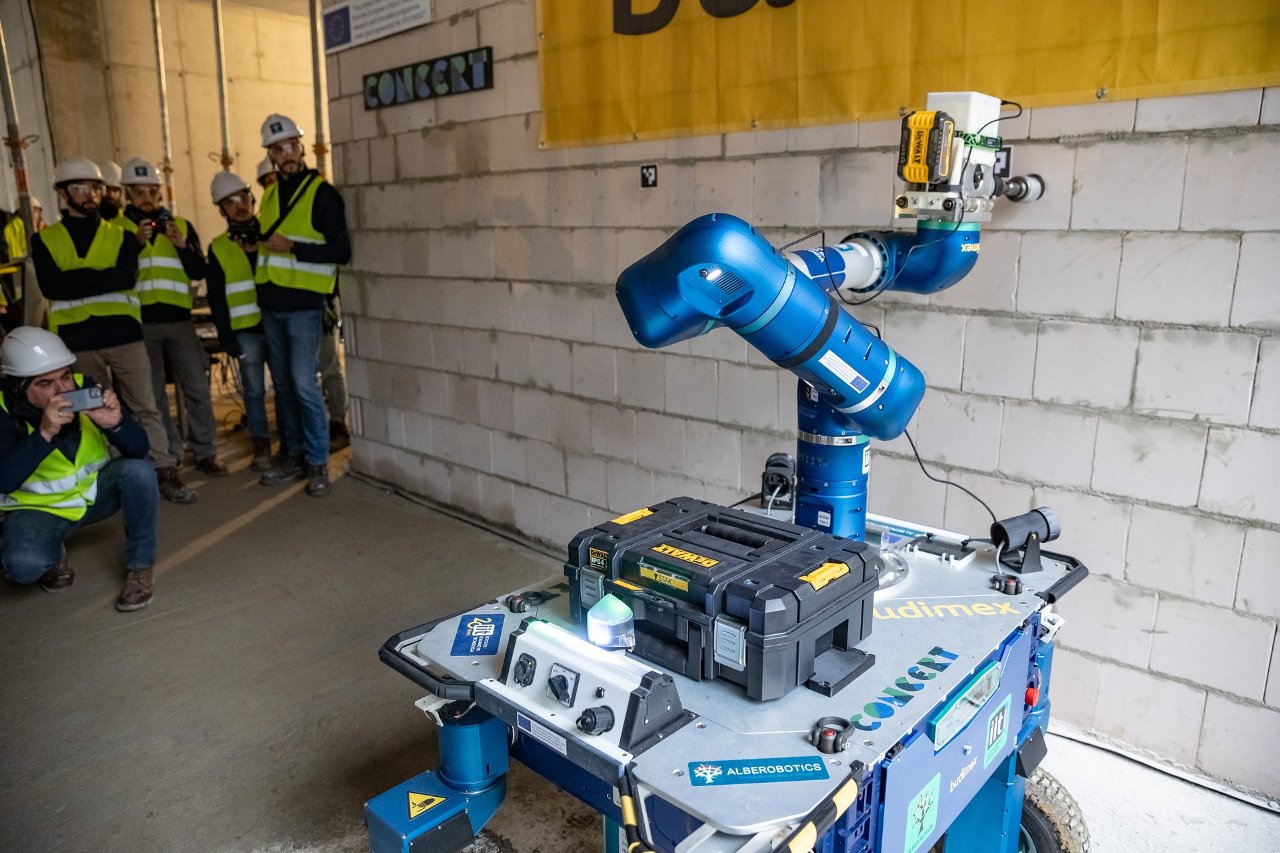
    With the support of the EU-funded CONCERT project, IIT has developed an innovative, modular robot platform. “Our aim was to create a flexible and adaptable solution that optimises construction processes, reduces the workload on people and improves safety,” explains Nikolaos Tsagarakis, project coordinator at IIT.

    Robot as a support – not a replacement
    Although the CONCERT robot can work autonomously, it was primarily designed as an assistance system for construction workers. While the machine takes over repetitive or dangerous tasks, skilled workers can concentrate on more complex activities. This not only increases work safety, but also efficiency on construction sites.

    “Instead of using a separate robot for each task, we have developed a fully reconfigurable solution that can be customised directly on the construction site,” continues Tsagarakis.

    Seamless integration into the digital construction site
    The robot was successfully tested under real construction site conditions. It not only demonstrated its performance, but also its flexibility by being able to adapt to the spontaneous requirements of the construction team.

    One major advantage is the link to digital building information models (BIM). This allows the robot to be controlled directly via a tablet without workers having to operate heavy power tools.

    A breakthrough for construction robotics
    CONCERT has ushered in a new era in digital construction site automation with the first reconfigurable multi-purpose construction robot platform.

    The solution not only has the potential for broad industrial application, but also exceeds the usual technology maturity level in research projects. “The flexibility of the platform makes it usable for many other construction tasks,” says Tsagarakis. Future developments will expand the areas of application even further.