In a densely built-up district such as District 2, the emergency services currently only reach the scene within the critical ten-minute mark in around 60% of cases. The planned expansion and redesign of the southern fire and ambulance station addresses this problem with a comprehensive approach aimed at shortening response times and increasing the efficiency of the services. At the same time, the project aims to enhance the urban development of the area, which is in line with the redesign of the urban space through the demolition of Weststrasse and the new construction of the “Hohe Haus West”.
The winning project from the architectural competition, “FUCHS”, creates a seamless integration into the existing structure of the fire station. The extension blends in harmoniously with the existing building in terms of both height and alignment and harmoniously completes the perimeter of the block. Particularly noteworthy are the courtyard-side extensions with shed roofs and photovoltaics as well as a setback from the first floor, which give the new building a striking independence. These architectural features make it possible to master the balancing act between preserving the historical heritage and fulfilling state-of-the-art operational requirements.
The “FUCHS” project not only impresses with its aesthetic and functional integration into the existing building fabric, but also sets new ecological standards. Thanks to the environmentally friendly energy supply, which is based 100 per cent on renewable energies, and the generously dimensioned photovoltaic system on the shed roofs, a contribution is being made to climate protection. In addition, the design optimises the operational processes of Schutz & Rettung Zürich and creates a coherent unit of high spatial quality.
The project impressively illustrates how the challenges of modern emergency care can be mastered in a historical context through creative and innovative solutions. The careful balancing of the needs of the emergency services and the requirements of heritage conservation has resulted in a project that breaks new ground both functionally and aesthetically. The result is a sustainable infrastructure that meets the requirements of modern emergency services and at the same time makes a valuable contribution to the urban quality of the location.
Tag: Bausubstanz
-

Modernisation and expansion of the south station
-

Former Steghof substation in Lucerne with protected status
The value of the former electricity plant at Sternmattstrasse 3 is to be carefully examined with regard to the building fabric that still exists. As the owner of the property, ewl wants to take this concern into account. “We will examine together with the preservation of historical monuments and urban planning whether the building fabric is worth preserving,” says Patrik Rust, Chairman of the Executive Board. The concern was formulated in an open letter from IG Unterwerk Steghof to ewl and signed by various Lucerne associations and interest groups (see enclosure).
Historical building and current substance
The core elements of the old electricity plant still date from the early 20th century. The building was constructed between 1904 and 1905 by the architect Carl Griot for the Elektrizitätswerk Luzern-Engelberg AG, which was founded in 1903. The plant was primarily used to supply the city of Lucerne with electricity, as the Thorenberg power station in Littau was no longer producing enough power.The building has a certain historical significance. However, the original brick building is no longer recognisable today. The former appearance was largely destroyed by several alterations from the late 1950s onwards. The façade was partially broken through, a mezzanine floor was inserted between two storeys and ornamental elements were knocked off. The building envelope has been covered with green fibre cement panels since 1979. From today’s perspective, this careless treatment of the building fabric seems incomprehensible. After preliminary clarifications with the cantonal monument protection authorities, the building has so far been listed neither as worthy of preservation nor as worthy of protection. This is now to be examined. Today, the former Steghof substation is used by ewl as a warehouse, especially for Lucerne’s Christmas lights.
Interim use and new construction of the ewl site
Another concern of IG Unterwerk Steghof is the examination of possible interim uses on the site. Patrik Rust sees safety hurdles as the main obstacle to a public interim use of the old Steghof substation, with regular visits by people. “Depending on the idea of use, a lot of money would have to be invested to make the building safe for visitors.”Two other buildings are structurally connected to Sternmattstrasse 3: a residential building with currently two rented flats and a disused control centre for the electricity, natural gas and water network systems. The disused control centre currently houses offices.
With regard to the planned large-scale development of the entire ewl site (“Rotpol” project), ewl sees its own needs as necessary. With the development of the ewl site, a completely new city district is to be created in the next few years. At the heart of the development will be the “Red House”, which is being carefully renovated. A historic industrial building, it will be open to the public for events. “The Red House has already established itself in recent years as an ideal venue for cultural events,” says Rust. It is officially considered an “object worthy of protection”.
During the planned construction phases of the Rotpol project, ewl employees need space for temporary solutions and office space. “In the surrounding area, it must be possible to place ewl’s supply material in a sensible way so that, first and foremost, the security of supply for the city of Lucerne with electricity, water and heat is not jeopardised,” says Rust. The construction project will probably also require handling areas for large vehicles and heavy construction equipment. “The site where the said buildings are located could serve as such a place.” Regarding the Rotpol project, on 4 May 2023, at the request of the business audit committee, the Grand City Council had referred back the report and motion “ewl Areal AG: Second financing step” for revision. Open questions are currently being clarified. According to the current status of the project work and with an outlook on the next steps, ewl is currently only considering interim uses for the company’s own purposes.
-

Werkstadt Zurich: Transformation into a climate-friendly neighbourhood
SBB is transforming the 42,000-square-metre Werkstadt site in Zurich into a vibrant urban space, to be completed by 2035. This will preserve the fabric of its historic buildings, which will one day be joined by both new buildings and extensions to create an exciting cluster. The transformation of the former SBB workshops will be exceptionally sustainable, featuring climate-conscious building measures, circular economy elements and an innovative energy concept.
Developing existing buildings
In close coordination with the monument preservation authorities, the existing buildings will be gradually renovated and joined by new buildings and extensions in the coming years. At the heart of the site, the former carriage workshop ‘Building Q’ will allow for a diverse usage mix under one roof from 2023. The development will offer an exciting interplay between the fabric of historic buildings, structural densification and public use of outdoor space.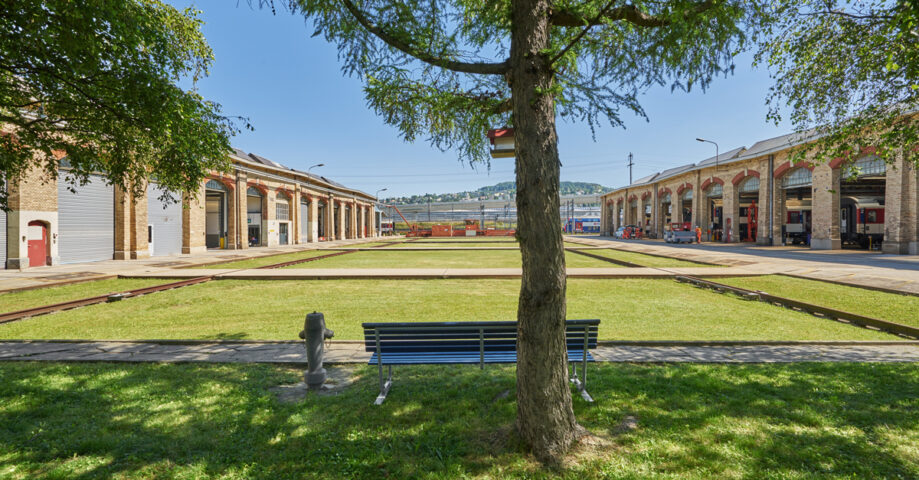
© SBB AG, Martin Zeller Environmentally friendly construction
‘SBB wants to be climate-neutral by 2030, and climate-compatible construction is an important factor in achieving this objective,’ said Gabriele Bühler, Project Manager at SBB. Various climate-conscious building measures have been incorporated into the planning of the site. That includes configuring the new buildings to promote the circulation of cool air currents. Where possible, the roof water will be allowed to seep into an above-ground system for further cooling. Surfaces will remain unsealed where possible. The transformation follows a systemic approach that considers the building along its entire life cycle. The aim is to keep CO2 emissions as low as possible. To ensure circularity, all construction components are recorded on the Madaster platform. There is also a particular focus on reusing components.Energy concept: 100% renewable
ewz was able to win SBB’s public tender with an energy solution based on 100 per cent renewable energies. Groundwater, which is collected in four wells on the site, serves as a source of heating and cooling. From these wells, the water flows to the energy centres in the larger buildings, which house heat pumps and cooling machines that bring the water to the required temperature. An anergy network connects all the buildings and ensures that excess energy is exchanged between the building groups. For example, excess heat or cold in one building can be used in another. This system also has the advantage of not requiring groundwater boreholes in every building: the smaller buildings are connected to the energy centres via a local heating network. Heating and cooling is generated without any CO₂ emissions, as the rest of the electricity also comes from renewable sources. The use of a monovalent energy system will ultimately lead to a CO2 reduction of over 2,100 tonnes per year.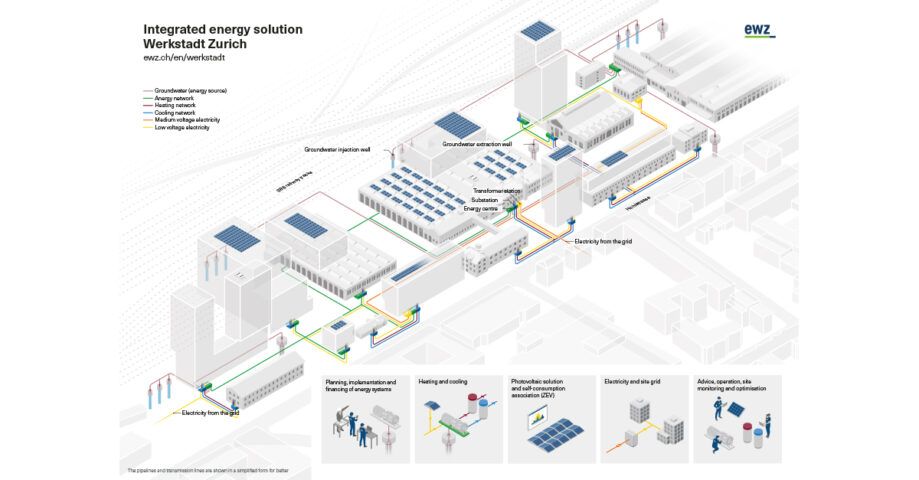
High self-consumption of solar power
ewz also plans, finances, creates and operates the transformer systems and medium-voltage lines to supply the site with electrical energy. ‘Some of the electricity that the people in the Werkstadt use on the site is produced there using photovoltaics,’ explains Markus Fischer, Head of Sales at ewz Energy Solutions. To this end, SBB and ewz want to make the best possible use of the roof areas for solar power production. Both the roof of Building Q, at the centre of the site, and the roofs of other buildings with a suitable structure and orientation for generating solar power are to be kitted out with photovoltaic systems. SBB requires its tenants on the site to form a self-consumption association (ZEV). ‘When completed, the ZEV will consist of around 300 parties that will use locally produced electricity on the site. This allows us to achieve a high self-consumption rate, which, in turn, makes a significant contribution to the cost-effectiveness of the photovoltaic systems,’ says Markus Fischer. He expects self-consumption on the Werkstadt site to be almost 100 per cent when completed.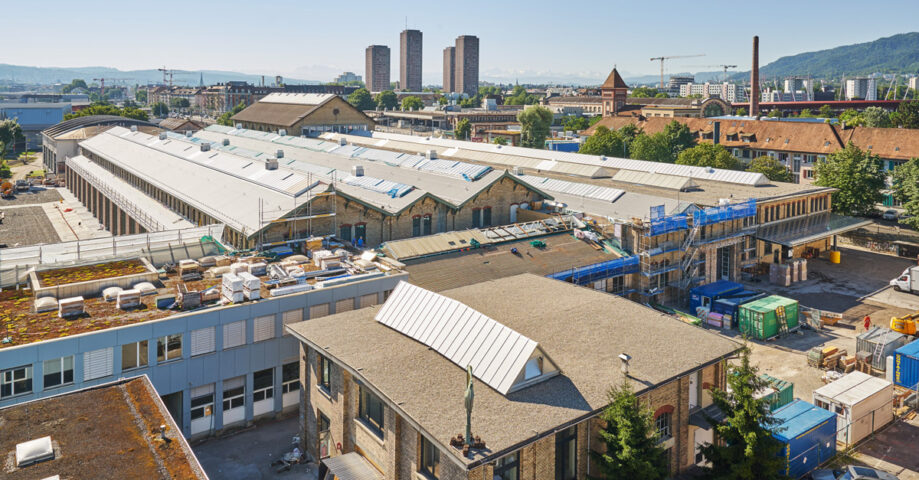
© SBB AG, Martin Zeller The benefits of contracting
For the owner, this form of collaboration has various benefits, including keeping financial risks and management costs very low. If a system fails, ewz makes sure it gets back into operation as quickly as possible. To ensure that the system can be operated efficiently, ewz will start undertaking energy-related operational optimisations shortly after commissioning. As part of an ongoing process, the systems will be optimised and adapted to the actual needs relating to their use. By extension, this ensures that they consume as little energy as possible, generate minimal costs and offer maximum convenience for users.Werkstadt Zürich is a successful example of a forward-looking approach to repurposing a historic industrial site. With the targeted renovation and expansion of existing buildings and a ground-breaking energy concept, the developers – together with the planners and ewz – are creating added value for future users and the environment alike. Find out more about the Werkstadt site’s innovative energy concept here.
-

Studio DIA allowed to renovate the Swiss embassy in London
The Bernese architectural office Studio DIA has the right to renovate and restructure the Swiss embassy in central London. With its Wellington project, the company won the one-stage project competition in the open procedure of the Federal Office for Buildings and Logistics in Bern, according to a press release .
Accordingly, one of the most important requirements was "to meet the demands of the different users with their different areas of responsibility". In addition to the embassy, the ambassador's apartment and other apartments are located in the partly listed building complex in the district of Marylebone. Switzerland Tourism and other organizations also use the house. The embassy has been in operation for more than 50 years.
According to the information, Wellington convinced with a clear separation of the various areas of use according to their functions. Above all, the outer facades are to be preserved, which means that the effort for the redesign is kept within limits and the necessary degree of sustainability is given.
All entries to the competition can be seen from August 19 to 30, 2022 in an exhibition at Fellerstrasse 15a in Bern from Monday to Friday from 4 to 7 p.m. and on Saturday from 10 a.m. to 3 p.m. in Bümpliz.