Tag: Bauteile

  • Until the chemistry is right

    Until the chemistry is right

    The fact that she has mastered her field from A to Z is, as she points out, also thanks to know-how built up by colleagues at Empa – such as engineer Gabor Kovac. He pushed the production of stack actuators with expandable silicone discs for many years and developed them to operational maturity with his partner Lukas Düring until their spin-off “CTsystems” was recently taken over by the Daetwyler Group.

    “The devices for measuring how actuators stretch in different electric fields were developed by them,” Opris says, “we were early on this topic, and that helped me enormously.” Unlike her colleagues, however, the chemist is working less on the technology for printing such components, but one “floor below” – on the synthesis of novel polymers that are suitable as non-conductive layers for stacked transistors, elastic films for power generation and other elements.

    The desired profile: as thin as possible, with the long-term goal of many layers only ten micrometres thick; easily stretchable, sensitive to low current voltage and robust at the same time. And above all: printable, i.e. without solvents for the conductive layers between which the polymers lie. “Solvents can damage the polymer layers. Besides, the material would have to dry for a long time in order not to give off harmful vapours,” explains Opris, “so we try to do without them – with the right chemistry.”

    There are many different requirements that researchers all over the world are dealing with. Suitable compounds that raise hopes are polysiloxanes, which the Empa specialist is also working on. An important advantage of these polymers: they are relatively easy to synthesise; the “backbone” of their strands is very mobile – and they can be specifically manipulated with polar groups, i.e. plus-minus charged molecules.

    Snake-like molecules
    What is difficult for laypeople to understand, Dorina Opris explains with a vivid image: “You can imagine these polysiloxanes like a pot full of snakes that want to move all the time.” The polar groups have a twofold effect on them. On the one hand, they make the molecular snakes more sensitive to electric fields so that they respond to low voltages. On the other hand, they act like a kind of glue between the molecules; this “stiffens” them and thus reduces the important elasticity. It is necessary to fine-tune both effects to achieve maximum success. For a practical application, the transition from the solid to the elastic state at low temperatures is important so that the technology can later be used at room temperature. In addition, such polymer structures still have to be chemically “cross-linked” so that they can become elastic layers – for example by UV light and with the help of so-called end groups: quasi molecular “hats” that the snakes wear at their ends. But in laboratory practice, it has so far proved tricky to reliably provide these polymers with defined end groups. “That annoys me already!” admits Opris with a smile.

    Healthy ambition is needed for the TRANS project, which the chemist herself calls “very, very ambitious”. The team is optimistic because earlier work has already produced encouraging results; for example, a polysiloxane compound that reacted to a voltage of only 300 volts and deformed strongly – an extremely low value. Printing capacitor layers without solvents has also already been achieved. And a doctoral student recently developed a piezo-electric elastomer that, when stretched, shows a significantly higher electrical response than other compounds currently in use.

    Creativity and team spirit for success
    Of course, many more steps are needed to achieve usable successes – and those qualities that have brought Dorina Opris to Empa and ETH Zurich. Not only stamina and the ability to turn failed attempts into progress, but also to create an inspiring environment for employees that allows open debate and also mistakes so that good ideas emerge.

    And above all: optimism. The boss believes that young researchers should be given exciting and challenging projects and then be allowed to work independently so that they remain motivated. Her advice to talented women based on her own biography: “Don’t wait until someone pushes you to do research. You have to be self-motivated and strong, and go for it! And also take a risk sometimes.”

  • Challenges are the mother of invention

    Challenges are the mother of invention

    Representative façade made of used materials
    The task: Simple, used everyday materials and components are to be used for the façade of a prominent administrative building at Zurich’s main railway station. At the same time, the client, who was actually represented at the workshop, wanted to use the replacement of the façade to give the property a representative expression.

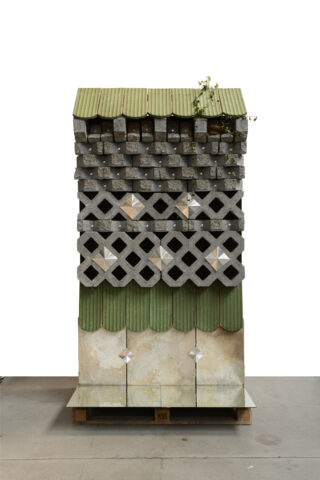
    The students are to create a design for the façade in small groups from the used material provided. They are to discuss and develop urban planning, constructive and atmospheric aspects. And finally, they are to build a section of the façade in original size. The students are supported and guided by ZHAW lecturers and international experts.

    The materials store contains various used or leftover components. Each group is given a different material as a starting point for their design idea: mirrors, steel grids, grass pavers, roof tiles, profiled sheets or glass-fibre reinforced plastic.

    Creative solutions
    The challenging task of giving the property an attractive and representative design expression with simple, used everyday materials leads to surprising results: The students reinterpret lawn paving stones into artistic stylistic elements.

    Turf stones are reused and transformed into artistic stylistic elements.

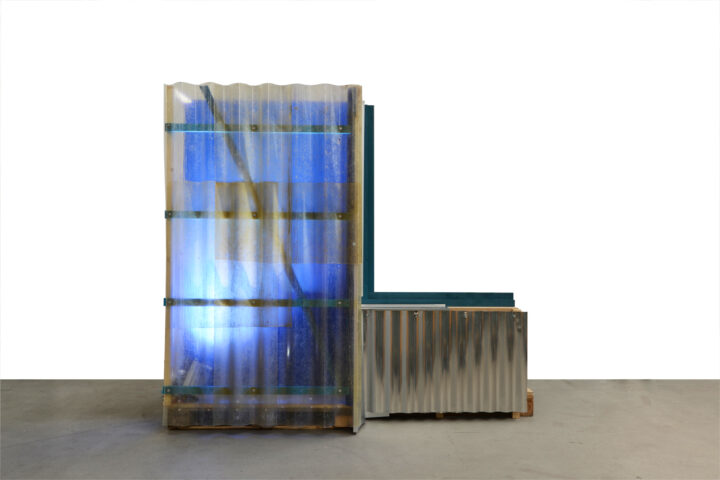
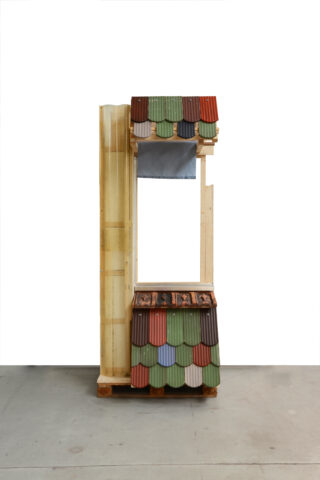
    They backlight plastic panels that simultaneously create a thermal buffer. They arrange roof tiles with varying reliefs and finishes to create animated surfaces.

    Backlit plastic panels create a thermally insulating buffer layer.

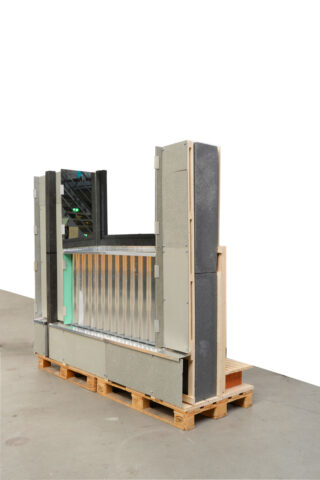
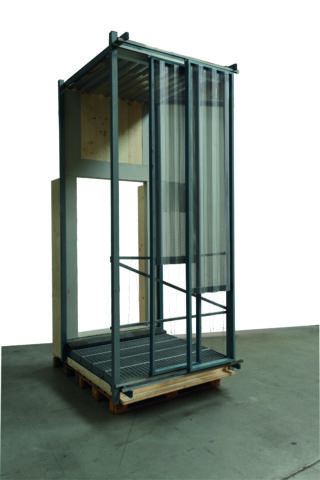
    In order to breathe homeliness into the sober administrative building, a group of students combines French balconies with galvanised stair treads, which also provide support for a green façade.

    Roof tiles with varying reliefs and paintwork become animated surfaces.

    Another group uses mirrors from the recently demolished Winterthur Cantonal Hospital as slanted window reveals, giving the façade a surreal, playful appearance.

    French balconies with galvanised stair treads provide cosiness and offer support for a green façade.

    Appreciation for the existing building stock
    The search for qualities in the seemingly worthless changes the students’ view of the existing building stock. Some students take the assignment so seriously that they question it: Is a replacement of the existing façade elements, as it is envisaged in reality, necessary at all? Can it be possible to preserve the existing façade and retrofit it for the new use? In their project, a group of students proposes to renovate the existing façade and to leave the scaffolding required for this on the building later – in order to create new living spaces in the outdoor area.

    Mirrors as diagonally inserted window reveals give the façade a surreal, playful appearance.

    Along the way, a realisation also grows during the workshop week. The architecture of reuse can indeed produce a variety of architectural attitudes and forms of expression – but they are all based on a common foundation: the respectful and careful treatment of existing buildings.

    The existing façade is to be renovated. The scaffolding used for this purpose will remain on the building after the renovation and create new living spaces in the exterior.
  • Baden launches pilot project for reuse in the building park

    Baden launches pilot project for reuse in the building park

    The city of Baden is the focus of a new research project on the reuse of building components at city level, according to a media release. The research programme Buildings and Cities of the Swiss Federal Office of Energy(SFOE) has been implemented with the participation of the Zurich-based company intep (Integrale Planung GmbH) and the Swiss Federal Institute of Technology Zurich(ETH) with Baden as a case study since January.

    The project will run for about two years and is largely financed by the SFOE. The city of Baden is contributing about a quarter of the project costs and the Federal Office for the Environment(FOEN) is also participating. “The city of Baden will benefit from tailor-made findings, especially for the city’s own construction projects and the ongoing revision of the land-use planning,” Markus Schneider, the city mayor, is quoted as saying.

    In the research project “Re-Use on the way to the net-zero target for buildings”, the focus is not on recycling building components, but on direct reuse in other buildings. For the project, component flows are being modelled, the environmental impact is being determined and the necessary framework conditions and measures for broad application are being systematically recorded, according to a statement from intep.

    “The CO2 emissions of a building over its entire service life – i.e. not only during operation but also during construction – are an important and still underestimated potential for the necessary reduction of CO2 emissions to net zero,” Nadja Lavanga, project manager at intep, is quoted as saying.

    Christian Vogler, energy coordinator of the city of Baden, names as reduction potentials “the preservation of existing buildings instead of new ones, circular and resource-saving construction methods, the reuse of building components and recycling”.

  • New reuse pavilion at the FHNW Campus Muttenz

    New reuse pavilion at the FHNW Campus Muttenz

    In the spirit of the annual theme "Constructive Futures – Beyond Concrete", the students of the third year course of the bachelor's degree in architecture, under the direction of Professors Ursula Hürzeler and Shadi Rahbaran, dealt with the reuse of components. The starting point for this was the floor-to-ceiling wooden ramp, which was attached to the front facade of the Swiss Architecture Museum S AM as an urban intervention as part of the exhibition "Access for All – Architectural Infrastructure Buildings São Paulo" 2021. This ramp was dismantled again after the end of the exhibition and the components should now be used for a new purpose.

    Architectural competition for students
    For this purpose, an architecture competition was held among the students in the 2021 autumn semester. The task was to design a place to stay in the park that was protected from the wind and sun, for use and free use by the university and the district. The winning project "Silvestris" that emerged from the competition was selected for further development and implementation. The students then developed the design idea together and in the spring semester of 2022 went into more detail in an interdisciplinary elective course. At the same time, the structural design, the static dimensioning, the development of the node connections and the execution planning were carried out by the Institute of Civil Engineering under the direction of Prof. Dr. Simon Zweidler, head of the construction laboratory. From the design to the manufacture of all steel nodes, digital fabrication was used in a pioneering way: After the complete 3D modeling, the surfaces required for the fold were calculated by software and the developed surface was cut from the solid sheet by laser; the subsequent three-dimensional bending was also carried out fully automatically.

    Static Challenges
    In the course of this detailed planning, various structural and static challenges had to be mastered. The limits of the reusability of components also became apparent; In this specific case, the old wood did not have the strength required for the new arena and the planned intensive use and duration. This led to the decision to build the statically relevant components with construction wood intended for this purpose with the appropriate strength and to use some of the old wood for secondary components. This resulted in a valuable learning process regarding the complexities and challenges of reusing components. However, the original structure of the ramp is still reflected in the dimensions of the elements and the shape of the new arena.
    The arena created in this way should offer various possible uses. The roof made of light fabric creates a shady place to stay, which can not only be used for teaching and teaching at the university, but also provides space for performances and also invites residents in the neighborhood to use and help shape it. The winning project and all other project proposals developed by the students are also on public display in an exhibition in the porch of the campus building.