Who is Mario Branda?
In office since April 2012, Mario Branda (PS) is the first socialist mayor of a Ticino city. Being in this case the cantonal capital, the record doubles. An achievement that is certainly a source of pride for Mr Branda who does not like big fanfare. In 2011 he resigned from the office of public prosecutor to run for the Council of State but was not elected. He did not let himself down and in the following year he ran for the office of mayor in Bellinzona and collected an avalanche of votes. Born in 1960, a lawyer by profession, Mario Branda works at the law and notary firm MLaw in Bellinzona.
You are the head of the city of Bellinzona which, in recent years with the aggregation, has undergone several changes. You recently developed the PAC, the Municipal Action Program. What is it about?
To understand why the need to acquire the PAC has arisen, we must take into account two important aspects that have
development of Bellinzona was born.
With the 2017 aggregation, the new Bellinzona brought together 13 municipalities and grew from 18,000 to almost 45,000 inhabitants and an area that – with 164 km2 – is the largest in Switzerland for a municipality with an equivalent population.
Managing the economic, cultural, eco-social development and guaranteeing maintenance and safety for such a large territory involves a considerable effort. With the aggregation, the administration of all the municipalities had to be standardized, a laborious operation because we have extensive agricultural and semi-agricultural areas – 1/3 of the Magadino Plan now belongs to the new jurisdiction – which have different needs and requirements compared to urban centers.
The second important aspect is AlpTransit: the opening of the Gotthard and Monte Ceneri base tunnels constitutes a fundamental and strategic aspect that will benefit the whole Canton of Ticino and, above all, the city of Bellinzona will experience important changes to the urban fabric over time. . Transformations that can be evaluated in 10-15 years, even if already now we can observe movements that were not there until some time ago.
The need has therefore arisen to create a document that would help the current Municipality and those who will continue to orientate itself and orient the development policy in this new reality. A competition was published in which various groups participated, with the aim of helping future choices in terms of planning and development of the city in the next 15-20 years and to be able to incorporate the current regulatory plans in a single document.
What does the PAC contain?
The PAC is a programming tool, consisting of a descriptive document and illustrative cards and plans. It contains some principles that are codified on which we will orient ourselves in the future and takes into account the following two important aspects:
– Polycentric identity. The new Bellinzona has different realities and it is important to maintain the identities of the individual municipalities, their social life and their development. The former Municipalities have accepted the new status of the Bellinzona district as long as services, capillary connections and safety are guaranteed throughout the territory.
-The Ticino river. From the landscape point of view, the river that crosses the territory from Moleno to Gudo characterizes the new territory and represents the backbone of the new Municipality.
Once these two general principles have been established, development projects follow that are oriented towards a centripetal evolution of quality, focusing on the construction and development of economic activities in already densely populated centers to relieve the pressure of further exploitation of the territory.
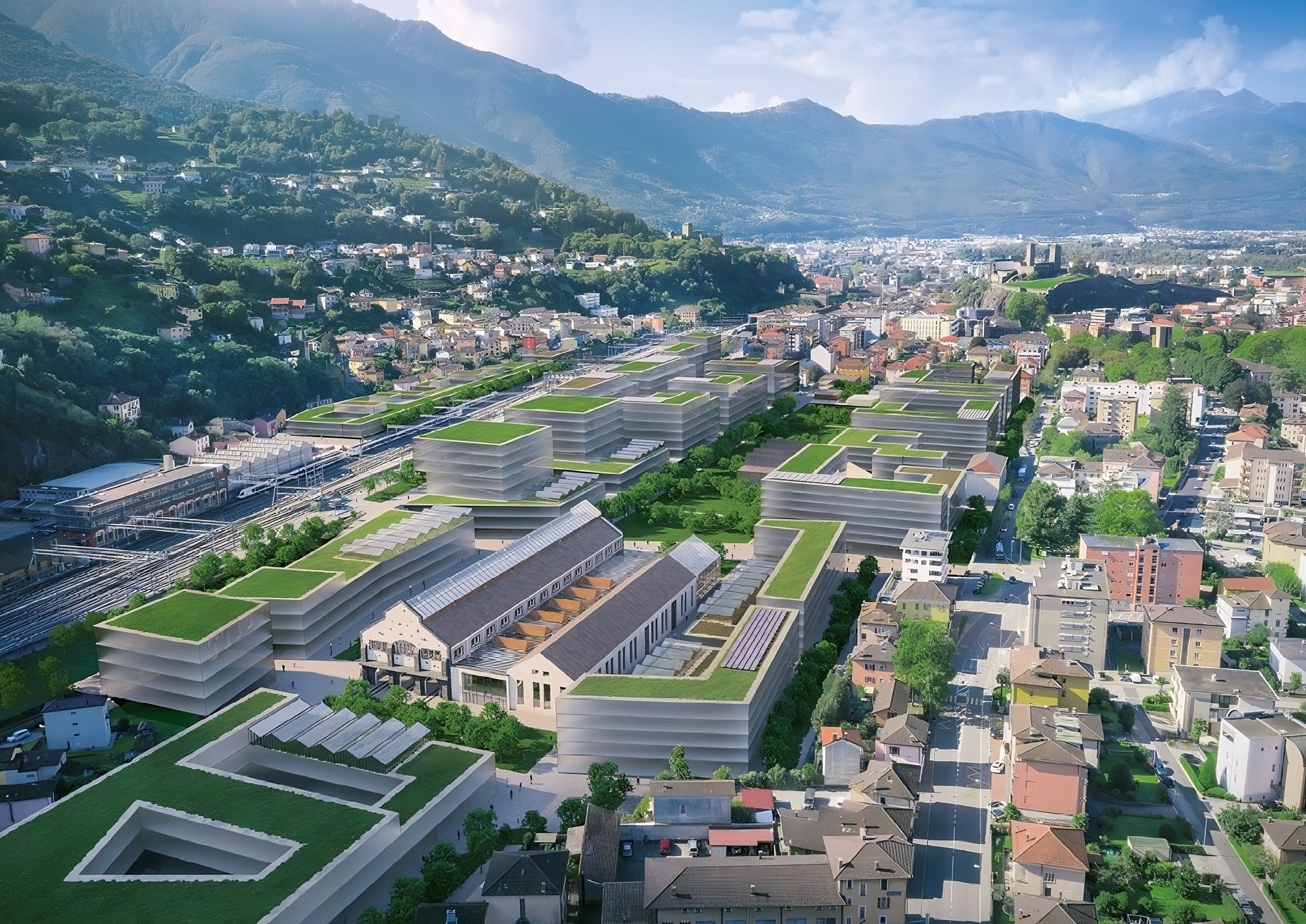
Two areas have been identified that are particularly suitable for construction activity and economic development: the sector of the former Ferriere Cattaneo and the space of the former workshops in Bellinzona, in the central area.
Could you tell me something about the ambitious project of the Ex Officine space? It would be interesting to have some details on the timing as well.
The project for the Ex Officine area actually includes various projects. The first big job will be to move everything located on the grounds of the SBB workshops and bring it to Castione. Here, an area of over 150,000 square meters has been identified which seems suitable for building the new SBB production site, in an easily accessible area for a total investment that should be around 400 million francs. Part of the costs will be covered by the canton (80 million francs) and the city of Bellinzona (20 million francs). The premises are good for thinking that the project can start once the administrative and recurring practices have been resolved.
If this operation goes through, as can be hoped, the current area of the SBB workshops will be vacated, a space of approximately 120,000 square meters in the heart of the city. To understand what to do with it, a Masterplan with an international competition was launched. The data have already been published and foresee the construction of a new partly residential neighborhood, the current locomotive repair cathedral could be converted into a cultural and social center; finally, a part intended for training with a Swiss Innovation Park, a sub-site of the Swiss Innovation Parks.
It will be a variant of the master plan that will also be based on the new Ma-sterplan to define the stages and processes of this new district. It is a project that has a vision and a horizon of 30-40 years, it will follow a defined path and it is hoped that it can be divided into lots and sectors, to be opened only when the previous one has already been completed and occupied. Part cen-
trale of about 30,000 square meters is intended for public green, a real park where the various buildings will develop around.
The land on which this new district will be built today is wholly owned by the SBB and the agreement signed in December 2017 established that half of it will be sold to the Canton of Ticino and the city of Bellinzona with the intention of carrying out a common project.
What other construction sites do you have in progress or do you plan to activate in the near future?
The new headquarters of the IRB will be inaugurated shortly in November. The current headquarters could be purchased by the city to include new biomedical research activities after some renovations. The idea is to consolidate the city of Bellinzona as a center for biomedical research.
In 2030 work should begin on another important project: the construction of the new hospital, which will be built in the Saleggina area. The first step – the allocation of the credit of 16 million francs by the Commission for the management of the Grand Council, for the purchase of the land owned by Armasuisse – has been made.
The other major project to be developed over the next four years will be to enhance the cultural offer of the city and the attractiveness of the three castles: essentially promoting the Bellinzona Fortress, a Unesco heritage site.
Finally, I’m curious to know what the mayor Mario Branda’s dream is?
In fact there are two: the consolidation of the IRB biomedical research poles and the one that will return to the building left empty by the IRB and, at the same time, take care of the project to enhance the Unesco heritage of the castles that could give a cultural and touristic turning point in Bellinzona.
And a slogan: for a Bellinzona, a pole of research but with Art!