Tag: Bevölkerung

  • Smart City Winterthur 2030

    Smart City Winterthur 2030

    Since the first smart city strategy in 2018, Winterthur has established itself as one of the most progressive cities in Switzerland. At that time, the focus was on quality of life and resource efficiency, supplemented by topics such as energy, mobility, education and health. With the revision of the strategy towards Smart City Winterthur 2030, the City Council is now focussing on new cross-cutting topics such as innovation, needs orientation and co-creation. These topics are crucial to meeting the requirements of a changing society.

    Two programmes are driving implementation
    The new strategy is being implemented through two programmes, the Innovation Programme and WinLab. The innovation programme supports employees of the city administration in the development and implementation of innovative projects. The aim is to strengthen the culture of innovation within the administration.

    The WinLab, on the other hand, acts as an urban real-world laboratory in which representatives from business, science, civil society and municipal institutions work together. In this creative space, forward-looking solutions for the city are developed and tested. Both programmes create scope for experimentation and promote sustainable innovations that meet the needs of citizens.

    A strategy for the future
    The Smart City Winterthur 2030 strategy comes into force on 1 January 2025 and is part of the long-term goal of shaping Winterthur as a sustainable and adaptable city. The strategy will be reviewed after five years at the latest to ensure that it continues to meet the needs of the city and its population.

  • Zug Economic Area – Facts and Figures Zug

    Zug Economic Area – Facts and Figures Zug

    Located within the Greater Zurich Area (GZA), Zug is one of the world’s leading economic regions. The location boasts an excellent infrastructure, great potential for young talent and political and economic stability.

    Both the municipalities and the canton of Zug are constantly evolving and adapting to the requirements. With innovative projects, such as a bypass to relieve congestion in the centre of Cham, lake water that will regulate the temperature in the houses in residential areas in the future and exciting projects, such as the Association for Decarbonisation or the Climate Charter Zug, the canton is shaping a modern image with ambition.

    Numerous areas of historical significance are being renovated and converted to create attractive mixed-use developments comprising residential, work and commercial space.

    As a result, Zug remains a canton worth living in, which is also reflected in a high level of life satisfaction.

    Zug is not only appreciated by its 133,000 residents, numerous independent ratings and studies also confirm Zug’s outstanding position. For example, Zug has been ranked first among the Swiss cantons in the Credit Suisse and UBS rankings for 24 years. The basic principles of business friendliness, service orientation and a culture of innovation make the canton of Zug an ideal partner for companies, educational institutions and research institutes.

    Testimonials

    Andreas Klopp
    General Manager Roche Diagnostics International AG

    “Rotkreuz is located in the Zurich-Zug life sciences cluster and offers ideal conditions for driving innovation thanks to its excellent infrastructure and high quality of life. For over 50 years, Roche in Rotkreuz has been contributing to the health of patients worldwide with diagnostic solutions.”

    Dr Katja Buller
    Vice President, Head of Corporate Affairs International, Biogen

    “Local and international specialists,
    “Local and international specialists, a multi-layered infrastructure and professional cooperation with the authorities have made the canton of Zug the ideal location for our international headquarters for more than 20 years”

    Katharina Gasser
    President of the Zug Chamber of Commerce

    “Our members appreciate the business-friendly conditions in the dynamic and innovative Canton of Zug. The authorities are service-orientated, make decisions quickly and work efficiently; the unique “spirit of Zug” is palpable.”

    Hanspeter Rhyner
    Chairman of the Executive Board, Zuger Kantonalbank

    “Zuger Kantonalbank combines tradition and modernity. This is precisely the DNA of the attractive location of the Canton of Zug. Digital AND personal –
    this is how we meet the needs of our customers in line with this DNA. And we can fulfil all needs and accompany you through life.”

  • Potential for transformation despite development delay in Basel

    Potential for transformation despite development delay in Basel

    The study conducted by Sotomo shows that Basel has experienced subdued growth momentum over the last ten years, particularly in comparison with cities such as Zurich, Geneva and Bern. With only six per cent growth in the housing stock since 2012, Basel brings up the rear among the eight largest Swiss cities. Only a small proportion of flats were built after 1990, which suggests a delayed development dynamic.

    Demographic challenges and opportunities
    The study also emphasises that Basel is the only city in the study that does not have a birth surplus, which indicates a weak population dynamic. The comparatively low proportion of young adults and families and the high proportion of older households reflect a demographic challenge that also influences the development of the labour market.

    Despite these challenges, the study emphasises that new-build flats do not necessarily lead to higher rents in existing flats. On the contrary, they could even revitalise the market for affordable flats in older buildings. This points to untapped opportunities in urban planning and development.

    The potential of “Klybeck Plus
    One particularly striking example of untapped potential is the planned “Klybeck Plus” urban quarter. This area is to be built on a former industrial site and offers space for flats for 8,500 people and 7,500 jobs. similar to Basel’s Gundeli or Geneva’s Le Pâquis neighbourhood, “Klybeck Plus” could offer a lively mix of living and working and at the same time be as green as Basel’s Gellert district.

    The study emphasises that, despite current challenges, Basel has considerable potential that can be exploited through strategic planning and innovative development concepts. The results are a wake-up call for urban planners, developers and political decision-makers to mobilise the available resources and reposition Basel as a dynamic and future-oriented city.

  • Site development – strategies for a vibrant city

    Site development – strategies for a vibrant city

    The city of Zurich is undergoing constant change, characterised by rising population growth and increasing demand for residential and commercial space. Balanced urban development that takes into account the needs of residents and incorporates ecological and social aspects is crucial.

    The Office of Urban Development plays an important role in the planning and implementation of this development. By coordinating public and private interests and developing urban development projects, the Office helps to ensure that Zurich remains a vibrant and attractive city. In doing so, it preserves the architectural heritage and creates space for forward-looking construction projects.

    The municipal structure plan is a key instrument for the long-term development of the city. It defines strategic goals and measures for sustainable site development and serves as a guideline for the coordination of various interests and stakeholders. In view of the projected population growth up to 2040, targeted planning and densification of existing areas is essential.

    The municipal structure plan defines areas that are suitable for structural densification, as well as areas for public open spaces, municipal buildings and facilities. The focus here is on creating a liveable environment that meets the needs of residents and enables sustainable urban development.

    Overall, site development and spatial planning in Zurich is a complex challenge that requires close cooperation between various stakeholders. The Office for Urban Development is committed to a balanced and future-orientated development of the city that preserves its identity and meets the need for living, working and recreational space.

  • A visionary spatial planning concept for the future of the Zurich metropolitan area in 2050

    A visionary spatial planning concept for the future of the Zurich metropolitan area in 2050

    With almost 40% of the Swiss population and the majority of jobs, the Zurich metropolitan area is home to a significant proportion of national life and economic activity. The updated spatial planning concept Metro-ROK 2050, an update of the first Metro-ROK from 2015, defines ambitious planning objectives for this important economic and living space. It aims to promote sustainable development that fulfils both the needs of the population and the protection of the environment.

    The concept divides the area into four action areas: urban landscapes with urban centres, transitional landscapes with regional centres, cultural landscapes and natural landscapes. This categorisation makes it possible to develop targeted measures that guarantee a high quality of life and at the same time make the area ecologically sustainable.

    A core concern of the Metro-ROK 2050 is the protection of green spaces and the promotion of high-quality inner-city development. No expansion of the settlement area is planned until 2040 in order to stop urban sprawl and make better use of existing areas. The building culture should be based on the circular economy principle, take grey energy into account and protect biodiversity.

    The concept also places a strong focus on the sustainable use of resources and the promotion of energy efficiency. Innovative technologies and ecological construction projects should help to improve the carbon footprint and make the metropolitan area more resilient to climate change. Renewable energies and the reduction of soil sealing are just as much a focus as the promotion of public transport and sustainable mobility solutions. The aim is to significantly increase the proportion of environmentally friendly means of transport by 2050.

    The Zurich Metropolitan Area 2050 spatial planning concept represents a decisive step towards sustainable and future-proof development. With the positive acceptance of the recommendations for action by the Metropolitan Council on 3 November, a further milestone has been reached. The concept reflects the commitment of the participating cantons to work together to ensure a liveable and ecologically sustainable Zurich metropolitan area.

  • More incentives for compact and ecological construction

    More incentives for compact and ecological construction

    At a time when the fight against global warming and the housing shortage is becoming increasingly urgent, everyone working in the construction sector is more challenged than ever. The building stock is responsible for a significant proportion of CO2 emissions and the need for new housing is growing faster than ever before. It is therefore essential to act quickly.

    Despite numerous initiatives and political initiatives, progress in solving these problems still seems to be too slow and the fronts are becoming increasingly hardened. Bernhard Lanzendörfer argues in favour of a joint search for quick, innovative, affordable and social solutions instead of getting lost in ideological standpoints.

    One example of an ideological standpoint is the petition by the Countdown 2030 association, which vehemently opposes the demolition of buildings. Bernhard Lanzendörfer argues that rigid ideas such as these will not solve the problems and calls for a differentiated view from a structural, ecological and social perspective.

    In view of the housing shortage, a substantial densification of living space is often only possible through the construction of replacement buildings. The building-within-existing-buildings approach quickly reaches its limits here, especially when it comes to modernising and adding storeys to existing buildings.

    In order to promote ecological and social construction, Lanzendörfer suggests that politicians should create concrete incentives. This could be done, for example, through rewards for the ecological upgrading of buildings or a higher utilisation rate for ecological flagship projects.

    In view of rising population figures and increasing urban sprawl, it is essential to build upwards. Although this may meet with resistance, according to Lanzendörfer it is the simplest solution for making better use of every square metre.

    It is important not to hinder innovative concepts with ideological barriers. The construction industry has already made great progress in the development of climate-friendly products, and politicians are also supporting the use of environmentally friendly building materials through new regulations in environmental protection legislation.

  • Researchers develop scenarios for Biel hospital site

    Researchers develop scenarios for Biel hospital site

    A new study by the Institute for Settlement, Architecture and Construction at Bern University of Applied Sciences provides initial impetus and possibilities for the further development and valorisation of the vacant hospital site in Biel’s Beaumont district. With the planned relocation of the Biel hospital centre to Brügg, one of the central development focal points for the coming years will be created there.

    According to a press release, the aim was to create a solid knowledge base on which architecturally sound and sustainable decisions can be made. A participatory approach allowed the needs and expectations of the population and relevant interest groups to be taken into account. Their opinions, demands and visions were collected through workshops, surveys and discussion rounds.

    As the study shows, there is the possibility that the site could become a place with a variety of uses that enriches the neighbourhood and becomes accessible and attractive for the entire urban population: “A variety of building types, for example, could enable a broad spectrum of uses, forms of housing and living spaces,” the press release states. “However, as the students’ work shows, the possibilities for valorisation and development of the site are almost limitless.”

    This independent research work by Bern University of Applied Sciences will now be made available to the city of Biel as the planning authority and Spitalzentrum Biel AG as the landowner for further work. In the next step, both will commission a feasibility study.

  • Development plan for the ZVB site was clearly approved

    Development plan for the ZVB site was clearly approved

    The ZVB acts as a mobility service provider in the service of the population. In order to be able to fulfil its mission in the future, an urgently needed new infrastructure is required, which is set out in the Areal An der Aa development plan. Today’s referendum Sunday marks a historic moment for ZVB: with 81.3% in favour, the electorate has clearly voted in favour of the future of ZVB and positioned itself behind the company.

    Cyrill Weber, Managing Director of ZVB, is delighted with the clear result and emphasised in his speech: “We have always worked to take all the concerns of our project into account and achieve the best possible result for everyone. Today’s vote shows me that our efforts are recognised and appreciated by the public.”

    Thanks to the positive decision, the construction project can move forward. With the new main base, ZVB will be able to promote the growth of mobility and drive forward the electrification of the fleet. ZVB employees, who currently work in outdated infrastructures, will have modern workplaces where they can give their best.

    By adopting the development plan, additional uses will be made possible on the company premises and the area will become more permeable and greener. The ZVB is very grateful for the great support it has received over the past weeks and months.

  • Residents of Eastern Switzerland would reduce living space

    Residents of Eastern Switzerland would reduce living space

    Nikola Vukovic and Raphael Dietrich have developed options for easing the housing market in Eastern Switzerland in their final thesis for the Master’s degree programme in Real Estate Management at OST – Ostschweizer Fachhochschule. “The Swiss population lives too generously,” Vukovic and Dietrich are quoted as saying in a corresponding OST press release. However, according to the findings of the two researchers, many residents of Eastern Switzerland would be prepared to reduce their living space.

    Specifically, 43 per cent of 379 participants in a survey as part of the master’s thesis stated that they could do without living space. A guest room or a hobby room were particularly frequently rated as unnecessary. However, alternatives are needed, “such as a central guest room that would be easy to rent in the flat block,” explains Vukovic.

    The Master’s students have also identified a high level of willingness among the population to move into a smaller flat. However, the problem here is that there are not enough small flats available, according to the press release. The price can also be an obstacle: “Nobody would give up a four-room flat for 1,000 francs for a smaller flat that costs the same or more,” says Vukovic.

    Urban centres could be eased by moving to more rural regions. In the survey, around 95 per cent of respondents indicated a willingness to do so. “However, the respondents would not move without conditions,” explains Dietrich. “Incentives would have to be created to encourage people to move away from urban centres.”

  • Skyscrapers like those in Manhattan are inconceivable for Switzerland

    Skyscrapers like those in Manhattan are inconceivable for Switzerland

    Switzerland is experiencing a remarkable dynamic in its housing market. According to a comprehensive analysis by Dani Steffen and his team at Lucerne University of Applied Sciences and Arts, specific regions such as Zurich, Geneva and central tourist areas are experiencing a striking housing shortage. This contrasts with more relaxed markets such as the Jura or Ticino, where there is an oversupply of rental flats. These regional disparities are illustrated by a nationwide vacancy rate of 1.15 per cent, which shows a worrying decline since 2020.

    Steffen emphasises that the lack of housing is not just a local phenomenon, but a nationwide one, despite regional differences. With the constantly growing population and the trend towards single households, the demand for living space remains constantly high, while residential construction activity is stagnating. This discrepancy between supply and demand is exacerbated by a combination of regulatory hurdles, geographical restrictions and economic factors such as inflation and interest rate rises.

    The study also highlights the rental burden, which on average accounts for around 20 per cent of the household budget, with lower income groups being significantly more burdened. Steffen points out that despite high rents in cities such as Zurich and Geneva, rental costs remain relatively stable in relation to income. This indicates a certain regional balance, although accessibility for lower income groups remains a challenge.

    In the future, the need for age-appropriate housing will increase in order to cater for the ageing population. Steffen emphasises the need to motivate older people to downsize their homes in order to create more space for families and relieve pressure on the housing market. However, this process requires sensitive approaches, as housing is a very emotional issue.

    Overall, the study shows that Switzerland is facing significant challenges in the area of housing construction, which require careful consideration of both the regional characteristics and the different needs of the population groups.

  • Plus de Jardins – The pulse of Thun’s new garden quarter Siegenthalergut

    Plus de Jardins – The pulse of Thun’s new garden quarter Siegenthalergut

    A major urban development project is taking shape in the south-west of Thun. The Siegenthalergut, which covers an area of five hectares, is to be transformed into a future-oriented residential neighbourhood for 1500 people over the next few years. Frutiger AG is working closely with the city to develop urgently needed living space for the people of Thun. The aim is for the entire development of the Siegenthalergut to be significantly characterised by the open space. For the design of the outdoor space, the city and Frutiger AG carried out a study contract in accordance with SIA 143. The task was to develop an open space concept for the park, the boulevard along Hohmadstrasse and the other outdoor spaces.

    Winning project “Plus de Jardins
    The centrepiece of the open space design is the “Plus de Jardins” project by the Zurich landscape architecture firm “Skala Landschaft Stadt Raum”, which emerged as the winner of the study contract. It is impressive in terms of both design and ecology and creates the ideal conditions for a versatile public park as a meeting place.

    Public park as a meeting place
    The park, which will cover around 7,100 m², is intended to be a meeting place for the entire neighbourhood. With a large open meadow for sports and play activities, surrounded by groups of trees and a natural stone band that rises up in places to form a seating wall, the park creates an inviting atmosphere.

    Ecological quality and multifunctionality
    The residential alleys between the building plots and the boulevard along Hohmadstrasse not only serve to provide access, but also contribute to a biodiverse quality with their varied design and biodiversity. Multifunctionality and different atmospheres in the various outdoor spaces characterise the concept and support the idea of a neighbourhood that facilitates encounters and creates new open spaces.

    Involvement of the local population
    There is a particular focus on involving the local population. Their needs and concerns are continuously incorporated into the further development of the project. Workshops and surveys were held to ensure that the concerns of the neighbourhood were taken into account in the study contract. The survey of the population was not limited to the topic of outdoor spaces, but also included various topics relevant to the development of this dimension.

    Future steps towards realisation

    The creation of a new zone with planning obligation (ZPP) is necessary for the realisation of the project, which is expected to go to public consultation in the first quarter of 2024. Once the ZPP has been approved by Thun City Council, it will be authorised by the canton. Following approval, a master plan will be drawn up for the entire perimeter, which will form the basis for the development regulations and the architectural competitions.

    Outlook for the construction phase
    The start of the first construction phase is planned for 2027. The Siegenthalergut is a prime example of sustainable urban development. It is characterised by a well thought-out combination of living space, open spaces and communal facilities.

  • sustainable “Neue Freistatt” housing project takes shape

    sustainable “Neue Freistatt” housing project takes shape

    The “Neue Freistatt” sustainable housing project, designed by Brügger Architekten and Studio Vulkan Landschaftsarchitektur, is taking shape in Thun. The aim of the project is to develop the town centre to provide affordable living space for a broad section of the population. The plans include 260 flats, a post office, a neighbourhood centre with a café, a kindergarten and a daycare centre. The city of Thun and the property developers, GBWG Freistatt and the Municipal Pension Fund, have jointly honed the project over the past year, and the indicative project is now available, which will serve as the basis for the actual construction project.

    The Municipal Pension Fund of Thun and GBWG Freistatt have agreed on the division. The pension fund will take over the buildings on Länggasse up to the Mattenstrasse-Länggasse roundabout, while GBWG Freistatt will take over the buildings along Jägerweg and all buildings on Mattenstrasse and out of town from the roundabout. Both parties are working closely together on the infrastructure, outdoor areas and car parks.

    The urban development concept is based on a garden city idea with a high proportion of greenery, optimised routing and high ecological standards. . The buildings along Jägerweg and Länggasse emphasise the structure of the site. Four- to seven-storey buildings are planned here, allowing for different types of housing. A public open space between the buildings and the Lindenplatz square with a community centre form the heart of the “Neue Freistatt”.

    During further development, the focus was placed on issues such as volume staggering, roof design and shading, whereby the building heights and shadows were deemed acceptable. A revised traffic concept rounds off the project. The referendum is scheduled for spring – summer 2024 and the start of construction is planned for 2025. Realisation will take place in three successive stages, with the first flats expected to be ready for occupancy from 2027. Interested parties can be kept up to date via the neuefreistatt.ch website.

  • Relocatees are looking for a long-term home

    Relocatees are looking for a long-term home

    Extending a family is the most common reason for moving in Switzerland, explains the Zurich University of Applied Sciences(ZHAW) in a press release. It has investigated the relocation behaviour of the Swiss population in a study conducted jointly with the Federal Office of Housing, the Fédération Romande Immobilière, the Swiss Homeowners’ Association and Raiffeisen Switzerland. According to the results, around 45 percent of 1094 respondents in German-speaking and French-speaking Switzerland are currently considering a move.

    “In general, housing satisfaction is high among the Swiss population,” co-project leader Holger Hohgardt of the Institute of Wealth and Asset Management at ZHAW is quoted as saying in the statement. According to the study’s findings, people are kept at their place of residence in particular by their spatial and social environment. “People in Switzerland move on average 5 to 6 times in their lifetime and want a long-term home,” Hohgardt explains.

    An increase in living space or a change from renting to owning their own home were most frequently cited as reasons for a change by respondents who were willing to move. Behind the desire for more living space is often starting a family or expanding. Conversely, the departure of children or retirement are rarely associated with a move. Only a minority is prepared to give up home ownership. According to co-project leader Selina Lehner from the ZHAW School of Management and Law, the respondents probably find it difficult “to part with what they already have, even though they recognise that their housing needs have changed”.

  • Spatial planning, the measure of all things?

    Spatial planning, the measure of all things?

    Source: Swiss Confederation

    In reality, however, the cantonal and municipal planning instruments are incomplete, rigid, purely quantitative and do not pursue a three-dimensionally developed picture of the future. The consequences are well known: Inconsistent cityscapes, insufficient densification potential, growing traffic volumes, uncoordinated infrastructural facilities and, finally, a dissatisfied population.

    Forward-looking spatial planning with new concepts is indispensable, because the current sluggish planning instruments of spatial planning are obviously at odds with the dynamic process of urban planning and to date fail to achieve the goals defined in the RPG.

    With the use of the already existing GIS data, the potential impacts on all relevant topics such as interior densification, land use, transport, energy consumption, greenhouse gas emissions and many others could be visualised, evaluated and communicated in a participatory manner throughout Switzerland on the basis of qualitative future scenarios – and beyond the cantonal borders.

    Buildings in the context of spatial planning
    Spatial planning also creates the framework conditions for the development of neighbourhoods and ultimately of the building stock. When we talk about sustainable buildings, it is not enough to look at them in isolation and focus solely on their substance. Buildings are to be understood in their context and thus in consideration of their contribution to the reduction of traffic volume, to densification and to social integration. Following this logic, the two standards SNBS Building Construction for Building and SSREI for Existing Buildings have been developed in Switzerland. In terms of their content, both are unique in an international comparison.

    Source www.ssrei.ch

  • Image of the future Upper Valais “We grow together”

    Image of the future Upper Valais “We grow together”

    The Upper Valais has been experiencing strong economic growth for several years and with it exceptional immigration. People from 119 nations live in the region today. In 2021 alone, more than 6500 people moved to Upper Valais. The region’s development is additionally influenced by global trends such as the increasing tendency towards urbanisation, new family and life models as well as a transformation of the working world through digitalisation. “In such a phase of change, it is helpful to have a common vision that everyone can orientate themselves by,” says Reinhard Imboden, President of the Upper Valais Region Association. “To ensure that such a vision of the future actually meets the needs of the population and is supported by them, everyone was invited to share their concerns and wishes, but also their priorities. Two broad-based population surveys and a carefully compiled impulse group led to the Upper Valais vision of the future that we have today.”

    Vision for the future
    Throughout the process, the fields of action for Upper Valais became clearer. On the one hand, there were the already strongly felt challenges that many other regions in Switzerland are currently facing: The population is concerned about ensuring basic medical care and coping with the shortage of skilled workers. With regard to the future of education, the population is focusing on digital and language skills and practical teaching. In the area of mobility, the public transport network and non-motorised traffic routes are to be expanded. The people of Upper Valais also see an urgent need for action in dealing with climate change. “The Valais has a high availability of renewable energy sources. The circular economy used to be the rule rather than the exception in our region. We thus have two strong levers for a more ecologically sustainable development of our region. This is something that the population wants to put to good use,” explains Tamar Hosennen, Managing Director of the RWO. The people of Upper Valais also identified the positive development of the mountain villages as an important field of action.

    The vision of the future is made available to all interested actors from politics, business and society as orientation and inspiration for their own strategy processes

  • Municipality of Hochdorf buys and develops Südi site

    Municipality of Hochdorf buys and develops Südi site

    At the end of August 2021, the management of the Hochdorf Group, known in the region as “Südi”, informed that it wanted to sell its 86,000 square metre site in Hochdorf. Shortly afterwards, the Hochdorf municipal council decided to participate in the bidding process.

    The acquisition of the site by the municipality for over 60 million Swiss francs required, among other things, the approval of the Hochdorf electorate. With 87.6 percent of the votes in favour, the project met with great support.

    Since the beginning of 2022, the municipality of Hochdorf has owned the land, which previously belonged to the Hochdorf Group and its pension fund. The Hochdorf Group has leased the site back until the end of 2025, with the option to extend it by one year. The municipality would like to use this time to plan the development of the site.

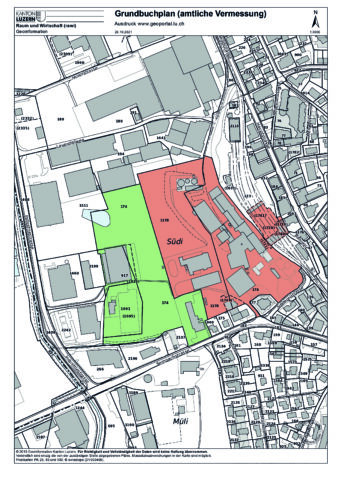
    Since the beginning of 2022, the municipality of Hochdorf has been the owner of the land, which previously belonged to the Hochdorf Group (red) and its pension fund (green).
    .

    The people of Hochdorf are to play a decisive role in this. The project began with a three-stage participation process. In a first step, qualitative focus discussions were held with interested parties until mid-September 2022. In a second step, the input from these discussions was discussed at a public participation event at the end of September 2022. In a third step, at the end of October 2022, the population was given the opportunity to evaluate and weight the inputs from the first two steps in an online survey and to further sharpen the emerging idea.

    Thanks to the many responses, those responsible gained a clear picture of the ideas of the people of Hochdorf. A large majority wants a central meeting place with inviting squares and paths. A broad housing mix and attractive office and commercial space are important to them. Ecological measures should also be a central factor in further planning.

    The findings and the vision derived from them were summarised in a report and presented to the population at the end of February 2023. They form the basis for the test planning due in summer 2023, where topics such as urban development, traffic planning or building density will be examined for the first time.

    The municipality would like to complete the utilisation planning, including the revision of the zoning plan, for part of the site by the end of the leaseback contract at the end of 2025 or 2026.

  • Zurich is once again ranked number 1 in the Smart City Index 2023

    Zurich is once again ranked number 1 in the Smart City Index 2023

    Three Swiss cities are among the nine smartest cities in the world. This is shown by the IMD Smart City Index 2023, for which a total of 141 cities around the globe were examined. With the exception of 2021, it has been compiled annually since 2019 by the World Competitiveness Center of the IMD Business School in Lausanne. It has its headquarters in Lausanne and Singapore.

    Zurich is in first place in this ranking, as it has been since the first edition of this index, ahead of Oslo, Canberra and Copenhagen. Lausanne follows in 5th place, after 4th place in 2020. At that time, Geneva held 6th place, this year it is 9th. Between Lausanne and Geneva, London, Singapore and Helsinki are ranked this year.

    In first place, Zurich naturally scores well above average on virtually all criteria. The city achieves top scores in terms of structures in the subject areas of health & safety, activities, work & school and governance – with two exceptions: air pollution and the availability of affordable rental housing. On the other hand, the city is in the middle of the pack for technology issues and only scores better for work & school.

    Lausanne, in 4th place, is mostly rated well above average on all structural topics. With regard to technologies, the city, like Zurich, is in the midfield almost everywhere. It achieves absolute top scores for green spaces, cultural activities and IT education in schools. In public transport, its online services are rated very highly.

    Geneva achieves the highest scores for urban green spaces, access to school education and feedback from citizens on decisions made by the city administration. Two negative outliers are found in agreement with the statement that businesses generate new jobs and that online access to job offers makes it easier to find work. For both, Geneva is at the bottom of the group index.

    In all three cities, affordable rents, traffic congestion and air pollution are cited as priorities by respondents. What is most striking about this year’s analysis, according to IMD, is that of the top 20 cities, 17 have been in the index since its inception. Among these 17 cities, six show either continuous improvement or stability from year to year. These “super champions” are Zurich, Oslo, Singapore, Beijing, Seoul and Hong Kong.

  • AEW installs district heating at Mutschellen

    AEW installs district heating at Mutschellen

    The Aargau energy supplier AEW Energie has plans to build a heating centre for the Mutschellen area on the Sika factory site in Widen, according to a media release. Private and municipal consumers in the heating network around the Mutschellen Pass are to be supplied with sustainable energy via a district heating network. The communities of Widen, Berikon AG and Rudolfstetten-Friedlisberg AG are connected.

    The local heating concept envisages predominantly regionally grown wood to generate the heat. The installation of modern, low-emission plant technology is intended to prevent the formation of a steam plume.

    Letters of intent have been signed with Sika Schweiz AG, the Turidomus investment foundation and other owners. The interest of the population in a district heating solution is being ascertained by means of a survey.

  • The dream of a family home in the country is becoming more and more of a dream

    The dream of a family home in the country is becoming more and more of a dream

    Das Einfamilienhaus erweist sich einmal mehr als Wohntraum Nummer 1 in der Schweiz. Bei Personen im Alter von 25 bis 30 Jahren ist der Wert mit 64 Prozent am höchsten. Stehen soll es auf dem Land. Ländliche Gegenden bleiben mit 48 Prozent Zustimmung auch in diesem Jahr die bevorzugte Wohnumgebung. 90 Prozent der Menschen, die auf dem Land leben, wollen auch in Zukunft dortbleiben. Bei der Stadtbevölkerung zeigt sich ein anderes Bild: Nur 65 Prozent der Befragten erachten die aktuelle Wohnumgebung als den bevorzugten Wohnort. Finanzielle Gründe sind die am meisten genannte Hürde (40%), die gegen einen Umzug spricht. Der Arbeitsweg bleibt trotz vermehrtem Home-Office der zweitwichtigste Hinderungsgrund.

    Kosten und Aussenbereich dominieren bei der Wahl eines Zuhauses – nicht das Home-Office
    Wichtigstes Kriterium bei der Wahl einer Wohnung resp. eines Hauses bleiben die Wohnkosten, gefolgt vom Aussenbereich. Neu abgefragte Kriterien wie das separate Zimmer für Home-Office oder ökologische Faktoren werden kaum als entscheidend genannt, aber von rund der Hälfte der Befragten zumindest als wichtiges Kriterium angesehen. Eine Lademöglichkeit fürs E-Auto, Service-Dienst-leistungen oder Luxuseinrichtung spielen bei der Wahl eines Zuhauses kaum eine Rolle.
    Bezüglich der Lage soll die Traumimmobilie ruhig (66%) und naturnah (66%) stehen. Zudem ist eine gute Anbindung an den öffentlichen Verkehr (51%) gefragt. Hier hat sich im Vergleich zum Vorjahr wenig verändert. Die Nachbarschaft wird von 41 Prozent der Befragten als besonders wichtig angegeben und liegt damit neu auf Rang 4 – zwei Plätze höher als letztes Jahr. Und auch die Nähe zur medizinischen Versorgung gewinnt einen Platz auf Kosten der Nähe zur Kinderbetreuungsstätte oder der Schule.

    Traum vom Eigenheim ungebrochen, scheitert aber meist an Angebot und Finanzierung
    Knapp die Hälfte der Befragten (46%) träumt von einer (weiteren) eigenen Wohnimmobilie. Dabei hat sich der Wunsch bei den jüngeren Befragten im Vergleich zum Vorjahr noch einmal verstärkt. Besonders ausgeprägt ist er nach wie vor bei der heutigen Mieterschaft: 62 Prozent träumen davon, ein Eigenheim zu kaufen. Schwierigkeiten bereiten das knappe Angebot (58%) und die hohen Preise (49%). Hinzu kommen strenge Finanzierungskriterien, welche einer Überhitzung des Immobilienmarktes vorbeugen sollen, aber zunehmend in Kritik geraten. 50 Prozent der Befragten beurteilen die geltenden Kriterien als nicht mehr der heutigen Realität entsprechend und sagen, dass der Kauf auch mit weniger Einkommen möglich sein sollte. «Die Immobilienpreise sind im Vergleich zu den Löhnen überdurchschnittlich gestiegen, was mit den starren Finanzierungsregeln dazu führt, dass sich mittlerweile Neukäufer ihre erste Immobilie erst mit 44 Jahren leisten können. Jüngeren Familien und Paaren wird das Wohneigentum dadurch unter anderem auch systembedingt verwehrt», so Martin Tschopp, CEO von MoneyPark.

    Landleben macht zufrieden, Eigentum noch zufriedener
    Glücklich ist, wer bereits ein Eigenheim hat. Zwei Drittel der Eigentümerinnen und Eigentümer geben an, sehr zufrieden zu sein, während es bei den Mieterinnen und Mietern nur ein Drittel ist. Die Zufriedenheit korreliert mit den Wohnkosten: Zwei Drittel der Eigentümerinnen und Eigentümer wenden weniger als 20 Prozent ihres Einkommens fürs Wohnen auf, während dies bei den Mieterinnen und Mietern nur für einen Drittel gilt. Die Auswertung zeigt zudem, dass Bewohnerinnen und Bewohner ländlicher Regionen eine signifikant höhere Zufriedenheit mit der aktuellen Wohnsituation (58% sind sehr zufrieden) aufweisen als Agglomerations- und Stadtbewohnerinnen und -bewohner (45% resp. 41%). Zudem fällt in der Deutschschweiz (53%) die Zufriedenheit deutlich höher aus als in der Westschweiz (40%) – mit Höchstwerten in der Ostschweiz (61%) und Tiefstwerten in der Genferseeregion (39%).

    Hohe Zufriedenzeit hält vom Verkauf ab
    Wer ein Eigenheim besitzt, möchte dieses auch gerne behalten. Nur drei Prozent der befragten Eigentümerinnen und Eigentümer möchten ihre Immobilie in den nächsten drei Jahren verkaufen. Weitere 15 Prozent planen den Verkauf in vier bis acht Jahren. Ein Blick auf die Altersgruppen zeigt, dass insbesondere Eigentümerinnen und Eigentümer bis zum 40. Altersjahr (24%) und Pensionierte (23%) Verkaufsabsichten hegen. Was primär von einem Verkauf abhält, ist die Zufriedenheit mit der aktuellen Wohnsituation (73%). Auch der Wunsch, das Eigenheim in der Familie weiterzugeben (31%), die emotionale Verbundenheit (30%) und die Annahme, dass der Wert der Immobilie weiter steigen wird (16%), lassen die Befragten von einem Verkauf absehen.
    Über ein Drittel der Befragten (37%) würde eine geerbte Immobilie vermieten und ein weiteres knappes Drittel (29%) würde sie selbst bewohnen. Für einen Verkauf würde sich nur ein knappes Fünftel (19%) entscheiden. «Dass Immobilien eine attraktive Kapitalanlage darstellen, hat sich auch bei Privatpersonen herumgesprochen. Dass deshalb geerbte Liegenschaften oft vermietet und nicht verkauft werden, führt zu einer zusätzlichen Verknappung des Angebots an Wohneigentum», so Dr. Roman H. Bolliger, CEO von alaCasa.ch.

    Jede/r Zweite hat in den letzten beiden Jahren substanziell ins Eigenheim investiert
    Seit dem Ausbruch der Corona-Pandemie anfangs 2020 hat knapp die Hälfte der befragten Eigentümerinnen und Eigentümer (47%) mehr als CHF 10’000.- ins Eigenheim investiert. Jede fünfte Investition (20%) stand unter dem Einfluss der Pandemie. Entweder wurde investiert, weil das Eigenheim wichtiger geworden ist, oder weil aufgrund der Corona-Einschränkungen Geld gespart und so ins Eigenheim investiert werden konnte. Dass das private Draussen wichtiger geworden ist, zeigen sowohl die getätigten wie auch die geplanten Investitionen deutlich: In keinen anderen Bereich wurde häufiger investiert als in den eigenen Garten respektive Aussenbereich (32%). Bäder (28%) und Küchen (27%) belegen die Plätze 2 und 3, dicht gefolgt von Maler- und Gipserarbeiten (26%) sowie neuen Bodenbelägen (25%). Und es geht weiter: 54 Prozent der Eigentümerinnen und Eigentümer planen in den nächsten drei Jahren substanziell in ihr Zuhause zu investieren. Die Bedeutung der Pandemie nimmt dabei ab: Nur für sieben Prozent der geplanten Investitionen ist sie der Auslöser. Dabei zeigt sich bei Solaranlagen eine starke Zunahme von 9 auf 17 Prozent. Auch Ladestationen für Elektroautos, Fassadenrenovationen, neue Fenster und Türen sowie Investitionen in Heizung, Lüftung und Klima werden vermehrt geplant.
    «Investitionen ins eigene Zuhause sind ein ausgezeichnetes Beispiel dafür, weshalb der ganzheitliche Blick auf Eigenheim, Versicherung und Vorsorge so wichtig ist. Investitionen können den Wert einer Liegenschaft steigern oder einfach Freude machen. Im Fall von werterhaltenden Arbeiten lassen sich zudem Steuervorteile realisieren, da diese Kosten abzugsfähig sind. So oder so ist der investierte Betrag aber nicht mehr bar verfügbar. Das gilt es beispielsweise bei der Pensionsplanung zu bedenken. Und natürlich empfehlen wir nach jeder grösseren Investition, die Versicherung zu überprüfen – egal, ob bei einer Photovoltaik-Anlage oder bei einer neuen Gartenlaube», so Ralph Jeitziner, Leiter Vertrieb Schweiz, Helvetia Versicherungen.

    Grüne Hypotheken werden als attraktiv angesehen, aber es fehlt an Wissen
    Es bleibt abzuwarten, ob die aktuell vieldiskutierte Abhängigkeit von fossilen Brennstoffen zu einem weiteren Investitionsschub in energetische Massnahmen führen wird. Heute profitieren nur sieben Prozent der befragten Eigentümerinnen und Eigentümer von einer grünen Hypothek oder einem entsprechenden Abschlag bei den Hypothekarzinsen. Knapp ein Fünftel der befragten Eigentümerinnen und Eigentümer (18%) weiss nicht, ob das Eigenheim die Kriterien für eine grüne Hypothek erfüllt. Nur elf Prozent geben an, dass sich ihre Immobilie qualifiziert. Von ihnen und von all jenen, die bereits eine grüne Hypothek haben, würden 63 Prozent bei einer Verlängerung (wiederum) eine grüne Hypothek wählen.

    Über die Wohntraumstudie
    Die Wohntraumstudie von MoneyPark, alaCasa und Helvetia Versicherungen ist die grösste unabhängige Untersuchung zur Zufriedenheit und zu den Wünschen der Schweizer Bevölkerung bezüglich ihrer Wohnsituation. Seit 2015 geht die Studie einmal im Jahr der Frage nach, wie die «Wohnträume» in der Schweiz konkret aussehen. Befragt wurden 1’001 Personen mit Wohnsitz in der Schweiz mittels repräsentativer Online-Umfrage im Februar 2022.
    Die integrale Studie finden Sie unter www.moneypark.ch/wohntraumstudie

    Kontakt
    Medienanfragen:
    MoneyPark Medienstelle
    press@moneypark.ch
    044 200 75 65

    Über MoneyPark
    MoneyPark ist der führende Spezialist für Hypotheken und Immobilien in der Schweiz und beschäftigt über 300 Mitarbeitende. Das junge Fintech bietet mit der Kombination aus persönlicher Beratung und wegweisender Technologie umfassende und massgeschneiderte Hypotheken- und Immobilienlösungen. Dabei unterstützt MoneyPark seine Kundinnen und Kunden mit unabhängiger Expertise – von der Suche über die Finanzierung, während der Eigentumsphase und beim Verkauf von Immobilien. Für die Finanzierung hält MoneyPark mit Hypothekar- und Vorsorgeangeboten von mehr als 150 Anbietern, darunter Banken, Versicherungen und Pensionskassen, die grösste Finanzierungsauswahl an einem Ort bereit. Die unabhängige Beratung erfolgt entweder in einer der schweizweit mehr als 20 Filialen oder ortsunabhängig via Telefon oder online. Institutionellen Investoren bietet MoneyPark ganzheitliche Hypothekarlösungen dank einem Setup aus leistungsfähigem Vertrieb und effizienter Portfoliobewirtschaftung.

    Über alaCasa.ch
    alaCasa.ch ist ein unabhängiges Expertennetzwerk für Wohnimmobilien und engagiert sich seit über 20 Jahren für eine hohe Dienstleistungsqualität rund ums Wohneigentum. Partner von alaCasa.ch sind professionelle Immobilienexperten für Eigentumswohnungen und Einfamilienhäuser. Sie zeichnen sich aus durch eine fundierte Ausbildung und eine langjährige Berufserfahrung. Dadurch können sie ihre Kunden kompetent und sicher bei Fragen rund um ihre Liegenschaft unterstützen. alaCasa-Partner sind unabhängig, etabliert und verfügen über eine tadellose Reputation.

    Über Helvetia
    Helvetia Versicherungen mit Sitz in St. Gallen hat sich seit 1858 zu einer erfolgreichen internationalen Versicherungsgruppe mit über 12 000 Mitarbeitenden und mehr als 7 Millionen Kundinnen und Kunden entwickelt. In der Schweiz ist Helvetia die führende Schweizer Allbranchenversicherung. Seit jeher ermöglicht sie ihren Kundinnen und Kunden, Chancen wahrzunehmen und Risiken einzugehen – Helvetia ist für sie da, wenn es darauf ankommt. Helvetia ist als beste Partnerin überall dort präsent, wo Absicherungsbedürfnisse entstehen, mit Versicherungs-, Vorsorge- und Anlagelösungen aus einer Hand sowie einfachen Produkten und Prozessen. Mit ImmoWorld bietet Helvetia ihren Kundinnen und Kunden eine umfassende Immobilienplattform kombiniert mit persönlicher Beratung in allen finanziellen Belangen rund um Suche, Kauf, Besitz und Verkauf eines Eigenheims. Dabei behalten die Expertinnen und Experten stets auch Versicherung und Vorsorge im Blick.

  • Canton of Zurich – on the pulse of the action

    Canton of Zurich – on the pulse of the action

    The canton of Zurich is an important growth driver in the Swiss economy. Its gross domestic product (GDP) was more than CHF 143 billion in 2017. That corresponds to more than 20 percent of Swiss GDP. This means that the canton of Zurich has the greatest economic output and added value within Switzerland. The added value can be increased by companies, research and educational institutions and specialist organizations cooperating along the value chain in clusters such as financial services, life sciences, creative industries, cleantech, aerospace, information and communication technology. According to the Statistical Office, the canton of Zurich generates more than 20 percent of the Swiss gross domestic product (GDP) with an annual GDP volume of over CHF 120 billion. This is the greatest cantonal economic added value in Switzerland.

    Maintaining international relationships is also an opportunity to directly follow and actively influence international developments in both the economic and political spheres. The business contacts acquired in this way are of direct benefit to the representatives from business, science and administration based in the canton.

    In terms of quality of life and standard of living, Zurich has held top positions in international rankings for many years. The city of Zurich emerged as the winner of the well-known Mercer study on quality of life seven times in a row. It has been in second place since 2009. The study compares 230 cities based on 39 criteria such as health care, entertainment, shopping, schools, housing, environmental issues, and the political and economic situation.

    A new index also measures the economic and social distribution of prosperity for the first time, and the metropolis on the Limmat ranks first among 113 cities, as zh.ch writes: The “Prosperity and Inclusion in Cities Seal and Awards Index” not only measures economic growth, but above all its quality and what proportion the different population groups have in it. Zurich scored particularly well in terms of work, living, leisure, security and education. Vienna follows in second place, ahead of Copenhagen, Luxembourg and Helsinki. In the inner Swiss city ranking, Zurich ranks first and Winterthur third.

    Testimonials

    Carmen Walker Spah
    Government Councilor,
    Director of Economics

    Thanks to the first-class universities, the availability of specialists, the excellent infrastructure and the high innovative strength of our economy, the canton of Zurich is a highly attractive location for companies.

    David Allemann
    Co-founder On

    Zurich is cosmopolitan, cool and rethinks. It is important that many creative minds live and work in Zurich who drive the location forward in terms of creativity and innovation. So Zurich remains unique.

    René Kalt
    Managing Director
    Innovation Park Zurich

    Universities and numerous innovative companies make Zurich a perfect location for networking science and business. The Innovation Park Zurich contributes to this knowledge and technology transfer, making Zurich even more innovative.

    Mario Jenni
    Co-Founder &
    CEO Bio-Technopark Schlieren-Zurich

    Zurich is an excellent life sciences location due to numerous health and technology companies as well as excellent universities. The “Paradeplatz” of the biotech scene is located in Schlieren and is becoming more and more important nationally and internationally.

  • Three quarters of the population live in cities

    Three quarters of the population live in cities

    Swiss cities have experienced a “real renaissance” in recent years, according to a press release by the Swiss Association of Cities and the Federal Statistical Office on the occasion of the publication of their yearbook “ Statistics of Swiss Cities 2021 ” with the focus on “Living in the City”. In the 80s and 90s of the last century, many people moved from the city to the countryside, today three quarters of the Swiss population live in the cities again.

    Most of them are at home in three-room apartments. In contrast, the vast majority of owners in Swiss cities, at 86.5 percent, have an apartment with four or more rooms. The smaller the community, the higher the proportion of single-family homes. In the case of multi-family houses, the opposite is true: in the largest cities, they make up an average of more than 43 percent. For the remaining cities, this is less than 33 percent.

    The bigger the city, the more tenants there are. The age structure within a municipality or city is roughly the same everywhere in Switzerland. Also, only 5 percent more people are single in cities than in rural areas. A total of 31 percent of city dwellers are foreign nationals. Outside it is only 20 percent.

    In Switzerland as a whole, non-profit housing construction only accounts for 1.3 percent. In large cities, on the other hand, the average is 11.4 percent, and in the city of Zurich even 22.4 percent.

    In urban politics, the FDP (27.2 percent) and SP (20.6 percent) set the tone, followed by the CVP (15.1 percent, minus 0.2 percent compared to the previous year) and the SVP (11.4 Percent, minus 0.2 percent). The Greens gained 0.8 percent over the previous year and are now 7.7 percent.

  • Smart cities work together

    Smart cities work together

    Basel, Bern, Lugano, Lucerne, St.Gallen, Winterthur and Zurich are already working together on the next national exhibition, " NEXPO – the new Expo ". Now, within this framework, they also want to jointly develop models for future cooperation between intelligent cities, according to a media release from the canton of Basel-Stadt. Its cantonal and urban development in the presidential department is taking the lead in a first pilot project of the initiative.

    With “Smart Inter-City – our common path into the future”, the participants not only want to develop models of cooperation between so-called Smart Cities, but also to implement them. By networking the seven cities, existing synergies are to be used. The project is also open to partners from business, science and the general public.

    The pilot project is to be promoted at the respective innovation locations of the participating cities. In Basel, for example, this includes the Smart City Lab Basel , which was launched by the canton and the SBB.