Tag: Bildung

  • sfb course in building automation HF increases efficiency in companies

    sfb course in building automation HF increases efficiency in companies

    Students on the Building Automation HF programme at sfb – Höhere Fachschule für Technologie und Management develop innovative projects for practical application, almost all of which are implemented, according to the press release. This benefits the Swiss economy, for example in the context of the Energy Strategy 2050 or other efficiency improvements. According to the sfb, the programme, which focuses on energy efficiency and building informatics, provides knowledge on how to operate the trades in a complex building as energy-efficiently as possible. 90 per cent of the final theses have a practical relevance, and it is not uncommon for students to make a career leap as a result. This is demonstrated, for example, by alumni Fabian Haist, who has completed further training to become a qualified building automation engineer HF and was available to answer questions for a series of sfb interviews.

    Based on his experience as an electrical planner, Fabian Haist prepared for his next career step with the sfb further training programme. “It played a key role in helping me to reach my current position, as a lot of the content was a perfect fit for my job profile,” he is quoted as saying. As an energy engineer at the Office for Environment and Energy of the Canton of Basel-Stadt (AUE), he is now responsible for implementing the cantonal energy law.

    In his diploma thesis, he planned an energy-related operational optimisation in a Basel school building and further developed the enforcement practice. According to Fabian Haist, the analysis has shown that even simple energy optimisations can lead to considerable savings: Energy savings of 15 per cent and cost savings of 17 per cent had been achieved in the Basel school building. The measures he has defined should now simplify the verification of operational optimisation.

    According to the sfb, the further education programme in building automation takes six semesters to complete, provided that the student has completed relevant vocational training. In addition to building automation, the module content includes data security, digital construction, renewable energies and fire protection. Skills in leadership, communication and teamwork are also taught. Details are available at information events in person and online as well as from a further education counselling service. The next start date is 13 August 2025.
  • Business opportunities in the Uri valley floor

    Business opportunities in the Uri valley floor

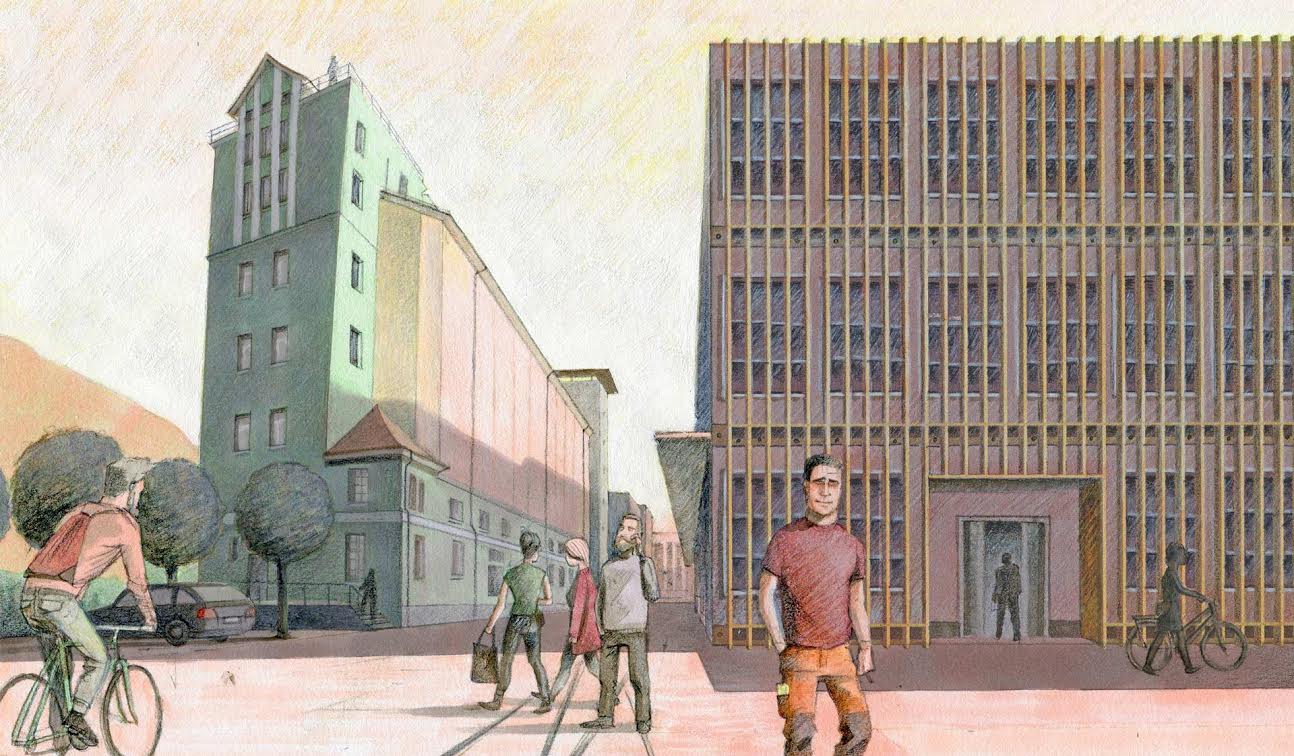
    Werkmatt Uri is one of the last large land reserves in the Uri valley floor. The first industrial uses with a direct railway connection were already established here during the First World War. The listed grain stores designed by architects Eduard Züblin and Robert Maillart in 1912/13 are particularly characteristic. These buildings will be preserved as landmarks and converted into an exhibition centre and art warehouse. The canton is investing in infrastructure to further develop the area between the new Altdorf cantonal railway station and the future Altdorf South motorway junction.

    Optimum location and economic impetus
    Uri is strategically located on the most important European north-south axis with the Gotthard Base Tunnel and the A2 motorway. The immediate proximity to the Altdorf intercity railway station and a modern bus concept promote the accessibility of Werkmatt. The improved accessibility provides impetus for economic and residential projects. With “Vena”, “Cubo” and “Strickermatte”, private investors have realised modern residential developments within walking distance.

    Development with vision
    Kässbohrer Schweiz AG has already recognised the added value of Werkmatt and relocated its headquarters to Altdorf in 2019. The new service building has created 30 qualified jobs in the areas of administration, sales, service, training, final assembly and production of special vehicles, mainly snow groomers. Werkmatt AG is also developing an innovative utilisation concept for building plots 9 and 13. The plans include a multifunctional centre with a business hotel with 80 rooms, co-working spaces, commercial and cultural spaces, restaurants and fitness and recreation areas.

    Targeted planning for sustainable growth
    As the owner, the canton of Uri is striving for a win-win situation with the future owners, users and investors in the area. The plots are to be sold and built on gradually over the next few years. The canton is developing the Werkmatt Uri site in a coordinated manner so that sustainable economic uses are created in the interests of the region as a whole. To this end, it is drawing up guidelines – including those relating to workplace density. The neighbourhood design plan serves as a planning instrument for investors and companies wishing to build on the site, which is binding on the owner and defines the parcel of land. It sets guidelines regarding utilisation, design and infrastructure.

    Success through co-operation
    Werkmatt Uri is an example of coordinated and sustainable site development. Companies benefit from a committed administration, short decision-making processes and needs-orientated solutions. The region expects the project to provide long-term economic impetus and create more than 1,000 jobs.
    Werkmatt Uri is therefore much more than just an industrial area, it is an economic driver and an attractive location for forward-looking companies.

  • Innovation campus in the heart of the Engadin

    Innovation campus in the heart of the Engadin

    The Engadin is known for its cultural diversity and breathtaking nature. At the same time, the region is increasingly focussing on innovation and sustainable development. The InnHub La Punt is a place where research, entrepreneurship and education come together.

    The centre offers a wide range of uses over an area of 7,700 square metres. These include workshop and classrooms, coworking workspaces, an auditorium with 250 seats, a sports training infrastructure, a spa, a restaurant with bar and lounge, a sports shop, a tourist information centre, 44 hotel rooms and 8 tourist flats. The multifunctional premises create a dynamic environment for innovation and interdisciplinary dialogue.

    Construction begins in spring 2025
    Following a comprehensive planning phase in which the concept was further refined, construction of the InnHub La Punt will begin in spring 2025. The municipality issued the building permit in autumn 2023. The existing buildings will be demolished first, followed by the excavation and construction of the underground car park by summer 2026. The shell will be completed by mid-2027 before the interior work begins. The opening is scheduled for the end of 2028.

    In parallel with the municipality of La Punt Chamues-ch’s future projects, including the road bypass and the renaturation of the Chamuerabach stream, the InnHub will create a new centre that will revitalise the town and provide new impetus.

    Sustainability as a central building block
    A key component of the project is its sustainable approach. The building is being constructed from local wood, granite and lime mortar and is an example of the circular economy and ecologically responsible construction. “The InnHub is a matter close to my heart, as I have lived in the Engadin for years. It is an example of sustainability and innovative construction methods,” emphasised architect Norman Foster in a video message.

    The operation of the campus is also designed to be sustainable. The initiators, including Caspar Copetti, are not focussing on short-term profits, but on long-term positive effects for the region. The InnHub is intended to create new jobs, promote year-round tourism and establish an innovation ecosystem in the Engadin.

    New impetus for the economy and the community
    The InnHub La Punt will not only attract companies, start-ups and skilled workers, but also facilitate strong networking with the local population. The municipality of La Punt Chamues-ch sees the project as an important step for the further development of the region. “The campus will create a cultural and social meeting point in our village. The projects that are being created here will inspire future generations to come to La Punt,” says mayor Peter Tomaschett.

    In addition to the long-term effects for the region, the InnHub offers an InnHub PopUp even before its completion, which can be used as a co-working and event venue for locals, holiday guests and professionals until it opens.

    A milestone for the Engadin
    The InnHub La Punt combines innovation, sustainability and community in a unique way. With a clear focus on responsible development, it will radiate far beyond the Engadin and serve as a model for sustainable innovation centres in the Alpine region. The combination of state-of-the-art architecture, innovative working environments and regional roots makes the InnHub a forward-looking project that will provide new impetus for the Grisons as a business location.

  • Historic site becomes new cultural and educational centre

    Historic site becomes new cultural and educational centre

    The city of Schaffhausen is pursuing an ambitious goal with the redevelopment of the Kammgarn site: to transform the historic area into an attractive location for culture, education and socialising. The Schaffhausen electorate approved this project back in August 2020.
    The comprehensive redesign not only creates a better connection to the urban fabric, but also new utilisation options. In addition to the existing entrances from Baumgartenstrasse, Rheinuferstrasse and Rheinstrasse, a new passageway will be created along Klosterstrasse. This strengthens the connection with the old town and increases the attractiveness of the neighbourhood. The Kammgarn area will become part of a “string of pearls” of meeting places along the banks of the Rhine, which will enhance the area in the long term.

    More quality of stay through new open spaces
    The redesign of the Kammgarnhof will transform the inner courtyard, which was previously used as a car park, into a car-free zone. Green spaces, seating and a water feature will increase the quality of stay and turn the courtyard into a central meeting place. The redesign will enable a variety of uses for events, culture and recreation.

    Another core element of the development is the construction of a single-storey underground car park with around 90 parking spaces under the courtyard. This will make the entire area above ground car-free and open up new possibilities for use. A pergola will be erected in front of the west wing, while a spacious terrace will be created in front of the north wing.

    Modern infrastructure for culture and education
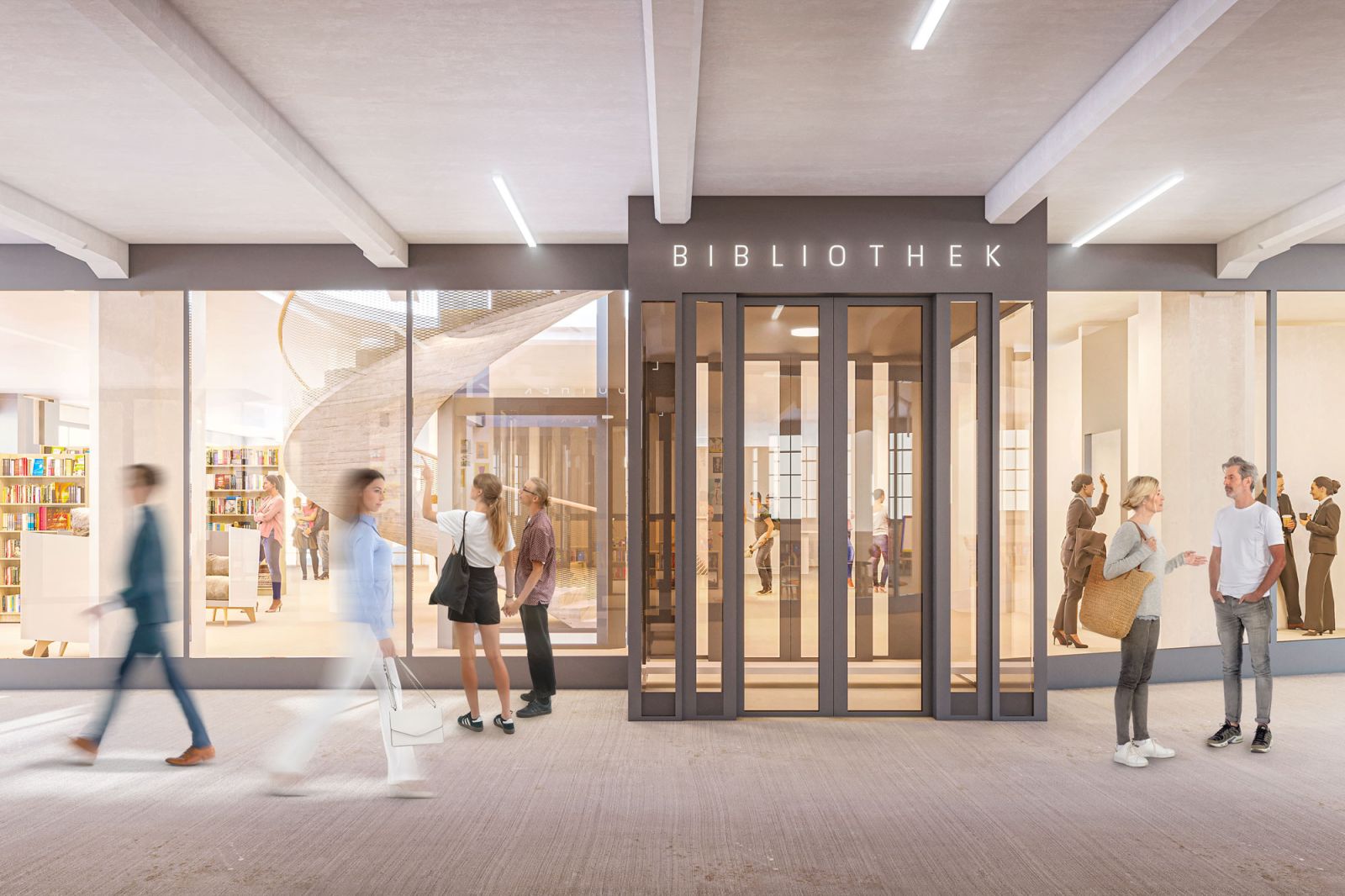
    The west wing of the Kammgarn site is being prepared for new uses as part of the refurbishment. The library and toy library will move into the ground floor and first floor. Glazed façades offer passers-by a glimpse into the world of books and games.
    The Schaffhausen University of Teacher Education will move into the second and third floors, while the fourth floor will be available for other tenants. The diverse use of the site reinforces its importance as an educational and cultural centre.

    Construction progress and archaeological work
    Construction officially began in September 2024 with the symbolic ground-breaking ceremony. Prior to this, archaeological rescue excavations were carried out, during which significant finds from the last 1000 years were discovered.

    Work is currently underway on the underground car park and the redesign of the courtyard. At the same time, the renovation of the west wing is progressing. In addition to structural measures, the façades and roof are being renovated and preparations are being made for the interior work.

    The first floor slab for the new courtyard was concreted in January 2025. To protect the valuable trees, a retaining wall (Rühlwand) is being erected around the large chestnut tree in the courtyard.

    A new meeting place for Schaffhausen
    After the remodelling, the Kammgarnhof will be an attractive place for locals and visitors to the city. Reading, meeting friends or enjoying concerts – all this will be possible in the redesigned surroundings.

    The construction of the underground car park is being financed jointly with IWC Schaffhausen, the direct neighbour of the site. This close collaboration will result in a sustainable solution that improves both the flow of traffic and the quality of life.

    A lively neighbourhood with a future
    The comprehensive renovation and redesign will transform the Kammgarn site into a modern cultural, educational and meeting centre. The connection to the old town and the Rhine will be strengthened, while new uses will enrich Schaffhausen’s cityscape. The project is scheduled for completion at the end of 2026 – a significant step for the long-term development of the city.

  • FORUM UZH Centre for Education and Research

    FORUM UZH Centre for Education and Research

    The FORUM UZH is a milestone for the structural and academic development of the University of Zurich. The new building comprises a total of 37,000 m² of usable space and will not only accommodate the predicted growth in student numbers, but also set new standards in teaching, research and sustainability. The new centre will bring together the faculties of law, economics and modern philology. These will be complemented by modern libraries, sports facilities for secondary schools and the Academic Sports Association as well as publicly accessible cafeterias and commercial areas.

    Architecture and spatial concept
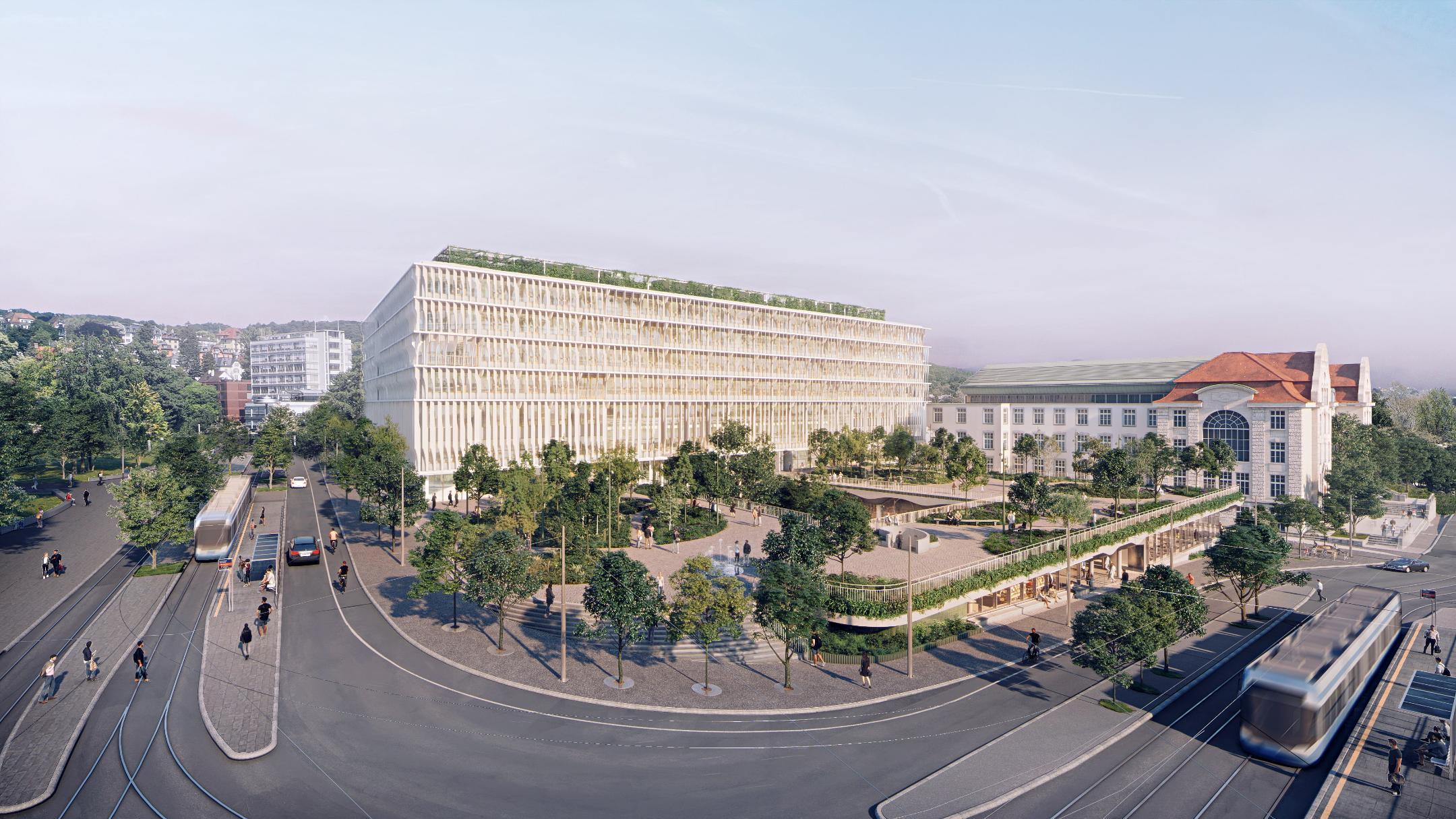
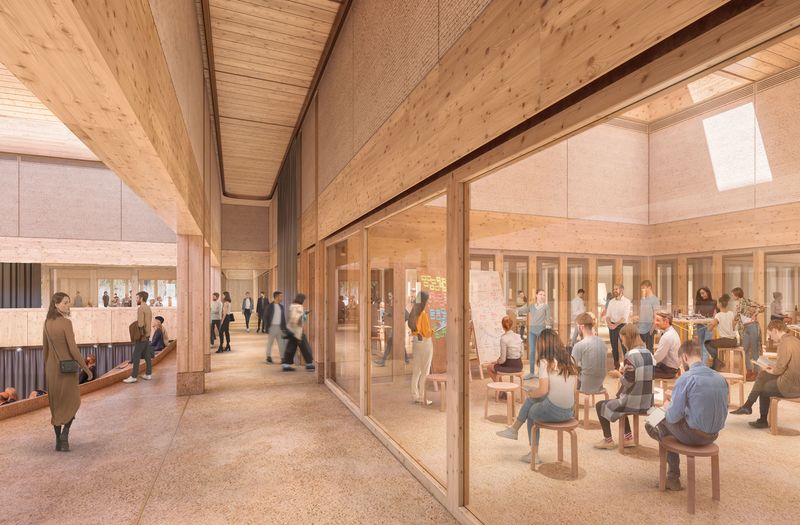
    The FORUM UZH consists of a terraced base for teaching and university life, a trapezoidal structure hovering above for research and a central courtyard. The structure is set back from Rämistrasse to create a spacious front zone with city balconies that blends in with the urban surroundings. The façade design with horizontal ceiling panels and vertical brise soleils gives the building a striking depth effect and allows for flexible light regulation inside.

    At the centre of the building is the eponymous Forum, a light-flooded hall that is a lounge, meeting and work space all in one. It connects all levels and can be used for university and public events for up to 2,000 people.

    Flexible learning environment and modern infrastructure
    The FORUM UZH offers a variety of innovative teaching and learning spaces. Five lecture theatres and several seminar rooms can be used flexibly and are equipped with state-of-the-art technology to enable hybrid teaching models. There will also be a spacious teaching and learning centre with over 700 student workstations. The university library will be united under one roof on the upper floors.

    Sustainability and innovative construction
    The FORUM UZH is based on a sustainable timber-concrete hybrid construction method that reduces CO² emissions while offering a high quality of stay. The intensively greened roof not only serves as a fifth façade, but also as an ecological compensation area with a habitat for flora and fauna. A photovoltaic system supplies its own electricity, while over 50 large trees on the redesigned town square have a positive impact on the microclimate.

    Thanks to the modular design, UZH saves as much CO² as would be released by the construction of 77 detached houses. The building will be certified in accordance with the SGNI Gold standard and Minergie P.

    Integration into the urban environment
    The FORUM UZH will not only be open to the university community, but also to the city’s population. The libraries, catering areas and neighbourhood shops will be open to the public and the Gloriaterrasse will be a green meeting place where people can linger. The urban design will create a direct link between the university quarter and the surrounding neighbourhoods.

    Construction schedule and next steps
    Following the completion of the preliminary project, construction work began in August 2024. Completion is scheduled for 2028 and the building will be occupied in 2029. Until then, students and researchers at the University of Zurich will be able to follow the development of this project of the century at close quarters.

  • Future for the metropolitan area Strategy 2027

    Future for the metropolitan area Strategy 2027

    The MKZ focuses on further expanding Zurich’s innovative strength and attractiveness as a business location. Platforms are designed to promote the exchange of knowledge, while targeted projects and legislative initiatives create a positive climate for innovation. This is how the MKZ responds to challenges such as climate change and geopolitical uncertainties.

    Promoting education and research
    Zurich should retain its leading position in education and research. A mission statement will bring the various players in the metropolitan area closer together. At the same time, the MKZ is promoting digitalisation in the administration in order to position the location nationally and internationally for the future.

    Rethinking the use of resources and mobility
    New working models such as working from home and flexworking are seen as an opportunity to improve the work-life balance and organise the use of space more efficiently. Pilot projects should clarify how to deal with limited land resources in the growing Zurich area.

    Strengthening social cohesion
    The MKZ is committed to equal opportunities and participation. Integration projects, social mixing and anti-discrimination initiatives are intended to promote cohesion in society and strengthen trust in political institutions.

    Platform, advocacy organisation, innovation laboratory
    The MKZ has three strategic roles. It is a platform for dialogue, an advocacy group for common concerns and an innovation laboratory for new approaches. These roles make it possible to involve members and external stakeholders and create synergies.

    Organisational implementation
    The strategy is divided into fields of action, which are operationalised through concrete mediation and action goals. Expert groups contribute the necessary knowledge to effectively implement the strategic objectives.

    The Zurich Metropolitan Conference’s Strategy 2027 provides a clear framework for promoting innovation, sustainability and social cohesion in the metropolitan area. Through targeted activities and collaborations, the MKZ contributes to the positive development of the Zurich economic and living environment.

  • Suissetec opens new building on the education campus in Lostorf

    Suissetec opens new building on the education campus in Lostorf

    The Swiss-Liechtenstein Building Technology Association suissetec is expanding and modernising its training and further education centre in Lostorf, according to a press release. By the beginning of 2025, a building with workshops, laboratories, training rooms and meeting areas is to be built on around 1,800 square metres. The new building will be presented to the public at an open day on 16 November 2024.

    The infrastructure offers new opportunities for the quality of training and further education in construction professions, according to the statement. Students can learn in a concrete shell at an outdoor workstation just like on a real construction site. Interdisciplinary workshops for plumbers and heating engineers as well as the integration of construction data modelling into the didactic concept would serve as a role model. Müller Wüst AG, which belongs to Debrunner Acifer, has created a digital fabrication model for construction, which is also intended for use in teaching.

    Digital tools allow for flexible, hybrid forms of learning. “Learners will work with real materials, but also practise digitally with virtual reality glasses,” says suissetec Director Christoph Schaer.

    The new two-storey building is the first part of an expansion comprising several buildings. From 2026, the other existing buildings will be renovated in three stages. Suissetec operates the campus as one of three training centres as a “meeting place as well as a place for training and further education” for the construction industry.

    The campus was certified as the country’s first Minergie site in 2023. This means that it fulfils strict energy criteria. The aim is to maximise self-sufficiency with renewable energy, which is generated on the site itself all year round.

  • New height-adjustable desk brings more flexibility to everyday school life

    New height-adjustable desk brings more flexibility to everyday school life

    Lista Office LO, based in Degersheim, has expanded its LO Education system to include a version of the LO Solo table. The table is mobile and infinitely height-adjustable and is now also available with a lower adjustment range, according to a press release from the internationally active manufacturer of office furniture. This means that the LO Solo table can also redefine teaching methods in primary schools. LO Education is a convertible table system for individual or group workstations.

    According to Lista Office LO, the furnishing system fulfils the requirements of modern school life by being quiet, quick and flexible to reconfigure. This has become necessary as the traditional form of frontal teaching has given way to independent thinking, creativity and communication. “The new diverse forms of teaching are only possible with a flexible set-up,” it says.

    Other elements of LO Education include tables and movable walls that can be grouped into different shapes thanks to castors. With the help of a magnetic solution, these can be connected to each other without tools and with little noise. According to the company, the LO Solo tables are equipped with holders for material boxes.

  • New professorships in Real Estate Economics & Finance from autumn 2024

    New professorships in Real Estate Economics & Finance from autumn 2024

    CUREM is pleased to announce a significant expansion of its academic focus. From autumn 2024, two new professorships in the field of “Real Estate Economics & Finance” will be established, supported by three major funding partners from the real estate industry. This step not only marks a milestone in the history of CUREM, but also sets new standards for cooperation between academic research and practice in the real estate industry.

    The creation of these professorships underlines CUREM’s role as a leading provider of further education and research in the property industry in Zurich. The close exchange between science and practice is of central importance: “We are firmly convinced that the interplay between academic research and practical knowledge forms the basis of excellent further education,” says the CUREM management.

    Academic excellence meets practice-orientated teaching
    Two renowned academics have been recruited for the new professorships, who enjoy both international and national recognition and share the vision of academic excellence and practice-orientated teaching: Prof Dr Christian Hilber and Dr Francisco Amaral.

    An international expert in housing policy and urban development
    Prof. Dr Christian Hilber will take up a part-time professorship ad personam (20%) at the University of Zurich from autumn 2024. Hilber, who is currently Professor of Economic Geography at the London School of Economics (LSE), brings with him outstanding expertise in the field of housing policy and urban development. These topics are also highly relevant for Switzerland, where housing policy is facing major challenges.

    “It is a particular pleasure for me to be able to contribute my experience in Zurich. Switzerland is facing major challenges in the area of housing policy, and I am convinced that together we can develop solutions that are both economically and socially sustainable,” emphasises Prof. Hilber.

    In addition to his academic career, Prof. Hilber has extensive experience in advising governments and international organisations such as the OECD and the Asian Development Bank. His work at CUREM will further strengthen international networking and the practical exchange of knowledge.

    Focus on financial and real estate economics
    Dr Francisco Amaral, who will be an assistant professor (100%) at the University of Zurich from October 2024, brings valuable expertise at the interface of financial and real estate economics. His research focuses on the interactions between risk and return in housing markets under different macroeconomic conditions.

    “In Switzerland, as in many Western countries, the housing market plays a central role in the financial stability and well-being of society. To develop sustainable measures that make the market more resilient and affordable, we need to understand what factors influence risk and return,” explains Dr Amaral, who holds a PhD from the University of Bonn.

    With his extensive research experience, Dr Amaral contributes significantly to the scientific consolidation and further development of CUREM, particularly in the areas of financial market analysis and real estate economics.

    Strengthening Zurich as a centre for real estate research
    The establishment of these professorships is not only a decisive step for CUREM, but also for Zurich as a location. The expanded scientific focus will further strengthen Zurich as a leading hub for property research and teaching in Europe. The close cooperation between science and practice will promote the transfer of knowledge and contribute to the development of innovative solutions for current challenges in the property sector.

    A pioneering step for the property sector
    With the new professorships in “Real Estate Economics & Finance”, CUREM is sending a clear signal for the future direction of real estate research and teaching in Zurich. The combination of academic excellence with practice-orientated knowledge will not only strengthen CUREM in the long term, but also the entire property sector. Prof Dr Christian Hilber and Dr Francisco Amaral will bring with them valuable experience and fresh impetus that will contribute to the further development of the institute and to overcoming the challenges of the housing market.

    This exciting development marks the beginning of a new era for CUREM and the property sector in Switzerland. We look forward to the future collaboration and the new perspectives that these professorships will open up.

  • Bernese timber construction and carpenters plan joint training centre

    Bernese timber construction and carpenters plan joint training centre

    According to a press release, the Extraordinary General Assembly of Holzbau Schweiz Sektion Bern(hssb) has now also voted in favour of setting up a joint training centre after the Bernese Master Carpenters’ Association. The Bernese carpenters had already approved a project loan of CHF 250,000 for this at the end of May. Now the hssb members have also voted unanimously in favour of a loan of the same amount.

    “This project will not only support our trainees, but also strengthen the entire wood industry in the region,” said hssb President Peter Haudenschild. “After long discussions within our association, I am delighted that we are now setting up a forward-looking training centre together with the carpenters,” says Jürg Rothenbühler, President of the Bernese Association of Master Carpenters.

    The Bern Wood Training Centre will be located in Lützelflüh BE. “We will own the land there – that creates security,” emphasises Haudenschild. According to the information provided, the decision was also based on the structural and logistical possibilities on site. The planned centre will consist of four floors with space for specialised workshops, training rooms and a shared infrastructure. The new training centre should offer both associations as much flexibility as possible. The aim is to be able to react as quickly as possible to changes in the number of learners and changes in vocational training.

    The wood training centre in Lützelflüh should be completed by spring 2028. The first inter-company courses are scheduled to start at the new location in August 2028.

  • Confederation introduces new guide for location promotion

    Confederation introduces new guide for location promotion

    The Federal Department of Economic Affairs, Education and Research(EAER) has launched a new advisory platform for companies and other forms of organisation. According to a press release, the platform, which will be available from 16 February, is intended to support users in their search for business locations and funding. In doing so, the advisory tool currently being introduced expands the existing portals on the website of the State Secretariat for Economic Affairs(SECO).

    The multilingual location promotion guide that has now been announced brings together various promotion projects and is intended to be easily accessible via the internet for interested parties and applicants. The current range comprises 16 promotion instruments with around 50 different offers. The primary target groups are entrepreneurs, authorities at all federal levels and individuals. According to the EAER, the new guide should make Switzerland even more attractive and transparent as a business location. It can be accessed at promotion.guide.

  • Eberli erhöht Lehrstellenplätze

    Eberli erhöht Lehrstellenplätze

    Eberli will sich stärker in der Ausbildung engagieren. Dazu will das Gesamtdienstleistungsunternehmen in der Bau- und Immobilienbranche der Zentralschweiz mit Sitz im Kanton Obwalden die Zahl seiner Lehrstellen erhöhen, informiert Eberli in einer entsprechenden Mitteilung. Konkret sollen in diesem und im nächsten Jahr jeweils ab Sommer zwei Auszubildende eine Lehre im kaufmännischen Bereich (KV EFZ Profil E) beginnen können.

    Interessierte können sich an Schnuppertagen einen Einblick in das Berufsbild und die Ausbildung bei Eberli beschaffen. Der nächste dieser Schnuppertage stehe am 4. Mai an, informiert Eberli.

    Hier erhalten die potenziellen Bewerber und Bewerberinnen eine Einführung in die Aufgaben eines KV-Lernenden und Antworten auf ihre entsprechenden Fragen. Gleichzeitig haben sie die Möglichkeit, sich vor Ort ein persönliches Bild zu machen und Lernende und Mitarbeitenden von Eberli kennenzulernen. Ein Formular für die Anmeldung zum Schnuppertag kann online ausgefüllt werden.

  • Finalists for the Enterprize have been determined

    Finalists for the Enterprize have been determined

    The three projects Holzbau-LAB, Swiss Mobility Program and Entrepreneurial Thinking and Acting at Vocational Schools in Switzerland are in the final of this year’s Enterprize , the SVC Foundation for Entrepreneurship and the Swiss Federal College for Vocational Training ( SFIVET ) inform in a statement . With the Enterprize, they honor outstanding projects in professional training and further education every year. Around 30 projects applied for the prize this year.

    Finalist Holzbau-LAB imparts practice-oriented knowledge and activities in the timber construction industry. The digital learning and theme worlds of the project of the Swiss timber construction industry association are open to learners, management employees, entrepreneurs, educational providers and teachers alike.

    The Swiss Mobility Program was launched in 2015 by the cantons of Lucerne and Ticino. Here, apprentices in all professions can complete an internship in the partner canton. The canton of Vaud has also been a partner since 2018.

    With the project Entrepreneurial Thinking and Acting at Vocational Schools in Switzerland, the Swiss Directors’ Conference of Vocational Schools wants to anchor the myidea.ch program in general education classes. Myidea.ch imparts entrepreneurial skills for learners at vocational schools. The program is currently being implemented by the four pilot cantons of Bern, Solothurn, Valais (French-speaking part) and Ticino.

    The winning project will be able to receive the Enterprize on May 31 at the EMS anniversary conference. The award ceremony takes place under the patronage of Federal Councilor Guy Parmelin.

  • HSG inaugurates the Square learning center

    HSG inaugurates the Square learning center

    On Sunday, February 13, the HSG inaugurates its new learning center. Square represents a “prototype of the university of the future” and should serve as a “place for surprising encounters and mutual inspiration”, writes the HSG in a statement . “The new learning and teaching formats that are being developed in Square are intended to inspire the entire university and prepare our students as best as possible for practice,” HSG Rector Bernhard Ehrenzeller is quoted as saying.

    Square’s work is based on three pillars that faculty, alumni and students have developed together. On the one hand, the learning center is intended to serve as an experimental field for new formats which, if successful, can be implemented at the HSG and other universities. For the spring semester beginning on February 21, 80 existing courses were selected to be carried out and evaluated in the square.

    On the other hand, Square will take on the role of a base camp for an exchange between students, alumni and researchers. The HSG has planned to include personalities from various professions and social groups. Paul Achleitner, Chairman of the Supervisory Board at Deutsche Bank, Gabriele Fischer, Editor-in-Chief and publisher of the German business magazine “Brand eins”, and Federal Chancellor Walter Thurnherr, among others, have confirmed for the spring semester.

    Last but not least, Square should also serve as a public space for a critical discourse by and with those who are not directly connected to the HSG. In order to attract residents of St.Gallen and guests from near and far, Square wants to present itself as a marketplace with an open atmosphere. Music, barista coffee and beer brewed especially for Square are also offered.

  • University of Applied Sciences on the way to the future

    University of Applied Sciences on the way to the future

    Die Fachhochschule Graubünden (FHGR) – die achte öffentlich-rechtliche Fachhochschule der Schweiz – ist heute auf fünf Standorte in neun Gebäuden innerhalb der Stadt Chur verteilt. Die Anzahl Studierender sowie das Forschungsvolumen der FHGR nehmen weiterhin zu. Die bestehenden Standorte bieten zu wenig Räumlichkeiten und Ausbaumöglichkeiten, um die Hochschule in Zukunft optimal aufzustellen. Bislang fehlt beispielsweise der Raum für den Austausch zwischen den Disziplinen sowie für die informelle Kommunikation zwischen den Studierenden und den Dozierenden. Darüber hinaus sind derzeit zu wenige studentische Arbeitsplätze vorhanden, die den heutigen Anforderungen genügen. Durch die Verteilung der Gebäude über die Stadt fehlt der Hochschule zudem die architektonische Visibilität.

    Aus diesen Gründen hat der Kanton Graubünden entschieden, das Fachholschulzentrum am Standort Pulvermühle neu zu erstellen. Hier befindet sich seit 1993 der Hauptsitz der FHGR. Der Neubau soll ein zusammenhängendes Bildungs- und Forschungszentrum ermöglichen, das von der Diversität und interdisziplinären Zusammenarbeit aller Organisationseinheiten lebt. Die Projektleitung wurde dem Hochbauamt Graubünden übertragen. In einem Wettbewerbsverfahren wurde aus den 57 eingegangenen Bewerbungen ein Generalplanerteam selektioniert, welches die Vorgaben und Ziele der Regierung bezüglich Funktionalität, Ortsbau und Architektur überzeugend umsetzt und die Realisierung in der geforderten Qualität und Wirtschaftlichkeit sowie unter Einhaltung der Kosten- und Terminvorgaben garantieren kann.

    Das Siegerprojekt überzeugt mit Nachhaltigkeit und Funktionalität
    Die Entscheidung fiel auf das Team rund um das Projekt «Partenaris». Den Lead übernimmt dabei das Zürcher Architekturbüro Giuliani Hönger Architekten. Überzeugt hat das Projekt die Jury durch die gleichmässige Berücksichtigung der Kriterien Architektur, Tragwerk, Nachhaltigkeit und Funktionalität. «Partenaris» sieht eine städtebauliche Positionierung des Neubaus vor – unter Einbezug der bestehenden Gebäude und durch die sorgfältige Gestaltung eines parkähnlichen Aussenraums. So wird ein attraktives Hochschulareal geschaffen. Die Planung berücksichtigt ausserdem die gewünschte Nutzungsflexibilität.

    Die erste Etappe sieht einen viergeschossigen U-förmigen Baukörper mit einer zentralen, rund 1200 Quadratmeter umfassenden Eingangshalle vor. Dabei öffnen sich die drei Gebäudeflügel nach Süden zur Pulvermühlestrasse hin und interagieren mit den bestehenden Gebäuden. Der Neubau wird als Hybrid-Skelettbau ausgeführt.

    Mittels Passerelle wird es mit dem Neubau verbunden. Die Obergeschosse sind für Nutzungen der Institute und Departemente vorgesehen, wobei der Öffentlichkeitsgrad und damit die Publikumsintensität mit jedem Stockwerk abnimmt. Das Raumprogramm wird mit vergleichsweise wenig Geschossfläche flächeneffizient umgesetzt. Dank der strukturierten Bauweise und ressourcenschonenden Materialisierung können die Werte bei der Grauen Energie auf einem guten Niveau gehalten werden. Im Westen entsteht zudem eine neue Terrasse. In der zweiten Etappe wird das bestehende Gebäude P57 in Richtung Westen erweitert.

    Aus Sicht des Kantons Graubünden ist die Realisierung des Fachhochschulzentrums hinsichtlich Bildung, Forschung und auch innovationspolitisch von grosser Wichtigkeit. Denn der Mangel an Fachkräften, insbesondere in den technisch-naturwissenschaftlichen Disziplinen, hat Auswirkungen auf die Bündner Unternehmen: Diesen fehlen das nötige Wachstum und die gewünschte Entwicklung. Die neue Fachhochschule soll junge Leute ausbilden, fördern und damit die Wettbewerbsfähigkeit der Bündner Volkswirtschaft stärken.

    Das Siegerprojekt wird in einem nächsten Schritt planerisch weiterbearbeitet. Danach muss es vom Grossen Rat genehmigt werden. Erhält «Partenaris» grünes Licht, soll Ende 2024 mit den Bauarbeiten begonnen werden. Im Jahr 2028 soll der Neubau bezugsbereit sein. Der Studienbetrieb läuft während den Umbauarbeiten weiter wie gewohnt.

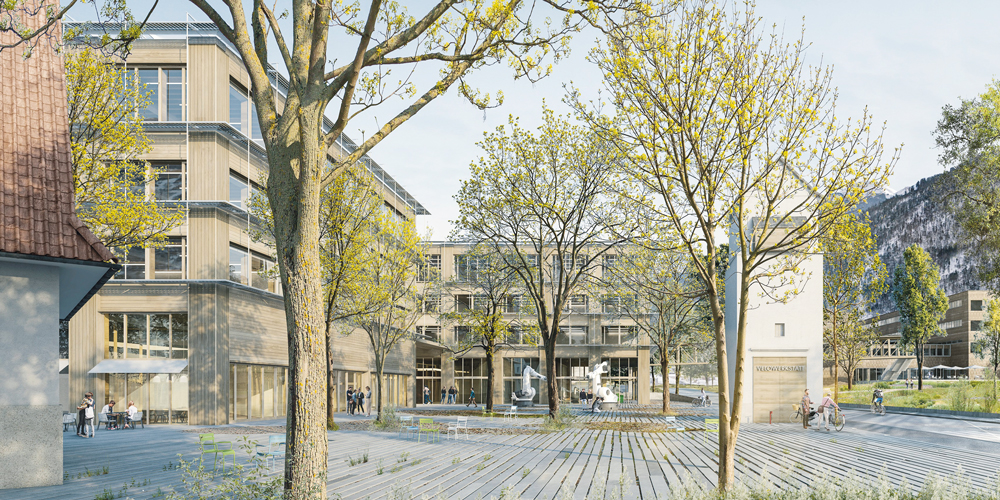
    Die Visualisierung zeigt den zukünftigen Campusplatz.
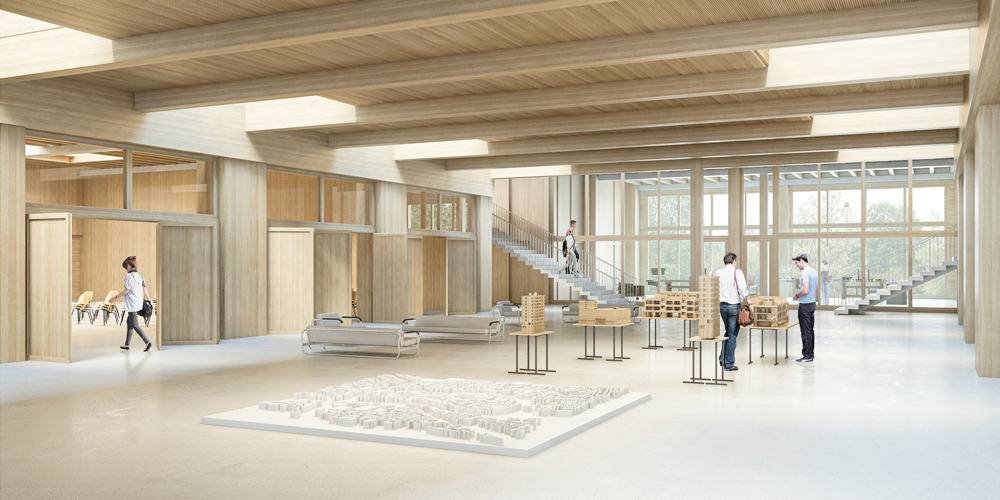
    So soll das Foyer des Neubaus dereinst aussehen.
  • SimplyNano wins award for promoting young talent

    SimplyNano wins award for promoting young talent

    This year’s Building Awards for outstanding engineering achievements in construction were presented on November 2nd in Lucerne. In the category promotion of young talent in the field of technology, the jury selected the SimplyNano project as the winner, the innovation society informed in a message . The company, which was founded in 2005 as a spin-off from the University of St.Gallen , developed SimplyNano. The project is carried out by the SimplySience Foundation and supported by a number of other foundations and companies as well as the public sector.

    The award recognizes the concept, high-quality didactic content and broad support from SimplyNano, according to the announcement. “Upper school children are motivated to deal with the nanoscale – just at the moment of choosing a career,” jury member Clementine Hegner-van Rooden is quoted as saying. “On a didactic, but very concrete level, this awakens a sensitivity for an area that is so far little known at this level and hopefully creates creative specialists for our professional world.”

    SimplyNano pursues “an integrative approach in promoting young talent on three levels”, is further explained in the communication. Schools are provided with an experiment kit with 40 ready-to-teach experiments and materials. Further training courses are offered for teaching staff. They take place at partner companies and thus also make it possible to network teachers and trainees.

    The engineering offices WaltGalmarini AG and COWI A / S have prevailed as the overall winner of the Building Awards with their project Second Hinterrheinbrücke. They were also victorious in the infrastructure category. Other awards went to Schnetzer Puskas Ingenieure AG and WaltGalmarini in the building construction category, to Kegel Klimasysteme in the energy and building technology category and to Alain Escher, eicher + pauli Bern AG in the young professionals category.

  • sfb continues training on building informatics

    sfb continues training on building informatics

    The sfb Higher Technical College for Technology and Management has responded to the increasing demand for specialists in building networking. As the first higher technical school, it has therefore introduced the course technician HF building technology with a specialization in building informatics. After a successful start in August this year, the sfb will continue to offer the course. New courses will start on August 18, 2022 at the Dietikon, Emmenbrücke LU and Zollikofen BE locations.

    The new courses also last six semesters. At all three locations, lessons are held on the entire Monday and Thursday evening. In Zollikofen there is also the possibility to attend classes on Thursday evenings and all of Saturday. Participants have the opportunity to qualify for the next step in their careers in the “largest growth market in the construction industry”, as sfb director Dorothea Tiefenauer puts it. “The technician HF building technology course at sfb focuses on building information technology and is geared towards the needs of the economy. Professionals with this training are in great demand on the job market, ”she adds.

    The sfb has a total of eight locations and, with more than 1200 students and 500 teachers, is one of the largest higher technical schools in Switzerland. It is supported by social partners in the machine, electrical and metal industries.

  • Better late than never

    Better late than never

    Actually, Brown-Boveri-Platz should have been rebuilt now and opened in summer 2022. But private construction work on the multi-storey car park led to delays: “The reasons are the later start of construction of the multi-storey car park and extensive relocation of the works”, René Zolliker from Baden's construction planning department told Immo! Nvest. Construction is now scheduled to start in summer 2023. About a year later, in autumn 2024, Brown-Boveri-Platz is to be opened. The redesigned square fulfills two basic functions: Firstly, the square is a place of passage and residence for passers-by, employees, customers and residents for around 300 days a year. Second, public events take place on the square for around 50 days. «The present project meets both requirements. The two-row wreath of trees creates the atmosphere that should characterize the new town square, and the inner open space of 40 x 50 m creates the necessary space for events with up to 2000 people, ”says Zolliker. Basically, the place is free from motorized traffic. Exceptions are the deliveries of goods for the ABB shipping company and the transformer center as well as the journeys of emergency vehicles by the rescue services.

    Use with benchmarks
    But how do you skillfully revitalize a space above a garage these days? The basic paper on the use of space with several benchmarks was already drawn up for the competition in a broad-based process: During the day, access to industry, trade, education, culture and leisure activities should be guaranteed. In the afternoon, the square will serve as a forecourt to the transformer halls, cinemas and the hotel, as well as an outdoor space for the congress center. In the project team led by the planning and construction department, in addition to the commissioned planner, the municipal departments civil engineering, works yard, urban ecology, location marketing, development planning, culture and the city police were represented. ABB Immobilien AG, Regionalwerke AG Baden and the planning team Hochhaus Ost / Parkhaus Brown-Boveri-Platz were also involved in the planning process. The biggest hurdle was the building credit approval by the residents' council. But now it should finally start.

  • Association for sustainable building is founded

    Association for sustainable building is founded

    The newly created Association for Sustainable Building Biological Building (VNBB) aims to make the construction industry more sustainable and climate-friendly. To this end, knowledge and skills are to be promoted and integrated into vocational training.

    As stated in a press release, the non-profit organization was initiated by Dr. Thea Rauch-Schwegler from the Baubioswiss Association over the past few years. Timber construction Switzerland , building envelope Switzerland , JardinSuisse , Lignum – Holzwirtschaft Schweiz and the Swiss Association of Painters and Plasterers have joined as founding members. Its new office in Wallisellen is also the seat of the VNBB. The management of the VNBB office is advertised. New club members and partners are expressly welcome.

    In 2019, the examination regulations for the advanced specialist examination for experts in healthy and sustainable building were recognized by the State Secretariat for Education, Research and Innovation. In this way, according to the VNBB, “the gap in higher vocational training in the field of sustainable building can be closed”. The first preparatory course for the diploma will start in 2022. At the same time, professional associations have also recognized the importance of the topic and decided to tackle the issue of sustainability in vocational training together.

  • Groundbreaking ceremony for the new Stierenmatt school pavilion

    Groundbreaking ceremony for the new Stierenmatt school pavilion

    The new construction of the Stierenmatt pavilion on the Hunziker area in the Limmatfeld area is scheduled to begin on October 1st. A temporary school building for the Stierenmatt school unit will be created. According to the city of Dietikon , this should offer space for nine primary classes. The creation of classrooms in the Limmatfeld district has been planned for some time. "Due to outstanding cantonal plans, the construction of the planned school building on the Stierenmatt area belonging to the city is delayed and will probably be completed in 2028 at the earliest," said a message from the city of Dietikon on the occasion of the vote on the loan financing of the project to justify a temporary solution .

    In the vote in June, according to the city, 2,056 voters were in favor and 735 were against the loan. This approved the submission for a loan of CHF 15.2 million.

    Construction work for the temporary school is expected to be completed in August 2021. The entire population is invited to the groundbreaking ceremony on Thursday, October 1st at 5.30 p.m. Registration is not necessary. Due to the current pandemic, however, there are no tables, benches and no toilet facilities available. Every visitor is legally obliged to register on an attendance list for contact tracing, the invitation draws attention to.

  • Lake Zurich education center inaugurates new building

    Lake Zurich education center inaugurates new building

    Patrick Heeb, Rector of the Education Center Lake Zurich ( BZZ ), inaugurated a new building at the BZZ in Horgen on Tuesday, together with District President and Education Director Silvia Steiner (ZH / CVP) as well as Government Council and Construction Director Martin Neukom (ZH / GPS). BZZ learners have already moved into the new school building.

    The new building, which has now been inaugurated, is intended to cover the school's increasing space requirements, as stated in a media release . With it, the school has new classrooms as well as a new triple gymnasium. The sports hall is made available to the sports department of the municipality of Horgen outside of school hours.

    After the completion of the new building, the renovation of the existing building will begin. After the construction work is completed, the BZZ will be able to benefit from its location on Lake Zurich. It will use the lake water to generate cold and heat.