Tag: BIM

  • BIM and digital twins the digital partners of buildings

    BIM and digital twins the digital partners of buildings

    BIM, Building Information Modelling, replaces static 2D plans with a shared, digital building model in which architecture, technology and costs interact in real time. All components are recorded as BIM objects with dimensions, services, prices, warranty and maintenance information, from the brickwork to the door, from the sensor to the pump.

    Instead of sending plans back and forth, everyone involved works in the same 3D model, recognises collisions early on and experiences the building virtually before the first excavator rolls in. This reduces the risk of errors, makes deadlines easier to plan and lays the foundation for clear budgets instead of later addenda.

    From the BIM model to the building twin
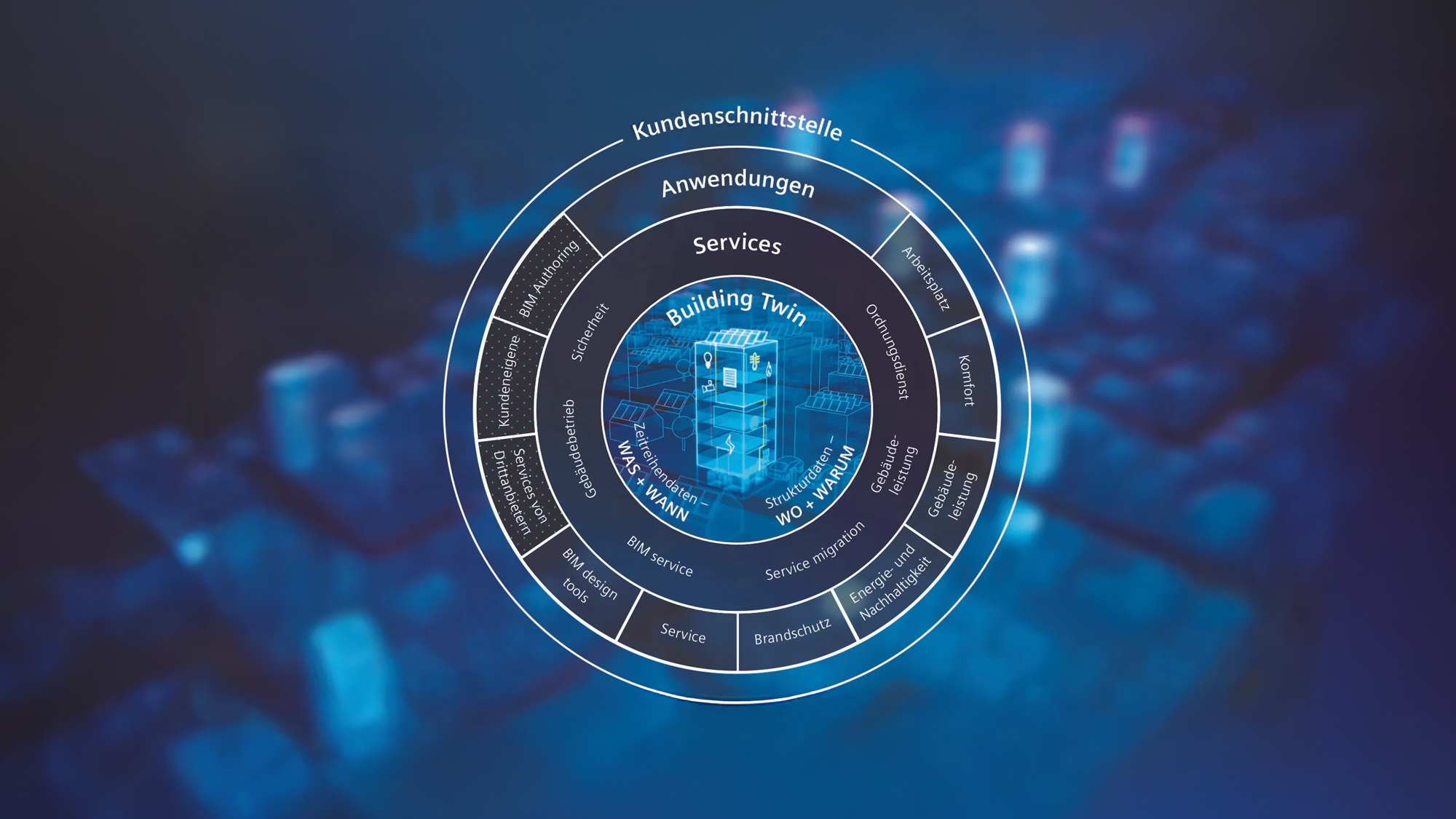
    The digital twin is created from the BIM model during operation. The building twin, which takes over up to 95 per cent of the planning information and links it with live data from the building. It forms the “single source of truth” for areas, technology and sensors and visualises performance, occupancy and comfort levels in real time.

    Cloud-based building twin platforms enable buildings to be monitored virtually, scenarios to be simulated and new applications to be scaled quickly, from energy monitoring to user-centred service suites with AI analytics. This transforms the rigid plan into a learning system that evolves with the requirements of operators, tenants and cities.

    Added value in operation instead of just on the construction site
    Around 80 per cent of a building’s life cycle costs are incurred during operation. This is precisely where BIM, in combination with digital twins, has the greatest leverage. Facility managers access maintenance cycles, operating instructions, manufacturer and warranty data in the 3D model, plan conversions precisely and reduce downtimes and journeys.

    Structured product and live data allow predictive maintenance, bundled procurement or automated reactions such as closing blinds in the event of severe weather warnings. At the same time, the transparent database supports ESG goals, decarbonisation and the circular economy, from energy and water tracking to the valuable reuse of materials in dismantling.

    Digital ecosystems as a model for the future
    Digital twins connect buildings, campuses and neighbourhoods to form intelligent ecosystems in which energy, use and mobility are coordinated. They provide insights into comfort, health, utilisation and emissions and help to manage net-zero strategies, new working environments and mixed-use urban building blocks based on data.

    For owners and operators, BIM and digital twins are thus becoming market differentiators. Those who understand their own portfolio digitally can better prioritise investments, manage risks and prove the return on investment of refurbishments, conversions and services. In an industry caught between decarbonisation pressure and user expectations, they are becoming the key to transforming properties from static objects into adaptive, future-proof infrastructures.

  • New tool facilitates coordination between 2D and 3D

    New tool facilitates coordination between 2D and 3D

    Revizto has added a number of new features to its integrated collaboration platform for the architecture, engineering, construction and operations (AECO) industry. As the Lausanne-based company explains in a press release, the new tools and improvements in Revizto 5.16 are designed to optimise workflows and enable smarter collaboration at every stage of a project.

    “Every improvement in this version has been designed to enable teams to coordinate more efficiently and make more informed decisions in real time,” CEO and founder Arman Gukasyan is quoted as saying. “All these improvements are the result of extensive discussions with our customers and feedback from our users. This is just another step in our journey to create a new standard for collaboration in the AECO industry.”

    New features include the ability for users to view a 2D sheet and a 3D model, including issues and markers, side-by-side, and the ability to instantly jump from a position in 2D to the corresponding position in the 3D model without having to switch between tabs. Further improvements relate to the selection field, object isolation and optimisation of the scheduler. The new “Required objects” collision function automates the coordination process, which can now also be carried out overnight.

  • BIM2SAP: Why a door is not just a door

    BIM2SAP: Why a door is not just a door

    Building Information Modelling (BIM) has established itself over the last few years as an effective method for the planning, execution and management of construction projects. With the understanding of model-based collaboration, the connections and links to other systems are increasingly expanding. This is because experience with BIM has in the meantime shown many property owners that the need for correct, up-to-date and easily accessible data by no means ends with the completion of a building.

    “On the contrary,” says Patrick Pick, Head of Service Unit BIM/LCDM at pom+. “The handling of data only becomes really demanding during operation. That is, when I want to use it for specific applications within the framework of efficient property management.” Here, the flawless transfer of data from the BIM model into the operational and property management systems is of particular relevance, says the trained architect and project manager.

    Optimising building management
    It is not uncommon for BIM to come up against a comprehensive, complex system architecture – such as SAP. The ERP software is used by many companies as a universal tool to link systems, applications and products and thus connect different business sectors and processes. This is particularly exciting for companies that own and manage their own buildings. Even if real estate is often not part of the core business, as is the case with a hospital or airport, for example, it is essential for the security and success of a company, such as pension funds or banks. For this reason, it is no longer just real estate specialists in facility, property and asset management who have been making their claim to data from real estate management for a long time, but also the finance, controlling, sustainability or IT departments.

    SAP has developed a special real estate module – SAP RE-FX – for this purpose. It stands for ‘Flexible Real Estate Management’ and enables a holistic view of the building from different perspectives: “On the one hand, information on the structure of the building, such as office or floor space, is displayed in the architectural view. On the other hand, the usage view contains information on typical business cases in the area of leasing, such as rental agreements, conditions and contractual partners,” explains Stefan Pallier, Consultant Facility & Project Management at Novo. This enables SAP RE-FX to seamlessly integrate the real estate data into the SAP core and to link different SAP modules.

    Reduction to the essentials
    Against this background, the combination of BIM and SAP provides considerable added value. This is because a data-driven planning method meets an application for information management in building operations. BIM thus generates the data, while SAP provides a platform for its use and maintenance. For this, it is crucial that the data can be transferred from project planning to operation with as little loss as possible. “The fragmentation of the processes usually turns out to be the biggest challenge. Project management is not based on object management. Instead, the planning and construction phases are treated as separate units,” says Patrick Pick.

    This makes the integration of BIM and SAP complex. It requires a correspondingly careful, expert transfer, transformation and structuring of the data from the BIM model in the target system. Patrick Pick likes to refer to this as ‘data-to-target’. In this approach, the data from the BIM model is analysed and reduced to the necessary information that is relevant for the SAP system. This process involves identifying the relevant data requirements, mapping this data to the appropriate fields and structures in SAP, and converting and transferring the data to the SAP system.

    Stefan Pallier adds with an example: “In the BIM model, 120 attributes must be defined so that a single door is ordered correctly. In building operation, however, we are only interested in a part of it – for example, whether it is a revolving door, sliding door, fire door or escape route doors. So we need certain information about it in SAP, for example about the locking mechanism, smoke protection or the legal maintenance standard.”

    If the relevant attributes are integrated correctly in SAP, this makes technically and commercially efficient property management possible. Before the actual data mapping, the necessary interfaces must be prepared and the responsibilities for individual data records clearly defined.

  • Steiner AG enters into a strategic partnership with HEGIAS

    Steiner AG enters into a strategic partnership with HEGIAS

    The dynamic startup HEGIAS offers the world’s first automated and browser-based solution for visualization and communication with Virtual Reality (VR) for the planning, construction and real estate industries. The rapidly growing company was founded in 2017 and currently employs around 20 people at the two locations in Zurich and Lugano. “With Steiner AG, we have a strong partner at our side who supports us in realizing our growth ambitions,” says Patrik Marty, CEO of HEGIAS. Giuseppe Giglio, Chief Digital Officer at Steiner AG, adds: “The new virtual collaboration environment will enable everyone involved in the project to work on the same model at the same time and from any location.” This simplifies and accelerates previous processes and contributes to a significant reduction in errors.

    Ajay Sirohi, CEO of the Steiner Group, is convinced that the cooperation will contribute to the long-term success of both companies: “The combination of HEGIAS’ digital expertise and our proven experience in the BIM and construction sectors enables us to jointly create tailor-made innovations for the market develop. With the first strategic partnership in the digital sector, we can expand our expertise in this area and actively help shape the future of the real estate industry. In the future, we are planning further collaborations with innovative start-ups in order to continue the digital transformation of our company and to grow sustainably in the field of future technologies.»

  • BIM data help with raw material shortages and material shortages

    BIM data help with raw material shortages and material shortages

    With the increasing degree of digitization, the chances of the construction industry anchoring their solutions in the plans of the architects and thus being advertised as a lead product more often increase. In addition, information about availability and delivery times can be added more easily. However, according to BIM expert Matthias Uhl, the degree of digitization in the construction industry is still lagging behind other sectors, depending on the size of the company. “BIM represents one of the greatest opportunities of the last decades. From the design to the operation of the building, processes and steps can be mapped more efficiently, cheaply and transparently. But building material manufacturers now have to digitally prepare and provide their data for this,” states Uhl, who has developed a BIM solution for manufacturers with BIM & More Orchestra. He gives three reasons why manufacturers now have to prepare their product portfolio digitally and provide planners and architects with BIM data.

    Firstly, the construction and real estate industries are already digital
    The degree of digitization of the large construction and real estate companies in Germany has reached a significant level in the past two years. The big players in the industry such as Drees & Sommer, Goldbeck or ZECH together make up a large proportion of the total planning volume. They have now become so digitized that they are increasingly dependent on digital products. “Out of necessity, they fall back on the products that are available in the leading planning programs with the appropriate level of detail,” explains Uhl. Building material manufacturers must realize that they only exist in the digital cosmos if they are digitally visible. Especially in view of the delivery and material bottlenecks, digital visibility is more important than ever for planners to check prices and availability beyond technical specifications.

    Second: All future trends have a digital component
    Construction methods and trends are increasingly developing out of digitalization. Uhl: “Whether modular construction, sustainability or prefabrication: all relevant ideas have a digital component. Without digitization in planning and implementation, it doesn’t work at all.” This also suggests that manufacturers now have to deliver their data digitally if they want to participate in the megatrends or want to shape them. With the amount of data, the possible combinations increase for planners and offices, with which not only new structural solutions can be found. In addition, alternatives become visible in the event of other unavailabilities.
    “Let’s take a look at the sustainability megatrend using the example of the Building Circularity Passport in the coalition agreement,” says Uhl, giving another example from climate protection. With the Building Circularity Passport, the federal government has anchored the topic of circular economy as a mandatory element for the future in the coalition agreement. Only access to transparent product information allows consideration of recyclability. The circular economy does not work without information on the material composition, manufacturing method, service life, repairability and recycling options of the products. “Product information forms the basis for a transition to a circular economy,” says Uhl. There are no laws yet, but they will come soon. The first municipalities in Germany want to introduce the Building Circularity Passport for their new buildings, regardless of the legislation. Any new school, kindergarten or office building will require products whose recyclability has been assessed, calculated and certified.

    Third: the complexity of the planning processes is increasing and with it the need for data
    Another reason for the provision of BIM data: The requirements for planning processes and thus for planners in terms of verification and calculations are becoming more and more complex. Planners and architects are therefore increasingly open to support from industry. “While today evidence of circular economy plays an increasingly important role, it used to be physical building requirements such as energy consumption, for example in the Energy Saving Ordinance (EnEV), in passive house calculations or energy-plus house concepts. These topics require a new level of data volume and information quality on the part of the planner,” explains Uhl. This need would continue to grow. This circumstance also requires the industry to make data available digitally now. “Product information from the industry has never been more popular than it is today. It has never been easier for manufacturers to gain acceptance from planners,” sums up the BIM data expert.

  • Implenia wins the German Construction Prize

    Implenia wins the German Construction Prize

    Implenia has been voted one of the best and most innovative construction companies in Germany at the German Construction Prize 2022 , the Opfikon-based construction and real estate company said in a press release . The company prevailed over 170 competitors in the category for companies with more than 500 employees and took second place behind Zech Bau . The podium was completed by Wolff & Müller .

    “We are very proud to be among the top three in the German Construction Prize 2022 and to be one of the best major construction and real estate service providers in Germany,” Matthias Jacob, Country President Germany at Implenia, said in the statement. “This confirms our claim to set ourselves apart from the competition with our skills in the management of large, complex real estate and infrastructure projects and a clear focus on sustainability.”

    The winners of the construction prize were determined by a jury in an extensive three-stage process. This year’s competition took place for the first time under the patronage of the Federal Ministry of Housing, Urban Development and Building , according to the statement.

    The award ceremony took place on May 31 at the digitalBAU 2022 trade fair in Cologne. A young talent prize for innovative digital solutions in the construction industry was also awarded at the trade fair, Implenia reports. He was won from Implenia by a young specialist in Building Information Modeling (BIM).

  • Amberg Engineering receives an order from Deutsche Bahn

    Amberg Engineering receives an order from Deutsche Bahn

    Amberg Engineering won the drawing of lots for planning the new railway line between Innleiten and Kirnstein near Rosenheim in Bavaria. In a joint venture with Obermeyer Infrastructure , the consulting company based in Regensdorf is to process the order from Deutsche Bahn (DB) in the Brenner Nordzulauf project , according to a press release . Both companies are already working together on an ongoing project on the Brenner Base Tunnel.

    The Innleiten-Kirnstein planning section in the Brenner-Nordzulauf rail network expansion project includes, among other things, the planning of the two Ringelfeld and Steinkirchen tunnels, including the technical tunnel equipment, the planning of the rails and roads as well as the planning for the new construction of flyover structures, troughs, noise protection walls and supporting structures.

    The digital process Building Information Modeling (BIM) is contractually mandatory. “We are very pleased to be able to show our planning expertise in such an exposed overall DB planning project. In addition, together with those involved in the project, we can further develop the BIM methodology in infrastructure planning,” Christoph Heiter, an engineer at Obermeyer Infrastructure, is quoted as saying.

  • Strabag is an active partner on Engineers' Day

    Strabag is an active partner on Engineers' Day

    Strabag Switzerland will take an active part in the day of engineers and will present a pilot project in Küsnacht in an online lecture. According to the media release from the Schlierem construction company, the start is on Friday, March 4, at 11 a.m. The lecture goes until 12:15 p.m. and will be broadcast on the Internet via Microsoft Teams. On the Engineer’s Day website, access is possible by clicking on it without prior registration. The speakers are Stijepan Ljubicic, Technical Group Manager BIM, and Christian Häni, Technical Group Manager Traffic Routes Engineering at Strabag.

    BIM stands for Building Information Modeling and describes the model-based planning, implementation and operation of construction projects, with the aim of optimizing the transfer of knowledge, the quality of the results and the efficiency of all those involved, according to Strabag. On March 4th, Strabag will present its project for the renovation of the Schiedhaldensteig in Küsnacht in the live presentation. Strabag is the total contractor and is responsible for the planning and construction management as well as the execution – model-based using the BIM 5D program. In Küsnacht, the upper part of the Schiedhaldensteig was rehabilitated in a very narrow and steep traffic area and the sewage pipes were replaced. At the same time, the existing gas, water and electrical lines at the plants on Lake Zurich were renewed.

    Even before the actual Engineer’s Day, a networking event will take place on Thursday, February 17, at the JED in Schlieren. Zurich government councilor Carmen Walker Späh and Federal Councilor Guy Parmelin will be taking part. According to a press release from the Limmatstadt AG location promotion, a panel discussion will highlight the qualities and potential of engineers from various disciplines.

  • "We anticipate a trend towards urban living"

    "We anticipate a trend towards urban living"

    To person
    Stephan Attiger (FDP) has headed the Construction, Transport and Environment Department of the Canton of Aargau since 2013. At the national level, the 54-year-old represents the concerns of the canton as President of the Conference of Construction and Environment Directors (BPUK) and as a board member of the Conference of Energy Directors (ENDK). Born in Baden, he worked for a long time in the management of various Swiss companies before moving into politics. Among other things, he was Mayor of the City of Baden from 2006 to 2013 and Grand Councilor of the Canton of Aargau from 2009 to 2013.

    You are in charge of the Construction, Transport and Environment Department of the Canton of Aargau. How do you have to imagine a typical working day for you?
    In the last few months, my working days have been rather untypical due to covid: I was often in the home office, physical meetings were rare, and official events hardly took place at all. But not every day is the same, and the process depends heavily on the schedule. Basically, early in the morning I discuss the short-term issues and what is to come in the medium and long term with my closest employees. This is followed by meetings at various levels: government council, department, departments, bilateral discussions and meetings with external parties. In between I study files.

    What milestones have you reached in terms of construction so far?
    On the one hand, there are numerous larger and smaller buildings that I was allowed to inaugurate – not only in road construction, but also in the environmental sector, such as flood protection and renaturation projects. The latter also have a direct and positive effect on the residential and location attractiveness. In addition, we have created important foundations for the planning and subsequent implementation of mobility projects. With the last revision of the structure plan and the new cantonal mobility strategy mobilitätAARGAU, we want to coordinate settlement and traffic development. It therefore sets specific spatial accents and differentiated goals per room type for the individual means of transport. This in turn affects civil engineering and building construction. As a canton, we also act as a role model.

    In what way?
    For example, we are promoting more biodiversity and quality of stay in the outdoor spaces of our properties. We are looking for good solutions for how biodiversity issues can be taken into account in new buildings and in the maintenance of existing properties. Climate adaptation measures on buildings and in their surroundings make a contribution to achieving our climate policy goals. Another good example is the new building for the Office for Consumer Protection, in which we want to use wood from the Aargau forests as a sustainable building material.

    What are currently the most important construction projects in building construction?
    A major project currently underway in the area of cantonal real estate is the new construction of the police building in Telliquartier in Aarau. The units of the cantonal police, which are distributed across numerous locations, are to be brought together here. The building permit is already available. At the end of March, the canton also started the consultation process for the new location of a canton school in Fricktal. The hearings on the aforementioned new building for the Office for Consumer Protection and the project to merge the Aargau IT department into one building in Unterentfelden were concluded. All construction measures are implemented according to the principle of sustainability. During planning, special attention is paid to the gray energy bound in the building, and the time for new user requirements is coordinated with the time of repair.

    Aargau has a large number of development areas that could offer space for additional residents. What are the plans here?
    The cantonal structure plan designates 21 residential areas with areas that are predestined for high-quality settlement development. These should make a significant contribution to absorbing the expected population growth over the next 10 to 20 years in suitable, easily accessible locations. The areas should not only support the economical use of the soil with an appropriate density, but also become high-quality and attractive residential locations in the interests of sustainable development. This is the task of the municipalities, which determine the appropriate framework conditions and requirements in the land use planning. The canton supports them in this.

    Area developments often stumble over traffic problems. Are you actively helping to find a solution?
    It is effectively the case that high demands are placed on traffic planning, especially when it comes to site developments. This is because there are many unknowns about future claims. Here, traffic planning must provide a flexible framework in order to be able to react to the various requirements of investors. As far as the canton is concerned, it takes an active part or sets the framework conditions at the interfaces.

    The project to extend the Limmattalbahn from Killwangen-Spreitenbach to Baden is currently making waves. What are your arguments to try to change your mind against the opponents of extra time?
    The reporting in the media unfortunately gives a distorted picture of the general level of acceptance for this project. In the public hearing, the regional planning associations and all municipalities in the perimeter of the new tram route as well as most associations of the Limmattalbahn approved. The specifically proposed lines also received broad approval. We take the public's reservations that emerged from the hearing very seriously. For example, we have added additional variants for the lines. We will examine these and other objected points in more detail until they are determined in the structure plan and weigh them against the other cantonal interests and with the reservations mentioned.

    Urban sprawl is also a problem in Aargau. Did the municipalities make mistakes in spatial development?
    It is important to look to the future. In today's inventory, the potential that can be better used for sustainable development should be recognized. The revision of the Spatial Planning Act of 2013 has shown that the development needs of the next 20 years can be covered with the internal development of the settlement, i.e. the use of the existing reserves. We take the containment of urban sprawl very seriously. The 2015 structure plan finally defines the settlement area. The consumption of crop rotation areas has already fallen sharply.

    How well or badly does the cross-community cooperation in spatial development work?
    The regional planning associations play an important role in this cooperation. You also have to coordinate the municipal land use planning regionally in accordance with the building law. The coordination along the municipal boundaries works.

    What does an optimal use of land resources look like for you?
    The economical use of the soil is a central concern. Building upwards cannot, however, be unrestricted. The quality of the settlement and the townscape must always be taken into account. And in the case of underground structures, care must be taken to ensure that there is enough space left where large trees can be planted and water can seep away. This is crucial for avoiding heat islands in the settlement area and for the groundwater. Climate change poses great challenges for us. Optimal use of soil as a resource, sustainable settlement development and high-quality residential and workplace areas are not mutually exclusive.

    The canton of Aargau is already well positioned when it comes to digitization. What are the future plans in the construction sector?
    The digitization of construction projects with Building Information Modeling (BIM) is a big topic for us. We are currently working on around 20 BIM pilot projects. At the beginning of the year, the first master builder submission was put out to tender as part of a pilot project in the invitation process. Our goal is for BIM to be used as standard for project management in all new projects in the civil engineering department from 2025. Astra and SBB have the same “timetable”.

    Pandemics have had an impact on urban planning before. Will Corona present urban planners with new challenges in the future?
    Our villages and small towns are ideally suited for walking and cycling as places with short distances. This is a very good starting position, even in times of pandemic. In more and more places there is the possibility to work in co-working spaces. In this way, long travel times can be avoided, even if there is little space for home office. Attractive public spaces and easily accessible recreational opportunities are important. These are in great demand, and not just since Corona. I do not believe that this pandemic will completely turn city planning upside down.

    According to an analysis by Wüest & Partner, the canton of Aargau has the highest potential for new living space and development areas alongside Geneva, Vaud and Zurich. What will have changed in Aargau in 10 years?
    According to our forecast, we will get more attractive living space, especially in easily accessible locations, near train stations, in the centers of our villages and cities. Existing buildings are being converted, some of them are being built. We anticipate a trend towards urban living, not least because of the demographic development. More older people are drawn to central locations where they can benefit from services, short distances and cultural offerings. But living in the country will also remain attractive. Many of the around 100,000 single-family houses in Aargau are being renovated and brought up to date in terms of energy or even replaced by new buildings.
  • Strabag operates completely digitally in Küsnacht

    Strabag operates completely digitally in Küsnacht

    The construction company Strabag Switzerland has been awarded the contract for the renovation of a road section in difficult terrain in the municipality of Küsnacht as well as the renewal of the gas, water and electrical lines of the local electricity supplier Werke am Zürichsee AG . According to the media release , the project will be digitally controlled from planning through construction to subsequent maintenance. For this purpose, so-called Building Information Modeling (BIM) is used. Strabag AG has been awarded the contract as general contractor. The start of construction is scheduled for the end of August and completion around October 2022, according to the announcement.

    The renovation project of the municipality of Küsnacht on the upper part of the Schiedhaldensteig is considered difficult. There, on the one hand, the renovation work has to be done in a very narrow and steep traffic area and, on the other hand, the sewerage pipes have to be replaced.

    BIM manager Stijepan Ljubicic from Strabag is quoted as saying that, on the one hand, “the construction site will be handled completely digitally” with regard to the use of BIM in the planning and implementation of the two construction projects. In addition to planning and execution, all work would be digitally documented and ultimately handed over to the client in a so-called as-built model. This data offers many advantages with regard to quality management, operation and maintenance as well as a planning basis for follow-up projects.

    The technical division manager for traffic route construction east at Strabag, Michael Graber, is quoted as saying that one of the main criteria for the award was the company's digital performance. The contract confirms Strabag's own competence and specialist knowledge in the field of BIM.

    The press release also gives facts about the construction. The excavation will make up 1,500 cubic meters, 240 meters of raw material will be laid. The road is being built over a distance of 750 meters, using 500 tons of rolled asphalt.

  • All players in the industry must be ready for change

    All players in the industry must be ready for change

    What exactly is Building Information Modeling?
    Literally translated, BIM means modeling construction information, which is a fairly precise definition. In addition to the digital planning and execution of projects, BIM also enables the data required for the work to be determined and reused. It's about working with three-dimensional models that are nothing more than visually represented databases. It sounds more complicated than it is, but in fact it's just a new way of working. If we used to have two-dimensional plans, now we have
    mo three-dimensional digital building models. It is important that everyone involved has access to the same data or is referred to in another way as the Single Source of Truth (Ed.). This ensures that the data stored in the databases is always up-to-date, correct and relevant for further processing. And that is exactly the biggest advantage.

    Why did SBB choose BIM for construction projects?
    In BIM we see an important potential for data processing and the entire value creation process. SBB expects a significant decline in investments in the planning, construction and management of real estate. This also applies to all of the railway infrastructure it owns.

    We can also make an important contribution to reducing CO2 emissions as we can use the data we collect to simulate how the company will develop in the next 20, 25 years and beyond. Since projects can be compared, they can be learned and transparency can be created over the entire life cycle.

    How is BIM used in the construction of the Letzitur tower?
    The Letziturm was one of the first SBB Immobilien buildings to be constructed using BIM-based working methods and practices. It is also a training project related to the management phase. Planning and executing a project of this magnitude will be completed in ten years, but managing the building will take at least four times longer. For example, we will use the experience of the last tower to try out materials. We are working on obtaining planning approvals through the collaboration platforms. We have learned a lot and can use it to optimize planning and implementation. From our point of view, this is an important first step.

    "One can no longer bear it alone as an owner."

    What conclusions can you draw from using BIM today?
    We recognized the potential of BIM for SBB very early on and actively promoted its development through the BIM @ FFS program set up for this purpose. We have made important progress since then. This program is based on four interlinked pillars: development, experimentation, approval and concrete involvement of the sector. We share all of our knowledge and experience at events with our partners, collect comments and observations, which we then integrate into the development process. We involve our community in this way. You can no longer build on your own, you need close cooperation between the parties. This is also reflected in the skills of the employees. On the part of the employees, we have clearly identified a great desire for mutual learning. The result is inspiring and instructive for everyone.

    What are the advantages?
    It goes without saying that data-powered designing and building is changing the way we work with our partners and how we develop projects with them that are now completed faster and more securely. Of course, only if everyone involved is willing to take over the system. An additional benefit, as mentioned earlier, is "A Source of Truth". Company data is stored in a structured way, is always up-to-date and can be found quickly. This means that the annoying and constant searching for and checking of data is largely eliminated. Compared to the past, communication is also more targeted and performance-oriented. Project groups can find solutions faster, visualize open problems and problems directly in the three-dimensional model and work out variants and alternatives more easily. This helps to understand each other.

    Are there any disadvantages?
    BIM is often only associated with the technological aspect. Of course, it would be nice to fly over the construction site with glasses that show us augmented reality. However, if the underlying data is incorrect, then the most advanced technology is useless. The data has to be correct, so we need a new way of working precisely. There are only two types of data: right or wrong. Today not everyone is ready to use new technologies and methods. However, all operators in the industry must be willing to change and do their part to make things work.

    What could be the reason why BIM has not yet established itself in Switzerland?
    Many associate BIM with the use of the latest software or the latest database technology. This is often necessary, but it is not enough on its own. In order to be able to use BIM successfully, we have to change the way we think and work. In the BIM environment, we often talk about collaborative project teams developing solutions together. This process takes time, but the trend gives me hope for the best. We also have to do our part as public sector clients in order to drive this development forward and to promote the use of BIM in the awarding of contracts, as we did for the Letziturm project, for example.
    What are SBB's goals when using BIM?
    We currently have around twenty pilot projects for which we provide background information. We also experiment with a variety of methods, technologies, and techniques. The knowledge gained from these projects flows into the development process. Thanks to regulations and standards, we can also take international basic elements into account. This way we are sure to keep up with the times. This knowledge is specifically given back to the industry. For confederate companies, the use of BIM will be mandatory for the construction of buildings in accordance with the federal digital strategy from 2021 and for infrastructure from 2025, as a lot still needs to be worked out in this area. This is our stated goal.

    SBB and the BIM Letziturm project
    Thanks to the renovation of the existing commercial and industrial areas, a new urban area is being created along the tracks between the Zurich-Altstetten and Hardbrücke stations. The Letziturm, a six-storey building east of the warehouse that has been declared a historical monument, defines a first urban horizon, which together with the two residential towers adapted to the height of Letzibach D forms a core of three tall buildings.

    Construction began that year. The 178 residential units, consisting of apartments with 1.5 to 7.5 rooms, should be ready from autumn 2022. On the ground floor there are two main entrances and two commercial rooms, each of which offers a view of the future. Square and in the SBB workshops. In between are the ground floors of four larger, two-story residential units, which offer a combination of work and living spaces and, if desired, can be directly connected to the public space.

    Both the smaller and the larger residential units are housed in the base building. Apartments with 2.5 to 4.5 rooms are planned above the 7th floor, where there is a common room. ■

  • Strabag relies on 3D models in the Fahrweid

    Strabag relies on 3D models in the Fahrweid

    Geroldswil , Weiningen and Limeco are part of the owner of the joint project drainage Fahrweid. As part of the project, a new sewer system is being implemented. For the central shaft structure, the construction company Strabag relies on Building Information Modeling (BIM), as stated in a message . A software is used for the planning, through which, among other things, 3D models of the buildings to be realized are created.

    "We are carrying out the central manhole structure together with the planners from ILF Switzerland using OpenBIM2Field as a pilot project," is how Stijepan Ljubicic, BIM manager at Strabag, is quoted in the message. The 3D models in particular have proven to be helpful. “The visual representation is a big advantage. Plans in 3D are easier to understand than complicated paper plans, especially for people in the team who speak other languages – they understand the 3D model better and faster, ”says foreman Adrian Wildhaber. But changes are also easier to implement than with plans on paper, says site manager Sven Landis, "in the model they are easily generated at the push of a button".