Tag: Biodiversität

  • Green spaces as ecological capital for cities

    Green spaces as ecological capital for cities

    Studies show that in cities such as Bern, there are dozens of hectares of what is known as “distance green”. Lawns with no function that are merely mowed. These areas are a previously unused asset. They could store rainwater, cool the urban climate and create habitats for diverse species. Instead of being viewed in isolation, they need to be understood as an interconnected ecosystem.

    Planning beyond plot boundaries
    Climate change and biodiversity do not stop at plot boundaries. Nevertheless, the competence of property owners is limited to their plots. To realize the potential of urban green spaces for climate resilience and biodiversity, we need political guidelines, cooperative action and new professions that professionally maintain and develop urban green spaces. A systemic approach to urban development is essential.

    Landscape architecture with a claim to leadership
    Architecture shapes urban development with grand gestures, but the robustness and sustainability of urban systems lies in open spaces. This is where landscape architecture has its strength. It can create resilient, ecological structures with minimal resources. This requires more self-confidence in the discipline and a willingness to take a leading role in urban development.

    Education for the future
    In order to meet the growing demand for landscape architects, new training paths are needed. A Bachelor’s degree course at Bern University of Applied Sciences could close this gap and test innovative teaching models. Central content would be systemic approaches that combine ecological, social and spatial factors and translate them into sustainable concepts.

    The green space between buildings is not superfluous. It is the ecological capital of the future. Those who see it as an integral part of urban planning will create resilient, liveable cities that can withstand the challenges of climate and biodiversity.
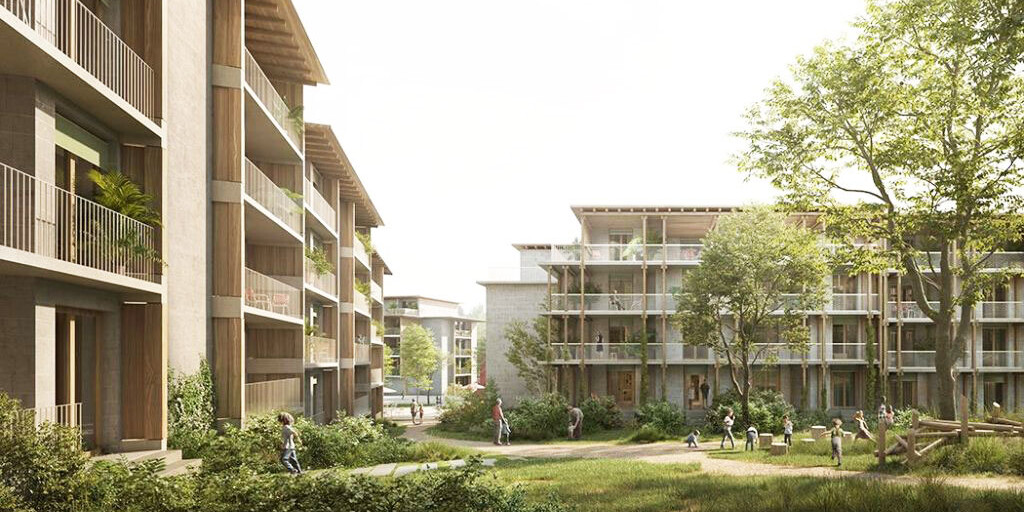
  • Gartenstadt Bergacker living with a future

    Gartenstadt Bergacker living with a future

    The approximately 70-year-old buildings on the Bergacker estate are no longer up to date and are in need of renovation. It is not feasible to renovate them while they are occupied, which is why the owners, Swiss Life for the western part of the site and Habitat 8000 for the eastern area, have decided in favour of a comprehensive replacement building.

    Test planning was carried out back in 2019 to develop a sustainable urban planning solution. The result is a concept based on four-storey terraced buildings that are arranged along the slope and create generous, green open spaces. These “garden courtyards”, developed by EMI Architekten and Maurus Schifferli Landschaftsarchitekt, tie in with the original garden city idea and promote the quality of life.

    Sustainability as a guiding principle
    The entire construction project is designed in accordance with the highest sustainability standards and aims to achieve the “Gold” certificate of the Swiss Sustainable Building Standard. Energy is supplied by geothermal probe heat pumps and photovoltaic systems, making the neighbourhood largely self-sufficient in renewable energy. Green roofs and climate-resistant outdoor spaces with wildflower meadows and shady trees promote biodiversity. At the same time, a large proportion of the garden courtyards remain unsealed in order to improve natural water management.
    In addition to ecological sustainability, the social component also plays a central role. The new building will create a total of 270 flats with 1.5 to 5.5 rooms, which are aimed at a broad public, from singles and families to older people. The focus is on affordable living space that is suitable for all stages of life.

    Living quality through intelligent architecture
    The new buildings make optimum use of the hillside location to offer maximum living comfort. A noise-reduced mezzanine floor has been created on the street side, while the rooms on the garden side have generous ceiling heights and offer direct access to the green open spaces. The floor plans are designed in such a way that morning sun in the kitchens and evening sun in the living rooms ensure a pleasant indoor climate. Each flat has two outdoor areas in the form of a loggia, a balcony or a terrace with a private garden.

    Particular emphasis is placed on communal areas. In a participatory process, tenants expressed a desire for seating, playgrounds, barbecue areas and urban gardens, which are now being integrated into the planning.

    Staggered implementation for a smooth transition
    To ensure an orderly transition for residents, the new building will be realised in several stages. The construction project planning should be completed by the end of 2025 before the first construction phase starts in 2026. The first new buildings are expected to be occupied in 2028, while the other construction phases should be completed by 2030.

    Swiss Life tenants will be actively supported throughout the entire process. They will receive help in finding accommodation, have priority when re-letting within the neighbourhood and benefit from flexible notice periods.

    A showcase project for sustainable living
    Gartenstadt Bergacker is becoming a forward-looking neighbourhood that combines sustainable construction with a high quality of living and a social mix. Conscious planning and the involvement of the tenants will create an environment worth living in that fulfils ecological, economic and social requirements in equal measure. The project sends out a strong signal for the future of sustainable living in the city of Zurich.

  • Zurich Airport begins with renaturation

    Zurich Airport begins with renaturation

    The Glatt section on the west side of Zurich Airport is to be ecologically upgraded and renaturalized, according to a press release. The revitalization of the section between Opfikon and Rümlang, which will begin in spring 2025, aims to increase biodiversity and promote local recreation.

    The project is intended to compensate for the impact on the landscape caused by several current and planned construction projects as part of the airport expansion. The Glattraum will become an attractive, large-scale recreational area for the population.

    The Glattraum Rümlang/Oberglatt landscape development concept drawn up by the canton of Zurich serves as a basis. It envisages an overall measure to enhance the Glatt instead of several small projects. This would result in “a coherent project that serves landscape protection as well as nature and species conservation”.

    Specifically, the section from Tolwäng to Fromatt is to be given a natural watercourse. In addition, the watercourse area is to be doubled in order to create more habitats for plants and animals. The revitalization project is to be implemented between 2025 and 2028.

  • Building authorities conference Appenzell Ausserrhoden

    Building authorities conference Appenzell Ausserrhoden

    This year’s conference for building authorities, organized by the Cantonal Office for Spatial Planning and Forests, focused on settlement ecology. Cantonal Councillor Dölf Biasotto opened the conference and made the connection to the vision of the 2024-2027 government program, which envisages a significant promotion of biodiversity in residential areas. The municipal building authorities play a central role in achieving these goals.

    Inspiring presentations and practical examples
    Six expert speakers highlighted various aspects of settlement ecology. The presentations showed how the sustainable design of settlement areas can succeed and provided valuable suggestions for municipalities and companies. The practical examples from Teufen and Gais in particular illustrated how municipalities can successfully integrate biodiversity into their settlements. The combination of green roofs with photovoltaic systems was also discussed and examined from a scientific perspective by Stefan Brenneisen.

    Excursion to the wild bee paradise and lively exchange
    At the end of the conference, the participants were able to visit the wild bee paradise of JUST Schweiz AG, which serves as a showcase example for the promotion of ecological company environments. At the subsequent drinks reception, the opportunity was taken to further discuss the insights gained and to strengthen networks.

    Settlement ecology as a common goal
    The 2024 Building Authorities Conference underlined the importance of diverse habitats in settlements for the promotion of biodiversity. The practical examples and specialist presentations provided important impetus for the future design of ecological habitats in municipalities. The event contributed to a valuable exchange of experiences and set clear priorities for the implementation of the government program.

  • Cities have many times more tree species than forests

    Cities have many times more tree species than forests

    A group of WSL researchers led by Benno Augustinus have studied the tree populations in 26 Swiss cities and their surrounding forests. According to a WSL press release, the study revealed an enormously high species richness in the cities with over 1,300 tree species. In contrast, only 76 tree species were identified in the surrounding forests. While cities are perceived as species-poor and forests as species-rich, the opposite is actually the case, according to Augustinus in the press release.

    According to the researchers, the high biodiversity in cities could be a gateway for invasive forest pests. Potentially dangerous introduced forest pests – so-called quarantine pests – find more potential hosts among the many tree species in the cities than in the forests. In order to protect the forest, it is therefore necessary to search for pests in the cities in particular, according to the press release.

    “It helps a lot if the population also keeps their eyes open for diseased trees,” Augustinus is quoted as saying. He recommends relying on the expertise of forestry companies when greening cities. In this sense, the WSL study “can also be interpreted as a call for more cooperation between foresters and urban green managers”.

  • The versatile world of wood

    The versatile world of wood

    Utilisation of the wood
    After a certain time, the tree reaches its growth limit. This is the perfect time to fell the tree – it is ready for harvesting. Depending on the tree species, the time until it is ready for harvesting varies between 60 and 150 years. Until then, the tree has had enough time to reproduce through seeds in the gaps in the forest. The plants in the young forest that are best adapted to the local climatic conditions prevail. In this way, the forest remains healthy thanks to natural selection. During thinning, desirable and well-grown trees are left standing as future trees. The abundance of light in the gaps created by felled trees allows a variety of shrubs and annual plants to colonise the ground – increasing biodiversity in a forest managed in this way.

    The majestic forest of Switzerland
    Around a third of Switzerland’s total land area is covered by protected forest. This forest provides protection against natural disasters, is a habitat for animals and plants, a place for recreation and leisure and a source of wood. Sustainability is a fundamental principle that requires the forest to fulfil all these functions in the long term without harvesting more wood than grows back. Enough wood grows in the Swiss forest every ten minutes to build a detached house. Around 60% of Swiss forests consist of conifers and 40% of deciduous trees. A large proportion of the wood felled is processed into sawn timber and planed products, while 10% is used for the production of paper and wood-based panels. A quarter is used directly as firewood. Around 10 million cubic metres of wood grow in Switzerland every year, only half of which is used. Wood is a durable material that regrows itself and plays an important role in the ecological balance. It is therefore sensible and advisable to use our own wood.

    Characteristics of wood
    Wood is a light yet strong material that can bear fourteen times more weight in relation to its weight than steel. Due to its natural cell structure, the static properties of wood are directional. Wood is most resistant along the grain, as it can withstand a hundred times higher tensile forces and four times higher compressive forces in this direction than across the grain. Understanding these static properties is of crucial importance when building with wood. In addition, the warm and pleasant feel of wood gives rooms a special atmosphere. The wood fibres in the installed wood constantly react to the air humidity and thus contribute to a balanced room climate.

    Variety of wood species – differences in the forest and in the home
    Not all woods are identical. The characteristics and appearance of wood vary depending on the tree species – there is a wide range from light to heavy, soft to hard and light to dark. Each type of wood therefore has specific properties that are suitable for different purposes. For example, the heartwood of sweet chestnut or oak, which is preserved with natural tanning agents, is particularly suitable for outdoor use, while long-fibre ash is used for parts subject to heavy wear. Fine-fibre woods such as beech or maple are used in furniture production. Promoting different tree species by using different types of wood helps to increase biodiversity. Each tree grows individually, so its wood may have more or fewer knots, wider or narrower annual rings, be slightly lighter or darker in colour and grow crooked or straight. Each tree trunk and section is utilised according to its qualities. Selected logs of high quality are processed in sawmills into a variety of sawn products such as beams, boards, laths, posts and glulam. Timber that is crooked and knotty or small diameter logs are converted into chipboard and fibreboard in panel mills. The best qualities are processed into veneer. From both an ecological and an economic point of view, it is crucial to determine the appropriate quality for the respective area of application in advance with the supplier.

    Wood-based materials
    The large formats of wood-based materials have made an important contribution to the development of modern timber construction. The production of wood-based materials follows a simple principle: the wood is chopped into boards, chips or fibres and then shaped into a new form with the help of glue. This results in products with standardised properties in a fixed thickness and size. Wood-based materials therefore offer added value and open up a wide range of design possibilities with wood. As a cost-effective building material for everyday use, wood-based materials are indispensable and are available in a wide range from timber merchants and DIY stores.

  • University of Bern makes Postgasse even greener

    University of Bern makes Postgasse even greener

    The University of Bern launched the project “The greenest alley in the world” in 2023 with a greening campaign in Postgasse. A second planting day took place on 25 May. “Our aim was and is to increase biodiversity, improve the urban climate locally and enhance the quality of life of residents with the minimum possible structural measures,” said Matthias Erb, initiator of the project and professor at the Institute of Plant Sciences at the University of Bern, in a press release.

    The project is supported by the City of Bern and partners from Bern’s business community, which means that the residents of Postgasse can design their neighbourhood largely free of charge. in 2023, eight trees, 23 small shrubs and over 300 seedlings were planted. This year, plants, soil and pots were delivered to Postgasse to continue the greening process. All residents were invited to take part in the gardening work. Boum, a spin-off company from the University of Bern, provided plant pots with an irrigation function.

    After planting in 2023, the Institute of Geography at the University of Bern carried out measurements that showed a localised drop in surface temperature. In order to have a noticeable impact on the air temperature, the greening would have to be significantly advanced, according to the press release. “I am confident that with further greening we can counteract the loss of biodiversity and, at least locally, the effects of extreme heat,” Adrian Métry, head of the project, is quoted as saying. A survey showed that 78 per cent of residents perceive the alley to be significantly greener after the first greening campaign, which improves the quality of life. According to the survey, a third of respondents had noticed a positive climate effect. 53 per cent said the project had prompted them to think about issues such as climate change and community. 94 per cent agreed to further greening with communal gardening.

  • Strabag completes renaturalisation of the Reuss

    Strabag completes renaturalisation of the Reuss

    According to a press release, the Schlieren-based construction company Strabag is carrying out a project on behalf of the canton of Uri to renaturalise areas that were separated from access to the river Reuss by dams in the past. A former alluvial forest near Erstfeld is to be revitalised and reconnected with the Reuss through various construction measures. The revitalisation project started in September 2023 and is expected to be completed by the end of April 2024, according to Strabag AG. Up to five specialists will carry out the renaturalisation work with the help of two or three excavators.

    The canton of Uri wants to use the project to improve the diversity and structure of the Reuss and its floodplain habitats. The aim is to include both alternating wet and damp areas as well as drier locations in order to promote a wide range of flora and fauna that is suited to the local conditions. The project also serves to protect against flooding near Erstfeld.

    According to Strabag, the existing dam on the left bank will be moved back and a side channel created behind the floodplain forest in order to allow the remaining floodplain to flood better and thus return it to the natural dynamics of the Reuss. In order to promote targeted flooding areas during flood events within the floodplain area, breakthroughs will be made in the existing dam and targeted ecological bank stabilisation measures will be installed in the side arm as well as flow-directing elements such as a guiding island and sandbanks in the main stream.

    To ensure that the guiding island is not washed away, wooden logs with root plates were installed in the stream bed and covered with boulders and bed load material, according to Strabag.

  • Neues Lehrkonzept für Biodiversität im Bauwesen lanciert

    Neues Lehrkonzept für Biodiversität im Bauwesen lanciert

    Angesichts der zunehmenden Herausforderungen des Artensterbens und des Verlusts an Biodiversität, insbesondere in urbanen Gebieten, hat das Projekt Campus4Biodiversity ein Lehrkonzept entwickelt, das darauf abzielt, zukünftige Fachleute in der Baubranche zu schulen und zu sensibilisieren. Dieses Konzept, das in Zusammenarbeit mit dem Institut für Baustoffe und biobasierte Materialien (IBBM) der Berner Fachhochschule (BFH), dem Netzwerk für Nachhaltigkeitslösungen (SDSN Schweiz) und der Non-Profit-Organisation scaling4good erstellt wurde, ist nun öffentlich zugänglich.

    Das Lehrkonzept stellt eine Reaktion auf den alarmierenden Zustand der Biodiversität in der Schweiz dar, wo fast die Hälfte der Lebensräume und über ein Drittel der Arten bedroht sind. Barbora Starovicova, Leiterin des Projekts, betont die Notwendigkeit, das Bewusstsein und Verständnis der Baufachleute zu schärfen, um effektive Lösungen für diese Umweltprobleme zu finden.

    Das Konzept richtet sich an Dozierende und Leitende von Baukursen an Universitäten und Fachhochschulen. Es soll den Studierenden nicht nur das notwendige Wissen vermitteln, sondern auch praktische Ansätze bieten, um biodiversitätsfördernde Maßnahmen in und um Gebäude herum zu entwickeln und umzusetzen.

    Die Bereitstellung des Lehrkonzepts als frei zugängliche Ressource ist ein entscheidender Schritt, um eine breite Wirkung zu erzielen und die Bauindustrie in Richtung einer nachhaltigeren Praxis zu führen. Dieses Konzept könnte sich als wesentlicher Beitrag zur Bekämpfung des Artensterbens und zur Förderung der Biodiversität in städtischen Umgebungen erweisen.

  • Call for applications for the “Binding Prize for Biodiversity”

    Call for applications for the “Binding Prize for Biodiversity”

    For further information on this call for applications, we recommend that you visit the official website of the Sophie and Karl Binding Foundation. There you will find up-to-date information and details on how to apply.

  • Binding Prize for Biodiversity 2023 awarded to eco-neighbourhood in Lausanne

    Binding Prize for Biodiversity 2023 awarded to eco-neighbourhood in Lausanne

    The “Pra Roman” site development by the Codha cooperative and the “Sur le Pra” association won the Binding Prize for Biodiversity 2023 because the development takes on the ecological and social networking functions for the neighbourhood and the city in an extremely exemplary manner and the project was approached in a participatory manner from the very beginning. The 2023 prize was announced as part of the annual theme “groundbreaking site developments”.

    Ecologically networked living spaces
    The “Pra Roman” housing estate with twelve apartment buildings on an area of 22,000 square metres is located on the outskirts of Lausanne. The surrounding area was integrated into the planning and construction of the 2020 development in an exemplary manner. For example, the award-winner created alternating humid wildlife corridors with integrated small structures for amphibians and small mammals and to promote wild plants. This awareness of taking responsibility for ecological connectivity in a larger system is central to the promotion of biodiversity in the settlement area.

    Involving residents in planning
    Raising residents’ awareness of biodiversity promotion was an important part of the “Pra Roman” project from the very beginning. Codha, the developer and cooperative for non-profit housing, initiated the association “Sur le Pra” at the beginning of the planning phase and developed a participatory process. Future residents met early on for site tours or nature observations and, with a high degree of design freedom, designed their near-natural outdoor spaces in workshops, which they later realised independently. The building owner supported them financially.

    Vegetable garden enables encounter and sensitisation
    One of these green spaces is the community vegetable garden. Here people exchange ideas and get to know nature as a basis for life. The culture of sustainable living and land use runs like a thread through the entire “Pra Roman” project. The surrounding ecosystems are observed, imitated in their diversity and connected with the settlement area.

    “We are convinced that this excellent example will encourage other real estate developers to think about biodiversity at an early stage and involve many people,” says Peter Lehmann, vice president of the jury for the award.

    Recognition prize goes to the Areal Bach project in St. Gallen
    In addition to the main prize, the Foundation also awards a recognition prize of 25,000 Swiss francs for smaller sites. The Areal Bach, an interim use near the St.Fiden railway station in St.Gallen, receives this prize because it impressively demonstrates the potential of the many fallow areas in the cities. With its perseverance and commitment, the Areal Bach association overcame resistance, seized the opportunity and, together with the population, ecologically upgraded the areas and revitalised them with creative ideas. It has managed to get many stakeholders on board to realise a jointly supported, multifaceted project. A temporary green oasis was created from a non-place, which can lay the foundations for biodiversity and quality of stay for the planning of a future area development.

  • Bern is to get the greenest alley in Switzerland

    Bern is to get the greenest alley in Switzerland

    The Institute of Plant Sciences at the University of Bern wants to contribute to coping with climate change and biodiversity loss. To this end, the institute is tackling a project in Bern’s old town together with business partners and residents. Here, the Postgasse, a listed building, is to be transformed into the greenest alley in Switzerland, the University of Bern informs in a statement.

    “We are supporting residents in greening their own windowsills and outdoor areas with suitable plants,” project initiator Matthias Erb is quoted as saying in the statement. Afterwards, the researchers from the University of Bern want to study the effects of greening on the ambient temperature, biodiversity, water balance and quality of life in the Postgasse. “The collected data and experience from this pilot project should help Bern and other cities in the future to increase their sustainability and attractiveness even more quickly and easily,” explains Armin Komposch from the Institute of Plant Sciences.

    The companies Baumschule Gartenpflanzen Daepp, Ricoterand Zollinger Bio are contributing plants, seedlings and soil to the project. Plant containers with automatic irrigation are contributed by Boum AG. The young Bernese company was founded in 2021 as a spin-off of the University of Bern.

    The official start of the project is a planting day on 6 May. Here, interested residents can pick up plants, soil and pots to green the Postgasse as they see fit. The residents themselves are to take over the subsequent maintenance.

  • The city wants to use synergies with the expansion of district heating

    The city wants to use synergies with the expansion of district heating

    Since 2020, Energie Wasser Bern has been working on expanding the district heating network from the energy center in the Forsthaus. By 2035, 36 kilometers of main lines are to be laid in the existing roads. The district heating project is of central importance for achieving the goals of the municipal energy plan and is one of the largest infrastructure projects in recent decades.

    Based on initial experiences in the Länggasse district, the municipal council intends to consistently use the district heating project for improvements in the interests of the population. If the street space is broken up for the laying of the lines, urban climate measures such as unsealing and planting of street and square surfaces, improvements for biodiversity, water retention or seepage should be implemented. At the same time, the municipal council wants to increase safety for pedestrians and cyclists and for school children. In addition, urban drainage measures are to be implemented underground and, where appropriate, traffic signal systems are to be optimised.

    Loan application is being prepared

    To implement these measures, the municipal council is planning an investment loan of CHF 35 million. This loan is also intended to finance the necessary positions in the Directorate for Civil Engineering, Transport and City Green (a total of 5 additional project manager positions). After completion of the district heating project, the additional job budget will be reduced again through natural fluctuation. In view of the highly competitive market for skilled workers, the district heating expansion that has already started and the long lead times for construction projects, the municipal council has authorized the responsible directorate to advertise the positions now.

    The corresponding loan proposal is now being prepared and is expected to be submitted to voters in the city of Bern in June 2023.

  • Tender for the Binding Prize for Biodiversity 2022: CHF 100,000 for biodiversity in settlement areas

    Tender for the Binding Prize for Biodiversity 2022: CHF 100,000 for biodiversity in settlement areas

    With the Biodiversity Prize, the Sophie and Karl Binding Foundation is looking for groundbreaking, inspiring projects in settlement areas that have brought about a high level of biological diversity. With the second call, she wants to find new role models that show how modern, densely built settlement areas can be combined with the promotion of native flora and fauna. In particular, solutions are sought that can also be transferred to other locations, are therefore scalable and have a broad impact. Projects that have produced innovative, integrative and effective solutions thanks to the involvement of different actors are particularly desirable.


    Promoting health and quality of life with biodiversity
    A lot can be done for biological diversity in the planning, construction and maintenance of properties and areas. Green spaces designed close to nature make a contribution to climate protection and adaptation, increase the attractiveness of the location, contribute to recreation and health promotion or stimulate social encounters. Approaches of this kind, which combine the promotion of biodiversity with an increase in the quality of life, are in demand.

    Submit your groundbreaking project now at www.preis-biodiversitaet.ch !
    The foundation and the six-member expert jury invite project teams from the areas of planning, construction, maintenance, authorities, organizations and project groups to submit projects they have already implemented to promote biodiversity in settlement areas. The prize is not intended for individuals or for projects on small areas of less than 5000 square meters.


    All information on participation in the call for tenders is available on the website www.preis -biodiversitaet.ch. The project is entered using the online form. The closing date for entries is January 31, 2022.

  • The Circle receives certification for sustainability

    The Circle receives certification for sustainability

    The Circle is expected to receive LEED Platinum certification in the spring of next year, HRS informs in an interview on the portal of the real estate company from Frauenfeld. HRS realized the area at Zurich Airport as a general contractor in collaboration with Amstein + Walthert , the main building technology planner responsible. For the highest standard of the green building classification developed by the US Green Building Council , a project must achieve 80 or more points.

    The LEED classification tries to “map all aspects of sustainable building”, explains Christian Appert from Amstein + Walthert in an interview. According to the CEO of the engineering service provider based in Zurich, The Circle was able to score points in a number of categories. As examples, Appert cites, among other things, drinking water savings through rainwater tanks, a combination of photovoltaics and greenery on the roofs as well as generous infrastructure for bicycles. The Circle has shown that “even large projects can be very sustainable,” says Appert.

    With the certification, The Circle will be “the largest LEED Platinum project in Europe and one of the ten to twenty largest in the world,” explains Rebecca Kull in an interview. According to the COO of HRS, this is “a superlative with great charisma” for Switzerland. Talking about sustainability is easy, says Kull. The decisive factor, however, is “lived sustainability”.

  • Holcim wants to strengthen water resources and biodiversity

    Holcim wants to strengthen water resources and biodiversity

    According to its own statements, Holcim is the first company in the construction industry to commit itself to measurable positive effects on biodiversity and more ecological water management. At the same time, the group wants to bring more nature into the cities.

    According to a press release , Holcim aims to reduce the water intensity in all product lines by 2030. A reduction of 33 percent is to be achieved in the production of cement. It should be 20 percent for aggregates and 15 percent for ready-mixed concrete. The building materials company promises to replenish fresh water in water-endangered areas by 2030: 75 percent of the locations should be “water-positive” by then. In addition, Holcim intends to equip 100 percent of all locations with water recycling systems during the same period.

    Holcim also wants to achieve measurable positive effects on biodiversity. The group wants to orient itself on the reporting system for biodiversity indicators (Biodiversity Indicator and Reporting System, BIRS ) of the International Union for Conservation of Nature IUCN . Rehabilitation plans should be available for all quarries by around 2022. The BIRS principles for all cultivated areas should be fulfilled by 2024. In addition, the use of solutions such as the water-permeable Holcim concrete Hydromedia and green roof systems for more livable cities is to be accelerated.

    Eva Zabey, Executive Director at Business for Nature , praises Holcim for these ambitious goals. They could “lead to scalable changes both in the building materials sector and in industry as a whole.” All ecosystems and societies are dependent on such measures and obligations from companies.

  • The population of Freiburg wants wind farms

    The population of Freiburg wants wind farms

    The population of Freiburg is behind the cantonal wind power projects. This is shown by a survey that MIS Trend carried out on behalf of Groupe E in September. According to a statement from the cantonal energy supplier, 72 percent are in favor of building wind farms in the canton. 65 percent also have no concerns about the installation of the systems.

    Groupe E wants to set up wind farms at four locations. These locations are entered in the canton's structure plan, which has already been approved by the federal government. The four wind farms should allow an additional electricity production of 156 gigawatt hours of electricity per year. Two thirds of electricity production should occur in winter, when photovoltaics are less productive. Compensation measures for the benefit of biodiversity are planned for the projects.