Tag: Brandschutz

  • The wood that protects itself

    The wood that protects itself

    Millions of tons of sawdust are produced worldwide every year. Most of it is burned, and the CO2 bound in the wood is released back into the atmosphere. This is precisely where the research team led by doctoral student Ronny Kürsteiner, under the direction of Ingo Bungert, Professor of Wood-based Materials at ETH Zurich, comes in. The aim is to keep the sawdust in the material cycle for longer.

    The trick with the watermelon seed
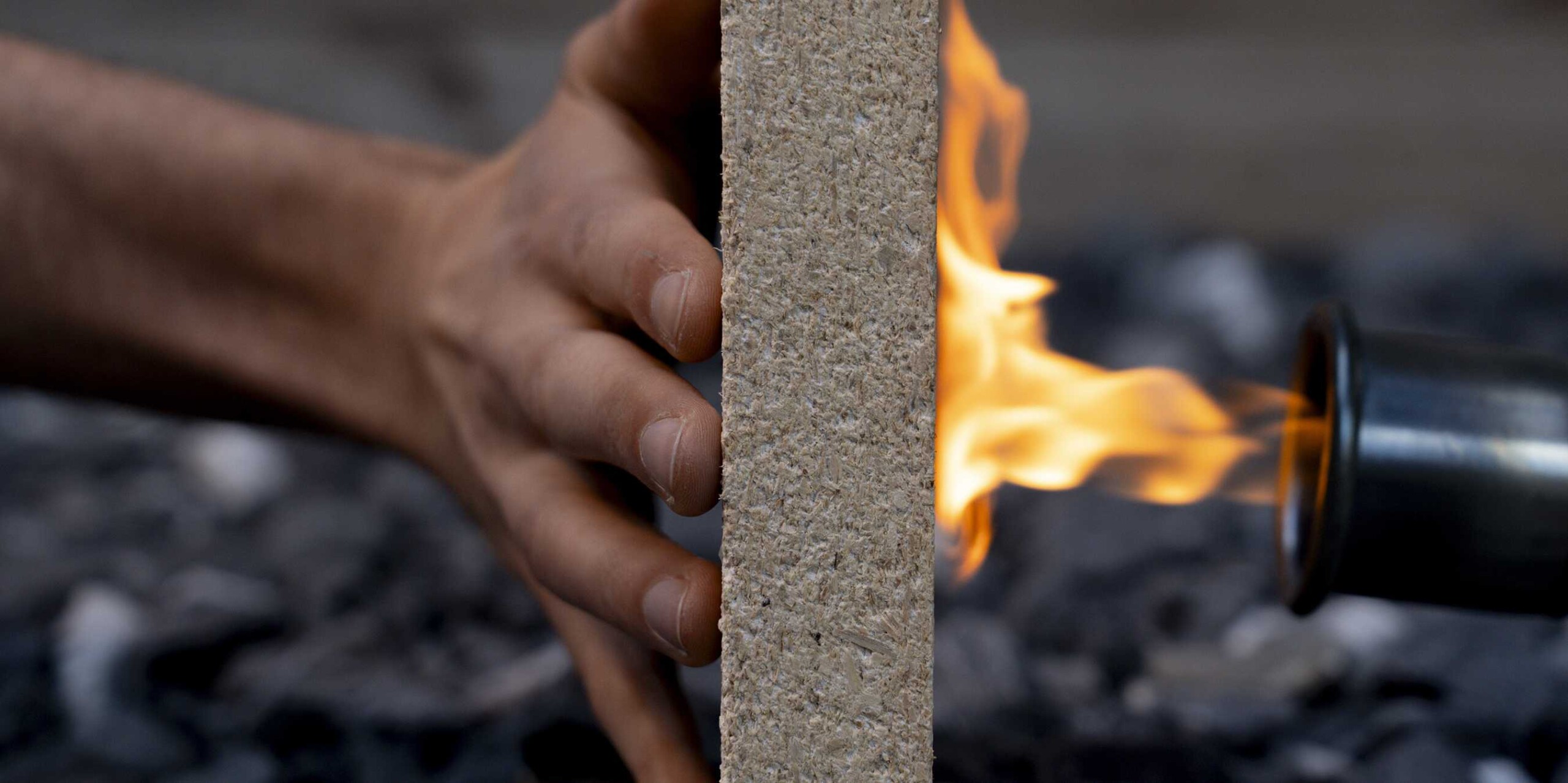
    The binding agent is struvite, a crystalline ammonium magnesium phosphate with known fire protection properties. The problem until now was that struvite was difficult to combine with sawdust due to its crystallization behaviour. The researchers found the solution in an enzyme from watermelon seeds. It controls crystallization in such a way that large struvite crystals are formed, which fill the cavities between the sawdust particles and bind them firmly together. The compressed material is then dried at room temperature.

    Three times longer than spruce
    The fire tests at the Turin Polytechnic speak for themselves. In a cone calorimeter, a standardized test method for heat exposure, untreated spruce wood caught fire after around 15 seconds. The struvite-sawdust composite took more than three times as long. Once burning, the material quickly forms a protective layer of inorganic material and carbon, which slows down the further spread of the fire. In addition, the struvite releases water vapor and ammonia under heat, which has a cooling effect and deprives the fire of oxygen.

    Lighter than cement, better for the climate
    Conventional cement-bonded chipboard, which is widely used in interior design today, consists of 60 to 70 percent cement by weight. They are heavy and climate-damaging to produce. The new struvite sawdust boards only require 40 percent binder. They are lighter, have a significantly better carbon footprint and do not end up in hazardous waste landfill after demolition.

    Recyclable and suitable for fertilizers
    The composite can be broken down into its components. Mechanically in the mill, then heated to just over 100 degrees, whereupon ammonia is released and the sawdust is sieved off. The mineral source material newberyite precipitates as a solid and can be reprocessed into struvite. If the material is not reused, it can be used as a long-term fertilizer. Struvite releases phosphorus, nitrogen and magnesium slowly and in a controlled manner into the soil.

    Sewage treatment plant as a source of raw materials
    Another cycle is emerging. Struvite is produced in large quantities as an unwanted by-product in sewage treatment plants, where it clogs pipes and is expensive to dispose of. “We could use these deposits as a base material for our building material,” says Kürsteiner. Whether the material will establish itself on the market depends primarily on the cost of the binder. A problem that could be solved with this source.

  • World’s first non-combustible vapour barrier presented

    World’s first non-combustible vapour barrier presented

    Ampack AG, which claims to be the leading provider of sealing solutions for building envelopes in Central Europe, is presenting its new range of non-combustible roof and façade membranes, adhesive tapes and vapour barriers. According to a company statement, the vapour barrier is the first of its kind in the world. The products do not contribute to the fire load and are therefore a fire-safe alternative to conventional class B or E building membranes, which release toxic smoke in the event of a fire.

    The range includes the high-performance Ampatex A primo plus membrane, “the first non-combustible, genuine vapour barrier with an sd value of 50 m” worldwide. According to Ampack AG, the membrane reflects heat, holds insulation securely in the cavity and offers physical moisture protection for the first time.

    With Ampatop A silver plus and Ampatop A black, Ampack is also presenting two roof and façade membranes. According to the company, the silver plus is ideal for rear-ventilated façades and use under photovoltaic systems, while the Ampatop A black is a particularly “stylish” solution for rear-ventilated structures and buildings with energy generation systems. The system-compatible adhesive tapes Ampacoll A Tape silver and Ampacoll A Tape black round off the fire protection products as permanently sealed connections and surface bonding.

    In future, the product range will set new fire protection standards in high-rise buildings, special buildings and ventilated façades, offer planning security for construction stakeholders and send a clear signal for safety in the construction industry.

  • Paradigm shift in property planning

    Paradigm shift in property planning

    AFC AG, which is active in the fields of fire protection, sustainable construction and building simulation, is presenting its specially developed LessTech concept, which analyses buildings in terms of their functional requirements. According to a press release, the spin-off from the Swiss Federal Institute of Technology in Zurich(ETH), based in Technopark Zurich, aims to achieve a paradigm shift in property development: away from oversized technical solutions and towards robust, economical and sustainable buildings. The aim is to increase controllability in construction, improve planning and investment security and reduce operating costs.

    The LessTech method works with digital tools such as thermal building simulation and CFD air flow analyses to check the impact of construction measures at an early stage. LessTech also brings innovation to the core area of fire protection: with early simulations and interdisciplinary collaboration, AFC creates solutions that are designed for maximum safety, according to the company. “With LessTech, we are creating a paradigm shift in building planning: less technology, less complexity – but more impact, stability and return on investment. Simplicity is the key to the properties of the future,” Daniel Gubler, CO-CEO of AFC AG, is quoted as saying about the benefits of the concept.

    The LessTech precision tool also improves the ESG (environmental, social and governance) compliance of buildings: “The most sustainable building component is the one that doesn’t have to be built in the first place,” explains AFC AG. With the label pre-check, AFC also supports building owners and investors in choosing the right sustainability label (e.g. SNBS, Minergie, LEED or BREEAM).

    Founded in 1995, AFC AG develops future-oriented and holistic solutions for sustainability, energy efficiency and safety concepts for safe, energy-efficient and climate-friendly buildings. Clients include Flughafen Zürich AG and SBB.

  • Takeover strengthens market position for building installations

    Takeover strengthens market position for building installations

    The Debrunner Koenig Group is taking over Simfloc AG. The acquisition of the Frauenkappelen-based company, which specialises in fire protection, flocculation and insulation, should help the wholesale group for construction, industry and commerce to become Switzerland’s first full-service provider for building installations, writes Debrunner Koenig in a press release on the takeover. No details are given about the purchase price.

    “The Debrunner Koenig Group strives for innovation, which ensures continuous further development in prefabrication,” Simon Engler, Managing Director of Simfloc AG, is quoted as saying in the press release. “The takeover means new opportunities for us on the market.” Engler will continue to manage Simfloc AG under the umbrella of the Debrunner Koenig Group. The takeover will not change anything for customers and business partners, according to the press release. The company name and corporate identity will also remain unchanged.

  • Load-bearing capacity and usability of timber buildings

    Load-bearing capacity and usability of timber buildings

    Wooden buildings have already proven their load-bearing capacity in the past: The palace of Knossos on Crete, built around 1700 BC, was constructed with wooden pillars and cedar timbers built horizontally into the walls. It survived a severe earthquake around 1400 BC virtually undamaged. The columns and beams of Greek temples and the framework of the mud-brick walls were made of wood until 600 BC.

    Compliance with the SIA structural standards
    Modern timber constructions guarantee structural safety and serviceability by complying with the SIA structural standards. Specialist planners and timber construction companies vouch for this. Unusual events such as fire and earthquakes are also investigated through analyses in various design situations. The variety of construction timber, wood-based materials and fasteners in combination with modern planning and production tools enables the designer to design an optimised load-bearing structure for every new construction project.

    Research and predictability
    The flammability of wood is widespread, but its behaviour in the event of fire is well researched and predictable. The similar strength properties at high temperatures as well as the low thermal conductivity due to the insulating carbon layer and the escaping water vapour make this building material stand out. The efficient fire safety of timber constructions is confirmed by extensive fire tests. With appropriate dimensioning or in combination with other materials, fire resistances of up to 240 minutes can be easily achieved. In contrast to steel and reinforced concrete constructions, timber constructions remain stable even at extremely high temperatures.

    Fire protection standards for timber components in Switzerland
    Fire-resistant timber components that are protected with non-combustible panels are considered non-combustible according to Swiss fire protection regulations. This shows the recognition of the fire protection authorities for the results of extensive studies, which prove that the combustibility of a building material is not the decisive criterion, but rather that the correct fire protection design of a construction has a greater influence on the fire behaviour. Current regulations permit the use of wood in various construction applications without restrictions and even in high-rise buildings under certain conditions. Timber therefore has a wide range of applications in all building categories and uses.

    Safe timber surfaces in interior spaces
    The requirements for structures in safety-sensitive areas such as vertical escape routes are met by suitable timber components with non-combustible fire protection cladding. Visible wooden surfaces are permitted in interior rooms, with the exception of escape routes.

    Compliance with quality requirements
    Thanks to the “Fire safety and wood” research and development project, which has been running since 2001, comprehensive technical and methodological principles and safe designs for timber components have been developed. An industry-specific quality assurance system defines the fire safety-related quality standards for wood in construction. In Switzerland, high-quality timber buildings are erected in strict compliance with quality requirements. The Lignum documentation on fire protection serves as a guideline and shows the many different ways in which wood can be used to ensure the correct realisation of timber components in small, large or tall buildings. It corresponds to the current state of the art in fire protection in accordance with Swiss regulations.

  • Guideline to create planning security for solar façades

    Guideline to create planning security for solar façades

    Swissolar wants to create planning security for photovoltaic (PV) installations on façades for planning offices and building owners. Media reports in May had created a distorted picture regarding the corresponding approval practice, writes the association of the Swiss solar energy industry in a statement. In joint discussions, Swissolar, fire protection authorities, planning offices and building owners have straightened out this picture and worked out a joint procedure, it continues.

    In consultation with the Association of Cantonal Fire Insurers, Swissolar will then publish a guideline for the planning of solar installations on façades. It is intended to serve as an interim solution until a state of the art paper (STP) is available, according to the statement. Swissolar intends to develop such a STP by autumn 2024 together with experts in photovoltaics and fire protection.

    “According to fire protection legislation, a verification procedure will still be necessary for the approval of PV façades,” Swissolar explains. The guideline here indicates the cases in which fire tests on the façades can be dispensed with. For the development of the final STP, fire tests are to be made in accredited laboratories abroad. “This procedure, which has been coordinated throughout Switzerland, ensures planning security for affected planners and building owners, while at the same time ensuring safety in buildings and personal protection,” writes Swissolar.

  • Alporit about to launch halogen-free insulation boards

    Alporit about to launch halogen-free insulation boards

    Alporit AG plans to launch insulation boards made of halogen-free polytrol rigid foam on the market next year. The halogen bromine usually used as a fire protection additive is already no longer accepted by several sustainability labels for environmental reasons, informs the Hightech Zentrum Aargau(HTZ) in a statement. It was involved in the development of the insulation boards together with the Fraunhofer Institute for Chemical Technology (ICT) in Pfinztal, Baden-Württemberg. A phosphorus-based material is used instead of bromine in the innovative insulation boards produced by Alporit AG, a member of the Zug-based swisspor Group.

    “The benefits of the cooperation with the ICT and the HTZ are very high for us,” Volker Brombacher is quoted as saying in the press release. The feasibility study carried out with the help of the research partners gives swisspor a unique selling point, as no comparable products are currently available internationally, says the head of research and development at swisspor AG. Following the successful feasibility study, application-related product tests were carried out and the production of the innovative insulation material was tested on a large-scale plant.

    The first product segments are to be launched in 2024. However, the production costs for the hallogen-free insulation material will be higher than for conventional insulation materials by a low double-digit percentage, writes the HTZ. Alporit AG is betting that the gain in sustainability will outweigh the higher production costs.