Tag: Brennstoffe

  • Online tool for climate-neutral industrial processes

    Online tool for climate-neutral industrial processes

    Industry is facing the challenge of converting its processes from fossil fuels to renewable energies. High-temperature heat pumps offer an energy-efficient solution for temperature ranges from 100 to 200°C in particular. They can not only provide process heat, but also generate cooling at the same time, which makes them particularly attractive for many branches of industry.

    Interactive technology map for companies
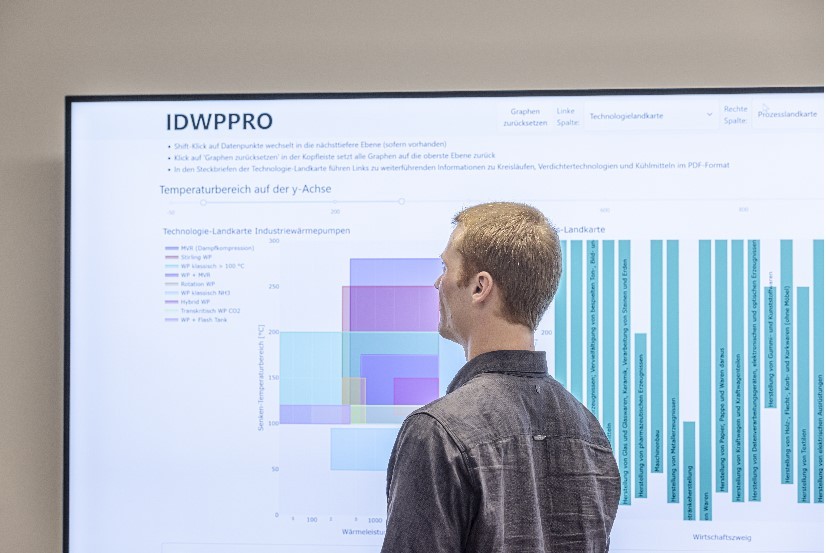
    In the research project “Identification of industrial heat pumps for process heat”, Fraunhofer ISE has developed an online tool that provides companies with targeted support in selecting the right heat pump technology.

    The tool offers

    • Visualisation of the available heat pump technologies in the temperature range and output
    • Allocation of heat pumps to specific industrial processes (e.g. cleaning, drying, cooling)
    • Interactive retrieval options for process temperatures in various industries
    • Detailed fact sheets on circulation processes, compressor technologies and refrigerants

    A contribution to climate-neutral industry
    The online tool is part of the Fraunhofer research topic “Climate-neutral industry”, which supports companies on their way to a CO₂-neutral energy supply.

    This includes:

    • Optimisation of potential energy savings
    • Utilisation of industrial waste heat
    • Integration of renewable energies (e.g. photovoltaics for in-house power supply)
    • Storage solutions for heating, cooling and electricity

    Special attention is also paid to the treatment of industrial waste water, which not only contains waste heat but often also valuable residual materials such as metals or acids. These can be efficiently recycled using modern recovery technologies.

    Participate and contribute data
    The data pool of the online tool is constantly being expanded. Manufacturers of heat pumps and industrial companies can get in touch with Fraunhofer ISE to integrate their data into the platform and thus drive development forward.

    With this new digital solution, Fraunhofer ISE offers companies an effective tool for decarbonising industrial processes and increasing energy efficiency – a decisive step on the way to climate-neutral production.

  • Emissions from heating oil and gas are falling

    Emissions from heating oil and gas are falling

    In Switzerland, emissions from fuels fell significantly in 2023 compared to the previous year, namely by 8.8 per cent. The different cold winter months were converted to average weather conditions. Compared to 1990, these emissions were 41.7 per cent lower. This is shown in the recently published CO2 statistics for 2023, which are published annually by the Federal Office for the Environment(FOEN).

    According to its press release, this decrease is mainly due to the improved energy efficiency of buildings and the increased use of renewable energies for heating. In particular, gas consumption has fallen significantly for the second year in a row.

    In contrast, CO2 emissions caused by fuels such as petrol and diesel remained the same as in the previous year. Compared to 1990, emissions have fallen by 5.2 per cent. According to the data, the fact that they did not rise again after the pandemic, i.e. after 2022, is partly due to the change in mobility behaviour that began at that time: more working from home and fewer business trips. On the other hand, the FOEN also cites the growing share of electromobility as a reason for this. The share of biogenic fuels in total fuel consumption has risen slightly from 3.4 per cent to 3.6 per cent.

  • Paradigm shift in energy planning

    Paradigm shift in energy planning

    Numerous countries have committed to being climate-neutral by 2050. For building and energy systems, this requires a rapid transition from fossil fuels to renewable energies and greater networking of different sectors. Buildings, mobility, industry, electricity, heat and synthetic fuels must interact and be planned in an integrated manner. Matthias Sulzer from Empa and Michael Wetter from the Lawrence Berkeley National Laboratory argue that the current planning processes do not do justice to this complexity and that a paradigm shift is therefore necessary.

    Current planning process – a silo mentality
    Today’s planning processes are organised by discipline, which leads to inefficient and suboptimal results. Engineers and architects work one after the other instead of collaborating across disciplines. This linear, “waterfall” approach leaves little room for iteration and optimisation in the overall system. Sulzer emphasises that this approach is no longer sufficient to meet the requirements of future, flexible energy systems.

    Inspiration from the chip industry
    Sulzer and Wetter propose a planning approach inspired by the chip industry. The electronics and computer scientist Alberto Sangiovanni-Vincentelli has revolutionised chip manufacturing with his “platform-based design”. This concept uses different levels of abstraction for the holistic analysis and optimisation of systems and creates universally valid, modularly combinable models. This model could also be applied to building and energy systems in order to automate and modularise planning.

    Advantages of a model-based planning process
    A model-based planning process would mean that models are used not only to analyse, but also to specify and build systems. These blueprints could be combined in a modular way to clearly define the design and functionality of a system. This would revolutionise planning, construction and operating processes and promote the necessary digitalisation and automation to achieve the ambitious decarbonisation targets.

    Pilot project at Empa
    The EU project GOES, led by Empa, is a first step towards the application of platform-based design in the energy sector. A pilot plant with 144 geothermal probes is being developed on the Empa campus in Dübendorf as the first application of this concept. The aim is to define the various abstraction levels of decision-making and to standardise the interfaces.

    The implementation of an automated and modular planning process is crucial for achieving climate neutrality by 2050, and Sulzer and Wetter are convinced that this paradigm shift will significantly increase the flexibility and efficiency of energy systems. The approach offers a promising solution to meet the challenges of decarbonisation and ensure security of supply.