Tag: Bürogebäude

  • Winning project for high-rise building near Regensbergbrücke in Zurich

    Winning project for high-rise building near Regensbergbrücke in Zurich

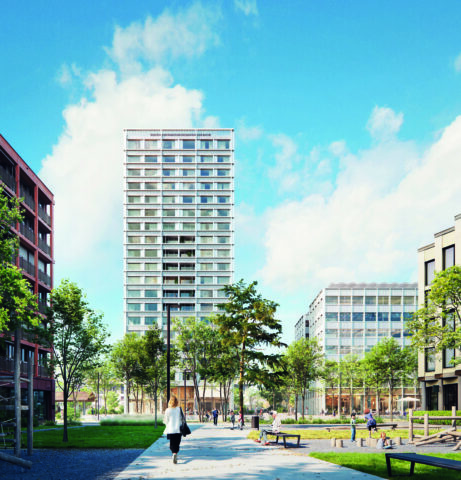
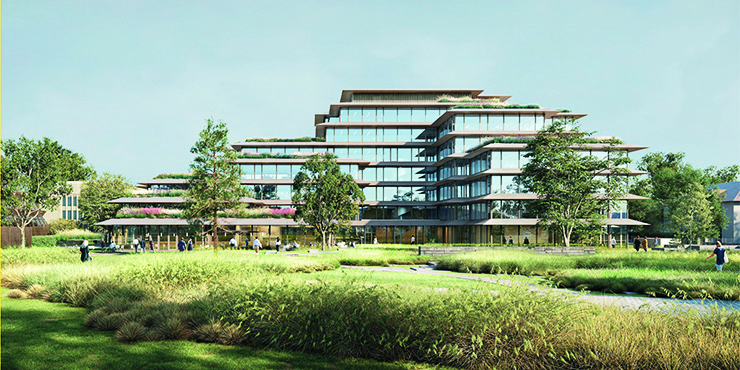
    At the Regensberg Bridge in Zurich Oerlikon, SBB is planning an office building around 40 metres high with public uses on the ground floor. The winning project, developed by “Team Esch Sintzel”, makes skilful use of the challenging site shape and topography. It also achieves a high degree of energy self-sufficiency, which makes it particularly forward-looking.

    Focus on efficient use and sustainability
    The planned high-rise building will be 80 per cent energy self-sufficient. Thanks to advanced building technology, passive cooling and solar cells on the roof and façade, the building will be able to cover most of its own energy requirements. This fits in perfectly with SBB’s ambitious climate targets.

    Eight office floors and public uses on the ground floor
    The new building is being realised as a nine-storey commercial building, with flexible floor plans that are ideal for services, health and education. The ground floor will be enlivened by catering and retail spaces, while the outdoor space concept with a near-natural track level and barrier-free urban level will ensure a high quality of stay.

    Public exhibition of the competition entries
    The competition entries will be exhibited from 12 to 15 July 2024 on the 8th floor of the Franklinturm at Hofwiesenstrasse 349 in Zurich-Oerlikon. Interested parties can visit the exhibition from Friday to Sunday from 2 pm to 6 pm and on Monday from 11 am to 3 pm.

    Framework plan for Zurich Oerlikon railway station south-west development site
    The basis for the project is the “Zurich Oerlikon railway station south-west development site” framework plan drawn up in 2012 together with the City of Zurich. This defined an eight-storey building to the west of the Franklin Tower in terms of urban planning. The building permit requirements have been met and construction is scheduled to begin in 2027.

  • New building at headquarters in Weggis officially opened

    New building at headquarters in Weggis officially opened

    Thermoplan inaugurated its new building at its headquarters in Weggis on 22 June after almost 960 days of construction, the globally active Lucerne-based manufacturer of fully automatic coffee machines announced in a press release. The red ribbon in front of the spacious entrance area of the modern production and office building was cut by Thermoplan CEO Adrian Steiner together with the founding couple Esther and Domenic Steiner. Over the course of the entire open day, almost 5,000 visitors gathered on the festive mile along Weiherstrasse.

    Thermoplan develops and produces fully automatic coffee machines for professional use in catering and other businesses. Among other things, Thermoplan equips the global Starbucks chain with fully automatic coffee machines. The globally active company is committed to Switzerland as a production location: the fully automatic coffee machines are all manufactured at the headquarters in Weggis, Thermoplan states in its self-promotion. Around 80 per cent of the components used also come from Swiss production.

  • RTAG constructs new building in Altstätten

    RTAG constructs new building in Altstätten

    RTAG, a property service provider based in the St.GallenBodenseeArea, has broken ground on its new headquarters. According to a press release, the 1000 square metre office building was planned and designed by the architectural firm göldipartnerarchitekten ag from Altstätten. It contains 40 modern office workstations on three floors. The building itself is intended to be a functional and design focal point on Churerstrasse, one of the gateways to Altstätten, according to the press release. It is also characterised by its environmentally friendly construction. Heating and cooling will be provided by geothermal heat pumps and a photovoltaic system. The building envelope on the upper floors will be clad in wooden panelling. The surroundings will be landscaped with native plants and the roof will be extensively greened. The wood-aluminium windows used will also be designed to be environmentally friendly. The new building should be ready for occupancy in summer 2025.

    Roger Stieger, founder and third partner at RTAG, is quoted in the press release as saying that the decision to stay in Altstätten and plan a new building was a logical one. “Our roots are in Altstätten, we have grown from here and we want to continue to develop successfully from here in the future.”

  • HKG remodels traditional Aarau garage

    HKG remodels traditional Aarau garage

    The engineering and consulting firm Herzog Kull Group Holding AG (HKG) is converting the Aarhof Garage in Aarau into a modern office building and will also use it itself, according to a press release. The garage was built in 1950 and will meet modern building standards following the renovation, according to the HKG press release. 45 office workstations are to be created on the ground floor. The project is being realised by HKG together with the Aarau architectural firm Schneider & Schneider. In addition to the offices, there will also be meeting rooms, a break room and a kitchen.

    In its press release, HKG refers to a report in the “Aargauer Zeitung” newspaper, according to which the costs will amount to CHF 3.2 million. Work on the conversion is scheduled to begin in 2024, probably in late summer. The refurbishment, conversions and new buildings on the upper floor should be completed by mid-September 2025.

    According to HKG, three two-and-a-half-room loft flats with high ceilings will be built on the upper floor. As the area around the Traditionsgarage was traditionally a green spot in Aarau, a green space is to be created again in memory of the historic gardens, according to the press release.

    Founded in Aarau in 1978, HKG specialises in innovative building technology ranging from electricity planning to building automation. HKG also specialises in renewable energies such as photovoltaics.

    In addition to its headquarters in Aarau, HKG has offices in Schlieren ZH, Baden, Bern, Chur GR, Crissier VD, Lucerne, Olten SO, Pratteln BL, Rotkreuz ZG, St.Gallen and Vilters SG. HKG employs around 200 permanent staff, including 89 with higher technical qualifications, 65 with technical qualifications, 23 commercial and administrative staff and 23 apprentices.

  • Tower complex on Sulzerallee: all of a piece

    Tower complex on Sulzerallee: all of a piece

    A tower complex is to be built on Sulzerallee in Neuhegi – in the heart of the new urban centre. The requirements for the urban setting and the architectural design of the building ensemble are correspondingly high.

    The “Gussstück” project by Graf Biscioni Architekten and Lorenz Eugster Landschaftsarchitektur was unanimously chosen as the winner of a study commission in which six architectural firms participated.

    At the intersection between Sulzerallee and the public park strip, the project envisages a 60-metre high-rise with around 145 flats and a multifunctional and flexible office building with a rental area of around 11,000 square metres, radiating out over Neuhegi.

    the planned tower complex is to be placed “precisely like a casting” at the outer end of Sulzerallee, writes the architecture firm on its website. The two buildings are to appear as an ensemble through common alignments and span an intermediate space.

    The tower complex is to be reminiscent, with various facets, of the formerly huge Giesserei site.

    At the current planning stage, the project comprises around 145 flats with a variety of different flat types, although the exact mix is still being worked out. It is important to the developer to offer a diverse range of different flat types and sizes as well as amenities. This will also allow for differentiated pricing.

    In general, the spaces are to be planned flexibly, so that a wide variety of commercial uses are also possible. The goal is to revitalise the neighbourhood with various forms of use that meet the needs of local residents and employees, but also serve as a point of attraction for external visitors.

    A photovoltaic system will be implemented with the project. It is also planned to certify both the high-rise building and the commercial building with the SNBS Gold sustainability label after completion.

    The preliminary project will be completed by May 2023, and the next step will be to work out the details of the competition project. The building application is expected to be submitted in autumn 2023, and construction is scheduled to start at the end of 2024. The client currently expects a construction period of around two years and an occupation date at the end of 2026 at the earliest.

    The site on which the tower complex is being built is being developed jointly by Mettler2-Invest and Swiss Life. The two plots are currently owned by Swiss Life. After completion of the study contract, they will be rezoned based on the winning project. Mettler2Invest will acquire the commercial part. The high-rise building with the rental flats and a small commercial part will remain in Swiss Life’s portfolio.

  • Storz Medical expands company headquarters with two new buildings

    Storz Medical expands company headquarters with two new buildings

    Storz Medical broke ground for two new buildings at its headquarters in Tägerwilen on 21 April. The manufacturer of devices for shock wave therapy is on a growth course. Therefore, it needs a new warehouse and a new administration building, according to a media release.

    Accordingly, a storage capacity of 30,000 cubic metres will be built on a gross floor area of 3848 square metres. The office building will be 2390 square metres in size and three storeys high, just like the existing building. Both new buildings will have an “extremely high standard with aesthetically high-quality architecture in a timeless design”. The façade of the office building, for example, will be made entirely of glass.

    The designs come from the architectural firm Günter Hermann Architekten from Stuttgart. The construction is being carried out by the total contractor Methabau from Amriswil TG.

    A heat pump is also planned, which can also cool the offices in summer. A new photovoltaic system will add another 1600 solar modules to the existing 648. The plant will generate 1000 megawatt hours of electricity per year. Of this, 700,000 kilowatt hours are expected to be fed into the local grid.

    As a result, according to Storz Medical, it will provide electricity for at least 155 households and “is expected to be one of the largest private producers of sustainable energy in the canton of Thurgau”, the media release states.

    Storz Medical produces and distributes medical devices for shock wave therapy in more than 130 countries. The devices are used in the fields of orthopaedics, urology, dermatology, neurology, cardiology and veterinary medicine, for example to break up kidney stones. The company employs 259 people worldwide, including 176 at the Tägerwilen site.

  • Summertime has a positive effect on the energy balance of office buildings

    Summertime has a positive effect on the energy balance of office buildings

    Researchers from the Urban Energy Systems-Lab of the Swiss Federal Laboratories for Materials Testing and Research(Empa), based in Dübendorf, have studied the influence of the changeover from winter to summer time on the heating and cooling energy required by office buildings. They came to the conclusion that setting the clocks forward by one hour has a positive effect on the energy balance, according to a media release.

    Accordingly, the scientists simulated the heating and cooling energy expended with and without daylight saving time for different climatic regions based on data from various office buildings in 15 American cities. In order to include the influence of climate change, they took into account not only the current climate, but also future climate scenarios up to 2050.

    They were able to determine energy savings across all climate scenarios and zones. The highest possible saving was 3 per cent. “Since much more cooling than heating energy is consumed in summer, the time change has an overall positive impact on the energy balance of a building,” Massimo Fiorentini, one of the four study authors, is quoted as saying.

    Therefore, in the debate about abolishing the time change, political decision-makers should not only consider the electricity savings, as has been the case up to now, but also the potential for energy savings in office buildings during summer time.

    Nevertheless, the researchers see the clock change as only one of many possibilities for reducing energy consumption. Improving the building stock, behavioural changes and a general adjustment of working hours are also important building blocks in climate protection.

  • Roche opens tallest building in Switzerland

    Roche opens tallest building in Switzerland

    Roche has opened a new office building with 3,200 jobs at its headquarters in Basel. At 205 meters, Building 2 is currently the tallest building in Switzerland. The new building has 50 floors.

    With the construction, the pharmaceutical company is once again committed to its headquarters in Basel. "Building 2 is another visible commitment by Roche to the Basel site, where Roche was founded over 125 years ago," CEO Severin Schwan is quoted as saying in the statement. "It is another milestone in our site development, which creates a highly attractive, modern location for our headquarters."

    Roche has invested 550 million Swiss francs in Building 2. Employees who were previously housed in various buildings across Basel are to come together at the new location. The building allows modern forms of collaboration, from teamwork to concentrated forms of work to a combination of distance and office work.

    According to the announcement, the building is "one of the world's most sustainable office towers". It is heated with waste heat from the area and cooled with groundwater. It also has an energy-efficient facade with 50 percent glass and provides a bicycle cellar with 400 parking spaces.

    Another building is expected to open on the site in autumn 2024: Roche is currently building a new research and development center for 1.2 billion Swiss francs.

  • Implenia wins two large and complex real estate projects in western Switzerland

    Implenia wins two large and complex real estate projects in western Switzerland

    New Kyoto office building in the Green Village in Geneva

    The Swiss Life Investment Foundation has commissioned Implenia as general contractor to construct the Kyoto office building in the new Green Village district on the grounds of the World Council of Churches in Geneva. The project has a total volume of more than CHF 60 million and will be around
    take two years. Implenia's Real Estate Division has been commissioned to develop the Green Village district, and Implenia's Buildings Division has already realized the Montreal residential building. The Kyoto office building has ten floors, including the ground floor, which will be partially converted at the request of the future tenant. Sustainability plays into the development of the Green
    Village plays a central role, so the new building is aiming for SNBS certification. The project was planned with BIM and executed with Lean Construction.

    New residential and commercial building on Alleestrasse in Biel

    As the general contractor, Implenia is constructing two new replacement buildings with five full floors in the Brühlstrasse Süd area in Biel for the client Meili Unternehmungen AG. A total of 105 rental apartments and service areas on the ground floor facing the street are planned to a high architectural standard. The project resulted from a study commissioned by Meili Unternehmungen AG and won by the architects Bart & Buchhofer AG. The solid construction with a rear-ventilated wooden facade is created with geothermal probes, a heat pump and a large-scale photovoltaic system. The project has a total volume of CHF 42 million and will last around two and a half years.

  • ACRON acquires certified sustainable office property in Leudelange, Luxembourg

    ACRON acquires certified sustainable office property in Leudelange, Luxembourg

    “With our participation in the fully rented office building WOODEN, designed according to the ecological state of the art, we are offering German investors, among others, a direct investment in a sustainable property. By investing in this project, investors have the best prospects for a stable and promising investment," says Kai Bender, Managing Director of ACRON GmbH.

    Wooden SA is the owner of the WOODEN office property, whose floor space of 9,462 m² is fully let to renowned financial companies. Among other things, the building will house the headquarters of Bâloise Assurances Luxembourg. The Baloise leases around 82 percent of the total floor space for up to 15 years. The remaining 18 percent will be used by the CLE (Compagnie Luxembourgeoise d'Entreprises) until at least the end of 2028.

    The first wooden office building of this size in Luxembourg is a "pioneer project" at a desirable location in Leudelange. The growing importance and rapid development have already made Leudelange the most important conurbation in Luxembourg and one of the top locations for real estate in the country.

    The tenants are expected to be able to move into their office space from the end of 2022.

    This investment opportunity is open to semi-professional and professional investors from Germany via ACRON LUX REAL ESTATE I SCS (ISIN: LU2399210942), which was founded specifically for this purpose. After the investment in this club deal has been fully placed with 10 to 15 investors, the composition of the group of investors will probably not change until the exit. The company's goal is to develop WOODEN, hold and manage the property and later sell it for a profit.

    BREEAM is the world's leading certification system for sustainable construction, which includes the entire life cycle of buildings – from new construction to use and maintenance. WOODEN was rated "BREEAM Excellent". The WELL Building Standard was developed to promote health and well-being in buildings worldwide. The types of wood used in the property come exclusively from sustainable forestry from PEFC-certified forests in the greater Luxembourg area. For every tree felled, one or two new ones are planted.

  • Leading security technology manufacturer Telenot enters the market for access control technology

    Leading security technology manufacturer Telenot enters the market for access control technology

    "For companies of all kinds as well as for public buildings, it is of obvious importance to control the safe access to the building as well as the flow of people and access authorizations inside in a structured and precise manner. Because security begins at the company door,” says Hendrik Spering. Telenot's product manager is one of the developers of the innovative access control system, the latest addition to the company's portfolio. The specialists for electronic security technology have now presented a comprehensive expansion stage for the system.

    Optimum processes for every requirement
    As usual from Telenot, the hilock 5000 ZK impresses with maximum performance and efficiency for every type of building. "During the development, we had in mind a system that was flexible in every respect, which enables optimal business processes and visitor flows, regardless of whether it is a small shop, an administration building or a large industrial plant," explains Spering. Particularly practical: thanks to the VdS approval of the control device as a switching device for an intruder alarm system, access control and intruder alarm technology can be linked in an economical and VdS-compliant manner, as required by building property insurance companies.

    Basic license enables extensive solutions
    The basic principle of the access control system is simple: everyone who wants to enter the building is checked before they enter. If someone is not authorized, they are not allowed in. The complexity is hidden in the details: For companies, for example, it is important that all employees can enter the company premises without delay. However, if there are areas that should only be accessible to certain groups of people, the same access control system must also regulate such authorization solutions. And this, if necessary, with a time limit or under other predefined conditions. The new access control system enables the flexible configuration and control of such authorization solutions in buildings of all kinds. This makes it easier for users to implement optimal business processes or visitor flows.

    “In combination with the compasZ 5500 management software and the hilock 5500 evaluation control unit with integrated Ethernet interface, we offer an economical solution for every size and type of property,” says Spering. Function time models can be set up very easily, for example to regulate the opening of shops. Even special routines for public holidays do not pose a problem for the system. Both significantly reduce the time required for administration and serve the security of the company. In addition, all access rights can be coordinated across locations – whether from one or more locations. The new system also offers countless other applications such as area change control, counting functions, elevator control, toggle authorizations, admin administration, formation of organizational units and groups. The highest encryption standards ensure maximum security – from the administration software to the evaluation and control device, the RFID reader to the transponder.

    Even with the basic license, the access control system enables the construction of a solution that is sufficient for many applications. Should an extension of functions or licenses become necessary, for example due to the opening of a new location, this can easily be done by the specialist company via the Telenot online shop, which is available around the clock.

    Access control with chip, code or smartphone access
    For on-site use, users can access a wide range of peripheral products. In addition to the well-known cryplock RFID readers, Telenot has a brand new selection of mechatronic locking elements in its range – door handles, door fittings, locking cylinders, furniture locks or locker locks. They connect centrally wired online access control systems with mechanical locking systems. This new type of access control has many advantages, as Spering explains: "The costs that arise in a company because of lost keys are considerable. Depending on the system and the key, they can easily reach a four-digit amount. With our mechatronic locking system, only the lost transponder has to be blocked.” This is done quickly and easily in the software.

    Flexible authorization management
    The innovative character of the access control system is also evident in the management of authorizations. With Credential Data Management (CDM), the user has a flexible choice of two online versions (classically wired or as a wireless system) and one offline system. With the latter, the access authorizations are written directly to the transponder. Since the component has no direct access to the evaluation and control unit (i.e. it is offline), the transponder is also used for data transfer between the online and offline system. A Smartphone Access CDM can also be integrated into the system. In this case, an app on the smartphone serves as a transponder.

  • Halter establishes a research center in Lupfig

    Halter establishes a research center in Lupfig

    As of February 1, Halter AG took over the Futura Towers in Lupfig from Wisca Immo SA . According to a press release from the Schliere-based real estate developer and new owner, the two buildings with almost 25,000 square meters of commercial, production and storage space are to become a multifunctional center for teaching, research, manufacturing, leisure facilities and gastronomy. This should be repositioned under the brand name Futurama. The property, completed in 1992, has eleven upper floors and three lower floors with 287 parking spaces and 30 additional outdoor parking spaces.

    Futurama stands for a modern working world of short distances for teaching and research institutes, industrial production as well as office and service companies, says Halter Managing Director Andreas Campi, who is responsible for developments. “We will attach particular importance to the quality of stay and create additional leisure facilities and gastronomy offers,” Campi continues.

    The location is directly connected to public transport, a five-minute walk from the Lupfig train station. There is also a good connection to the A1/3 motorway with two motorway junctions, according to the statement. Futurama is in the immediate vicinity of green.ch’s Zurich-West campus data center.

    The takeover of the Futura Towers by Halter “ignites the great hope that life will finally come into being in the properties, which have mostly been unused for almost 30 years,” said Richard Plüss, the mayor of the Lupfig municipality.

  • Basel Rosental Tower enters the planning phase

    Basel Rosental Tower enters the planning phase

    HRS Real Estate is taking over the overall management of the further project development, the search and selection of investors as well as the realization and marketing of the Basel project Rosentalturm at the Basel exhibition center. According to a press release , MCH Messe Basel and HRS Real Estate have signed a corresponding agreement.

    A project competition is now being held in cooperation with the construction and transport department of the canton of Basel-Stadt and with the support of the Zurich planning specialists Planpartner . According to the information, seven architectural firms were invited: Buchner Bründler Architects, Herzog & de Meuron and Morger Partner Architects from Basel. Burkard Meyer Architekten from Baden AG as well as the two Zurich offices Michael Meier and Marius Hug Architekten and Armon Semadeni Architekten are competing for the best design.

    The assessment committee made up of national experts is chaired by Thomas Hasler from Staufer + Hasler Architekten from Frauenfeld. The results are expected in autumn 2022. Construction is scheduled to start in summer 2023.

    The Rosentalturm building is to be erected on the site of the existing trade fair car park. The parking lot will be underground. Of the total of 48,000 square meters planned, 40,000 are intended for housing and 8,000 for commercial use.

  • Eye-catcher on Lake Zurich

    Eye-catcher on Lake Zurich

    With the winning project from CF Møller Architects resulting from the study, a modern and representative office building is being created. It is consistently oriented towards the lake and the lake promenade. Most noticeable are the storey-high glass surfaces and the canopies, which will be equipped with photovoltaic modules. The building will also meet high energy requirements, which is underlined by the desired LEED Platinum label. After the various requirements from the building permit have been met and the building permit has been received, the dismantling and renovation work is currently taking place. Since the property was built in 1974, the work also includes the professional disposal of asbestos-containing materials. A task that is demanding and time-consuming. A special challenge in the construction
    ruktion is also the merging of the different design of the finishing details of the terrace and parapet. And last but not least, the construction site is in the inner-city area, which also brings logistical challenges with it.

    Basic renovation
    Bellerivestrasse 36 is a reference property for Allreal, as on the one hand it meets high standards in the field of sustainable building. This is evidenced by the desired LEED Platinum label. the
    PV systems will also help to reduce the consumption of fossil fuels in the company’s portfolio of investment properties. Allreal wants to halve the proportion of fossil fuels in its portfolio by 2030. On the other hand, Bellerivestrasse 36 is also an example of Allreal’s business model. The property was operated as an investment property until the end of last year. When the anchor tenant moved out, it was possible to fundamentally renovate the building. In-house project development then carried out a study contract, then specified CF Møller’s winning project and made it ready for construction. The Realization division is currently implementing the project. From summer 2023, the property will then be occupied by the new tenants and reintegrated into the portfolio of investment properties and managed by Allreal. The company thus covers the entire value creation process from a single source.

    After: This is how the building should look after the renovation.

    Lots of flexibility
    “In addition to the exclusive location directly on Lake Zurich and the collaboration with a foreign architect, the high quality of materials and details of the components used are extremely attractive,” says project manager Alain Granwehr from Allreal. “The facade in particular, with its protruding canopies and the photovoltaic elements mounted on it, is a challenge in the construction process”. The pandemic is changing user needs. A clear picture is not yet emerging. At the moment, many customers are still unsure which long-term changes will prevail in connection with the demands on the workplace, says Allreal on request. However, the company has not noticed any decline in demand, particularly for properties in very good locations. The property at Bellerivestrasse 36 will also benefit from this. In addition, once the modernization has been completed, the commercial building will be able to be operated as a multi-tenant property and thus offers a great deal of flexibility.

  • Baden's tallest building is called Akara Tower

    Baden's tallest building is called Akara Tower

    In addition to other projects, the tallest residential and office building in the city is being built on the former ABB site near Baden's train station. In the meantime, the name for the 66 meter high tower is also known: Akara Tower. The client is Akara Funds based in Zug, planning and construction are carried out by HRS Real Estate from Frauenfeld TG. The real estate company Markstein AG , based in Baden, has been commissioned to market the commercial and office space in the Akara Tower and the rental apartments.

    In terms of traffic, 150 rental apartments are being built in the Akara Tower in the best traffic location, just a four-minute walk from the train station. They have 1.5 to 4.5 rooms. Office and service space can be rented on floors two to four. There are two commercial spaces on the ground floor. Marketing of the office space will start this autumn. The apartments will be advertised for rent from summer 2022. The move into the Akara Tower is planned for the fourth quarter of 2023.

    The planning also includes the establishment of parking spaces. Next to the high-rise building and under the future town square, an underground parking garage with almost 500 parking spaces is being built. The parking spaces provided for the high-rise are also located there. There are also around 350 bicycle parking spaces available.

  • Forest Tower: creative center in the lower Aare valley

    Forest Tower: creative center in the lower Aare valley

    As a six-storey building with a wooden facade and ribbon windows, the Forest Tower protrudes over the Kleindöttingen industrial park – an area with an industrial history in the lower Aare valley, which is now primarily used by logistics-intensive and production-oriented companies as a location.

    The former production building was converted into an office building earlier. So far, the owner Hiag has advertised the office space contiguously. Now she wants to liven up the rooms with a new idea: The Forest Tower is to become a creative hotspot. In order to realize the project, Hiag is looking for creative minds – companies, private individuals, freelancers and self-employed – who want to settle in the Forest Tower. As soon as two or three interested parties agree, the owner wants to start renovating the first floor.

    For teams that need their own office, office space of various sizes and with plenty of daylight should be created. A shared studio should provide space for creative work, for example with a work area in the middle of the room and with additional workplaces on the walls. A co-working space is also being planned.

    A common meeting room should be created for meetings, customer presentations or workshops. The Community Area, a communal area with a coffee kitchen and lounge, is to serve as a meeting point. The Ideation Salon, a room with a large screen, whiteboard and moderation material, is intended to provide a creative environment for workshops and networking. Company aperitifs with a view of the Klingnau reservoir could soon take place on the roof of the building. The fast internet, a professional printer and the common rooms should be available to the entire Forest Tower community.

    Kleindöttingen is part of the so-called Zurzibiet, an economic region that is also gaining in importance on a supraregional level. It comprises 26 communities between Baden and Brugg. The area is characterized, among other things, by its convenient location and moderate cost structure. The proximity to research and innovation centers makes it particularly attractive for qualified specialists and companies.

  • ETH Zurich helps with the construction of the Zug wooden high-rise

    ETH Zurich helps with the construction of the Zug wooden high-rise

    A ten-story office building with wooden components is to be built on the Suurstoffi site in Risch Rotkreuz. With a height of 80 meters, it will be one of the tallest wooden houses ever, as the Swiss Federal Institute of Technology Zurich ( ETH ) writes in an article. A lot of basic research is also required for the construction. Due to fire protection, this type of construction has only been allowed in Switzerland since 2015.

    According to the article, basic research for the new building is being carried out in the ETH building hall on the Hönggerberg. There, for example, it is simulated how the timber structure would behave in strong winds. Computer models are not always sufficient for such simulations. This is why experiments are carried out in the ETH building hall. "For us, testing something usually means loading it until it is destroyed," explains Dominik Werne, head of the construction hall, in the article. In the case of innovations in particular, computer models have to be validated through tests, adds Andrea Frangi, Professor of Timber Construction at the Institute for Structural Analysis at ETH.

    Tests on the structure of the Zug high-rise are currently being carried out in the building hall. This is planned by the Zurich engineering firm WaltGalmarini and built by the general contractor Implenia . After the tests at the ETH, the researchers decide together with engineers from WaltGalmarini which systems Implenia should use during construction.

  • «Alpha»: a novelty in the canton of Zug

    «Alpha»: a novelty in the canton of Zug

    The windows of the Alpha office building, which has been under construction in Baar since summer 2020, are a novelty in the canton of Zug. Stephan Häusler, owner and CEO of Stephan Häusler AG and owner of Alpha, says: “We are foregoing classic sun blinds and relying on the SageGlass product for the glass facade. This adapts to the respective conditions depending on the amount of sunlight. " The glass darkens automatically, preventing the interior from heating up. Nevertheless, you can enjoy the view without restriction at any time. “This saves us energy as well as the maintenance and repair costs that are regularly incurred with classic sun blinds. The windows are a first in our canton. "

    The Alpha office building also has a lot to offer: An ideal location, a beautiful entrance area and timeless architecture. But these attributes alone are no longer enough to score points with the targeted clientele. Häusler: “In the Alpha, tenants benefit from exclusive advantages. There is, for example, the large garden, which is also ideal for outdoor meetings. There are also two cozy loggias on each floor, which are more familiar from apartments. " On the ground floor there is a lounge with direct access to the outside area. In addition, the construction of a larger meeting room is planned. This can be reserved selectively and is suitable for events with up to 30 guests.

    Fresh air thanks to ventilation blades
    The interior design of the individual office complexes can be freely designed. Two showers are already planned in the basement – if the employees want to jog, fit or bike over lunch and then continue working after having showered. Häusler emphasizes the careful interior design: “For example, we manufacture the interior doors that lead into the offices from high-quality wood. This looks homely and differs from the run-of-the-mill office groove. We value beautiful colors and shapes. " The entire planning is based on the “New Work” working model: Everyone works differently. “New Work” enables more independent and freer doing and letting go. New forms of creative activities are possible in the Alpha. And if your heads do smoke, fresh air can be supplied without any problems: “Thanks to the built-in ventilation blades, the facade windows can be opened manually. This is something that people really appreciate. You don't feel like you're in an office glass box in the Alpha. "