Tag: Büromarkt

  • Increase in vacancy rates on the Swiss office market

    Increase in vacancy rates on the Swiss office market

    The latest surveys by CBRE show that the available office space in Switzerland grew to 1.82 million square metres in the third quarter of 2023, which corresponds to 3.8 percent of the total stock. The peripheral office markets, which are located away from the five largest office locations – Zurich, Geneva, Basel, Bern and Lausanne – are particularly affected. There has been a significant increase in available space here, with the region around Zurich Airport and the Limmat Valley, for example, achieving an availability rate of 13.3 per cent.

    Meanwhile, demand for office space in central locations remains high. Tenants are increasingly focussing on aspects such as good accessibility, sustainability and high-quality fit-out by the landlord. The availability of office space in Zurich’s city centre fell to 2.7 percent in the same quarter, and even to 2.0 percent in Zurich’s CBD.

    The decline in overall demand is influenced by various factors. On the one hand, the increased supply of office space has outstripped construction activity and thus the completion of new projects. On the other hand, the cooling economic situation has led to a fall in demand. This trend has so far been masked by strong economic growth and high take-up of space, which has offset the increase in home office activity. However, the subdued demand is now making itself felt in the form of higher vacancy rates, which represents a challenge for property management.

  • CBRE Switzerland Office Take Up Index

    CBRE Switzerland Office Take Up Index

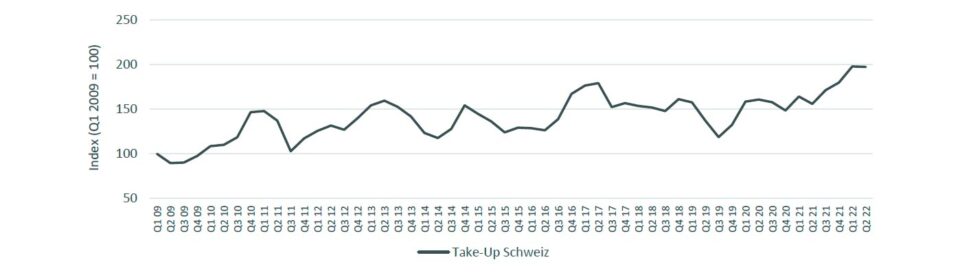
    CBRE Switzerland publishes its CBRE Switzerland Office Take-Up Index for the first time. The index is based on the advertisements switched off on the real estate online marketplaces and traces the quarterly volume of space let on the Swiss office market. It is a highly up-to-date indicator of office demand and is presented for the whole of Switzerland and for three geographic sub-markets (see figures below).

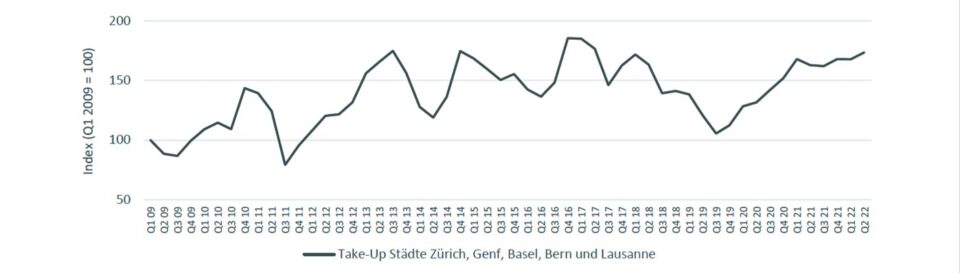
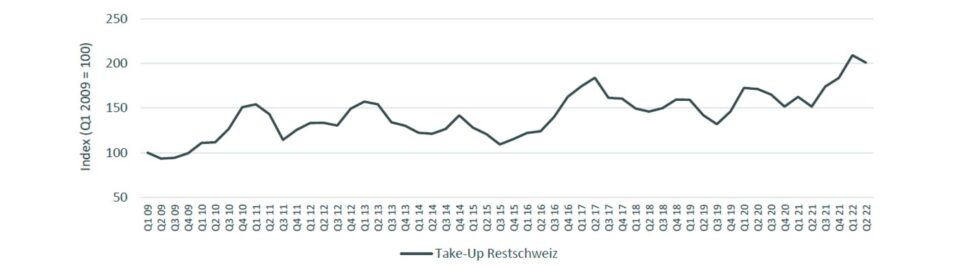
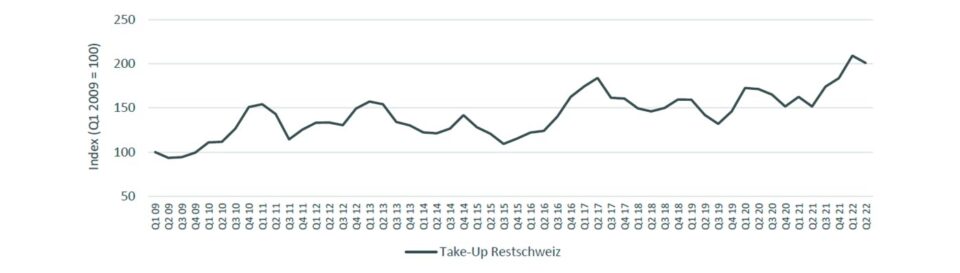
    All sub-indices have shown record activity in office lettings since the fourth quarter of 2021 and especially since the beginning of 2022. Although the economic recovery is currently being hampered by new global uncertainties, overcoming the Covid-19 crisis has prompted companies to restart their often-paused real estate projects. In the suburbs of the largest Swiss cities, too, rental activity has recently picked up again (see Figure 3). The only slight increase in the movement of space turnover in the cities themselves (see Figure 2) can be explained by the fact that the average availability rate here is a low 3.1%. As a result, large-scale rentals of space are now rare or “off-market” away from the measurable online channels. By contrast, take-up in the rest of Switzerland outside of the metropolitan areas of the major cities is already declining slightly (see Figure 4).

    The pronounced desire for centrality with the end of the COVID-19 pandemic has led to a further decline in office vacancy rates in the inner cities, which is why take-up is now also shifting to the well-developed suburban areas.

    David Schoch, Research & Consulting CBRE Switzerland
    Figure 1: Office space take-up throughout Switzerland
    Figure 2: Take-up of office space in the cities of Zurich, Geneva, Basel, Bern and Lausanne
    Figure 3: Take-up of office space in the suburbs of Zurich, Geneva, Basel, Bern and Lausanne
    Illustration
    Figure 4: Office space take-up in the rest of Switzerland (Switzerland excluding the cities of Zurich, Geneva, Basel, Bern and Lausanne and their suburbs)

    Methodology description:
    The quarterly calculation of the take-up is based on the advertisements on real estate online marketplaces and is shown as a centered average of three quarters. If advertisements are removed from the network and not re-activated within a certain period of time, they are included in the take-up. Direct rentals, ie the rental of space that was not advertised on the online marketplaces, are not taken into account here, which has a negative impact on the amount of the take-up. For example, in the case of larger properties, the pre-letting of project developments or owner-occupied new buildings, not all or no areas are advertised. At the same time, for various reasons, areas are always completely or temporarily taken off the network without a successful letting taking place, which in turn has a positive effect on the amount of the take-up. Lease renewals are not part of the take-up. The index is based on the first quarter of 2009 (= 100) and thus falls at a time that was characterized by temporarily negative economic development and the beginning of the low interest rate phase that has persisted to this day.

  • Investors are lining up in front of first-class properties

    Investors are lining up in front of first-class properties

    Wer heute eine Immobilie an bester Lage erstehen will, braucht viel Geld und Geduld. Vor Büro- und Wohngebäuden mit hervorragender Erschliessung bilden sich heute lange virtuelle Schlangen von Investoren, die ihre Mittel möglichst sicher anlegen wollen. Bieterverfahren treiben die Preise auf neue Höchstwerte: In der Zürcher Goldküsten-Gemeinde Zumikon etwa erwarb ein Käufer kürzlich ein nicht mehr benötigtes, nur eine Minute neben einer ÖV-Station gelegenes Feuerwehrgebäude mit einigen Wohnungen für rund CHF 21 Mio. 37 Interessenten hatten sich beworben, der Endpreis lag fast zweieinhalb Mal so hoch wie der von der Gemeinde aufgrund einer professionellen Schätzung vorgegebene Mindestpreis von CHF 8.7 Mio. Im Fokus der Anleger standen 2021 vor allem sogenannte Core-Objekte: “Als risikoarme Anlageklasse sind erstklassige Immobilien nach wie vor ohne Alternative”, begründet Yonas Mulugeta, CEO von CSL Immobilien, diese in den Zentren beobachtbare Entwicklung.

    Die Preisentwicklung führte 2021 dazu, dass die Netto-Anfangsrenditen in den meisten Segmenten des Investmentmarkts weiter auf neue Tiefstwerte sanken – dies, obwohl die meisten Investoren eher eine Seitwärtsbewegung erwartet hatten. Wohnliegenschaften erstklassiger Güte rentierten im Landesschnitt mit 1.85% (Vorjahr 2.1%). Noch stärker sanken die Renditen für Top-Büroobjekte: Diese fielen mit 1.9% (Vorjahr 2.35%) sogar knapp auf das Niveau der Wohnimmobilien.

    Ein Grund dafür: Investoren, die im Wohnmarkt nicht mehr zum Zug kamen, wichen in den Büromarkt aus. Auf Interesse stiessen 2021 auch Gewerbe- und Logistikimmobilien – dies als eine weitere Ausweichbewegung von Investoren, die vom boomenden Onlinehandel profitieren wollen.

    Leere Büros in der Peripherie

    Auch die Unternehmen fokussierten ihre Nachfrage 2021 noch stärker auf zentrale Standorte. Der grössere Teil der in den vergangenen sechs Monaten verfügbaren Büroflächen von 2.43 Mio. m2 (Vorjahr 2.26 Mio. m2) entfiel deshalb auf Liegenschaften ausserhalb der städtischen Zentren. Im Wirtschaftsraum Zürich waren in den vergangenen sechs Monaten rund 910’000 m2 Bürofläche inseriert (Vorjahr 812’000 m2). Damit ist das Angebot innerhalb eines Jahres um 12% gestiegen – ähnlich stark wie in den Wirtschaftsräumen Bern (+14%) und Genf (+12%).

    Der Fokus der Unternehmen auf zentrale Bürostandorte ist insbesondere auch auf die Pandemie zurückzuführen. Viele Mitarbeitende haben sich an das Homeoffice gewöhnt. Um sie zumindest teilweise zurück ins Büro zu holen und dort einen neuen Alltag zu etablieren, muss dieses attraktiv sein. Neben der zentralen Lage mit guter Verkehrsanbindung gehört dazu ein ansprechendes Interieur, das Kreativität und Teamprozesse fördert. Unternehmen, die dies nicht bieten können, haben auf dem Arbeitsmarkt einen Nachteil.

    Eigenheimpreise flächendeckend gestiegen

    Auch im Wohnmarkt machte sich die Pandemie bemerkbar: Das Zuhause gewann an Bedeutung. Gleichzeitig löste das Homeoffice in vielen Haushalten ein Platzproblem aus. Dies führte zu einer steigenden Nachfrage – insbesondere im Eigentumssegment, das weiterhin vom attraktiven Finanzierungsumfeld profitiert. Auf der Angebotsseite kam nur wenig Neues hinzu. Die Folge waren fast flächendeckend steigende Preise für Eigenheime. Dieser Trend dürfte sich 2022 fortsetzen – die Hypothekarzinsen bleiben auf tiefem Niveau, auch wenn sie zuletzt leicht gestiegen sind.

    Im Mietwohnungssegment wirkte sich die gestiegene Nachfrage insbesondere strukturell aus: Gesucht waren 2021 vor allem grössere Objekte, während das Interesse an 1- bis 2.5-Zimmer-Wohnungen an vielen Lagen spürbar abnahm. Die Erfahrung von CSL Immobilien im Markt zeigt: Paare beziehen heute kaum mehr eine 2.5-Zimmer-Wohnung, sondern suchen mindestens eine Wohnung mit 3.5, lieber noch mit 4.5 Zimmern. Dies zeigt sich auch in den Zahlen: Im Kanton Zürich stieg der Anteil der 1- bis 2.5-Zimmer-Wohnungen unter den leerstehenden Wohnungen 2021 auf 27%, ein Jahr zuvor lag dieser noch bei 22%.

    Die Leerstandsquote im Wohnmarkt sank 2021 aufgrund der grossen Nachfrage über das ganze Land gesehen auf 1.54% (Vorjahr 1.72%).

    Allerdings zeigt die Quote grosse regionale Unterschiede. Im Vergleich der grössten Agglomerationen weist Zug mit 0.4% den tiefsten Wert auf, Olten-Zofingen mit 3.8% den höchsten. Im Kanton Zürich lag die Leerstandsquote 2021 bei 0.72% (Vorjahr 0.91%). In der Stadt Zürich stieg die Leerstandsquote 2021 zwar minimal an, zeigte aber mit 0.17% (Vorjahr 0.15%) immer noch einen äusserst ausgetrockneten Markt.

  • Pandemic accelerates real estate trends

    Pandemic accelerates real estate trends

    Yonas Mulugeta, CEO of CSL Immobilien , sums up the findings from the current CSL Real Estate Market Report 2021 . According to a corresponding press release, this applies in particular to the office market. The vacancy rate for offices has reached a high: the available supply of commercial space has increased by 23 percent to 2.26 million square meters in the course of the past year. That is the highest value since 2014.

    At the same time, however, the demand for central locations in major centers such as Zurich increased. The authors of the report deduce from this that the home office is not the end of the office. Instead, office space would be used more as social meeting and collaboration places. Because "Location factors such as an urban environment with attractive lunch or leisure options or proximity to customers and industry meeting points have become more important as a result of the pandemic".

    The vacancy rate in the residential market has also reached a high. In the previous year, the Swiss average rose from 1.66 to 1.72 percent – a value that was last reached in 1988. Outside the major centers, high vacancy rates of over 2 or 3 percent are not uncommon in all of Switzerland. CSL expects vacancies to continue to rise and rents to fall in 2021. Residential property has benefited from the increased value of a beautiful home during the pandemic. Because of the increasing number of homeworkers, real estate in more peripheral locations would have found buyers more easily.

    For multi-asset investors in particular, real estate investments have become a replacement for bonds with negative interest rates. Returns in all real estate asset classes continued to decline.