Tag: Bundesamt für Strassen

  • Three sustainable residential buildings for the Gotthard road tunnel workers

    Three sustainable residential buildings for the Gotthard road tunnel workers

    Since 1980, the Gotthard road tunnel has been the most important Swiss car corridor through the Alps. After more than 40 years of operation, this is in need of renovation. The Federal Roads Office (Astra) is building a second tube by 2029 so that the road connection can be used without interruption despite the repairs. In order to offer the teams involved in the construction optimal accommodation during their assignments, the Astra announced an architecture and investor competition. The contract was awarded to Swiss Property, which developed its project together with the engineering office Pirmin Jung. They convinced the jury with three buildings; two of them in element and one in modular construction as well as a digitized planning and construction with the Timber OS system developed by Swiss Property. This enabled the optimal balance between yield, costs and energy consumption to be calculated.

    The three buildings are named Dammastock, Galenstock and Rhonestock. Your future residents are surrounded by rock, concrete, dust and noise every day. For this reason, the rooms were deliberately designed with a high feel-good factor and a warm atmosphere. A main component used in construction is local wood.

    The Dammastock is the largest of the three buildings: in 2021, 102 single rooms, each with an area of around 14 square meters, as well as an underground car park were built here. The Dammastock has been ready for occupancy since December 2021. The facade consists of saw-grey spruce and fir wood. The building is to be dismantled in 2032: Thanks to the 105 individual wooden modules used, the Damma
    stock can be easily dismantled, transported and reassembled at another location. Possible conversions include a temporary school building, an asylum home or guest rooms.

    The other two buildings, Galenstock and Rhonestock, will be erected as hybrid structures with 72 single rooms of 14 square meters each. Both will have a staircase core made of reinforced concrete. The buildings consist of system timber construction elements made of spruce and fir wood and, thanks to the alpine architecture, harmonize perfectly with their surroundings. After the tunnel work, these buildings can be used on the spot in the long term: the interior design allows for an uncomplicated conversion into 16 apartments with areas of 40 to 110 square meters. The three buildings in Göschenen thus create a benefit that goes beyond the tunnel project.
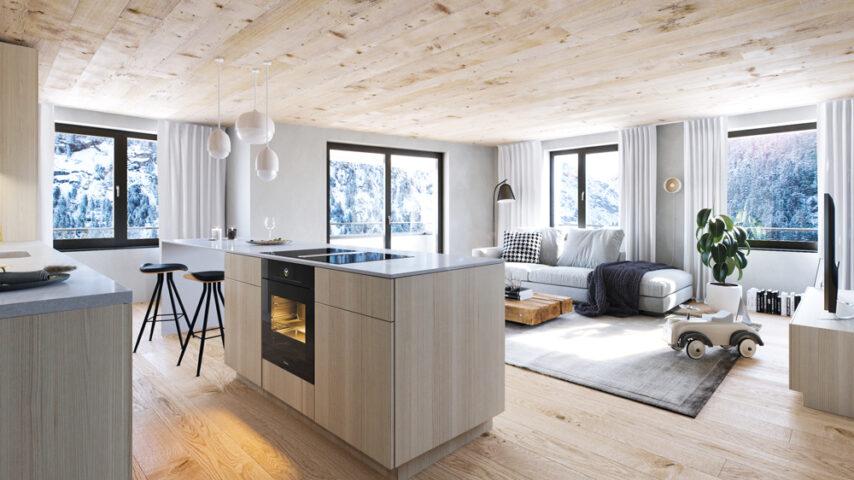
    The interior rendering shows what an apartment could look like after conversion.
  • Federal Roads Office uses mobile bridge

    Federal Roads Office uses mobile bridge

    The Federal Roads Office ( FEDRO ) has launched the FEDRO Bridge pilot project. According to a press release , this is a mobile bridge for use in maintenance work on motorways. The traffic is slowed down at 60 kilometers per hour over the almost 240 meter long bridge. Underneath there is a space of around 100 meters where work can be carried out undisturbed by road traffic. When the construction phase is finished, the mobile bridge is pushed a hundred meters further and the work continues.

    This eliminates the barriers and shutdowns of sections of the roadway that are otherwise necessary for occupational safety. You can also work unhindered during the day. With today's traffic volume on many sections of the motorway, it has not been possible to reduce lanes for maintenance work during the day for a long time, according to the statement from the Federal Office. Accordingly, more and more construction work on the national highways has to be carried out at night. ASTRA believes that lane reduction without traffic jams on the main axes such as A1 and A2 is only possible after 11 p.m. Because of the lower noise limits, some work such as noisy demolition is not possible at night.

    The Federal Office therefore decided to develop and build the ASTRA Bridge. In the fact sheet for the mobile bridge, the length is specified as exactly 236 meters, the width as 7.30 meters and the height as 4.32 meters. Underneath, it is possible to work on a hundred meters at a width of 5.2 meters and a height of 3.10 meters.

    The ASTRA Bridge is equipped with a landing gear. Raised hydraulically by 10 centimeters, it can travel lengthways and crossways. Once the work under the bridge has been completed, it will continue to drive 100 meters by remote control for the next construction phase, according to the fact sheet. To assemble the bridge before use, 18 low-loaders are required for transport and four cranes are required for assembly.

    According to the Federal Office, the individual elements for the ASTRA Bridge are currently being built and then transported to the bridge's storage area in Rothrist TG. The bridge is to be assembled and tested for the first time in late autumn. If these tests are satisfactory, the ASTRA Bridge will be used in spring 2022 as a pilot project for paving renovations on the A1 section between Recherswil SO and Kriegstetten SO. According to the press release, the ASTRA Bridge prototype will cost around CHF 20 million. After completion of a construction project and a maintenance phase, it can be used again for the next construction project.

  • Electromobility needs new goals

    Electromobility needs new goals

    Federal Councilor Simonetta Sommaruga discussed with those involved in electromobility what would be beneficial for its rapid expansion. At a top meeting with high-ranking representatives from the automotive, electricity, real estate and vehicle fleet sectors as well as the cantons, cities and municipalities, new objectives were outlined.

    They should join in with the goals that were set for the year 2022. According to a joint media release by the Federal Department for the Environment, Energy and Communication and the Federal Offices for Energy and Roads , they had already been reached in February 2021, with electric vehicles accounting for 15.1 percent.

    One of the proposals provides information and advice as well as more attractive and attractively priced services relating to the purchase of plug-in vehicles. In addition, the number of public charging stations should increase faster. This requires suitable measures to accelerate planning and construction. In addition, use and billing systems should become simpler and more transparent. Ultimately, it is important to create more charging options in the parking lot in front of the house or in the underground car park of apartment buildings.

    The actors in the Electromobility Roadmap would work out these goals in the coming months and derive suitable measures from them. Implementation should begin quickly. "The success in electromobility shows that the population wants to live in a climate-friendly way and be clean on the road," said Sommaruga. "Together we make it possible."