Tag: Bundesgesetz

  • National Council decides on offensive for wind energy

    National Council decides on offensive for wind energy

    The National Council has joined the amendments of the Council of States and followed it with regard to the bill on the accelerated approval of wind power plants by 136 votes to 53. Originally, this bill came from the National Council’s Committee for the Environment, Spatial Planning and Energy. The background to this is the goal of making Switzerland less dependent on electricity imports in times of low sunshine.

    According to a parliamentary press release, energy minister Albert Rösti (SVP) said that an increase in capacity was therefore necessary. However, this would have to be realised “without severely eroding the usual rights of co-determination”. According to the information, there was fundamental opposition to the wind power offensive in parliament only on the part of the SVP. The other parliamentary groups agree that wind energy makes a valuable contribution to the electricity supply in the winter months.

    Therefore, the tenor was that it was unacceptable that projects had to wait more than 20 years for approval. The bill stipulates that the accelerated procedures may only be applied if the municipalities have already approved the installation as part of the land-use planning. According to Rösti, this applies to 39 turbines that are to supply 250 gigawatt hours of electricity annually. These include the Grenchenberg wind farm in the canton of Solothurn, the Eoljorat Sud and Sur Grati projects in the canton of Vaud and the Crêt Neuron project in the canton of Neuchâtel.

    The accelerated procedures are to be applied to wind energy projects in the national interest until an additional capacity of 600 megawatts has been installed. For these projects, the canton will now be responsible for the building permit. In addition, the legal remedies against this decision will be limited: it will only be possible to challenge it before the highest cantonal court.

  • Spatial planning, the measure of all things?

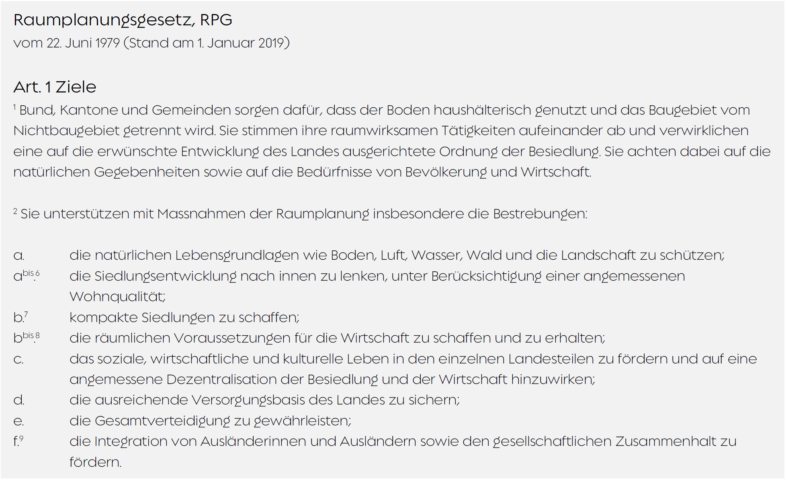
    Spatial planning, the measure of all things?

    Source: Swiss Confederation

    In reality, however, the cantonal and municipal planning instruments are incomplete, rigid, purely quantitative and do not pursue a three-dimensionally developed picture of the future. The consequences are well known: Inconsistent cityscapes, insufficient densification potential, growing traffic volumes, uncoordinated infrastructural facilities and, finally, a dissatisfied population.

    Forward-looking spatial planning with new concepts is indispensable, because the current sluggish planning instruments of spatial planning are obviously at odds with the dynamic process of urban planning and to date fail to achieve the goals defined in the RPG.

    With the use of the already existing GIS data, the potential impacts on all relevant topics such as interior densification, land use, transport, energy consumption, greenhouse gas emissions and many others could be visualised, evaluated and communicated in a participatory manner throughout Switzerland on the basis of qualitative future scenarios – and beyond the cantonal borders.

    Buildings in the context of spatial planning
    Spatial planning also creates the framework conditions for the development of neighbourhoods and ultimately of the building stock. When we talk about sustainable buildings, it is not enough to look at them in isolation and focus solely on their substance. Buildings are to be understood in their context and thus in consideration of their contribution to the reduction of traffic volume, to densification and to social integration. Following this logic, the two standards SNBS Building Construction for Building and SSREI for Existing Buildings have been developed in Switzerland. In terms of their content, both are unique in an international comparison.

    Source www.ssrei.ch

  • Milestone for the further development of CH energy policy

    Milestone for the further development of CH energy policy

    Particularly important decisions of the Commission meeting of 20-23.2.2023

    • A regulation for solar plants in the national interest: This will make it possible to build Alpine solar power plants even after the expiry of the urgent federal decree (“Solar Express”).
    • The obligation of operators of larger storage hydropower plants to participate in the energy reserve: Photovoltaics (PV) in combination with hydropower enables a secure power supply in winter, provided the reservoirs are not emptied prematurely for economic reasons.
    • The possibility of loans in case the resources of the grid surcharge fund are not sufficient for the intended promotion of renewable energy production: This can avoid a “stop-and-go”.
    • Data from smart metering systems are to be made available to end consumers in real time: This promotes the optimal coordination of electricity production (e.g. from PV systems) and consumption at the local level, which can reduce investments in electricity grids.
    • Storage facilities without end consumption are to be exempted from the grid fee for an unlimited period. And storage facilities with end consumption should also be able to benefit from a refund of the grid fee for the energy fed back into the grid from these storage facilities: This promotes the grid-serving use of stationary storage facilities as well as the bidirectional charging of electric vehicles.
    • The framework conditions for local electricity communities (LEG) have been significantly improved compared to the resolution of the Council of States: this is also a significant contribution to the intelligent use of the grids.
    • In rural areas, high costs for grid reinforcements often lead to PV projects being suspended. A cost pass-through is intended to provide relief here.
    • The parliamentary initiative by Swissolar President Jürg Grossen’s initiative to harmonise the taxation of the sale of solar electricity was unanimously approved. This is an essential contribution to clearing up the “patchwork” of framework conditions for solar plants.


    Detailed information at www.parlament.ch