Tag: Bundesrat

  • Federal Council plans next expansion of transport infrastructure

    Federal Council plans next expansion of transport infrastructure

    The Federal Council is preparing the next expansion of rail, road and agglomeration transport. It has instructed the Federal Department of the Environment, Transport, Energy and Communications(DETEC) to prepare a consultation draft for a first expansion phase in 2027 by the end of June 2026, the Federal Council announced in a press release. DETEC will base its work on an ETH report commissioned by the Federal Council. In this report, the university sets out which projects should be realised as a matter of urgency over the next 20 years from a technical perspective.

    By the end of January 2026, DETEC is also to draw up a proposal based on the report as to which transport infrastructure projects should be implemented by 2045. Additional revenue must be generated in the railway sector. The existing financial framework will be maintained for road expansion and the agglomeration transport programme.

    “The prioritisation by ETH Zurich and the subsequent political decision by the Federal Council should ensure an orderly, financially viable and holistically coordinated development of transport infrastructure by 2045,” the press release states. The Federal Council is sticking to a staggered expansion programme when determining the expansion stages. The consultation proposal for the first expansion phase in 2027 is intended to bundle all planned measures for rail, road and urban transport. At the same time as its presentation, the Federal Council intends to provide an outlook for the further expansion stages in 2031 and 2035.

  • Federal government selects five reserve power plants

    Federal government selects five reserve power plants

    Following its meeting on 14 May 2025, the Federal Council will conclude contracts with energy service providers for the operation of five reserve power plants. According to a press release, the Swiss Federal Office of Energy(SFOE) has conducted direct negotiations with potential providers in advance. Following the end of the tendering process in February 2025, the Federal Department of the Environment, Transport, Energy and Communications(DETEC) decided to select five projects with a total capacity of 583 megawatts (MW).

    The selected projects include the reserve power plant Monthey VS with 55 MW from CIMO, the reserve power plant Sisslerfeld 1 in the municipality of Eiken AG with 13 MW from Getec, the reserve power plant Stein AG with 44 MW from Getec, the reserve power plant Sisslerfeld 2 in Eiken AG with 180 MW from Sidewinder and the reserve power plant Auhafen in Muttenz BL with 291 MW from Axpo. All five plants will run on CO2-neutral fuel, according to the press release.

    The five projects should be ready for operation between 2027 and 2030. For the transition, DETEC is currently working on variants using hydropower, emergency power generators and consumption reserves.

  • Electricity agreement with the EU triggers opening of the electricity market

    Electricity agreement with the EU triggers opening of the electricity market

    Switzerland’s planned electricity agreement with the EU also provides for the electricity market to be opened up to end consumers. According to a press release, the Federal Council therefore presented key points for this opening on 14 May.

    The Federal Council’s key points stipulate that end consumers can choose to remain in the basic supply of the local supplier with its regulated prices and can also freely choose their electricity supplier. They are also free to return to the basic supplier, even during the year. Basic suppliers can charge a fee for switching out of or back into the basic supply.

    At the same time, consumer protection measures are to be introduced. For example, a comparison portal will provide an overview of offers. An ombudsman’s office will offer arbitration options. The contracts with the supplying companies must fulfil certain requirements. The Federal Electricity Commission will monitor the market.

    The electricity market has been open in the EU since 2007. A referendum in 2002 failed to open up the Swiss electricity market. Since 2009, the market has been open to large customers with a consumption of at least 100,000 kilowatt hours per year.

  • Canton of Zurich calls on Federal Council to act

    Canton of Zurich calls on Federal Council to act

    The pressure on the housing market is enormous. Demand is constantly rising, while supply is lagging behind. The canton of Zurich is particularly affected, where construction projects are increasingly being delayed or prevented by appeals. The consequences are rising rents, social tensions and growing political pressure to act. Five cantonal popular initiatives show how much the issue of housing concerns the population.

    Improvements are unnecessarily delayed
    Although new noise protection regulations have already been adopted, their implementation is still a long time coming. The Zurich cantonal government is calling on the Federal Council to bring the changes to the law into force quickly. This is because protection interests must not be allowed to block the expansion of urgently needed living space. A clear legal basis is essential for planning security and accelerated procedures.

    Protection instrument or strategic objection tool?
    The Government Council is particularly critical of the increasing direct application of the federal inventory ISOS, which actually serves to protect important sites. However, the inventory is increasingly being used to object to new construction projects. With serious consequences for inner densification. This problem is already very noticeable in Zurich, but it is increasingly spreading to other cantons.

    Although the cantonal government supports the announced round table on the ISOS issue, it is calling for concrete and timely solutions that must be developed together with the federal government, cantons and municipalities.

    Call for political prioritisation
    According to the cantonal government, the provision of housing is a key concern for the population and the economy. The federal government must strike a new balance between protection interests and structural development so that urgently needed housing construction is not blocked any further. The responsibility for this now lies with the relevant federal authorities.

  • Federal Council imposes limits on buildings outside building zones

    Federal Council imposes limits on buildings outside building zones

    The Federal Council is proposing that the number of new buildings outside of building zones be increased by a maximum of 1 per cent compared to 2023. At its meeting on 19 June, it submitted a corresponding draft for consultation, the Federal Council announced in a press release. The consultation draft is a proposal for the ordinance on the revised Spatial Planning Act. It was passed by both chambers on 29 September last year and aims to stabilise construction outside of building zones at a certain level.

    There are currently around 620,000 buildings outside of building zones in Switzerland. If the bill comes into force, this figure could increase by a maximum of 6,200 buildings. With an average of 500 new buildings outside the building zone each year, the maximum permitted number would be reached in just over ten years, writes the Federal Council.

    The Federal Council is also proposing changes to the handling of special zones. Here, the volume and area of new buildings outside of building zones will have to be compensated for by the demolition of existing structures. In agricultural zones, the priority of agriculture over other uses is reaffirmed.

  • Federal Council supports price recommendations for Swiss timber

    Federal Council supports price recommendations for Swiss timber

    Initiative 21.463 “Price recommendations also for wood from Swiss forests” is intended to offer the approximately 250,000 Swiss forest owners better guidance on the market. The possibility of agreeing guide prices, similar to those in agriculture, allows forest owners to better align their sales prices with market conditions. This contributes to stability and transparency on the timber market and supports the sustainable management of forests.

    Positive effects of price recommendations
    The Federal Council sees the introduction of price recommendations as an important step towards promoting the forestry and timber industry. The publication of these recommendations is intended to support more market-oriented behaviour on the part of those involved. This leads to indirect positive effects, as the sale of timber makes a significant contribution to the financing of forest management and maintenance. As a result, all functions of the forest, including its ecological and social services, are better ensured.

    Independent implementation by sector organisations
    The implementation of the price recommendations should be carried out independently by the forestry and timber sector organisations. The Federal Council emphasises that the proposed regulation in the WaG does not constitute an unlawful elimination of competition under antitrust law. Individual companies are not obliged to comply with the recommended prices, and no price recommendations are set for consumer prices. This ensures that competition remains fair and that the price recommendations merely serve as a guide.

    By supporting the parliamentary initiative, the Federal Council is sending out a signal in favour of strengthening the Swiss forestry industry. The introduction of price recommendations for raw timber is intended to increase market transparency, secure the financial basis for sustainable forest management and thus maintain the diverse functions of the forest in the long term.

  • Federal Council amends four key ordinances in the renovation and recycling process

    Federal Council amends four key ordinances in the renovation and recycling process

    There are around 38,000 sites in Switzerland containing environmentally hazardous substances, of which around 4,000 need to be remediated. The new Contaminated Sites Ordinance, which comes into force on 1 June 2024, allows treated excavated material to be reinstalled at the remediation site. This is ecologically more favourable than the previous practice, which required large-scale material transport and treatment. The reinstallation must ensure that no further remediation is necessary and the site is monitored in the long term.

    Chemical Risk Reduction Ordinance: adjustments for refrigerants and batteries
    A revised Chemical Risk Reduction Ordinance, which is based on EU standards and the latest technical developments, will come into force on 1 January 2025. This will restrict particularly climate-damaging refrigerants in new systems and appliances in order to achieve the goals of the Montreal Protocol and protect the ozone layer. From 1 July 2024, the ordinance will also regulate the return and disposal of significantly damaged batteries and the reimbursement of the advance disposal fee for exports. These amendments offer companies more legal certainty and contribute to sustainable disposal.

    Extension of the transitional provisions in the programme agreements
    Since 2008, the Confederation and cantons have jointly defined environmental targets and corresponding subsidies in programme agreements. For the period 2025-2028, the transitional provisions of the Water Protection and Forestry Ordinance will be extended by four years in order to continue and finalise projects that have already been started. These changes will come into force on 1 January 2025 and ensure the continuity of important environmental measures.

    The amendments adopted by the Federal Council strengthen environmental protection and optimise the regulatory framework. These measures emphasise Switzerland’s commitment to sustainable development and efficient resource management, while providing greater clarity and certainty for the industries concerned.

  • Federal Council supports restriction of the right of appeal for associations

    Federal Council supports restriction of the right of appeal for associations

    The National Council’s Committee for the Environment, Spatial Planning and Energy has drafted a proposal to restrict the right of environmental organisations to lodge complaints about smaller residential buildings within the building zone. This initiative aims to simplify the bureaucratic process of planning permission, particularly for small-scale construction projects.

    The Federal Council issued its opinion on this proposal on 27 March 2024 and supports the proposals of the UREK-N. It is in favour of restricting the right of appeal for residential buildings with a floor area of up to 400 m2 within building zones. This step should help to make the construction process more efficient for private developers and at the same time ensure the protection of important environmental and cultural heritage sites.

    In addition, the Federal Council agrees with the exceptions proposed by the UREK-N. In particular, the right of appeal by associations should remain in place for construction projects that affect important sites, historical sites and cultural monuments, as well as for buildings in sensitive areas such as biotopes or water areas.

    The bill is expected to be discussed by the National Council in the special session in April. This development illustrates the ongoing efforts to ensure a balanced approach between economic development and environmental protection in the construction industry.

  • National Council wants more photovoltaic systems on condominiums

    National Council wants more photovoltaic systems on condominiums

    On Wednesday, it adopted a motion by Ticino SP National Councillor Bruno Storni with this demand. Storni also wants to make it easier to carry out energy-efficient renovations and install electric car charging stations in condominium buildings.

    To this end, the Federal Council should adjust the necessary quorums in the condominium law when passing resolutions on such projects. In order to achieve the goals of the federal government’s Energy Strategy 2050, it is important that the energy efficiency of condominium buildings increases, says Storni.

    With 119 votes in favour, 66 against and 6 abstentions, the large chamber accepted Storni’s proposal. It will now go to the competent committee of the Council of States for consideration.

    The Federal Council rejected the motion. The current law contains a differentiated and balanced regulation of the decision-making of condominium owners’ associations. It should be left to the condominium owners, within the framework of their private autonomy, to decide on renovation and conversion projects by means of the proven rules of decision-making.

  • Federal Council requests 218.1 million for civil federal buildings

    Federal Council requests 218.1 million for civil federal buildings

    The largest single construction project in the Real Estate Message 2023 is the renovation and expansion of the Reckenholz greenhouse site (ZH). cHF 29.5 million have been budgeted for this. cHF 21.1 million are requested for the extension of the connecting level at the Liebefeld administrative centre (Köniz, BE). In addition, a new building is to be constructed in Cameroon’s capital Yaoundé for the office and residence of the Swiss representation. The commitment credit for this amounts to CHF 27.5 million.

    Renovation and expansion of the Reckenholz greenhouse site
    Reckenholz is one of Agroscope’s two regional research centres. The external greenhouses there, as well as the building services in the operations building, have reached the end of their life cycle. The greenhouses will be replaced by energy-efficient and flexibly usable air-conditioned research chambers. The building services in the operations building will be renovated and adapted to the new requirements.

    Extension of the connecting level at the Liebefeld Administrative Centre
    The South Campus in Liebefeld is divided into several administrative and laboratory buildings for the Federal Office of Public Health (FOPH), the Federal Food Safety and Veterinary Office (FSVO), the Federal Office for Agriculture (FOAG) and the Swiss Federal Institute of Metrology (METAS). in 2025, the Competence Centre for Agricultural Research (Agroscope), which is part of the FOAG, will move to Posieux. This will enable further development of the campus from 2026 onwards. In preparation for this, and in order to introduce mobile-flexible forms of work, the underground connection level is to be extended. This will improve the spatial and technical connections between existing buildings and any new buildings that may be added as part of the further development, as well as integrating them into the access and security concept.

    Construction of the new office and residence in Yaoundé
    The Swiss representation in Cameroon is currently housed in rented buildings. A flexible and functional embassy infrastructure is now to be built on a federally owned plot of land. The new building will simplify the functional processes between the chancellery, the residence and an official residence, which will now be located at the same site. This enables synergies in the security concept as well as the technical infrastructures and allows multifunctional use of the representative premises, for example.

    Further real estate projects 2023
    The Federal Office for Buildings and Logistics (FBL) will use a further commitment credit of 140 million for projects not individually specified below an amount of 10 million Swiss francs, for property purchases that cannot be planned or are urgent, and for the planning of future real estate embassy projects.

  • Merger of Credit Suisse and UBS

    Merger of Credit Suisse and UBS

    Credit Suisse and UBS entered into a merger agreement on Sunday under which UBS will be the continuing entity. Following the negotiations that took place over the weekend and led to the signing of the merger agreement, UBS and Credit Suisse have concluded that a merger is in the best interests of their shareholders and stakeholders. The Federal Department of Finance, the Swiss National Bank and FINMA had previously required the two companies to complete this transaction in order to restore the necessary confidence in the stability of the Swiss economy and the Swiss financial centre.

    The merger is subject to the following material conditions:

    • All Credit Suisse shareholders will receive 1 UBS share for 22.48 Credit Suisse shares in exchange for the merger. This exchange ratio corresponds to an acquisition price of CHF 3 billion for all Credit Suisse shares.
    • The merger is subject to customary closing conditions. Both parties are confident that all conditions can be fulfilled. The merger is expected to be completed, if possible, by the end of 2023.
    • The Swiss National Bank will provide Credit Suisse with access to facilities through which it will receive substantial additional liquidity.
    • It is expected that, in order to ensure a smooth integration of Credit Suisse into UBS, UBS will appoint employees to key positions at Credit Suisse as soon as legally possible.
    • Credit Suisse will continue its business as usual and implement its restructuring measures in cooperation with UBS.
    • UBS has expressed confidence that Credit Suisse employees can continue to be employed.

    Credit Suisse was informed on Sunday by FINMA of its decision that Credit Suisse’s Additional Tier 1 capital (arising from the issuance of Tier 1 capital notes) in the aggregate principal amount of approximately CHF 16 billion will be written down to zero.

    Taking into account the special circumstances affecting the Swiss economy as a whole, the Federal Council issues an emergency ordinance tailored to this specific transaction. It should be noted that the merger is being carried out without the otherwise required approval of the shareholders of UBS and Credit Suisse in order to increase transaction security.

    Axel P. Lehmann, Chairman of the Board of Directors of Credit Suisse, said: “The announced merger represents the best possible outcome given the extraordinary and unprecedented circumstances. Credit Suisse has been through an extremely difficult period. Although the team has worked tirelessly to clean up many significant legacy issues and implement the new strategy, today we are forced to adopt a solution that will deliver a sustainable outcome.”

  • Federal Council wants to further strengthen the competitiveness of Swiss SMEs and regions

    Federal Council wants to further strengthen the competitiveness of Swiss SMEs and regions

    With the Dispatch on Location Promotion 2024-2027, the Federal Council is further developing the strategic foundations of federal location promotion. It is pursuing the following five goals with location promotion in the years 2024-2027: Improve the framework conditions for SMEs, strengthen regions, contribute to sustainable development, exploit the opportunities of digitalisation and strengthen the attractiveness of the business and tourism location. Compared to the period 2020-2023, the importance of sustainable development and digitalisation will be upgraded. In addition, location promotion will be geared even more strongly to the needs of the main target groups – SMEs and regions. In order to implement the goals, 23 concrete activities will be defined in the coming years by SECO and the mandated organisations (guarantee cooperatives, Swiss Export Risk Insurance, Swiss Association for Hotel Credit, Switzerland Tourism, Switzerland Global Enterprise). Some of them are implemented in cooperation with the cantons and other partners.

    The focal points of location promotion
    In SME policy, the focus is on expanding EasyGov.swiss, the one-stop shop of the Confederation, cantons and municipalities for businesses. This can make a significant contribution to reducing the administrative burden on businesses. In the period 2024-2027, the scope of EasyGov services is to be further expanded in order to meet the needs of businesses for additional electronic government services. As part of the expansion of EasyGov, it is planned, for example, to be able to offer businesses a bundled process for moving companies (change of address) in the future. Further expansion is also planned in the area of aliens law notifications and permits for businesses.

    In tourism policy, the focus is on the further development of investment promotion, sustainable development and the digital transformation of tourism. Another priority for the years 2024-2027 is the implementation of the recovery programme for Swiss tourism to counteract the effects of the Covid 19 pandemic.

    The New Regional Policy NRP will enter its third eight-year multi-annual period (2024-2031) in 2024. The existing thematic funding priorities of “industry” and “tourism” will be continued. In addition to digitalisation, sustainable development and the “local economy”, which complements the export orientation of the NRP, will be given particular weight as cross-cutting themes.

    Finally, the offer of support for the export industry, for example in relation to trade-related issues, and in particular access for Swiss exporters to large foreign infrastructure projects, will be further developed in line with demand and the “Team Switzerland” approach will be expanded. For example, various associations, federal offices, Switzerland Global Enterprise and Swiss Export Risk Insurance are increasingly conducting joint promotional activities abroad. These are aimed, among others, at general contractors who carry out large infrastructure projects. Further business opportunities are being identified in important markets.

    Commitment credits and payment frameworks
    In order to continue and further develop the instruments of location promotion, the Federal Council is proposing commitment credits and payment frameworks totalling CHF 428.83 million to parliament for the years 2024-2027. For the years 2020-2023, an amount of around CHF 399 million was available. In addition, there is a payment framework for the creation of the Regional Development Fund in the years 2024-2031 amounting to CHF 217.3 million (reduced by CHF 12.7 million compared to the previous period 2016-2023).

    Location promotion is implemented using the instruments of SME policy, tourism policy, the New Regional Policy (NRP) and foreign trade promotion.

  • Housing shortage: Federal Council waits

    Housing shortage: Federal Council waits

    For Wohnbaugenossenschaften Schweiz, it is incomprehensible that the Federal Council simply wants to wait and see in the face of the housing shortage. In an interpellation, Manuela Weichelt, National Councillor (Greens) and member of the board of Wohnbaugenossenschaften Schweiz, wanted to know what the Federal Council intends to do about the housing shortage. The Federal Council replied that it was aware that an insufficient supply of housing could hamper economic development and lead to socio-political tensions. However, it sees the responsibility for housing supply primarily with the real estate industry. Although non-profit housing construction plays an important role in the provision of affordable housing, it is already being promoted with the Fonds de Roulement and guarantees. If necessary, the Federal Council is prepared to evaluate further measures, as called for in a postulate by Damian Müller (FDP), member of the Council of States.

    Immediate measures are needed
    The housing shortage is driving rents ever higher. “The shortage of affordable housing is acute and measures need to be taken quickly,” stresses Manuela Weichelt. “We call on the Federal Council to act now. Recipes against the housing shortage are well known: More non-profit and affordable housing is needed.” The current situation shows that the real estate industry is not ensuring a sufficient supply of affordable housing. “The Federal Council recognises that the non-profit housing developers make an important contribution here. It is therefore all the more incomprehensible that it does not want to promote them more strongly. The current housing subsidies are not sufficient to rapidly increase the share of non-profit housing,” explains Eva Herzog, Member of the Council of States for Basel-Stadt (SP) and President of Wohnbaugenossenschaften Schweiz. In order to be able to build more, non-profit housing developers are particularly dependent on suitable building land. This requires active control, for example with defined shares or zones for non-profit housing. The federal government would have the power to secure land for non-profit building projects: For example, by making land that is no longer needed by the federal government and businesses close to the federal government available for this purpose. Or by giving municipalities the possibility to buy land for non-profit housing with a right of first refusal. The federal government could also support municipalities in the purchase of land, for example with a land acquisition fund.

  • Bundesrat steckt Ziele zur Standortförderung ab

    Bundesrat steckt Ziele zur Standortförderung ab

    Der Bundesrat entwickelt die strategischen Grundlagen zur Standortförderung des Bundes weiter. Mit seiner Botschaft für die Jahre 2024 bis 2027 verfolgt er laut einer Medienmitteilung fünf Ziele: Rahmenbedingungen für KMU verbessern, Regionen stärken, zur nachhaltigen Entwicklung beitragen, Chancen der Digitalisierung nutzen sowie die Attraktivität des Wirtschafts- und Tourismusstandorts stärken. Diese sind auch Bestandteile der Neuen Regionalpolitik, die 2024 in ihre dritte achtjährige Periode startet. Für die mandatierten Organisationen wurden 23 konkrete Aktivitäten formuliert.

    Im Vergleich zur Periode 2020 bis 2023 wird die Bedeutung der nachhaltigen Entwicklung und der Digitalisierung aufgewertet. Ausserdem soll sich die Standortförderung noch stärker an den Bedürfnissen der Hauptzielgruppen, den KMU und den Regionen, ausrichten. So liegt der Schwerpunkt bei der KMU-Politik im Ausbau von EasyGov.swiss, dem Online-Schalter für Unternehmen zur elektronischen Abwicklung von Bewilligungs-, Antrags- und Meldeverfahren an einem einzigen Ort.

    Den Fokus in der Tourismuspolitik setzt die Botschaft bei der digitalen Transformation der Branche und der Weiterentwicklung der Tourismusförderung. Zudem will der Bundesrat die Exportorientierung weiterentwickeln. So sollen sich etwa Promotionsauftritte im Ausland an Generalunternehmer mit grossen Infrastrukturprojekten richten.

    Für die Instrumente der Standortförderung beantragt der Bundesrat dem Parlament Finanzmittel in Höhe von 428,83 Millionen Franken, rund 40 Millionen mehr als in der ablaufenden Periode. Dagegen soll der Zahlungsrahmen für die Äufnung des Fonds für Regionalentwicklung in den Jahren 2024 bis 2031 gegenüber der Vorperiode um 12,7 Millionen Franken auf 217,3 Millionen Franken reduziert werden.

  • The Glattalbahn is getting longer

    The Glattalbahn is getting longer

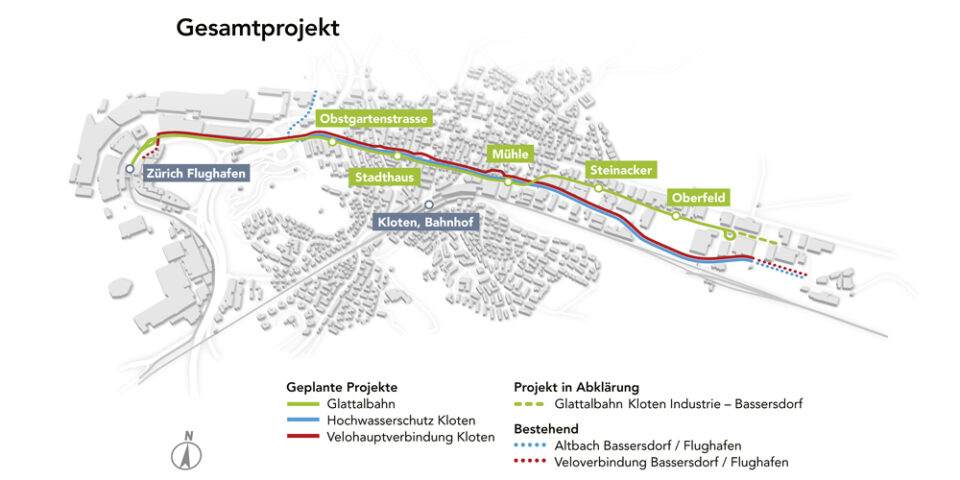
    The transport system in the Kloten region is reaching its limits. The consequences are increasing hours of traffic jams and severe noise and air pollution. The Glattalbahn extension to Kloten promises a chance for improvement, which, in addition to the extension of the tram line between the airport and the Steinacker development area in Kloten, includes two other sub-projects: A main bicycle connection with a separate footpath and flood protection for Kloten and for the airport. The spatial proximity and the dependencies of these sub-projects require joint project planning and construction. This means that the canton of Zurich can effectively and sustainably master three challenges in one project and make optimal use of synergies.

    On July 16, 2020, VBG Verkehrsbetriebe Glattal AG (VBG) submitted the application for the infrastructure concession to the Federal Office of Transport (BAV). The procedure examined whether there was a public interest in the construction and operation of the new tram connection and whether there were no significant public interests – for example environmental protection or nature and heritage protection – opposed to the granting of the concession. The Federal Council examined the application and decided to grant the license to the VBG. This decision cannot be contested. There will be opportunities for objections at a later point in time during the public approval of the plan.

    The VBG is currently working on the construction project that forms the basis for the cantonal loan approval. The decision of the cantonal council is expected in 2024. This is subject to an optional referendum. The project was submitted to the federal government in June 2021 as part of the 4th generation agglomeration programme. This will probably decide on co-financing by the end of 2023. The approval process (plan approval process under the Railway Act) is expected to run in parallel from 2023. Construction is currently expected to start in 2026, subject to legally binding planning approval and secured funding from the canton and the federal government. The construction work will take around four years.

    The Glattalbahn has big plans.
  • The federal government wants to develop a concept for energy-efficient measures in buildings

    The federal government wants to develop a concept for energy-efficient measures in buildings

    In his motion of September 26, 2019, the then National Councilor Christoph Eymann (LDP/BS) asked the Federal Council to “submit an implementation concept for energy-efficient Minergie-P measures to reduce the 80 percent energy losses in the building sector and also the use of roof and facade surfaces for solar energy production”. The National Council approved the initiative in June last year. At its meeting on May 31, the Council of States also approved the motion, the parliamentary services inform in a statement .

    However, because the Council of States has made an addition to the text, the motion will first go back to the National Council, is explained further in the communication. Specifically, the cantons should be involved in the development of the concept. This was recommended by the State Council Commission for the Environment, Spatial Planning and Energy ( Urek-S ) due to major cantonal differences in the existing building program.

    The Federal Council supports Eymann’s motion. “In view of the increased energy prices, for example because of the Ukraine war, the concern is not only important in terms of climate policy, but also economically,” quoted the Parliamentary Services Environment Minister Simonetta Sommaruga. “The population can be relieved in this way.”

  • Federal Council wants to accelerate procedures for renewables

    Federal Council wants to accelerate procedures for renewables

    Switzerland is lagging behind in the expansion of wind energy. The procedures for the construction of large hydroelectric power plants also take a long time. The Federal Council now wants to speed up the planning and approval procedures for large plants, it writes in a statement . No compromises should be made when it comes to protecting nature, the environment and monuments.

    The Federal Council wants to develop a concept with the locations of the most important hydropower and wind turbines. This should serve as a guideline for cantonal structural planning. The systems listed there should then only be subject to a cantonal planning approval procedure. This should be able to issue all permits. Thus, in the event of an objection, only one appeal through the instances should be possible.

    In addition, the Federal Council wants to accelerate the installation of photovoltaics on roofs and facades. Investments in new buildings should also be tax deductible. The approval of solar systems on facades is to be regulated via a notification procedure.

    The Swiss Energy Foundation welcomes the initiative of the Federal Council. “Switzerland needs a booster for renewable energies,” said Managing Director Nils Epprecht in a statement . “The Federal Council has recognized the urgency. In doing so, he does not question the two political cornerstones of Switzerland, the balancing of interests and federalism.”

    The consultation on the Federal Council’s proposal lasts until May 23, 2022.

  • The federal government wants to strengthen Switzerland as a location for start-ups

    The federal government wants to strengthen Switzerland as a location for start-ups

    In the opinion of the Federal Council, Switzerland as a start-up location is generally well positioned. In some areas, however, there is still room for improvement. The Federal Departments of Economic Affairs, Education and Research and of Justice and Police are now to examine measures on behalf of the Federal Council with which the location could be further strengthened.

    According to a communication , the Federal Council sees potential for improvement in the areas of technology transfer, internationalization, access to skilled workers and financing. He also emphasizes that “numerous states have launched extensive programs to support start-ups in recent years”. He therefore also wants to have the advantages and disadvantages of a Swiss innovation fund examined comprehensively. In particular, it should be made clear to what extent such a fund could expand the risk capital market in Switzerland and thus improve the growth opportunities of innovative companies.

  • Federal government specifies requirements for wind energy

    Federal government specifies requirements for wind energy

    "Since 2018, the Energy and Spatial Planning Act explicitly oblige the cantons to define areas in their structure plans that are suitable for the use of wind energy," the Federal Council explains in a press release . At its meeting on September 25th, it approved the necessary adjustments to the wind energy concept. All planning and project sponsors must orient themselves to this concept.

    In the wind energy concept, usage and protection interests are weighed up against each other. From this consideration, the federal government derives areas that it believes are suitable for the use of wind energy. The interests of the federal government in nature and landscape protection areas as well as military and civil technical systems of the federal government must be taken into account by the cantons when designating areas for the use of wind energy. The adapted concept stipulates that under certain conditions wind turbines can be erected in landscapes of national importance. In biotopes of national importance, however, the construction of wind turbines is excluded.

    The cantons continue to have the authority to determine the specific areas that come into question for the use of wind energy. In the structure plans already approved by the federal government for the cantons of Aargau, Basel-Landschaft, Bern, Freiburg, Neuchâtel, Schaffhausen, Solothurn, St.Gallen, Waadt and Wallis, more than 50 such areas have already been defined. In addition, the communication points to a number of wind energy projects that are already well advanced in the planning stage.

  • Decommissioning and disposal funds show profits

    Decommissioning and disposal funds show profits

    The decommissioning and disposal funds ( STENFO ) to be accumulated by the operators of nuclear facilities are intended to cover the costs of decommissioning Swiss nuclear power plants and the disposal of radioactive waste, explains the Federal Council in a communication . At its meeting on September 18, it approved the annual reports of the two funds for the 2019 reporting year. The two funds currently have a total of CHF 8.492 billion. At the end of 2018, the fund amounts had totaled 7.492 billion francs.

    The decommissioning fund currently has CHF 2.724 billion available for the decommissioning and demolition of the nuclear facilities and the disposal of the radioactive waste generated. The funds exceeded the target amount of CHF 2.525 billion targeted for the end of 2019 by CHF 198.8 million, writes the Federal Council. A return on investment of 12.26 percent resulted in a profit of CHF 297.9 million in the fund's income statement.

    The disposal fund set up for the costs of disposing of radioactive waste showed funds of 5.768 billion Swiss francs at the end of 2019. The fund was thus quoted at 615 million francs above its target amount of 5.153 billion francs, informs the Federal Council. Compared to the end of 2018, a profit of 666.8 million francs was posted. It resulted from a return on investment of 13.09 percent.

  • Axpo President calls for a sliding market premium

    Axpo President calls for a sliding market premium

    In a joint guest commentary for the “Tages-Anzeiger”, two leading representatives of the Swiss energy industry take a hard line against the Federal Council's plans to implement the Energy Strategy 2050. “Switzerland has the wrong instruments for promoting renewable energies. We have a suggestion on how this can be changed, ”write Thomas Sieber, Chairman of the Board of Directors of the energy company Axpo , and Gianni Operto, President of AEE Suisse , the umbrella organization for renewable energies and energy efficiency.

    The proposal can be summarized in two words: Moving market premium. The Federal Council proposes a model with investment contributions for the energy law revision. The amounts are fixed in advance. From the authors' point of view, the problem is that it will hardly be possible to determine the most economically efficient contribution amount. Either there is unnecessary over-funding or too little funds are budgeted, which leads to the shutdown of plants that are no longer profitable. The sliding market premium, for which a “broad alliance of the Swiss energy industry” advocates, is already being used successfully in other countries. Production capacities would be put out to tender in a competition. "Those interested with the lowest offers are guaranteed a minimum remuneration for the electricity produced over a certain period of time – but only if the market price does not cover this." The sliding market premium supports precisely and only as much as necessary. It is therefore not a subsidy, but a fair price tag for a central service.

    Since the expansion of renewable capacities in Switzerland is currently not profitable for electricity suppliers, Swiss energy suppliers and institutional investors invested abroad. At the end of 2019, the expansion of renewable capacities financed in this way had increased to 11.5 terawatt hours, almost a fifth of the total annual production in Switzerland.