Tag: bus

  • Zurich cantonal government invites the public to participate in the fifth-generation agglomeration programmes

    Zurich cantonal government invites the public to participate in the fifth-generation agglomeration programmes

    In order to receive federal funding, the agglomeration programmes must meet certain requirements. These include analysing the current situation and identifying development trends in the areas of settlement, landscape and transport. On this basis, future scenarios are developed and necessary measures are derived. Between 30 and 50 per cent of these measures can then be co-financed by the federal government, provided they are ready for implementation.

    The programmes cover various regions and focus on specific priorities. In the Limmat Valley, the focus is on multimodal transfer points and the electrification of bus transport. In the city of Zurich and the Glattal, transport hubs and cycle networks are being expanded. Winterthur’s measures focus on public transport and pedestrian and cycle-friendly urban development.

    The new programme for the lowlands and the Furttal valley focuses on designing road spaces to be compatible with residential areas. In the Zurich Oberland, the focus is on the accessibility of regional centres and multimodal transfer points.

    Participation and consultation procedure
    The public consultation procedure was launched on 3 July 2024 by government decree no. 765/2024 and runs from 5 August to 20 September 2024. During this period, cities, municipalities, planning regions, transport companies, associations and the public are invited to comment. Neighbouring cantons and neighbouring agglomeration programmes such as Schaffhausen and Obersee are also invited to participate.

    Government Councillor Carmen Walker Späh emphasises the importance of the programmes: “Everyone benefits from a modern infrastructure. An efficient infrastructure is the lifeblood of the economy.”
    The drafts of the agglomeration programmes and other relevant documents will be available from 5 August at zh.ch/ap5.

  • On a bus tour through Wil West

    On a bus tour through Wil West

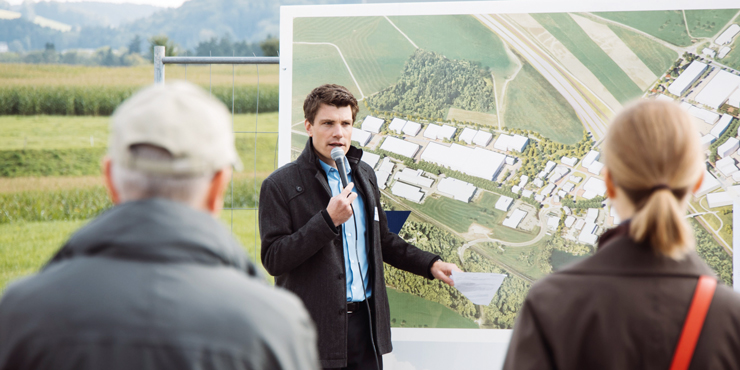
    Around 70 people were present on three Wil Mobil buses and explored various posts on the Wil West site in the style of a “scout exercise”. There were representatives from all the departments involved in the cantons of St. Gallen and Thurgau as well as the 23 member communities of the Wil region. And off we go: The northern network extension was discussed at the Ebnetsaal in Bronschhofen, aspects such as infrastructure and ecology on the terrace of the car world of Rotz and the details of the cantonal usage zone in Gloten.

    The tour of the site met with a consistently positive response: many participants had real aha moments when it came to the “dimension of the project” or “how detailed ecological compensation measures have already been defined”. The area tour with various stations should also be a central instrument in the future to make Wil West more tangible. Corresponding implementations are being planned for both the media and the population.

    The District President of St. Gallen, Marc Mächler, also insisted that Wil West be brought to life and that the project be brought to the next phase: "We must soon get away from the paper and the plans and show people specifically what is happening here." The CFO also submitted details of the special loan for the development of the site, which the Cantonal Council is expected to discuss in its first reading in November. In addition to Mächler, site manager Susanne Hartmann was also present from the government of the canton of St. Gallen. The Canton of Thurgau was also represented by the head of construction, Carmen Haag. The latter explained the network decision on the new connecting road and the footpaths and cycle paths, over which the Great Council of Thurgau has to decide. The Wil West motorway junction is at the center of the infrastructure construction. The Astra is planning this as an exciting high-spinning bridge and will then build it later.

    The modernized “Wil West” logo with the claim “The future lies with us” also premiered at the location conference. The claim stands for the self-confidence that the future lies here in the region and that future generations will find attractive jobs locally and no longer have to migrate in large droves to other cities. In addition to the logo debut, a new, fresh website is also being planned.

    Three young personalities from regional politics took part in the “Voices of the Future” podium: Meret Grob, City MP Green prowil; Salome Zeintl, President Jungfreisinnige Wil and the surrounding area and Serge Müller, Vice President SP Münchwilen district. They combined many positive aspects with the project, such as cross-cantonal cooperation or the economic strengthening of the entire region. However, they also expressed the need to involve the young and the population in general even more and to think more about the future, instead of just looking at today's forms of construction and transport.

    On a bus tour through Wil West.
  • E-buses connect Zurich's ETH locations

    E-buses connect Zurich's ETH locations

    The transport company Eurobus , based in Bassersdorf ZH, is now using three fully electric articulated buses from Mercedes-Benz . The vehicles from the eCitaro G model series, which were presented just a few weeks ago, are used on the so-called ETH link between the two locations of the Swiss Federal Institute of Technology in Zurich. They are the first to run in regular service.

    The 18.13 meter long, fully electric articulated buses run 100 percent on green Swiss water. Their capacity is 38 seated, 93 standing and two wheelchair places. They also offer public WiFi, USB charging sockets and air conditioning. With immediate effect, they will replace the previous diesel-powered shuttle buses between the center of Zurich and Hönggerberg. They fill up with new electricity at the Hönggerberg stop.

    “In addition to their environmental friendliness, the new electric buses are characterized above all by their quiet driving style, comfortable low-floor entry and attractive interior and exterior design,” said the managing director of Eurobus welti-furrer AG, Patrick Nussbaumer, in a media release from Daimler. "With this, the ETH is sending a clear signal and strengthening its position as a future-oriented educational institute."

    Armin Krieg, Head of Sales for City Buses at the Winterthur Daimler subsidiary EvoBus (Schweiz) AG , is satisfied “that with the introduction of the eCitaro G we are consistently continuing our announced timetable for e-mobility in city buses and Daimler Buses is the innovation and technology leader in the epicenter of technical and scientific research and teaching, of all places. "

  • Basel begins converting to electric buses

    Basel begins converting to electric buses

    Basler Verkehrs-Betriebe ( BVB ) are planning to procure a total of 126 electric buses by 2027. The BVG are thus implementing the statutory mandate to operate their public transport services in the canton of Basel-Stadt with 100 percent renewable energy by 2027. In the coming days, BVB will tender the first procurement phase for 62 e-buses. They are scheduled to go into operation in 2022. "I am pleased that after a long planning phase we can finally take the first concrete steps towards an environmentally friendly and modern e-bus system", BVB director Bruno Stehrenberger is quoted in a media release .

    The services for the general planner of Garage Rank are also being put out to tender these days. It will be completely rebuilt between 2023 and 2027 because it no longer meets today's requirements. At a later point in time, living space is also to be realized there. During this construction phase, the buses will be parked on two replacement areas.

    Industrielle Werke Basel ( IWB ) is responsible for setting up a corresponding charging structure in Garage Rank and in the provisional parking areas. In addition, the IWB will install so-called occasional charging points at five terminal stops, where buses can recharge electricity while they are waiting. This increases their range and makes the entire bus network more flexible.

    Converting the bus fleet will cost a total of around 360 million francs. Of this, around 147 million Swiss francs go to the procurement of the e-buses. The construction of the new Garage Rank, the temporary fixtures and other minor infrastructure adjustments cost around 161 million francs. The costs for setting up the charging infrastructure by IWB amount to around 52 million francs. The corresponding loan application is now with the Grand Council.

  • RVBW plans to use four e-buses

    RVBW plans to use four e-buses

    Four electric buses will be operating on RVBW Line 5 from March 2021. They will transport passengers between Baldegg via Baden train station to Ennetbaden. The new buses are equipped with innovative technology from ABB Switzerland. The canton of Aargau announced this in a media release as the customer for the public transport services.

    The project will be carried out in close cooperation with ABB. The Federal Office of Energy has classified it as a flagship project worth supporting. The drive technology is developed at the ABB site in Turgi. The charging station is also from ABB. The batteries are produced in Baden.

    A charging station will be installed at each of the two terminal stops. There buses can be charged in up to six minutes. The canton is contributing almost 1.5 million francs to the investment costs for the charging infrastructure.

    RVBW line 8 between Neuenhof and Wettingen has been operated with an electric bus on a trial basis for two years since mid-December 2019. On these two lines, the RVBW wants to gain initial operational experience with the use of e-buses. In the future, RVBW intends to operate all city bus routes electrically. The switch from internal combustion to electric motors is to take place gradually.