Tag: CBRE Switzerland

  • Reversal in office availability and further polarization between downtown and suburbs

    Reversal in office availability and further polarization between downtown and suburbs

    As of the end of June, office space available across Switzerland within three months rose for the second consecutive quarter to 1.67 million sqm, or 3.5% of the stock (see Figure 1), after reaching a multi-year low of 3.2% in Q4 2022. This is mainly due to an additional supply of office space in the suburbs of Zurich (airport region and Limmattal), where the availability rate rose from 15% to 16.6% within the six-month period. On Zurich city land, office supply also rose to 190,000 sq m or 2.8%, 13,000 sq m more than in Q1 2023 (177,000 sq m or 2.7%) and the first increase since Q4 2020 (see Figure 2). Especially in Zurich’s CBD (Central Business District), supply increased by 8,000 sqm to 51,000 sqm (2.6 %) within three months.

    In Zurich, it is noticeable that some companies in the information and communications technology (ICT) sector, which accounted for a large share of demand in recent years, have reviewed or revised their expansion plans. In addition, the merger of the two largest Swiss banks, UBS and Credit Suisse, will also gradually have an impact on the Zurich office market. Although this impact is not expected to be significant, it could create good opportunities for other market participants to find centrally located space in a still tight market environment with low construction activity and upward pressure on prime rents.
    Furthermore, it is noticeable that the increase in available office space in the city of Basel has turned into a reduction in supply for the first time since 2016. Some major leasing successes in the CBD and Klybeck have led to a reduction in the availability rate from 5.6% to 4.5% (117,000 m2) within one quarter. However, a significant rebound in supply is expected in the medium term.

    Otherwise, the office space markets in the other Swiss cities of Geneva, Bern and Lausanne are proving stable and thus unimpressed by the slowdown in economic growth. The Swiss office market has benefited from high take-up in recent years, with good economic growth even more than offsetting the impact of home working. However, office demand has recently slowed due to the weakening economy, and subletting activity has also increased. Office take-up in the first half of 2023 is down 28% from the first half of 2022 to an average of 490,000 sq m per quarter and is expected to remain at this lower level in the second half of 2023, which is roughly in line with the long-term average (see Figure 3).

  • CBRE Switzerland Office Take Up Index

    CBRE Switzerland Office Take Up Index

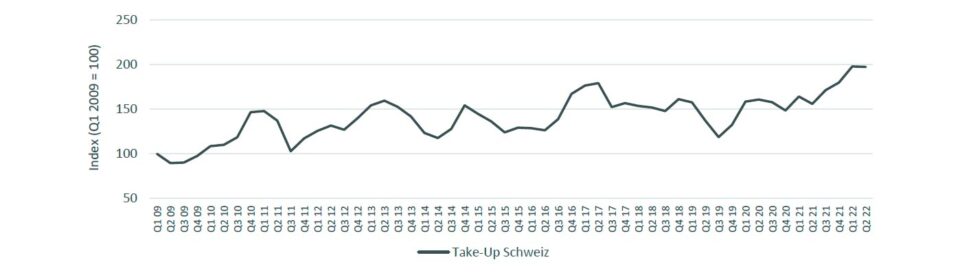
    CBRE Switzerland publishes its CBRE Switzerland Office Take-Up Index for the first time. The index is based on the advertisements switched off on the real estate online marketplaces and traces the quarterly volume of space let on the Swiss office market. It is a highly up-to-date indicator of office demand and is presented for the whole of Switzerland and for three geographic sub-markets (see figures below).

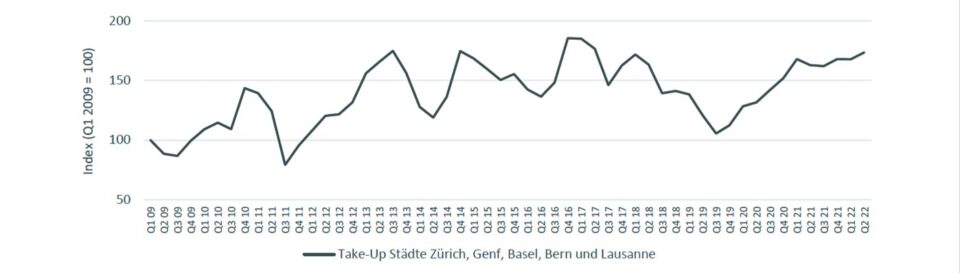
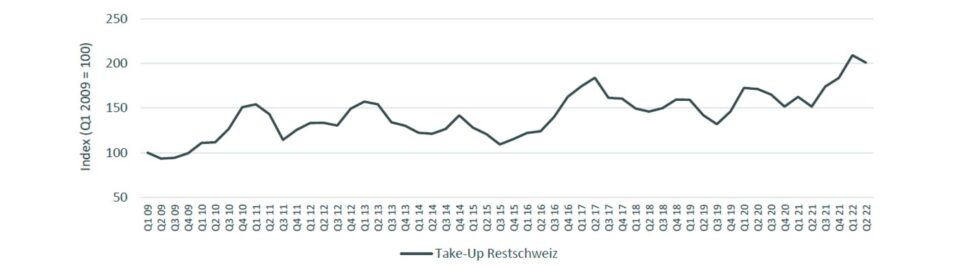
    All sub-indices have shown record activity in office lettings since the fourth quarter of 2021 and especially since the beginning of 2022. Although the economic recovery is currently being hampered by new global uncertainties, overcoming the Covid-19 crisis has prompted companies to restart their often-paused real estate projects. In the suburbs of the largest Swiss cities, too, rental activity has recently picked up again (see Figure 3). The only slight increase in the movement of space turnover in the cities themselves (see Figure 2) can be explained by the fact that the average availability rate here is a low 3.1%. As a result, large-scale rentals of space are now rare or “off-market” away from the measurable online channels. By contrast, take-up in the rest of Switzerland outside of the metropolitan areas of the major cities is already declining slightly (see Figure 4).

    The pronounced desire for centrality with the end of the COVID-19 pandemic has led to a further decline in office vacancy rates in the inner cities, which is why take-up is now also shifting to the well-developed suburban areas.

    David Schoch, Research & Consulting CBRE Switzerland
    Figure 1: Office space take-up throughout Switzerland
    Figure 2: Take-up of office space in the cities of Zurich, Geneva, Basel, Bern and Lausanne
    Figure 3: Take-up of office space in the suburbs of Zurich, Geneva, Basel, Bern and Lausanne
    Illustration
    Figure 4: Office space take-up in the rest of Switzerland (Switzerland excluding the cities of Zurich, Geneva, Basel, Bern and Lausanne and their suburbs)

    Methodology description:
    The quarterly calculation of the take-up is based on the advertisements on real estate online marketplaces and is shown as a centered average of three quarters. If advertisements are removed from the network and not re-activated within a certain period of time, they are included in the take-up. Direct rentals, ie the rental of space that was not advertised on the online marketplaces, are not taken into account here, which has a negative impact on the amount of the take-up. For example, in the case of larger properties, the pre-letting of project developments or owner-occupied new buildings, not all or no areas are advertised. At the same time, for various reasons, areas are always completely or temporarily taken off the network without a successful letting taking place, which in turn has a positive effect on the amount of the take-up. Lease renewals are not part of the take-up. The index is based on the first quarter of 2009 (= 100) and thus falls at a time that was characterized by temporarily negative economic development and the beginning of the low interest rate phase that has persisted to this day.