Tag: CKW

  • Electricity tariffs 2023 also CKW must increase

    Electricity tariffs 2023 also CKW must increase

    In the past twelve months, global energy prices have risen massively. Electricity prices on the market have increased tenfold. In addition to the war in Ukraine, the main drivers are the after-effects of the corona pandemic and a lower availability of foreign power plants. These price increases lead to higher electricity procurement costs. In addition, there are also significantly higher costs for the national grid company Swissgrid for the transmission grid.

    As a result, CKW's energy and grid tariffs will increase in 2023, as will most energy suppliers in Switzerland. For a private customer with a medium power consumption, this results in an increase in the additional costs of around CHF 23 per month, for SMEs in the basic service with a medium power consumption they amount to around CHF 500 per month.

    The regulatory requirements require that both the company's own production and the procurement of electricity on the market are included in the price calculation. In times of rising market prices, this leads to higher tariffs. When market prices are low, this has a positive effect on electricity customers.

    The production of solar power is more worthwhile than ever
    On the other hand, the high prices are having a positive effect on solar power producers. Because the electricity fed into the grid is remunerated according to the SFOE reference market price, which is based on the market price. In the first half of 2022, this averaged 23.0 centimes per kilowatt hour. For comparison: two years earlier it was 3 centimes per kilowatt hour. The revenue from solar power has thus increased eightfold. An average 15 kWp solar system on the roof of a family home will generate an additional yield of over CHF 2,000 per year. The production of solar power is currently more worthwhile than ever.

    Current developments show how dependent Switzerland still is on other countries. The expansion of renewable energies is key to becoming more independent as a country.

    Tips for saving electricity
    With simple measures you can reduce your own electricity consumption and thus also the costs.• The generation of heat is one of the largest electricity consumers. It is therefore worth setting the heating correctly: in the living room to 20 degrees, in the bedroom to 16 degrees. You save 6 percent on heating costs for every degree lower in temperature.• Washing dishes in a full machine uses half as much energy as by hand.• Showering with water-saving attachments saves up to 50 percent water – and therefore also a lot of energy for hot water preparation.• Showering instead of bathing saves around 70 liters of water – or 65 centimes per shower.• Switching off the light when you don't need it is always worthwhile – even if it's only for a short time.• In Swiss households, around 10 percent of electricity is wasted, especially when it's not used through standby consumption. It is worth turning off devices such as TVs, game consoles, coffee machines, etc. when they are not in use. For example, with a socket strip that can be switched off.• Heating water in a kettle instead of in a pan uses about half as much energy.• Replacing conventional light bulbs or energy-saving lamps with LED lights can significantly reduce consumption.

    Source and other electricity saving tips www.ckw.ch/energiespartipps

  • The government of Uri rejects the environmental associations' objection to the renewal of a license for CHC

    The government of Uri rejects the environmental associations' objection to the renewal of a license for CHC

    Rapid expansion of renewable energies is more necessary than ever. The hunger for electricity in Switzerland is growing, the reliability of electricity imports from abroad is dwindling and a third of the annual domestic electricity production will be lost with the phasing out of nuclear energy. In short: new power plants urgently need to be built to prevent power shortages in Switzerland very soon.

    In 2018, the Canton of Uri publicly published the modified license application for the use of the Meienreuss and thus advocated the expansion of renewable energies in the canton of Uri. The environmental organizations WWF and Pro Natura then raised an objection. CKW repeatedly sought dialogue with the objectors to reach an agreement, but without success. At its meeting on July 5, 2022, the government of Uri rejected the objections of the environmental associations and thus sent an important signal for the energy transition. The environmental associations can lodge an appeal with the Uri High Court on this decision and thus take legal action, which can go as far as the Federal Supreme Court. This would trigger a massive project delay. However, CKW CEO Martin Schwab hopes that they too have recognized the seriousness of the situation: “In terms of the energy transition and in view of the current energy crisis, it must be possible for us to implement such important projects of national importance quickly. This requires targeted action on all sides. You can’t be in favor of the energy transition, the expansion of renewable energies and more climate protection and at the same time block important projects,” says Schwab.

    Power station of national importance produces electricity for the people of Uri
    The Meiental power plant is located in the municipal area of Wassen and is a joint project by CKW and several local partners. The total investment is around CHF 37 million. Hydropower has been the backbone of electricity supply in Switzerland for over 100 years. Because it produces ecologically sustainable, renewable electricity reliably and predictably at all times – even in winter. However, due to ecological requirements, hydropower is facing production losses of around 10 percent by 2050. With the Meiental run-of-river power plant, CKW wants to make an important contribution to more renewable electricity production and security of supply in the canton of Uri. The targeted annual production is 32 GWh. This corresponds to the consumption of around 7100 average 4-person households.

    Original project revised and reduced
    The power plant project meets all the requirements of the “Protection and use concept for renewable energies in the canton of Uri” (SNEE). The SNEE shows where in the canton of Uri systems for energy production from renewable sources such as water, wind and sun can be set up and where landscapes and watercourses should be preserved undiminished. Based on the SNEE, CKW has revised its original project submitted in 2008 and reduced it from two to one power station stage in the lower reaches of the Meienreuss. The use of the ecologically more valuable upper course with partial floodplain character as well as the alpine tributaries is dispensed with. With a protection and use plan, these parts of the body of water are excluded from use for energy production for the concession period of 80 years that has been applied for.

    Due to the large production volume, the Meiental power plant is considered a power plant of national importance under the Swiss Energy Act. The national public interest in safe electricity production thus takes precedence over regional protection interests. Furthermore, without this power plant, it would not be possible for the Canton of Uri to be able to achieve its own expansion target of 150 GWh for its own energy production.

  • The winning project for the Reussbühl West district has been chosen

    The winning project for the Reussbühl West district has been chosen

    Office of Living Things and Büro Dudler for space and traffic planning.

    The 27’000 square meters

    The assessment committee for the study contract for the redesign of the CKW site in Reussbühl, which is now used for commercial and industrial purposes, unanimously decided in favor of the “Habitat – Quartier im Hain” project. It was developed by the Zurich architects Salewski Nater Kretz in collaboration with the Office of Living Things and the Dudler office for space and traffic planning.

    According to a CKW press release , the 27,000 square meter area is to be “transformed into an attractive, lively and distinctive city quarter”. The energy service provider will give up its location there “in a few years”. In the call for tenders, requirements were made with regard to heat generation and rainwater management. In addition, at least half of the CKW shed hall, a former silk mill, was to be retained. Residential buildings will primarily be built on the remaining area.

    The winning project “convinces in the reinterpretation and further development of the historical landscape”, which was once characterized by floodplains and water-using industry. The design based on the so-called sponge city principle “cleverly” incorporates these historical references. This project will be further developed in the coming months and will then form the basis for the Reussbühl West development plan. The designs of all planning teams are on display at CKW in Rathausen from June 21st to July 4th.

  • Swissolar President Jürg Grossen in conversation

    Swissolar President Jürg Grossen in conversation

    In the last year, the expansion of photovoltaics has reached a new record. Will this boom last longer?
    Jürg Grossen: It still has to increase significantly, we have to expand two to three times faster than we have up to now. This is not an easy task. It needs the right funding instruments and incentives, then we can do it.

    Which instruments are you thinking of?
    Grossen: A mix of different measures. We must continue the one-time payment for new solar systems and see that there is enough money in the pot. Today, the extension is limited by the financial resources. We can prevent this by making the grid surcharge fund more flexible and allowing it to temporarily become indebted. And through a slight increase in the network surcharge – the statutory fee per kilowatt hour of electricity consumed.

    In addition, we need incentives to further increase self-consumption of self-produced solar power. Today, under certain conditions, you can join forces within your neighborhood to use solar power together. We must expand these mergers. For example, to regional energy communities, which can also use the local distribution grid for a reduced grid fee. Last but not least, there needs to be a certain level of standardization in the purchase fees for solar power producers. Today in Switzerland, depending on the distribution network operator, there is a fee of between 3 and 20 centimes per kilowatt hour. This is difficult to explain.

    All models for the Swiss energy mix 2050 now assume that photovoltaics will become the second pillar of energy supply alongside hydropower. Why has solar energy been given such weight?
    Grossen: On the one hand, the prices for solar modules have fallen sharply and their performance has steadily improved. This makes the production of solar power cheaper. On the other hand, we have learned in recent years how much photovoltaics can contribute to the power supply. As an apprentice in the late 1980s, I installed solar systems on SAC huts. My boss at the time was convinced that PV systems could never be operated profitably on the grid. He died believing that. In our business, we only started planning PV projects again in the last 15 years, and over time we have seen that a huge contribution can be made – especially in combination with e-mobility. In addition, the PV electricity is produced exactly where it is needed, in the building.

    In the future, Switzerland will primarily lack winter electricity. With which concepts can photovoltaics make a greater contribution to closing this gap?
    We achieve the main share with systems on buildings in the mountain regions and in the Mittelland. The systems already supply 30 percent of the electricity in winter, and even more can be achieved with better orientation and the use of facades and balconies. In the mountains, the yield is twice as high in winter, but the costs are much higher for systems outside of residential areas. Therefore, one should primarily use the existing infrastructure – for example dams, cable car stations or hotels.

    We will have far too much solar power in summer in the future. We have to convert it into synthetic gases or fuels.

    And turn it back into electricity in winter?
    Yes, sensibly in combined heat and power plants, where heat is also generated in winter. With a pure conversion back to electricity, the energy loss is very high. Some of it will also be used as hydrogen, which will reduce losses. For example in trucks or construction machinery.

    You said that we need to expand two or three times faster. It is already difficult to find solar technicians today. How do we recruit the necessary skilled workers?
    With Swissolar, we will start a program that will make it easier for career changers to enter this professional field. Because there will be industries that will need far fewer staff in the future, such as car garages, gas stations or the oil heating industry. It would be great if we could recruit these specialists for solar expansion. In addition, we want to establish training with a federal certificate of proficiency, so that training is possible straight from school.

    The shortage of skilled workers is a major challenge. But we can also become even better as an industry. The assembly of solar systems must become more “industrial”. For the homeowner, it should not make a significant difference whether they have a roof built with or without solar modules.

    The energy policy discussions in recent months have revolved primarily around security of supply and impending gaps. How do you assess the situation?
    I am very glad that this discussion is finally coming to light. Because it is important and justified. The panic that some are spreading is unjustified. We will not be able to solve the problems with new nuclear power plants. In addition to building up a storage reserve for the winter, we have to start with the demand side in particular. Studies say that in the worst case, there could be a power cut for around fifty hours a year. There are enough consumers who would be willing to reduce their electricity consumption for a short period of time if they were compensated for it. So it's not just about additional production, but also about intelligent power consumption. In the future, electric cars will also be able to play a major role here. Because we will not only charge batteries, we will also be able to use them flexibly as storage. This is still not given enough consideration in the whole discussion on security of supply.

    Many were very surprised at how quickly e-mobility has grown over the past two years. You are an electric car driver from the very beginning. Also surprised?
    Not at all. But pleased and relieved. I bought an electric car in 2010 and saw how many kilometers I could drive with just a few PV modules. That was awesome. And the cars have gotten a lot better since then. Today, comfort in e-cars is better than in combustion-powered cars. We owe that to Elon Musk, who showed the industry how it can be done with Tesla.

    What developments do you expect in the field of batteries?
    I have become cautious with such forecasts. When it comes to PV modules and computer chips over the last few decades, we've always heard: it can't get any better or smaller. And we were repeatedly taught better by technological developments. That's why I don't see any hard limits as a matter of principle. Energy density and weight will be much better and electric cars will be cheaper than combustion engines in a few years.

    One more thing is important to me. In the future, we will have to use the batteries more than once: ten years in the car, at least ten years in the building and only then for recycling. We don't need new batteries from the factory in the buildings or the district storage facilities, but can rely on batteries that have been discarded from the e-vehicles.

    In your scenarios, you assume a significant improvement in energy efficiency. This topic has receded somewhat into the background in recent years. Do we need another awareness-raising campaign like the one we did when Federal Councilor Adolf Ogi demonstrated how we could cook eggs while saving energy? Or does technology solve all problems?
    It's certainly not wrong to keep reminding people to use energy efficiently, but it's not primarily about making sacrifices. I still cook my breakfast egg according to the Ogi principle. That was a great idea. However, one must not forget that a great deal has happened in the field of energy efficiency. Today we need significantly less energy per capita. Consumption has become decoupled from population and economic growth. Total energy consumption has also fallen significantly in the last ten years and is now lower than it was in 1990. In addition, the energy efficiency of electronic devices has improved by 30 to 60 percent. And the end of the road has not yet been reached. The currently higher energy prices will certainly also help to make energy efficiency even more attractive.

  • An important day for the energy transition in the canton of Lucerne

    An important day for the energy transition in the canton of Lucerne

    12 years ago, CKW subsidiary Steiner Energie built the last hydroelectric power station in the canton of Lucerne in Malters. Even then, CKW was intensively involved in the planning of the Waldemme power plant. A lot of water flowed down the Waldemme before the excavators could finally drive up and drive their shovels into the ground.

    Within a year, some of this water will be used to produce clean, renewable electricity. At today's ground-breaking ceremony in Flühli, government councilor Fabian Peter, head of the building, environment and economic department, expressed his delight: "With the new construction of this power plant, CKW is making another important contribution to achieving the energy and climate policy goals in the canton of Lucerne. »

    Expansion of renewable energies is urgently needed
    In his speech to more than 70 invited guests, CKW CEO Martin Schwab was primarily pleased that the power plant is finally being built. Because it was a long and rocky road. Schwab positively emphasized the great commitment in Entlebuch. "The region is a pioneer in using its own local energies." At the same time, Schwab warned: “We urgently need to expand the production of renewable energy in Switzerland. The corona pandemic and the war in Ukraine clearly show how dangerous strong dependencies on foreign countries can be, »said Schwab. Today things are progressing much too slowly in Switzerland. “This is primarily due to the long approval process. The Waldemme power plant is the best example of this: it took more than 17 years from the first plans to the groundbreaking.»

    "We want to move forward and make a significant contribution to the energy transition in Switzerland – in hydropower, wind power, solar energy and other renewable technologies. But the resistance is often great. This is paradoxical, as we all want the energy transition and need more renewable energies for it."

    Electricity for 1500 households
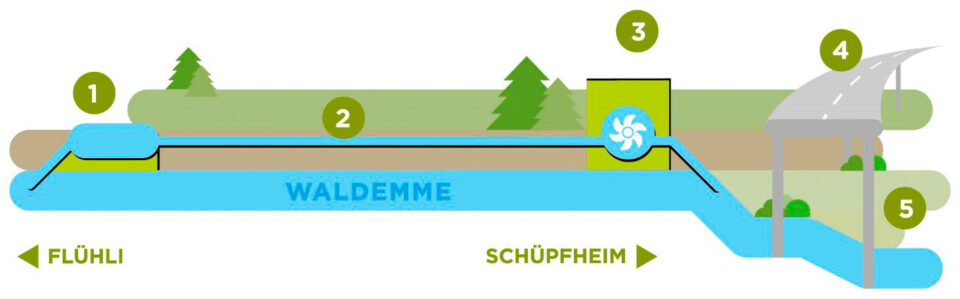
    The roughly one-year construction phase begins with the ground-breaking ceremony. The water intake is at the hamlet of Matzenbach in Flühli. From this location, part of the water from the Waldemme is routed via a 2.1-kilometer-long underground pressure line to the power plant headquarters, where ecological electricity is produced. The power plant control center is located directly in front of the Lammschlucht at the Chrutacher Bridge. Immediately afterwards, the water is fed back into the natural course of the Waldemme and flows through the Lamm Gorge. The power plant has an output of 1.4 megawatts and produces an average of 6.5 GWh of electricity. This means that clean electricity can be generated from mid-2023, which will cover the annual needs of around 1,500 average four-person households. CKW is investing CHF 12.4 million in the power plant.

    In the hamlet of Matzenbach, the water intake (1) takes part of the water from the Waldemme. In the approximately two-kilometer-long underground pressure line (2), the water is routed to the power plant center (3) at the Chrutacher Bridge (4), where it drives a turbine and generates electricity. Directly at the headquarters, the water is fed back into the natural course of the Waldemme and flows through the Lamm Gorge (5), which is untouched by the project.
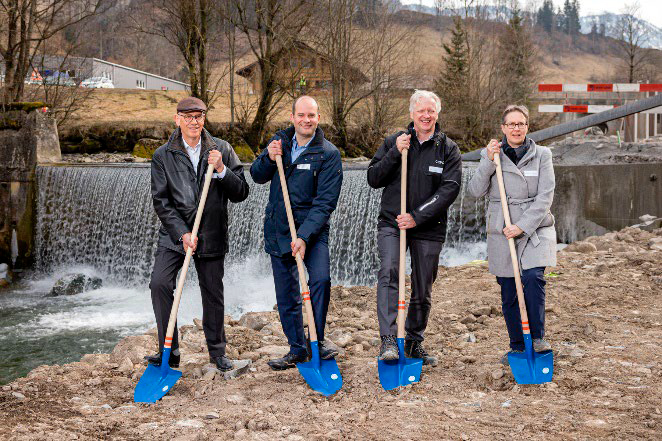
    Breaking ground at the Waldemme: (from left) Hans Lipp, Flühli municipal mayor, Fabian Peter, member of the cantonal government and head of the building, environmental and economic departments of the canton of Lucerne, Martin Schwab, CEO of CKW and Hella Schnider-Kretzmähr, Flühli municipal president.
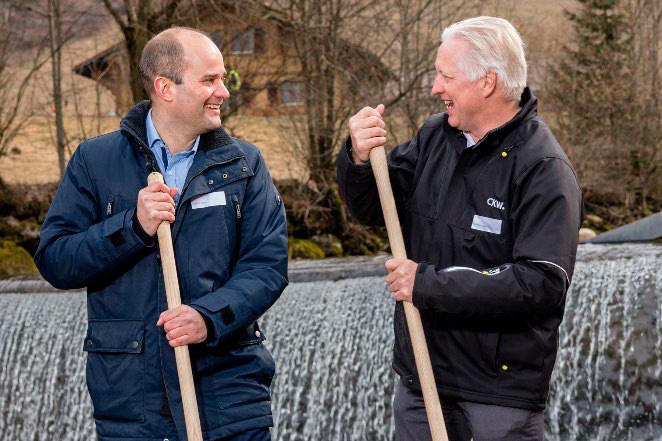
    Happy about the start of construction: Fabian Peter, member of the government and head of the building, environment and economic department of the canton of Lucerne, and Martin Schwab, CEO of CKW.

    About CKW: The CKW Group is a leading Swiss provider of integrated energy and building technology solutions. For more than 125 years, the company has been supplying electricity to over 200,000 end customers in the cantons of Lucerne, Schwyz and Uri. In addition, there are innovative products and services throughout Switzerland in the fields of connectivity & IT infrastructure, electrical engineering, energy technology, IT & communication and security. The CKW Group employs over 2,100 people. With around 350 apprentices in 14 professions, it is the largest private-sector training company in Central Switzerland.
    In the 2020/21 financial year, CKW generated sales of CHF 916 million. With 81 percent of the shares, Axpo Holding AG is the majority shareholder of CKW.
    Further information at www.ckw.ch

  • CKW buys Elektro Basilisk AG

    CKW buys Elektro Basilisk AG

    CKW AG is growing in German-speaking Switzerland: the Lucerne-based specialist for integrated energy and building technology solutions has bought the Basel electrical company Elektro Basilisk AG . As CKW reports , with this targeted addition, it is optimally expanding its own portfolio. At the same time, it supports the strategy of expanding the building technology business, and especially solar. "Elektro Basilisk AG optimally complements the competencies within the CKW Group both geographically and thematically," Thomas Gisler, head of the electrical business unit at CKW, is quoted as saying.

    The company Basilisk, founded in 1997, offers all services related to electrical and telematics installations, repair services and solar technology. Almost 40 employees work for the company. Like the managing directors, you will remain in the company.

    According to its own information, the CKW Group supplies over 200,000 end customers in the cantons of Lucerne, Schwyz and Uri with electricity. It also offers products and services across Switzerland in the areas of IT infrastructure and communication, electrical engineering and energy technology. CKW employs more than 1900 people.

  • CKW submits a license application for a hydropower plant

    CKW submits a license application for a hydropower plant

    CKW has submitted the concession and building application for the Waldemme small hydropower plant in Flühli LU to the Canton of Lucerne. In the past few months, the project has been revised with the involvement of environmental protection organizations, as CKW writes in a press release. In contrast to the original plan, the Lammschlucht gorge, among other things, is to remain untouched.

    According to CKW's plans, the power plant is to be completed by 2023. It should have an output of 1.4 megawatts and produce around 6.5 gigawatt hours of electricity per year. According to the information, this will cover the needs of around 1,500 four-person households. CKW expects an investment sum of around 13 million francs.

    With the investment, CKW is "making a contribution to a secure and sustainable energy supply" and "taking care of orders for the Lucerne economy", says CKW CEO Martin Schwab. The major part of the order volume will remain in the canton of Lucerne.

    Government Councilor Fabian Peter (FDP) welcomes the project. “The canton of Lucerne must also make its contribution to the energy transition in 2050 and to achieving the climate targets. There is potential for this in the field of renewable energies that should be used and promoted with suitable framework conditions ”, he is quoted in the communication from CKW.

  • New large storage system should help stabilize the network

    New large storage system should help stabilize the network

    CKW and Axpo are responding to the expansion of volatile renewable energies. In 2021 you will be implementing a battery storage system in Rathausen which, according to a CKW announcement , can be used for three different markets at the same time for the first time. On the one hand, the system can provide electricity when it is needed, thereby breaking the peak loads. On the other hand, it should help Swissgrid to keep the voltage in the grid stable. Ultimately, it helps to quickly balance out differences between the supply of electricity and demand at any time.

    The system consists of two large batteries, each weighing 50 tons, and each housed in a 12 meter long container. It has an output of 6.25 megawatts. That is enough to supply 15,000 households with electricity for one hour.

    The system will be installed from mid-2021 and integrated into CKW's medium-voltage network.

  • CKW relies on intelligent electricity meters

    CKW relies on intelligent electricity meters

    According to a media release , CKW has already used intelligent measuring systems in the past “in selected regions and specifically in larger new buildings”. Now all conventional electricity meters in the supply area are being replaced by smart meters. Accordingly, CKW will now replace 180,000 meters.

    The intelligent measuring systems have several advantages for consumers, as CKW informs. In future, customers will be able to track their electricity consumption online and thus “identify potential energy savings more easily”. In addition, the meter reading no longer has to be read on site, which makes things easier when moving, for example. "Furthermore, the CKW customer service can answer questions about energy consumption or the electricity bill faster and more competently with the current measurement data," says the message.

    CKW will benefit from the experience it has already gained with intelligent measuring systems. The company tested various communication technologies. "The radio technology used has proven itself particularly in the predominantly rural areas of Central Switzerland compared to other technologies in terms of stability," said CKW. This stability is "of central importance" for the operating costs.