Tag: CO2 Emissionen

  • Climate-neutral industry – Vision 2026

    Climate-neutral industry – Vision 2026

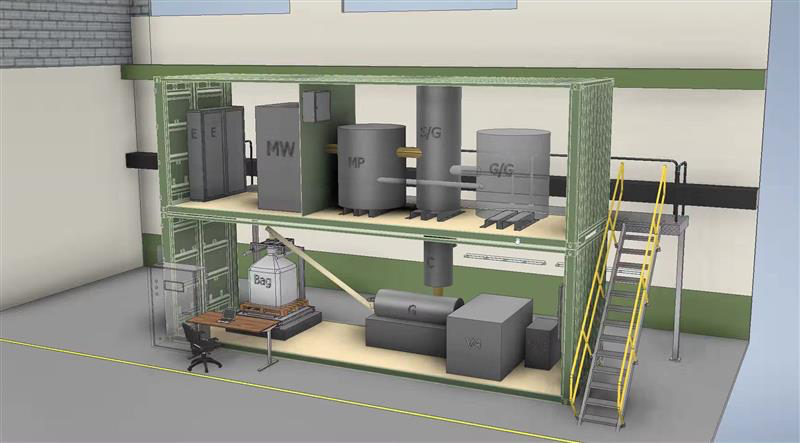
    Founded in 2022, the Association for the Decarbonisation of Industry aims to reduce emissions to a minimum through innovative technology. At the forefront is the methane pyrolysis process, which enables emission-free energy utilisation by splitting hydrogen from methane. The remaining carbon is utilised as a resource, for example as humus in agriculture or as a building material, which binds the carbon in the long term.

    Cooperation between business, research and politics
    Without the cooperation of 16 leading companies, Empa and politicians from the Canton of Zug, the project would hardly be possible. Together, they are contributing to the development and scaling up of the pyrolysis process, which is to be scaled up from laboratory to industrial size by 2026. The partners are providing funding of over CHF 8 million, thereby sending a strong signal for the decarbonisation of industry.

    Methane pyrolysis Reduction of CO2 emissions
    The association is focusing on methane pyrolysis, a process that minimises CO2 emissions when using natural gas. Instead of traditional combustion, hydrogen is obtained from methane, while the carbon is in solid form and therefore does not cause any emissions. This technology could save up to 270 g of CO2 per kilowatt hour produced and is therefore a potential key to the net-zero targets by 2050.

    Sustainable ecosystem without waste
    The association is working to create an ecosystem that optimally utilises all components of the process. Through the circular economy concept, not only hydrogen, but also carbon and waste heat are to be efficiently reused to avoid waste. This holistic strategy creates a model that is ideally suited to a climate-friendly future.

    Membership of the Association for the Decarbonisation of Industry
    Companies that are committed to the climate-neutral future of industry and would like to benefit from the findings of the association can become members. The association is tax-exempt and donations are deductible in the canton of Zug. Members gain access to advanced knowledge and support an initiative that lays the foundations for an emission-free
    industry.

  • Solar powered RV charges towing vehicle

    Solar powered RV charges towing vehicle

    The Lucerne University of Applied Sciences and Arts ( HSLU ) has designed a practical example of sustainable living without CO2 emissions: a mobile home. The electricity that the Solar Butterfly needs inside is produced by fold-out solar wings. This also charges the electric towing vehicle. According to a press release , students led by Stephen Wittkopf are significantly involved in the implementation of the project. He heads the knowledge and innovation transfer at the Department of Technology & Architecture at the HSLU.

    The Solar Butterfly is currently being built near Lucerne in central Switzerland. Its construction material consists largely of plastic waste that is collected from the sea and then transformed. The motorhome is 10 meters long and 13 meters wide with the sun panel wings up. They offer a total of 80 square meters of space for generating solar power.

    The project was initiated by Swiss environmental pioneer Louis Palmer. 15 years ago he was the first person to circumnavigate the world in a solar-powered car. From May 2022, the Solar Butterfly will travel around the world together with its passengers. On this trip around the world they want to identify 1000 inspiring projects against global warming, record them and then publish them.

  • Switzerland launches building education offensive

    Switzerland launches building education offensive

    The shortage of skilled workers in the construction and real estate industry is to be remedied. To this end, the Swiss “Building Education Offensive” has now been launched. The starting event will take place on January 20 at 4 p.m. and will be streamed live. According to a press release from the Swiss Federal Office of Energy , a “roadmap with 32 measures and four fields of action” will be presented.

    Ultimately, the building sector in Switzerland should make a significant contribution to reducing CO2 emissions. To do this, “hundreds of thousands of fossil-based heating systems would have to be replaced by renewable ones, a large number of buildings would have to be renovated in terms of energy, intelligent control systems would have to be installed and the power supply of the buildings would have to be completely converted to renewable energies”. However, there is already a shortage of skilled workers. At the same time, the number of those who decide to do an apprenticeship in this industry is declining.

    The education offensive was developed by all relevant representatives of the building and education sector. They were supported by EnergieSchweiz , the Swiss Federal Office of Energy’s program for renewable energy and energy efficiency. The State Secretariat for Education, Research and Innovation , the Federal Office for the Environment and the State Secretariat for Migration were also involved.

  • Zurich is investing CHF 573 million in district heating

    Zurich is investing CHF 573 million in district heating

    In a press release , the City of Zurich announced the approval of the “Thermal grids of the power plant” credit line in the amount of CHF 573 million. The amount is to flow into the switch from fossil to renewable heating and cooling in the city and financially secure the conversion of the heating supply required to achieve the climate target. Those entitled to vote should decide on the approval in 2022.

    The city set the course for the climate policy expansion plans “ Net Zero 2040 ” of the electricity company of the city of Zurich ( ewz ) in spring 2021 with the opening of the Zurich Heat Advice Center. The legal foundation was laid in November 2021 with the Heat Supply Ordinance.

    City Councilor Michael Baumer is quoted as saying that the municipal measure, which is divided into six sub-projects, makes an “important contribution to decarbonisation in the heating sector”. The financial buffer is “only a first step, the actual work is just beginning,” announces Baumer.