Tag: Co2-neutral

  • Biochar concrete opens up prospects for a climate-neutral construction industry

    Biochar concrete opens up prospects for a climate-neutral construction industry

    Four construction companies from Switzerland have joined forces to found KLARK AG, based in Landquart GR, on 25 August 2025: Ulrich Imboden AG from Visp VS, Logbau AG from Maienfeld GR, Novakies AG from Rapperswil BE and Toggenburger AG from Winterthur. Their common goal is to make KLARK concrete, which is CO2-neutral thanks to the addition of biochar, available throughout the country.

    In a press release, they describe the founding of KLARK AG as a milestone for the Swiss construction industry: “It shows that ecological responsibility, economic thinking and cooperative structures can go hand in hand – even and especially in an industry that has long been considered sluggish.” KLARK stands for a move towards a building materials market “that not only measures climate effects, but actively changes them”. This is “industry innovation instead of individual battles”.

    The KLARK climate clay is mixed with as much biochar from untreated waste wood from regional forestry until a CO2-neutral product is created. According to the information provided, it has the same properties as traditional concrete, which causes CO2 emissions of up to 250 kilograms per cubic metre.

    The CO2 reduction performance has been verified with a verified life cycle assessment in accordance with the accounting rules of the Coordination Conference of Building and Property Bodies of Public Building Owners(KBOB). The life cycle assessment results are published on the KBOB list. KLARK concrete can be produced with 50, 75 or 100 per cent sink rate and is fully recyclable.

    Eberhard Bau AG from Kloten ZH, Aarebeton Aarau AG and Arnold & Co. AG Sand- und Kieswerke from Flüelen UR are already on board as licence holders for the production of KLARK concrete. “This creates a central competence centre for CO2-saving construction with concrete, supported by regional pioneers with a national reach,” the press release states.

  • CO2-neutral commercial building with ramp and roof garden

    CO2-neutral commercial building with ramp and roof garden

    Felix Partner Architektur und Design from Zurich have symbolically handed over the first dismantled components of the former Stewi headquarters in Winterthur-Grüze to their customers for recycling at the start of construction of their Green Spin project in Winterthur. According to a press release, most of the demolished parts will not end up in landfill, but will be reused in other buildings. The demolition concrete will also be shredded and used to produce recycled concrete.

    A service building for commercial tenants will be built on the same site. Companies that also focus on sustainability themselves are set to move in from late summer 2027.

    The building shell is planned as a CO2-neutral timber construction. A green inner courtyard and a roof garden will also be realised. Photovoltaic modules on the façades and wind turbines will supply green electricity, while geothermal energy will be used for heating. The building is to be certified in accordance with the international BREEAM sustainability standard.

    The centrepiece is a ramp that is up to six metres wide and rises gently around the inner courtyard. It provides access to the rental areas on all levels, including by bicycle. The commercial, office, production and sports space will be complemented by catering outlets and individual retail outlets.

    “I hope this project will inspire others to think big and act boldly,” said FDP National Councillor Andri Silberschmidt in his speech at the start of construction. Jens Andersen, Winterthur’s master builder, emphasised that the project “fits in perfectly with our strategy of sustainable urban development”.

  • Where electricity will come from in 2050

    Where electricity will come from in 2050

    For Switzerland to become CO₂-neutral by 2050, transport, heat supply and industry must be largely electrified. Today’s electricity demand of 56 terawatt hours will increase to around 75 TWh by 2050. At the same time, 23 TWh will come from nuclear energy. The necessary reorganisation of the energy system is far-reaching in technical, economic and social terms.

    Massive expansion of renewable energy
    According to the EDGE report, around 60 % of electricity must be covered by new renewable energies by 2050, specifically 45 TWh per year. This would be possible with 28 TWh from photovoltaics, 13 TWh from wind power and 4 TWh from biomass. To achieve this, photovoltaic capacity would have to be quadrupled to 26.8 GW. Wind power would need to be expanded 80-fold to 8.4 GW, especially for winter operation. According to the researchers, this is hardly realisable without strong subsidies.

    Limiting electricity imports makes the system more expensive
    The new Electricity Act limits net electricity imports in winter to 5 TWh. In order to meet this target, an additional 80 % more wind power, 11 % more gas capacity and 10 % more solar capacity would be required. This would increase electricity generation costs by 20 % and electricity prices could more than double.

    Europe remains decisive
    If European electricity trading were to be severely restricted, e.g. through a 70 % reduction in cross-border grid capacities, Switzerland would have to expand wind power by a further 20 %. Supply costs would rise by an additional 8 %. A survey by the EDGE consortium shows the conflicting priorities. 60 % of the population would like to cooperate with Europe, while at the same time 70 % want energy independence and favour domestic energy sources.

    Investments flow abroad
    Another study shows that more than half of the annual investments made by Swiss energy suppliers in large-scale renewable energy projects are channelled mainly to Germany, France and Italy. Only 1 % of these funds are invested in Switzerland. There is a lack of suitable projects or framework conditions in Switzerland. This means that Switzerland is often financing the energy transition indirectly, but not at home.

    Net zero has its price
    The cost of living could rise between 2020 and 2050, for example due to CO₂ taxes, emissions trading or higher production costs. The annual consumption loss of a household could be 0.63-0.75 %, depending on the global climate protection pathway. Without offsetting options abroad, the costs could rise to up to 1%. In the long term, however, this would be more favourable than the consequences of unchecked climate change.

    The energy transition is feasible and challenging
    A CO₂-neutral electricity supply by 2050 is technically possible if photovoltaics and wind power are massively expanded, imports are used intelligently and investments are channelled in a targeted manner. Access to the European electricity market remains crucial. At the same time, we need broad social support and an understanding that inaction will be more expensive than a bold transformation.

  • The CO2-neutral future as a common goal

    The CO2-neutral future as a common goal

    The collaboration between Zimmermann and Ackermann aims to explore innovative ways of utilising the atmosphere as a resource. Empa and Eawag are working together to develop technologies that effectively bind CO2 and thus contribute to decarbonisation. Despite the high expectations and pressure to deliver solutions, both recognise an urgent need to act and are optimistic that they can make a significant contribution.

    Research and cooperation as the key to success
    The research institutions rely not only on their internal expertise, but also on cooperation within the entire ETH Domain and with international partners. The aim is to develop practicable solutions to the climate crisis by pooling knowledge and resources. Eawag, which specialises in water research, and Empa, which focuses on materials science, complement each other perfectly in their efforts to promote both climate adaptation and climate protection.

    Future-oriented projects and technologies
    From the development of negative emission technologies to the exploitation of new energy sources from CO2, researchers are working on projects that will enable a long-term change towards a sustainable society. The initiatives include both the improvement of existing technologies and research into innovative approaches to reducing CO2 from the atmosphere.

    The various “pillars” of the concept are currently being developed, such as the extraction of CO2, its chemical conversion and, finally, technologies to produce value-adding materials in which the carbon is bound in the long term. The first projects for negative emission technologies are already under development at Empa, such as insulation materials made from biochar and types of cement that absorb CO2 during the setting process instead of releasing it. Further initiatives are to be launched next year. Ms Zimmermann herself would like to launch a wood topic based on her research background. Initial discussions between various stakeholders have begun.

    Funding and support for the research initiatives
    Funding for the ambitious projects is secured from various sources, including grants and contributions from the participating institutions. The aim is to use the research work to support not only Switzerland but also the global community in the fight against climate change.

    Switzerland as a pioneer in climate protection
    Thanks to its favourable framework conditions, Switzerland continues to be an international leader. It is ideally positioned to develop technologies and concepts and to apply and market them internationally. This increases the competitiveness of Swiss industry and makes a valuable contribution to global climate protection.

    You can find the full interview at this link. https://www.empa.ch/web/s604/mining-the-atmosphere-interview-tanja-zimmermann-martin-ackermann

  • Griesser protects passive house in Barcelona from the sun

    Griesser protects passive house in Barcelona from the sun

    According to a press release, Griesser, the sun shading manufacturer based in the St.GallenBodenseeArea, has supplied and installed the sun shading solution for an older terraced house in Barcelona that has been converted into a CO2-neutral passive house. The planning and consultancy firm Energiehaus Arquitectos in Barcelona, which specialises in the renovation of energy-efficient buildings, renovated the building to create a completely CO2-neutral property. The building is called “ShowPass“, where “Pass” stands for passive house. According to Griesser, it is the first CO2-neutral building renovated in Barcelona to receive certification from Ecómetro in Madrid and EnerPHit certification from the Passive House Institute in Darmstadt, a standard for the modernisation of old buildings with passive house components.

    For the external solar shading, the Spanish architectural firm opted for Metalunic Sinus slat blinds from Griesser. According to the press release, the Swiss sun shading specialist is thus making a key contribution to the CO2 neutrality of the building.

    Micheel Wassouf, CEO of Energiehaus Arquitectos, is quoted as saying that sun protection is not only a functional benefit but also a creative design tool. The design of the Griesser slat blinds makes a significant contribution to the aesthetics of the building. They harmonise perfectly with the larch wood façade. “Sun protection should be seen as a creative design tool and not as a dry fulfilment of duty,” continues Wassouf.

    Griesser AG, headquartered in Aadorf, produces in its own factories in Switzerland, Austria and France and sells its products in over 20 countries.

  • Umwelt Arena shows lighthouse project Building 2050 Urdorf

    Umwelt Arena shows lighthouse project Building 2050 Urdorf

    The latest flagship project of the Building 2050 concept of the Swiss Environment Arena Foundation isa CO2-neutral housing development in Urdorf. It is now being made accessible to interested parties as part of guided tours. According to a LinkedIn post by the foundation, the programme is also suitable as a company outing. In the first module, participants are given a guided tour of the housing complex itself. They are also shown a model flat. The second module takes place in the Umwelt Arena in Spreitenbach, where further background information on the Building 2050 concept is presented. The Environment Area itself will also be in focus. Among other things, participants could travel between the two locations on the Limmattalbahn.

    The CO2-neutral residential development in Urdorf features several sustainable building concepts. For example, recycled concrete and brick were used, which allow solar thermal energy to be stored with as little loss as possible. In addition, showers with heat recovery, geothermal probes and triple-glazed windows, for example, contribute to high energy efficiency. Thanks to such measures, electricity and heat are free of charge for tenants within a defined budget. The development was built by W. Schmid + Co. Glattbrugg and Umwelt Arena’s exhibition and specialist partners.

  • AEW builds heating network in Villmergen industrial estate

    AEW builds heating network in Villmergen industrial estate

    AEW Energie AG has announced its intention to become more efficient in the expansion of renewable thermal energy and is establishing a heating network in the Villmerger industrial area at a cost of CHF 12 million. According to a press release, the municipality granted permission for the building application submitted in April. Construction work is to start in the 4th quarter of the current year. The date for the first delivery of renewable district heating to about 550 single-family homes is set for the 2024/2025 heating period.

    David Gautschi, Head of Production at AEW, has announced that the total heat will save 710,000 cubic metres of natural gas annually, which would cause 1500 tonnes of CO2 emissions.

    According to the information, the heat network uses waste wood as fuel, wood from the region as needed according to ecological cascade use, and solar energy with the help of a photovoltaic system with a peak output of 200 kilowatts.

    The supply unit is to be built between the Bünztalstrasse in the south-west, the municipal boundary in the south-east, the railway line in the north-east and the agricultural zone in the north-west. The heating centre will be built on the Cellpack AG site on Durisolstrasse. The fuels will be supplied via Anglikerstrasse and the Cellpack AG site.

    With this project, the Aargau electricity supplier wants to make a contribution to the Energy Strategy 2050.

  • Uneco produces petrol and diesel from wood

    Uneco produces petrol and diesel from wood

    Sursee-based Uneco Energie Schweiz AG is currently installing a pilot plant for the local production of synthetic fuels from biomass. The facility will be built on the site of the two Buttisholz companies Interspan Tschopp and Toma Holz . Uneco board member Peter Müller presented the project at the second energy aperitif organized by the Energie Hub Buttisholz association.

    The “Putin-free” energy, as Müller described the new form of energy according to a report in the weekly newspaper “Anzeiger vom Rottal” at the energy aperitif, is to be produced primarily from wood residues. According to the information, the process is based on the technology of so-called thermochemical carbon conversion . The fuels kerosene, petrol and diesel are obtained from wood, biomass and other organic waste. Finally, activated carbon can also be produced. This could be used by the construction industry, for example, as insulating material.

    The pilot plant is scheduled to go into test operation at the end of the year. Its expansion in the coming year is already being considered. With this pilot plant, Uneco wants to show how non-fossil energy can get from the laboratory into the local real economy.

    The energy aperitif is organized by the Energie Hub Buttisholz association. The municipality wants to be CO2-neutral by 2035 and thus become a lighthouse project in the energy transition.

  • This is how the paper energy system works

    This is how the paper energy system works

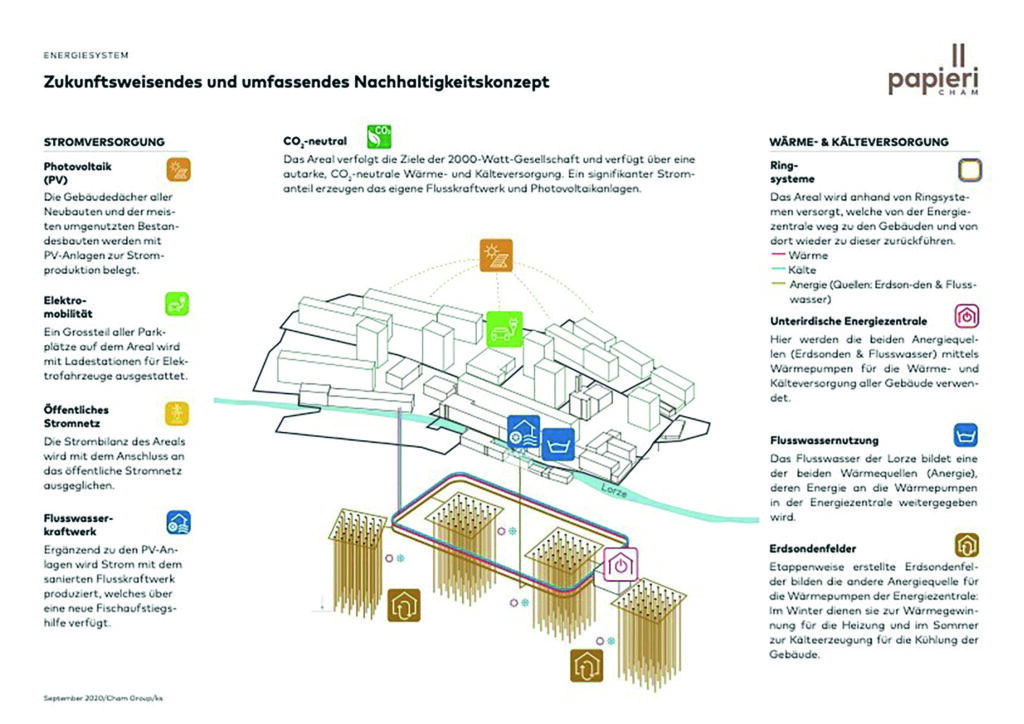
    The Papieri area is to be operated in a CO2-neutral manner and to play an important role in the implementation of the desired 2000 watt society. The sophisticated energy system consists on the one hand of its own river power plant, which has been producing electricity since 1890. Now it has been upgraded with the latest technology as part of the site development. In addition, the water from the Lorze is used as a heat source and electricity production is supported by photovoltaic systems on the building roofs. Newly installed heat pumps complete the advanced energy system. Not only is the CO2 neutral
    Real heating of the buildings in winter, but also the cooling of all residential and commercial units in summer.

    Modern technology also sets the tone when it comes to living: All apartments are equipped with fiber optic connections and a smart living system. The control of the heating, ventilation, shading or also the light and energy management can be controlled via a centrally installed touch panel or via mobile devices such as smartphones or tablets.

  • Primeo Energie is building a new heating center in Allschwil

    Primeo Energie is building a new heating center in Allschwil

    According to a media release , Primeo Energie is building a new underground heating center for the existing heating network between the indoor swimming pool and the music school in Neuallschwil. The foundation stone was officially laid on Wednesday. The system is operated with two wood-burning boilers with an output of 840 kilowatts each. In addition, a heat pump uses the environmental heat and waste heat from the indoor pool. This generates 80 percent of the energy required. The plant will go into operation in early summer 2021.

    "The community and Primeo Energie are setting another example for a renewable, CO2-neutral heating supply", said Nicole Nüssli-Kaiser, President of the City Council. "With this central heating system, we not only heat the school building, but also enable the entire district to rely on renewable thermal energy."

    This new heating center is another piece of the puzzle in the heating network, the message goes on to say. It will be connected by a pipeline to the heating network, which is also primarily fired with wood chips, at the old people's center at Bachgraben. This enabled synergies to be used between the two district heating networks. Further properties are to be connected to the network. By merging several centers, security of supply will also be increased.