Tag: CO2 Speicherung

  • 3D-printed concrete stores CO2 and reduces resource consumption

    3D-printed concrete stores CO2 and reduces resource consumption

    Researchers at the Structural Engineering Laboratory of the Swiss Federal Laboratories for Materials Science and Technology (Empa) are working on the development of concrete elements produced using a 3D printer. According to a press release, the building elements are stable without traditional steel reinforcement and are virtually cement-free. The material is designed to store carbon dioxide as it cures.

    The research is being carried out as part of the European CARBCOMN project (Carbon-negative compression dominant structures for decarbonised and de-constructable concrete buildings). Alongside Empa, researchers from the Swiss Federal Institute of Technology Zurich (ETH) and the Empa spin-off re-fer in Seewen, as well as other European partners, are involved in the development.

    The material for 3D printing is derived from recycled industrial waste, such as steel slag. Geometrically optimised shapes are produced using a special process. Iron-based shape memory alloys (Fe-SMA) from re-fer are used as reinforcement. To cure this concrete, carbon dioxide is injected into a combustion chamber, where it chemically bonds with the concrete mixture. “We are combining unique expertise here – 3D printing, structural performance and our speciality: iron-based shape memory alloys,” Empa researcher Moslem Shahverdi is quoted as saying in the press release. “On the one hand, we use digital manufacturing methods to build in a resource-efficient manner. On the other hand, we are replacing conventional cement with binders that have a lower carbon footprint.” The concrete components are also designed so that they can be dismantled after use and reused elsewhere.

    Launched in 2024, the four-year project is funded under Horizon Europe and brings together eleven leading research institutions and architectural firms from across Europe. According to the press release, these include Ghent University, Darmstadt Technical University, the University of Patras in Greece, as well as Zaha Hadid Architects from London, Mario Cucinella Architects from Bologna, and the companies Tesis from Penta di Fisciano in Italy, orbix from Genk, and incremental 3D from Innsbruck.
  • Climate project establishes CO2 storage within the building materials cycle

    Climate project establishes CO2 storage within the building materials cycle

    According to a press release, the climate protection programme run by zirkulit Beton AG in Kloten has now been officially registered as a project aimed at increasing carbon sequestration capacity. This makes it the first project for CO2 storage in circular concrete to be approved by the FOEN in Switzerland. The programme comprises several CO2 storage facilities operated in partnership with concrete manufacturers at various locations across Switzerland.

    As part of the programme, biogenic CO2 is captured from Swiss biogas plants, transported to recycled concrete plants and, there, brought into contact with granulate from demolition concrete in the storage facilities developed by zirkulit. The CO2 reacts with the cement paste contained in the concrete aggregate to form calcium carbonate and is thereby permanently bound in a mineral form. This aggregate is then used to produce circular concrete.

    “This creates a permanent carbon sink within a durable building material,” says zirkulit Beton AG, “a key lever on the path to net-zero in the building sector.” This underscores its commitment to actively contributing to the transformation towards a circular and climate-friendly construction industry.

    The programme is financially supported by the Klimarappen Foundation. Together with the partners of zirkulit Beton AG, it is funding the project as one of five national pilot projects for negative emission technologies and carbon capture and storage. Klimarappen is providing a total of 50 million Swiss francs for this purpose. Funding is provided under a multi-year supply contract for the CO₂ removals achieved through the programme.

  • Research develops climate-friendly alternative to cement

    Research develops climate-friendly alternative to cement

    The production of cement as a binding agent for concrete accounts for 8 per cent of global carbon dioxide emissions. Researchers from various European universities and institutes are working under the leadership of the Karlsruhe Institute of Technology (KIT) in Germany to develop alternatives to cement. According to a press release, the Zug-based building materials manufacturer Holcim is involved in this research work as part of the European C-SINK project.

    The research focuses on magnesium-containing silicates, which react with CO₂ to form magnesium carbonate in a targeted, accelerated mineralisation process. This additive could be the new binder for concrete, replacing Portland cement clinker. The material is currently being tested in the KIT laboratories with the participation of all parties involved. This involves close integration of simulation, experimental research and large-scale, realistic testing at the Materials Testing Institute in Karlsruhe. “We can use simulations and machine learning to predict which concrete formulations will work,” says Frank Dehn, head of the Institute for Solid Construction and Building Materials Technology and the Karlsruhe Materials Testing and Research Institute at KIT, quoted in the press release. “We then use experiments in a targeted manner to verify these predictions. In this way, we want to develop reliable parameters that show that concrete with the new binder is climate-friendly and meets the requirements for load-bearing capacity, durability and safety.”

    The project is funded by the European Innovation Council (EIC) as part of the Pathfinder programme “Towards cement and concrete as a carbon sink”. In addition to KIT and the coordinating PAEBBL AB (Sweden), the Technical University of Delft (Netherlands), the Catholic University of Leuven (Belgium), the Agencia Estatal Consejo Superior de Investigaciones Científicas and PREFABRICADOS TECNYCONTA S.L. (both Spain) are also involved, with support from Holcim Technology. The project is funded with 4 million euros over a period of four years.

  • Innovative materials in construction

    Innovative materials in construction

    Lightweight concrete in a single pour
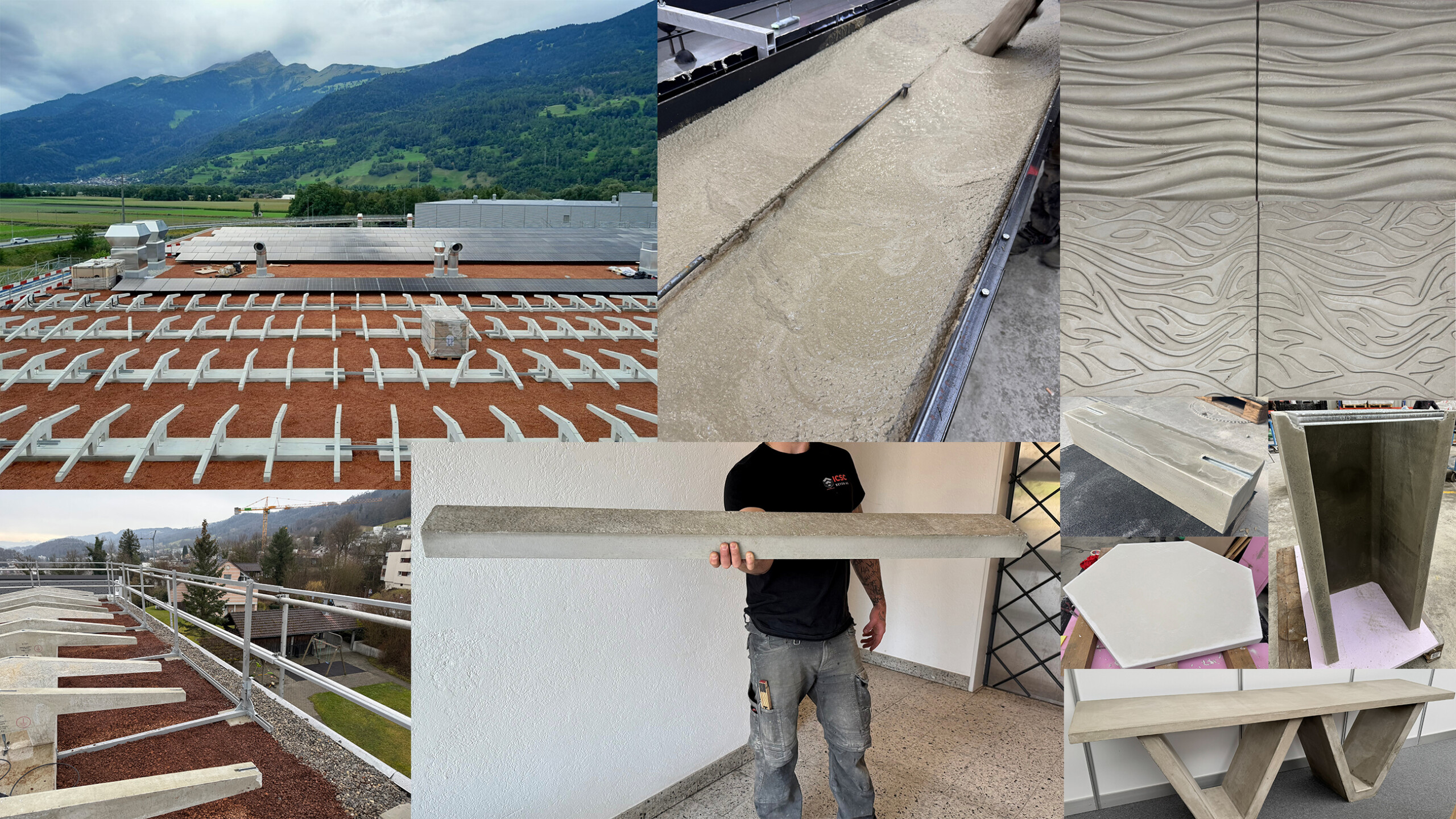
    ICSC Beton AG presented prefabricated parts made from its own lightweight concrete based on expanded glass, which are significantly lighter than normal concrete. At the same time, they have good insulation values, frost resistance and fire protection. This material is used to produce prefabricated elements that speed up construction processes and increase quality on the construction site. One focus is on lightweight concrete elements that combine static function, integrated ballasting and simple installation of solar modules, thus enabling roof renovation and solar installation in a single step. For experts in the audience, it became clear how prefabrication, lightweight concrete and photovoltaics can be combined to create sophisticated system solutions. With less weight, fewer interventions in the roof and more energy yield per square metre.

    Climate-neutral concrete on the construction site
    KLARK demonstrated how CO₂-saving concrete is already being used in building construction today. Without additional work for the construction site and with an externally tested climate impact. The concrete is based on the addition of biochar from waste wood, which permanently binds the carbon and stores hundreds of kilograms of CO₂ per cubic metre in the structure of the concrete. Technically, it largely behaves like conventional concrete. It can be pumped or processed by crane and remains fully recyclable. The stored CO₂ is not released again during demolition. In the Speakers Corner, it became clear that this opens up the opportunity for clients and planners to make measurable contributions to net zero strategies using familiar construction methods without having to reinvent processes and roles on the construction site.

    Climate additives for plaster and co.
    KohlenKraft presented a climate-positive building material that permanently binds CO₂ in the building and at the same time offers advantages in terms of building physics. The centrepiece is a climate additive based on biochar, which can be mixed into mineral building materials such as plasters and coatings, turning building components into long-term carbon stores. In addition to CO₂ storage, the systems aim to improve the indoor climate and regulate humidity. This is an argument that has met with great interest, particularly in refurbishments and high-quality interior fittings. The message to manufacturers, planners and construction companies is that climate effects can be integrated directly into existing products without having to fundamentally change processing and detailed planning.thinking in concrete, building with wood
    In the Speakers Corner, the TS3 technology used real projects to demonstrate how familiar design logic and a new timber construction technique come together. An important step in turning large-volume timber buildings from a pioneering project into an established option. Today, large-scale, biaxial load-bearing timber ceilings with column grids of up to 8 x 8 metres can be realised with a special end-face bonding of cross-laminated timber. Load-bearing structures that were long reserved for reinforced concrete. The panels are rigidly joined on site by grouting the joints with cast resin, resulting in beam-free, point-supported flat timber ceilings that can be treated like flat concrete ceilings in the design. For architects and engineers, this opens up great freedom in terms of floor plans and subsequent conversions, as non-load-bearing walls can be moved flexibly, while weight, construction time and carbon footprint are significantly reduced compared to concrete ceilings.