Tag: Credit Suisse

  • Assessment of the interest rate market in March by Avobis

    Assessment of the interest rate market in March by Avobis

    Fears of inflationary dynamics getting out of hand seem to be confirmed. In February, almost all nine CPI segments recorded price increases compared to the previous month. This is due to increasing prices for services and goods regardless of their origin (Figure 1). An easing of inflation is currently not in sight and with the first adjustment of the mortgage reference rate expected in June, inflation is likely to move further away from the SNB target. The market then adjusted its interest rate and inflation expectations significantly upwards, as can be seen from the strongly inverted yield curve.

    However, the problems at Silicon Valley Bank and later at Credit Suisse led to fears of a possible banking crisis, which pushed the inflation issue into the background. The concern that further interest rate steps by the central banks could cause a systemic collapse in the banking sector also led to a rethink in the Swiss interest rate market, causing market interest rates to correct sharply downwards. The takeover of Credit Suisse by UBS and the global injection of liquidity into the banking system subsequently partially alleviated fears. Ultimately, the SNB’s monetary policy decision on 23 March and its signal caused a certain disillusionment in the markets, whereupon the focus returned to the inflation problem and higher interest rate steps were thus again priced in.

    Although the swap curve at the end of the month is roughly the same as at the beginning of the month, the initial situation has changed noticeably, which is particularly evident in the higher expected interest rate volatilities at the end of the month compared to the beginning of the month.

    The impact of the banking turmoil on economic growth is uncertain. A decline in demand could dampen inflationary pressures. The impact on financing conditions is equally unclear, as banks may become more cautious and reluctant to lend. This would be similar to an interest rate hike in the fight against inflation. These effects now need to be monitored and assessed accordingly, which is why the swap curve implies only moderate interest rate steps for the next two meetings despite decoupled inflation.

    Our expectations
    Inflation in Switzerland has been decoupled from normal conditions. The Swiss franc as a monetary policy instrument to combat imported inflation is only effective to a limited extent in the fight against rising domestic inflation. Additional restrictive measures are therefore necessary. If the global financial system continues to prove robust, another 50 bps hike could be implemented at the next meeting. However, should further systemic risks emerge, a smaller rate hike or even a pause in interest rates could be considered. It is crucial to monitor the situation carefully and evaluate various scenarios comprehensively.

    Abroad
    Growing concerns about a possible banking crisis following the collapse of three regional banks in the US have prompted central banks to respond with liquidity injections. Nevertheless, a recent study suggests that the US banking system has unrealised losses of two trillion USD, which strongly questions the possibility of further interest rate hikes. Thus, while inflation remains unimpressed despite the unexpectedly rapid rise in interest rates, cracks are beginning to appear in the banking system.

    The rise in interest rates since last year has led to considerable losses in the value of mortgage-backed bonds and other virtually risk-free bonds, which make up a large part of banks’ assets. One study shows that the market value of the assets of the US banking system is two trillion USD lower than the binancial value. Combined with a high proportion of uninsured deposits at some US banks, loss realisations could threaten their stability.
    If half of the uninsured depositors were to withdraw funds, close to 190 banks would be potentially exposed to risk. This would also affect insured depositors, with potentially $300 billion of insured deposits at risk.

    Although the banking system is currently sound, there could be a lack of liquidity in the event of a bank run, leading to a cascading effect in loss realisation and ultimately jeopardising solvency. This could expose both American and other banks to a looming liquidity crisis. Therefore, the Fed, the ECB and other central banks are taking coordinated measures to strengthen liquidity.

    The market is already pricing in interest rate cuts for the Fed and only small interest rate steps for the ECB due to fears of possible systemic risks (Figures 5 and 6). The reasons for this are, on the one hand, the restrictive effect of the liquidity problem on lending and, on the other hand, the aggravation of the liquidity problem or even the emergence of systemic risks in other areas through a continued restrictive monetary policy. Both would lead to a decline in economic growth and thus a dampening effect on inflation. Thus, market-implied inflation expectations have not risen despite continued high inflation figures and falling interest rate expectations.

    Our expectations
    The current situation in the banking sector seems to have calmed down for the time being, but there is still a risk that the rapid rise in interest rates since last year could burden other areas of the financial system besides the banking sector. Therefore, we rule out further interest rate hikes for the time being. At the same time, however, we also consider interest rate cuts unlikely. Inflation is still too high and must be fought with a restrictive monetary policy. Moreover, besides the key interest rate, central banks have a wide range of instruments at their disposal to deal with problems such as liquidity difficulties. For these reasons, we expect the Fed to pause on interest rates at its next meeting and to keep a close eye on the situation surrounding the banks and the inflation trend in the coming months. For the ECB, on the other hand, we expect a rate hike of at least 25 bps due to the devastating inflation trend.

  • Merger of Credit Suisse and UBS

    Merger of Credit Suisse and UBS

    Credit Suisse and UBS entered into a merger agreement on Sunday under which UBS will be the continuing entity. Following the negotiations that took place over the weekend and led to the signing of the merger agreement, UBS and Credit Suisse have concluded that a merger is in the best interests of their shareholders and stakeholders. The Federal Department of Finance, the Swiss National Bank and FINMA had previously required the two companies to complete this transaction in order to restore the necessary confidence in the stability of the Swiss economy and the Swiss financial centre.

    The merger is subject to the following material conditions:

    • All Credit Suisse shareholders will receive 1 UBS share for 22.48 Credit Suisse shares in exchange for the merger. This exchange ratio corresponds to an acquisition price of CHF 3 billion for all Credit Suisse shares.
    • The merger is subject to customary closing conditions. Both parties are confident that all conditions can be fulfilled. The merger is expected to be completed, if possible, by the end of 2023.
    • The Swiss National Bank will provide Credit Suisse with access to facilities through which it will receive substantial additional liquidity.
    • It is expected that, in order to ensure a smooth integration of Credit Suisse into UBS, UBS will appoint employees to key positions at Credit Suisse as soon as legally possible.
    • Credit Suisse will continue its business as usual and implement its restructuring measures in cooperation with UBS.
    • UBS has expressed confidence that Credit Suisse employees can continue to be employed.

    Credit Suisse was informed on Sunday by FINMA of its decision that Credit Suisse’s Additional Tier 1 capital (arising from the issuance of Tier 1 capital notes) in the aggregate principal amount of approximately CHF 16 billion will be written down to zero.

    Taking into account the special circumstances affecting the Swiss economy as a whole, the Federal Council issues an emergency ordinance tailored to this specific transaction. It should be noted that the merger is being carried out without the otherwise required approval of the shareholders of UBS and Credit Suisse in order to increase transaction security.

    Axel P. Lehmann, Chairman of the Board of Directors of Credit Suisse, said: “The announced merger represents the best possible outcome given the extraordinary and unprecedented circumstances. Credit Suisse has been through an extremely difficult period. Although the team has worked tirelessly to clean up many significant legacy issues and implement the new strategy, today we are forced to adopt a solution that will deliver a sustainable outcome.”

  • Material prices dampen growth in the construction industry

    Material prices dampen growth in the construction industry

    More is being built in Switzerland again: In the second quarter of 2022, sales in the main construction trades rose by around 6 percent year-on-year to CHF 6.1 billion. Incoming orders meanwhile increased by 12 percent to 6.4 billion Swiss francs. The figures come from the current construction index of Credit Suisse and the Swiss Builders' Association ( SBV ).

    However, according to the report, the growth will be put into perspective by the “sharp price increases” for many building materials and a “significant increase” in energy and transport costs. For example, the prices of probation bars have risen by 87 percent and those of plastic pipes by 19 percent compared to the same quarter of the previous year. Meanwhile, diesel was around 45 percent more expensive in the second quarter of 2022 than a year ago.

    Because sales have risen less than costs, the already low profit margin of 2 to 3 percent has now fallen even further, according to the report. In addition, the SBV expects the Swiss National Bank to raise interest rates further by the end of the year. As a result, sales in the main construction trades are likely to grow more slowly in the medium to long term. In the short term, the report assumes an 8.9 percent increase in sales in the third quarter of 2022 compared to the same quarter in the previous year.

  • Credit Suisse announces a comprehensive strategy review

    Credit Suisse announces a comprehensive strategy review

    • Alternatives beyond the results of last year's strategy review should be considered, particularly given the changed economic and market environment. The goal of the review is to create a more focused, agile group with a significantly lower absolute cost base that can deliver sustainable returns to all stakeholders and provide superior service to clients.
    • The first-class global wealth management business, the leading universal bank in Switzerland and the asset management business with multiple specializations are to be strengthened.
    • Transformation of the Investment Bank into a capital-light, advisory-oriented banking business and a more focused market business, complementing the growth of wealth management and Swiss Bank.
    • Review of strategic options for the Securitized Products business, which may include injecting debt capital into this market-leading, high-yield platform to realize untapped growth opportunities and free up additional resources for the bank's growth areas.
    • The Group's absolute cost base is to be reduced to below CHF 15.5 billion in the medium term, in part through a bank-wide digital transformation that prudently ensures lasting savings while maintaining focus on improving risk management and risk culture.

    Credit Suisse will provide more detailed information on the progress of the strategy review, including specific targets, upon the release of its third quarter 2022 results.

    Axel P. Lehmann, Chairman of the Board of Directors of Credit Suisse, said: "I am delighted to welcome Ueli as our new Group CEO to oversee the comprehensive strategic review at such a pivotal moment for Credit Suisse. With in-depth industry knowledge and an impressive track record, Ueli will help drive our strategic and operational transformation, building on existing strengths and accelerating growth in key business areas. Ever since I took over as Chairman of the Board and was able to review our bank with the renewed Board of Directors, I have come to appreciate the first-class quality of our business areas. But we need to be more flexible to ensure they have the resources necessary to remain competitive. Our goal must be to become a stronger, simpler and more efficient group with more sustainable earnings. I would like to take this opportunity to thank Thomas for his great commitment to Credit Suisse over the past 20 years, especially as Group CEO. He has put in tremendous effort and served our clients in Switzerland and internationally with great integrity and entrepreneurial spirit. I wish him all the best for the future."

    Thomas Gottstein, outgoing CEO of Credit Suisse, said: “It has been a great honor and privilege to serve Credit Suisse over the past 23 years. The bank has impressive capabilities across all four divisions and an immense talent pool of more than 50,000 colleagues worldwide. Despite the challenges of the past two years, I am very proud of what we have achieved since I joined the Executive Board seven years ago and more recently in strengthening the bank, targeting high caliber executive recruitment and improving our risk culture. In the last few weeks, after discussions with Axel and my family and for private and health reasons, I have come to the conclusion that it is the right time to step down and to place the further phase with the decisive measures announced today in the hands of a successor. »

    Ulrich Körner, new CEO of Credit Suisse, says: "I would like to thank the Board of Directors for the trust they placed in me at the beginning of this fundamental transformation. I look forward to working with all my colleagues in the bank and on the Executive Board and to devoting my full energy to the implementation of our transformation. This is a challenging undertaking, but at the same time a great opportunity to position the bank for a successful future and to realize its full potential. I would also like to thank Thomas for his support and partnership.»

    Ulrich Körner has been a member of the Executive Board and CEO of Asset Management since April 2021. He came from UBS Group, where he was a member of the Executive Committee for 11 years, including six years as Head of Asset Management. Prior to that, he served as Chief Operating Officer. Since 2011 he has also headed the Europe, Middle East and Africa region for UBS. Before joining UBS, he held senior positions at Credit Suisse, including Chief Financial Officer and Chief Operating Officer of Credit Suisse Financial Services and CEO of the Switzerland region. Ulrich Körner holds a PdD in Business Administration from the University of St. Gallen (HSG).

    Expansion of the leading position in wealth management and in the Swiss universal bank
    Strong global wealth management, the universal bank in Switzerland and asset management form the roots of Credit Suisse. Strengthening these positions is a priority in the strategy review. At the same time, options for a fundamental transformation of the investment bank into a highly competitive banking division and a more sustainable markets division to complement wealth management and Swiss Bank are being examined.

    In wealth management, Credit Suisse aims to expand its leading position in Switzerland, EMEA, parts of the Americas and APAC. In doing so, it can capitalize on its strengths in the ultra high net worth segment while accelerating core high net worth growth to drive recurring revenue, underpinned by a unified global platform. The bank's leadership position in Switzerland will be further strengthened by expanding "high-touch" capabilities in relation to wealth management, corporate and institutional clients, as well as accelerating "high-tech" activities through the CSX offering.

    strategy review in relation to the Investment Bank; Review of strategic options for securitized products
    The Board of Directors and senior management of Credit Suisse are convinced that the strategy review must essentially ensure that a less capital-intensive, advisory-oriented Banking division and a more focused Markets division are created. This complements the growth of the wealth management business and Swiss Bank and the strategic goals can be better met. In addition, the aim is to continue providing first-class services to customers and achieve more consistent performance.

    The Bank will review various strategic options to continue the growth of our market-leading Securitized Products platform and associated financing business. It is a highly profitable global business with approximately USD 20 billion in risk-weighted assets and approximately USD 75 billion in leveraged exposure. It offers significant untapped growth opportunities that may be leveraged through raising leverage can become. This, in turn, would free up additional resources that could be invested in Credit Suisse's growth areas. Credit Suisse will continue to provide full support to clients in the Securitized Products area.

    The Investment Bank's leadership is strengthened with the appointment of David Miller and Michael Ebert as Co-Heads of Banking and Markets, respectively. Christian Meissner, CEO of the Investment Bank, will focus on the ongoing strategic transformation of the business.

    The development and implementation of the new strategy will be overseen by the full Board, supported by an ad hoc committee chaired by the Board, the Investment Bank Strategy Committee. Michael Klein chairs and other members are Mirko Bianchi, Richard Meddings and Blythe Masters.

    Reduction of absolute cost base to below CHF 15.5 billion; further promotion of risk management culture
    The Board of Directors and the Executive Board of Credit Suisse have launched a program to reduce the Group's absolute cost base to below CHF 15.5 billion in the medium term given the difficult economic and market environment. This builds on the Bank's commitments made at the Investor Deep Dive in June: to deliver significant savings in the Technology & Operations function to improve scalability and ensure the long-term sustainability of these efficiencies, while continuing to drive digital transformation and maintaining a robust risk culture of the group is further optimized.

    Axel P. Lehmann says: «With this in-depth strategy review, we are setting clear priorities for the future of the company. We want to create lasting values by looking after our customers with care, commitment and entrepreneurial spirit. As we execute on our strategy review, our transformation and culture change will return Credit Suisse to its pre-eminent position as the bank for entrepreneurs in global finance."

  • Loanboox now enables real estate financing

    Loanboox now enables real estate financing

    The Zurich start -up Loanboox enters the brokerage of loans for housing cooperatives, real estate funds and companies. The financing expert Patrick Zurfluh is joining the company as Head of Real Estate Financing, according to a press release .

    The first pilot transactions have already been completed, including a housing cooperative from the canton of Zurich. By processing via Loanboox, the borrower was able to save 20 percent of the financing costs and more than halved her expenses.

    As Head of Real Estate Financing, Patrick Zurfluh wants to advise and support real estate companies in the future. Before that, he worked for the Raiffeisen and Credit Suisse banks as a real estate financing specialist. “It struck me that real estate financing should be made simpler and more cost-efficient. That’s why I’m with Loanboox now,” he is quoted as saying in the media release.

    Loanboox has been brokering loans from investors to public sector borrowers for five years. All parties can view and organize their documents and communications as well as deadlines via the Loanboox digital money and capital market platform. Municipalities, cities and large companies have received 2,500 loans through Loanboox to date. The company is also open to partnerships with associations and organizations.

  • Credit Suisse mortgage rate forecasts

    Credit Suisse mortgage rate forecasts

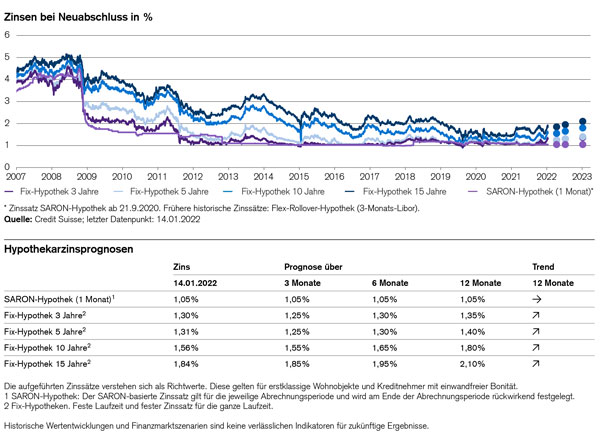
    The COVID-19 pandemic will keep Switzerland busy for a while, but is only likely to slow down the economic recovery temporarily. We expect economic growth of 2.5% for the current year. The growth is therefore weaker than in the previous year (4%). Switzerland is currently much less affected by rising inflation than the USA or the euro area. But the inflation rate in Germany is also likely to be above the average for the last two years. This remains within the target range of the Swiss National Bank. An increase in the key interest rate is therefore not to be expected until at least the end of 2023. The interest rates for SARON mortgages, which have replaced the previous Flex rollover mortgage (3-month Libor), are therefore likely to remain at their lows for the next 12 months. As a result of rising inflation and the start of a series of anticipated interest rate hikes in the US, Fix mortgage rates have risen significantly in recent weeks. In contrast to the SARON mortgages, we anticipate a further slight increase in interest rates for Fix mortgages by 5 to 30 basis points over the next 12 months. However, as before, the development is likely to be accompanied by ups and downs. Overall, interest rates will therefore remain at a historically very low level over the next 12 months.

  • World economy after COVID-19. This is what investors expect.

    World economy after COVID-19. This is what investors expect.

    Economic growth continues
    The pandemic isn’t over yet, but vaccinations have at least brought some normalcy back. The upswing is likely to continue in 2022. Strong economic growth of 4.3 percent is expected. The reasons for this are as follows: solid demand, a supportive fiscal and monetary policy environment and further easing measures.

    Inflation likely to peak
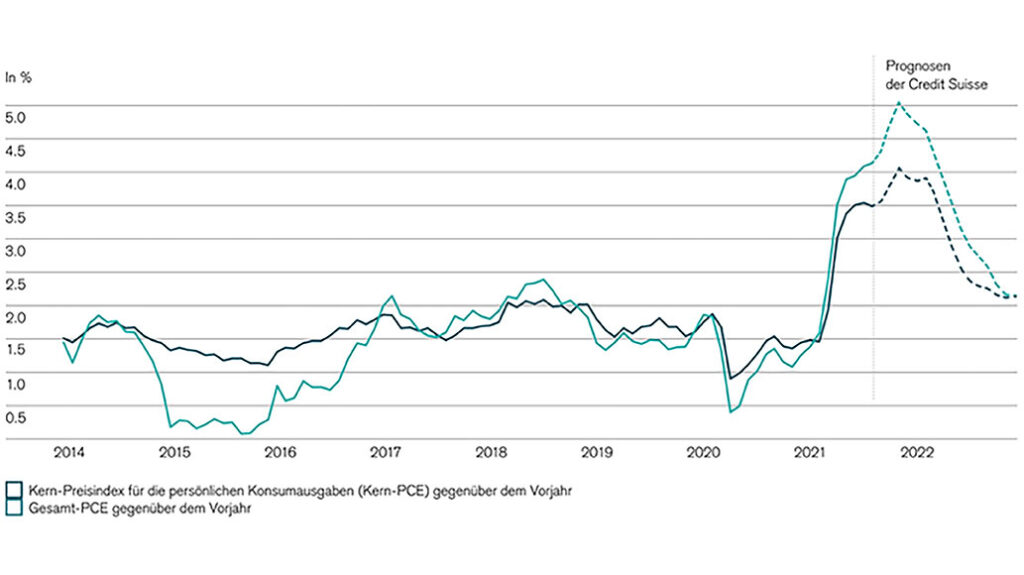
    The rise in inflation was one of the central themes of 2021 and will continue to occupy us in the future. For 2022, the global inflation rate is expected to remain at an elevated level of 3.7 percent. The key question is how central banks will respond. Credit Suisse experts assume that many will initially reduce their purchases of securities. Interest rates, on the other hand, are likely to remain unchanged as long as inflation falls from 2021 levels.

    Inflation rate in the US is likely to fall after 2022
    Most of the recovery in prices lags behind the US. The base effects wear off.

    Last data point: 09/2021

  • Credit Suisse brings Mama Shelter Hotel to Zurich

    Credit Suisse brings Mama Shelter Hotel to Zurich

    A Mama Shelter hotel will move into the skyscraper at Zurich Oerlikon train station. Credit Suisse Asset Management has concluded a corresponding contract with the operating company KNSA Hospitality on behalf of a real estate fund, Credit Suisse informs in a message . The opening of the first Mama Shelter hotel in Switzerland is planned for the second half of 2024.

    The listed building had previously housed the Swissôtel, which went bankrupt in 2020. The successor Mama Shelter will occupy nine of the total of 28 floors. A total of 132 apartments, mostly with 1.5 to 2.5 rooms, are to be built on the remaining floors. The base of the building will also have a publicly accessible city balcony with a bar, the message says.

    The hotels of the Mama Shelter brand are not only designed as typical hotels, but also as meeting places, work and living spaces, is further explained in the communication. The concept also provides for innovative gastronomy and a co-working zone. The renovation work is to begin next March.

  • Swiss office market: pandemic is leaving its first traces

    Swiss office market: pandemic is leaving its first traces

    While the advertised space in London and New York skyrocketed in the wake of the COVID-19 pandemic, the space available in Switzerland increased only moderately at the end of the 2nd quarter of 2021 compared to the same quarter of the previous year, from 5.5% to 5.8%. Although the uncertainties about the future need for office space are still very high for many tenants, a number of lease extensions and new contracts have been observed on the market – mostly for the purpose of optimizing or concentrating the location.

    Reluctant demand for office space
    The usually close link between the growth of office work and the demand for office space has decoupled during the pandemic. Despite a relatively robust development in office employment, many customers were reluctant to rent new space, especially since coping with the pandemic is dragging on and the trend towards home offices is consequently becoming entrenched. The demand for space is likely to suffer in the next few years from the fact that more and more companies are enabling their employees to partially work from home, even after COVID-19. The real estate economists at Credit Suisse still consider last year’s forecast, according to which the corona-induced breakthrough in home offices to reduce the need for office space by around 15% in the medium term, as a good benchmark. However, economic growth and the increasing proportion of office work due to the digitization effect are counter-trends, which is why real estate economists expect demand for office space to stagnate in the medium term.

    The supply of space is increasing again – but less than expected
    As a direct consequence of the sluggish demand, the office space advertised for rent is currently increasing again in all regional sub-markets without exception. In the office markets of the major centers, the supply in absolute numbers increases most strongly in the agglomeration communities around the central cities (outer office markets). In percentage terms, however, the supply has increased most in the city centers. Higher supply rates can be observed above all in those sub-markets that are currently recording a high level of space access. For example, the increased construction activity in Basel is making a significant contribution to the increase in the available space at the knee of the Rhine. In contrast, the comparatively intact market situation on the Zurich office market is closely related to the low level of construction activity. The comparison between Lausanne and Geneva is interesting: While weak demand was responsible for the increase in the supply of space to 12.3% in the city on the Rhone, Lausanne benefited from relatively robust demand despite higher construction activity, so that the supply of space here increased significantly less.

    Investors are planning less office space
    In the past twelve months, building permits for office space with an investment volume of CHF 1,598 million have been granted. This is around 17% below the long-term average since 1995. Investors have become more cautious about investing in office buildings and are holding back on new projects as long as the uncertainty regarding future space requirements is not cleared up. In a long-term comparison, the amounts approved for office renovations remain at a low level. In most cases, replacement new buildings are preferred to renovations today. Conversions in apartments, which are increasingly being considered – especially in the Bern office market – are not included in these figures. This reluctance on the part of investors should help ensure that most office markets are unlikely to develop too large imbalances over the next few quarters.

    Home office only slows down space requirements temporarily
    Based on a study commissioned by two federal offices on industry developments up to 2060, the real estate economists at Credit Suisse derive the development of office employment up to 2060 and use this to forecast long-term demand for office space. Current trends such as employment growth, the digitization of many work areas, but also the trend towards home offices are developing in the opposite direction. While home office reduces space requirements in the medium term, the increasing digitization of all areas of life and work is increasing the office quotas – i.e. the proportion of employees with an office workstation – in all industries and thus generating a large need for additional office space in the long term. Between 2000 and 2019, the average office rate in Switzerland climbed from 34% to 45%. According to the modeling, it should increase further to 60% by 2060. Over time, this effect is likely to overshadow the trend towards home offices, which is reducing space, and generate significant additional demand for office space in the long term.

    Immediate view streaked through
    In the short term, there are two opposing developments that are having an impact on the demand for office space. On the one hand, the absorption of space is likely to continue to be resinous, despite stronger employment growth, and to lag behind the usual level. A further increase in the supply of space is therefore possible, especially as there have only been a few cases of large-scale abandonment or reductions in space due to the COVID-19 pandemic. However, such dismantling plans exist. On the other hand, a certain amount of demand is likely to have built up. The real estate economists at Credit Suisse are forecasting a renewed increase in supply, particularly for large and peripheral spaces. They also expect a further increase in vacancies next year and ongoing pressure on rental prices, which could be a little higher than the current minus of 0.1%.

    Figure: Expansion and supply in the large and medium-sized centers
    Circumference: stock of office space; Expansion: building permits for the last four years compared to the long-term average; Supply quota in% of the 2018 portfolio

    The full study on “Swiss office space market 2022” is available in German here .

  • Credit Suisse sees good opportunities for proptechs

    Credit Suisse sees good opportunities for proptechs

    The corona pandemic has also posed challenges for the proptech industry, as a new report from Credit Suisse shows. Globally, for example, 25 percent less risk capital has flowed into such start-ups. However, the reluctance to invest has not left any major mark on the industry. Almost 80 percent of Proptechs were able to increase their number of employees in the past twelve months. Only 3 percent reported a decrease in the workforce. In addition, 87 percent expect a further increase in staff in the next twelve months.

    Furthermore, only around 10 percent of proptechs suffered a setback in sales. In contrast, 80 percent were able to increase their sales during the Corona crisis. According to the report, the industry is aiming to double sales in 2021. In 2022 and 2023, too, higher sales growth is expected than in 2020.

    Credit Suisse also looks at the Swiss proptech industry in the study. Accordingly, the number of proptechs active in Switzerland also increased last year. With over 320 companies, Switzerland has an extremely high density of proptechs in an international comparison, it is said.

    However, the bank also points out that many proptechs with similar business models appear in the market. She assumes that not all companies will be able to position themselves successfully. Credit Suisse sees the quality of the management team and the scalability of the business model as the most important success factors of a Poptech.

  • Cosmos construction project goes to real estate fund

    Cosmos construction project goes to real estate fund

    Mobimo is selling its building-approved Cosmos project in Dübendorf to a real estate fund managed by Credit Suisse , the Lucerne real estate company informed in apress release . In 2000, Mobimo acquired the corresponding property on Zürichstrasse. Instead of the commercial building that existed at the time, four new buildings with a total of around 170 apartments as well as areas that can be used for offices, businesses or sales are to be built.

    Construction work is scheduled to start this month. In the late summer of 2023, the buildings complying with the Sustainable Building Switzerland Standard (SNBS Gold) and the greenproperty seal of approval should be completed. Among other things, a photovoltaic system and a geothermal probe will be installed, explains Mobimo.

    “We have developed a convincing new building project from an investment property with potential,” Mobimo CEO Daniel Ducrey is quoted in the press release. "Cosmos is a good example of the interaction between active portfolio management and internal development competence."