Tag: digitale Baustelle

  • How artificial intelligence secures the construction process

    How artificial intelligence secures the construction process

    According to a press release, the Benetics AI email assistant is designed to help prevent one of the most costly sources of error in everyday construction work: incorrect execution due to outdated plans. This assistant was developed by Benetics AG. Founded in 2022, the Zurich-based software company will be presenting it as a world first at Swissbau in Basel from 20 January.

    Following the voice assistant for the skilled trades, also based on artificial intelligence (AI), which will be launched in 2024, “the AI email assistant is the second world first from Benetics AI,” says CEO Ferdinand Metzler. “This brings us another step closer to our vision: less time-consuming administrative work and more focus on what makes the skilled trades strong: productive work.”

    The email assistant recognises construction plan PDFs in incoming email attachments and compares them with existing plans in all current projects. It automatically notifies users when a new plan version has been received. And at the touch of a button, it ensures that no one is still working on the old plan version.

    The AI assistant is embedded directly in Microsoft Outlook and can be integrated from there into other systems such as SharePoint or other DMS and CDE solutions. According to the information provided, the open API of Benetics AI and new connectors on Make.com and Zapier enable flexible integrations. “This creates a continuous digital plan flow all the way to the fitter on the construction site for the first time,” the press release states.

    “The Outlook integration brings even more structure to the construction process,” says Bledar Beqiri. He is head of installation in plant engineering at Basler Rosenmund Haustechnik AG and a user of the AI email assistant. “New plan statuses reach our teams faster and without detours. This reduces sources of error and gives our project managers more certainty in execution.”
  • Robot platform ensures safety and efficiency on construction sites

    Robot platform ensures safety and efficiency on construction sites

    Work such as drilling, sanding, spraying insulation or lifting heavy materials harbours high risks. According to recent figures, in 2024 there were 30 fatalities on construction sites in Europe alone within four months.

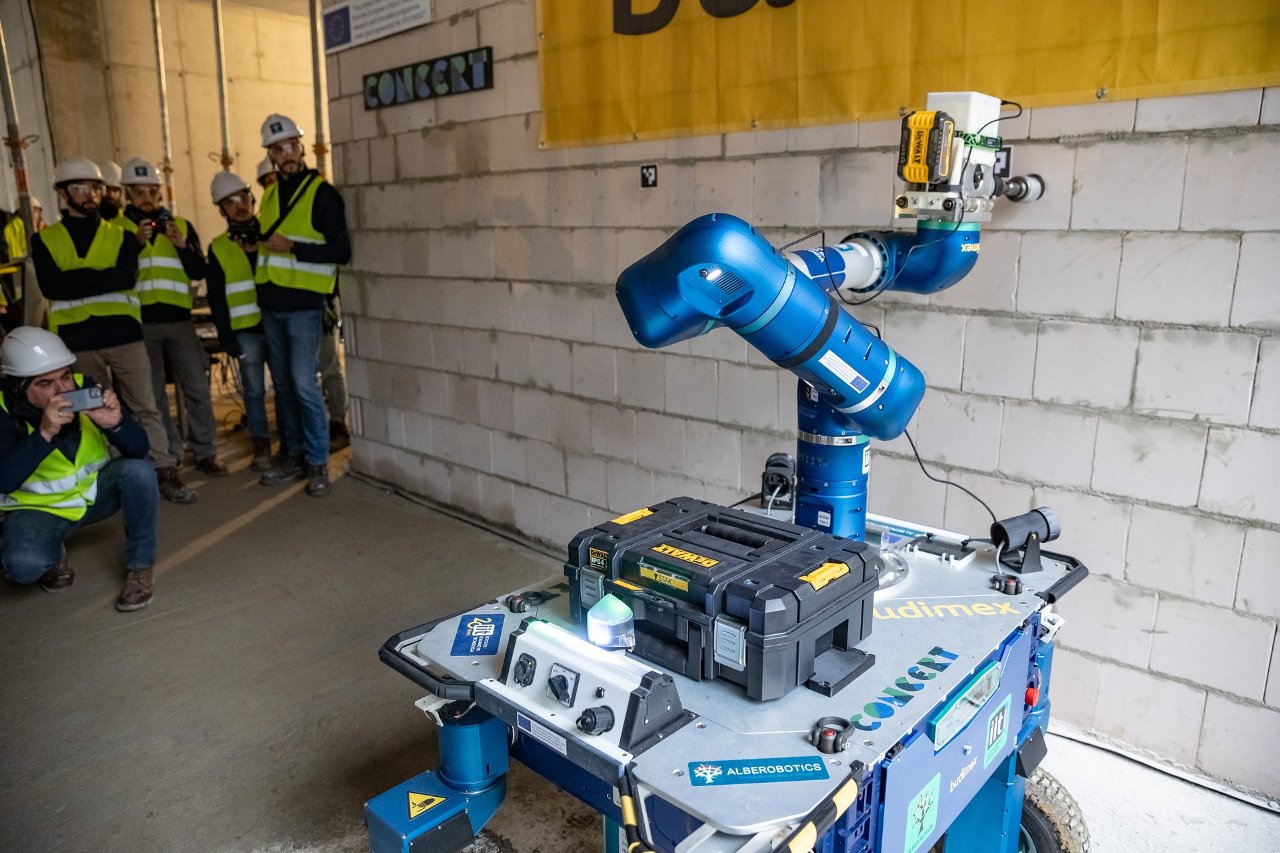
    With the support of the EU-funded CONCERT project, IIT has developed an innovative, modular robot platform. “Our aim was to create a flexible and adaptable solution that optimises construction processes, reduces the workload on people and improves safety,” explains Nikolaos Tsagarakis, project coordinator at IIT.

    Robot as a support – not a replacement
    Although the CONCERT robot can work autonomously, it was primarily designed as an assistance system for construction workers. While the machine takes over repetitive or dangerous tasks, skilled workers can concentrate on more complex activities. This not only increases work safety, but also efficiency on construction sites.

    “Instead of using a separate robot for each task, we have developed a fully reconfigurable solution that can be customised directly on the construction site,” continues Tsagarakis.

    Seamless integration into the digital construction site
    The robot was successfully tested under real construction site conditions. It not only demonstrated its performance, but also its flexibility by being able to adapt to the spontaneous requirements of the construction team.

    One major advantage is the link to digital building information models (BIM). This allows the robot to be controlled directly via a tablet without workers having to operate heavy power tools.

    A breakthrough for construction robotics
    CONCERT has ushered in a new era in digital construction site automation with the first reconfigurable multi-purpose construction robot platform.

    The solution not only has the potential for broad industrial application, but also exceeds the usual technology maturity level in research projects. “The flexibility of the platform makes it usable for many other construction tasks,” says Tsagarakis. Future developments will expand the areas of application even further.