
Tag: digitale Transformation

  • How Switzerland is training the PropTech specialists of tomorrow

    How Switzerland is training the PropTech specialists of tomorrow

    Interdisciplinarity is the key
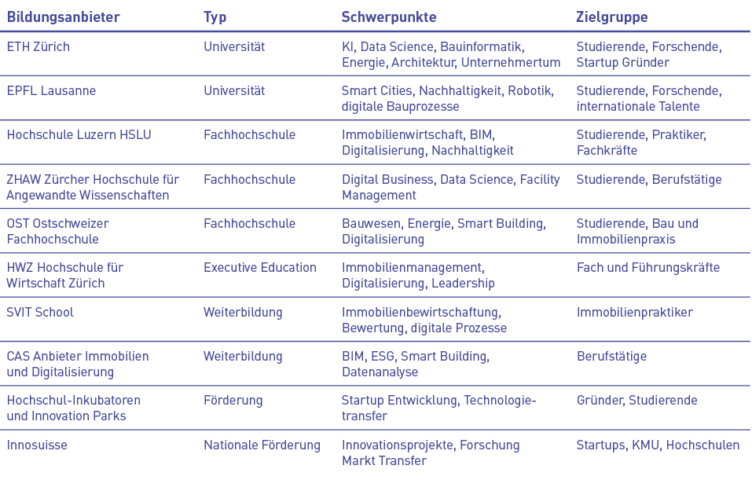
    PropTech is not a traditional field of study. Rather, expertise is created by combining different disciplines. In Switzerland, training programmes combine subjects such as property economics, construction, IT, data analysis, sustainability and management.

    This interdisciplinarity reflects the reality of the industry. PropTech specialists need to understand technical solutions, categorise regulatory frameworks and think economically at the same time. Swiss educational institutions are responding to this with modular programmes and practice-oriented formats.

    Universities as drivers of innovation
    ETH Zurich and EPFL Lausanne form the academic foundation of many technological developments. Degree courses and research programmes in civil engineering, architecture, computer science and data science provide expertise that flows directly into PropTech solutions.

    Universities of Applied Sciences such as HSLU, ZHAW or OST complement this offering with a strong practical focus. Projects in collaboration with companies, start-ups and public institutions enable students to work on real-world problems. This results in a direct transfer of knowledge into application.

    Further education for property practice
    In addition to academic education, in-service training is becoming increasingly important. Many specialists in administration, valuation, development or management need to catch up on or deepen their digital skills.

    In Switzerland, there are a growing number of CAS and MAS programmes with a focus on digitalisation, BIM, data analytics, sustainability and real estate management. These programmes are aimed specifically at practitioners and impart applicable knowledge for everyday working life.

    Collaboration with the industry
    A key success factor is the close cooperation between educational institutions and the property industry. Companies act as practice partners, provide use cases or participate in the content design of training courses.

    This keeps training content up-to-date and close to the market. Students and further education participants benefit from real insights into ongoing transformation processes and establish relevant networks at an early stage.

    Entrepreneurship and start-up promotion
    Many training programmes integrate entrepreneurial elements. Incubators, innovation programmes and student initiatives promote a spirit of entrepreneurship and experimentation. Students are encouraged to develop their own ideas and pursue them as start-ups.
    This combination of education and entrepreneurship is an important driver for the Swiss PropTech scene. Numerous successful companies have emerged from university projects and have been able to establish themselves on the market thanks to targeted support.

    Challenges and outlook
    Despite the strong educational landscape, the shortage of skilled labour remains a challenge. The demand for specialists in the fields of data analysis, software development, BIM and ESG is outstripping supply.

    At the same time, the need for hybrid profiles that combine technology and property practice is increasing. Educational institutions are therefore faced with the task of continuously developing their programmes and addressing new target groups.
  • Apply now for the Digital Journey Challenge 2025

    Apply now for the Digital Journey Challenge 2025

    The digital transformation is unstoppable and offers enormous opportunities for small and medium-sized enterprises in particular. The Digital Journey Challenge 2025, launched by the Centre Suisse d’Électronique et de Microtechnique (CSEM), is aimed at companies and start-ups that want to take their innovative strength to a new level with digital technology.

    The focus is on promoting pioneering projects in areas such as artificial intelligence, the Internet of Things (IoT), automation and other key technologies. Applicants receive professional guidance, technological expertise and up to CHF 100,000 in financial support.

    Three strong arguments in favour of your participation
    Technology Boost
    Access to CSEM expertise in eight key technologies

    Financial support
    Up to CHF 100,000 for development time, consulting and technology transfer

    Strengthen market position
    Greater visibility, more media presence, access to expert networks

    Simple application process, big impact
    Participation is straightforward. Interested parties download the factsheet, describe their idea and submit the form. All information and conditions are available on the CSEM website. The application deadline is 15 September 2025.

    Success story
    The 2024 winning project shows just how effective the challenge can be. Varioprint AG impressed with its AI-supported 3D inspection solution for printed circuit boards. Their project “AI in Every Pixel” addresses a global growth market and accelerates quality control in the electronics industry in the long term.

    Apply now and play an active role in shaping your digital transformation.

  • Digital concrete analyses for higher quality and sustainability

    Digital concrete analyses for higher quality and sustainability

    Sika has made a strategic investment of an undisclosed amount in the Canadian company Giatec Scientific, headquartered in Ottawa. In a press release, it describes the Zug-based speciality chemicals company as a “significant milestone in its overarching digital strategy”.

    Giatec develops sensors, software solutions and data analysis tools that improve the quality, durability and sustainability of concrete, from production to transport and processing. Sika anticipates that Giatec’s Artificial Intelligence-based precise analysis and optimisation of concrete mixes, together with Sika’s admixture technologies, will lead to “significant” cost and CO2 savings.

    Pouria Ghods, CEO and co-founder of Giatec, wants to “redefine the future of AI-powered concrete construction” through this strategic partnership with Sika. He sees the global presence of the new partner as a great opportunity “to establish our intelligent technologies worldwide”.

    Like Ghods, Sika’s Head of Construction, Ivo Schädler, wants to help shape the future of the concrete industry through digital transformation “working closely with Giatec and its network of strategic global partners such as Heidelberg Materials. By utilising digital innovation, we provide the construction industry with data-driven insights that improve sustainability and performance and enable the next level of modern construction.”

  • Appenzellerland, Winterthur and Zurich honoured with awards

    Appenzellerland, Winterthur and Zurich honoured with awards

    The Smart City Hub Switzerland association has presented its Smart City Hub Awards for innovative approaches to intelligent and sustainable urban solutions for the first time. Seven projects were nominated from a total of 20 submissions, the association, which is made up of representatives from cities and federal service providers, announced in a press release. Of these seven nominees, the Smart Appenzellerland, Generative AI Assistance for Winterthur and Zuri Accessible CiTy (ZuriACT) projects have now been honoured in the Newcomer, Innovation and Smart Citizen Services categories.

    The organisation Verein Smartes Appenzellerland(VSAL) was the winner in the Newcomer category. Its project promotes digital transformation in Appenzellerland. The press release emphasised the development of a platform for the Internet of Things and educational initiatives in mathematics, IT, science and technology.

    The prize in the Innovation category went to the city of Winterthur. In the Generative AI Assistance project, it is testing the use of artificial intelligence in practical applications that are accompanied by training and ethical reflection.

    TheCity and University of Zurich were honoured with the award for Citizen Services. Their Zuri Accessible CiTy (ZüriACT) project aims to improve accessibility in Zurich using digital tools and better data. Innovative technologies are used to simplify accessibility data in collaboration with those affected.

  • Benetics presents strong growth

    Benetics presents strong growth

    Benetics has developed software that can be used to efficiently coordinate work on construction sites. Since entering the market in October 2023, the Zurich-based proptech has recorded strong growth. According to an article on startupticker.ch, 25 companies, mainly from the electrical industry, are already using Benetics’ digital application. Most of these are companies with 10 to 15 employees, while the largest customer has over 100 employees using the software.

    “Our app-based tool hardly needs any time for onboarding, makes construction plans digitally usable and, in addition to other functions, has photo documentation of the work done and an integrated intelligent translation service,” Benetics co-founder and CEO Ferdinand Metzler is quoted as saying in the article. Users can enter texts and voice messages in their native language. They are then automatically translated into the languages used by the other participants.

    Benetics is currently run by 13 people, nine of whom come from the development industry. Many of them, including the two other co-founders Aaron Shon and Johan Tibell, previously worked at Google, according to the article. “With our development team, we are quick to implement customer input,” says Metzler. The company also has extensive expertise in big data and artificial intelligence.

  • Increasing efficiency in property management through digital transformation

    Increasing efficiency in property management through digital transformation

    The property industry faces the challenge of adapting to rapid technological developments in order to remain competitive. Digital tools and platforms offer innovative solutions to optimise management processes and improve interaction with tenants. By implementing property management software, for example, incoming rent can be monitored, maintenance requests can be processed efficiently and communication with tenants can be digitalised. These systems make it possible to record relevant data centrally and make it available at any time, which speeds up decision-making processes.

    Another aspect of digital transformation is the use of data analysis and artificial intelligence to identify market trends and optimise portfolio management. Predictive analytics can help to forecast future market developments and make investment decisions based on sound data. In addition, digital technologies enable the creation of new services, such as virtual tours of properties, which are invaluable, especially in times of social distancing.

    The integration of smart home technologies into property management also offers significant benefits. Automated systems for heating, lighting and security can reduce operating costs and increase living comfort for tenants. At the same time, this increases the attractiveness of the property on the market.

    For a successful digital transformation, however, it is crucial that companies in the property sector not only invest in the right technology, but also train their employees accordingly. A willingness to adapt to new ways of working and continuous training are essential in order to fully exploit the benefits of digitalisation.

    In summary, the digital transformation of the property industry offers numerous opportunities to simplify processes, reduce costs and improve service for tenants. By making strategic use of digital technologies, property companies can increase their efficiency and secure a decisive advantage in a highly competitive market. It is time to seize the opportunities of digitalisation and lead property management into the digital age.

  • Stefan Metzger takes over at digitalswitzerland

    Stefan Metzger takes over at digitalswitzerland

    According to a media release , Stefan Metzger will take over the management of digitalswitzerland from January 2022. The previous managing director, Nicolas Bürer, is stepping down at his own request. Bürer led the initiative for around five years. Last year he was also responsible for the operational merger with the ICTswitzerland association.

    “I would like to thank Nicolas for his commitment to digitalswitzerland,” said President Sascha Zahnd. Bürer has “successfully further developed the initiative and transformed the once regional vision for Zurich into a nationwide and now even global movement,” he adds. According to Marc Walder, digitalswitzerland founder and Ringier CEO, digitalswitzerland has grown to become “the most relevant location initiative in Switzerland” under the leadership of Bürer.

    With Metzger, digitalswitzerland is gaining “a proven expert in the field of digital transformation” with global experience, according to Walder. The press release describes Metzger as a digital expert. For 13 years he served the Swiss business of the global IT consulting firm Cognizant as Country Managing Director. Metzger has been committed to digitalswitzerland for a year and was also a member of the Executive Committee.

    Diana Engetschwiler, head of the Swiss Digital Day launched five years ago, will also become the deputy managing director of digitalswitzerland from the beginning of 2022. She succeeds Sébastien Kulling, who is moving to the digitalswitzerland foundation as managing director.

    The aim of digitalswitzerland is to position Switzerland as the world’s leading, digital innovation location. The initiative currently has 240 organizations among its partners.