Tag: Durchgangsbahnhof

  • Public consultation on the Lucerne agglomeration programme

    Public consultation on the Lucerne agglomeration programme

    The fifth generation of the Lucerne agglomeration programme (AP LU 5G) includes the towns of Sursee and Sempach for the first time, as well as several new municipalities such as Meierskappel and Neuenkirch. This expansion of the perimeter emphasises the increasing importance of regional cooperation in the sustainable development of settlement and transport structures. The focus of AP LU 5G is on coordinating transport development with settlement planning in order to optimally meet the challenges of growth and mobility in the region.

    Key projects through station and bypass
    The key projects of the LU 5G AP are the Lucerne through station and the A2 Lucerne motorway bypass. These major projects financed by the federal government form the backbone of long-term transport planning in the Lucerne region. In addition, accompanying measures and projects are planned by the canton and municipalities, such as the expansion of parking facilities and the creation of continuous bus lanes, in order to further improve the efficiency and flexibility of the transport system.

    Investments in overall transport and walking and cycling
    The LU 5G AP plans extensive investments in transport and settlement development. Overall transport, including important transport hubs such as the expansion of Ebikon railway station, will receive CHF 216 million in funding up to 2031. Pedestrian and bicycle traffic, with measures to optimise the cantonal bicycle network and improve local recreation, will also be given high priority. Projects in this area will be supported with a total of CHF 129 million.

    Public participation and future steps
    Public participation offers municipalities, experts and interested members of the public the opportunity to play an active role in shaping the AP LU 5G. The comments and suggestions, which can be submitted until 1 October 2024, will be incorporated into the revision and finalisation of the programme. An information event will be held in Rothenburg on 2 September 2024 to explain the draft and the planned measures in detail. Registrations are possible until 28 August 2024.

    The programme will be reviewed and adjusted once the public consultation has been completed. Adoption by the government is planned for 2025, before the AP LU 5G is submitted to the federal government for review.

  • Lucerne through station: major project reaches milestone

    Lucerne through station: major project reaches milestone

    The Lucerne through station is intended to eliminate bottlenecks in the Lucerne rail hub with new, underground approaches and an underground station. The project, which is currently in the planning phase, is intended to create capacity in today’s fully utilised railway system and thus enable new, more direct and faster rail connections in the future. “The underground station and the new, underground access routes will improve the accessibility and attractiveness of Central Switzerland,” says Massimo Guglielmetti, SBB overall project manager for Lucerne through station. “Without infrastructure expansion, further development of rail services in Lucerne is no longer possible.”

    In the preliminary project, SBB presents the technical feasibility of the large-scale project, which consists of the sub-projects underground station, three-lane tunnel and Neustadt tunnel:

    • With the underground station, a total of 44 metres wide platform hall for four tracks will be built below the existing station. This will create more space at Lucerne station, which is currently used by around 100,000 passengers every day
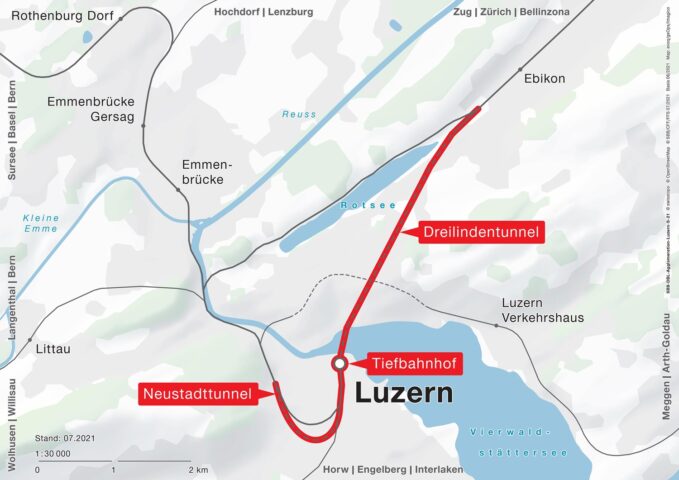
    • The 3.8-kilometre-long three-lane tunnel will create an underground, direct line from Ebikon to Lucerne, crossing under the lake basin over a length of 400 metres. This second access removes the bottleneck situation in the railway network and enables more frequent and faster train connections
    • The 2.1-kilometre-long Neustadt Tunnel connects the underground station to the existing access road. This will enable through connections and eliminate the need for a majority of trains to turn around in the Lucerne terminus station

    In order for the planned improved service to be of benefit to the whole of Central Switzerland, the railway infrastructure in the catchment area must also be expanded at certain points. In addition, parking facilities are needed outside Lucerne station to be able to park trains overnight and outside peak times

    Lowering tunnel under the lake basin
    Compared to previous plans, a lowering tunnel is now planned for the subway of the lake basin. Five prefabricated elements of the tunnel tube will be lowered into the bottom of Lake Lucerne. This means that it is not necessary to drain the lake basin in sections. The environment and landscape are less affected. This construction method has never been used in Switzerland before.

    The costs for the three project parts, the underground station, the Dreilinden tunnel and the Neustadt tunnel, are estimated at 3.3 billion Swiss francs. For the realisation, SBB expects a construction period of 11 to 13 years

    Additional studies on howto proceed
    SBB is now clarifying possible implementation sequences for the major project on behalf of the Federal Office of Transport (FOT). The results should be available by the end of 2023. A decision will then be made on the next steps in the project. “All the work is going according to plan. I am convinced that the Federal Council will be able to present a well-studied and advanced project to parliament in 2026,” Anna Barbara Remund, FOT Vice Director and Head of the Infrastructure Division, told the media in Lucerne. The federal parliament will ultimately decide on the implementation

    Great importance for Lucerne and Central Switzerland
    The expansion of the Lucerne railway junction is one of the most important infrastructure projects in the region. “Central Switzerland has been waiting for the urgently needed infrastructure upgrades at the Lucerne hub and in the direction of Zurich for 50 years,” held Cantonal Councillor Fabian Peter, Director of Construction, Environment and Economic Affairs and President of the Central Switzerland Public Transport Directors. “An attractive public transport offer is crucial if we are to be able to cope with mobility growth at all and handle it sustainably,” said Fabian Peter. “In order for the through station to unfold its full benefits, Central Switzerland expects it to be realised and financed from a single source.”

    For the city of Lucerne, there will be the opportunity to make the space around the station attractive, to make the station more accessible and to increase the quality of stay. “The city will also work to ensure that the construction period of over ten years is as compatible with the city as possible,” said City Councillor Manuela Jost, Director of Construction. “Even during this time, open spaces must be preserved and the city centre must remain accessible.”sBB is planning the through station on behalf of the Federal Office of Transport. It is working with the canton and city of Lucerne, Zentralbahn, the Lucerne transport association and the cantons of Obwalden and Nidwalden, and is involving the LuzernPlus association of municipalities.

    Source www.sbb.ch

  • New through station Lucerne

    New through station Lucerne

    Lucerne station is the sixth-largest railway station in Switzerland: around 100,000 passengers board and disembark here every day. The problem: the double-track access has reached its capacity limit and is prone to disruptions. The forecast growth in public transport mobility in the canton of Lucerne is around 40 percent by 2030. Rail mobility has already increased by 50 to 100 percent in the last ten years – especially on the canton’s main development axes.

    The Federal Office of Transport, the Swiss Federal Railways (SBB), the cantons of Lucerne, Nidwalden and Obwalden, the city of Lucerne, the regional development agency LuzernPlus, the Lucerne Transport Association and the Zentralbahn (Central Railway) therefore want to expand rail services with the Lucerne through station (DBL) and implement various infrastructure projects. The planned through station is considered a generation project in Central Switzerland.

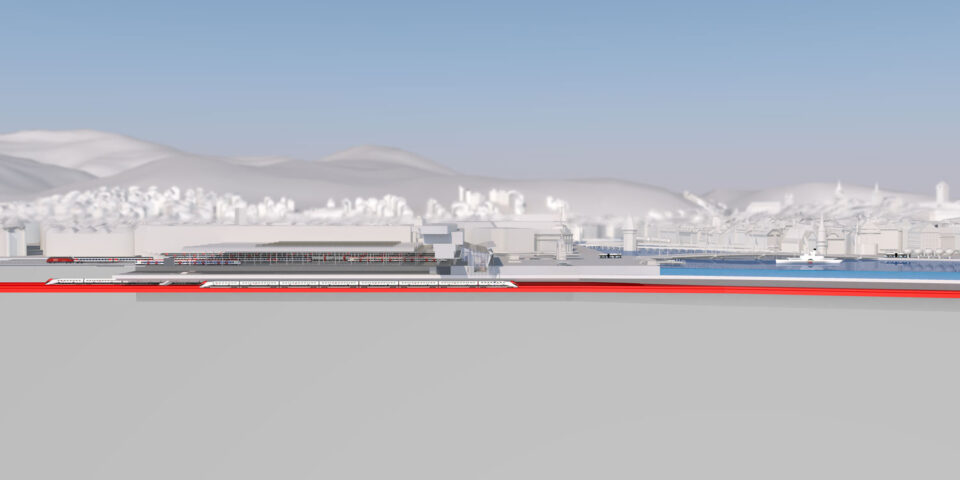
    The visualisation shows the side view of the through station.

    An underground through line with four lowered tracks is planned under the existing terminus station. This will be supplemented by a 3.5-kilometre-long underground double-track access and exit from Ebikon (three-lane tunnel) and a likewise underground double-track access and exit to the Heimbach area (Neustadt tunnel). The existing above-ground parking facilities at Lucerne station will be partly relocated, as they will then no longer be directly connected to the underground through station.

    The DBL creates the conditions for faster connections in the region’s S-Bahn system as well as a faster north-south connection via Lucerne. This not only sets the course for more mobility, but also for achieving the climate goals in terms of sustainable mobility development. After all, the greatest potential for switching to public transport lies in the agglomerations and in connections between regional centres.

    The planned route.

    But the DBL will also optimise economic and urban development opportunities: The population will become more mobile, and in the centre of the city of Lucerne new space for urban development will be created thanks to the release of above-ground track infrastructure. The popular tourist cantons of Obwalden and Nidwalden will also benefit from better access.

    The Zurich-Zug-Lucerne-Sursee-Olten axis in particular will benefit from the improved services. The Lucerne-Zug-Zurich line is the busiest railway line in the Lucerne region. With the addition of six long-distance trains from Lucerne to Zurich, the DBL will increase the timetable, enable a basic 30-minute interval for long-distance services and a quarter-hourly interval for regional services.

    The DBL offers the possibility of managing the travel time between Lucerne and Milan envisaged in the NRLA concept and brings Ticino closer to German-speaking Switzerland: 20 minutes of travel time can be saved thanks to the DBL. The north-south connection via Lucerne will thus be faster than the one via Zurich, which passes through the busy Zurich main station.

    The federal parliament approved the 2035 expansion step for the railway infrastructure in 2019. SBB is currently working on the preliminary project, which is expected to be completed in the first months of 2023. This will be followed by the examination of the results of a study on the implementation sequence, which should take about another six months. in 2027, the federal parliament will decide whether the DBL can be realised after 2030. If everything goes smoothly, the through station could be opened in 2040 at the earliest after a construction period of about ten years.

    The costs will be available when the preliminary project is completed. The project will be financed through the Railway Infrastructure Fund (BIF). The client for the DBL project is the Federal Office of Transport (FOT). SBB is responsible for planning and implementation. The railway infrastructure will be expanded step by step – the expansion steps are determined every four years by the National Council and the Council of States.