Tag: Eawag

  • Successful expansion of the “co-operate” research campus in Dübendorf

    Successful expansion of the “co-operate” research campus in Dübendorf

    The expansion of the research campus in Dübendorf, which took place from 2021 to 2024, includes a state-of-the-art laboratory building, a multifunctional building and a new multi-storey car park. These infrastructure measures are crucial in order to meet the increasing demands of research. The additional 30 laboratories and offices offer researchers an improved working environment that meets the latest technological and environmentally friendly standards.

    Sustainability and innovation go hand in hand
    A special feature of the new campus is its focus on sustainable energy generation and utilisation. A newly developed high-temperature geothermal probe system stores waste heat in summer and uses it to heat the buildings in winter. These and other technological innovations, which come directly from the Empa and Eawag laboratories, will not only be used on the campus, but will also be further researched to optimise their efficiency and environmental compatibility.

    A green and car-free campus
    In order to make the campus site more environmentally friendly and pedestrian-friendly, existing parking spaces were moved to the new multi-storey car park and the site was extensively landscaped. A “green belt” connects the two research institutes and creates an inviting atmosphere for employees and visitors. The new campus square at NEST also offers an attractive open space for socialising and recreation.

    Looking to the future
    With the completion of the “co-operate” project, Empa and Eawag have not only modernised their research infrastructure, but also laid the foundations for future innovations. The combination of state-of-the-art construction, sustainable energy utilisation and an improved working environment promotes cutting-edge research and strengthens Switzerland’s position as a leading location for scientific innovation.

  • “co-operate” – a model for climate-friendly construction

    “co-operate” – a model for climate-friendly construction

    As far as the sparing use of resources and the reduction of CO2 emissions are concerned, the campus that is taking shape on the Empa site in Dübendorf should certainly become a model student – from the top to the bottom, from the roofs to a depth of 100 metres, where the earth probes of a unique experimental seasonal energy storage system end. In summer, these “tubes” will store the waste heat from, for example, the refrigeration machines, ventilation systems and laboratory equipment, and then use it in winter for heating or for the production of hot water. The goal: to reduce the CO2 emissions of the buildings on the entire campus to a minimum and at the same time explore this innovative technology for a sustainable energy future.

    Minimising greenhouse gas emissions: This aspiration also shapes the constructions of the new campus. The three-storey building to the right of the entrance is a unique “wood-concrete car park” whose ceilings are a sophisticated construction of spruce beams and slabs with concrete overlay. According to the construction company Implenia, this hybrid construction method made it possible to reduce the thickness of the concrete layers to about one third. A significant saving was made on the “climate polluter” cement: around 9,300 m2 of concrete ribbed ceilings were replaced with wooden beam ceilings – also a contribution to the current trend of replacing concrete, where possible and sensible, largely with constructions made of wood.

    According to Kevin Olas, Head of Real Estate at Empa, one of the challenging aspects of this project was the cleverly integrated installation of lighting, electrical lines and waste water pipes, so as not to detract from the aesthetics of this sophisticated hybrid construction. In addition, the planning also had to take future aspects into account: With a view to climate change, the multi-storey car park was planned as a modular construction made of demountable prefabricated parts – with a view to a more distant future in which individual mobility may play a lesser role than it does today. Then parts of the building could also be converted into workshops or for other purposes.

    Urine as raw material for fertiliser
    In this future, environmentally friendly recycling will also determine building: Not only steel, concrete or wooden elements can be recycled in a climate-friendly way, but also human “raw materials”. Take urine, for example: in the large laboratory building at the centre of “co-operate”, “NoMix” toilets have been installed, which experts from the Eawag Water Research Institute have developed over the past few years. Without changing the usual use, they separate human urine from the so-called black water from faeces, flushing water and toilet paper.

    Because urine contains valuable nutrients such as nitrogen, phosphorus and potassium, it can be used to produce fertiliser for agriculture. In a process specially developed by Eawag, the raw material is first stabilised in the basement of the NEST building using a biological process, thus losing its strong odour. An activated carbon filter removes all drug residues before the liquid is finally evaporated – to produce a high-quality fertiliser called “Aurin”, which is marketed by the Eawag spin-off Vuna GmbH. 1000 litres of urine produce 100 litres of this fertiliser, which since 2018 has also been approved by the Federal Office for Agriculture for use on edible plants.

    Many mosaic stones for a good carbon footprint

    In addition to the inconspicuous urine collection system, many obvious details document the campus’ claim to be a signpost for environmentally friendly construction. Photovoltaic installations will massively increase the campus’ own electricity production. And on more than 14,000 m2 of floor space, people move on recycled asphalt with a high proportion of 80 percent recycled material in the base layer and 20 percent in the thin surface layer.

    At the same time, the landscape architects have freely dispensed with asphalt in order to design close to nature: Previously sealed areas are “liberated”, such as Ludwig-Tetmajer-Strasse on the Empa site. “This ‘car park asphalt desert’ will become a green and shady zone,” explains Kevin Olas. And behind the large new buildings, biodiversity is also being promoted with diverse plants and trees – thanks to selected heat-resistant species that will also feel at home in future climate conditions.

  • New Empa and Eawag campus takes shape

    New Empa and Eawag campus takes shape

    The Swiss Federal Laboratories for Materials Testing and Research (Empa) and the ETH Domain’s water research institute, Eawag, are expanding their campus on the Empa site in Dübendorf, which will soon go into operation under the name co-operate, according to a media release. The architecture and design of the extension are conceived as a “signpost” for climate and environmentally friendly building and show approaches for less resource consumption and minimal CO2 emissions, for more circular economy through less material consumption as well as for gaining and saving energy, it says.

    A attractive building has been erected near the entrance to the campus. The construction is a wood-concrete car park, which was realised by Implenia using a hybrid construction method. Instead of concrete ribbed ceilings, wooden beam ceilings were used over an area of 9300 square metres. As a result, the building requires considerably thinner concrete layers and reduces the consumption of cement, which is “harmful to the climate”.

    According to Kevin Olas, head of Empa’s real estate division, lighting, electrical lines and sewage pipes had to be installed with consideration for the aesthetics of the hybrid construction. In addition, the modular construction method using prefabricated parts had to be used in view of climate change. This meant that parts of the building could be converted into workshops, for example.

    In addition to building materials such as steel, concrete and wooden elements, human “raw materials” can also be recycled: urine, for example, is suitable as a raw material for fertiliser production because it contains the nutrients nitrogen, phosphorus and potassium. The urine collection system NoMix-WCs installed in the laboratory building creates the raw material for the recycled fertiliser Aurin. This is marketed by the Eawag spin-off Vuna.

    Other building blocks on the campus include photovoltaics, recycled asphalt and no asphalt in the landscaping, which focuses on promoting biodiversity and provides for the planting of a diverse flora.

    Source: empa.ch

  • New NEST unit sprint: demolition, departure, breakthrough

    New NEST unit sprint: demolition, departure, breakthrough

    The new NEST unit Sprint offers 200 square meters of office space made mostly from reused materials and components. Partitions made of different materials that can be flexibly removed divide the office unit into twelve individual offices. The unit was built on the lowest platform of the NEST building, the research and innovation platform of Empa and Eawag. It took only ten months from the ground-breaking ceremony to the opening.

    The entire sprint unit follows the “Design for Disassembly” approach. Their design already takes dismantling into account, and their construction facilitates future modifications and dismantling to recover components and materials. In this way, the premises can be efficiently transferred to another cycle at the end of their service life.

    The sprint unit wants to find solutions that are as universal as possible and thus simplify the reuse of building materials. The project is a collaboration between various actors from research, business and the public sector. During the construction and subsequent use of Sprint, the opportunities and challenges of the reuse process are continuously documented and compiled – with the aim of making the construction more marketable. The sprint unit shows that building with reused materials and components is a viable alternative to building with new material that meets the market requirements for flexible and fast building.

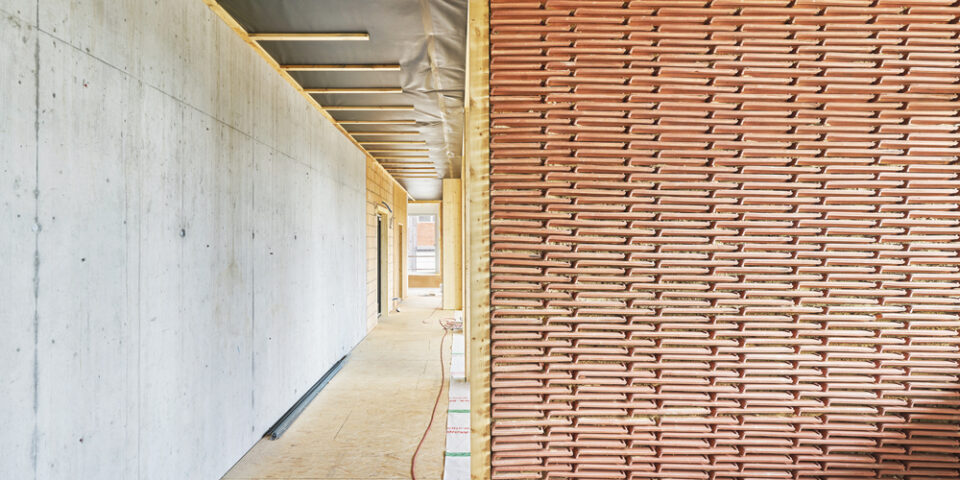
    Building with reused materials is a step-by-step approach – the issue of available materials runs through the whole process. This requires, among other things, a rethinking of planning and execution, a flexible schedule and flexibility in design. For example, the material found also determines the final design. Sprint shows “that reused material is by no means a hurdle for the design, but that creativity can be used to achieve design elements that you would not have originally thought of,” says Oliver Seidel, architect and member of the management board at baubüro in situ AG. An example are the different partition walls. Some are built from scrap bricks, some from old books, and still others from old carpet.

    The reuse of materials is not necessarily cheaper in today’s market situation. However, Seidel is convinced: “As soon as a competitive market with reused materials and components has been established, there will also be cost advantages with reuse.” In addition, certain reused materials such as natural stone or automatically closing fire protection doors would suddenly become affordable, in contrast to the same components made of new material.

    One of the office partitions in the sprint unit is made of bricks that would actually have ended up as waste in the landfill.
    The sprint unit was completed in just ten months – re-use does not necessarily have to have an impact on the construction time.
  • Look to the future of construction technology

    Look to the future of construction technology

    It is a long way from the idea to marketable innovation – especially in the construction industry. There is a gap between technologies that work in the laboratory and the market that demands well-engineered and reliable products. The modular research and innovation building NEST of the Swiss research institutes Empa and Eawag aims to close this gap.

    The NEST (Next Evolution in Sustainable Building Technologies) was opened in 2016 and is located on the Empa campus in Dübendorf. The building consists of a building core with three cantilevered platforms. Temporary, thematically different building modules, so-called units, can be installed on it. In this way, research teams, architectural offices and companies from the construction industry can test and develop materials, technologies, products, energy concepts and usage concepts together at NEST. In the sense of a “living lab”, the installed units are actually used living and working environments.
    The “HiLo” unit is currently under construction on the top platform of NEST. Construction started in summer 2019. The unit is intended to demonstrate the possibilities in lightweight construction. In addition to an innovative roof construction, material-saving lightweight floors and an adaptive solar facade are used. During operation, the building technology is to be continuously optimized with the help of machine learning. The unit will officially open on October 6, 2021.

    The two-story “STEP2” unit is also being planned. Business and research partners implement them together in an open innovation approach. After its completion, which is planned for summer 2022, it will serve as an interdisciplinary innovation workshop and office environment. The unit’s central projects include a spiral staircase in the shape of a human spine, a building envelope that adapts to the external conditions, and a floor ceiling made with 3D printing.

  • Artwork produces solar power

    Artwork produces solar power

    Solar cells can also decorate buildings as objects of art. This is shown by a project that has now been implemented at the NEST research building of the Eidgenössische Materialprüfungs- und Forschungsanstalt ( Empa ) and the EAWAG water research institute. The facades of the building have been fitted with photovoltaic modules, which together result in a work of art.

    To this end, Empa implemented the project called Glasklar, on which it worked together with Zug Estates and students and lecturers from the two departments of Design & Art and Technology & Architecture at the Lucerne University of Applied Sciences and Arts. The latter designed photovoltaic modules in a two-week block event, which visually match the NEST building as design objects. The design was implemented by textile design student Lynn Balli. It was selected for use in the NEST building in an interdisciplinary design competition.

    “If we can arouse the interest of designers in the design of building-integrated photovoltaic modules, we will make an important contribution to greater acceptance of photovoltaic facades and thus promote the expansion of renewable electricity production in Switzerland,” says Björn Niesen, NEST innovation manager Message from Empa quoted.

  • NEST office unit demonstrates potential for circulation

    NEST office unit demonstrates potential for circulation

    A new unit went into operation on Tuesday in the NEST research and innovation building of the Federal Materials Testing and Research Institute ( Empa ) and the ETH Domain's water research institute ( Eawag). As Empa in a message emphasized the office module called is Sprint was completed in just ten months. This demonstrates that building with reused materials and components is “a viable alternative to building with new material”. It “meets the market requirements for flexible and fast building”.

    The entire unit follows the so-called design for disassembly approach. If necessary, the flexible partitions could be dismantled. This enables flexible use of space and the recycling of built-in materials.

    The still existing skepticism of the construction industry about the reuse of materials is unjustified. Contrary to initial concerns about the tight schedule, "we were even able to find the re-use materials faster than new material," is quoted from Kerstin Müller, architect and business service member at the Basel construction office in situ , which planned the sprint unit.

    In addition, reuse is not yet cheaper given the current market situation. However, that will change as soon as a competitive market has developed, believes component hunter Oliver Seidel from in situ. In addition, there is a need for CO2 taxation, "which relieves the cost of new materials and used materials in order to be able to quantify the ecological added value."

  • Empa and Eawag expand campus

    Empa and Eawag expand campus

    The symbolic construction work for the expansion of the research campus by Empa and Eawag in Dübendorf began on Wednesday. The groundbreaking ceremony gave the go-ahead for a new laboratory building. In addition, a multifunctional building and a multi-storey car park are planned on the 20,000 square meter site. According release Empa and completion is scheduled for the middle of the 2024th

    The laboratory building will provide space for around 60 new laboratories and offices, the multifunctional building 1000 square meters of office space and space for restaurants on the ground floor. All parking spaces will be moved to the multi-storey car park. A total of 260 vehicles should find space in it. This would make the outside areas more inviting and safer for pedestrians and cyclists. In addition, more greening is possible.

    In the future, research will not only be carried out in, but also on and with the new buildings. Innovations from Empa's laboratories are to be used primarily in the areas of energy and building technology. For example, a field with geothermal probes is planned that will store the waste heat from the buildings and release it again in winter. A research project will then investigate how this innovation affects the campus energy supply.

  • Office floor in NEST is being built so that it can be recycled

    Office floor in NEST is being built so that it can be recycled

    The office unit in NEST called Sprint is intended to set new standards for circular building. The groundbreaking ceremony will take place in mid-April. It should be finished in summer. Sprint is located on the first floor of NEST in Dübendorf. The three-storey modular building is the research and innovation center of the Federal Materials Testing and Research Institute ( Empa ) and the water research institute of the ETH Domain ( Eawag ).

    As stated in a press release by Empa, those involved in the planning concentrated on finding the most general solutions possible for a later dismantling. In doing so, they follow a design approach that facilitates future changes and dismantling to recover systems, components and materials. Today's buildings have to be built in such a way “that their components can be fed back into cycles”, says Kerstin Müller, managing architect at baubüro in situ and managing director of Zirkular GmbH .

    Your colleague Oliver Seidel points out that reusing materials is often associated with lower costs. “But the added value lies in another area: Re-use is more sustainable. And in terms of quality there is no loss. ”On the contrary. For example, the aesthetics of an old wooden parquet floor represent added value.

    "For the first time, Empa is combining the approach of reuse and the market requirements of fast and flexible construction," Enrico Marchesi, innovation manager and project manager at NEST, is quoted as saying. "With the new 'Sprint' unit, we want to show that these needs can be met together."

  • Implenia is building on the Empa campus in Dübendorf

    Implenia is building on the Empa campus in Dübendorf

    Implenia is implementing the first stage of the new Empa campus in Dübendorf. According to its media release , the construction company will build a laboratory building, a multifunctional building and a multi-storey car park for the Federal Water Supply Agency (Eawag) from spring 2021. Completion is planned for autumn 2023. The order volume is around CHF 56 million.

    This winning project by sam architects emerged from a two-stage overall performance competition. In the press release, Implenia describes its architectural language as “functionally elegant and elegantly reserved”. All new buildings are to receive a Minergie-P-Eco certification.

    "We are very pleased that we are able to carry out another interesting project for Empa Eawag with the research campus", Jens Vollmar, Head Division Buildings at Implenia, is quoted in the press release. "We are thus building on the longstanding relationship that we were able to develop, for example, with the successful implementation of the Chriesbach Forum, also in Dübendorf."

  • NEST is planning a new STEP2 unit

    NEST is planning a new STEP2 unit

    A new unit will move into the Dübendorfer NEST , the research and innovation building of the Eidgenössischer Materialprüfungs- und Forschungsanstalt ( Empa ) and Eawag , the ETH Domain's water research institute. It bears the name STEP2 . According to a press release by Empa, two new floors are currently being planned on the existing NEST building for this innovation workshop.

    These are as forward-facing as the NEST itself: a spiral staircase in the shape of a spinal column from 3D printing will connect the two new floors. A ribbed filigree ceiling requires around a third less material than a conventional one, and an efficient building envelope should ensure optimal comfort. Further information on these and other innovative construction details as well as regular information on the creation of the unit are available on the STEP2 website .

    The project itself was initiated by BASF. Together with numerous other partners from science and industry, the STEP2 unit will work “purposefully” towards marketable, sustainable solutions for building envelopes, energy systems, digital and industrial production and the circular economy. “This interdisciplinary collaboration is intended to ensure that the leap onto the market can ultimately succeed as quickly as possible,” says Enrico Marchesi, Principal Innovation Manager at BASF, the main partner of the new unit.

    The project team, according to the announcement, is currently completing the preliminary project. The planning of the construction should start at the beginning of 2021. Completion is planned for summer 2022.